Quotulatiousness

September 12, 2021

Early Rome, Part III: Livy and the Roman Tradition of Early Rome

Filed under: Books, Europe, Greece, History — Tags: , , , — Nicholas @ 06:00

Thersites the Historian
Published 5 Sep 2021

Here, I examine Livy’s Book I with an emphasis on the tradition that he worked in and his agenda for undertaking such a massive and ambitious project.

Patreon link: https://www.patreon.com/thersites

PayPal link: paypal.me/thersites

Discord: https://discord.gg/QCaXXFr

Brave Browser: https://brave.com/noa557

Twitter link: https://twitter.com/ThersitesAthens

Minds.com link: https://www.minds.com/ThersitestheHis…

Steemit/dtube link: https://steemit.com/@thersites/feed

BitChute: https://www.bitchute.com/channel/jbyg…

Small signs of positive change in the culture wars?

Filed under: Media, Politics, Science, USA — Tags: , , , , , — Nicholas @ 05:00

Andrew Sullivan is hopeful that the small signs he mentions here are not just straws in the wind, but the beginning of a real reaction against “the Successor Ideology” among the ultra-woke cultural elite:

… both The Atlantic and The New Yorker have just published long essays that push back against woke authoritarianism and cruelty. Since both magazines have long capitulated to rank illiberalism, this is encouraging. And since critical theory is an entirely elite-imposed orthodoxy, it matters when the ranks of the elite crack a little.

Anne Applebaum links the woke phenomenon to previous moral panics and mob persecutions, which is where it belongs. She too begins to notice the obliteration of due process, individual rights, and mercy among her crusader peers:

    Even if you have not been suspended, punished, or found guilty of anything, you cannot function in your profession. If you are a professor, no one wants you as a teacher or mentor (“The graduate students made it obvious to me that I was a nonperson and could not possibly be tolerated”). You cannot publish in professional journals. You cannot quit your job, because no one else will hire you. If you are a journalist, then you might find that you cannot publish at all.

Applebaum’s Atlantic piece is a good sign from a magazine that hired and quickly purged a writer for wrong think, and once held a town meeting auto-da-fé to decide which writers they would permanently anathematize as moral lepers.

Similarly, it was quite a shock to read in The New Yorker a fair and empathetic profile of an academic geneticist, Kathryn Paige Harden, who acknowledges a role for genetics in social outcomes. It helps that Harden is, like Freddie DeBoer, on the left; and the piece is strewn with insinuations that other writers on genetics, like Charles Murray, deny that the environment plays a part in outcomes as well (when it is clear to anyone who can read that this is grotesquely untrue). But if the readers of The New Yorker need to be fed distortions about some on the right in order for them to consider the unavoidable emergence of “polygenic scores” for humans, with their vast political and ethical implications, then that’s a step forward.

The profile also puts the following woke heresy into the minds of the Upper West Side: “Building a commitment to egalitarianism on our genetic uniformity is building a house on sand.” And this: “Genetic diversity is mankind’s most precious resource, not a regrettable deviation from an ideal state of monotonous sameness.” The New Yorker is also telling its readers that there are around “thirteen hundred sites on the genome that are correlated with success in school. Though each might have an infinitesimally small statistical relationship with the outcome, together they can be summed to produce a score that has predictive validity: those in the group with the highest scores were approximately five times more likely to graduate from college than those with the lowest scores.”

All of this is empirically true. But if this is empirically true, critical theory, which insists that absolutely nothing but white supremacist society leads to inequalities, is dead in the water. Refuted. Proven false by reality. Finished — even as it continues to be the premise of other countless pieces The New Yorker has run in the past few years. At some point, this will require a measure of rethinking, a moderation of the left’s absolutist blank-slatism just as the evidence is finally disproving it once and for all. The Successor Ideology, remember, holds that genetics play no role in human society, and that all inequalities are a function of the environment. Take that absolute claim away — which is to say to subject it to empirical testing — and it crumbles. And The New Yorker just took it away.

And then, in the better-late-than-never category, The Economist, the bible for the corporate elite, has just come out unapologetically against the Successor Ideology, and in favor of liberalism. This matters, it seems to me, because among the most zealous of the new Puritans are the boards and HR departments of major corporations, which are dedicated right now to enforcing the largest intentional program of systemic race and sex discrimination in living memory. Money quote: “Progressives replace the liberal emphasis on tolerance and choice with a focus on compulsion and power. Classical liberals conceded that your freedom to swing your fist stops where my nose begins. Today’s progressives argue that your freedom to express your opinions stops where my feelings begin.”

The Economist also pinpoints the core tenets of CRT in language easy to understand: “a belief that any disparities between racial groups are evidence of structural racism; that the norms of free speech, individualism and universalism which pretend to be progressive are really camouflage for this discrimination; and that injustice will persist until systems of language and privilege are dismantled.” These “systems of language and privilege” are — surprise! — freedom of speech and economic liberty. If major corporations begin to understand that, they may reconsider their adoption of a half-baked racialized Marxism as good management. Maybe that might persuade Google not to mandate indoctrination in ideas such as the notion being silent on questions of race is “covert white supremacy”, a few notches below lynching.

Hitler Finally Fed Up with his Army – WW2 – 159 – September 11, 1942

World War Two
Published 11 Sep 2021

Adolf Hitler sacks Wilhelm List, Army Group Commander in the Caucasus. His replacement does not have military command experience. The fighting there is still successful this week, though, as is the advance through the suburbs of Stalingrad. The Japanese are advancing along the Kokoda Trail and on Guadalcanal, but the Axis attacks in North Africa have failed badly.
(more…)

Ocean travel without losing half the crew to scurvy

In the most recent Age of Invention newsletter, Anton Howes discusses the scurvy dogs of the Spanish Main, or any other ocean before Europeans discovered how to fight off scurvy:

An English ship of the late 16th/early 17th century: this is a replica of the Susan Constant at the Jamestown Settlement in Virginia. The original ship was built sometime before 1607 and rented by the Virginia Company of London to transport the original settlers to Jamestown.
Photo by Nicholas Russon, March 2004.

For as long as humans have suffered severe food shortages, scurvy has been known. The first record of it appears to date to ancient Egypt, in 1550BC, and it was especially familiar to the inhabitants of northern climates, with fresh vegetation every winter becoming scarce. Our word for scurvy almost certainly comes from the old Norse skyrbjugr — the skyr being a sort of soured cow’s milk that was thought to have caused the disease by going bad. In mid-sixteenth-century sources, scurvy was often referred to as though it was endemic to the Netherlands — a flat land assailed by the North Sea each winter, that had suffered long sieges and devastation thanks to the Dutch Revolt, and where fishing and merchant shipping employed an especially large proportion of the workforce. The Dutch thus had a perfect storm of factors to make vitamin C deficiencies more common, even though they abounded in fresh-caught fish and imported Baltic grain.

And so, over the centuries, the people of the northern climes had discovered the cure. Or rather, cures. The Iroquois ate the bark, needles or sap of evergreen trees — most likely white cedar, or some other kind of spruce, fir, juniper or pine, all rich in vitamin C. Their remedy saved the lives of Jacques Cartier’s colonists based near modern-day Quebec City in the winter of 1536. It’s the reason white cedar is known as arborvitae, the tree of life. And the Saami of northern Scandinavia prized cabbages and other leafy greens, in the summertime filling up casks of reindeer milk with crowberries and cloudberries, to be ready for winter.

[…]

Still more remedies were discovered by accident, as European ships began to range farther and farther abroad. The very first Portuguese voyagers around the Cape of Good Hope almost immediately discovered the value of orange and lemons — especially effective sources of vitamin C, as their acidity helps to preserve it. The voyage of Vasco da Gama, having been the first to round the Cape and reach the eastern coast of Africa, was then stricken with scurvy. They were only inadvertently saved when they traded with some Arabian ships laden with oranges, before landing at Mombasa. There, the ruler sent them a sheep and some sugar-cane, the gift also happening to include some oranges and lemons. Although the Portuguese couldn’t stay there long — they learned of a conspiracy to capture their ship — one of the voyagers later reported in wonder how the climate there must have been especially healthful to have cured them all.

Fortunately, at least some of the crew suspected the citrus instead. On the return journey from India, after a fatally slow three-month crossing of the Indian Ocean, some of the newly scurvy-ridden sailors asked their captain to procure them some oranges at Malindi. At least a few of the crew must certainly have been saved by this request, though perhaps the excitement of their imminent deliverance induced a few fatal aneurysms: “our sick did not profit”, was the report, “for the climate affected them in such a way that many of them died here.” By the time the fleet limped home back to Lisbon in 1499, scurvy had still managed to claim the lives of over two thirds of the original crew.

Nonetheless, the status of oranges as a scurvy wonder-cure had entered sailors’ lore. When Pedro Alvares Cabral repeated da Gama’s feat of rounding the Cape of Good Hope in 1500, his crew purposefully treated their scurvy using oranges. And by the 1560s, if not earlier, the news of the cure had spread beyond the Portuguese. Sailors from the Low Countries, on the eve of the Dutch Revolt from Spain, were said to be staving off scurvy by eating oranges in large quantities, skins and all. (Orange peel is in fact especially rich in vitamin C, so they were onto something.) Their value was certainly appreciated by the Dutch explorer Jacob Corneliszoon van Neck by the time of his second expedition to the Indian Ocean in 1598. Not long after setting out, he purchased 10,000 oranges from a passing ship off the coast of Spain, rationing them out to all his crew. And on the return journey via St Helena they were dismayed when initially “we found no oranges, whereof we had most need, for those that were troubled with the scurvy disease.”

The account of van Neck’s journey was translated into English for the first voyage of the East India Company in 1601, which may be why its commander, James Lancaster, directed his crew to drink three spoonfuls of lemon juice every morning. Lancaster doesn’t appear to have paid any special attention to oranges and lemons ten years earlier, when he first attempted the voyage, although other English mariners like the privateer Sir Richard Hawkins had in the 1590s already been extolling their virtues. We don’t know many of the details of Lancaster’s lemon juice trial, but his flagship’s crew was not entirely saved. Contrary to common report, at least a third of them had died by the time they left their first landing at Table Bay, South Africa — a proportion similar those on the other ships of his fleet, though we don’t know how many actually died of scurvy or of other causes. But upon the expedition’s return, the experience placed lemon juice firmly on the list of known scurvy cures — “the most precious help that ever was discovered against the scurvy” as the East India Company’s surgeon-general put it.

Terry Pratchett: Discworld And Beyond

Filed under: Books, Britain, Humour — Tags: , , , — Nicholas @ 02:00

Biographics
Published 19 Mar 2021

Dive into Discworld.

QotD: The US Supreme Court’s Dred Scott decision of 1857

Filed under: History, Law, Liberty, Quotations, USA — Tags: , , , , — Nicholas @ 01:00

Scott was a slave who claimed to be free because his owners had taken him to U.S. states where slavery was outlawed; in ruling on the case, Chief Justice Roger Taney, writing for a 7-2 majority, found that Blacks were “beings of an inferior order” who, under the constitution, “had no rights which the white man was bound to respect.”

The Scott decision is now considered an important contributing cause of the U.S. Civil War, which began four years later. It proved, beyond anyone’s doubt, President Abraham Lincoln’s maxim that a sovereign nation could not survive half-slave and half-free. Northern states might be capable of abolishing slavery locally, but this “abolition” would never apply to imported slaves from elsewhere considered as property. One cannot fully understand U.S. history, never mind the progress of its law, without studying and appreciating Taney’s cruel language.

And, indeed, for the world at large, Dred Scott is an unsurpassed reminder of the distinction between law and justice, and of the limitations of a highly reverenced written constitution. Taney not only accepted the (irrefutable) argument that the constitution explicitly countenanced slavery: he wrote fawningly of the Founding Fathers as great men, “high in their sense of honour,” who could never have upheld absolute equality before the law on one hand while hypocritically denying it to Blacks in practice. The Declaration of Independence’s claim that “all men are created equal,” the ex-slaveowner Taney wrote, was never understood by anyone to include inferior races.

Abolitionists of the time saw the innate hypocrisy: the contemporary newspaper editor William Lloyd Garrison risked his life by calling the constitution “a league with hell.” But [University of Buffalo law professor Matthew] Steilen thinks it is better not to expose Black students to the details of that debate. Reading Taney’s “gratuitously insulting and demeaning” words and arguments, he tweeted, is likely to, and there is no other way to put this, injure their feelings. To inquire too deeply into the detail of slavery, and of the law that shielded it, would require Black students to “relive the humiliation” of Dred Scott.

Colby Cosh, “Another Day in a Feelings-First World”, NP Platformed, 2021-06-09.

September 11, 2021

Twenty years on

Filed under: History, USA — Tags: , , — Nicholas @ 10:12

Mark Steyn‘s observations:

We shall not resume our anniversary observances today. The war is lost, at home and abroad. On the domestic front, we doubled the rate of Muslim immigration to the west and began assimilating ourselves with Islam’s strictures on freedom of expression and the like. The decade-and-a-half since the Danish Mohammed cartoons has been one long remorseless surrender on core western liberties. When a school teacher gets beheaded in the street, there is no outrage at the act, just a mild regret that he should have been foolish enough to provoke his own fate. Even the milder jests from the immediate post-9/11 era — the cartoon of the woman trying on new burqas in the changing room and wondering, “Does my bomb look big in this?” — would not be published today.

In the broader society, our rulers quickly determined that it was easier to punish us than our enemies. The post-9/11 security state surely helped soften up western populations for the Chi-Com-19 lockdowns, in which entire nations have been reduced to TSA-administered airports.

As for the war overseas, it ended with a military that can do everything except win handing the keys to Afghanistan back to the guys who pulled off 9/11 — and apologizing for the two-decade inconvenience by gifting the mullahs with some of the most expensive infrastructure on the planet plus an air force, approximately five assault rifles for every Taliban fighter, and express check-in for the forty-seven per cent of the Afghan population that apparently served as US translators.

The position of the United States is far weaker than it was twenty years ago. Around the planet, the assumption of friends and enemies alike is that the American moment is over and the future belongs elsewhere. They are making their dispositions accordingly. It is not a question of wishing “the post-American world”, but of accepting the known facts.

David Warren reposted his thoughts from the fifteenth anniversary:

A generation or more is necessary to see any large event in some historical perspective. That the fall of the Berlin Wall was a “large event” we could see immediately, but not what it portended. The political world would be transformed, but the New World Order that George Bush Senior foresaw was a mirage. Ditto with events since 9/11.

Several thousand were killed on that day in 2001 — the anniversary of the Ottoman defeat at the Gates of Vienna. This was a comparatively small number, by modern standards. The rich symbolism of this Islamist operation was lost on the West, which no longer cares for history or legend. A brilliant assault of “asymmetric warfare”, it fulfilled all of its objectives. The torch has since been passed from the more moderate al-Qaeda to the more fanatic Daesh, and will be passed again in due course. Osama bin-Laden personally lost face by being hunted down and killed like a rat, but his vision of a restored Islamic Caliphate survives him. It inspires still the young in heart and mind.

The immediate intention was to humiliate the “Great Satan”; to awaken the sleeping giant and make him blindly thrash; to goad him into self-destructive behaviour as he struck against an enemy he could neither locate nor understand. Beyond this: to expose him as a paper tiger, tilting a balance of power, and transferring initiative from the mightily-armed “Crusader” to the nimble “Jihadi”. Within the Muslim world: to show that only the radical Salafist faction could get results, could change the direction of history and, as it were, “make Arabia great again”.

As I suggested above, we are still too close to this event to grasp its full significance; but after fifteen years we in the West are in a much worse position than we were on the 10th of September, 2001. We showed, as the Islamists predicted, that we did not have the stamina to prevail, even against weak adversaries; that America and allies could only fight “Vietnams”. Our will is shaken, and to Salafist delight, we have by now expressed contrition for fourteen centuries of Christian defence against Islamic aggression. We bow respectfully, as our culture is insulted, and as versions of Shariah are imposed. In disregard of our own security, we have thrown our borders open to massive Muslim immigration. We follow, at every junction, the course of sentimentality, and adapt to the certainty of defeat. After each hit we call for grief counsellors.

On MeWe, Byron Clark reposted a transcript of the call Todd Beamer made from United Airlines flight 93 that morning:

Todd: Hello … Operator … listen to me … I can’t speak very loud. – This is an emergency. I’m a passenger on a United flight to San Francisco. We have a situation here … Our plane has been hijacked … can you understand me?
Lisa: (exhaling a deep breath to herself) I understand … Can the hijackers see you talking on the phone?
Todd: No
Lisa: Can you tell me how many hijackers are on the plane?
Todd: There are three that we know of.
Lisa: Can you see any weapons? What kind of weapons do they have?
Todd: Yes … they don’t have guns … they have knives – they took over the plane with knives.
Lisa: Do you mean … like steak knives?
Todd: No, these are razor knives … like box cutters.
Lisa: Can you tell what country these people are from?
Todd: No … I don’t know. They sound like they’re from the mid-east.
Lisa: Have they said what they want?
Todd: Someone announced from the cockpit that there was a bomb on board. He said he was the captain and to stay in our seats and stay quiet.
He said that they were meeting these men’s demands and returning to the airport… It was very broken English, and… I’m telling you…it sounded fake!
Lisa: Ok sir, please give me your name.
Todd: My name is Todd Beamer.
Lisa: Ok Todd … my name is Lisa … Do you know your flight number? If you can’t remember, it’s on your ticket.
Todd: It’s United Flight 93.
Lisa: Now Todd, can you try to tell me exactly what happened?
Todd: Two of the hijackers were sitting in first class near the cockpit. A third one was sitting near the back of the coach section. The two up front got into the cockpit somehow; there was shouting. The third hijacker said he had a bomb. It looks like a bomb. He’s got it tied to his waist with a red belt of some kind.
Lisa: So is the door to the cockpit open?
Todd: No, the hijackers shut it behind them.
Lisa: Has anyone been injured?
Todd: Yes, they … they killed one passenger sitting in first class. There’s been lots of shouting. We don’t know if the pilots are dead or alive. A flight attendant told me that the pilot and copilot had been forced from the cockpit and may have been wounded.
Lisa: Where is the 3rd hijacker now Todd?
Todd: He’s near the back of the plane. They forced most of the passengers into first class. There are fourteen of us here in the back. Five are flight attendants. He hasn’t noticed that I slipped into this pantry to get the phone. The guy with the bomb ordered us to sit on the floor in the rear of the plane … oh Jesus. Help!
Lisa: Todd … are you ok? Tell me what’s happening!
Todd: Hello … We’re going down … I think we’re going to crash … Wait – wait a minute. No, we’re leveling off … we’re ok. I think we may be turning around … That’s it – we changed directions. Do you hear me … we’re flying east again.
Lisa: Ok Todd … What’s going on with the other passengers?
Todd: Everyone is … really scared. A few passengers with cell phones have made calls to relatives. A guy, Jeremy, was talking to his wife just before the hijacking started. She told him that hijackers had crashed two planes into the World Trade Center … Lisa is that true??
Lisa: Todd … I have to tell you the truth … it’s very bad. The World Trade Center is gone. Both of the towers have been destroyed.
Todd: Oh God — help us!
Lisa: A third plane was taken over by terrorists. It crashed into the Pentagon in Washington DC. Our country is under attack … and I’m afraid that your plane may be part of their plan.
Todd: Oh dear God. Dear God … Lisa, will you do something for me?
Lisa: I’ll try … if I can … Yes.
Todd: I want you to call my wife and my kids for me and tell them what’s happened. Promise me you’ll call.
Lisa: I promise – I’ll call.
Todd: Our home number is 201 353-1073 … You have the same name as my wife … Lisa … We’ve been married for 10 years. She’s pregnant with our 3rd child. Tell her that I love her … (choking up) … I’ll always love her … (clearing throat) We have two boys … David, he’s 3 and Andrew, he’s 1 … Tell them … (choking) tell them that their daddy loves them and that he is so proud of them. (clearing throat again) Our baby is due January 12th … I saw an ultra sound … it was great … we still don’t know if it’s a girl or a boy … Lisa?
Lisa: (barely able to speak) I’ll tell them, I promise Todd.
Todd: I’m going back to the group — if I can get back I will …
Lisa: Todd, leave this line open … are you still there?
Lisa: (dials the phone) Hello, FBI, my name is Lisa Jefferson, I’m a telephone supervisor for GTE. I need to report a terrorist hijacking of a United Airlines Flight 93 … Yes I’ll hold.
Goodwin: Hello, this is Agent Goodwin … I understand you have a hijacking situation?
Lisa: Yes sir, I’ve been talking with a passenger, a Todd Beamer, on Flight 93 who managed to get to an air phone unnoticed.
Goodwin: Where did this flight originate, and what was its destination?
Lisa: The flight left Newark New Jersey at 8 A.M. departing for San Francisco. The hijackers took over the plane shortly after takeoff, and several minutes later the plane changed course – it is now flying east.
Goodwin: Ms. Jefferson … I need to talk to someone aboard that plane. Can you get me thru to the planes phone?
Lisa: I still have that line open sir, I can patch you through on a conference call … hold a mo …
Todd: Hello Lisa, Lisa are you there?
Lisa: Yes, I’m here. Todd, I made a call to the FBI, Agent Goodwin is on the line and will be talking to you as well.
Todd: The others all know that this isn’t your normal hijacking. Jeremy called his wife again on his cell phone. She told him more about the World Trade Center and all.
Goodwin: Hello Todd. This is Agent Goodwin with the FBI. We have been monitoring your flight. Your plane is on a course for Washington, DC. These terrorists sent two planes into the World Trade Center and one plane into the Pentagon. Our best guess is that they plan to fly your plane into either the White House or the United States Capital Building.
Todd: I understand … hold on … I’ll … I’ll be back …
Lisa: Mr. Goodwin, how much time do they have before they get to Washington?
Goodwin: Not long ma’am. They changed course over Cleveland; they’re approaching Pittsburgh now. Washington may be twenty minutes away.
Todd: (breathing a little heavier) The plane seems to be changing directions just a little. It’s getting pretty rough up here. The plane is flying real erratic … We’re not going to make it out of here. Listen to me … I want you to hear this … I have talked with the others … we have decided we would not be pawns in these hijackers suicidal plot.
Lisa: Todd, what are you going to do?
Todd: We’ve hatched a plan. Four of us are going to rush the hijacker with the bomb. After we take him out, we’ll break into the cockpit. A stewardess is getting some boiling water to throw on the hijackers at the controls. We’ll get them … and we’ll take them out. Lisa … will you do one last thing for me?
Lisa: Yes … What is it?
Todd: Would you pray with me?
They pray: Our father which art in Heaven
Hallowed be thy name,
Thy kingdom come, thy will be done
on earth as it is in heaven.
Give us this day our daily bread,
And forgive us our trespasses
As we forgive our trespassers,
And lead us not into temptation
But deliver us from evil
For thine is the kingdom, and the power, and the glory
Forever … Amen
The Lord is my shepherd, I shall not want …
He makes me to lie down in green pastures
He leads me beside the still waters
He restores my soul
He leads me in paths of righteousness
for His name’s sake
Yea, though I walk through the valley of the shadow of death
I will fear no evil, for thou art with me …
Todd: (softer) God help me … Jesus help me … (clears throat and louder)
Are you guys ready? …
Let’s Roll …

Thursday’s debate was “a grand Kabuki theatre, increasingly divorced from any grounded reality about our fiscal situation, or our ability to deliver on complex programs or problems”

Filed under: Cancon, Media, Politics — Tags: , , , , , , — Nicholas @ 03:00

In The Line, Jen Gerson offers her observations of the debate on Thursday night among most of the federal party leaders — missing, of course, the participation of the PPC’s Maxime Bernier who was pointedly not invited:

“2019 Canadian federal election – VOTE” by Indrid__Cold is licensed under CC BY-SA 2.0

No one can be said to have “won” such an exercise. You “win” these “debates” not by proposing the best policies, or offering competing philosophies, or even by presenting the best rhetoric. Rather, a “winner” is determined by who comes off the best to a general public that largely doesn’t follow the minute differences of respective platforms.

By that measure, no one really won Thursday’s debate, but Trudeau especially did not win it. I imagine that one of the problems of being raised as a spectacle of wealth, privilege and popularity is that it doesn’t quite prepare you for the moment when the worm turns, when people learn to dislike you for all the right reasons; when you are no longer given the proper deference and respect you feel is owed to you.

Trudeau came off as defensive, and flustered, taking hit after hit from other party leaders on topics ranging from his record, reconciliation and, especially, his self-interested decision to call a party in the first place. That he lacks a credible answer to why we’re holding this election at all three weeks into this campaign is a deep failure, one large and deep enough to consume his prospects of forming a majority government — and his hold on the party leadership along with it.

Annamie Paul offered the best performance of the night by far, and demonstrated that the Green party as a whole is unworthy of her. Whatever private internal dramas that may be unfolding, in public that party condemns itself to obscurity by refusing to get behind a woman who is, by every measure, impressive.

Bloc leader Yves-François Blanchet made himself into an idealized avatar of a whiny and aggrieved Quebec nationalism that puts Alberta to shame. It takes a real special lack of self-awareness to imagine that Quebecers have had it rougher in this country than Indigenous people. Or that Blanchet, by virtue of his French ancestry, has suffered from greater oppression than, say, Annamie Paul. One day, the rest of Canada is going to stop humouring these insulated, thin-skinned delusions — but not before Quebec’s seat count declines relative to the rest of the population’s. In the meantime, Blanchet’s ability to beam pure DGAF energy into the English debates at least made him seem like a human, albeit a delusional and unpleasant one.

By this measure, Erin O’Toole “won” the debate by not losing it. I can’t remember a single thing he actually said, and in such a setting this can only work to his favour.

I mean, what is there to say? On actual substantive policy issues, I couldn’t escape the sense of watching a grand Kabuki theatre, increasingly divorced from any grounded reality about our fiscal situation, or our ability to deliver on complex programs or problems.

Sturmgewehr MP-44 Part I: Mechanics

Filed under: Germany, History, Military, Weapons, WW2 — Tags: , , , — Nicholas @ 02:00

Forgotten Weapons
Published 27 Sep 2016

The MP-43 (which is mechanically identical to the MP-44 and StG-44; the differences are the subject for another video later) is a tilting bolt rifle with a long stroke gas piston. It was manufactured primarily from complex sheet steel stampings, as a way to minimize the amount of high-quality and thus difficult to acquire steels needed for its construction. The rifle is heavy by today’s standards, but remarkably ergonomic (except for the metal handguard, when heats up quickly). Its sights come right up to the eye when shouldering the rifle, and it disassembles quickly and easily.

It really is one of the best small arms developed during World War II.

http://www.patreon.com/ForgottenWeapons

QotD: Racism, anti-racism, and cognitive dissonance

Filed under: Books, Politics, Quotations, USA — Tags: , , , , — Nicholas @ 01:00

In a little while, our chattering classes are going to have a field day roasting Charles Murray over a spit for his next book, which will openly argue that it has been scientifically proven that black people are, on the average, not as cognitively nimble as other people. For about a month, the usual suspects will jostle for space condemning the very address of this subject as racism incarnate.

Okay – but any public discussion that both reviles the idea that black people are less intelligent than others while also lustily demanding that it’s “racist” to submit black people to cognitive challenges is hopelessly incoherent. We disparage rape culture, diet culture – this exemption culture is premised on a basic assumption that it’s unsavory to require serious challenge of black students Because Racism.

No. You don’t get past racism by creating new forms of it. Scrapping traditional challenges should only be on the table after black kids have mastered the challenge anyway. Zora Neale Hurston gets the final word:

    It seems to me that if I say a whole system must be upset for me to win, I am saying that I cannot sit in the game, and that safer rules must be made to give me a chance. I repudiate that. If others are in there, deal me a hand and let me see what I can make of it, even though I know some in there are dealing from the bottom and cheating like hell in other ways.

The current “woke” consensus is that Hurston was wrong on this, that she was expecting too much. I would just love to see one of today’s Elect in a room with Hurston trying to tell her where she was going wrong.

John McWhorter, “Revisiting Classics at Princeton”, It Bears Mentioning, 2021-06-09.

September 10, 2021

Why France Did Not Surrender After Sedan – Empress Eugénie Flees The Country I Franco-Prussian War

Filed under: France, Germany, History, Military — Tags: , , , , — Nicholas @ 06:00

realtimehistory
Published 9 Sep 2021

Sign up for a free 1 month trial for Skillshare: https://skl.sh/realtimehistory08211

After the French defeat at Sedan, the German states expect peace negotiations. But instead the new French republic declares an early form of “total war” and continues the fight. Meanwhile Empress Eugénie flees the country for Britain.

» THANK YOU TO OUR CO-PRODUCERS
John Ozment
James Darcangelo
Jacob Carter Landt
Thomas Brendan

» OUR PODCAST
https://realtimehistory.net/podcast – interviews with historians and background info for the show.

» LITERATURE
Arand, Tobias: 1870/71. Der Deutsch-Französische Krieg erzählt in Einzelschicksalen. Hamburg 2018
Arand, Tobias/Bunnenberg, Christian (Hrsg.): Karl Klein. Die Fröschweiler Chronik. Hamburg 2021
Herre, Franz: Eugénie. Kaiserin der Franzosen. München 2000
Howard, Michael: The Franco-Prussian War. London 1961
Milza, Pierre: L’année terrible. La guerre franco-prussienne. Septembre 1870 – mars 1871. Paris 2009

» SOURCES
Braun, Lily (Hrsg.): Kriegsbriefe aus den Jahren 1870/71 von Hans v. Kretschman. Berlin 1911
Hérisson, Maurice Graf d’: Journal d’un officier d’ordonannce. Juillet 1870 – Février 1871. Paris 1885
Goncourt, Edmond de: Journal des Goncourt. Memoire de la vie litteraire. 2.1. 1870-1871. Paris 1890
Russell, William Howard: Meine sieben Kriege. Die ersten Reportagen von den Schlachtfeldern des 19. Jahrhunderts. Frankfurt a. M. 2000

» OUR STORE
Website: https://realtimehistory.net

»CREDITS
Presented by: Jesse Alexander
Written by: Cathérine Pfauth, Prof. Dr. Tobias Arand, Jesse Alexander
Director: Toni Steller & Florian Wittig
Director of Photography: Toni Steller
Sound: Above Zero
Editing: Toni Steller
Motion Design: Philipp Appelt
Mixing, Mastering & Sound Design: http://above-zero.com
Maps: Battlefield Design
Research by: Cathérine Pfauth, Prof. Dr. Tobias Arand
Fact checking: Cathérine Pfauth, Prof. Dr. Tobias Arand

Channel Design: Battlefield Design

Contains licensed material by getty images
All rights reserved – Real Time History GmbH 2021

Why even highly gifted young quarterbacks rarely succeed as they move toward the NFL

Filed under: Football, Sports, USA — Tags: , , , , , — Nicholas @ 05:00

Severian at Rotten Chestnuts looks at the early career life-cycle of football quarterbacks:

At all levels of American football below pro, the “option” is a major facet of the game. This is an offensive play where the quarterback can either run the ball himself, pitch it to another player, or throw it downfield, as he thinks best. It certainly helps if the quarterback is a strong-armed, accurate passer, but the key criterion here is speed. If you get defenders cheating up in order to stop the run, you don’t have to be as strong or accurate with your throws. What matters is that the QB can pass — meaning, he can throw it X yards downfield, within a few yards’ radius of a given spot — not how often he does so. The closer he can get it to the spot, and the further downfield that spot is, the better, but so long as he’s in the vicinity the option system works well.

This starts very, very early in a player’s career. The lower down the skill ladder you go, the more prominent the “option” offense. In “Pop Warner” leagues — kids below age 12, basically — the option pretty much IS the offense, since few kids can throw the ball very far, much less with accuracy. Throwing a football with both velocity and accuracy is extremely difficult, and it doesn’t help that sound throwing mechanics feel brutally unnatural — you know you’re doing it right when it feels like your shoulder is going to pop out of its socket at the very instant your elbow ligaments snap and hit you in the face … which, unfortunately, is exactly what it feels like when you’re doing it wrong, and your shoulder IS about to pop out at the same moment your elbow ligaments snap.

What happens, then, is that kids generally learn how to throw with very poor form … but coaches generally aren’t going to correct them, either because they don’t know the proper mechanics themselves, or because they are focused exclusively on winning games. Who cares if little Kayden, Brayden, or Jayden is going to blow his arm out hucking it like that when he hits high school? That’s Coach Smith’s problem. All that matters now is that he can get it to X spot with radius Y.

Thus the possible career path of any kid who can throw a football reasonably well quickly diverges. If he’s too slow to run the option effectively, his coaches will try to turn him into an “air raid” style quarterback, which means he throws on every play, mechanics be damned, because we need to win now, and what the hell, he can get it there, can’t he? But even the “air raid” style of play is enormously more difficult to coach, because that means you need to be able to coach a whole corps of wide receivers to run a whole bunch of increasingly complex routes. Here, look:
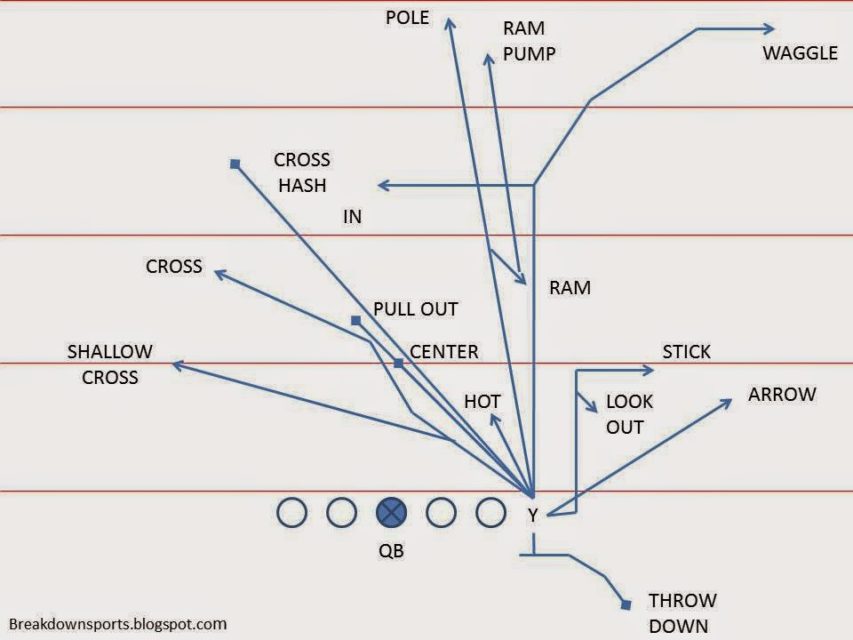
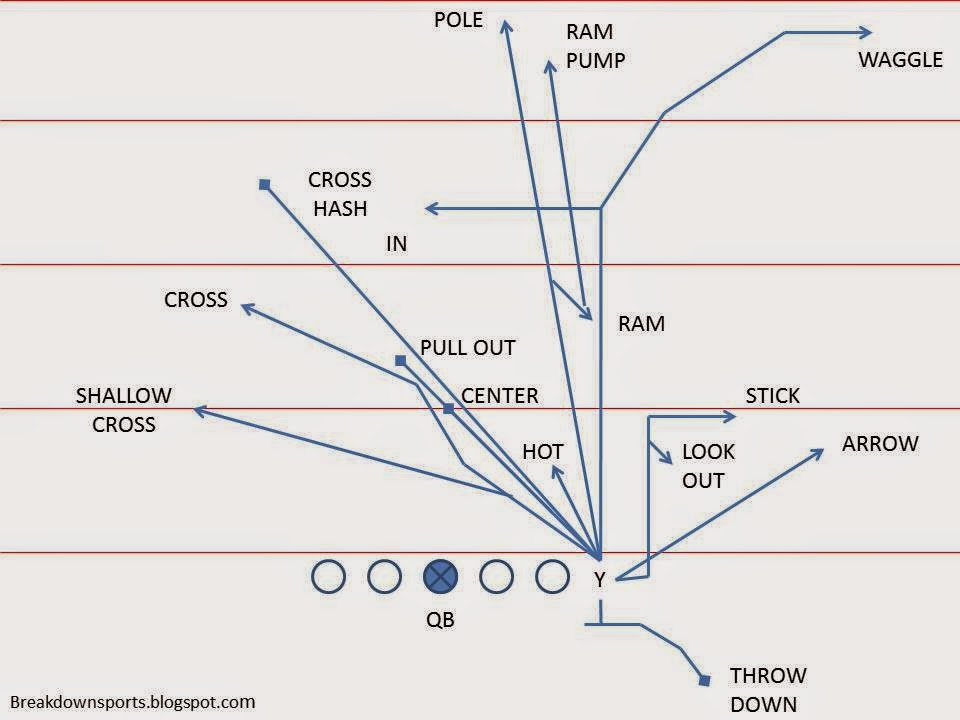
That’s what’s known as a “route tree”, and all of your receivers — five guys, usually, on every play, plus their backups — need to know how to run every one of them, every time. Which means your playbook is going to be huge, because you (theoretically, anyway) need a play for each one of those routes, for each receiver on the field. And obviously your quarterback has to have something going on upstairs, because he needs to memorize five different guys’ routes for every single play, plus audibles and checkdowns (changing any given player’s route, or even the entire play, on the fly), and so on.

I’m sure y’all see where I’m going with this, but it’s important to note that the key selection — whether a given kid shall be an “option” quarterback, or an “air raid” quarterback — has been made by someone else, much lower on the skill ladder. It would be great if one and the same kid could do both to a high degree of skill, but since human neurons apparently don’t work like that, it’s natural for everyone involved to take the path of least resistance.

And again, I’m not blaming coaches for this. Forget things like “getting fired for losing too many games”, and just consider the sheer amount of work. Stipulating for the sake of argument that you’ve got 50 man-hours in a week to get ready for a game, how do you best allocate them? Getting your QB to throw with proper mechanics alone probably takes a significant chunk of that time, and even though he’ll have to do a lot of it on his own — throwing passes at a tire in the backyard until his arm feels ready to fall off — you’re still spending a LOT of time on something that will make no appreciable difference to the game’s outcome this Friday night. And then throw in the other stuff — how much time does it take just to “install” (as the term d’art is) a game plan that has all those routes in it, much less coaching all the receivers up to where they can run them all?

Nah, brah. Just hand Jonquarious the ball and let him run it, and if he has to huck it downfield every now and again, let him do it his way. Again, this will make no difference at all to the outcome of this week’s game — he’ll either run it or he won’t; make the throw or not — but it frees up a lot of man hours to do all the other stuff a coach has to do that we haven’t talked about yet, such as defense.


The German Slave Economy – WW2 Special

Filed under: Economics, Europe, Germany, History, Military, WW2 — Tags: , , , , , , — Nicholas @ 04:00

World War Two
Published 9 Sep 2021

To fuel the German war economy, the Nazis force millions of Prisoners of War, Concentration Camp inmates and civilians from all over Europe to work for in their factories and on their farms as slave laborers under harsh circumstances.
(more…)

By Gandhi’s reckoning, the PPC is entering stage three (“First they ignore you, then they ridicule you, …”)

Filed under: Cancon, Liberty, Media, Politics — Tags: , , , , — Nicholas @ 03:00

In The Line, Matt Gurney says that the dying media will have to start taking Maxime Bernier and the PPC much more seriously if the recent “blips” in the polls turn out to be accurate:

To riff off the old song, there’s something happening here, though what it is ain’t exactly clear. Like it or not, we’re going to have to start paying attention to the People’s Party of Canada and its leader, Maxime Bernier. If polls are to be believed, they’re having a great election.

The PPC hasn’t warranted much attention before. It has largely served as a vanity vehicle for Bernier, who probably can’t believe he’s been able to keep himself out of an ordinary job this long. The party is a mixture of populist outreach and pie-in-the-sky pseudo-libertarianism. It has proposed a smattering of policies, but none of them are much more than a talking point or meme. They are often summed up as a “far-right” party — or at least further right than the Conservative Party of Canada — but it feels overly generous to place them firmly anywhere in particular on the political spectrum. Their organizing principle has seemed to be anger with the status quo, and a feeling of alienation from the majority consensus on most political views.

The PPC took just under 300,000 votes in the 2019 election, or 1.6 per cent of ballots cast. It was a rounding error on a fringe, and seemed set to stay that way. This, combined with a history of dogwhistle racism, is why journalists and political analysts paid it little attention (and that includes yours truly).

Something seems to be happening, though. The party has climbed in the polls, with some showing they’ve climbed by a lot. There are important caveats: Some of this can be written off as within-the-margins-of-error blips in the numbers. Perhaps there is some methodological quirk that is causing polling companies to overestimate the PPC’s standing. Maybe frustrated people are parking their vote there for a time but will come back to one of the traditional parties when actually making their x on a ballot.

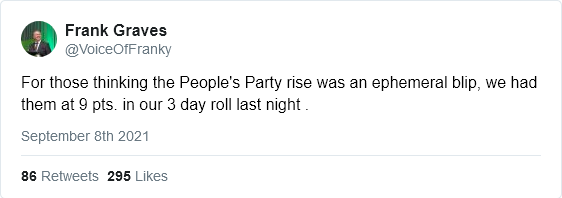
So yeah. There’s all kinds of ways to rationalize this into a nothingburger, if you’re so inclined, but the fact remains there is a trend, consistent across different polls, from different companies, and over an extended period of time. It really does seem as though the party is set to double, triple or maybe even quadruple its support, relative to the last election. The latest Ekos poll has them at nine per cent. That’s an outlier on the high side, but if they came even close to that, the PPC would eclipse the Green Party of Canada’s best-ever showing. By a lot.

My friend John Wright is a pollster with decades of experience, and the executive vice president at Maru Public Opinion. He called me this weekend to tell me that something was up with the PPC’s numbers — I’d already realized the same, at least on an intuitive level, but he had the numbers to back it up. His numbers are broadly similar to what’s showing up in other polls. I asked him what he could tell me about the typical PPC voter, and he said there isn’t a ton of information about them, but pulled what data he could find.

The typical PPC supporter, based on polls as recent as last month, is … pretty normal, actually, at least demographically. They are fairly evenly distributed across every segment of Canadian society. No province has a wildly high or low number of PPC supporters (Alberta was a bit higher than the others, but only a very small bit, and with an overall small sample size). They are found fairly consistently across all age groups and economic and educational classes. The only really notable divergence in Wright’s numbers was on gender lines — men are twice as likely to support the PPC as women.

The Channel Dash / Operation Cerberus — How to win through refuge in audacity

Filed under: Britain, Germany, History, Military, WW2 — Tags: , , , , , , — Nicholas @ 02:00

Drachinifel
Published 9 Jan 2019

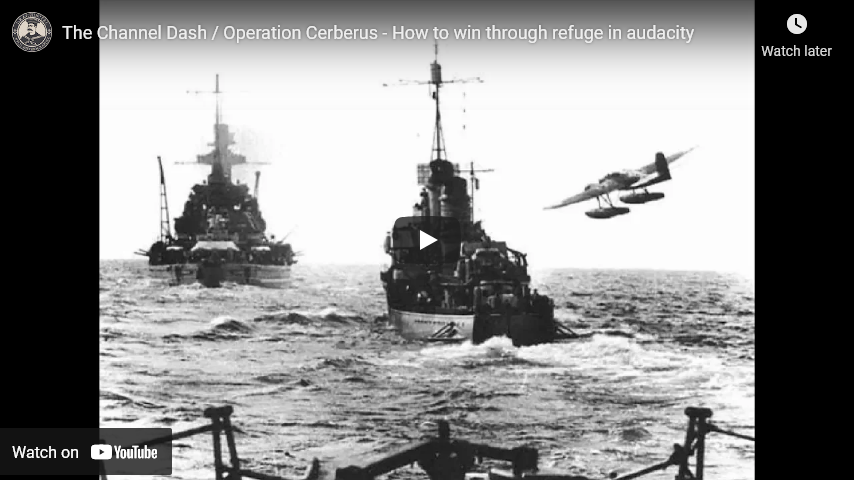
Today we look at the Channel Dash, also known as one of the few times Hitler was right, the British were asleep and the Germans succeeded in spite of thinking they were all doomed. An operation made up purely of rolling natural 1’s and 20’s.

« Newer PostsOlder Posts »

Powered by WordPress