
It is a part of the Great Unlearning of our age that today’s progressives are forgetting the hard lessons that elevated national self-determination to center stage. Visceral hostility to the national idea is nearly universal among the West’s cosmopolitan ruling elites, who conflate it with racism and bigotry and blame it for the catastrophes of the first half of the twentieth century. The upper reaches of our social strata are composed increasingly of a class of transnationals who hold a passport of convenience (or three), and seem to drift along from San Francisco to Singapore to London to Hong Kong, equally at home in each, without permanent attachment to any. Today, a banker in New York has more in common with a management consultant in Tokyo or a lawyer in Dubai than with a soybean farmer in Nebraska or an auto mechanic in Jacksonville. The transnationals share few common assumptions, beliefs, and aspirations with their geographical compatriots from the lower orders, and they have little use for the nation-state, with its flag-waving, jingoism, and other sentimental expressions of folkish unity. History, it seems, continues to mock poor Karl Marx, who proclaimed that the proletariat has no country. As the Brexit vote and Donald Trump’s election clearly show, it is in fact the haute bourgeoisie that has no country; the proles are deeply attached to theirs.
E.M. Oblomov, “The Case for National Realism: Diversity is the hallmark of empires, not democracies”, City Journal, 2019-01-02.
September 10, 2021
QotD: Prole nationalism and the globalist elite
September 9, 2021
Furniture Forensics with a Country Chair
Rex Krueger
Published 8 Sep 2021This post-and-rung chair looks like trash, but it’s actually a master-class in green woodwork.
More video and exclusive content: http://www.patreon.com/rexkrueger
See More About Traditional Furniture!: (Scroll Down)
(more…)
Did Freudian Psychology Create Modern Art? | B2W: ZEITGEIST! I E.25 Harvest 1924
TimeGhost History
Published 8 Sep 2021The Surrealist Movement is born this season with unsurprising eccentric drama. Salvador Dali will one day be a part of it, but for now he is still in art school and has actually only just come out of prison. Also this season, a crime which sees police chasing America’s first ever “Public Enemy No. 1”
(more…)
When you mess around in a software testing environment … make sure it actually is a test
A British local government found out the hard way that they need to isolate their software testing from their live server:
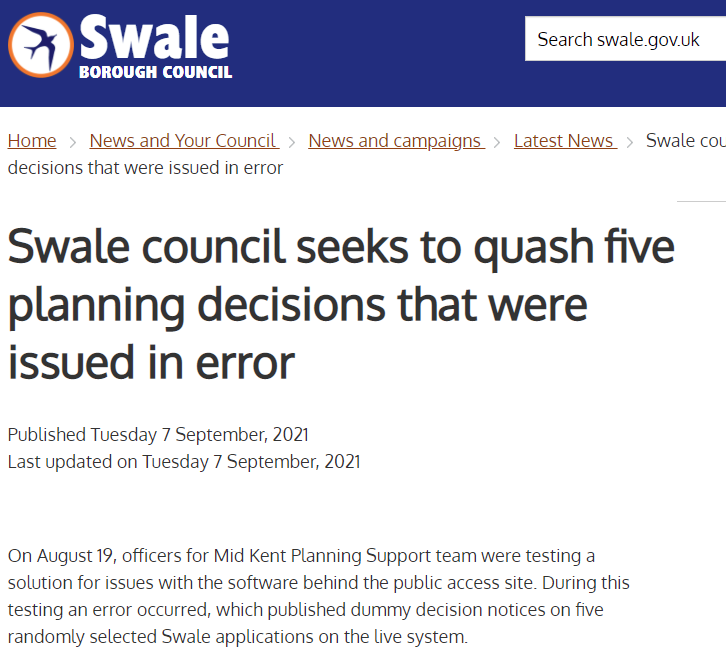
A borough council in the English county of Kent is fuming after a software test on the council’s website led to five nonsensical dummy planning application documents being mistakenly published as legally binding decisions.
According to a statement from Swale Borough Council, staff from the Mid Kent Planning Support Team had been testing the software when “a junior officer with no knowledge of any of the applications” accidentally pressed the button on five randomly selected Swale documents, causing them to go live on the Swale website.
After learning what had happened, the council moved to remove the erroneous decisions from public display, but according to the statement: “Legal advice has subsequently confirmed they are legally binding and must be overturned before the correct decisions are made.”
Publishing randomly generated planning decisions is obviously bad enough, but the problems got worse for Swale when it was discovered that the “junior officer” who made the mistake had also added their own comments to the notices in the manner of somebody “who believed they were working solely in a test environment and that the comments would never be published,” as the council diplomatically described it.
So it was that despite scores of supportive messages from residents, the splendidly named Happy Pants Ranch animal sanctuary had its retrospective application for a change of land use controversially refused, on the grounds that “Your proposal is whack. No mate, proper whack,” while an application to change the use of a building in Chaucer Road, Sittingbourne, from a butchers to a fast-food takeaway was similarly denied with the warning: “Just don’t. No.”
The blissfully unaware office junior continued their cheerful subversion of Kent’s planning bureaucracy by approving an application to change the use of a barn in the village of Tunstall, but only on condition of the numbers 1 to 20 in ascending order. They also approved the partial demolition of the Wheatsheaf pub in Sittingbourne and the construction of a number of new flats on the site, but only as long as the project is completed within three years and “Incy Wincy Spider.”
Finally, Mid Kent’s anonymous planning hero granted permission for the demolition of the Old House at Home pub in Sheerness, but in doing so paused to ponder the enormous responsibility which had unexpectedly been heaped upon them, commenting: “Why am I doing this? Am I the chosen one?”
For their part, Swale Borough Council’s elected representatives were less than impressed by the work of their colleagues at the Mid Kent Planning Support Team and wasted no time in resolutely throwing them under the bus.
“These errors will have to be rectified but this will cause totally unnecessary concern to applicants,” thundered Swale councillors Roger Truelove, Leader and Cabinet Member for Finance, and Mike Baldock, Deputy Leader and Cabinet Member for Planning in a shared statement. “This is not the first serious problem following the transfer of our planning administration to Mid Kent shared services. We will wait for the outcome of a proper investigation and then consider our appropriate response as a council.”
Tank Chats #123 | Oxford and Cambridge Carriers | The Tank Museum
The Tank Museum
Published 16 Apr 2021Tank Museum Historian David Fletcher presents a Tank Chat on the Carrier, Tracked, CT20, otherwise known as the Oxford Carrier. This unusual vehicle was an early post-Second World War British Armoured Personnel Carrier and Gun Tractor, which saw service in the Korean War. David also touches upon the Cambridge Carrier, built by Rolls-Royce as an updated and improved version of the Oxford, which never got out of the prototype stage.
(more…)
QotD: Terrorism
Victor Davis Hanson, Ripples of Battle, 2004.
September 8, 2021
Making Hitler Transgender? – Early Operations of the CIA – WW2 – Spies & Ties 08
World War Two
Published 7 Sep 2021World War Two gave birth to a new American centralised intelligence agency: The OSS (Office of Strategic Services). Led by “Wild Bill” Donovan, it is the cradle of many outrageous plans, spy stories, and gadgets.
(more…)
The Line‘s She-lection Bullshit Bulletin No. 3 … scary black fully semi-automatic assault machinegun edition
The folks at The Line continue their good work in pointing out some of the bullshittiest bullshit the politicians spew on the campaign trail. This week has been all about politicians promising to crack down even harder on the hunters and sport shooters who keep driving their pickup trucks (plastered with Trump bumper stickers, of course) into downtown Toronto to shoot their scary black fully semi-automatic AK-15 or AR-47 assault machineguns with chainsaw bayonets at innocent gang-bangers at 3 in the morning:
It is hard to know where to even begin picking through the bullshit that Canadians have had dumped atop their heads this week on the gun-control file. Both the Liberals and Conservatives hurled their share, but the worst offenders were by far the incumbents who claimed to ban “military-style assault weapons”.
Let’s start with this: Canadian law categorizes guns into three categories depending on their technical specifications: length, ammunition calibre, mode of operation, and the like. The categories are licensed and regulated differently. It can get pretty complicated. Despite their near-constant use, the terms “assault rifle”, “assault weapon” or the even-scarier sounding “military style assault weapon/rifle” have no specific or universally recognized meaning, including under Canadian law and firearms regulations. They aren’t part of or used by the categorization system.
This is essential to understand: because the terms have no specific and universally held meaning, these campaign-ready phrases can be appended to pretty much any type of rifle, whatever its actual legal category under our law. And that’s how we all found ourselves aspirating bullshit this week.
Most gun experts would generally classify an assault rifle/weapon as a rifle that fires medium-powered (or higher) ammunition and is capable of a “full auto” mode — that is, the weapon will continue firing as long as the trigger is held down. This results in a rapid volley of bullets at a cost of diminished accuracy (the recoil makes the firearm difficult to hold on target). These firearms typically have their ammunition kept in detachable magazines of 20 or 30 rounds each. When a magazine is emptied, it can be replaced by a practiced user in moments.
These sorts of weapons have been banned in Canada since the 1970s.
In 2020, the Liberals used an executive order — an Order in Council — to change the classification of several broad categories of until-then legal rifles, with the effect of preventing sales and further restricting most lawful uses for owners. None of these firearms were assault rifles/weapons by any reasonable standard. All are capable of semi-auto operation only, meaning one round is fired for each pull of the trigger. Under Canadian law, the magazines are limited to five rounds (there are some rare exceptions but five is the law).
Sigh. Still with us?
So the Liberals chose firearms linked to tragic events in Canada or abroad, like the AR-15, deemed these “assault weapons” and then banned them. But there was nothing meaningful or rational about this ban; it was was entirely a matter of political messaging. Numerous other rifles — firing the exact same ammunition from the exact same size of magazine at the exact same semi-automatic pace — remain legal and for sale to any licensed would-be purchaser. This isn’t an oversight. It’s just that the Liberals’ political goals were met by simply banning rifles linked to tragedies and ignoring the rest.
That’s the key thing to understand about what the Liberals did — it was always bullshit policy. But it sounds good to Canadian voters who don’t know fuck-all about guns. In that way, it’s meeting the Liberals’ needs.

Conservative leader Erin O’Toole quickly abandoned his party’s pledge to revoke the Liberals’ 2020 order-in-council once someone noticed and called attention to it. This should not be a surprise to anyone who has paid attention to O’Toole in the past … he’s what we used to call a “Red Tory” — really just a Liberal wearing a blue suit.
500 Year-Old Pizza VS Today
Tasting History with Max Miller
Published 25 May 2021Help Support the Channel with Patreon: https://www.patreon.com/tastinghistory
Tasting History Merchandise: crowdmade.com/collections/tastinghistoryFollow Tasting History here:
Instagram: https://www.instagram.com/tastinghist…
Twitter: https://twitter.com/TastingHistory1
Tiktok: TastingHistory
Reddit: r/TastingHistory
Discord: https://discord.gg/d7nbEpyTasting History’s Amazon Wish List: https://amzn.to/3i0mwGt
LINKS TO INGREDIENTS & EQUIPMENT**
Sony Alpha 7C Camera: https://amzn.to/2MQbNTK
Sigma 24-70mm f/2.8 Lens: https://amzn.to/35tjyoW
10 inch removable bottom pan: https://amzn.to/3f8ZZI0
Rose Water: https://amzn.to/3oL0xqILINKS TO SOURCES**
Scappi Video: https://www.youtube.com/watch?v=o4Ymv…
Tomato Video: https://www.youtube.com/watch?v=beBQg…
Pizza – A Global History by Carol Helstosky: https://amzn.to/3bHFPCQ**Some of the links and other products that appear on this video are from companies which Tasting History will earn an affiliate commission or referral bonus. Each purchase made from these links will help to support this channel with no additional cost to you. The content in this video is accurate as of the posting date. Some of the offers mentioned may no longer be available.
Subtitles: Jose Mendoza
PHOTO CREDITS
Stuffed pizza from Giordano’s: By TNVWBOY – https://www.flickr.com/photos/tnvwboy…, CC BY 2.0, https://commons.wikimedia.org/w/index…
Lombardi’s Pizza: By Beyond My Ken – Own work, CC BY-SA 4.0, https://commons.wikimedia.org/w/index…
Sushi Pizza: Quinn Dombrowski from Berkeley, USA, CC BY-SA 2.0 https://creativecommons.org/licenses/…, via Wikimedia Commons
Pizza Bagels: Mike Mozart https://www.flickr.com/photos/jeepers…MUSIC CREDITS
“Bushwick Tarentella” – Thatched Villagers by Kevin MacLeod is licensed under a Creative Commons Attribution 4.0 license. https://creativecommons.org/licenses/…
Source: http://incompetech.com/music/royalty-…
Artist: http://incompetech.com/#tastinghistory #pizza

QotD: Wine Ratings
But Americans, the kind who don’t collect vintage-chart flash-cards, are faced with a paralyzing array of choices. They can resolve never to venture beyond the few, usually well-advertised, brands they know. Or they can check the ratings. Not just Parker’s. Numbers from Wine Spectator, Wine Enthusiast and Wine & Spirits all appear on the shelf-talkers. And what’s wrong with that? Doesn’t knowing that SOMEONE considered it a Best Buy make you feel a little less in-the-dark when coughing up $15-$20 for an unfamiliar bottle?
Perhaps your local movie critic weeps over female bonding, while your tastes run more to female bondage. At least you can read his opinion, even as you take it through a filter. You won’t agree with all wine critics, either, but that’s no reason to knock the whole concept.
In the best of worlds, you would always have a trusted œno-professional or wine-geek friend help you. Otherwise, letting someone else plough through the business of comparing hundreds of wines for you makes sense, even if the result is rating an artistic creation with a number. Not perfect, but certainly helpful.
Jennifer “Chotzi” Rosen, “The Rating Game”, Rocky Mountain News, 2002-07-02.
September 7, 2021
L. Neil Smith, 12 May 1946 – 27 August 2021
From what might be the penultimate issue of the Libertarian Enterprise, Neil’s daughter Rylla Smith says farewell to her father:

Lester Neil Smith III, novelist and political commentator, gunsmith and musician, visionary and futurist, passed away on Friday, August 27th at Poudre Valley Hospital after a lengthy battle with heart and kidney disease. He was 75 years old.
A long-time resident of Fort Collins, Colorado, Neil was born on May 12th, 1946 at Mercy Hospital in Denver, Colorado to Maj. Lester N. Smith II and Marie L. Coveleskie Smith.
Neil, known in the world of science fiction as L. Neil Smith or, affectionately, “El Neil”, is survived by his beloved wife, Cathy L.Z. Smith, his daughter, Rylla C. Smith, his brother Roger L. Smith, his nephews Nolan and Travis, and his aunt, Barbara Ohlwiler, as well as countless friends and brothers-in-arms. He was preceded in death by his mother and father.
Neil’s life was one spent perpetually looking forward — toward the future of freedom, of technology, of the continuation of the evolution of the human body, mind, and spirit, and toward the endless sea of stars. As a child, he wanted to be a marine biologist, to discover the unknown in the depths of the seas; this translated naturally in his young adulthood to a thirst for knowledge of the far greater unknown beyond the shores of this world.
Neil had an avid interest in the politics of personal liberty and always stood for what he believed to be right. He had a passion for friendly debate and never shied away from speaking his mind.
In the late 1970s, he wrote the first of his many novels, The Probability Broach, which began a long and prolific career in the burgeoning world of liberty-oriented science fiction, and was the creator of the Prometheus Award, as well as the recipient of the 2016 Special Prometheus Award for Lifetime Achievement.
Memorial services will be held in Fort Collins, Colorado on a date yet to be determined; for more information, please follow Neil’s memorial page on EverLoved.com or contact Rylla Smith at ryllacat@gmail.com.
“And yet, what is bravery but the capacity to reject our fears, ignore and supress them, then go on to do whatever it is we are afraid to do.” — L. Neil Smith
Early Rome, Part II: Dionysius of Halicarnassus and the Greek Tradition of Early Rome
Thersites the Historian
Published 4 Sep 2021In this video, I provide an analysis of the opening sections of Dionysius of Halicarnassus’ History of Rome, discussing where his place in the historiographical tradition and the goal of his work.
Patreon link: https://www.patreon.com/thersites
PayPal link: paypal.me/thersites
Discord: https://discord.gg/QCaXXFr
Brave Browser: https://brave.com/noa557
Twitter link: https://twitter.com/ThersitesAthens
Minds.com link: https://www.minds.com/ThersitestheHis…
Steemit/dtube link: https://steemit.com/@thersites/feed
BitChute: https://www.bitchute.com/channel/jbyg…

Fallen Flag — the New York, New Haven & Hartford Railroad

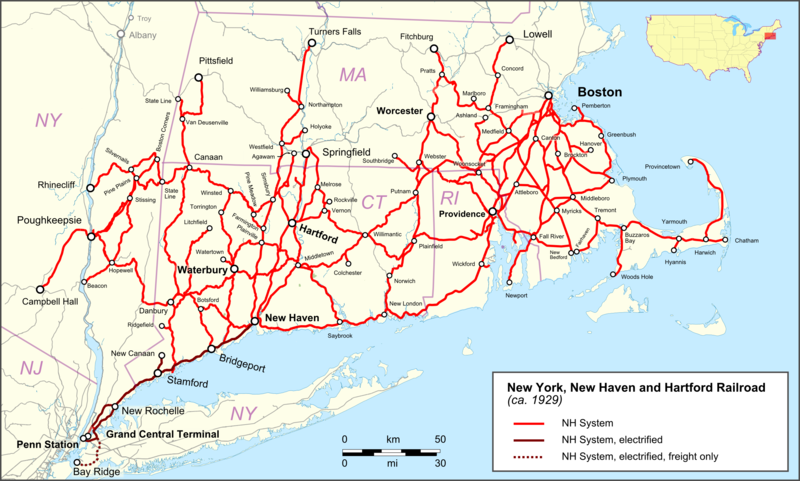
Around the beginning of the 20th century, New York investors led by J. P. Morgan gained control, and in 1903 installed Charles S. Mellen as President. Charles Francis Murphy’s New York Contracting and Trucking company was awarded a $6 million contract in 1904 to build rail lines in the Bronx for the New York, New Haven, and Hartford Railroad. An executive at the railroad said the contract was awarded to avoid friction with New York City’s Tammany Hall political machine. In response to this contract, the New York State Legislature amended the city’s charter so that franchise-awarding power was removed from the city council and given to the Board of Estimate and Apportionment, which only recently became defunct in 1989. Morgan and Mellen achieved a complete monopoly of transportation in southern New England, purchasing other railroads and steamship and trolley lines. More than 100 independent railroads eventually became part of the system before and during these years, reaching 2,131 miles at its 1929 peak. Substantial improvements to the system were made during the Mellen years, including electrification between New York and New Haven. […] Morgan and Mellen went further and attempted to acquire or neutralize competition from other railroads in New England, including the New York Central’s Boston and Albany Railroad, the Rutland Railroad, the Maine Central Railroad, and the Boston and Maine Railroad. But the Morgan-Mellen expansion left the company overextended and financially weak.
In 1914, 21 directors and ex-directors of the railroad were indicted for “conspiracy to monopolize interstate commerce by acquiring the control of practically all the transportation facilities of New England.”
J.W. Swanberg carries on the story of the railroad’s woes during and after the First World War:
The New Haven was a financial powerhouse at the start of the 20th century, but from 1903 to 1913, the road was driven to near bankruptcy under President Charles S. Mellen and financier J.P. Morgan. One gain in this period, though, was control of the Central New England Railway, which included the Hudson River bridge at Poughkeepsie, N.Y., and the link to Maybrook and nearby Campbell Hall. This was New Haven’s gateway to the west, also served by trunk lines Erie; New York, Ontario & Western; and bridge lines Lehigh & Hudson River and Lehigh & New England.
World War I government control and the Roaring 1920s boom times saved the New Haven, but not enough to survive the Great Depression, and bankruptcy came in 1935. World War II traffic allowed recovery and rebuilding, but soon all was lost by mismanagement and bankruptcy came again in 1961. The postwar New Haven faced not only highway and airline competition but also the almost total erosion of New England’s heavy industrial base. Just a shell of the once-mighty railroad was forced into a reluctant Penn Central on Jan. 1, 1969.
One of the line’s claim to fame was the early electrification program the New Haven embarked on in 1907:
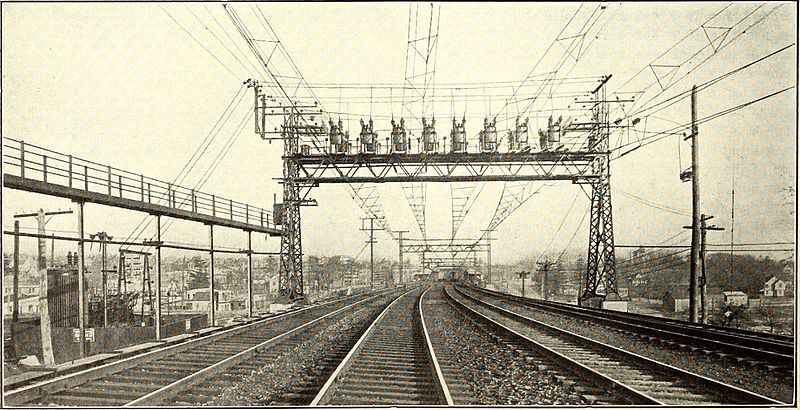
“View of Typical Sectionalizing Bridge, Auto-Transformer Installation and Cable Runway May 2, 1914.”
Photo and original caption from Electric Railway Journal via Wikimedia Commons.
The New York, New Haven and Hartford Railroad pioneered electrification of main line railroads using high-voltage, alternating current, single-phase overhead catenary. It electrified its mainline between Stamford, Connecticut, and Woodlawn, New York, in 1907, and extended the electrification to New Haven, Connecticut, in 1914. While single-phase AC railroad electrification has become commonplace, the New Haven’s system was unprecedented at the time of construction. The significance of this electrification was recognized in 1982 by its designation as a National Historic Engineering Landmark by the American Society of Mechanical Engineers (ASME).
[…]
The New Haven’s system was extended across the Hell Gate Bridge to the New York Connecting Railroad upon the line’s construction. The system of electrification was an extension of the New Haven’s revised 11/22 kV autotransformer architecture. The original electrification extended from the New Haven’s main line, across the Hell Gate Bridge, to the Bay Ridge yard. The line south of Bowery Bay Junction was de-electrified in the 1950s. The line between New Rochelle and the Harold Interlocking was transferred to Amtrak in 1976 upon dissolution of Penn Central. The electrification system continued to be controlled as a portion of the ex-New Haven system until the 1987 conversion to 60 Hz operation.
When the New Haven main line was converted by Metro-North to 60 Hz operation, the Amtrak Hell Gate line was also converted, but as an isolated system powered from the Van Nest substation. Control of the catenary system was transferred from Cos Cob to the Load Dispatcher at New York Penn Station. Although conversion occurred subsequent to the PRR-era electrification, Amtrak substation numbers 45-47 were assigned for consistency with the rest of the PRR numbering scheme.

New Haven dual-power diesel-electric FL9 locomotive 2011 with train #138, a NYC – Pittsfield train, at South Norwalk, CT on October 13, 1968. The stub of the former branch to the docks is in the foreground.
Photo by Roger Puta via Wikimedia Commons.
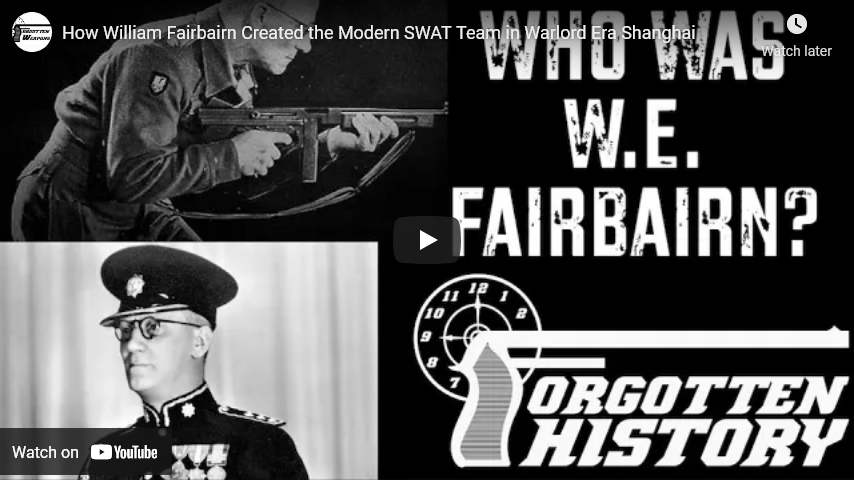
How William Fairbairn Created the Modern SWAT Team in Warlord Era Shanghai
Forgotten Weapons
Published 1 Jun 2021William E. Fairbairn is best known for his work with Eric Sykes and their “Commando” knife design during World War Two. However, Fairbairn spent some 33 years in the Shanghai Municipal Police, working his way up from a beat constable to Assistant Commissioner. There he was responsible for the SMPD adopting truly forward-thinking fighting methods, and he essentially invented the modern SWAT team (the “Reserve Unit”, which Fairbairn led for 10 years). He combined expertise in formal marksmanship, instinctive practical shooting, and hand-to-hand combat schools (including jiu-jitsu and judo) into a comprehensive training program like no other on earth at the time.
Book references:
The World’s First SWAT Team, by Leroy Thompson:
https://amzn.to/2TrYiNvGentleman & Warrior, by Peter Robins:
https://amzn.to/3vuODn9http://www.patreon.com/ForgottenWeapons
https://www.floatplane.com/channel/Fo…
Cool Forgotten Weapons merch! http://shop.forgottenweapons.com
Contact:
Forgotten Weapons
6281 N. Oracle 36270
Tucson, AZ 85740
QotD: Calvin was right
Hobbes: “‘The Dynamics of Interbeing and Monological Imperatives in Dick and Jane: A Study In Psychic Transrelational Gender Modes.'”
Calvin: “Academia, here I come!”
Bill Watterson, Calvin and Hobbes.


