
Anyway, because I’m actually interested in how people are and how they lived, I love “living history”. I know, I know, I’m the one who brought up the Civil War, but though I admire (in a very limited sense) the dedication of “reenactors”, we ain’t going there, lest the comments get way off track. Instead, I’ll refer you to the works of Ruth Goodman. She apparently shows up on a lot of “living history” shows in Britain, which are apparently quite popular over there, and she writes good books about the experience, most with “How to” in the title: I’ve read How to be a Victorian and How to be a Tudor, and they’re both great fun.
The thing you’ll notice right away if you read them is how utterly tedious life was pre-electricity. Actually, no, tedious is the wrong word, since in our usage it implies “mindless” and that’s exactly the opposite of Victorian and especially Tudor life. A much better word is “laborious”, maybe even just “hard”. Life was hard back then. Even the simplest tasks took hours, because everything had to be done by hand. You had a few simple machines, of course — simple in the mechanical sense, though nearly every page brings its “gosh, I never would’ve thought of that!” surprise — but mostly it’s muscle power. If you’re lucky, a horse’s or a donkey’s muscles do some of the heaviest work, but mostly it’s straight-up human effort.
And it’s far from mindless. How to be a Tudor has a long section on baking bread, for instance, and it’s fascinating. There’s a reason bakers had their own guild and were considered tradesmen; it takes a lot of well-honed skill to make anything but the coarsest peasant stuff. And of course that coarse peasant stuff takes a decent amount of skill itself, which is just one of a zillion little skills your average housewife would have. If you read the section on bread-baking and really try to imagine doing it, you’ll find yourself almost physically exhausted … and that’s just one minor chore among dozens, maybe hundreds, that everyday people had to do each and every day.
In other words, everyday Tudor people were “simple”, in the old sense that means “unsophisticated”, but they were never, ever bored. Even the relatively well-off, even when everything was peaceful and prosperous and functioning perfectly, were constantly mentally engaged with the world. They had to be. Imagine if getting your daily bread took not just two hours’ labor, but an actual plan. If you didn’t start your day figuring out how you were going to get fed that day, you wouldn’t eat. They had dozens, probably hundreds, more daily tasks than we ever have, and while any one of those tasks can probably be performed on autopilot if taken in isolation, they were never taken in isolation. Maybe the housewife could bake bread on autopilot, but while her hands were doing that seemingly of their own volition, her mind was lining up the zillion other things she had to do that day. Her mind was constantly engaged.
And “housewife” was a deeply meaningful term back then. The next thing that strikes you, after the sheer amount of effort everything took, is the necessity of communal life. Just the basics of day-to-day living pretty much requires a nuclear family — husband, wife, a few kids. And that’s your hardy yeoman type on the edge of starvation on the forest’s fringes. In any larger settlement, everyone knows everyone, intimately, because your very life depends on it — not only do you know the miller personally, you’ve got a major, indeed mortal, interest in how he lives his life, because if he’s shorting you, you die … or, at least, your already hard life gets a whole lot harder. There’s basically no such thing as privacy, because there can’t be.
Severian, “On Boredom”, Rotten Chestnuts, 2021-08-17.
September 8, 2024
QotD: Life in pre-mechanical times
September 7, 2024
What is Jagmeet Singh’s actual plan here?
In The Line, Jen Gerson outlines the NDP leader’s options now that the Confidence and Supply Agreement has been “ripped up”:
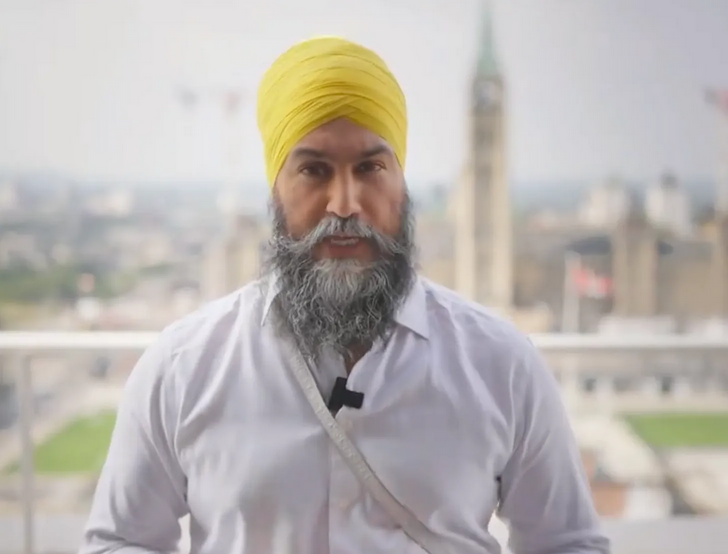
Federal NDP leader Jagmeet Singh announces the end of the Confidence and Supply Agreement.
Screencap from the NDP official video via The Line,
… I’m starting to consider the possibility that Jagmeet Singh is bad at politics.
I mean, think about this.
We at The Line have long pointed out that CASA was a bad deal for the NDP. It earned the party only a few piecemeal spending concessions like two-treatment Pharmacare and a half-baked dental program. It’s the Liberals who will, and have, taken full credit for both.
Meanwhile, Singh has lost all credibility as a government critic. What blows he can level at the Liberals are fatally undermined by the fact that he’s supported them for years. If the Liberals are complacent in enabling corporate greed, then Singh is demonstrably an enabler of a government that is “too weak, too selfish and too beholden to corporate interest to fight for people”?
I realize that nobody in Liberal-land is going to take this advice seriously, but I’m going to offer it anyway. On its current trajectory, Canada is heading toward a two-party system. Either the Liberals are going to eat the NDP, or the NDP is going to eat the Liberals. Until Wednesday, I put my money on the latter. Now, I’m not so sure.
If the Liberals maintain any existential instinct at all, they’d call Singh’s bluff. Drop the writ on a party that’s demonstrably unprepared to fight the battle it’s proclaimed. Eat the left, and survive to fight on another day. The meal is right there for the taking.
Singh’s big announcement about “ripping up” CASA — meep meep — gains him absolutely nothing. What additional leverage can he expect to acquire in a post-CASA parliament that he didn’t already possess?
Perhaps Wednesday’s announcement was merely a gambit to soothe internal problems, or distance himself from the Liberals. Okay, fine. This might be a viable strategy if it buys Singh a few months to trash Trudeau and raise funds off the effort while frantically trying to wash off the stinky stain of hypocrisy.
But what’s going to happen when the Liberals face their next confidence motion, presumably as soon as the Conservatives can arrange one? What happens at the next one, and the next one after that?
What credibility can Singh possibly hope to maintain if he votes for the Liberals, again? How in the world is the NDP seriously going to claim to have ripped up CASA while effectively acting as if it is in a CASA? The NDP cannot credibly distance itself from the sitting government while spending the next year propping up said government again and again and again in successive confidence motions. Especially after such a brazen display of pulling out of the deal.
No. They’re going to have to pull the trigger, and soon. Obviously. Clearly.
Singh sees this.
Right?
A Nation Divided, Part One
The Korean War by Indy Neidell
Published 6 Sep 2024Join us as we unfold the post-WW2 history of Korea that resulted in political escalation and eventually a military conflict in 1950. Stay tuned for the remaining parts of this mini-series!
(more…)
Trump’s visit to Arlington broke all the norms – no President has ever done this before!
Not being an American, I didn’t realize that sitting and former Presidents were banned from the grounds of Arlington National Cemetery, so Trump’s norm-obliterating visit has attracted widespread vilification from all corners of the nation:
If you read the news, Donald Trump recently did something so shocking and unprecedented that observers are staggered by his descent into evil:
He went to Arlington National Cemetery and brought a photographer, so the only possible comparison is to Literally Adolf Hitler. It was so outrageous for Trump to perform the Nazi maneuver of being photographed at Arlington that the son of the late Senator John McCain was forced to make an announcement to the world, revealing that the horror of the event had forced him to change his party registration and support the Democratic presidential candidate:
Sample framing from that story:
Jimmy McCain, who has served for 17 years in the military and is an intelligence officer, said he was angered by Trump’s conduct at the cemetery last week, adding “it was a violation.”
“It just blows me away,” he told CNN. “These men and women that are laying in the ground there have no choice” about being in a political ad.
See how evil Donald Trump is? No McCain man would ever stand for some bastard shooting a political ad at Arlington National Cemetery. Also, you can click here to watch the political ad that John McCain shot at Arlington National Cemetery.
[…]



S&W M1917: A US Army revolver in .45 ACP
Forgotten Weapons
Published Jun 3, 2024When the United States entered World War One, it had a significant shortfall in military handguns. The M1911 pistol production was expanded as much as possible, but more guns were needed. Both Colt and Smith & Wesson adapted revolver designs to Army standard .45 ACP ammunition, and both were accepted into service as the M1917, despite being different guns with no interchangeable parts.
The most interesting mechanical element of the M1917 is the development of half-moon clips to allow easy extraction of the rimless .45 cartridge. The clips were designed by S&W, but also licensed to Colt for use in their M1917 revolvers as well.
The S&W M1917 began as Smith & Wesson’s Triple Lock design, which was simplified a bit (by removing the cylinder crane lock and the barrel lug) and rechambered for .455 Webley to sell to British and Canadian forces before the US entered the war. About 75,000 were sold like this, and it was then rechamberewd again for .45 ACP for US military sales. The first US deliveries were made in October 1917, and about 163,000 were produced by the time production ended in 1919. Only about half of them actually got to the front lines by the end of the war, and many of the guns went into storage. They were actually brought back out and used in significant use in World War Two as well.
(more…)
QotD: Instrumental music doesn’t always need or want lyrics attached
Mark Steyn, “Sleigh Ride”, Steyn Online, 2019-12-08.
September 6, 2024
Climate catastrophism in a phrase – “The sky gods are angry and we’re all gonna pay”
Relax, weather-panic true believers — this is a post from Jim Treacher who gets paid to write funny stuff. This means you can mock everything in it as “fake news”:
I’m pretty old at this point, and for my whole life, the media has been predicting the weather will kill us all.
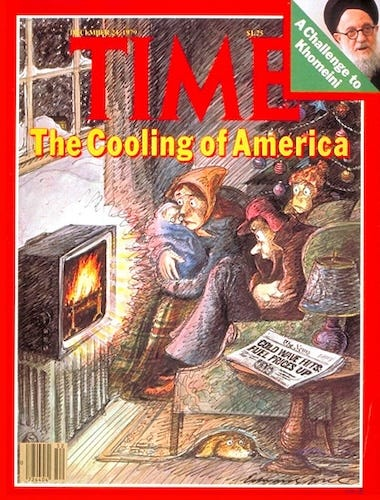
When I was a kid, the news was all about the coming Ice Age.
Brrrrr! Iran was a bunch of terrorist assholes even back in the ’70s, but the existential threat to America hadn’t been updated yet. They thought the cold was gonna get us.
And that dumb magazine was only $1.25 an issue! Everything might be more expensive 45 years later, but at least we haven’t all frozen to death.
Then the big threat became “global warming”. But when people noticed it wasn’t getting any warmer outside, despite the climate models that were supposed to horrify us, the scare tactic became “climate change”. They didn’t think we’d notice, I guess.
And through it all, there was one constant refrain: The sky gods are angry and we’re all gonna pay.
Do you leave your phone charger plugged in when you’re not using it? Do you drive a gas-powered car because it actually works? Then you’re destroying the planet, according to a pack of millionaires with yachts and private jets.
But now the celebrities and other climate supplicants are in dismay. The weather is letting them down again! Yet another of their predictions hasn’t come true, and they want to know why their climate deities have abandoned them.
Halfway through an Atlantic hurricane season that forecasters expected would be one of the most active on record, there has been a considerable interlude in storms during what is typically the busiest portion of the season, leaving observers to wonder if the forecast was a bust — or if the worst may be yet to come.
Often, at this time of the year, it isn’t uncommon to see two, three or even four named storms occurring simultaneously. But on Wednesday there were no current storms, and there hasn’t been one since Hurricane Ernesto formed, beginning as a tropical storm, on Aug. 12 …
Despite the reprieve in recent weeks, though, “it is too early to dismiss the seasonal hurricane outlook as a bust,” said Dan Harnos, a meteorologist at the NOAA Climate Prediction Center.
You got that? We haven’t endured as many deadly, destructive hurricanes as the scientists predicted. And they’re worried about it. They want people to suffer and die, but they’re hopeful that nature will still unleash its fury on us.
There’s still time for the worst to happen. Fingers crossed!
“I support Jagmeet Singh’s right to terminate his half pregnancy”
Matt Gurney on NDP Leader Jagmeet Singh’s decision to pull the plug on the Confidence and Supply Agreement that had propped up Justin Trudeau’s government, long after it became clear that the Liberals were garnering all the benefits and the NDP were losing core supporters over the arrangement:
Let us start with words of affirmation and support: I support Jagmeet Singh’s right to terminate his half pregnancy. How could anyone not? His constant daily humiliation was getting uncomfortable to observe.
I know you might be expecting some kind of political analysis here. What will the end of the Confidence and Supply Agreement — or Supply and Confidence Agreement (we probably should’ve settled on one before the thing collapsed)—mean for Canadian politics, the upcoming elections, and the next general federal election? But the truth is, I don’t know. No one does. All we can say with any particular certainty is that our minority government situation has become more complicated. The Conservatives will keep trying to bring the government down. Don’t be surprised if they try to make everything a confidence motion, if only to further embarrass Singh. The NDP, for their part, will face some brutal decisions. Most polls show them heading for a wipeout, with half of their seats looking likely to flip to someone else. They’d need a huge spike in the polls just to break even. So, that’s going to be fun for them to navigate. Then, of course, there’s Justin Trudeau and the Liberals. Their prospects look awfully bleak, too. But it’s entirely possible they might decide to rip the Band-Aid off and call an election at some point in the reasonably near future.
Am I predicting any of these things? No. Like I said, I have no idea what’s going to happen. If I had to guess, I’d say the NDP will continue to support the government unofficially for the foreseeable future while all the parties reassess the new reality on the ground. But that guess is entirely subject to revision as events unfold. Time will tell. What more can I offer you?
So, in terms of political commentary on yesterday’s news, that’s about it. I don’t expect any immediate changes, and we’ll see where things shake out. Thanks for reading.
But there is a related point I’d like to make. And though it may sound snarky, I mean it with total sincerity. I am so, so happy for Jagmeet Singh. Since the deal was announced, he’s had to keep Trudeau in office while also acting like he was as disgusted with the PM as the typical Canadian voter seems to be. It was, truly, cringe-inducing, a real-life manifestation of the first half of the Hot Dog Car sketch (the back half gets weird).
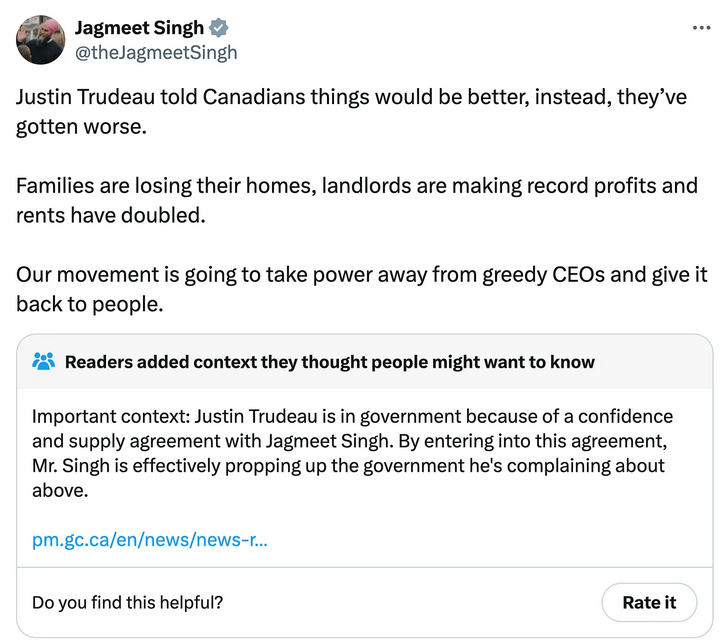
I wasn’t kidding when I said it was painful to watch. And it wasn’t just me who noticed — a few podcasts ago, Jen and I had a laugh at Singh getting hit by Twitter’s Community Notes fact-checking service. After one of his regular tweets attacking Trudeau, a note was added to it, reminding readers that Singh was officially, as per a signed agreement, responsible for keeping Trudeau in power. It was laugh out loud funny, and, alas for the NDP leader, we were very much laughing at him, not with him.
That’s finished now. His nightmare is over. He can stop looking so goddamn ridiculous every day now. The deal is dead.
And now that it is, we can finally take a long look back at it and wonder how the hell Singh ever decided that the deal, or at least how he behaved during the deal, was a good idea.
In the National Post, Chris Selley seems a bit less charitable toward Singh, for largely the same reason … the pain and humiliation was almost entirely self-inflicted:
So, the deal is off. NDP leader Jagmeet Singh apparently located a few scraps of dignity in some long-forgotten kitchen drawer or closet. Just minutes before Prime Minister Justin Trudeau was set for a press conference to give himself yet more credit for the NDP’s national school-lunch program, Singh announced he was calling off the NDP’s two-and-a-half-year-old confidence-and-supply agreement with the governing Liberals.
“Canadians are fighting a battle … for the future of the middle class,” Singh pronounced. “Justin Trudeau has proven again and again he will always cave to corporate greed.” Reports suggest it was the Liberals last month ordering the railway unions back to work and into binding arbitration with their employers that finally soured the milk in Dipperland.
“In the next federal election, Canadians will choose between Pierre Poilievre’s callous cuts or hope” Singh continued, casting himself as the Barack Obama figure in the forthcoming contest — “hope,” he specified, “that when we stand united, we win; that Canada’s middle class will once again thrive together.”
Because a Canadian political announcement must come with some impenetrable bafflegab, Singh added the following: “It’s always impossible until it isn’t. It can’t be done until someone does it.”
Up is left. Forward is up. United we dance. The future.
All the reasons for the NDP to cut the Liberals loose on Wednesday were so myriad and obvious that it’s difficult to remember what on earth the point of this agreement was supposed to be. Singh got no cabinet seats out of it, maybe just a few “thanks for your contribution” pats on the back from Trudeau and his ministers along the way. But the NDP essentially gave away any policy wins to the Liberals.
New Democrats understand better than anyone else the fundamentally amoral nature of the Liberal Party of Canada. They understand the Liberals’ all but total conflation of the party’s best interests with the country’s, and therefore its utter lack of shame. Anything the Liberal party does, anything it says, even if it’s completely the opposite of it did and said yesterday, is precisely the medicine Canada needs. And the NDP understands as well as the Conservatives do how mainstream Canadian media privileges the Liberals in that regard.
Saw Straight Every Time with These Simple Tricks
Rex Krueger
Published May 29, 2024Learn to use layout and body mechanics to saw straight and square.
QotD: “Discount” airlines
Ghost of a Flea, “Sic transit gloria mundi“, Ghost of a Flea, 2005-05-23.
September 5, 2024
CASA doloroso, or Jagmeet finally locates a pair
Ding, dong! The long-running deal between the New Democrats and Justin Trudeau’s Liberals has finally been terminated. It was Jagmeet Singh’s support that kept Trudeau in power and had been intended to run until next summer, but Singh announced he was no longer going to provide confidence and supply votes in Parliament. The editors at The Line warn us that this doesn’t automatically mean we can start heating up the tar and ripping open the feather pillows quite yet:
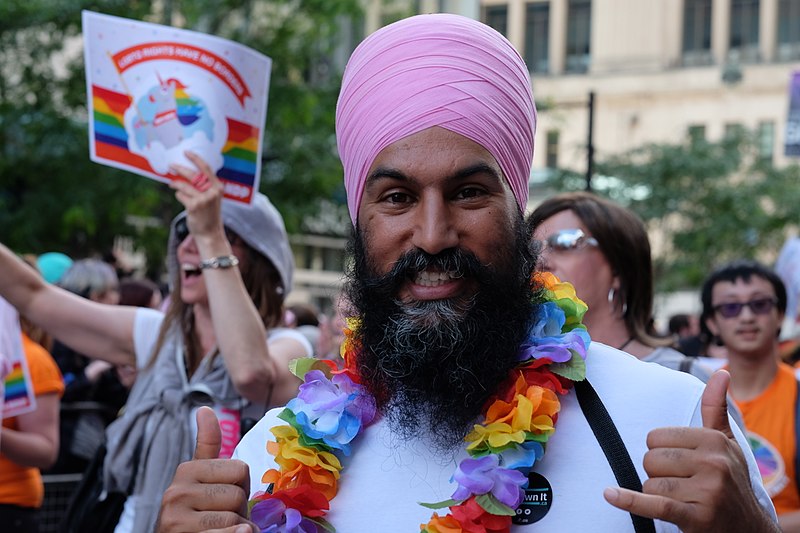
Federal NDP leader Jagmeet Singh in happier days at a 2017 Pride parade.
Photo via Wikimedia.
On Wednesday, Jagmeet Singh finally took longstanding criticism to heart, and announced he would be tearing up the Confidence and Supply Agreement, the deal that allows the Liberals to hold the confidence of the house.
That said, don’t expect an election just yet.
CASA has been an unmitigated disaster for the little sister of the non-alliance alliance between the two parties. As we’ve previously noted here at The Line, Singh proved to be a weak negotiator, agreeing to support Justin Trudeau with nary a cabinet seat nor a concrete spending promise. To date, the only real concessions the NDP have landed amount to, essentially, half-baked Pharmacare and dental programs that are little more than targeted subsidies to the poor. The merits of these programs in and of themselves is a debate for another day; however, what benefits they do bring have not benefited the NDP one whit.
That’s because the Liberals will — and have — taken full credit for these programs, while Singh has been left in the unenviable position of having to criticize a sitting government that he continues to buttress through the CASA. In other words, for virtually no spending concessions, the NDP has fatally undermined its position as a credible critic of the government.
Meanwhile, the Conservative Party — still strong in the polls — can lean on the NDP’s hypocrisy in order to gather up traditional blue collar and even union workers into the bosom of its culturally cozy embrace.
Obviously, this position is untenable. However, we at The Line admit to being surprised that Singh is actually ripping it up ahead of the deal’s natural expiry in June of 2025. Rather, we expected the Liberals to rag the puck on this government for as long as constitutionally possible — and, to be honest, we thought the NDP would stay in step because the party is, at its heart, weak.
Lo! We were surprised.
By ending CASA, the party has time to restore some of its spent credibility, bashing Trudeau hard to drum up fundraising ahead of the next election. Without the NDP’s support, the Liberals can carry on only until they are required to pass a confidence motion — likely the Spring budget. This gives the NDP a few months to generate support. Of course Singh won’t win that election, but he can now leave his party in a stronger position to live to fight another day.
That is … unless Trudeau decides to respond to the collapse of CASA by simply dropping the writ now, catching his opponents on the left off guard and unprepared to run a full election campaign.
Is the DEI tide finally receding from corporate boardrooms?
At the Foundation for Economic Education, Jon Miltimore explains why many major US corporations are reconsidering their earlier “all in” approach to lecturing their customers about progressive causes:

Bud Light’s brand ambassador, Dylan Mulvaney, whose antics triggered a consumer boycott that cost the company over a billion in lost revenue.
DEI is just one form of corporate social activism, which comes in various forms and includes its cousin Environmental, Social, and Governance (ESG). Both ideas fall under, to some degree, Corporate Social Responsibility (CSR), the idea that corporations have a duty to take social and environmental actions into consideration in their business models.
If you’re wondering why Burger King has commercials on climate change and cow farts, and why Bud Light’s commercials went from featuring Rodney Dangerfield and Bob Uecker to trans activist Dylan Mulvaney, it’s because of CSR.
The idea that corporations should fight for social causes has skyrocketed in recent years to such an extent that activism is inhibiting companies in their primary mission: generating profits by serving customers.
“Firms leveraging situations and social issues is not new, but showcasing their moral authority despite a disinterested consumer base is,” Kimberlee Josephson, an Associate Professor of Business at Lebanon Valley College in Annville, Pennsylvania, has observed.
Bud Light’s decision to feature Mulvaney cost them an estimated $1.4 billion in sales, and it revealed the danger of corporations leaning into social activism, particularly campaigns and policies that alienate their own consumer bases.
Not very long ago, companies like Chick-fil-A faced backlash from progressive activists for supporting traditional marriage. Culture war advocates on the right have responded in similar fashion.
Conservative influencers have made a point of raising awareness around “woke” corporate initiatives — white privilege campaigns, climate change goals, LGBTQ events, etc. The most successful ones, such as Robby Starbuck who pioneered the campaign against Tractor Supply and John Deere, made a point of targeting corporations with conservative consumer bases.
“If I started a boycott against Starbucks right now, I know that it wouldn’t get anywhere near the same result,” Starbuck recently told the Wall Street Journal.
One can support Robby Starbuck’s tactics or oppose them. What’s clear is that corporations increasingly face risks for participating in social activism campaigns, and the threats now come from both sides of the political aisle.
Respectful neutrality on cultural issues used to be the default way for companies to avoid insulting the general public and potentially alienating customers. Under the influence of DEI/ESG/CSR advocates, corporations were persuaded that they could offend half of the population without suffering any meaningful financial losses. That turned out to be untrue.
Matilda I – The Little Tank That Did | Tank Chat #176
The Tank Museum
Published May 24, 2024In 1940, this small but well armoured tank was pretty much all that stood between the German Blitzkrieg and a battered British Army that was retreating to the coast.
Slow, small, and armed only with a machine gun, the A11 Infantry Tank (Matilda I) would achieve great things in its only significant battlefield action – effectively saving the British Expeditionary Force from annihilation.
At Arras on 21st May 1940, Matilda Is and IIs of 4th and 7th Royal Tank Regiment counterattacked the rapidly advancing 7th Panzer Division. In doing so, they successfully halted the German advance and unnerved Hitler so much that he issued an order forbidding further advances — thus giving the British and French chance to organize the Dunkirk evacuation.
In this video, David Willey covers the history of this diminutive and often ridiculed little tank which altered the course of history by saving an entire army.
This video features archive footage courtesy of British Pathé.
QotD: Common misunderstandings about the title of “Dictator” in the Roman Republic
The nearest equivalent to this I can think of would be if Olaf Scholz suddenly announced that he was reviving the position of Deutscher Kaiser (German Emperor) for himself, except without the legal structure of that title (e.g. the Prussian crown acting as the permanent president of a federation of monarchs) or the constitutional limits it used to have. We would rightly regard that as a new office, using the title of the old one.
This point is often missed in teaching Roman history because Roman history is very long and so gets very compressed in a classroom environment. Even in a college course focused entirely on the history of Rome, the gap between the end of the old dictatorship and the start of the new one might just be a couple of weeks, so it is easy for students to accept the new dictators as direct continuations of the old ones, unless the instructor goes out of their way to stress the century-long discontinuity. This is, of course, all the more true if the treatment is in a broader European History (or “Western Civ”) course or in a High school World History course – which might be able to give the Roman Republic as a whole only a week of class time, if even that much. In that kind of compressed space, everything gets mushed together. Which in turn leads to a popular view of the Roman dictatorship that this office was always a time-bomb, ready to inevitably “go off” as soon as it fell into the hands of someone suitably ambitious, because the differences and chronological gap between the old, customary dictatorship and the new irregular one are blurred out of vision by the speed of the treatment.
Just as a side note, this is generally a problem with the Roman Republic. Popular treatments of how the Republic worked – much less pop-culture representations of it – are almost always badly flawed […] The opening minutes, for instance, of the Crash Course video on the Romans is a series of clear errors, one after another, in describing how the Republic functioned as a matter of law and practice. If for some reason you want to not be wrong about the structure of Roman government, the book to read – though it is more than a bit dry and quite pricey – is A. Lintott, The Constitution of the Roman Republic (1999). I keep thinking that, as a future series, I might take a look at the basic structures of Greek and Roman civic government (“How to Polis, 101″ and “How to Res Publica, 101″) – especially if I can talk a colleague into providing a companion treatment of medieval Italian commune government – both as a historical exercise but also for the world builders out there who want to design more realistic-feeling fictional pre-modern governments that aren’t vassalage/manorialism systems.
Bret Devereaux, “Collections: The Roman Dictatorship: How Did It Work? Did It Work?”, A Collection of Unmitigated Pedantry, 2022-03-18.
September 4, 2024
There’s always been “BC weird”, but today’s BC politics is weirder than ever
Although I can technically say I’ve been to British Columbia, a couple of hours driving around just west of the BC/Alberta border in 1988 doesn’t give me any real understanding of Lotusland’s, uh, unique political landscape. Fortunately, here’s Rob Shaw in The Line to give a somewhat better-informed view of BC politics today:

British Columbia politics has always been weird.
This is a province in which an obese Taiwanese billionaire once bought a premier’s personal amusement park using envelopes stuffed with cash in his underwear; where the clerk of the legislature was convicted of fraud; where the Speaker claimed the legislature’s ceremonial mace was bugged by spies; and an MLA stole from a children’s charity for the disabled.
In short, the province has a bit of a reputation. So it might be tempting to view the most recent headlines about the implosion of the former dominant B.C. Liberal party — and the meteoric rise of the B.C. Conservatives — as keeping with British Columbia’s unique brand of zaniness.
Except, it isn’t.
B.C.’s political realignment mirrors one that’s already occurred in several other provinces and is playing out federally, as well, as a tired, middle-road centrist party is squeezed out by a harder-right, hungrier, more-energetic conservative movement.
At the leading edge of it all is an unlikely figure — a 61-year-old former Liberal cabinet minister with a low profile, who was booted from the B.C. Liberal caucus in 2022 by leader Kevin Falcon for sharing a social media post questioning the role of CO2 in climate change. Rather than retire quietly, John Rustad took the ejection, pivoted and joined the moribund B.C. Conservative party, which had clocked only 1.9 per cent of the popular vote in 2020. He gave the party a seat in the legislature, and a profile to grow. Since then, it has skyrocketed.
“Of course nobody thought you could do this in a year, take a political party from two to three per cent to challenge to form government,” Rustad told me. “Lots of people ask me about it and I put it down simply to people are really desperate and looking for change.” Last week — two years and 10 days after he was fired — Rustad stood in a Vancouver hotel ballroom to accept Falcon’s political surrender. The leader of the B.C. Liberal dynasty, a party that ruled the province from 2001 to 2017 under premiers Gordon Campbell and Christy Clark, announced that he was disbanding B.C. United ahead of the next election. Supporters were encouraged to flock to the Conservatives.
“This is the right thing to do for the province,” Falcon said at the Aug. 28 press conference. “I said to John: I may only agree with about 75 per cent of what you might believe in, but I do know this, that on his very worst day John Rustad would be a far better premier than (B.C. NDP premier) David Eby on his very best day. And I’ve never lost sight of that bigger picture.” The Conservatives have been within striking distance of the governing NDP for months, according to polling done by almost every firm in the country.


