
Megan McArdle recounts a story of a couple who lived through the depression (well, the Great Depression … in culinary terms, they may never have emerged from the ordinary depression of lunchbag letdown):
September 11, 2018
QotD: Debunking the “company store” story
First, company stores flourished in many parts of the USA, especially in the coal regions and other places with many isolated work sites, long before any legal minimum wages were put into effect. Second, Alchian is right that the workers understood perfectly how these stores worked (how could they not have when the stores were so common?): they provided basic consumption goods — flour, bacon, beans, kerosene, matches, cotton cloth — at the work-and-living site on credit, as advances against the workers’ future pay. Yes, the prices were higher than in, say, the closest towns. But the closest towns were often much too far away to allow the workers or their wives to go there easily, frequently, or cheaply. So, what the stores actually did was to reduce transaction costs for the workers, who otherwise would have been unlikely to accept employment in remote, isolated places far from stores.
Robert Higgs, letter to Don Boudreaux, 2016-11-06.
Comments Off on QotD: Debunking the “company store” story
September 10, 2018
American Handguns of World War 1 I THE GREAT WAR Special feat. C&Rsenal
The Great War
Published on 8 Sep 2018Check out Othais’ channel: youtube.com/candrsenal
Indy and Othais take a look at the US service pistols of World War 1.
Comments Off on American Handguns of World War 1 I THE GREAT WAR Special feat. C&Rsenal
September 9, 2018
Hunter S. Thompson, Jann Wenner and Rolling Stone
Darcy Gerow on the sudden rise and long, long decline of Rolling Stone:
The suffocating media bias of the 1960s was difficult to escape. A lethargic gray specter of middle-class America was distributed with cunning sterility through the generic, bogus smiles of cable news networks and traditional print. Despite the election and assassination of Kennedy and the signing of the Civil Rights Act, if you had turned on a T.V. this was still Eisenhower’s America: regimented, religious, conservative. And the cultural vacuum created by the Eisenhower years had began to suck even harder with Lyndon Baines Johnson at the helm.
American media was out of touch with this new generation. Elitist authoritarians were preaching their moral superiority stamped with stars and stripes to a generation of cynics. These kids didn’t have a fucking clue what they wanted, but they wanted no part of what they were being given. So rose Rolling Stone, a counterculture bible for babyboomers, co-founded by Jann Wenner.[…]
Things were different in the 1960s. The anti-war movement and the civil rights movement were a just cause. The catalyst for a just movement of equal rights for women and gays and minorities was free speech, of which Jann Wenner was a huge proponent. When students at U.C. Berkley marched in the streets in the 1960s, it was an attack on the elitist, authoritarians and an establishment hellbent on keeping opposing viewpoints and the ideas of personal liberty stifled. The gang of “cruel faggots” kept the official narrative running but no one under 30 was listening.
The whole goddamn world had had enough of the travesty of war in Southeast Asia. There was no ignoring the ineptitude of American politics. The only reasonable thing to do in 1969 was to drive out to Altamont for the weekend, load up on heinous chemicals, hunker down and rethink your approach to the political process.
Thompson, the then-young, liberal anti-hero, could often be found gobbling LSD and firing his guns (he was a lifetime member of the NRA) at propane bottles for a crowd of jeering burnouts or Bay area bikers at his fortified compound, Owl Farm, in Woody Creek Colorado.
It was Jann Wenner’s idea to put Hunter, with all of his fear and loathing, on to the campaign trail in 1972. Why not get the guy who wrote Hell’s Angels? Hunter was someone with a penchant for dealing with vicious thugs and sick freaks gone crazy on power, someone who could draw a parallel between Richard Nixon and Sonny Barger.
Thompson’s openly-biased, subjective and wild account of the 1972 presidential election was the red Chevy convertible of campaign coverage. ‘Sympathy for the Devil’ on repeat and at full volume, barrelling across the country at 110 miles an hour or so and in search of an honest politician. In Hunter’s eyes, the only one that even came close was George McGovern, the senator from South Dakota.
McGovern’s non-interventionist platform focused on a complete withdrawal from Vietnam, amnesty for draft evaders and a Milton Freidman-inspired, negative income tax meant to replace the bureaucratic burden of social welfare programs and a complicated tax code. Thompson’s version of events is the story of an idealistic underdog fighting against the odds only to be crushed by postmodern Americanism and the establishment incumbent, “Tricky Dick Nixon.” McGovern might have owed a White House win, in part, to Thompson’s and Rolling Stone’s relentless support had he not owed his White House loss to the mental distress of his vice-presidential pick, Thomas Eagleton.
There’s no way to properly explain how great Rolling Stone was in those early years. How well the magazine represented the anti-establishment culture, individual liberty and equality for everyone. It can’t be compared to anything else because there was nothing else, only the traditional mainstream garbage and Rolling Stone.

Comments Off on Hunter S. Thompson, Jann Wenner and Rolling Stone
“This isn’t hardball so much as Calvinball: a game where one player constantly makes up new rules as he goes along”
Andrew Coyne provides a useful set of clues to help ordinary folks understand the NAFTA “negotiations”:
Talks on a renegotiated North American Free Trade Agreement, which at various times in the past days, weeks and months have been said to be on the verge of either a deal or collapse, are now reported to be “progressing slowly.” An agreement was not expected by the end of the day Friday. Some reports said it was not expected till the end of the month. Or maybe December.
In other words, business as usual. Had you read none of the several thousand reports on the negotiations since they began more than a year ago you would be scarcely less informed than the most avid trade watcher. Some points to bear in mind as the talks grind toward their next “deadline”:
No one knows anything. Any number of authoritative commentators have weighed in on the failure of the talks, if they are in fact failing, and who is to blame if they are. But the truth is that unless you were in the room with the negotiators you have no idea what is really going on — assuming even they do. This is not because there have been no leaks or official accounts of the proceedings, but because…
Everyone is lying to you. Many a rookie reporter has had the same experience covering a labour negotiation. The talks are said to be coming “down to the wire,” facing a dramatic “midnight deadline.” Sources close to one side or the other confide there will be “no more concessions,” that a “strike is now unavoidable.”
So the deadline comes and goes and nothing happens: they keep talking. Or else the side that had vowed not to give an inch more caves and cuts a deal. Which is to say that while all sides dutifully proclaim their aversion to “negotiating through the media,” everyone negotiates through the media, all the time. The NAFTA talks are no different.
The NAFTA talks are completely different. There has never been a trade negotiation like this, because there has never been a president, or leader of any major country, like Donald Trump. It isn’t just that he lies all the time, or changes his mind on those occasions when he is not lying.
Comments Off on “This isn’t hardball so much as Calvinball: a game where one player constantly makes up new rules as he goes along”
September 8, 2018
Battle of Saipan – Steel and Coral – Extra History – #1
Extra Credits
Published on 6 Sep 2018The battle of Saipan would decide the fate of the Pacific War. On a tiny island, just five miles wide, thousands died under advanced artillery and amphibious tanks. This series is brought to you by World of Tanks PC. Check out the game at the link below and use the invite code FORAGER for extra goodies. https://redir.wargaming.net/r06pve1j/…
Support us on Patreon! http://bit.ly/EHPatreon
Comments Off on Battle of Saipan – Steel and Coral – Extra History – #1
September 7, 2018
QotD: Government distortion of the housing market
Behind the veneer of free-market governance is a deep expanse of government involvement in massive areas of the economy, such as the housing market and health care. People don’t make decisions on housing and health-care concerns every day, but when they do, they would benefit from the information that markets provide about whether they can afford a large house or whether a particular drug is worth the price. Government distortion of these key markets has scrambled these signals.
An annual congressional report, “Estimates of Federal Tax Expenditures,” gives insight into how Washington manipulates supply and demand in these sectors. Consider house prices. This year, Washington will pay homeowners $99 billion in forgone taxes to borrow money to purchase or refinance a house or to sell that house and reap the profit. Americans will buy or sell about $600 billion worth of houses this year. Government subsidy, then, represents nearly one-sixth of this market. The federal government also provides a guarantee for most mortgages, thanks to Fannie Mae and Freddie Mac, the two government-supported mortgage companies that benefited for decades from an implicit government guarantee before they got an explicit guarantee during the 2008 financial crisis.
These subsidies have fired the growth of the housing industry. Between 1975 and 1979, the U.S. Treasury paid out $102.6 billion in mortgage-interest breaks in today’s dollars. Between 2015 and 2019, the Treasury will pay out $419.8 billion in such tax favoritism — a more than fourfold rise, nearly ten times the population increase. The hike is particularly extraordinary, considering that in the late 1970s, the annual interest rate on a mortgage was 9 percent, twice what it is today. Taking today’s lower rates into account, Washington has increased the mortgage subsidy more than eightfold.
It’s no surprise that mortgage debt has soared, to $9.5 trillion, from $2.6 trillion in inflation-adjusted dollars in 1981. Back then, mortgage debt constituted 31 percent of our nation’s GDP. Today, it makes up nearly 53 percent. [Dierdre] McCloskey, who thinks that free markets are generally healthy, acknowledges that “there are examples of the price signal not coming through.” The mortgage-interest deduction is “a silly idea,” she says, yet “very hard to change.”
Indeed, government subsidy is a critical factor in whether families can afford to purchase a home, and what kind of home, how large, and in what zip code. The home-mortgage deduction, then, helps determine how people live — yet we barely notice. Few of us consider how the government shapes one of the biggest decisions we’ll ever make, or how the U.S. government’s presence in the housing market maintains the value of our homes.
Nicole Gelinas, “Fake Capitalism: It’s not free markets that have failed us but government distortion of them”, City Journal, 2016-11-06.
Comments Off on QotD: Government distortion of the housing market
September 6, 2018
Trans-partisan planning
At Coyote Blog, Warren Meyer offers a plan to address man-made climate change, pitched to avoid being dismissed as “typical” of one or the other side:
While I am not deeply worried about man-made climate change, I am appalled at all the absolutely stupid, counter-productive things the government has implemented in the name of climate change, all of which have costly distorting effects on the economy while doing extremely little to affect man-made greenhouse gas production. For example:
- Corn ethanol mandates and subsidies, which study after study have shown to have zero net effect on CO2 emissions, and which likely still exist only because the first Presidential primary is in Iowa. Even Koch Industries, who is one of the largest beneficiaries of this corporate welfare, has called for their abolition
- Electric car subsidies, 90% of which go to the wealthy to help subsidize their virtue signalling, and which require more fossil fuels to power than an unsubsidized Prius or even than a SUV.
- Wind subsidies, which are promoting the stupidist form for power ever, whose unpredictabilty means fossil fuel plants still have to be kept running on hot backup and whose blades are the single largest threat to endangered bird species.
- Bad government technology bets like the massive public subsidies of failed Solyndra
Even when government programs do likely have an impact of CO2, they are seldom managed intelligently. For example, the government subsidizes solar panel installations, presumably to reduce their cost to consumers, but then imposes duties on imported panels to raise their price (indicating that the program has become more of a crony subsidy for US solar panel makers, which is typical of these types of government interventions). Obama’s coal power plan, also known as his war on coal, will certainly reduce some CO2 from electricity generation but at a very high cost to consumers and industries. Steps like this are taken without any idea of whether this is the lowest cost approach to reducing CO2 production — likely it is not given the arbitrary aspects of the program.
These policy mess is also an opportunity — it affords us the ability to substantially reduce CO2 production at almost no cost.
Comments Off on Trans-partisan planning
September 5, 2018
The continuing paranoid style in American politics
John Gray discusses the mass psychosis that gripped the left in November 2016 and still has not slackened that grip:
Visiting New York a few weeks after Trump’s victory in the presidential election, I found myself immersed in a mass psychosis. The city’s intelligentsia was possessed by visions of conspiracy. No one showed any interest in the reasons Trump supporters may have had for voting as they did. Quite a few cited the low intelligence, poor education and retrograde values of the nearly 63 million Americans who voted for him. What was most striking was how many of those with whom I talked flatly rejected the result. The election, they were convinced, had been engineered by a hostile power. It was this malignant influence, not any default of American society, that had upended the political order.
Conspiracy theory has long been associated with the irrational extremes of politics.
The notion that political events can be explained by the workings of hidden forces has always been seen by liberals as a sign of delusional thinking. A celebrated study by the political scientist Richard Hofstadter, The Paranoid Style in American Politics (1964), linked the idea with the far Right. Yet in New York in December 2016, many of the brightest liberal minds exhibited the same derangement. Nearly two years later, they continue to reach to conspiracy theory as an explanation for their defeat.
The former lead book reviewer at the New York Times, Michiko Kakutani, devotes several pages to Hofsfadter’s work in her short polemic, The Death of Truth. Citing him approvingly, she notes that “the modern right wing” has “tended to be mobilised by a sense of grievance and dispossession”. As Hofstadter put it, they feel that “America has been largely taken away from them.” The charm of this citation is the lack of self-awareness it reveals. It would be difficult to find a better description of the anguish of liberals such as Kakutani, who feel they have been robbed of their historically appointed role as the moral and intellectual leaders of society.
For those who embrace it, a paranoid style of liberalism has some advantages. Relieved from any responsibility for the debacles they have presided over, the liberal elites that have been in power in many western countries for much of the past 30 years can enjoy the sensation of being victims of forces beyond their control. Conspiracy theory implies there is nothing fundamentally wrong with liberal societies, and places the causes of their disorder outside them. No one can reasonably doubt that the Russian state has been intervening in western politics. Yet only minds unhinged from reality can imagine that the decline of liberalism is being masterminded by Vladimir Putin. The principal causes of disorder in liberal societies are in those societies themselves.
Comments Off on The continuing paranoid style in American politics
September 4, 2018
“So now we know what ‘the resistance’ really is. It’s the establishment”
Brendan O’Neill on the funeral of “maverick” Republican senator John McCain:
So now we know what ‘the resistance’ really is. It’s the establishment. It’s the old political order. It’s that late 20th-century political set, those out-of-touch managerial elites, who still cannot believe the electorate rejected them. That is the take-home message of the bizarre political spectacle that was the burial of John McCain, where this neocon in life has been transformed into a resistance leader in death: that while the anti-Trump movement might doll itself up as rebellious, and even borrow its name from those who resisted fascism in Europe in the mid 20th-century, in truth it is primarily about restoring the apparently cool, expert-driven rule of the old elites over what is viewed as the chaos of the populist Trump / Brexit era.
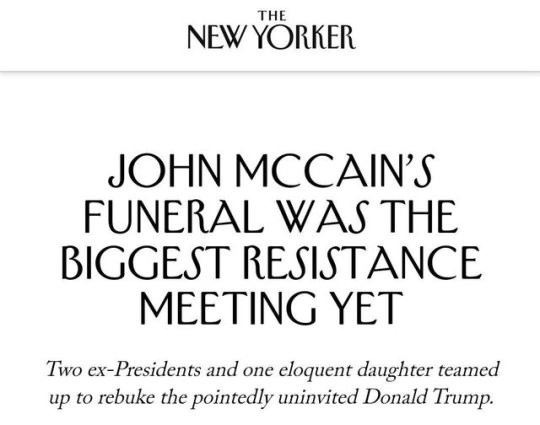
The response to McCain’s death has bordered on the surreal. The strangest aspect has been the self-conscious rebranding of McCain as a searing rebel. In death, this key establishment figure in the Republican Party, this military officer, senator, presidential candidate and enthusiastic backer of the exercise of US military power overseas, has been reimagined as a plucky battler for all that is good against a wicked, overbearing political machine. ‘John McCain’s funeral was the biggest resistance meeting yet’, said a headline in the New Yorker, alongside a photo of George W Bush, Bill Clinton, Hillary Clinton, Al Gore, and soldiers from the US Army, the most powerful military machine on Earth. This is ‘the resistance’ now: the former holders of extraordinary power, the invaders of foreign nations, the Washington establishment.
The New Yorker piece, like so much of the McCain commentary, praises to the heavens the anti-Trump theme of McCain’s funeral. McCain famously said Trump couldn’t attend his funeral. And that in itself was enough to win him the posthumous love of a liberal commentariat that now views everything through the binary moral framework of pro-Trump (evil, ill-informed, occasionally fascistic) and anti-Trump (decent, moral, on a par with the warriors against Nazism). Even better, though, was the fact that orators at the funeral, including McCain’s daughter Meghan and both Bush and Obama, used the church service to slam Trumpism, without explicitly mentioning it, and in the process to big-up what came before Trumpism, which of course was their rule, their politics, their establishment. The Washington political and media set might seem bitterly bipartisan, said the New Yorker writer, but it is also ‘more united’ in one important sense – ‘in its hatred of Donald Trump’.
[…]
The religious allusions, the talk of vengeance against Trump, the misremembering of McCain’s life so that it becomes a moral exemplar against the alleged crimes of Trumpism, exposes the infantile moralism of the so-called resistance. Albert Burneko, assessing some of the madder McCain commentary, says there is now a ‘condition’ that he calls ‘Resistance Brain’, where people display an ‘urge to grab and cling on to anything that seems, even a little bit, like it might be the thing that Finally Defeats Donald Trump’. Even if the thing they’re grabbing on to is actually a bad thing. Like a seemingly endless FBI investigation into the elected presidency. Or George W Bush, whose moral rehabilitation on the back of Anti-Trumpism has been extraordinary. Or neoconservatism: this was the scourge of liberal activists a decade ago, yet now its architects are praised because they subscribe to the religion of Anti-Trumpism. Being against Trump washes away all sins.
Comments Off on “So now we know what ‘the resistance’ really is. It’s the establishment”
September 3, 2018
Planes, Trains, and… Actually, just Trains
Knowing Better
Published on 18 Sep 2016The railroad has affected your life more than you may have realized. From starting the mail order business to creating some of America’s greatest landmarks, see how this simple transportation system shaped the country we live in today.
Patreon ► http://patreon.com/knowingbetter
Twitter ► https://twitter.com/KnowingBetterYT
Facebook ► https://facebook.com/KnowingBetterYT/
Reddit ► https://reddit.com/r/KnowingBetter/—
Why Trains Suck in America – Wendover Productions – https://youtu.be/mbEfzuCLoAQ
Photo Credits –
American Waterways/Canals are edits of images I used to teach in 2011 – The originals were from Wikicommons and have long since been removed or updated. No Copyright Information can be found.
The Three Proposed Railroad Routes are edits of images I used to teach in 2013 – The originals were from Wikicommons and have long since been removed or updated. No Copyright Information can be found.
I don’t normally add comments about the daily 2:00am videos, but there are a couple of things in this video that I think needed to be addressed. First, he rather casually skips over the vast increase in American railway building even before the enabling legislation for the transcontinental lines, and misses a great opportunity to explain how important they were in determining the outcome of the American Civil War. Second, and rather more irritatingly, he blithely asserts the common myth about the “Big Oil” conspiracy to buy up and shut down municipal light rail (streetcars, interurban railways, and radials). The various streetcar systems had almost all been economically shaky since the Great Depression (many had to be taken over by the municipalities involved to keep them out of bankruptcy), and the huge increase in private car ownership after World War 2 was the coup de grâce that finished off most of the rest. During the same time, bus routes were encroaching on the streetcar’s territory and had the huge advantage of not being tied to rails (allowing relatively easy re-routing without huge construction costs).
Comments Off on Planes, Trains, and… Actually, just Trains
September 2, 2018
Amtrak service and the “takings” clause
Back in August, Fred Frailey reluctantly came to the conclusion that at some point American freight railways are going to have to challenge in court Amtrak’s legislated ability to pre-empt freight traffic on their networks:

Amtrak’s
Eastbound Empire Builder crossing Two Medicine Trestle at East Glacier MT on 20 July 2011.
Photo by Steve Wilson via Wikimedia Commons.
We all know about “taking the Fifth.” It’s our right under the Fifth Amendment to the U.S. Constitution not to be compelled to testify against ourselves. In other words, a court cannot force us to admit to driving 60 mph in a 45-mph zone (or something worse). That amendment has another, less-well-known clause, which says government cannot take away our property without just compensation. Lawyers know this as the “Takings Clause.” The Fifth came to mind the other day as I rode Amtrak’s Empire Builder from Seattle to Chicago. I’ll get to my point, but first the experience.
[…]
All of this did terrible things to our schedule-keeping. By the third morning, as the train approached Devils Lake, N.D., we were more than eight hours late (the next day’s eastbound Builder was even later). But imagine what the Empire Builder does to BNSF’s freights every day. The Amtrak Improvement Act of 1973 reads: “Except in an emergency, intercity passenger trains operated by or on behalf of [Amtrak] shall be accorded preference over freight trains in the use of any given line of track, junction, or crossing.”
BNSF appears totally committed to obedience of this law but doing so devours the capacity of this route. It’s not just that freights give way; whizzing along at a 79 mph versus 55 or 60 for the freights, the Empire Builder eats capacity as if it were two or three freights, Six high-priority Z trains prowl the northern Transcon every day, and I don’t think a single one of them that I observed was moving as we went by. One Z train was sandwiched between two stopped manifest trains, all making way for our Builder.
Obviously, Amtrak pays BNSF for the right to run trains over the freight railroad. But whatever it pays is but a fraction of the cost in delays to its own trains incurred by BNSF. Were the northern Transcon double-tracked all the way, these delays would obviously be minimized. But at $3 million or more a mile, double tracking consumes capital like a dry sponge, and it’s not Amtrak’s capital, either.
So now to my point: Isn’t it fair to say that Amtrak, which the U.S. Supreme Court in 2015 decreed to be an arm of government, is confiscating the property (track capacity) of host railroads? And if it is, shouldn’t the freight railroads be fairly compensated for the delays to their freights caused by the loss of this capacity? Try as I might to say otherwise, I am forced to answer “yes” to both questions.
Comments Off on Amtrak service and the “takings” clause
August 31, 2018
The American First Army Gears Up – Germany Retreats I THE GREAT WAR – Week 214
The Great War
Published on 30 Aug 2018As the German Army withdraws along the Western Front, the Entente prepares for ever more offensives. This includes the newly founded American First Army which will have the task to attack the Germans in the Meuse-Argonnes area.
Comments Off on The American First Army Gears Up – Germany Retreats I THE GREAT WAR – Week 214
August 29, 2018
Out of Context: How to Make Bad History Worse | World War 2
Knowing Better
Published on 5 Mar 2018Churchill was a genocidal maniac. The Japanese were rounded up into concentration camps. FDR let Pearl Harbor happen. When you take history out of context, you can make it say whatever you want – including making bad things worse.
A long list of links to sources is included, but I’m too lazy to re-link ’em all, just go to YouTube to see them. Back in 2009, I did a short fisking of Pat Buchanan’s hit-piece on Churchill’s “reponsibility” for the outbreak of WW2.
Comments Off on Out of Context: How to Make Bad History Worse | World War 2


