
… liberals spent years trying to diagnose the unique psychological disease that seemed to have beset the Republican Party — Acute Chronic Racism, or perhaps Psychosomatic Obstructionitis — I have always suspected that the fervent devotion to pointless and often counterproductive obstruction was less a Republican disease than a symptom of a larger structural problem in our politics. As people have geographically sorted themselves into partisan enclaves, partisanship has risen dramatically; the culture war has taken the kind of fierce battles that rocked the country during the civil rights era to all 50 states, rather than concentrating them on a handful of states and cities; and perhaps most importantly, a century of “good government” initiatives, from primary elections to campaign finance reform to anti-earmark legislation, have gutted the parties as a source of political discipline and political deal-making. These weak parties were unable to mount any kind of coherent response to the social media revolution, which allowed candidates and activists to do an end-run around the party professionals who would have stopped them in an earlier era.
The result is a fundamentally broken politics. But that politics is not broken because of something that “Republican elites” did. Liberals have been very fond of arguing that those elites somehow encouraged the growth of these destabilizing influences by not shutting down … well, name your candidate: right-wing talk radio, the tea party, obstructionist forces in Congress, Donald Trump. Liberals are about to find out what those Republicans have long known: they had no power to shut them down. All the tools they might have used had been taken away decades ago, mostly by progressives.
For exactly the same structural forces are at work on the left. Things fall apart; the center cannot hold. Those forces have been masked by Democratic possession of the presidency, which is a unifying force far out of proportion to its actual usefulness. As long as your party holds the White House, you feel like you have a shot at getting things done, and you are willing to cut a great deal of slack to your leadership. Prepare to see Republicans get a lot quieter and more cooperative, and the obstreperous forces on the left to get angrier and more intransigent.
Megan McArdle, posting on Facebook, 2016-11-11.
August 29, 2018
August 28, 2018
Stross in conversation with Heinlein
Charles Stross explains why so many Baby Boomer SF writers fall so far short when they write in imitation of Robert Heinlein:
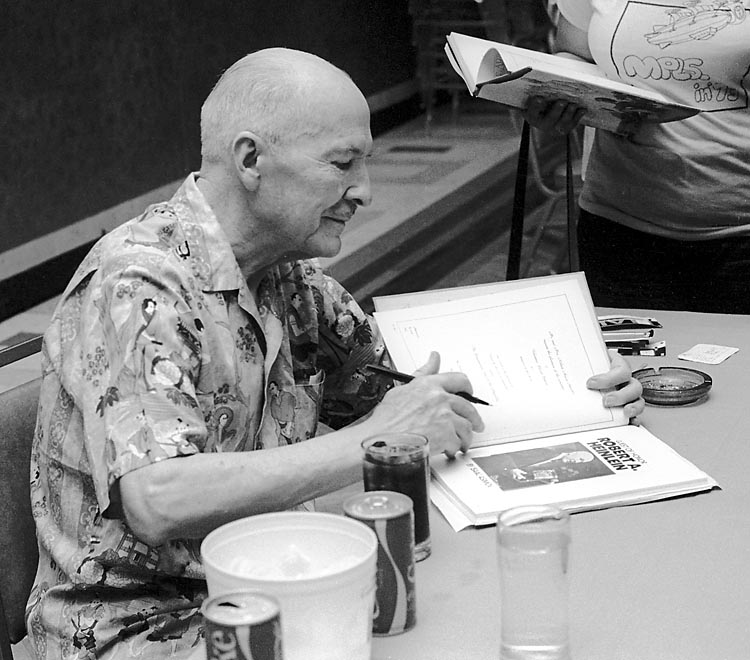
Robert A. Heinlein at the 1976 World Science Fiction Convention
Via Wikimedia Commons.
RAH was, for better or worse, one of the dominant figures of American SF between roughly 1945 and 1990 (he died in 1988 but the publishing pipeline drips very slowly). During his extended career (he first began publishing short fiction in the mid-1930s) he moved through a number of distinct phases. One that’s particularly notable is the period from 1946 onwards when, with Scribners, he began publishing what today would be categorized as middle-grade SF novels (but were then more specifically boys adventure stories or childrens fiction): books such as Rocket Ship Galileo, Space Cadet, Red Planet, and Have Space Suit, Will Travel. There were in all roughly a dozen of these books published from 1947 to 1958, and as critic John Clute notes, they included some of the very best juvenile SF ever written (certainly at that point), and were free of many of the flaws that affected Heinlein’s later works — they maintained a strong narrative drive, were relatively free from his tendency to lecture the reader (which could become overwhelming in his later adult novels), and were well-structured as stories.
But most importantly, these were the go-to reading matter for the baby boom generation, kids born from 1945 onwards. It used to be said, somewhat snidely, that “the golden age of SF is 12”; if you were an American boy (or girl) born in 1945 you’d have turned 12 in 1957, just in time to read Time for the Stars or Citizen of the Galaxy. And you might well have begun publishing your own SF novels in the mid-1970s — if your name was Spider Robinson, or John Varley, or Gregory Benford, for example.
Then a disturbing pattern begins to show up.
The pattern: a white male author, born in the Boomer generation (1945-1964), with some or all of the P7 traits (Pale Patriarchal Protestant Plutocratic Penis-People of Power) returns to the reading of their childhood and decides that what the Youth of Today need is more of the same. Only Famous Dead Guy is Dead and no longer around to write more of the good stuff. Whereupon they endeavour to copy Famous Dead Guy’s methods but pay rather less attention to Famous Dead Guy’s twisty mind-set. The result (and the cause of James’s sinking feeling) is frequently an unironic pastiche that propagandizes an inherently conservative perception of Heinlein’s value-set.
It should be noted that Charles Stross is politically left, so calling something “conservative” is intended to be understood as a pejorative connotation, not merely descriptive.
But here’s the thing: as often as not, when you pick up a Heinlein tribute novel by a male boomer author, you’re getting a classic example of the second artist effect.
Heinlein, when he wasn’t cranking out 50K word short tie-in novels for the Boy Scouts of America, was actually trying to write about topics for which he (as a straight white male Californian who grew up from 1907-1930) had no developed vocabulary because such things simply weren’t talked about in Polite Society.
Unlike most of his peers, he at least tried to look outside the box he grew up in. (A naturist and member of the Free Love movement in the 1920s, he hung out with Thelemites back when they were beyond the pale, and was considered too politically subversive to be called up for active duty in the US Navy during WW2.) But when he tried to look too far outside his zone of enculturation, Heinlein often got things horribly wrong. Writing before second-wave feminism (never mind third- or fourth-), he ended up producing Podkayne of Mars.
Trying to examine the systemic racism of mid-20th century US society without being plugged into the internal dialog of the civil rights movement resulted in the execrable Farnham’s Freehold. But at least he was trying to engage, unlike many of his contemporaries (the cohort of authors fostered by John W. Campbell, SF editor extraordinaire and all-around horrible bigot). And sometimes he nailed his targets: The Moon is a Harsh Mistress as an attack on colonialism, for example (alas, it has mostly been claimed by the libertarian right), Starship Troopers with its slyly embedded messages that racial integration is the future and women are allowed to be starship captains (think how subversive this was in the mid-to-late 1950s when he was writing it).
In contrast, Heinlein’s boomer fans rarely seemed to notice that Heinlein was all about the inadmissible thought experiment, so their homages frequently came out as flat whitebread 1950s adventure yarns with blunt edges and not even the remotest whiff of edgy introspection, of consideration of the possibility that in the future things might be different (even if Heinlein’s version of diversity ultimately faltered and fell short).

August 27, 2018
QotD: The trouble with term limits
I used to be a big supporter of term limits, but I think the evidence at this point is that they actually empowered lobbyists and activist groups, both because politicians going back to the “real world” needed somewhere to work after they left office, and because the politicians were too naive to recognize when they were being taken for a ride by a special interest. The longer I stay in Washington, the more skeptical I am of any silver bullet …
Megan McArdle, commenting on Facebook, 2016-11-11.
August 25, 2018
Swedish Antiaircraft Artillery: Bofors 40mm Automatic Gun M1
Forgotten Weapons
Published on 24 Aug 2018Note: In the video I mistakenly describe this as a two-stamp NFA gun. It is actually deactivated, and thus does not require a tax stamp. Sorry for the mistake!
http://www.patreon.com/ForgottenWeapons
The Swedish Bofors company developed their 40mm antiaircraft gun in the 1930s, and it would go on to be one of the most successful weapon designs in modern history. Used by both sides in WWII and in all theaters, improved versions of the 40mm Bofors gun continue to serve in military front lines to this very day. In the US, they comprise part of the armament on the AC-130 Spectre gunships, for example.
This particular gun is a WW2 vintage piece, made in Sweden. Most of the examples used by the United States were made under license by Chrysler, the car company. Something like 60,000 were produced during the war, mostly for naval use. These guns would be a mainstay of American vessels’ air defense against Japanese Kamikaze attacks.
If you enjoy Forgotten Weapons, check out its sister channel, InRangeTV! http://www.youtube.com/InRangeTVShow
August 23, 2018
Cultural Appropriation Tastes Damn Good: How Immigrants, Commerce, and Fusion Keep Food Delicious
ReasonTV
Published on 1 Aug 2018Writer Gustavo Arellano talks about food slurs, the late Jonathan Gold, and why Donald Trump’s taco salad is a step in the right direction.
———-Reason is the planet’s leading source of news, politics, and culture from a libertarian perspective. Go to reason.com for a point of view you won’t get from legacy media and old left-right opinion magazines.
—————————
The late Jonathan Gold wrote about food in Southern California with an intimacy that brought readers closer to the people that made it. The Pulitzer Prize–winning critic visited high-end brick-and-mortar restaurants as well as low-end strip malls and food trucks in search of good food wherever he found it. Gold died of pancreatic cancer last month, but he still influences writers like Gustavo Arellano, Los Angeles Times columnist and author of Taco USA: How Mexican Food Conquered America.
Arellano sat down with Reason‘s Nick Gillespie to talk about Gold’s legacy, political correctness in cuisine, and why Donald Trump’s love of taco salad gives him hope in the midst of all of the president’s anti-Mexican rhetoric. The interview took place at Burritos La Palma, named by Gold as home to one of the five best L.A. burritos.
August 21, 2018
Creating An American Army – John J. Pershing I WHO DID WHAT IN WW1?
The Great War
Published on 20 Aug 2018Check Out Desert Operations: https://desertoperations.gamigo.com/
John Pershing already had a long career in in the US forces when World War 1 broke out. When 1917 came around he was tasked with the monumental challenge of creating and expanding the American Expeditionary Forces and send them over to Europe.
August 20, 2018
QotD: Economic refugees wanting to re-create the hell they just escaped from
I can’t tell you now many people I know here in Arizona that tell horror stories about California and how they had to get out, and then, almost in the same breath, complain that the only problem with Arizona is that it does not have all the laws in place that made California unlivable in the first place. They will say, for example, they left California for Arizona because homes here are so much more affordable, and then complain that Phoenix doesn’t have tight enough zoning, or has no open space requirements, or has no affordability set-asides, or whatever. I am amazed by how many otherwise smart people cannot make connections between policy choices and outcomes, preferring instead to judge regulatory decisions solely on their stated intentions, rather than their actual effects.
Warren Meyer, “When You Come Here, Please Don’t Vote for the Same Sh*t That Ruined the Place You Are Leaving”, Coyote Blog, 2016-11-02.
August 19, 2018
Poor whites in the pre-Civil War South
Colby Cosh retweeted this fascinating thread by Keri Leigh Merritt (embed through the ThreadReaderApp):
August 18, 2018
Mythbusting with the .30-06 American Chauchat: Reliability Test
Forgotten Weapons
Published on 28 Jul 2018http://www.patreon.com/ForgottenWeapons
Everyone knows, of course, that the Chauchat is the worst gun ever, and can’t normally get through an entire magazine without malfunctioning. Well, let’s try that out … and with an even worse culprit; an M1918 Chauchat made for the AEF in .30-06.
If you enjoy Forgotten Weapons, check out its sister channel, InRangeTV! http://www.youtube.com/InRangeTVShow
August 17, 2018
QotD: TINA
I believe, and I have alluded to this several times, that we must anchor all our policies in North America. We are, I have said, again more than once, bound by what some wag called TINA²: we are Trapped In North America and There Is No Alternative. (TINA X TINA = TINA²) That’s the crux of it … no matter what some romantics might wish we are and must remain for generations anchored in North America. We are not big enough and rich enough to be powerful enough to face the world on our own, treating the USA as just another great power ~ as, arguably, Australia does. Geography, economics, personal issues ~ we are kith and kin ~ and the power imbalance make us dependent upon America to a degree that some, including me, find unhealthy.
But, until we can grow our population to 100 million, until we can grow up and appreciate that we need substantial hard (military) power in order to promote and protect our vital interests around the globe, until we can become a global free trader, and until America’s decline is more marked then There Is No Alternative … we are Trapped In North America ~ trapped in Donald Trump’s America, for now, anyway.
Ted Campbell, “Anchor, cornerstone or stumbling block?”, Ted Campbell’s Point of View, 2018-07-17.
August 16, 2018
August 15, 2018
Hotel security theatre meets DEF CON attendees in Las Vegas
Las Vegas hotels have a clear duty to be more vigilant about their security procedures, but the folks at the most recent DEF CON gathering were perhaps not the best-chosen group to try out a new “swaggering bully-boys security enforcement” policy:
In the wake of the mass shooting in Las Vegas in October of 2017, hotels in the city started drafting more aggressive policies regarding security. Just as Caesars Entertainment was rolling out its new security policies, the company ran head on into DEF CON — an event with privacy tightly linked to its culture.
The resulting clash of worlds — especially at Caesars Palace, the hotel where much of DEF CON was held — left some attendees feeling violated, harassed, or abused, and that exploded onto Twitter this past weekend.
Caesars began rolling out a new security policy in February that mandated room searches when staff had not had access to rooms for over 24 hours. Caesars has been mostly tolerant of the idiosyncratic behavior of the DEF CON community, but it’s not clear that the company prepared security staff for dealing with the sorts of things they would find in the rooms of DEF CON attendees. Soldering irons and other gear were seized, and some attendees reported being intimidated by security staff.
And since the searches came without any warning other than a knock, they led, in some cases, to frightening encounters for attendees who were in those rooms. Katie Moussouris — a bug bounty and vulnerability disclosure program pioneer at Microsoft, an advocate for security researchers, and now the founder and CEO of Luta Security — was confronted by two male members of hotel security as she returned to her room. When she went into the room to call the desk to verify who they were, they banged on the door and screamed at her to immediately open it.
Current status: two members of hotel security banging on my door after I asked to go into my room and verify them with hotel security. I'm on speaker phone with hotel security, asking for a supervisor to come verify. I'm terrified. What the hell is this @CaesarsPalace #DEFCON
— Katie Moussouris (@k8em0) August 11, 2018
In another case, a hotel employee—likely hotel security—entered the room of a woman attending DEF CON without knocking:
This evening, a man in a light blue collared shirt with a walkie talkie, entered my room with a key without knocking while I was getting dressed. He left when I started screaming. @CaesarsPalace is investigating whether it was a hotel employee. @defcon has also been alerted.
— Maddie Stone (@maddiestone) August 12, 2018
Robert Heinlein – Highs and Lows – #2
Extra Credits
Published on 14 Aug 2018Heinlein’s novels made science fiction mainstream and even contributed to modern libertarianism. His novels vary widely in the philosophies they explore, but ultimately they all reflect how Heinlein saw himself: as the self-reliant “competent man” protagonist of his stories, despite glaring inconsistencies.
August 14, 2018
Sean Gabb’s view of Anglo-American relations from 1945 to today
He seems such a nice, mild-mannered chap but who else but a virtual bomb-chucking anarchist could title an article “Death to America?”
My view of America is tinged with a paranoia born from jealousy and resentment. I believe that American self-respect has, for at least the past hundred years, required the destruction of England as a great and independent nation. The Americans speak a language that did not emerge among themselves. They live within a system of law and within a set of constitutional assumptions that are also not co-existent with their nation. If their country were a minor power, they could, like Haiti, or Australia, or America before the 1870s, accept the fact of inferiority. If it were to vanish from the earth, they could look on the originator of their language and institutions with sentimental affection, as the Byzantines did on Athens and Rome.
Their problem is that, before 1940, England was a strong competitor. Since then, it has been generally subordinate, but never with full willingness. Therefore, the Americans have mixed occasional humiliation, as at Suez, with continual meddling in our politics. Our foreign policy has, since 1945, been largely set by Washington. Our leaders are mostly American Quislings, and these have systematically promoted American culture at the expense of our own. It may be that the accumulation of blocking powers by our new Supreme Court is an imitation to be welcomed. But the importation of American political correctness is not to be welcomed. Nor, I suggest, should we welcome the official replacement of English with American words and expressions — see, for example, the use of “train station” for “railway station”. This may appear, in itself, a trivial complaint. Repeated across the whole administrative and educational machinery, it has the effect of making our own recent past into a foreign country.
What the Americans want is for England to be discussed mainly in the past tense. They will study our literature, and sometimes our history. Some of their higher classes will put on Anglicised airs and graces, much as the Romans turned hellenophile after they had plundered and enslaved Greece. But to see their preferred model for living Englishmen, look at the characters played by Wilfred Hyde-Whyte, or the character of Alfred in Batman — polite, reliable, elderly, and, above all, ineffectual.
Though I dislike the European Union, I believe that the long term interests of my country lie in a close relationship with France and Germany, and in an amicable working arrangement with Russia. We have an obvious commonality with France and Germany of economic and strategic interests. We are of approximately equal weight. None is able to dominate the others. Each must work in compromise with the others. Any talk of “hands across the Atlantic” is either self-deception or a lie. Except perhaps between 1922 and 1940, there has never been an equality between England and America. Any close relationship between these countries has otherwise rested on the domination of one by the other — a domination with at best a limited overlap of interests. Though roles have changed, so it was at times before 1914, and so it has been since 1940.
August 12, 2018
Misunderstanding what the trade deficit represents
In a post from last week, Tim Worstall explains why Donald Trump is wrong about the economic impact of a trade deficit:
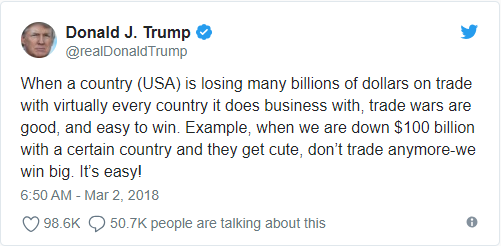
I should note here that I didn’t, because as a foreigner I can’t, support The Donald at the last election. But I didn’t support Hillary even more. So this is more about really, actually, insisting that Trump is wrong on trade issues rather than just the more general he’s wrong about everything common in the US press.
[…]
What Trump, DiMicco and Navarro are getting wrong is this, the GDP equation.
Y = C+I+G+(X-M)GDP is consumption plus investment plus government spending plus the trade balance – and minus it if there’s a trade deficit. So people look at this and think yep, if there’s a trade deficit than that makes Y, GDP, smaller!
But this is a mistake, an error. For, as the textbook immediately goes on to explain, what is it that we do with imports? Well, we either consume them, use them in investments or government buys them. So all imports are already in C and I and G. Meaning that if we don’t deduct them we’ll be double counting them. So, to avoid double counting we subtract them.
Trump and his advisers are simply wrong on this. The trade deficit doesn’t reduce the size of the economy. They’re getting it wrong simply because they’re not reading the second page of the explanation of the GDP equation.


