
A few years ago, I did some research on three early Victorian murders that caused me to read several provincial newspapers of the time. I discovered incidentally to my research that the owners or editors of about half of the British provincial newspapers also sold patent medicines; and this made perfect sense, for by far the greatest advertisers in provincial newspapers were the manufacturers of patent medicines. The owners or editors of the newspapers sold advertisements to the producers of patent medicines, then they sold the newspapers in which the advertisements appeared, and finally they sold the products themselves to the readers. It was an excellent example of rational commercial synergy. (About half of the medicines, by the way, were either to cure or to prevent syphilis — a disease, then, that was a great support to the press of the time.)
Now, the principal quality or characteristic of the sellers of patent medicine has always been effrontery, that is to say the blatant insinuation of the false. Thomas Holloway’s innovation was to insinuate such falsehood on a mass or industrial scale. There was hardly a newspaper in which he did not place a weekly advertisement; moreover, he pioneered the advertisement that masquerades as news story. He would ensure that reports of miracle cures in faraway places, supposedly wrought by his pills and ointment, and written as matter-of-factly as possible, were placed in every newspaper, reports whose veracity no one could possibly check for himself, of course.
As Napoleon once said, repetition is the only rhetorical technique that really works — besides which hope and fear render people susceptible to effrontery. In Thomas Holloway’s time, the fear of illness was often, and the hope of cure rarely, justified; at least Holloway’s preparations were unlikely to do much harm (they contained aloe, myrrh, and saffron), unlike the prescriptions of the orthodox doctors of the time. They allowed for the possibility of natural recovery, whereas orthodox medicine often hurried its consumers into their graves. Nevertheless, the claims Holloway made for his ointment and pills were preposterous, and something is not curative just because it fails to kill.
Holloway made an immense fortune by his effrontery and founded a women’s college in the University of London on the proceeds.
Theodore Dalrymple, “The Way of Che”, Taki’s Magazine, 2017-10-28.
February 12, 2023
QotD: The heyday of Victorian newspapers
February 10, 2023
“What’s happening to children is morally and medically appalling”
In The Free Press, Jamie Reed explains why she gave up her job as as a case manager at The Washington University Transgender Center at St. Louis Children’s Hospital and is now speaking out against the early and aggressive therapeutic treatment of gender-confused children and teens:
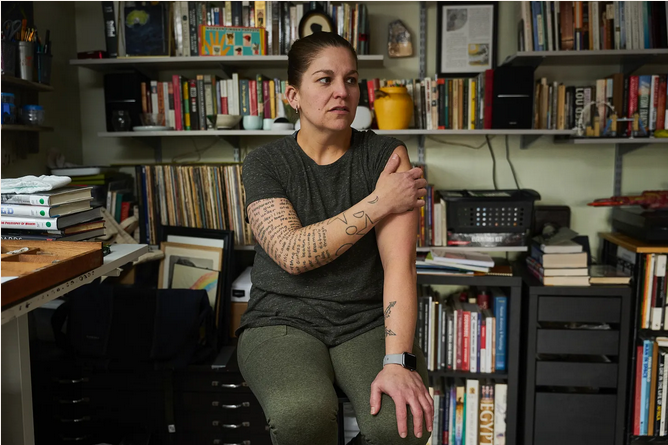
Reed in her office. (Theo R. Welling).
Soon after my arrival at the Transgender Center, I was struck by the lack of formal protocols for treatment. The center’s physician co-directors were essentially the sole authority.
At first, the patient population was tipped toward what used to be the “traditional” instance of a child with gender dysphoria: a boy, often quite young, who wanted to present as — who wanted to be — a girl.
Until 2015 or so, a very small number of these boys comprised the population of pediatric gender dysphoria cases. Then, across the Western world, there began to be a dramatic increase in a new population: Teenage girls, many with no previous history of gender distress, suddenly declared they were transgender and demanded immediate treatment with testosterone.
I certainly saw this at the center. One of my jobs was to do intake for new patients and their families. When I started there were probably 10 such calls a month. When I left there were 50, and about 70 percent of the new patients were girls. Sometimes clusters of girls arrived from the same high school.
This concerned me, but didn’t feel I was in the position to sound some kind of alarm back then. There was a team of about eight of us, and only one other person brought up the kinds of questions I had. Anyone who raised doubts ran the risk of being called a transphobe.
The girls who came to us had many comorbidities: depression, anxiety, ADHD, eating disorders, obesity. Many were diagnosed with autism, or had autism-like symptoms. A report last year on a British pediatric transgender center found that about one-third of the patients referred there were on the autism spectrum.
Frequently, our patients declared they had disorders that no one believed they had. We had patients who said they had Tourette syndrome (but they didn’t); that they had tic disorders (but they didn’t); that they had multiple personalities (but they didn’t).
The doctors privately recognized these false self-diagnoses as a manifestation of social contagion. They even acknowledged that suicide has an element of social contagion. But when I said the clusters of girls streaming into our service looked as if their gender issues might be a manifestation of social contagion, the doctors said gender identity reflected something innate.
To begin transitioning, the girls needed a letter of support from a therapist — usually one we recommended — who they had to see only once or twice for the green light. To make it more efficient for the therapists, we offered them a template for how to write a letter in support of transition. The next stop was a single visit to the endocrinologist for a testosterone prescription.
That’s all it took.
When a female takes testosterone, the profound and permanent effects of the hormone can be seen in a matter of months. Voices drop, beards sprout, body fat is redistributed. Sexual interest explodes, aggression increases, and mood can be unpredictable. Our patients were told about some side effects, including sterility. But after working at the center, I came to believe that teenagers are simply not capable of fully grasping what it means to make the decision to become infertile while still a minor.
February 8, 2023
“Smoking has been a net gain for the Treasury ever since King James I started taxing it heavily in the 1600s”
Christopher Snowden asks whether we should believe the consistent claims of public health advocates on how much things they disapprove of (smoking, drinking, etc.) “cost” the taxpayer:
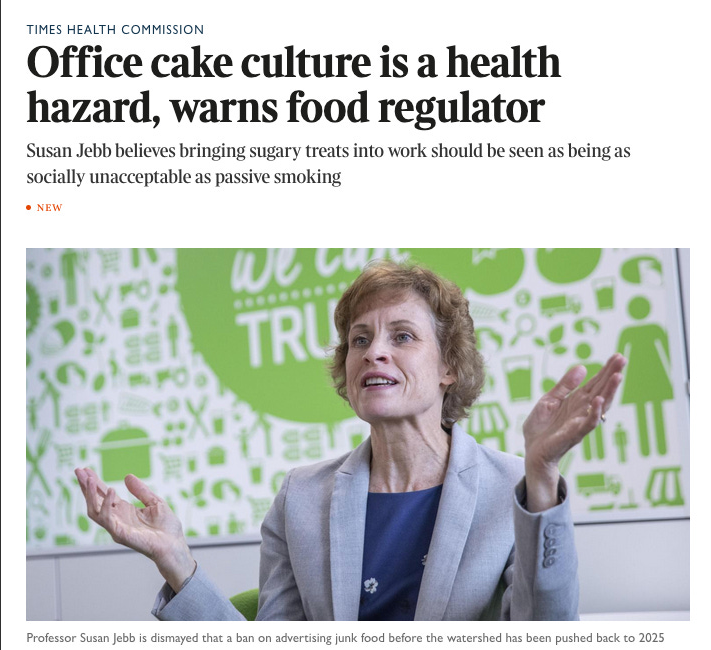
If smoking costs the taxpayers £173 billion, then how much does widespread forced feeding of office pastries cost?
If you say that a certain activity costs society £10 billion a year, most people would assume that if that activity disappears, society will save £10 billion a year.
They might have different ideas of what “society” means. Some will assume that the £10 billion is a cost to taxpayers while others will assume that some of the cost is borne by private individuals and businesses. But the majority will, quite reasonably, assume that the cost is to other people, i.e. those who do not participate in the activity.
And nearly everyone will assume that the £10 billion is money in the conventional sense of cash that can be exchanged for goods and services.
But when it comes to estimates from “public health” campaigners about the cost of drinking/smoking/obesity, all these assumptions would be wrong. Most of the “costs” are to the people engaged in the activity and they are not financial costs. Taxpayers would not pay less tax if they disappeared. In general, they would pay more.
Last month I mentioned an estimate of the “cost” of gambling in the UK and said:
These studies have no merit as economic research. They are purely driven by advocacy. The hope is that the average person will wrongly assume that the costs are to taxpayers and agitate for change.
The main aim of these Big Numbers is to convince the public that heavily-taxed activities place a burden on society that exceeds the tax revenue, thereby justifying yet more taxes and prohibitions.
In the case of smoking, this has become more and more difficult. Smoking has been a net gain for the Treasury ever since King James I started taxing it heavily in the 1600s. Today, as the smoking rate dwindles and tobacco duty rises ever higher, anti-smoking campaigners have got their work cut out duping non-smokers into thinking otherwise.
Tobacco duty brings in about £12 billion a year. For years, groups like Action on Smoking and Health (ASH) used a figure of £13.74 billion as the “cost of smoking”. This came from a flimsy Policy Exchange report which included £5.4 billion as the cost of smoking breaks and £4.8 billion as the cost of lost productivity due to premature mortality. Neither of these are costs to the taxpayer. They are not even external costs, i.e. costs to non-smokers.
Last year, in a review commissioned by the Department of Health, Javed Khan came up with a figure of “around £17 billion” as the “societal cost” of smoking. This included “reduced employment levels” (£5.69 billion) and “reduced wages for smokers” (£6.04 billion). Again, these costs fall on smokers themselves and are not external costs. They are, in other words, none of the government’s business.
Last week, a report commissioned by Action on Smoking and Health (ASH) pulled out all the stops and announced that the cost of smoking to Britain was now — wait for it! — £173 billion. Go big or go home, eh?
February 4, 2023
QotD: Leftists against humanity
Here’s the list as to why:
NOT AN EXHAUSTIVE LIST:
1) Pushing to maximize abortion
2) Pushing to maximize homosexuality
3) Multiple different initiatives to make child rearing more difficult and expensive including
a) Ramping up the intensity of social services scrutiny, effectively necessitating high intensity “helicopter parenting”
b) Turning schools into indoctrination factories that don’t prepare children to function independently but do prepare them to have constant fights with their parents over their indoctrination
c) Making healthcare more expensive through constantly ramping regulation, making the actual having of children more difficult and prohibitively expensive
d) Pushing to nationalize healthcare, granting them further power over who lives or dies – allowing limitation of IVF, and also
e) legitimizing legal euthanasia while also pushing to make healthcare decisions for the public (see Canada right now)4) Pushing from other regulatory angles to make the de facto standard a two-income family, ensuring children are raised in daycares and further pushing family budgets to the brink
5) Using the student loan system to turn the bulk of reproductive age, upwardly mobile people into collateral in a deal that passes billions of dollars directly from the US government to the same system that then indoctrinates those kids to the point of full societal dysfunction; encouraging, as much as possible, the use of sex as entertainment ONLY
6) Turning sterilizing yourself into the hot new fad for kids
7) Turning the simple identification of gender into a minefield so that even sex between people who aren’t mutilating themselves is suddenly difficult to even consider
8) Willfully manipulating nursing homes into putting elderly people in a position where they are MOST LIKELY to die during COVID
9) Adopting COVID policies which foreseeably shut down cancer diagnostics and treatment for almost two years, which is the most likely cause of the 10 fold increase in the rate of cancers since the COVID lockdowns (although I can’t entirely discount that the vaccines themselves are partially responsible because, sing it with me now, you can’t ensure the long term safety of something that hasn’t been around long enough to have long term safety data, which is why we do clinical trials and not mass experiments on the general public. I note in passing that the drug companies are so trustworthy they demanded legal indemnity as a condition of participating, while swearing blind that the product was safe and effective even though it was physically fucking impossible for them to have data to back that up due to minor problems like the requisite quantity of time not passing.)
Sarah Hoyt, “I Don’t Believe in Aliens”, According to Hoyt, 2022-10-31.
February 3, 2023
A spectre is haunting Ontario politics: the spectre of [Shock! Horror!] American-style healthcare!
Everyone in Canada has heard alarming stories of people in the United States being presented with five- or six-figure bills for hospital care, and any hint that one of our provincial healthcare systems might move in that direction scares the pants off almost everyone. Politicians know this well, and salivate at the chance of deploying charges that their opponents favour “American-style” changes to our system because it’s a guaranteed vote-winner. None of it has to be true — very few Canadians know much about US systems aside from the horror stories — but it’s always effective.
In The Line, Harrison Ruess makes the sensible point that there are more healthcare systems in the western world than those of Canadian provinces and our closest neighbour:

Toronto General Hospital in 2005.
Photo via Wikimedia Commons.
First, to be emphatic on this point, we need to be realistic about where our system ranks globally.
It is truly bewildering to me the lengths that otherwise smart and empathetic Canadians will go to to defend the status-quo approach to health care in Canada. The results we get, versus the money we spend, is simply not brag-worthy. The argument that our system works great, if only we threw more money at it, doesn’t stand up to scrutiny.
Is our health care okay? Sure. Decent? Probably. Is it great? Hardly. Could we do better? Yes, much. Do we need to spend more? Maybe a tad, but not likely much, if any. To wit:
According to OECD data, on life expectancy Canada ranks 16th. On mortality rates from avoidable causes, we’re 23rd. On cancer survival rates we range from 13th down to 18th, depending on the cancer type. On the number of one-year-olds vaccinated for diphtheria, tetanus and pertussis, we rank an abysmal 37th (even the U.S. is higher here at 27th. Gulp.). One area where we do rank closer to the top is spending as a proportion of GDP, where we sit seventh.
World Health Organization (WHO) data wasn’t any more flattering, where Canada’s health care ranked 30th in overall performance despite being 10th in spending. The Commonwealth Fund ranks Canada 10th out of 11 in performance and 6th out of 11 in spending. In report after report Canadians aren’t getting the outcomes we need or want based on the money we’re spending on our current system.
Besides for reasons of nostalgia, why would anyone spend their energy defending these sorts of results? “We’re 16th! We’re 16th!” is hardly a chant you’d hear at a rally. It’s time to do better. And I get the feeling most people recognize this – certainly when you get onto Main Street.
Ipsos polling from December 2021 reported that 55 per cent of Canadians are “somewhat satisfied” with their health care, alongside 22 per cent that are “somewhat dissatisfied.” I.e. three quarters of Canadians find themselves in the middle of the road on the quality of our health care. This seems about right — mediocre support for mediocre health care. (The strongly satisfied and strongly dissatisfied were about even, at 12 per cent and 10 per cent respectively.)
But today Canadians are also, rightly, very worried. Leger polling in January 2023 showed that 86 per cent of Canadians are worried about the state of our health care.
January 30, 2023
Crime on Toronto’s public transit system is merely a symptom of a wider social problem
As posted the other day, Matt Gurney’s dispiriting experiences on an ordinary ride on the TTC are perhaps leading indicators of much wider issues in all of western society:

“Toronto subway new train” by BeyondDC is licensed under CC BY-NC-ND 2.0 


 .
.
Caveats abound. Toronto is, relatively speaking, still a safe city. The TTC moves many millions of people a week; a large percentage of whom are not being knifed, shot or burnt alive. And so on. We at The Line also suspect that whatever is happening in Toronto isn’t happening only in Toronto, but Toronto’s scale (and the huge scope of the TTC specifically) might be gathering in one place a series of incidents that would be reported as unconnected random crimes in any other city. A few muggings in Montreal or Winnipeg above the usual baseline for such crimes won’t fit the media’s love of patterns as much as a similar number of incidents on a streetcar or subway line.
Fair enough, duly noted, and all that jazz.
But what is happening out there?
Your Line editors have theories, and we’ve never hesitated to share them before: we think the pandemic has driven a portion of the population bonkers. We’d go further and say that we think it has left all of us, every last one, less stable, less patient, less calm and less empathetic. For the vast majority of us, this will manifest itself in many unpleasant but ultimately harmless ways. We’ll be more short-tempered. Less jovial at a party. Less patient with strangers, or even with loved ones. Maybe a bit more reclusive.
But what about the relatively small majority of us that were, pre-2020, already on the edge of deeper, more serious problems? What about those who were already experiencing mental-health issues, or living on the edge of real, grinding poverty?
It’s not like the overall societal situation has really improved, right? COVID-19 itself killed tens of thousands, and took a physical toll on many more, but we all suffered the stress and fear not just of the plague, but of the steps taken to mitigate it. (Lockdowns may have been necessary early in the pandemic, but they were never fun or easy, and that societal bill may be coming due.) Since COVID began to abate, rather than a chance to chill out, we’ve had convoys, a war, renewed plausible risk of nuclear war, and now a punishing period of inflation and interest-rate hikes that are putting many into real financial distress. We are coping with all of this while still processing our COVID-era stress and anxiety.
The timing isn’t great, is what we’re saying.
And on the other side of the coin, basically all our societal institutions that we’d turn to to cope with these issues — hospitals, social services, homeless shelters, police forces, private charities, even personal or family support networks — are fried. Just maxed out. We have financial, supply chain and, most critically, human-resource deficits everywhere. The people we have left on the job are exhausted and at their wits’ end.
This leaves us, on balance, less able to handle challenges than we were in 2020, due to literal exhaustion of both institutions and individuals. Meanwhile, against the backdrop of this erosion of our capacity, our challenges have all gotten worse!
It’s not hard to do the mental math on this, friends. It seems to us that in 2020, the policy of Canadian governments from coast to coast to coast, and at every level, was to basically keep a lid on problems like crime, homelessness, housing prices and shortages, mental health and health-care system dysfunction, and probably others we could add. One politician might put a bit more emphasis on some of these issues than others, in line with their partisan priors, but overall, the pre-2020 status quo in Canada was pretty good, and our political class, writ large, basically self-identified as guardians of that status quo, while maybe tinkering a bit at the margins (and declaring themselves progressive heroes for the trouble of the tinkering).
But then COVID-19 happens, and all our problems get worse. And all our ways of dealing with those problems get less effective. It doesn’t have to be by much. Just enough to bend all those flatlined (or maybe slightly improving) trendlines down. Instead of homelessness being kind of frozen in place in the big cities, it starts getting worse, bit at a time, month after month. The mental-health-care and homeless shelter systems that weren’t really doing a great job in 2020, but were more or less keeping big crises at a manageable level, started seeing a few more people fall through the cracks each month, month after month. Those people are just gone, baby, gone.
The health-care system that used to function well enough to keep people reasonably content, if not happy, locks up, and waitlists balloon, and soon we can’t even get kids needed surgeries on time.
The housing shortage goes insane, and prices somehow survive the pandemic basically untouched.
The court system locks up, meaning more and more violent criminals get bail and then re-offend, even killing cops when they should be behind bars.
None of these swings were dramatic. They were all just enough to set us on a course to this, a moment in time where the problems have had years to compound themselves and are now compounding each other.
Here’s the rub, folks. The Line doesn’t believe or accept that any of the problems we face today, alone or in combination, are automatically fatal. We can fix them all. But we need leaders, including both elected officials and bureaucrats, who fundamentally see themselves as problem fixers, and who understand right down deep in their bones that that is what their jobs are, and that they are no longer what they’ve been able to be for generations: hands-off middle managers of stable prosperity.
January 20, 2023
“… any association with Davos should put an individual or organization under notice of suspicion”
CDR Salamander wants to sign up — like so many of us — for a post-Davos world:

The whole World Economic Forum/Davos experience is one part Bond villain parody, one part clout seeking billionaires, one part megalomania, a heaping cup of greed, and a dash of rent seeking.
In 2023 things have reached the point where any association with Davos should put an individual or organization under notice of suspicion. Amazing to see people who claim to be American conservatives or lovers of liberty attending in an non-ironic, non-protesting capacity.
This wannabee gaggle of quasi-oligarchs and autocrat throne sniffers represents everything that is wrong with the human desire for control, power, and to crush the individual for fun and profit.
They pretend to be the world government in waiting that no one asked for, no one wants, and trust me on this — no one wants to live under. Being unaccountable to the people is their ideal state.
If you don’t know what I am referring to above, shame on you. Google it yourself, but I couldn’t help but giggle when I read the title from this article by Gideon Rachman at The Financial Times; Geopolitics threatens to destroy the world Davos made.
Really? It is? Then by all means let’s have MOAR!
…the 2023 WEF — the first to take place in its regular winter location since the pandemic began — could be seen as signalling a return to normalcy. However, China’s sudden abandonment of its zero-Covid policy has raised fears that a new wave of variants could emerge.
And, even if a fresh pandemic phase is avoided, Covid has left its mark on the way governments and businesses think about globalisation. The assumption that goods and commodities can always be shipped easily around the world has been shattered.
Except for the mentally fragile few and those who leverage power through them, the world is over COVID like it is over the flu. The last three years has been a clarifying event bringing in to stark relief those autocracy worshipers and hypocrites who hold individual rights in contempt. It also helped us see the existential danger a free people can face when they put themselves at the mercy of governments who see a crisis opening a door for an easy grasp at additional powers they will never want to give back.
The past the Davos set desired failed the future that is our present, but that doesn’t give pause to any of them. The Davos view of the future where everyone (except for those at the top) lives in a pod, eats bugs, owns nothing but is “happy” is at best dystopian, at worst justifies at some point if they are not stopped, open global revolt against the ruling class with all the violence and blood that comes with it.
[…]
Simply unacceptable in democratic nations that the will of the people might promote change in political leadership. Next thing you know, they might want even more free speech and redress of grievances.
Those world leaders who are present might do well to take the funicular up to the Schatzalp Hotel, which served as Mann’s model for the sanatorium in The Magic Mountain. The hotel’s view is the best in Davos — it may offer a chance for quiet reflection on how to prevent war and natural disaster from once again engulfing the global economy
Unspoofable.
Perhaps they should reflect on how they encouraged Russian aggression and European vulnerability to hydrocarbon blackmail? Should they take a moment to see how they look the other way as the PRC engages in wholesale oppression of their Muslim minority? Are they proud of their dividends derived from almost unimaginable levels of air and water pollution flowing out of PRC’s slave labor run factories?
Unlikely — they might miss out on the next party.
A post-Davos world?
How do we bring it here faster?
Christopher Snowden on our latest “Clown World” alcohol guidelines
At Velvet Glove, Iron Fist, Christopher Snowden pokes gigantic holes in the stated justification for the latest Canadian drink consumption recommendations (also mentioned in this post yesterday):

“Pelee Island winery”by John Kannenberg is licensed under CC BY-NC-ND 2.0


Canada is on the brink of making itself an international laughing stock by cutting its drinking guidelines from two drinks a day to two drinks a week. The previous guidelines were only set in 2011 so Canadian drinkers can be forgiven for being suspicious about this dramatic change. The evidence base has not significantly changed in the interim. The evidence for the health benefits of moderate drinking has continued to pile up.
The only thing that has really changed is that neo-temperance zealots like Tim Stockwell have tightened their grip on alcohol research. Stockwell and his “no safe level” pal Tim Naimi both live in Canada and are both authors of the report that has made the ludicrous new recommendations.
I have been saying for over a decade that the “public health” plan is to get the guidelines down to zero so they can start regulating alcohol like tobacco. The evidence does not support this fundamentally ideological campaign and so the evidence has been dropped in favour of fantasy modelling and cherry-picking.
[…]
A Canadian “standard drink” contains 13.45 grams of alcohol. Three standard drinks equals 40 grams. Four standard drinks equals 53 grams. The meta-analysis has no data on people who drink so little, so the claim that colon cancer risk increases at three or more standard drinks is not supported even by the authors’ own preferred source.
As for breast cancer, which can only affect half the population and is partly why most countries have different guidelines for men and women, the report cites this meta-analysis of 22 studies, 13 of which found no statistically significant association with drinking. It pooled the studies and reported a 10 per cent increase in risk for people drinking 10 grams of alcohol a day. As with the colon cancer study, this was the minimum quantity studied so it tells us nothing about Canadians who drink 3-5 standard drinks.
In terms of mortality, another meta-analysis found that light drinking was not positively associated with any form of cancer, including breast cancer, and was negatively associated with cancer in a couple of instances […]
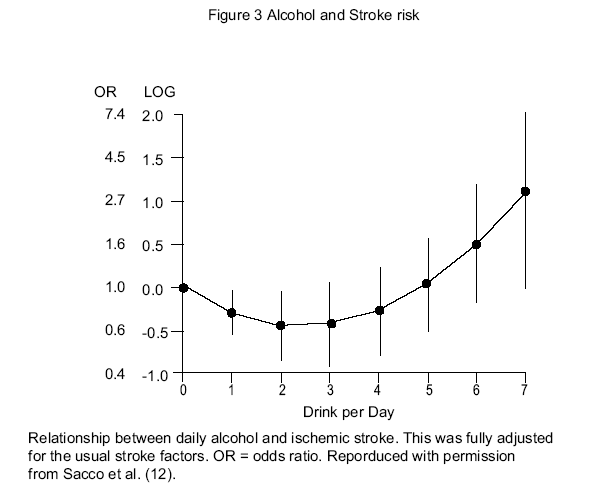
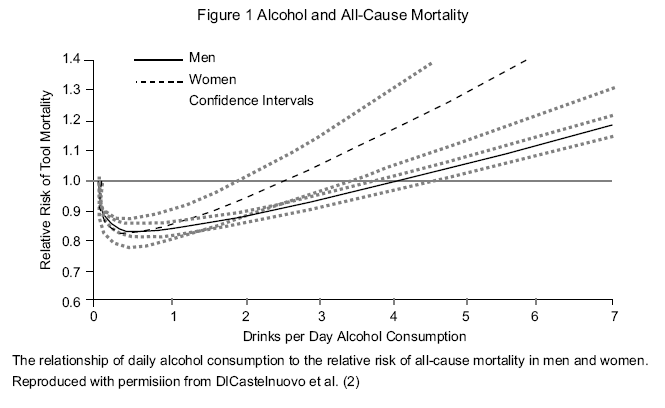
As countless studies have shown, heart disease and stroke risk is substantially reduced among light and moderate drinkers. For example, a meta-analysis of prospective cohort studies (which track people’s drinking habits and health status over a number of years and are the most reliable studies in observational epidemiology) found that drinkers were 25 per cent less likely to die from coronary heart disease than teetotallers. The evidence for strokes is similar.
This is main reason why life expectancy is longer for moderate drinkers and the relationship between alcohol consumption and mortality is J-shaped.
The authors of the Canadian report essentially ignore all this evidence and instead focus on a cherry-picked meta-analysis written by Stockwell, Naimi and pals which massively adjusted the figures to arrive at their desired conclusion. This is inexcusable.
At The Line, Jen Gerson points out the utter absurdity of public health officials doing their best Carry Nation bar-smashing imitations while at the same time pushing for “harm reduction” policies for cocaine, heroin, and other illegal narcotics:
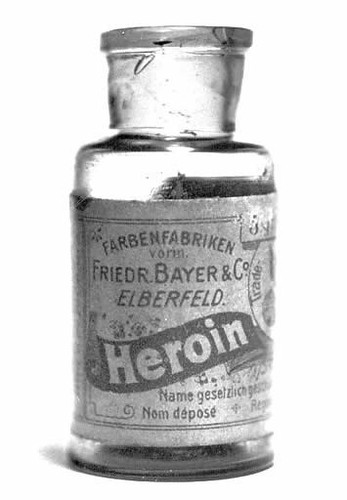
“Bayer Makes Heroin” by dog97209 is licensed under CC BY-NC-ND 2.0 .
“The guidance is based on the principle of autonomy in harm reduction and the fundamental idea behind it that people living in Canada have a right to know that all alcohol use comes with risk,” noted the CCSU and, hey, yeah!
I like to understand my risks so that I can make informed decisions.
But you know what else poses significant risk?
Lots of morphine and cocaine.
I think this is generally known. But God help you if you want to engage in a conversation about the risks society might be courting with safe supply or even harm-reduction strategies, and have fun being labelled a Conservative troglodyte who just wants suffering addicts to die in the street. You’re probably just a rich, callous asshole who opposes all of these evidence-based policies who blows second-hand smoke into the faces of your children while drinking your sixth beer of the night at the local pub. Just shut up and pick up those discarded needles in your yard, you monster.
I was picking on Health Canada previously, but they’re hardly the only ones who display a bizarre split-personality on these issues. Any story by or on the CBC on the matter of alcohol use now sounds like something straight out of the Women’s Christian Temperance Union. Yet just try to find critical reporting on safe consumption sites or safe supply policies. Almost all of it is uniformly glowing.
[…]
Obviously, I don’t think that our public-health officials are telling Canadians that heroin takes the edge off a hard day better than a glass of red or a pint of beer. But did we learn nothing over the course of the pandemic about the importance of consistent and clear public-health communications? The target audience for this is not those who have carefully studied harm reduction and substance use disorders. It’s people who just like to have a drink with dinner.
If our governments want to maintain any credibility, they can’t be uptight about how many glasses of pinot noir we drink, and then appear to be loosey goosey on heroin. It’s just impossible to take that kind of suck-and-blow at face value, but that’s exactly how this messaging will come across to people who aren’t closely engaged with this issue. “The government wants to give free hard drugs to junkies but thinks my cocktail is a problem?”
January 19, 2023
You must be protected from coworkers who threaten your health … by bringing in cake?
Christopher Snowden knows a slippery slope when the media pushes another nanny state health concern as serious as cake in the workplace:
If nobody brought in cakes into the office, I would not eat cakes in the day, but because people do bring cakes in, I eat them.
Who is this co-worker from hell? Who is this whining, snivelling infant demanding that the rest of the world forfeits their small pleasures because she has no self-control?
It is none other than the head of the Food Standards Agency, Susan Jebb, who is in The Times tomorrow comparing cakes to passive smoking.
The full quote reads:
“We all like to think we’re rational, intelligent, educated people who make informed choices the whole time and we undervalue the impact of the environment”, she said. “If nobody brought in cakes into the office, I would not eat cakes in the day, but because people do bring cakes in, I eat them. Now, OK, I have made a choice, but people were making a choice to go into a smoky pub.”
Indeed they were, Susan, before people like you took that choice away to such an extent that even a pub that put up a sign saying “SMOKERS ONLY” on the door and employed no one but smokers would still forbidden from accommodating them.
I’ve made a few slippery slope arguments in my time — contrary to midwit opinion, they are often valid — but even I never imagined that a workplace smoking ban would evolve into a workplace cupcake ban. Talk about the thin end of the wedge!
While saying the two issues were not identical, Jebb argued that passive smoking inflicted harm on others “and exactly the same is true of food”.
To inflict something on someone implies that it is done without their consent. In that sense — and leaving aside the question of whether wisps of secondhand smoke are actually harmful — passive smoking doesn’t inflict harm on a person who knowingly goes to a smoky pub. The same is obviously true of someone who offers you a cake. If they held you down and physically shoved it down your throat, that would be a different matter, but surely that is already illegal under some law or other?
Meanwhile, Canadian nanny state enablers are trying to do battlespace prep to get the government to mandate new warning labels to containers of alcoholic beverages and to significantly cut the already low maximum “recommended consumption”:
… a report on the new drinking guidance released Tuesday by the Canadian Centre on Substance Use and Addiction says the warning labels could inform consumers about serious health risks including cancer, the number of standard drinks in a container and the benefits of limiting consumption to two drinks a week.
“Consuming more than two standard drinks per drinking occasion is associated with an increased risk of harms to self and others, including injuries and violence,” the report says.
The guidance is based on the findings of a panel of 23 experts who reviewed nearly 6,000 peer-reviewed studies as part of a two-year process that also considered feedback from 4,845 people during an online public consultation process in spring 2021.
The most recent available data show that alcohol causes nearly 7,000 cancer deaths each year in Canada, with most cases being breast or colon cancer, followed by cancers of the rectum, mouth and throat, liver, esophagus and larynx. Liver disease and most types of cardiovascular diseases are also linked to alcohol use.
The guidance updates Canada’s Low-Risk Drinking Guidelines set in 2011, when two drinks a day were considered low risk and it was believed that women could safely consume up to 10 drinks a week and men could have 15 drinks.
January 15, 2023
One last dance for Davos?
Elizabeth Nickson on the “walls closing in” but this time it isn’t “on Trump”, but it might be “on the World Economic Forum” and their enablers:
Klaus and his gang were in full egomaniacal flight last week in Davos. I wonder how secretly scared they were, swanning around in their $30,000 Loro Piana topcoats dreaming of what … a nice quiet prison? Their liability for this latest attempt to escape the whirlwind through forced pharmaceuticals and the construction of the Biomedical Security State, must be dawning on them. It was always a possibility, but they figured the populace — thanks to their equally witless behaviourists — were so dumb they’d consent to being permanently damaged and think it was the fault of the extreme right. And climate change.
[…]
In Australia, the more Covid shots you’ve had, the more Covid you get and the more you die. The unvaccinated sail by relatively unperturbed.
Did you know that Big Pharma takes between $8 to $10 Trillion out of the US economy every year? GDP is only $23 Trillion. That’s a lot of money to claw back by every injured person, every family who lost a wage earner, a mother, a treasured child. This is a profit center for the great unwashed unmatched in human history. A massive transfer of wealth from the .01% to us.
They are all liable: every executive, every celebrity, every film producer, every hospital chief, every newspaper publisher, every television station owner, every multinational media company, every medical center, every university, every employer, every politician who forced and bullied people. Their wealth is about to become ours.


January 14, 2023
QotD: What would it be like to always believe you’re right?
This is not because I’m such a humble guy. If anything, it’s the reverse — it’s because “being right” is such an important part of my self-concept that if I’m going to put my reputation on the line, I need to really BE right. And as we all know, 99% of being right comes from acknowledging all the times you were wrong. Admitting I don’t know when I really don’t know is painless. Admitting I was wrong when I thought I was right stings, but it doesn’t hurt nearly as bad as my own inner self-knowledge of being wrong. That really stings, and so I’d rather take the pain of admitting I was wrong any number of times to the much greater pain of actually being wrong on something fundamental.
To the Leftist, none of that computes. They’re always right. About everything. They literally can’t be wrong. And if what they were right about yesterday is 180 degrees from what they’re right about today, well, that’s just Reality reconfiguring itself. The Earth is stable; it’s the sun and stars that are moving around it. And if that leaves you with deferents and epicycles and retrograde motion and all that, well, so be it. See above, re: the physical impossibility of them being wrong …
… at least as individuals. But get them in a group, and all of a sudden a whole roomful of sort-of-Gods turns into a persecuted minority, even when everyone in the group agrees with everyone else. Even when the group, collectively, controls everything. If you think it’s bad in politics, y’all, go to a faculty meeting at the nearest college. To hear them tell it, the wolf is always at the door. Donald Trump and his jackbooted stormtroopers really are lurking behind every bush, waiting to jump out and pour bleach on them while yelling “This is MAGA country, bitch!” They’re afraid of their own students, because they just know those kids are out there thinking Unapproved Thoughts, and somehow those Unapproved Thoughts can physically harm them … even though they control the grade book, and can — and of course do — punish Unapproved Thought with extreme prejudice.
[…]
If I’m reading Zorost correctly, the answer might be as simple as: They can’t abstract, so they’re literally physically incapable of Reality-testing their heuristics. The Experts have given them the TORAH (that’s The One Right Answer, H8rz!), and since they can only evaluate individual cases as they come into view — they can only micro-focus on each parked car in the lot, to return to the earlier metaphor — they can’t draw the really-obvious-to-non-autists conclusion that they are not a persecuted minority, but in fact control everything.
Severian, “Why Are They Always Underdogs?”, Founding Questions, 2022-09-07.
January 13, 2023
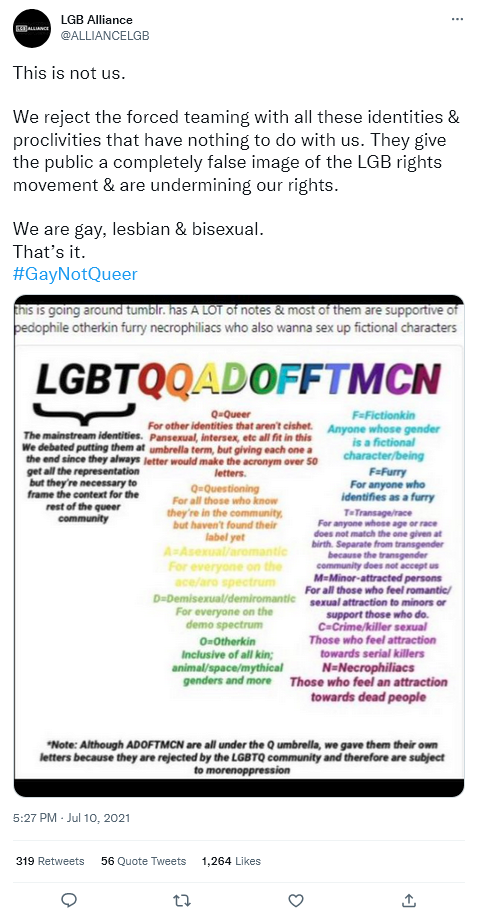
“Forced teaming”
In Quillette, Jonathan Kay provides us with our new term of the week:

Two people at EuroPride 2019 in Vienna holding an LGBTQ+ pride rainbow flag featuring a design by Daniel Quasar; this variation of the rainbow flag was initially promoted as “Progress” a PRIDE Flag Reboot.
Photo by Bojan Cvetanović via Wikimedia Commons.
I learned a new term this week: “Forced teaming“. It describes what happens when a group of people — say, gay men and lesbian women — are forbidden from breaking ranks with some larger constituency, such as (in this case) the LGBT movement.
The example I’m discussing here is one that Quillette writers have been exploring for several years now. As author Allan Stratton noted last year, the central ideological fixation of many transgender-rights activists is the negation of biological sex as a meaningful marker of human identity. The true source of sexual attraction, they will insist, isn’t the reality of sexed male and female bodies; but rather an abstract gender spirit lodged within our souls, which somehow broadcasts itself in a way that prospective romantic partners are able to sense and interpret. As Stratton notes, this mythology isn’t just flagrantly wrong. It’s also homophobic to such extent that it denies the sexually defined nature of gay identity. Moreover, this homophobic element can’t be excised from gender ideology without fatally undercutting the (typically unspoken) mission of many biologically male trans activists, since giving up this claim “would be to admit that a lesbian isn’t going to be attracted to a male body, no matter how many times she is assured that the body in question belongs to someone who identifies as a woman.”
On Wednesday, Montreal-based Substacker Eliza Mondegreen provided an eyewitness report that helps illustrate what the “forced teaming” of ideologically non-compliant LGB men and women now looks like. The Centre for Human Rights and Legal Pluralism (CHRLP) at McGill University had planned to host a January 9th talk about the tension between sex and gender identity, to be delivered by Robert Wintemute, a professor of Human Rights Law at King’s College London. According to the event page, he was to discuss “whether or not the law should be changed to make it easier for a transgender individual to change their legal sex from their birth sex, and about exceptional situations, such as women-only spaces and sports, in which the individual’s birth sex should take priority over their gender identity, regardless of their legal sex.”
Though Wintemute seems the furthest thing from a bigot (or even a conservative), he is loathed by many trans activists due to what they see as an act of unforgivable apostasy. In 2006, Wintemute co-authored something called the “Yogyakarta Principles“, an international manifesto demanding that unfettered self-identification be recognized as the one and only means of distinguishing men from women. But he later recanted, declaring that “a key factor in my change of opinion has been listening to women”. Needless to say, many of Wintemute’s former activist friends then began treating him like Lord Voldemort. And Montreal’s Gazette newspaper, echoing such denunciations, darkly warned readers that the visiting human-rights professor had “ties to LGB Alliance, an advocacy group described by various LGBTQ2+ organizations and activists as a transphobic hate group”. (In truth, the LGB Alliance is simply a British charity that, as its name suggests, signal-boosts lesbian, gay, and bisexual individuals who believe that the interests of L, G, and B are now sometimes at cross-purposes with T.)
British feminists, who by now are well used to progressive mobs shutting down speaking events in the name of trans solidarity, may guess the rough contours of what happened next. A self-described “transfeminist sapphic activist” named Celeste Trianon compared Wintemute to a “cannibal”, and announced a protest, suggesting that followers should “bring out the pitchforks”.
January 7, 2023
Propaganda to support the narrative
Chris Bray is definitely possibly most likely not kidding around here:
We can’t award the gold medal yet, because the contestants are still showing up at the starting line.
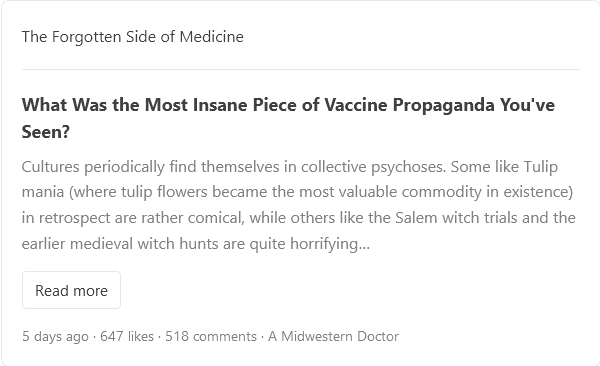
Elsewhere at Substack, A Midwestern Doctor recently highlighted some of the most egregious vaccine propaganda that appeared during the current forever-pandemic, in a piece that has the potential to safely and effectively vaccinate your mind against bullshit:
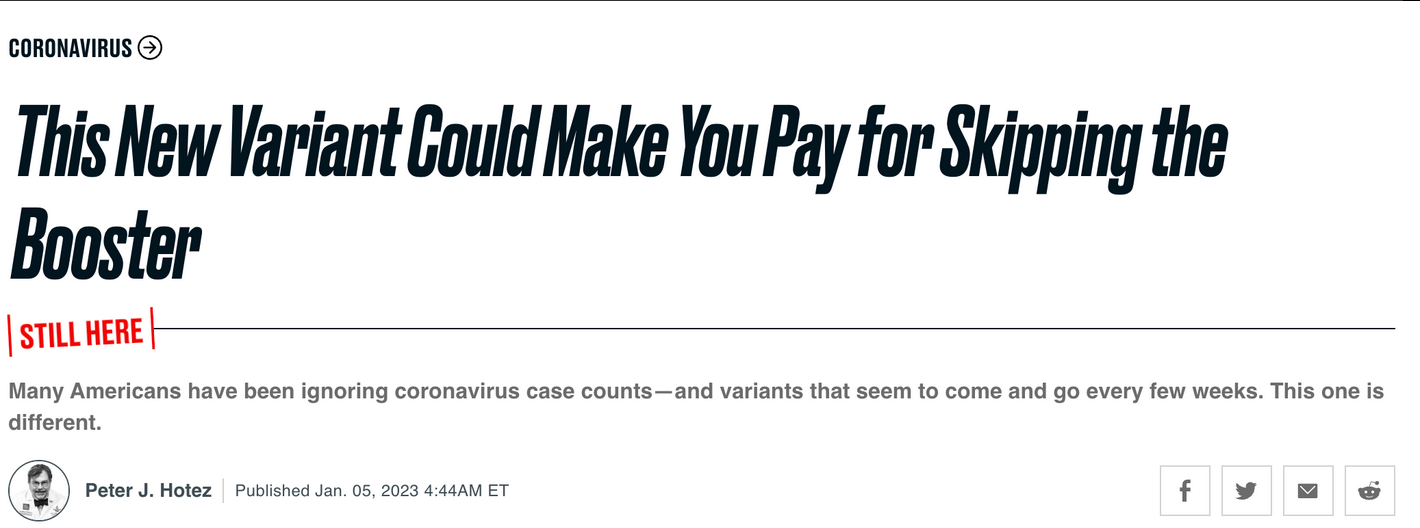
But now we need to add a new example from the current week, because Peter Hotez exists and keeps publishing. His latest piece of analysis calmly warns that the new variant is maybe possibly or not the Most Worstest Evuh, in a huge rhetorical first that tries to overcome Covid exhaustion with louder hysteria:
tHiS oNe iS diFFeReNtttttttttt&#*$*$%^#&@, Version 957,1095,397.02. Your next winter of severe illness and death will be everything you were promised in your first winter of severe illness and death, we swear. If you died last time, JUST WAIT UNTIL YOU DIE AGAIN THIS TIME, FOOL.
How can you spot propaganda? Like this, from a paragraph near the bottom of Hotez’s latest:
Unfortunately, XBB.1.5 is still too new to have clinical data in-hand to show exactly what vaccines mean in terms of warding it off. At the Texas Children’s Hospital Center for Vaccine Development, we, like other groups, are scrambling to look at our own vaccine’s effects on XBB.1.5. However, the writing is on the wall here — boosting is your best bet at protecting yourself and your loved ones.
First sentence: We have no data about this. Third sentence: The thing we have no data for is your best bet to do the thing that we have no data for.
Every claim Hotez makes is a version of this maybe-definitely-uncertainty-certainty soup, telling you he doesn’t know while telling you that he knows
December 31, 2022
If Hell is “other people”, then the deepest level of Hell must be “other high school students”
Tom Knighton on a recent post from FEE about the awfulness of the school experience for a lot of students:

“Leaside High School entrance Toronto Ontario Canada” by ammiiirrrr is licensed under CC BY-NC-SA 2.0  .
.
I was never a big fan of school. While I always thought education was important, I never liked school itself.
Part of that was because I was the kid most likely to get picked on, but even when that wasn’t happening, I still didn’t like it. Learning boring stuff while not getting to delve deeper into interesting topics just made it a chore to be endured.
Couple with the fact that cruelty is such a part of the “educational experience”, it’s no wonder that I didn’t like it.
Hell, even when everyone was being chill, the fact that I didn’t fit in did a number on me, including a time when I genuinely wanted to end my own life. I don’t talk about that kind of thing much, but it was a stark reality of that time.
[…]
Granted, I always chalked my difficulties at the time — and I’m much better now, I should note — with a number of things besides the structure of school itself. Mostly the fact that it was a small school, I was the weird kid, and while I had friends, I never felt like I really fit in.
Yet I can’t rule out that the structured nature of education at the time contributed greatly to the problem.
As noted in the original piece, the patterns for suicidal behavior in teens don’t match up with adults. That tells us that there’s something at play other than just the weather, the temperature, or whatever.
Regardless, it raises serious questions about our schools as an environment. Teachers and administrators would tell you that they strive to create a nurturing environment for students of all ages. I’m pretty sure most of them mean it, too.
Yet these studies suggest that they’re failing. Miserably.
But let’s not ignore the possibility that much of this may well be because, frankly, kids can be little sociopaths. They’re mean. They’re cruel. Someone will seek out those they perceive as weak and victimize them while others get to enjoy the show, even while being glad they’re not the target.
Then there’s the fact that it’s impossible to hide from any deficiencies you might have, including social deficiencies just as good fortune with finding romantic partners of your preferred sex and that’s going to play a role as well.
December 21, 2022
QotD: The Spoon Theory
Since then, the theory has ballooned into an illness kingdom filled with micro-celebrities offering discounts on supplements and tinctures; podcasts on dating as a spoonie; spoonie clubs on college campuses; a weekly magazine; and online stores with spoonie merch. In the past few years, spoonie-ism has dovetailed with the #MeToo movement and the ascendance of identity politics. The result is a worldview that is highly skeptical of so-called male-dominated power structures, and that insists on trusting the lived experience of individuals — especially those from groups that have historically been disbelieved. So what do spoonies need from you? “To believe; Be understanding; Be patient; To educate yourself; Show compassion; Don’t question”.
Spoonie illnesses include, but are not limited to, serious diseases like multiple sclerosis and Crohn’s disease, but also harder-to-diagnose ones that manifest differently in different people: polycystic ovary syndrome (PCOS), Rheumatoid arthritis (RA), endometriosis, postural orthostatic tachycardia syndrome (POTS), Ehlers-Danlos syndrome, dysautonomia, Guillain-Barré Syndrome, gastroparesis, and fibromyalgia. Another spoonie illness is myalgic encephalomyelitis — or chronic fatigue syndrome — which has now been linked to long Covid.
These illnesses are often “invisible”: To most people, spoonies may appear healthy and able-bodied, especially when they’re young. Many of the conditions affect women more frequently, and most are chronic illnesses that can be managed, but not cured. A diagnosis often lasts for a lifetime, while symptoms come, go, morph, and multiply.
Spoonies find community in having complicated conditions that are often hard to identify and difficult to treat. That’s why a lot of spoonies include a zebra emoji in their social media bios, borrowed from the old doctor’s adage: “When you hear hoof beats, look for horses, not zebras.” In other words: assume your patient has a more common illness, rather than a rare one.
The spoonie mantra might be: I am the zebra.
Although the term is relatively new, the spoonies fit into a long history of women having amorphous, hard-to-diagnose conditions. Since ancient times, women who were diagnosed under the general category of “hysteria” were prescribed treatments such as sex, hanging upside down, and the placement of leeches on the abdomen. Then, in the 19th century, the new field of psychoanalysis concluded that women with hysteria were not suffering from physical disorders, but mental ones. Whether the women’s inexplicable pain was a function of their brains or of their bodies — or of each other (see mass hysteria), or of the devil (see Salem, 1692) — has always been a fraught subject.
And then the internet arrived and created a 21st century version of Freud’s Vienna, in which everyone was always on the couch, perpetually the patient.
Suzy Weiss, “Hurts So Good”, Common Sense, 2022-09-06.


