
Fascinating Horror
Published Feb 23, 2021“On the 6th of December 1917 two ships collided in the mouth of Halifax Harbour in Nova Scotia, Canada …”
► Suggestions: hello@fascinatinghorror.co.uk
MUSIC:
► “Glass Pond” by Public Memory#Documentary #History #TrueStories
December 6, 2024
The Halifax Explosion | A Short Documentary | Fascinating Horror
Comments Off on The Halifax Explosion | A Short Documentary | Fascinating Horror
December 5, 2024
Mélanie Joly in Halifax, demonstrated her belief that “communication” is much more important than “action”
In The Line, Matt Gurney continues his report from the recent Halifax International Security Forum, where the Trudeau government’s representatives were Foreign Affairs Minister Mélanie Joly and Bill Blair, the Minister of National Defence:

Whoo boy. Mélanie Joly has got to go. Now. Today, if possible. Because we’ve got problems enough without, uh, well … maybe I should just explain what happened.
Joly is, of course, our foreign affairs minister. She and Bill Blair, the national defence minister, constituted the “star power” the Trudeau government sent to the Halifax International Security Forum, which I attended late last month. Joly would have, no doubt, taken part in many direct meetings with allied counterparts and various stakeholders behind closed doors during the three-day event. I can’t tell you what happened there. I can tell you, though, what happened during her public, on the record appearances. One of them in particular. And I can tell you what happened after it.
It wasn’t good.
I covered a bit of the basics about the Forum itself — what it is, who funds it, who shows up — in my last column about this year’s event, so I’ll skip the recap this time. Except for this: the event schedule is divided up into on-the-record panel discussions, off-the-record sessions (generally, those are the more interesting ones), and just lots of slack time for networking and gabbing over coffee and routinely excellent food. Joly took part in two of the on-the-record sessions. In one, she gave introductory remarks. They were about what you’d expect. The other time, she was a panelist. And that’s the one where things went wrong for Joly.
Joly was on a panel titled “Era of Unity: Victory for Ukraine”, moderated by Russian political dissident and chess grandmaster (uh oh) Garry Kasparov. Kasparov can be an aggressive moderator, and he and Joly sparred about the value of the United Nations. (I’m more of Kasparov’s view on the value of the UN, to put it mildly, but Joly more or less held her own under his questioning.) Kasparov followed up with a question about tangible support by Canada for Ukraine. He set it up as a hypothetical — he alluded to the recent re-election of Donald Trump, and noted that there are many who’d be happy to sell out Ukraine to secure some kind of peace with Russia. “Will Canada step in … will Canada play a bigger role? Canada is an important country, as you said,” Kasparov put to Joly. “When you have free time from diplomatic victories at the United Nations,” he asked, a bit mockingly, “can you help Ukraine win?”
Oh dear, I thought. This could be bad.
And it was. And then it got worse.
To Kasparov’s specific question — would Canada help Ukraine win? Would Canada step up and do more? — Joly replied at length about how much she believes in defence. And collaboration. And working together with allies. And why we need an Arctic strategy. And the value of deterrence. And the need for a stronger security architecture in the Indo-Pacific. And then some stuff about North Korean missiles. And then a nice bit about Canada’s long friendship with Ukraine. And how Canada, even though we’re smaller than the U.S., will always advocate for Ukraine at the NATO table.
I haven’t quoted directly from what the minister said. I am conscious about not wanting this entire column to become long quotes. You can see the entire exchange between Kasparov and Joly here, starting at around the 37 minute mark. What I can tell you as someone who watched it in person was that there was a real vibe shift — see, I can talk about vibes, too! — in the room as Joly spoke. Kasparov had asked a straightforward question and he’d gotten an answer that seemed as if Joly was envisioning a globe in her head, and spinning it, and just commenting on everything that came to mind as a different region came into view. Oh! There’s the Indian Ocean! Say something about the Indo-Pacific!
It was bad. Everyone in the room knew it was bad, with the possible exception of Joly.
But Joly hadn’t hit bottom yet.
Comments Off on Mélanie Joly in Halifax, demonstrated her belief that “communication” is much more important than “action”
December 4, 2024
The Korean War Week 024 – Marines Attacked at Chosin Reservoir – December 3, 1950
The Korean War by Indy Neidell
Published 3 Dec 2024On and around the frozen waters of the Chosin Reservoir, the US Marines and the Chinese Communist forces fight out a brutal battle. In the west, the Chinese offensive continues. For the UN forces, there is no chance of victory, but living to fight another day may yet be possible.
Chapters
00:00 Intro
00:48 Recap
01:11 Chosin Reservoir Prelude
03:58 Yudam-ni
06:32 Task Force Faith
08:25 Hagaru
12:58 The Aftermath of Chosin
14:49 The Tokyo Conference
15:56 Wawon and Kunu-ri
20:30 Summary
20:42 Conclusion
(more…)
Comments Off on The Korean War Week 024 – Marines Attacked at Chosin Reservoir – December 3, 1950
Admirals belatedly realize it might be useful to be able to reload those fancy missiles at sea
CDR Salamander has been banging this drum for a long, long time, but it appears that the US Navy is finally acknowledging that being able to reload the (many) Vertical Launch System (VLS) missile cells on ships somewhere other than a fully functional naval base would be more than a nice-to-have capability:
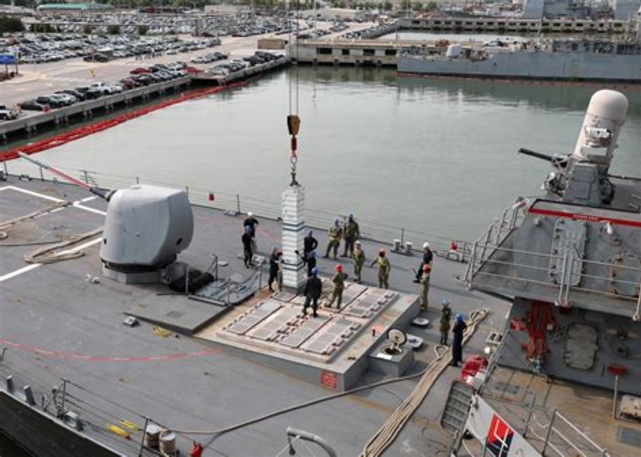
Reloading a VLS cell on a US Navy ship in port.
Photo attributed to defunct website defense-aerospace.com.
If you have made the horrible error of not reading every post here, over at the OG Blog and listening to every Midrats, then you may be new to the issue of being able to reload our warships’ VLS cells forward.
Slowly … a bit too slowly … Big Navy has decided that those people in the 1970s (who still remembered fighting a contested war at sea) might have been right all along. With SECNAV Del Toro’s encouragement, we continue to try to find a way to get the surface force a capability to reload forward.
There is plenty of room on the bandwagon and we’re glad to hoist everyone onboard the reload/rearm party-bus. If you need to catch up, the issue continues to break above the background noise, and WSJ has a very well produced article on it that requires your attention.
However, I got a little bit of an eye twitch at this pull-quote:
Until recently, the Navy didn’t feel much need for speed in rearming its biggest missile-firing warships. They only occasionally launched large numbers of Tomahawk cruise missiles or other pricey projectiles.
Now, Pentagon strategists worry that if fighting broke out in the western Pacific — potentially 5,000 miles from a secure Navy base — destroyers, cruisers and other big warships would run out of vital ammunition within days, or maybe hours.
Seeking to plug that supply gap, Del Toro tasked commanders and engineers with finding ways to reload the fleet’s launch systems at remote ports or even on the high seas. Otherwise, U.S. ships might need to sail back to bases in Hawaii or California to do so — putting them out of action for weeks.
Yes, I am going to do this, and you’re coming along for the ride.
In the name of great Neptune’s trident … THIS IS NOT A NEW REQUIREMENT!!!
My first “… shit, we need to be able to do this …” was during the DESERT FOX strikes against Iraq in 1998. I cannot remember if it were USS Stout (DDG 55) or USS Gonzalez (DDG 66) that we put Winchester on TLAM by the third day … but except for the ships we left on the other side of the Suez (who we would put to good use later), the rest of our TLAM ships and submarines were about done.
The fact we threw away an ability to reload/rearm forward was an old story inside the surface Navy when I picked it up in the last years of the previous century. We had a clunky erector set like contraption that was hard to use and took up VLS cell space, but instead of finding a better way, we just chunked the whole idea, slid in our Jesus Jones CD, and figured we had ownership of the seas until the crack of doom.
There is nothing “until recently” about this. Not to get off topic, but the real story here is why time and again this century’s senior leadership decided it was “too hard” or “too dangerous” while they were in full knowledge not just of the operational experience demanding this capability, but what we discovered over and over again in wargames.
Comments Off on Admirals belatedly realize it might be useful to be able to reload those fancy missiles at sea
December 3, 2024
Canadian Armed Forces: Can the RCN Really Stop Russia and China in the Arctic?
Esprit de Corps Canadian Military Magazine
Published 2 Dec 2024Vice Admiral Angus Topshee recently told the National Post that the Canadian Navy is able to defend our Arctic waterways against China or Russia … without help from our allies (aka the US Navy). It is time to target just what the heck the Admiral is talking about!
Comments Off on Canadian Armed Forces: Can the RCN Really Stop Russia and China in the Arctic?
Evolution of Airborne Armour
The Tank Museum
Published Jul 19, 2024Lightly armed airborne troops are at a huge disadvantage when faced with regular troops with heavy weapons and armour. In World War II this led to huge losses for paratroops on Crete and at Arnhem. Since then, many attempts have been made to level the playing field, to give airborne soldiers a fighting chance.
From the Hamilcar gliders of World War II to the C17 Globemaster, we look at how to make a tank fly.
00:00 | Intro
00:47 | The Origins of Airbourne Operations
02:34 | Gliders
07:20 | A Tank Light Enough to Fly?
09:02 | Success & Failure
14:24 | Post-War Solutions
17:41 | Better Aircraft – Better Tanks?
20:15 | Strategic Deployment
21:39 | ConclusionThis video features archive footage courtesy of British Pathé. This video features imagery courtesy of http://www.hamilcar.co.uk/
#tankmuseum
Comments Off on Evolution of Airborne Armour
December 2, 2024
“I think we’re moving out of the ‘FA’ stage into the ‘FO’ era on that one, friends”
In a rare sighting of a Matt Gurney column from The Line outside the paywall, he shares some of his thoughts after attending this year’s Halifax International Security Forum in Nova Scotia:
For those who don’t know, the “Forum”, or HISF, is an annual gathering of military leaders, defence and intelligence experts, and others whose work relates to defence and security issues, from across NATO and the Western alliance broadly. Funded by NATO, the Canadian government and private-sector sponsors, it is something of a jewel in Canada’s defence crown, a chance to bring some very powerful and influential people to a gorgeous Canadian city to wine and dine them, in hopes that they don’t realize our military is a disaster that is largely incapable of contributing to our collective defence. The agenda is always divided into a mix of free time for social networking, off-the-record chats (which are generally the most interesting) and also a series of on-the-record events that can be quoted from, and which are broadcast live online.
[…]
In our latest episode of The Line Podcast, we discussed this at length, in the context of the ICC issuing arrest warrants for Israeli prime minister Benjamin Netanyahu and his now-former defence minister. I quipped on the pod that the “rules-based international order” is a lot like the “sanctity of marriage”. It’s something we talk about as if it exists, and we’d all like it to exist, but it really doesn’t. It just doesn’t. It’s an ideal worth striving for, but not actually a thing that exists and can be counted on. The Line had also previously written about our belief that there is no rules-based international order in a prior dispatch, and then ran a counterpoint to that perspective by a reader who disagreed. It was a good counterpoint! It didn’t change my mind.
Shearer tackled the question directly, and so perfectly that I think his answer has changed my view of the situation. It hasn’t changed my opinion, but it has changed how I’m going to describe it. Here’s what Shearer said (I’ve tidied up the quote a tiny bit for clarity, but you can watch the whole thing around the 39-minute mark of this video). For context, the panel was about the so-called “CRINKS” — China, Russia, Iran and North Korea, and the challenge they are posing to the Western alliance. I’ll include Coomarasamy’s question, and then show you what Shearer said that made me go “Huh”.
Coomarasamy: Are we in a world now where we can’t really talk about a rules-based international order, but two separate, competing ones?
Shearer: That’s a big question. I think the rules-based order, frankly, turns out to have been, in hindsight, a power-based order. It was unchallenged U.S. military power that made possible the liberal order of the last 50 years. With all its benefits for so many countries. Was the U.S. always a perfect hegemon within that system? Occasionally not. It would shift its weight around, and there were consequences from that. But overall, it worked because the United States was a relatively benign hegemon.
That’s it. That’s exactly it. That’s exactly what I have intuitively felt in the last few years, and haven’t done a good enough job explaining. I grasped it in a big-picture intellectual sense, but I hadn’t been able to shrink it down into a single sentence like that. When Shearer said that the rules-based order was, actually, a U.S. military power-based order, it clicked in my brain. That’s the way to articulate it.
For the last few decades, we thought we were living in a rules-based-international order, and planned our lives around that. But what we were actually living in was a global order led by a relatively benign global superpower and preserved by its astonishing military power.
And that world is ending.
Comments Off on “I think we’re moving out of the ‘FA’ stage into the ‘FO’ era on that one, friends”
USS Constitution – “Old Ironsides” – 1950’s newsreel
Charlie Dean Archives
Published Jan 1, 2014USS Constitution is a wooden-hulled, three-masted heavy frigate of the United States Navy. Named by President George Washington after the Constitution of the United States of America, she is the world’s oldest floating commissioned naval vessel. Launched in 1797, Constitution was one of six original frigates authorized for construction by the Naval Act of 1794. Joshua Humphreys designed the frigates to be the young Navy’s capital ships, and so Constitution and her sisters were larger and more heavily armed and built than standard frigates of the period. Built in Boston, Massachusetts at Edmund Hartt’s shipyard, her first duties with the newly formed United States Navy were to provide protection for American merchant shipping during the Quasi-War with France and to defeat the Barbary pirates in the First Barbary War.
Source: http://en.wikipedia.org/wiki/USS_Cons…
CharlieDeanArchives – Archive footage from the 20th century making history come alive!
Comments Off on USS Constitution – “Old Ironsides” – 1950’s newsreel
December 1, 2024
“Huntziger must be shot!” – WW2 Commentary 1939-1940
World War Two
Published 30 Nov 2024Today Indy and Spartacus sit down to answer all kinds of questions about the first year of WW2. How phony was the Phony War? How do you go around the Maginot Line? And much more! Also, Indy sings a song about Charles Huntziger.
(more…)
Comments Off on “Huntziger must be shot!” – WW2 Commentary 1939-1940
November 30, 2024
Forgotten War Ep 5 – Chindits 2 – The Empire Strikes
HardThrasher
Published 29 Nov 202402:00 – Here We Go Again
06:36 – Perfect Planning
13:16 – Death of a Prophet
14:51 – The Fly In
18:56 – Dazed and Confused (in the Monsoon)
20:40 – Can’t Fly in This
31:54 – Survivor’s ClubPlease consider donations of any size to the Burma Star Memorial Fund who aim to ensure remembrance of those who fought with, in and against 14th Army 1941–1945 — https://burmastarmemorial.org/
(more…)
Comments Off on Forgotten War Ep 5 – Chindits 2 – The Empire Strikes
$7 BILLION – Is Ajax Worth It? | Tank Chats #177
The Tank Museum
Published Aug 2, 2024This is how the UK’s newest armoured fighting vehicle, Ajax, has been described time and time again by the British media. With repeated delays and continual bad press, the Ajax programme has been subject to much scrutiny over the course of its procurement and development. Public opinion of this vehicle is, in a word, poor.
But is this perception wholly accurate, or is there more to the Ajax story?
In this video, David Willey guides us through the problematic history of the Ajax family, discusses its reconnaissance capabilities on the modern battlefield and hears from members of the British Army who have had a chance to put this vehicle to the test.
Comments Off on $7 BILLION – Is Ajax Worth It? | Tank Chats #177
November 29, 2024
Why the Communists subjugated half of Europe
World War Two
Published 28 Nov 2024From the Bolshevik Revolution to post-war dominance, Stalin’s plans forever changed Europe’s political landscape. Discover how the Soviet Union used ideology, diplomacy, military power, and ruthless suppression to control Eastern Europe and establish a new world order.
(more…)
Comments Off on Why the Communists subjugated half of Europe
November 28, 2024
Town-class destroyers – Guide 400
Drachinifel
Published Aug 3, 2024The Town class destroyers, old Wickes, Clemson and Cadwell class vessels of the US Navy, transferred to the British Royal Navy and others, are today’s subject.
(more…)
Comments Off on Town-class destroyers – Guide 400
QotD: The trace italienne in fortification design
Now I should note that the initial response in Italy to the shocking appearance of effective siege artillery was not to immediately devise an almost entirely new system of fortifications from first principles, but rather – as you might imagine – to hastily retrofit old fortresses. But […] we’re going to focus on the eventual new system of fortresses which emerge, with the first mature examples appearing around the first decades of the 1500s in Italy. This system of European gunpowder fort that spreads throughout much of Europe and into the by-this-point expanding European imperial holdings abroad (albeit more unevenly there) goes by a few names: “bastion” fort (functional, for reasons we’ll get to in a moment), “star fort” (marvelously descriptive), and the trace italienne or “the Italian line”. since that was where it was from.
Since the goal remains preventing an enemy from entering a place, be that a city or a fortress, the first step has to be to develop a wall that can’t simply be demolished by artillery in a good afternoon or two. The solution that is come upon ends up looking a lot like those Chinese rammed earth walls: earthworks are very good at absorbing the impact of cannon balls (which, remember, are at this point just that: stone and metal balls; they do not explode yet): small air pockets absorb some of the energy of impact and dirt doesn’t shatter, it just displaces (and not very far: again, no high explosive shells, so nothing to blow up the earthwork). Facing an earthwork mound with stonework lets the earth absorb the impacts while giving your wall a good, climb-resistant face.
So you have your form: a stonework or brick-faced wall that is backed up by essentially a thick earthen berm like the Roman agger. Now you want to make sure incoming cannon balls aren’t striking it dead on: you want to literally play the angles. Inclining the wall slightly makes its construction easier and the end result more stable (because earthworks tend not to stand straight up) and gives you an non-perpendicular angle of impact from cannon when they’re firing at very short range (and thus at very low trajectory), which is when they are most dangerous since that’s when they’ll have the most energy in impact. Ideally, you’ll want more angles than this, but we’ll get to that in a moment.
Because we now have a problem: escalade. Remember escalade?
Earthworks need to be wide at the base to support a meaningful amount of height, tall-and-thin isn’t an option. Which means that in building these cannon resistant walls, for a given amount of labor and resources and a given wall circuit, we’re going to end up with substantially lower walls. We can enhance their relative height with a ditch several out in front (and we will), but that doesn’t change the fact that our walls are lower and also that they now incline backwards slightly, which makes them easier to scale or get ladders on. But obviously we can’t achieved much if we’ve rendered our walls safe from bombardment only to have them taken by escalade. We need some way to stop people just climbing over the wall.
The solution here is firepower. Whereas a castle was designed under the assumption the enemy would reach the foot of the wall (and then have their escalade defeated), if our defenders can develop enough fire, both against approaching enemies and also against any enemy that reaches the wall, they can prohibit escalade. And good news: gunpowder has, by this point, delivered much more lethal anti-personnel weapons, in the form of lighter cannon but also in the form of muskets and arquebuses. At close range, those weapons were powerful enough to defeat any shield or armor a man could carry, meaning that enemies at close range trying to approach the wall, set up ladders and scale would be extremely vulnerable: in practice, if you could get enough muskets and small cannon firing at them, they wouldn’t even be able to make the attempt.
But the old projecting tower of the castle, you will recall, was designed to allow only a handful of defenders fire down any given section of wall; we still want that good enfilade fire effect, but we need a lot more space to get enough muskets up there to develop that fire. The solution: the bastion. A bastion was an often diamond or triangular-shaped projection from the wall of the fort, which provided a longer stretch of protected wall which could fire down the length of the curtain wall. It consists of two “flanks” which meet the curtain wall and are perpendicular to it, allowing fire along the wall; the “faces” (also two) then face outward, away from the fort to direct fire at distant besiegers. When places at the corners of forts, this setup tends to produce outward-spiked diamonds, while a bastion set along a flat face of curtain wall tends to resemble an irregular pentagon (“home plate”) shape [Wiki]. The added benefit for these angles? From the enemy siege lines, they present an oblique profile to enemy artillery, making the bastions quite hard to batter down with cannon, since shots will tend to ricochet off of the slanted line.
In the simplest trace italienne forts [Wiki], this is all you will need: four or five thick-and-low curtain walls to make the shape, plus a bastion at each corner (also thick-and-low, sometimes hollow, sometimes all at the height of the wall-walk), with a dry moat (read: big ditch) running the perimeter to slow down attackers, increase the effective height of the wall and shield the base of the curtain wall from artillery fire.
But why stay simple, there’s so much more we can do! First of all, our enemy, we assume, have cannon. Probably lots of cannon. And while our walls are now cannon resistant, they’re not cannon immune; pound on them long enough and there will be a breach. Of course collapsing a bastion is both hard (because it is angled) and doesn’t produce a breach, but the curtain walls both have to run perpendicular to the enemy’s firing position (because they have to enclose something) and if breached will allow access to the fort. We have to protect them! Of course one option is to protect them with fire, which is why our bastions have faces; note above how while the flanks of the bastions are designed for small arms, the faces are built with cannon in mind: this is for counter-battery fire against a besieger, to silence his cannon and protect the curtain wall. But our besieger wouldn’t be here if they didn’t think they could decisively outshoot our defensive guns.
But we can protect the curtain further, and further complicate the attack with outworks [Wiki], effectively little mini-bastions projecting off of the main wall which both provide advanced firing positions (which do not provide access to the fort and so which can be safely abandoned if necessary) and physically obstruct the curtain wall itself from enemy fire. The most basic of these was a ravelin (also called a “demi-lune”), which was essentially a “flying” bastion – a triangular earthwork set out from the walls. Ravelins are almost always hollow (that is, the walls only face away from the fort), so that if attackers were to seize a ravelin, they’d have no cover from fire coming from the main bastions and the curtain wall.
And now, unlike the Modern Major-General, you know what is meant by a ravelin … but are you still, in matters vegetable, animal and mineral, the very model of a modern Major-General?
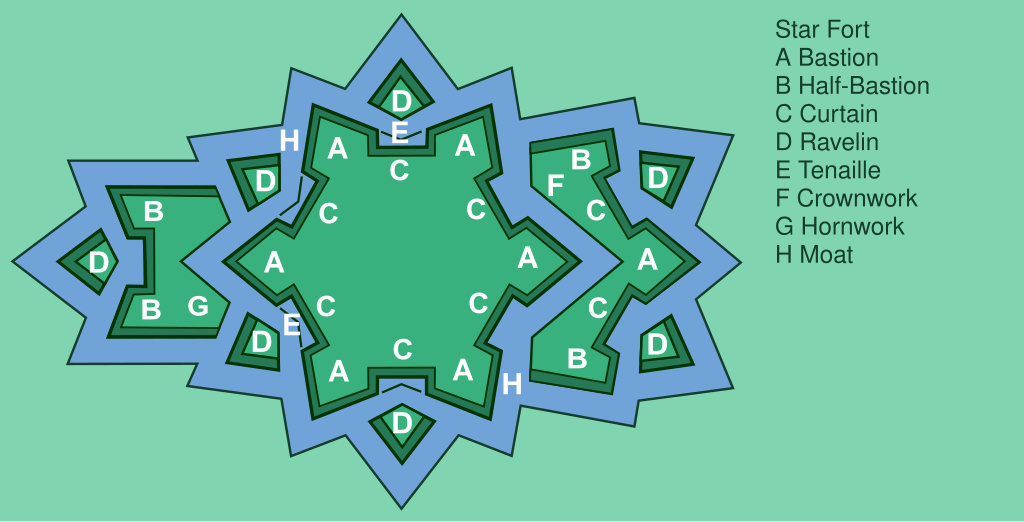
But we can take this even further (can you tell I just love these damn forts?). A big part of our defense is developing fire from our bastions with our own cannon to force back enemy artillery. But our bastions are potentially vulnerable themselves; our ravelins cover their flanks, but the bastion faces could be battered down. We need some way to prevent the enemy from aiming effective fire at the base of our bastion. The solution? A crownwork. Essentially a super-ravelin, the crownwork contains a full bastion at its center (but lower than our main bastion, so we can fire over it), along with two half-bastions (called, wait for it, “demi-bastions”) to provide a ton of enfilade fire along the curtain wall, physically shielding our bastion from fire and giving us a forward fighting position we can use to protect our big guns up in the bastion. A smaller version of the crownwork, called a hornwork can also be used: this is just the two half-bastions with the full bastion removed, often used to shield ravelins (so you have a hornwork shielding a ravelin shielding the curtain wall shielding the fort). For good measure, we can connect these outworks to the main fort with removable little wooden bridges so we can easily move from the main fort out to the outworks, but if the enemy takes an outwork, we can quickly cut it off and – because the outworks are all made hollow – shoot down the attackers who cannot take cover within the hollow shape.
An ideal form of a bastion fortress to show each kind of common work and outwork.
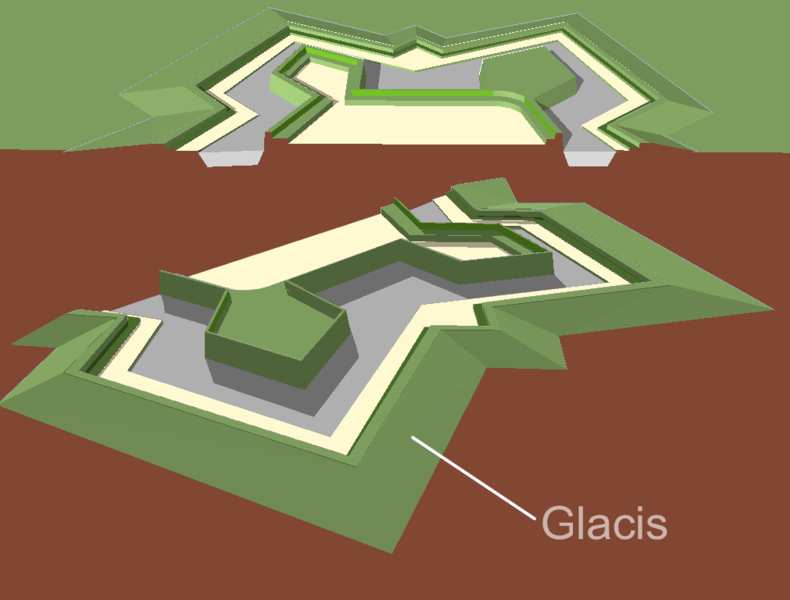
Drawing by Francis Lima via Wikimedia Commons.We can also do some work with the moat. By adding an earthwork directly in front of it, which arcs slightly uphill, called a glacis, we can both put the enemy at an angle where shots from our wall will run parallel to the ground, thus exposing the attackers further as they advance, and create a position for our own troops to come out of the fort and fire from further forward, by having them crouch in the moat behind the glacis. Indeed, having prepared, covered forward positions (which are designed to be entirely open to the fort) for firing from at defenders is extremely handy, so we could even put such firing positions – set up in these same, carefully mathematically calculated angle shapes, but much lower to the ground – out in front of the glacis; these get all sorts of names: a counterguard or couvreface if they’re a simple triangle-shape, a redan if they have something closer to a shallow bastion shape, and a flèche if they have a sharper, more pronounced face. Thus as an enemy advances, defending skirmishers can first fire from the redans and flèches, before falling back to fire from the glacis while the main garrison fires over their heads into the enemy from the bastions and outworks themselves.
A diagram showing a glacis supporting a pair of bastions, one hollow, one not.
Diagram by Arch via Wikimedia Commons.At the same time, a bastion fortress complex might connect multiple complete circuits. In some cases, an entire bastion fort might be placed within the first, merely elevated above it (the term for this is a “cavalier“) so that both could fire, one over the other. Alternately, when entire cities were enclosed in these fortification systems (and that was common along the fracture zones between the emerging European great powers), something as large as a city might require an extensive fortress system, with bastions and outworks running the whole perimeter of the city, sometimes with nearly complete bastion fortresses placed within the network as citadels.
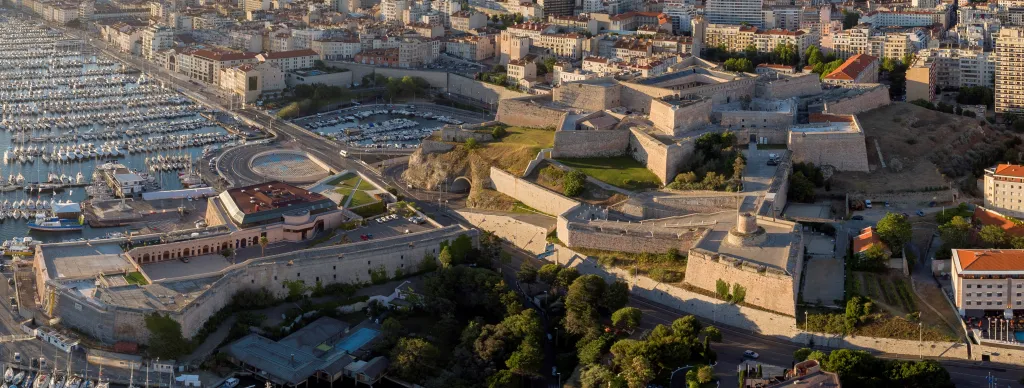
Fort Saint-Nicolas, which dominates the Old Port of Marseille. The fort forms part of a system with the low outwork you see here and also an older refitted castle, Fort Saint-Jean, on the other side of the harbor.
Photo via Wikimedia Commons.All of this geometry needed to be carefully laid out to ensure that all lines of approach were covered with as much fire as possible and that there were no blindspots along the wall. That in turn meant that the designers of these fortresses needed to be careful with their layout: the spacing, angles and lines all needed to be right, which required quite a lot of math and geometry to manage. Combined with the increasing importance of ballistics for calculating artillery trajectories, this led to an increasing emphasis on mathematics in the “science of warfare”, to the point that some military theorists began to argue (particularly as one pushes into the Enlightenment with its emphasis on the power of reason, logic and empirical investigation to answer all questions) that military affairs could be reduced to pure calculation, a “hard science” as it were, a point which Clausewitz (drink!) goes out of his way to dismiss (as does Ardant du Picq in Battle Studies, but at substantially greater length). But it isn’t hard to see how, in the heady centuries between 1500 and 1800 how the rapid way that science had revolutionized war and reduced activities once governed by tradition and habit to exercises in geometry, one might look forward and assume that trend would continue until the whole affair of war could be reduced to a set of theorems and postulates. It cannot be, of course – the problem is the human element (though the military training of those centuries worked hard to try to turn men into “mechanical soldiers” who could be expected to perform their role with the same neat mathmatical precision of a trace italienne ravelin). Nevertheless this tension – between the science of war and its art – was not new (it dates back at least as far as Hellenistic military manuals) nor is it yet settled.
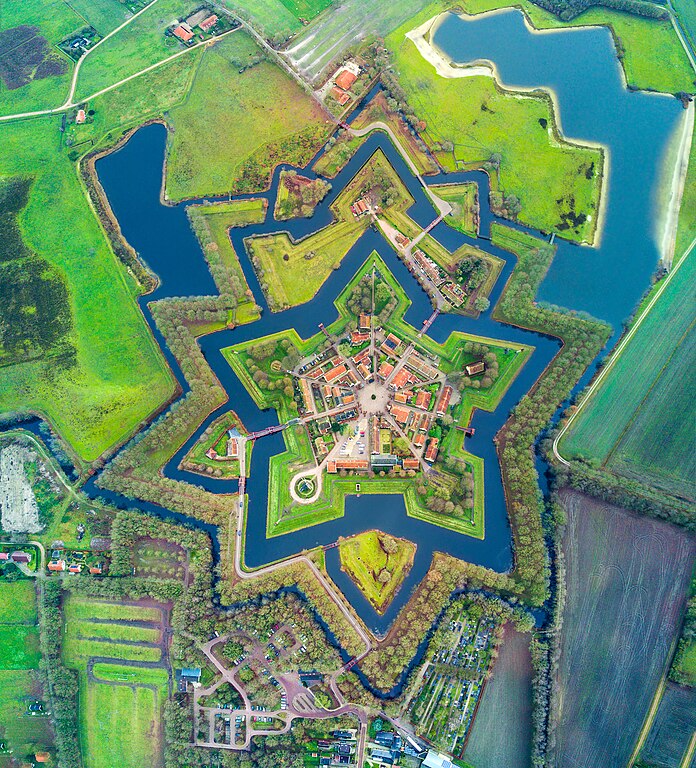
An aerial view of the Bourtange Fortress in Groningen, Netherlands. Built in 1593, the fort has been restored to its 1750s configuration, seen here.
Photo by Dack9 via Wikimedia Commons.But coming back to our fancy forts, of course such fortresses required larger and larger garrisons to fire all of the muskets and cannon that their firepower oriented defense plans required. Fortunately for the fortress designers, state capacity in Europe was rising rapidly and so larger and larger armies were ready to hand. That causes all sorts of other knock on effects we’re not directly concerned with here (but see the bibliography at the top). For us, the more immediate problem is, well, now we’ve built one of these things … how on earth does one besiege it?
Bret Devereaux, “Collections: Fortification, Part IV: French Guns and Italian Lines”, A Collection of Unmitigated Pedantry, 2021-12-17.
Comments Off on QotD: The trace italienne in fortification design
November 27, 2024
Trump’s plan to dismiss transgender troops will apparently “gut” the US military
As if the US military services hadn’t suffered enough from their own government, it’s now being widely asserted in the media that Trump’s declared plan to get rid of all current transgender service members will be a desperately hard blow to an already over-stressed military structure:
The news media is calmly warning that Donald Trump is planning to ban transgender servicemembers from the American military, which will absolutely gut the armed forces.
Sample claim, from Newsweek, quoting the leader of an LGBT advocacy nonprofit:
Abruptly discharging 15,000-plus service members, especially given that the military’s recruiting targets fell short by 41,000 recruits last year, adds administrative burdens to war fighting units.
There would be a significant financial cost, as well as a loss of experience and leadership that will take possibly 20 years and billions of dollars to replace.
We’ll practically have no military left! It would be like a whole infantry division suddenly just vanishing: 15,000-plus transgendered service members.
You’re going to see this number a lot in the weeks ahead. The New Republic, today: “Donald Trump’s plan to ban transgender people from the military would have a devastating effect: At least 15,000 members would be forced to leave.”
That number comes from a 2018 report by the now-defunct Palm Center, a pro-LGBT independent research institute in California, which reached this conclusion: “Transgender troops make up 0.7% (seven-tenths of one percent) of the military (Active Component and Selected Reserve)”. Their best guess about a total number: 14,707. The media is just rounding that number up to the next thousand.
The Palm Center … extrapolated a lot, let’s say, in good part by multiplying their guess about a percentage, derived from a grossly inadequate survey of a select number of active duty troops, times the total number of servicemembers. Page 4:
Assuming that the distribution of transgender men and women is roughly equivalent in the Active and Selected Reserve Components, it is possible to derive an estimate of the number of transgender troops in the Selected Reserve as follows. The number of transgender women is .0066 x 652,623 = 4,307 and the number of transgender men is .0091 x 156,080 = 1,420. The total number of transgender members of the Selected Reserve is 4,307 + 1,420 = 5,727. And, the total number of transgender troops is 8,980 (active) + 5,727 (reserve) = 14,707.
Assuming the distribution, it is possible to derive an estimate. That’s the basis of the 15,000 number that you’ll see in news stories. Remember that language.
Similarly, a 2016 RAND study offered these findings (among others), and note the remarkable thing that happens between the first and second paragraph:
It is difficult to estimate the number of transgender personnel in the military due to current policies and a lack of empirical data. Applying a range of prevalence estimates, combining data from multiple surveys, and adjusting for the male/female distribution in the military provided a midrange estimate of around 2,450 transgender personnel in the active component (out of a total number of approximately 1.3 million active-component service members) and 1,510 in the Selected Reserve.
Only a subset will seek gender transition–related treatment. Estimates derived from survey data and private health insurance claims data indicate that, each year, between 29 and 129 service members in the active component will seek transition-related care that could disrupt their ability to deploy.
So studies indicate that there are 3,960 transgendered servicemembers, and also that there are 14,707 transgendered servicemembers, and “between 29 and 129 service members in the active component” who will actively seek gender transition services in a typical year.
So it’s definitely somewhere between 29 and 15,000.

Comments Off on Trump’s plan to dismiss transgender troops will apparently “gut” the US military


