
The Korean War by Indy Neidell
Published 26 Nov 2024Thanksgiving 1950 comes and goes in the snowy north of Korea, and Eighth Army’s push to the Yalu River begins the following day. It soon becomes apparent, though, that the Communist Chinese are ready and waiting for them, in numbers greater than anyone on the UN side have predicted. After weeks of preamble and preparation, the two forces finally collide in full strength.
Chapters
00:00 Intro
00:51 Recap
01:16 X Corps
03:14 Turkey Time
05:50 The US Offensive
09:05 The Second Phase Offensive
12:39 East Flank Disaster
15:27 Summary
15:47 Conclusion
(more…)
November 27, 2024
The Korean War 023 – The Eagle Versus the Dragon – November 26, 1950
Comments Off on The Korean War 023 – The Eagle Versus the Dragon – November 26, 1950
November 26, 2024
The ghost airport of Nicosia: Rare glimpse inside the abandoned 1974 battleground
Forces News
Published Jul 20, 2024Nicosia International Airport was once a busy hub full of holidaymakers but since the Cyprus conflict of 1974, it has been frozen in time.
Today, the disused airport resembles a ghost town as it sits abandoned in the 180km buffer zone dividing the Republic of Cyprus and the Turkish-occupied north.
On the 50th anniversary of the conflict, Forces News goes inside the eerie airport and learns how it became the site of a major battle.
(more…)
Comments Off on The ghost airport of Nicosia: Rare glimpse inside the abandoned 1974 battleground
November 25, 2024
The Experimental SOE Welrod MkI Prototype
Forgotten Weapons
Published Aug 12, 2024The Welrod was a program to develop a silent assassination pistol for British SOE (Special Operations Executive) late in 1942. It needed to be chambered in the .32 ACP cartridge, be effective to a range of 15m, and have its firing not recognizable as a firearm at 50m distance. The project was led by Major Hugh Quentin Reeves, who developed much of SOE’s inventory of gadgets.
The Welrod concept was ready in January 1943, and it was not quite the Welrod that we recognize today. This initial MkI design used a fixed internal 5-round magazine and a thumb trigger, along with a rifle style bolt action mechanism. Samples were produced in April 1943, and testing showed that it was rather awkward to use. A MkII version was quickly developed in June 1943 with a more traditional style of grip and magazine, and formal trials led to the adoption of that MkII design. Incidentally, this is why the first Welrod produced was the MkII, and the later production version in 9mm was designated the MkI (it was the first mark of 9mm Welrod).
Eventually many thousands of Welrod pistols were manufactured, and they almost certainly remain in limited use to this day. This example we have today is the only surviving MkI example, however.
(more…)
Comments Off on The Experimental SOE Welrod MkI Prototype
November 24, 2024
“… if Russia were found to have had its own troops assemble a long-range missile and help launch it into the United States, do you think a US president would feel able to let it slide?”
It probably tightened a lot of already tight sphincters when it was announced that President Biden had authorized the Ukrainian government to use US-supplied long-range missiles to attack targets on Russian soil:
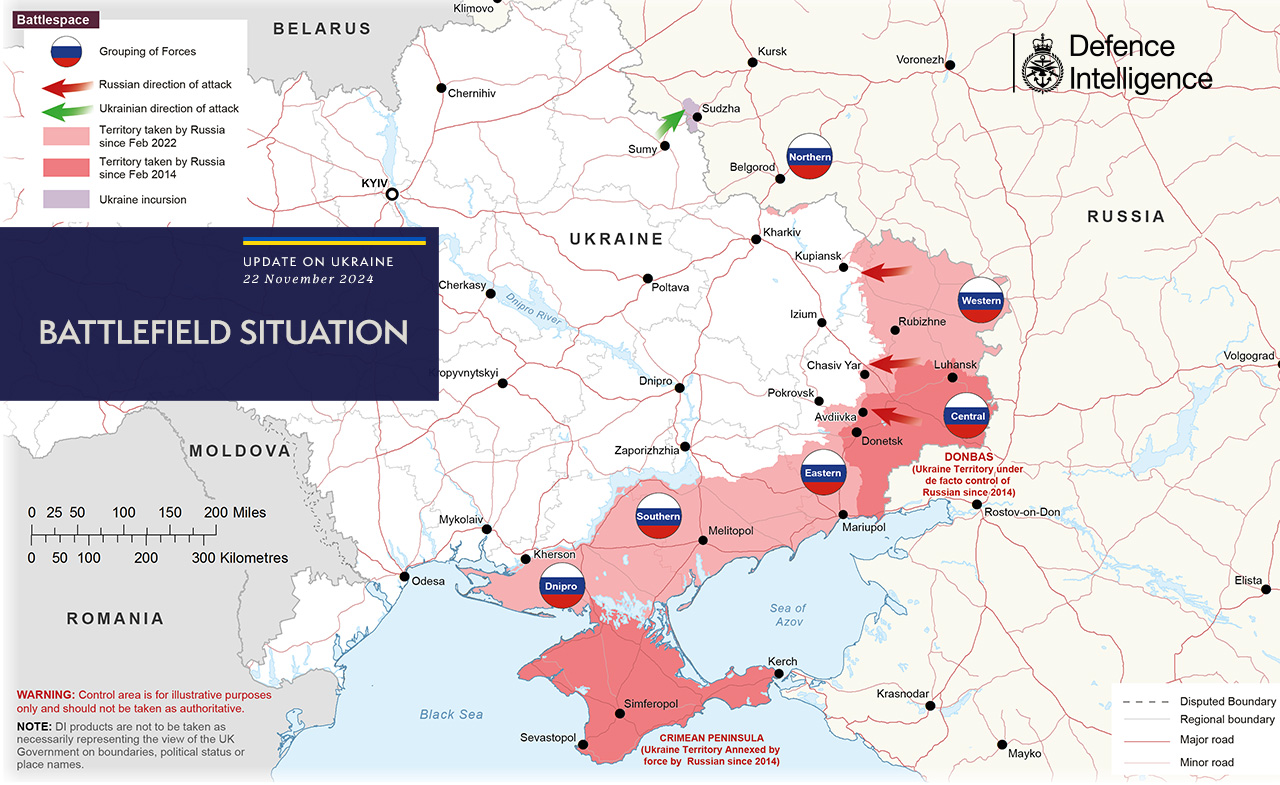
There was something truly surreal about President Biden suddenly changing course and agreeing to give Ukraine advanced long-range missiles to attack deep inside Russian territory in the last two months of his administration. There was no speech to the nation; no debate in the Senate; just a quiet demonstration of unilateral presidential fuck-you power. You know: the kind we’ve long worried about with Donald Trump. The missiles up the ante considerably against a nuclear power for a simple reason. As Putin noted:
experts are well aware, and the Russian side has repeatedly emphasized this, that it is it is impossible to use such weapons without the direct involvement of military specialists of the countries producing such weapons.
The tiny tsar continued:
We consider ourselves entitled to use our weapons against the military facilities of those countries that allow to use their weapons against our facilities. And in case of escalation of aggressive actions we will respond also decisively and mirrored.
And he looked on edge, bedraggled and belligerent, his arms and hands not moving a millimeter in what sure looks like AI.
There was a time when a NATO missile strike on Russian territory, followed by a Russian threat to attack NATO “military facilities” in response, would have caused the world to stop dead, paralyzed by the fear of nuclear armageddon. Yet here we are, blithely preoccupied by Pete Hegseth’s sexual exploits and Congressional bathrooms.
Others are not so sanguine. “I believe that in 2024 we can absolutely believe that the Third World War has begun,” Ukraine’s former military chief, Valery Zaluzhny, warned yesterday, noting both the new involvement of NATO troops and the involvement of North Korea. Our own president, having brought us much closer to the brink as a lame duck, seemed unconcerned. He was last seen wandering off-stage in the vague direction of the Brazilian rainforest. Not optimal.
The UK prime minister, Keir Starmer, was even punchier, and pledged to allow Ukraine to use British long-range missiles as well: “We need to double down. We need to make sure Ukraine has what is necessary for as long as necessary, because we cannot allow Putin to win this war”. When asked if he was prepared to risk the UK forces or Ukraine or a third country like Poland being nuked in response, as Putin has threatened, Starmer simply ignored the question.
Meanwhile, just to keep things from escalating, the deputy chief of the British defense staff told a parliamentary committee yesterday:
If the British Army was asked to fight tonight, it would fight tonight. I don’t think anybody in this room should be under any illusion that if the Russians invaded Eastern Europe tonight, then we would meet them in that fight.
There seems to be a general impression that Putin is of course bluffing, that NATO can keep lobbing missiles into Russian territory with minimal consequences, and nothing could possibly go wrong.
But Putin has responded by launching a long-range missile that could be used to carry a nuke but didn’t, as well as lowering the bar for the use of nukes in his military “doctrine“. And ask yourself: if Russia were found to have had its own troops assemble a long-range missile and help launch it into the United States, do you think a US president would feel able to let it slide? Here’s what the British missile, the Storm Shadow, did in hitting an underground military facility in Kursk, according to unverified Russia media sources:
[The strike] resulted in the Death of 18 Russian Officers, including a Senior Commander, as well as 3 North Korean Officers. In addition, a Dozen other Soldiers and Officers were Wounded in the Attack, including one of North Korea’s most Senior Generals.
I can’t verify that, but it’s perfectly possible. To have NATO’s fingers on the targeting and launch of that missile puts us in a whole new category of conflict.
The job of a president is to keep us far, far away from any risk of nuclear conflict, as Biden seemed to understand until now. And any student of history will know that blithe complacency as two sides trade military escalations is often exactly the precursor to something going very, very wrong. Accidents happen; misjudgments occur; the point of never getting to this point is that this point contains a host of unknowables, some of them globally existential.
I assume that this is all about strengthening Kyiv’s hand in what will be grueling negotiations to end the conflict once Donald Trump gets back into office. Or the intelligence is worse than we know and it’s about avoiding an Ukraine collapse before Biden leaves office — which, after Afghanistan, would be a final, damning verdict on his foreign policy. Or the intelligence is better than we know and the Russian economy is so weak and his military so depleted that NATO thinks this extra pressure will force Putin to crack. Or it’s a norm-defying attempt from an outgoing administration to derail any peace process the incoming one might want to start. The latter possibility — with Biden rolling the dice because he thinks someone else will have to face the music — is not a minimal risk.
How Allied and Nazi Generals Created the Clean Wehrmacht Myth
World War Two
Published 23 Nov 2024After the fall of the Third Reich, many of Hitler’s generals are convicted as war criminals by the Allies and condemned to prison and disgrace. Yet, within a few years, the Western Powers embrace them Cold War partners against the Soviet Union. In this new alliance, they rewrite history and create the enduring myth of the “clean Wehrmacht“.
(more…)
Comments Off on How Allied and Nazi Generals Created the Clean Wehrmacht Myth
November 22, 2024
Kalthoff 30-Shot Flintlock: The First Repeating Firearm Used in War (1659)
Forgotten Weapons
Published Aug 7, 2024The first repeating rifle used in combat by a military force was a flintlock system developed by the Kalthoff brothers. It was adopted in the 1640s by the Danish Royal Guard, who purchased a bit more than 100 of the guns, and used them successfully in the Siege of Copenhagen in 1659. The Kalthoff is a .54 caliber flintlock rifle with a magazine of 30 balls under the barrel and a powder storage compartment in the buttstock. A lever under the action is rotated forward 180 degrees and then back to completely reload the rifle — this action loads a ball into the chamber, seats it fully in place, loads powder behind it, primes the pan, cocks the hammer, and closes the frizzen. This was an amazing amount of firepower in the mid-1600s, and the mechanism in the gun is brilliant.
The Kalthoff brothers (Peter, Mathias, Caspar, Henrik, and William) spread out across Europe working for many royal courts although it was in Denmark where their gun saw the most substantial military use. The system would lead to other repeating flintlock designs like the Lorenzoni, but these did not really meet the quality of the original Kalthoffs (in my opinion). However, the system was very expensive to make and rather fragile to use. By 1696 the Danes had taken them out of service in favor of simpler and more durable designs. Kalthoffs today are very, very rare, and it was an incredible privilege to be able to take this one apart to show to you. Many thanks to Jan, its owner, for letting me do that!
(more…)
Comments Off on Kalthoff 30-Shot Flintlock: The First Repeating Firearm Used in War (1659)
QotD: Pre-modern armies on the move
Armies generally had to move over longer distances via roads, for both logistical and pathfinding reasons. For logistics, while unencumbered humans can easily clamber over fences or small ridges or weave through forests, humans carrying heavy loads struggle to do this and pack animals absolutely cannot. Dense forests (especially old growth forests) are formidable obstacles for pack and draft animals, with a real risk of animals injuring themselves with unlucky footfalls. After all the donkey was originally a desert/savannah creature and horses evolved on the Eurasian Steppe; dense forest is a difficult, foreign terrain. But the rural terrain that would dominate most flat, arable land was little better: fields are often split by fences or hedgerows which need to be laboriously cleared (essentially making a path) to allow the work animals through. Adding wagons limits this further; pack mules can make use of narrow paths through forests or hills, but wagons pulled by draft animals require proper roads wide enough to accommodate them, flat enough that the heavy wagon doesn’t slide back and with a surface that will be at least somewhat kind on the wheels. That in turn in many cases restricts armies to significant roadways, ruling out things like farmer’s paths between fields or small informal roads between villages, though smaller screening, scouting or foraging forces could take these side roads.
(As an aside: one my enduring frustrations is the tendency of pre-modern strategy games to represent most flat areas as “plains” of grassland often with a separate “farmland” terrain type used only in areas of very dense settlement. But around most of the Mediterranean, most of the flat, cleared land at lower elevations would have been farmland, with all of the obstructions and complications that implies; rolling grasslands tend to be just that – uplands too hilly for farming.)
The other problem is pathfinding and geolocation. Figuring out where you off-road overland with just a (highly detailed) map and a compass is sufficiently difficult that it is a sport (Orienteering). Prior to 1300, armies in the broader Mediterranean world were likely to lack both; the compass (invented in China) arrives in the Mediterranean in the 1300s and detailed topographical maps of the sort that hikers today might rely on remained rare deep into the modern period, especially maps of large areas. Consequently it could be tricky to determine an army’s exact heading (sun position could give something approximate, of course) or position. Getting lost in unfamiliar territory was thus a very real hazard. Indeed, getting lost in familiar territory was a real hazard: Suetonius records that Julius Caesar, having encamped not far from the Rubicon got lost trying to find it, spent a whole night wandering trying to locate it (his goal being to make the politically decisive crossing with just a few close supporters in secrecy first before his army crossed). In the end he had to find a local guide to work his way back to it in the morning (Suet. Caes. 31.2). So to be clear: famed military genius Julius Caesar got lost trying to find a 50 mile long river only about 150 miles away from Rome when he tried to cut cross-country instead of over the roads.
Instead, armies relied on locals guides (be they friendly, bought or coerced) to help them find their way or figure out where they were on whatever maps they could get together. Locals in turn tend to navigate by landmarks and so are likely to guide the army along the paths and roads they themselves use to travel around the region. Which is all as well because the army needs to use the roads anyway and no one wants to get lost. The road and path network thus becomes a vital navigational aid: roads and paths both lead to settlements full of potential guides (to the next settlement) and because roads tend to connect large settlements and large settlements tend to be the objectives of military campaigns, the road system “points the way”. Consequently, armies rarely strayed off of the road network and were in most cases effectively confined to it. Small parties might be sent out off of the road network from the main body, but the main body was “stuck” on the roads.
That means the general does not have to cope with an infinitely wide range of maneuver possibilities but a spiderweb of possible pathways. Small, “flying columns” without heavy baggage could use minor roads and pathways, but the main body of the army was likely to be confined to well-traveled routes connecting large settlements.
Bret Devereaux, “Collections: Logistics, How Did They Do It, Part III: On the move”, A Collection of Unmitigated Pedantry, 2022-08-12.
Comments Off on QotD: Pre-modern armies on the move
November 21, 2024
Canadian defence priorities – don’t listen to what they say, watch what they spend the money on
The Hub provides an edited transcript of what retired Lieutenant General Andrew Leslie (and former Liberal whip in the Commons) said to the Standing Committee on National Defence earlier this month, which shows very clearly where national defence ranks in Justin Trudeau’s world:
My intent is to offer some criticism of the status quo so that we can learn and then perhaps some sort of question period to get into some solutions. Essentially, in my opinion, “Strong, Secure, Engaged“, the precursor to the current defence policy, delivered nothing substantive in terms of modern military equipment, which saw Canada, in fact, become weaker, more insecure, and essentially absent from the deployable stables of troops required for either United Nation missions, or, of course, NATO.
The 2024 defence policy update of “Our North, Strong and Free” is no better, unfortunately, in that it promises some urgently needed equipment years from now, but nothing today. Indeed, the 2024 defence spend will be less than that of 2023. Of course, we’re well aware of what just happened down [in the] United States. Both Republicans and Democrats are united and increasingly vocal about telling Canada how disappointed, frustrated and fed up they are with Canada’s failure to defend itself and their allies, with a special mention on the Arctic.
Meanwhile, as we know, and I was involved in the last NAFTA renegotiations, that’s coming due at a time when a variety of key players down south have articulated clearly the base of 3 percent [of GDP spending on defence] looms on the horizon, and how defence, security, trade, and border security are all intertwined. At this time of crisis internationally, with what’s happening in the Middle East, in Ukraine, Canada’s military readiness is at its lowest level in 50 years. Canada spent last year, in 2023, more money on consultants and professional services than it did on the Army, Navy, and Air Force combined — which quite frankly, is madness.
The Army has over 50 percent of its vehicle fleets, which are awaiting spare parts and technicians. The Navy is struggling mightily — bless them — to keep elderly warships, a handful of them at sea, specifically in the Indo-Pacific, and they’re desperately short of trained sailors. The Air Force has been unable to participate in significant NATO deterrent exercises, either up north or over the oceans, in conjunction with our friends and allies, because they don’t have the pilots, the spare parts, or the money to fly the aircraft.
In the Arctic, which is many times larger than Europe, Canada has fewer than 300 military support staff who are not a deterrent — they’re essentially unarmed. Some of them are part-time, bless them, and about 1,600 Ski-Doos equipped with rifles, and Canadian Rangers who are not combatants. Their role is to observe and report.
The bottom line is that Canada has no permanently assigned combat elements to deter potential presence by the Russians or the Chinese, who are showing up in our waters with increasing frequency. But other people do. Russia specifically has between 25,000 to 35,000 combat troops deployed in their Arctic with huge amounts of operational equipment — air, land and sea. The United States, bless them, has 22,000 full-time military and part-time military professionals with more equipment than the entirety of the Canadian Forces in terms of combat delivery. So really, thank you America for defending our Arctic.
We are facing unprecedented dangers and challenges, and quite frankly, I see no sense of urgency to change, to modify, to re-guide the efforts of the government towards supporting and assisting in the Canadian Forces.
Some facts. We have less than 35 military personnel deployed on UN missions; in 2003, we had close to 2,500. We are the only NATO nation whose level of military operational readiness is going down when everyone else is skyrocketing up. We have the longest and least efficient procurement system in NATO; indeed, in any nation that I can find. We are the only nation in NATO that does not have a costed plan to get to 2 percent of GDP, which was first agreed to by the minister of defence in 2008 and reiterated in 2014, 2015, 2016, 2017, and I could go on. We are the only NATO nation whose defence minister has publicly admitted that he could not convince his fellow cabinet members of the importance of NATO defence spending, and the 2 percent GDP. And, as mentioned already, we’re the only NATO nation whose defence budget decreased this year.
Emphasis mine.
Comments Off on Canadian defence priorities – don’t listen to what they say, watch what they spend the money on
1966: Chieftain Tank Simulator | Tomorrow’s World | Retro Tech | BBC Archive
BBC Archive
Published Jul 15, 2024“All the tension, the excitement, and indeed the technical demands of driving a modern tank into battle … but, in fact, I haven’t moved a yard.”
Raymond Baxter test drives the British Army’s Chieftain tank simulator, used for training tank drivers. The illusion is created using a large 1:300 scale model of the battlefield, a computer, and a roving mirror connected to a television camera. The battlefield can be altered simply by swapping out the model trees and buildings.
Mr Baxter can attest to how realistic the experience is, and it costs just one tenth of the price of training in a real Chieftain tank.
Clip taken from Tomorrow’s World, originally broadcast on BBC One, 28 September, 1966.
Comments Off on 1966: Chieftain Tank Simulator | Tomorrow’s World | Retro Tech | BBC Archive
November 20, 2024
The Korean War Week 22 – Winter is Coming! – November 19, 1950
The Korean War by Indy Neidell
Published 19 Nov 2024Eighth Army commander Walton Walker makes his final preparations for the big push north to the Yalu River. The Communist Chinese prepare their own forces and wait for the Americans to make their move. At the same time, the freezing Korean winter arrives in force, plunging temperatures well below freezing. The Americans must get this done, and soon.
(more…)
Comments Off on The Korean War Week 22 – Winter is Coming! – November 19, 1950
November 19, 2024
WF-51: A Swiss Intermediate-Cartridge Copy of the FG-42
Forgotten Weapons
Published Aug 5, 2024After World War Two the Swiss needed a new self-loading military rifle to replace their K-31 bolt actions. Two major design tracks followed; one being a roller-delayed system based on the G3 at SIG and the other being a derivative of the German FG-42 at Waffenfabrik Bern. Bern, under the direction of Adolph Furrer, had been experimenting with intermediate cartridges since the 1920s, and they used this as a basis to develop an improved FG-42 using an intermediate cartridge (7.5x38mm). The program began in 1951 and went through about a half dozen major iterations until it ultimately lost to the SIG program (which produced the Stgw-57).
Today we are looking at one of the first steps in the Bern program, the WF-51. The most substantial change form the FG42 design here is the use of a tilting bolt instead of a rotating bolt like the Germans used. It is a beautifully manufactured firearm, and a real pleasure to take a look at …
Many thanks to the Royal Armouries for allowing me to film and disassemble this rifle! The NFC collection there — perhaps the best military small arms collection in Western Europe — is available by appointment to researchers:
https://royalarmouries.org/research/n…You can browse the various Armouries collections online here:
https://royalarmouries.org/collection/
(more…)
Comments Off on WF-51: A Swiss Intermediate-Cartridge Copy of the FG-42
November 18, 2024
QotD: Napoleon and his army
Napoleon’s easy rapport with his troops also gives us some glimpses of his freakish memory. On multiple occasions he chats with a soldier for an hour, or camps with them the eve before a battle; and then ten years later he bumps into the same guy and has total recall of their entire conversation and all of the guy’s biographical details. The troops obviously went nuts for this kind of stuff. It all sort of reminds me of a much older French tradition, where in the early Middle Ages a feudal lord would (1) symbolically help his peasants bring in the harvest and (2) literally wrestle with his peasants at village festivals. Back to your point about the culture, my anti-egalitarian view is that that kind of intimacy across a huge gulf of social status is easiest when the lines of demarcation between the classes are bright, clear, and relatively immovable. What’s crazy about Napoleon, then, is that despite him being the epitome of the arriviste he has none of the snobbishness of the nouveaux-riches, but all of the easy familiarity of the natural aristocrat.
True dedication to the welfare of those under your command,1 and back-slapping jocularity with the troops, are two of the attributes of a wildly popular leader. The third2 is actually leading from the front, and this was the one that blew my mind. Even after he became emperor, Napoleon put himself on the front line so many times he was practically asking for a lucky cannonball to end his career. You’d think after the fourth or fifth time a horse was shot out from under him, or the guy standing right next to him was obliterated by canister shot, the freaking emperor would be a little more careful, but no. And it wasn’t just him — the vast majority of Napoleon’s marshals and other top lieutenants followed his example and met violent deaths.
This is one of the most lacking qualities in leaders today — it’s so bad that we don’t even realize what we’re missing. Obviously modern generals rarely put themselves in the line of fire or accept the same environmental hardships as their troops. But it isn’t just the military, how many corporate executives do you hear about staying late and suffering alongside their teams when crunch time hits? It does still happen, but it’s rare, and the most damning thing is that it’s usually because of some eccentricity in that particular individual. There’s no systemic impetus to commanders or managers sharing the suffering of their men, it just isn’t part of our model of what leadership is anymore. And yet we thirst for it.
Jane and John Psmith, “JOINT REVIEW: Napoleon the Great, by Andrew Roberts”, Mr. and Mrs. Psmith’s Bookshelf, 2023-01-21.
1. When not flinging them into the face of Prussian siege guns.
2. Okay, there are more than three. Some others include: deploying a cult of personality, bestowing all kinds of honors and awards on your men when they perform, and delivering them victory after victory. Of course, Napoleon did all of those things too.
Comments Off on QotD: Napoleon and his army
November 17, 2024
Three (more) Forgotten Roman Megaprojects
toldinstone
Published Jul 19, 2024This video explores another three forgotten Roman megaprojects: the colossal gold mines at Las Médulas, Spain; the Anastasian Wall, Constantinople’s outer defense; and Rome’s artificial harbor at Portus.
Chapters:
0:00 Las Médulas
3:13 The Anastasian Wall
5:24 Portus
(more…)
Comments Off on Three (more) Forgotten Roman Megaprojects
November 16, 2024
RT20: Croatia’s Insane Kludged 20mm Anti-Materiel Rifle
Forgotten Weapons
Published Jul 31, 2024During its Homeland War, Croatia manufactured a wide variety of ad-hoc firearms including a number of anti-materiel rifles. The RT-20 was the largest of these, and its development began with the discovery of a stash of Yugoslav M55 anti-aircraft cannon barrels chambered for 20mm Hispano in a warehouse. These barrels were cut down, fitted with single-shot bolt actions, bipods, and bullpup stock assemblies and became the RT-20s. The most unusual element of the design is the use of gas vents about halfway down the barrel which open into a hollow tube which vents over the shooter’s shoulder. This creates a gas exhaust jet upon firing to help counteract recoil (and also reducing the muzzle velocity by about 25%). The recoil from firing is still pretty brutal, but the guns can be used — and were during the war for Croatia’s independence. A few remain in Croatian police inventory today …
A big thanks to the Croatian Police Museum (Muzej Policije) in Zagreb for giving me access to film this rare piece for you! Check them out at: https://muzej-policije.gov.hr
(more…)
Comments Off on RT20: Croatia’s Insane Kludged 20mm Anti-Materiel Rifle
QotD: Mao Zedong’s strategy of “protracted war” is a “strategy of the weak”
First, the party trying to win a protracted war accepts that they are unable to win a “war of quick decision” – because protracted war tends to be so destructive, if you have a decent shot at winning a war of quick decision, you take it. I do want to stress this – no power resorts to insurgency or protracted war by choice; they do it out of necessity. This is a strategy of the weak. Next, the goal of protracted war is to change the center of gravity of the conflict from a question of industrial and military might to a question of will – to make it about mobilizing people rather than industry or firepower. The longer the war can be protracted, the more opportunities will be provided to degrade enemy will and to reinforce friendly will (through propaganda, recruitment, etc.).
Those concerns produce the “phase” pattern where the war proceeds – ideally – in stages, precisely because the weaker party cannot try for a direct victory at the outset. In the first phase, it is assumes the stronger party will try to use their strength to force that war of quick decision (that they win). In response, the defender has to find ways to avoid the superior firepower of the stronger party, often by trading space for time or by using the supportive population as covering terrain or both. The goal of this phase is not to win but to stall out the attacker’s advance so that the war can be protracted; not losing counts as success early in a protracted war.
That success produces a period of strategic stalemate which enables the weaker party to continue to degrade the will of their enemy, all while building their own strength through recruitment and through equipment supplied by outside powers (which often requires a political effort directed at securing that outside support). Finally, once enemy will is sufficiently degraded and their foreign partners have been made to withdraw (through that same erosion of will), the originally weaker side can shift to conventional “positional” warfare, achieving its aims.
This is the basic pattern that ties together different sorts of protracted war: protraction, the focus on will, the consequent importance of the political effort alongside the military effort, and the succession of phases.
(For those who want more detail on this and also more of a sense of how protracted war, insurgency and terrorism interrelate as strategies of the weak, when I cover this topic in the military history survey, the textbook I use is W. Lee, Waging War: Conflict, Culture and Innovation in World History (2016). Chapter 14 covers these approaches and the responses to them and includes a more expensive bibliography of further reading. Mao’s On Protracted War can be found translated online. Many of Giáp’s writings on military theory are translated and gathered together in R. Stetler (ed.), The Military Art of People’s War: Selected Writings of General Vo Nguyen Giáp (1970).)
Bret Devereaux, “Collections: How the Weak Can Win – A Primer on Protracted War”, A Collection of Unmitigated Pedantry, 2022-03-03.
Comments Off on QotD: Mao Zedong’s strategy of “protracted war” is a “strategy of the weak”


