
Take another look at the conventional narrative. Almost every key event involves a battle, a period of time in a relatively localized area where combatants slugged it out to see who would occupy some bit of land or sea. To [How the War Was Won author Phillips Payson] O’Brien, this focus is silly, a relic of long-ago wars in ages with far less industrial capacity.
Start with theory. States fight to impose their will on another state in pursuit of some political goal. To do that requires that they achieve sufficient local military superiority that the other state can’t stop them from achieving their political goal.
Nazi Germany wanted to be the new administrators of the agricultural area of the western Soviet Union. To do that, they had to evict the Soviet military, whether through direct destruction or forcing the Soviet government to withdraw their armed forces. Individual battles for control of a localized area only matter if they are a means to that end.
Does the occupation or non-occupation of that point on the map affect the ability of a combatant to keep fighting?
In some limited cases, yes. Battlefield victory enabled Germany to overrun France before France could really focus its productive effort on the war. After their surrender, the French could not produce weapons, and they functionally could not organize their manpower to fight the Germans. But if the German army conquered, say, a random city in the Soviet Union, like Stalingrad, Soviet production and manpower was barely affected. The war goes on.
In theory, the German army could destroy so much of the Soviet military in one battle (or even a few discrete battles) that the Soviets run out of men or weapons. If there was ever a time this could have happened, it would have been the German invasion of the Soviet Union in 1941, when the Germans basically won a series of crushing victories.
The problem for the Germans was that by World War II, people in the combatant countries were good at building stuff in vast quantities, and the major combatants of World War II generally had access to sufficient natural resources. Even massive armies could not destroy produced weapons systems (e.g., tanks, airplanes) on the battlefield fast enough to remove the other side’s ability to continue fighting. What could (and did) happen was the destruction of the other side’s ability to produce and distribute weapons.
Sure enough, if you look at the actual data from even the largest battles, neither side really destroys a hugely significant amount of stuff. Take the Battle of Kursk — the largest tank and air battle of World War II. Wikipedia will dazzle you with the numbers of soldiers involved (millions), tanks deployed (in the ballpark of 10,000), and aircraft in the sky (in the ballpark of 5,000).
In this entire vast battle that supposedly dictated the outcome of the Eastern Front, the Germans lost approximately 350 armored fighting vehicles (AFVs) during the most intense 10 days of fighting. In the two months around when the battle took place, the Germans lost 1,331 AFVs on the entire Eastern Front. In the year of the battle, 1943, the Germans built more than 12,000 AFVs. Also worth noting: they disproportionately lost older, obsolete tanks at Kursk, and built new, capable tanks. The Germans lost a very manageable amount of equipment at Kursk — less than a month’s worth of AFV production.
If modern war means you cannot realistically destroy enough weapons in one battle to matter — if the largest battle of all time didn’t really matter — what did?
Anonymous, “Your Book Review: How the War Was Won“, Astral Codex Ten, 2024-08-09.
November 15, 2024
QotD: Battles are over-rated
November 14, 2024
Trump’s position and likely options on Ukraine
In his weekly commentary, Niccolo Soldo considers what the incoming Trump administration might do about the war in Ukraine:
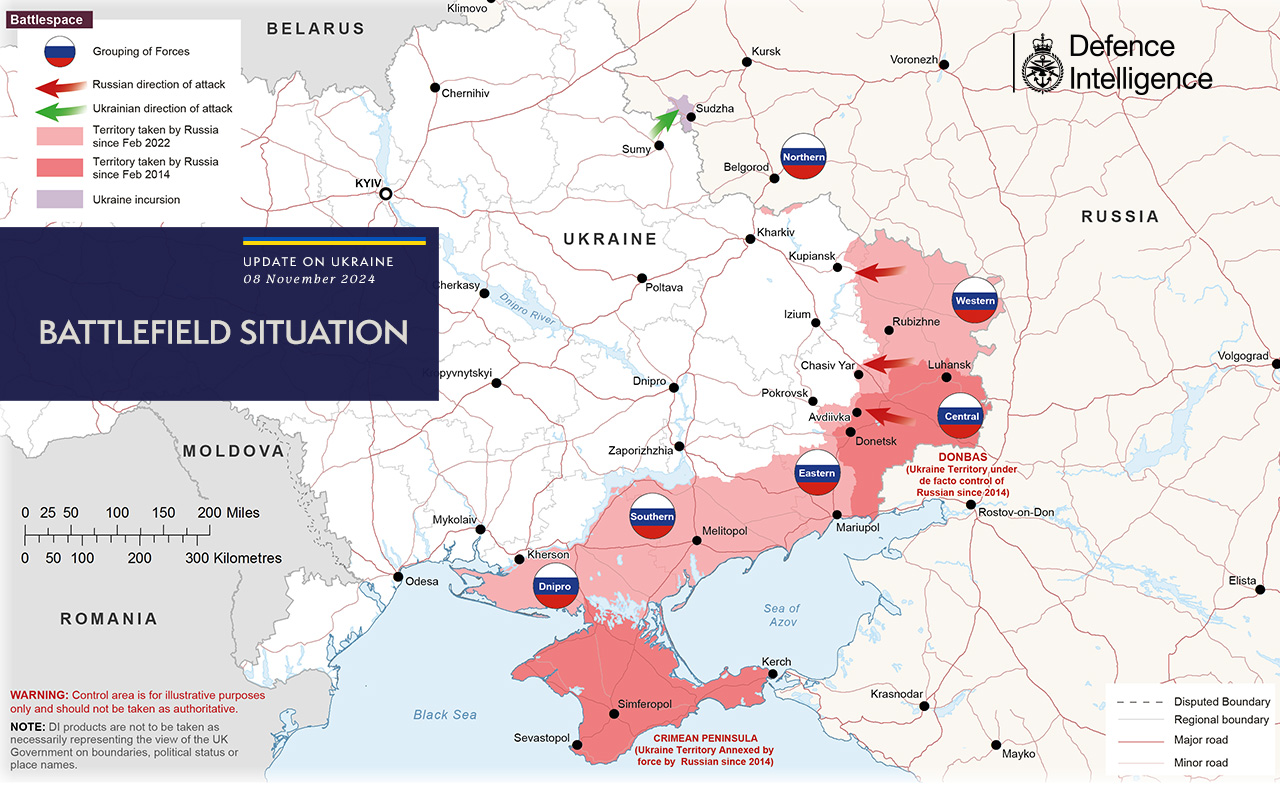
The situation in Ukraine as of 8 November, 2024.
Map from the UK Ministry of Defence via X.
… Ukraine is losing the war, and is losing it at a faster pace than before. Time is not on Kiev’s side, and there is no magic wand that anyone can wave to turn the tide in its favour. The question is: how much is Kiev willing to give up in order to save as much as it can?
The foreign policy blob is on tenterhooks, waiting to see what Trump will do regarding this conflict:
Like in Trump’s first term, different factions are set to compete to influence the Republican’s foreign policy. More traditionally minded allies such as Mike Pompeo, the former secretary of state now in contention to lead the Pentagon, are likely to push for a settlement that doesn’t appear to give a major win to Moscow. Other advisers, particularly Richard Grenell, a top candidate to lead the State Department or serve as national-security adviser, could give priority to Trump’s desire to end the war as soon as possible, even if it means forcing Kyiv into significant concessions.
Pompeo is out, but that doesn’t mean that those like him are entirely out either, as he has DoD officials sharing his views. No doubt that there are certain elements in the State Department, CIA, and in Congress as well who take the same position.
The proposals all break from Biden’s approach of letting Kyiv dictate when peace talks should begin. Instead, they uniformly recommend freezing the war in place — cementing Russia’s seizure of roughly 20% of Ukraine — and forcing Ukraine to temporarily suspend its quest to join the North Atlantic Treaty Organization.
One idea proposed inside Trump’s transition office, detailed by three people close to the president-elect and not previously reported, would involve Kyiv promising not to join NATO for at least 20 years. In exchange, the U.S. would continue to pump Ukraine full of weapons to deter a future Russian attack.
Under that plan, the front line would essentially lock in place and both sides would agree to an 800-mile demilitarized zone. Who would police that territory remains unclear, but one adviser said the peacekeeping force wouldn’t involve American troops, nor come from a U.S.-funded international body, such as the United Nations.
“We can do training and other support but the barrel of the gun is going to be European,” a member of Trump’s team said. “We are not sending American men and women to uphold peace in Ukraine. And we are not paying for it. Get the Poles, Germans, British and French to do it.”
“Pumping” Ukraine full of weapons would be attractive to Trump, as it means steady cash flow. He is a businessman after all.
The last bit is the most important, as it conforms to US policy trends in which the dumpster fire that they started is left to the Europeans to extinguish while the Americans go deal with the Chinese.
That proposal in some respects echoes comments made by Vice President-elect JD Vance during a September interview, when he suggested a final agreement between Ukraine and Russia could involve a demilitarized zone “heavily fortified so the Russians don’t invade again.” Russia, Vance continued, would get to keep the land it has taken and be assured of Ukraine’s neutrality.
“It doesn’t join NATO, it doesn’t join some of these sort of allied institutions,” he said on “The Shawn Ryan Show,” a podcast.
“No NATO, no stealth NATO”, is music to Moscow’s ears. The problem here is that the Russians do not trust the Americans to keep up their end of any deal. Russian Foreign Minister Lavrov has famously described the Americans as “agreement non-capable”.
Also, why would the Russians even agree to negotiate at this point?
For one, Ukraine and Russia still have vastly differing war aims and little desire to alter them. With Russian troops advancing slowly but steadily in Ukraine, the Kremlin has shown little inclination to negotiate, and has shown its willingness to escalate the conflict with hybrid attacks outside its borders, such as sabotage operations in Europe.
“The objectives of the special military operation remain unchanged and will be achieved,” Dmitry Medvedev, a top Russian official, posted Wednesday to X after learning of Trump’s victory over Vice President Kamala Harris, the Democratic presidential nominee.
Zelensky is over a barrel:
Zelensky, whose country is heavily dependent on the U.S. for military and financial assistance, could — more easily than Putin — be forced by Trump to negotiate, but the Ukrainian leader would have to contend with a public that views ceding territory as capitulation to Moscow.
Trump has said that Ukraine’s survival is important to the U.S., but has repeatedly criticized Zelensky, calling him the “greatest salesman”, a stance that has worried some officials in Kyiv that a Trump-led U.S. might push for a settlement that favors Russia.
Zelensky on Wednesday congratulated the president-elect on his victory, appealing to their September meeting in New York and praising his “‘peace through strength’ approach in global affairs”.
Forcing Zelensky to concede land would open up the possibility of a coup d’etat in Kiev, and even civil war. Even if a deal were hammered out, Zelensky would be forced to try to sell it at home. There are may factions in Ukraine that have no desire to budge even one inch, and would happily take his head off of the rest of his body to make sure that no one signs away any Ukrainian land.
November 13, 2024
The Korean War Week 21 – US Elections Threaten MacArthur! – November 12, 1950
The Korean War by Indy Neidell
Published 12 Nov 2024MacArthur’s forces struggle to make sense of the recent Communist Chinese intervention in Korea, especially when the Chinese vanish as quickly as they arrived. Back in the US, the war’s popularity has reached an all-time low on the eve of the crucial 1950 midterm elections. Is MacArthur about to pay the price for his failure to deliver results on the ground?
Chapters
00:00 Intro
01:01 Recap
01:24 The Chinese Vanish
02:37 The East
04:35 The US Situation
11:28 Bombing the Yalu
13:03 Summary
13:23 Conclusion
14:26 CTA
(more…)
Anglo-German Dreadnought Arms Race – Anything you can build I can build better!
Drachinifel
Published Nov 17, 2021Today we take a whistlestop tour behind the driving forces and outcome of the Anglo-German Naval Arms Race that led up to WW1.
November 12, 2024
Type 92 Japanese HMG
Forgotten Weapons
Published Mar 9, 2015The Type 92 was the final iteration of a machine gun that began as the Model 1897 Hotchkiss HMG made in France. The Japanese army purchased many of these guns, and then produced their own slightly refined version. These in turn were replaced by the updated Type 3 (1914) heavy machine gun, and finally the Type 92 (1932). A lightened upgrade to the Type 92 was prototyped (the Type 1, 1941), but never went into production. Mechanically, the Type 92 is very much like a scaled-up Type 11 light machine gun, using 30-round strips to feed. Despite being generally derided today, these machine guns were very reliable, accurate, and effective. This particular one happens to have a 7mm Mauser barrel in it, from a South American contract.
http://www.forgottenweapons.com
Theme music by Dylan Benson – http://dbproductioncompany.webs.com
November 11, 2024
In memoriam
A simple recognition of some of our family members who served in the First and Second World Wars:
The Great War
 Private William Penman, Scots Guards, died 16 May, 1915 at Le Touret, age 25
(Elizabeth’s great uncle)- Private Archibald Turner Mulholland, Argyll & Sutherland Highlanders, mortally wounded 25 September, 1915 at Loos, age 27
(Elizabeth’s great uncle) - Private David Buller, Highland Light Infantry, died 21 October, 1915 at Loos, age 35
(Elizabeth’s great grandfather) - Private Harold Edgar Brand, East Yorkshire Regiment. died 4 June, 1917 at Tournai.
(My first cousin, three times removed) - Private Walter Porteous, Durham Light Infantry, died 4 October, 1917 at Passchendaele, age 18
(my great uncle, who had married the day before he left for the front and never returned) - Corporal John Mulholland, Argyll & Sutherland Highlanders, wounded 2 September, 1914 (shortly before the First Battle of the Aisne), wounded again 29 June, 1918, lived through the war.
(Elizabeth’s great uncle) - John Eleazar (“Ellar”) Thornton, (ranks and dates of service unknown, served in the Royal Garrison Artillery, the East Surrey Regiment, and the Essex Regiment (dates of service unknown, but he likely joined the RGA in 1899). Put on the “Z” list after the war — recall list. He died in an asylum in 1943.
(my grandfather’s eldest brother) - Henry (Harry) Thornton, (uncertain) Lancashire Fusiliers. (We are not sure it is him as there were no identifying family or birth date listed. Rejected for further service.)
(my grandfather’s second older brother)
The Second World War
- Flying Officer Richard Porteous, Royal Air Force, survived the defeat in Malaya, was evacuated to India and lived through the war.
(my great uncle) - Able Seaman John Penman, Royal Navy, served in the Defensively Equipped Merchant fleet on the Atlantic convoys, the Murmansk Run (we know he spent a winter in Russia at some point during the war) and other convoy routes, was involved in firefighting and rescue efforts during the Bombay Docks explosion in 1944, lived through the war.
(Elizabeth’s father. We received his Arctic Star medal in July, 2024.) - Private Archie Black (commissioned after the war and retired as a Major), Gordon Highlanders, captured during the fall of Singapore (aged 15) and survived a Japanese POW camp (he had begun to write an autobiography shortly before he died)
(Elizabeth’s uncle) - Elizabeth Buller, “Lumberjill” in the Women’s Timber Corps, an offshoot of the Women’s Land Army in Scotland through the war.
(Elizabeth’s mother) - Trooper Leslie Taplan Russon, 3rd Royal Tank Regiment, died at Tobruk, 19 December, 1942 (aged 23).
Leslie was my father’s first cousin, once removed (and therefore my first cousin, twice removed). - Reginald Thornton, rank and branch of service unknown, hospitalized during the war with shellshock and was never discharged back into civilian life. He died in York in 1986.
(my grandfather’s youngest brother)
My maternal grandfather, Matthew Kendrew Thornton, was in a reserved occupation during the war as a plater working at Smith’s Docks in Middlesbrough. The original design for the famous Flower-class corvettes came from Smith’s Docks and 16 of the 196 built in the UK during the war (more were built in Canada). My great-grandmother was an enthusiastic ARP warden through the war (she reportedly enjoyed enforcing blackout compliance in the neighbourhood using the rattle and whistle that came with the job).
For the curious, the Commonwealth War Graves Commission the Royal British Legion, and the Library and Archives Canada WW1 and WW2 records site provide search engines you can use to look up your family name. The RBL’s Every One Remembered site shows you everyone who died in the Great War in British or Empire service (Canadians, Australians, New Zealanders, South Africans and other Imperial countries). The CWGC site also includes those who died in the Second World War. Library and Archives Canada allows searches of the Canadian Expeditionary Force and the Royal Newfoundland Regiment for all who served during WW1, and including those who volunteered for the CEF but were not accepted.
In Flanders fields the poppies blow
Between the crosses row on row,
That mark our place; and in the sky
The larks, still bravely singing, fly
Scarce heard amid the guns below.We are the Dead. Short days ago
We lived, felt dawn, saw sunset glow,
Loved and were loved, and now we lie
In Flanders fields.Take up our quarrel with the foe:
To you from failing hands we throw
The torch; be yours to hold it high.
If ye break faith with us who die
We shall not sleep, though poppies grow
In Flanders fields.Lieutenant Colonel John McCrae, MD Canadian Army Medical Corps (1872-1918)
Here is Mark Knopfler’s wonderful song “Remembrance Day” from his Get Lucky album, set to a slideshow of British and Canadian images from World War I through to more recent conflicts put together by Bob Oldfield:
The Angel of Victory: Canada’s Processing of The Great War (Vancouver, BC)
Valour Canada
Published Jan 9, 2024This video, by Hania Templeton, discusses the historical context, significance, and current meaning of The Angel of Victory in Vancouver, BC. Hania’s work received first place in Valour Canada’s 2023 History & Heritage Scholarship (VCHHS) contest.
To learn more about this annually awarded #scholarship, including the rules and regulations for eligible entrants, please visit https://valourcanada.ca/education/vch…
QotD: Military glamour
In the 19th century, warfare was one of the first contexts in which English speakers used the term glamour in its modern metaphorical sense. (The word originally meant a literal magic spell that made people see things that weren’t there.) “Military heroes who give up their lives in the flush and excitement and glamour of battle”, opined a U.S. congressman in 1885, “are sustained in the discharge of duty by the rush and conflict of physical forces, the hope of earthly glory and renown”.
Even people who hated military life could feel the attraction. Writing after the briefest of conscriptions (a single night in the barracks), D.H. Lawrence in 1916 lamented “this terrible glamour of camaraderie, which is the glamour of Homer and of all militarism”.
The slaughter and apparent futility of the Great War changed all that. Peace activists and bitter veterans now saw the “glamour of battle” as a dangerous delusion rather than a valuable inspiration. “Are you going to tell your children the truth about what you endured,” an American challenged fellow veterans in 1921, “or gild your reminiscences with glamour that will make them want to have a merry war experience of their own?” In 1919, the British painter Paul Nash wrote that the purpose of The Menin Road, his bleak portrait of a desolate and blasted landscape, was “to rob war of the last shred of glory, the last shine of glamour.”
Virginia Postrel, “Casualty of War”, Virginia’s Newsletter, 2023-08-10.
November 10, 2024
WW2 in Numbers
World War Two
Published 9 Nov 2024World War II wasn’t just the deadliest conflict in history — it was a war of unprecedented scale. From staggering casualty numbers to military production and economic costs, this episode breaks down the biggest statistics that defined the global conflict.
(more…)
November 9, 2024
Did US Indecision Encourage Stalin in Korea?
The Korean War by Indy Neidell
Published 8 Nov 2024In March 1950, Stalin finally approves Kim Il-sung’s plans for an invasion of South Korea. But why now? Today Indy looks at the wider Cold War context that fed into Stalin and Mao Zedong’s decision making. He also examines whether the lack of a clear and public commitment from the US to defend the Asian theatre helped to invite the invasion.
(more…)
History of SAW (Squad Automatic Weapon) use in the US Army
Forgotten Weapons
Published Jul 26, 2024The first squad automatic weapon used by the US Army was the French Mle 1915 Chauchat, which was the primary LMG or automatic rifle for troops in the American Expeditionary Force in World War One. At that time, the Chauchat was a company-level weapon assigned where the company commander thought best. In World War Two, the Chauchat had been replaced by the BAR, and one BAR gunner was in each 12-man rifle platoon. The BAR was treated like a heavy rifle though, and not like a support weapon as light machine guns were in most other armies.
After Korea the value of the BAR was given more consideration and two were put in each squad instead of one, but the M14 replaced the BAR before it could gain any greater doctrinal importance. The M14 was intended to basically go back to the World War Two notion of every man equipped with a very capable individual weapon, and the squad having excellent flexibility and mobility by not being burdened with a supporting machine gun. The M60 machine guns were once again treated as higher-level weapons, to be attached to rifle squads as needed.
After Vietnam, experiments with different unit organization — and with the Stoner 63 machine guns — led to the decision that a machine gun needed to be incorporated into the rifle squad. This led to the request for what became the M249 Squad Automatic Weapon, and its adoption in the 1980s. At last, the American rifle squad included an organic supporting machine gun.
Today, the USMC is once again going back to the earlier model with every rifleman carrying the same weapon, now an M27 Individual Automatic Rifle. The Army may also change its organizational structure with the new XM7 and XM250 rifle and machine gun, but only time will tell …
(more…)
November 8, 2024
An alternative path to meeting Canada’s 2% of GDP defence-spending aspirations
I’m not convinced that Brian Graff is correct here, but it’s certainly a bit of unusually out-of-the-box thinking on Canada’s defence shortcomings:
Canada has sent a few tanks over to Ukraine, as well as other supplies and financial aid. We will have to replenish these things, and this might be an opportunity to expand Canada’s capacity to make and export military arms and equipment. Maybe our defense policy and spending has been wrongheaded. Since we have so few troops, are unlikely to need to defend our own soil, and are far from any country likely to be in conflict, we may be able to meet our 2% target with some innovative thinking.
Since the Second World War, the US has described itself as the “arsenal of democracy”, a phrase which Franklin Roosevelt used in 1940 when the US was supporting Britain (and Canada) by sending arms, most notably through the “Lend Lease” program that sent ships and equipment to Britain, technically on loan.
Maybe a bigger part of Canada’s own defence policy should be to make and stockpile arms, equipment, and supplies to send to our allies or friends in times of need. Such equipment need not be “state of the art” like F-35 fighter jets. Canada could also expand production of parts for equipment assembled in other NATO countries – particularly for spare parts we need for ourselves.
We need not limit this to new equipment. Canada could also promote companies that refurbish older equipment to be stockpiled or resold. And of course, Canada could determine which countries benefit from our stockpiles of military equipment. We could ensure that this equipment is not acquired by countries with regimes we oppose, and we would have the leeway to give or sell only to the “right” side of a conflict, possibly with strings attached.
Take our Leopard 2 tanks that were built in Germany. We have given some to Ukraine. We have unfortunately scrapped even older Leopard 1 tanks, that could have been refurbished or modified to serve as platforms for other uses. Canada should probably give the rest of our tanks to Ukraine, then get into the business of buying older Abrams tanks from the US to refurbish as replacements or for re-export.
Israel is a good example of a nation that builds up its military capacity with secondhand tanks and other equipment, and is now a major exporter of military equipment that it developed at least in part for its own defence.
The trend in US equipment has been to build state of the art equipment, and buy smaller quantities of it. But the conflict in Ukraine has shown that even when fighting a country with advanced military technology like Russia, using some older equipment combined with innovative new designs has been successful for both sides. Along with the introduction of drones, the Russians have modified older bombs to become guided bombs that are accurate and far cheaper than building new missiles.
November 7, 2024
Forgotten War Ep4 – Rise of the Chindits
HardThrasher
Published 4 Nov 2024Please consider donations of any size to the Burma Star Memorial Fund who aim to ensure remembrance of those who fought with, in and against 14th Army 1941–1945 — https://burmastarmemorial.org/
(more…)
November 6, 2024
The Korean War 020 – American Disaster at Unsan! – November 5, 1950
The Korean War by Indy Neidell
Published 5 Nov 2024American forces drive onwards, almost oblivious to the emerging Communist Chinese threat. At Unsan, an American regiment finds itself at the mercy of two Chinese divisions, who bear down on it from three sides. Getting out before being overrun will be no easy feat.
Chapters
01:18 Destruction of the 7th
03:41 Unsan Prelude
05:41 The Disaster at Unsan
10:47 Aftermath
13:31 Elsewhere
16:15 Summary
16:30 Conclusion
(more…)
November 4, 2024
QotD: Early raids on, and sieges of, fortified cities
In contrast, the emergence of states focused on territorial control create a different set of strategic objectives which lead towards the siege as the offensive method of choice over the raid. States, with their need to control and administer territory (and the desire to get control of that territory with its farming population intact so that they can be forced to farm that land and then have their agricultural surplus extracted as taxes), aim to gain control of areas of agricultural production, in order to extract resources from them (both to enrich the elite and core of the state, but also to fund further military activity).
Thus, the goal in besieging a fortified settlement (be that, as would be likely in this early period, a fortified town or as later a castle) is generally to get control of the administrative center. Most of the economic activity prior to the industrial revolution is not in the city; rather the city’s value is that it is an economic and administrative hub. Controlling the city allows a state to control and extract from the countryside around the city, which is the real prize. Control here thus means setting up a stable civilian administration within the city which can in turn extract resources from the countryside; this may or may not require a permanent garrison of some sort, but it almost always requires the complete collapse of organized resistance in the city. Needless to say, setting up a stable civilian administration is not something one generally does by surprise, and so the siege has to aim for more durable control over the settlement. It also requires fairly complete control; if you control most of the town but, say, a group of defenders are still holding out in a citadel somewhere, that is going to make it very difficult to set up a stable administration which can extract resources.
Fortunately for potential defenders, a fortification system which can withstand a siege is almost always going to be sufficient to prevent a raid as well (because if you can’t beat it with months of preparatory work, you are certainly unlikely to be able to quickly and silently overcome it in just a few night hours except under extremely favorable conditions), though detection and observation are also very important in sieges. Nevertheless, we will actually see at various points fortification systems emerge from systems designed more to prevent the raid (or similar “surprise” assaults) rather than the siege (which is almost never delivered by surprise), so keeping both potential attacking methods in mind – the pounce-and-flee raid and the assault-and-stay siege – is going to be important.
As we are going to see, even fairly basic fortifications are going to mean that a siege attacker must either bring a large army to the target, or plan to stay at the target for a long time, or both. In a real sense, until very recently, this is what “conventional” agrarian armies were: siege delivery mechanisms. Operations in this context were mostly about resolving the difficult questions of how to get the siege (by which I mean the army that can execute the siege) to the fortified settlement (and administrative center) being targeted. Because siege-capable armies are either big or intend to stick around (or both), surprise is out of the window for these kinds of assaults, which in turn raises the possibility of being forced into a battle, either on the approach to the target or once you have laid siege to it.
It is that fact which then leads to all of the many considerations for how to win a battle, some of which we have discussed elsewhere. I do not want to get drawn off into the question of winning battles, but I do want to note here that the battle is, in this equation, a “second order” concern: merely an event which enables (or prohibits) a siege. As we’ll see, sieges are quite unpleasant things, so if a defender can not have a siege by virtue of a battle, it almost always makes sense to try that (there are some exceptions, but as a rule one does not submit to a siege if there are other choices), but the key thing here is that battles are fundamentally secondary in importance to the siege: the goal of the battle is merely to enable or prevent the siege. The siege, and the capture or non-capture of the town (with its role as an administrative center for the agricultural hinterland around it) is what matters.
Bret Devereaux, “Collections: Fortification, Part I: The Besieger’s Playbook”, A Collection of Unmitigated Pedantry, 2021-10-29.


