Gandhi’s views on the European crisis were not entirely consistent. He vigorously opposed Munich, distrusting Chamberlain. “Europe has sold her soul for the sake of a seven days’ earthly existence,” he declared. “The peace that Europe gained at Munich is a triumph of violence.” But when the Germans moved into the Bohemian heartland, he was back to urging nonviolent resistance, exhorting the Czechs to go forth, unarmed, against the Wehrmacht, perishing gloriously — collective suicide again. He had Madeleine Slade draw up two letters to President Eduard Beneš of Czechoslovakia, instructing him on the proper conduct of Czechoslovak satyagrahi when facing the Nazis.
When Hitler attacked Poland, however, Gandhi suddenly endorsed the Polish army’s military resistance, calling it “almost nonviolent.” (If this sounds like double-talk, I can only urge readers to read Gandhi.) He seemed at this point to have a rather low opinion of Hitler, but when Germany’s panzer divisions turned west, Allied armies collapsed under the ferocious onslaught, and British ships were streaming across the Straits of Dover from Dunkirk, he wrote furiously to the Viceroy of India: “This manslaughter must be stopped. You are losing; if you persist, it will only result in greater bloodshed. Hitler is not a bad man …”
Gandhi also wrote an open letter to the British people, passionately urging them to surrender and accept whatever fate Hitler had prepared for them. “Let them take possession of your beautiful island with your many beautiful buildings. You will give all these, but neither your souls, nor your minds.” Since none of this had the intended effect, Gandhi, the following year, addressed an open letter to the prince of darkness himself, Adolf Hitler.
The scene must be pictured. In late December 1941, Hitler stood at the pinnacle of his might. His armies, undefeated — anywhere — ruled Europe from the English Channel to the Volga. Rommel had entered Egypt. The Japanese had reached Singapore. The U.S. Pacific Fleet lay at the bottom of Pearl Harbor. At this superbly chosen moment, Mahatma Gandhi attempted to convert Adolf Hitler to the ways of nonviolence. “Dear Friend,” the letter begins, and proceeds to a heartfelt appeal to the Führer to embrace all mankind “irrespective of race, color, or creed.” Every admirer of the film Gandhi should be compelled to read this letter. Surprisingly, it is not known to have had any deep impact on Hitler. Gandhi was no doubt disappointed. He moped about, really quite depressed, but still knew he was right. When the Japanese, having cut their way through Burma, threatened India, Gandhi’s strategy was to let them occupy as much of India as they liked and then to “make them feel unwanted.” His way of helping his British “friends” was, at one of the worst points of the war, to launch massive civil-disobedience campaigns against them, paralyzing some of their efforts to defend India from the Japanese.
Here, then, is your leader, O followers of Gandhi: a man who thought Hitler’s heart would be melted by an appeal to forget race, color, and creed, and who was sure the feelings of the Japanese would be hurt if they sensed themselves unwanted. As world-class statesmen go, it is not a very good record. Madeleine Slade was right, I suppose. The world certainly didn’t listen to Gandhi. Nor, for that matter, has the modern government of India listened to Gandhi. Although all Indian politicians of all political parties claim to be Gandhians, India has blithely fought three wars against Pakistan, one against China, and even invaded and seized tiny, helpless Goa, and all without a whisper of a shadow of a thought of ahimsa. And of course India now has atomic weapons, a satyagraha technique if ever there was one.
Richard Grenier, “The Gandhi Nobody Knows”, Commentary, 1983-03-01.
May 15, 2020
QotD: Gandhi and the rise of Hitler
May 14, 2020
1948: The Dutch vs. the USA – 2nd Police Actions | The Indonesian War of Independence Part 4
TimeGhost History
Published 13 May 2020The international community forces the Dutch to end their first colonial offensive with the Renville Agreement. However, as the Dutch, the Indonesian Republicans and the multiple other groups continue fighting, an impasse devolops.
Join us on Patreon: https://www.patreon.com/TimeGhostHistory
Hosted by: Indy Neidell
Written by: Joram Appel
Director: Astrid Deinhard
Producers: Astrid Deinhard and Spartacus Olsson
Executive Producers: Astrid Deinhard, Indy Neidell, Spartacus Olsson, Bodo Rittenauer
Creative Producer: Joram Appel
Post-Production Director: Wieke Kapteijns
Research by: Joram Appel and Isabel Wilson
Edited by: Karolina Dołęga
Sound design: Marek KamińskiColorizations:
Dememorabilia – https://www.instagram.com/dememorabilia/
Carlos Ortega Pereira (BlauColorizations – https://www.instagram.com/blaucoloriz…
Jaris Almazani (Artistic Man) – https://instagram.com/artistic.man?Research Sources: https://bit.ly/IndoSources
Visual Sources:
Nationaal Archief
National Archives NARA
Tropenmuseum, part of the National Museum of World CulturesIcons from the Noun Project by Wonmo Kang, Creative Mania & Claudia Revalina
Archive by Screenocean/Reuters https://www.screenocean.com.
Music:
“Other Sides of Glory” – Fabien Tell
“Remembrance” – Fabien Tell
“Sailing for Gold” – Howard Harper-Barnes
“Last Point of Safe Return” – Fabien Tell
“It’s Not a Game” – Philip Ayers
“Moving to Disturbia” – Experia
“March Of The Brave 10” – Rannar Sillard
“March Of The Brave 9” – Rannar SillardA TimeGhost chronological documentary produced by OnLion Entertainment GmbH.
Three reasons the Western allies fail to fully acknowledge the efforts of the Soviets in WW2
Arthur Chrenkoff suggests three major reasons for why many Russians and other Soviet-nostalgics feel the west is wrongly denying the Soviet Union full credit for the defeat of Nazi Germany:

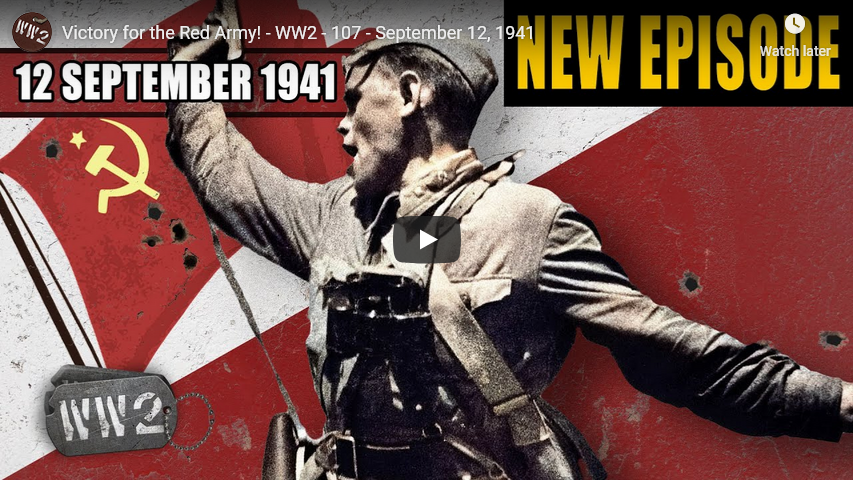
Kombat (Russian: Комбат, lit. “battalion commander”) is a black-and-white photograph by the Soviet photographer Max Alpert. It depicts a Soviet military officer armed with a TT pistol who is raising his unit for an attack during World War II. This work is regarded as one of the most iconic Soviet World War II photographs, yet neither the date nor the subject is known with certainty. According to the most widely accepted version, the photograph depicts junior politruk (political officer) Aleksei Gordeyevich Yeryomenko, minutes before his death on 12 July 1942, in Voroshilovgrad Oblast, Ukraine.
Wikimedia Commons.
But while the Russian – or, more correctly, Soviet – role in defeating Hitler is beyond question and deserves wider attention and recognition, there are several reasons why the Western acknowledgement of the eastern front will always remain qualified and somewhat ambiguous.
Firstly, while Russia continues to variously deny, downplay or excuse the fact, the Soviet Union was the initial co-aggressor in World War Two and for the first two years a Nazi ally and collaborator. Stalin might have had legitimate realpolitik reasons for the Ribbentrop-Molotov pact, in effect sacrificing Europe to win more time to prepare for the inevitable war with Germany (nice in theory, the gambit in any case did not work out in practice), but the fact remains that in concert with Hitler, Stalin invaded Poland and was rewarded with its eastern half, subsequently also helping himself to Bessarbia, annexing the Baltic states and invading Finland. In turn, the fact that Hitler assured himself he would not be facing a war on two fronts, which doomed Germany in World War One, allowed him to successively snatch Poland, Norway, Denmark, the Netherlands, Belgium, France, Yugoslavia and Greece, giving Germany a complete dominance over the continental Europe from the Atlantic to the Bug river and the Arctic Circle to Crete. And while Great Britain stood alone against Germany for a year from mid-1940 to mid-1941, Soviet resources and produce kept flowing in, feeding and arming the Nazi monster. This makes Stalin’s subsequent anger over the Allied delay in launching the Second Front in the West quite hypocritical – where was the Second Front in the East while Luftwaffe was blitzing Britain and its troops were battling Italians and Rommel in north Africa?
Secondly, without in any way diminishing the German barbarity in the east, a significant proportion of the Soviet military and civilian casualties were unnecessary and resulted from the communist government’s complete and utter disregard for the lives and well-being of its subjects. Stalin fought the war as he fought the peace at home. The man who prior to 1941 had managed to send somewhere upwards of 15 million of his own people to an early grave, clearly wasn’t going to spare the long suffering population when faced with an external existential threat. The Soviet Union might not have (at least initially) had much else, but it certainly had people, and they were sacrificed in obscene numbers by the man in the Kremlin and his minions on the ground. For most of the war, several Red Army soldiers were dying for every one German, while obeying absurd orders to stand ground or frontally attack in total disregard for the local circumstances or for that matter any reasonable tactical and strategic consideration. When Eisenhower and Zhukov caught up some time later in the war and the conversation turned to the best method of clearing mine fields, the Russian astonished the Allied Commander-in-Chief when he nominated simply sending the infantry through as the easiest and the cheapest method. This wasn’t a joke either; it was the way the Red Army fought from the first days of Barbarossa all the way to Berlin, even though the eventual overwhelming material superiority did save many an Ivan’s life in the later stages of the conflict. Not enough, however, to wipe out the entire generation of men born in the mid-1920s.
Thirdly, while the Red Army did indeed end the brutal Nazi occupation of the Central and the Eastern Europe, it did not bring freedom in any meaningful sense of the word, except perhaps (in most cases) freedom from sudden death. Debates about similarities and differences between the two totalitarian systems will no doubt continue well into the future. Unquestionably, for an average Slav, the Soviet domination was a better option that the Nazi one. Nazis, by and large, considered Slavs to be subhuman (though making some allowances, often quite significant, for their Slavic allies, like the Slovaks, the Croats or the Bulgarians), fit only to be initially enslaved and eventually exterminated. This was the far deadlier and much more ideological continuation of Germany’s 1000-year “drang nach osten” or the “civilising” mission to expand into the fertile east. Particular hatred was reserved for the Poles, who stood as a barrier for most of that millennium, preventing the dream of lebensraum from being realised. Russia was a much more recent enemy, having overlaid its Slavic barbarity with a Bolshevik malignancy. Even the initial Nazi plans called for starving between 25-30 million Belorussians, Ukrainians and Russians in order to free up food and resources for Germany. Communists could be deadly too, of course, and both the Reds and the Blacks were fond of decimating the local elites and intelligencia, but the Soviets at least did not see their Slavic brethren as subhumans but as proletarian masses to be converted to the glories of Marxism-Leninism.
Be that as it may, the Soviet liberation did not bring liberty or independence to the people of Eastern Europe. That had to wait until 1989-91.
Farquhar Hill: Britain’s WW1 Semiauto Rifle
Forgotten Weapons
Published 20 Feb 2017The Farquhar-Hill was a semiauto rifle developed in Britain prior to World War 1. It was the idea of Birmingham gunsmith Arthur Hill, and financed by Aberdeen industrialist Mowbray Farquhar. The design began as a long-recoil system, but that was replaced with a unique spring-buffered gas operated mechanism before production began.
Basically, a gas port in the barrel taps gas off to a piston, which moved about 3 inches rearward and was then caught and held by a latch. At that point, the other end of the spring would be released to move backward, pushing on the bolt and bolt carrier, unlocking and cycling the action. This gave the rifle a very light felt recoil impulse, and also buffered the bolt from potential over-pressure cartridges.
The Farquhar-Hill was chambered for the .303 British cartridge, and in its military form fed from 19-round drum magazines. A large order for 100,000 rifles was placed by the British military, but cancelled when WW1 ended. A small number of the rifles were sold in the military pattern as well as in box magazine-fed sporting patterns, but Farquhar was more interested in pursuing military contracts, and would continue to work with machine gun designs going into the 1920s.
Thanks to the Institute of Military Technology for giving me access to these two rifles: http://www.instmiltech.com
http://www.patreon.com/ForgottenWeaponsCool Forgotten Weapons merch! http://shop.bbtv.com/collections/forg…
If you enjoy Forgotten Weapons, check out its sister channel, InRangeTV! http://www.youtube.com/InRangeTVShow
May 13, 2020
Rudolf Hess – Nazi Pacifist, Traitor or Madman? – WW2 Special Episode
World War Two
Published 12 May 2020In a series of events, Hitler’s second in command Rudolf Hess decides to fly to Britain to enter peace negotiations with the Allies. But the true reasons behind and effects of his action remain ambiguous at best.
Join us on Patreon: https://www.patreon.com/TimeGhostHistory
Or join The TimeGhost Army directly at: https://timeghost.tvFollow WW2 day by day on Instagram @World_war_two_realtime https://www.instagram.com/world_war_t…
Between 2 Wars: https://www.youtube.com/playlist?list…
Source list: http://bit.ly/WW2sourcesHosted by: Indy Neidell
Written by: Joram Appel
Director: Astrid Deinhard
Producers: Astrid Deinhard and Spartacus Olsson
Executive Producers: Astrid Deinhard, Indy Neidell, Spartacus Olsson, Bodo Rittenauer
Creative Producer: Joram Appel
Post-Production Director: Wieke Kapteijns
Research by: Joram Appel
Edited by: Mikołaj Cackowski
Sound design: Marek Kamiński
Map animations: Eastory (https://www.youtube.com/c/eastory)Colorizations by:
Norman Stewart, https://oldtimesincolor.blogspot.com/
Carlos Ortega Pereira, BlauColorizations, https://www.instagram.com/blaucoloriz…
Jaris Almazani (Artistic Man), https://instagram.com/artistic.man?ig…
Olga Shirnina, https://klimbim2014.wordpress.com
Adrien Fillon, https://www.instagram.com/adrien.colo…Bibliography:
– Balfour, Michael, Propaganda in War, 1939–45: Organizations, Policies, and Publics in Britain and Germany (London, 1979).
– Fox, Jo. “Propaganda and the Flight of Rudolf Hess, 1941-45”. In: The Journal of Modern History 83:1 (March 2011) 78-110.
– Gorodetsky, Gabriel, “The Hess Affair and Anglo-Soviet Relations on the Eve of ‘Barbarossa'”. In: The English Historical Review 101:399 (Apr 1986) 405-420.
– Görtemaker, Manfred, “The Bizarre Mission: Rudolf Hess in Britain,” in Britain and Germany in the 20th Century, ed. M. Görtemaker (Oxford, 2006), 75–101.
– Heiden, Konrad, “Hitler’s Better Half”. In: Foreign Affairs 20:1 (Oct 1941) 73-86.
– Kettenacker, Lothar, “Mishandling a Spectacular Event: The Rudolf Hess Affair,” in Flight from Reality: Rudolf Hess and His Mission to Scotland, ed. David Stafford (London, 2002) 19–38.
– Schmidt, Rainer, “The Marketing of Rudolf Hess: A Key to the ‘Preventative War Debate’?” War in History 5 (1998) 62-83.Sources:
Bundesarchiv
Portraits of Douglas Douglas-Hamilton, duke of Hamilton and Duff Cooper, MP, courtesy National Portrait Gallery
Narodowe Archiwum Cyfrowe
Zentralbibliothek Zürich
Portrait of Max Aitken, Lord Beaverbrook, courtesy Nationaal Archief
IWM D 8987Soundtracks from the Epidemic Sound:
Rannar Sillard – “March Of The Brave 4”
Reynard Seidel – “Deflection”
Andreas Jamsheree – “Guilty Shadows 4”
Johannes Bornlof – “The Inspector 4”
Johannes Bornlof – “Deviation In Time”Archive by Screenocean/Reuters https://www.screenocean.com.
A TimeGhost chronological documentary produced by OnLion Entertainment GmbH.
Tank Chats #69 Ram Mark II | The Tank Museum
The Tank Museum
Published 15 Mar 2019David Fletcher talks about the WW2 Ram Mark II tank, built by Canada during the Second World War.
It was based upon the American Medium M3 (Lee) and many components were supplied by the United States.
Support the work of The Tank Museum on Patreon: ► https://www.patreon.com/tankmuseum
Visit The Tank Museum SHOP: ► https://tankmuseumshop.org/
Twitter: ► https://twitter.com/TankMuseum
Tiger Tank Blog: ► http://blog.tiger-tank.com/
Tank 100 First World War Centenary Blog: ► http://tank100.com/ #tankmuseum #tanks #tankchats
May 11, 2020
Battle of Cape Matapan: Just Four Minutes to Cripple a Fleet
Historigraph
Published 10 May 2020For unlimited access to the world’s top documentaries and nonfiction series go to http://go.thoughtleaders.io/167132020… and use the promo code ‘
historigraph‘ to get 30 days free access.Buy Historigraph Posters here! teespring.com/stores/historigraph
Support the channel on Patreon: https://www.patreon.com/historigraph#CapeMatapan #Historigraph #Historigraph #CuriosityStream
► Twitch: https://www.twitch.tv/historigraph
► Twitter: https://twitter.com/historigraph
► Instagram: https://www.instagram.com/historigraphSources:
The Battle of Matapan, SWC Pack
Engage the Enemy More Closely, Corelli Barnett,
Dark Waters, JE Harrold
Music:
“Unnatural Situation” by Kevin MacLeod
Link: https://incompetech.filmmusic.io/song…
License: http://creativecommons.org/licenses/b…“Volatile Reaction” by Kevin MacLeod
Link: https://incompetech.filmmusic.io/song…“Crypto” by Kevin MacLeod
Link: https://incompetech.filmmusic.io/song…
Imperial Gewehr 71
Forgotten Weapons
Published 30 Jan 2016Sold for $575.
The Gewehr 1871 was the first rifle adopted by the newly-formed German state after its unification at the end of the Franco-Prussian War. It replaced the decades-old Dreyse needle rifles, and fired an 11x60mm black powder cartridge. It was the first significant rifle designed by the Mauser brothers, and would evolve into the iconic and ubiquitous Mauser 98 design over the years.
May 10, 2020
Enigma Captured! – WW2 – 089 – May 9, 1941
World War Two
Published 9 May 2020An Enigma encode is captured in the Atlantic Ocean as the Germans make plans for a new offensive in Crete. Britain is heavily bombed by the Luftwaffe and fighting continues in Iraq, China and East-Africa.
Join us on Patreon: https://www.patreon.com/TimeGhostHistory
Or join The TimeGhost Army directly at: https://timeghost.tvFollow WW2 day by day on Instagram @World_war_two_realtime https://www.instagram.com/world_war_t…
Between 2 Wars: https://www.youtube.com/playlist?list…
Source list: http://bit.ly/WW2sourcesWritten and Hosted by: Indy Neidell
Director: Astrid Deinhard
Producers: Astrid Deinhard and Spartacus Olsson
Executive Producers: Astrid Deinhard, Indy Neidell, Spartacus Olsson, Bodo Rittenauer
Creative Producer: Joram Appel
Post-Production Director: Wieke Kapteijns
Edited by: Iryna Dulka
Sound design: Marek Kamiński
Map animations: Eastory (https://www.youtube.com/c/eastory)Colorizations by:
– Julius Jääskeläinen – https://www.facebook.com/JJcolorization/
– Olga Shirnina, a.k.a. Klimbim – https://klimbim2014.wordpress.com/
– Carlos Ortega Pereira, BlauColorizations, https://www.instagram.com/blaucoloriz…
– Adrien Fillon – https://www.instagram.com/adrien.colo…
– Dememorabilia – https://www.instagram.com/dememorabilia/Sources:
– Narodowe Archiwum Cyfrowe
– Bundesarchiv, CC-BY-SA 3.0: Bild 101I-769-0229-10A / Borchert, Erich (Eric), Bild 101I-317-0053-18 / Amphlett, Eduard, Bild_101I-567-1523-38, Bild 141-0853, Bild_146-2006-0188
– Micheal Hörenberg, Uferstr. 29, D-78343 Hemmenhofen
– Imperial War Museum: E 6822, AUS 897, E 4791, E 3040E, E 3042E, E446, E 3025E, E 1164, E 1172, E 3020E, E 2182,
– Ju 52 graphic by TSRL from Wikimedia
– DFS 230 and Ju 87 graphics by Kaboldy from WikimediaArchive by Screenocean/Reuters https://www.screenocean.com.
A TimeGhost chronological documentary produced by OnLion Entertainment GmbH.
May 9, 2020
History Summarized: The Meiji Restoration
Overly Sarcastic Productions
Published 8 May 2020Japan may well have the record for World’s Speediest Industrialization, but how did they accomplish so much so fast without falling victim to Europe’s favorite 19th century pastime of “Colonization”? And how did Japan build up a Pan-Asian empire so darn quickly? All that and more in this deep-dive into the Meiji Restoration!
SOURCES & Further Reading:
Modern Japan: A Very Short Introduction by Goto-Jones.
The Japanese Empire: Grand Strategy from the Meiji Restoration to the Pacific War by Paine.
Bushido: The Soul of Japan by Nitobe.THAT WACKY POLITICAL CARTOON: “Japan Makes Her Debut Under Columbia’s Auspicies” https://tile.loc.gov/storage-services…
This video was edited by Sophia Ricciardi AKA “Indigo”. https://www.sophiakricci.com/
Our content is intended for teenage audiences and up.
PATREON: https://www.Patreon.com/OSP
DISCORD: https://discord.gg/h3AqJPe
MERCH LINKS: https://www.redbubble.com/people/OSPY…
OUR WEBSITE: https://www.OverlySarcasticProductions.com
Find us on Twitter https://www.Twitter.com/OSPYouTube
Find us on Reddit https://www.Reddit.com/r/OSP/
The Battle of Trafalgar – Admiral Nelson’s Moment
IT’S HISTORY
Published 13 May 2015It was the defining moment of the British naval history and let the groundwork for their naval superiority over the next century. Horatio Nelson’s brilliant battle tactics let to a decisive victory over Napoleon’s French Navy. Find out all about the famous Battle of Trafalgar with Indy on IT’S HISTORY.
» The Complete Piracy-PLAYLIST: http://bit.ly/PiratePlaylist
» ALL EPISODES of Battlefields: http://bit.ly/BattlefieldsOfHistory
» JOIN OUR COMMUNITY FOR MORE HISTORY KNOWLEDGE!
Follow us on Twitter: http://twitter.com/thehistoryshow
Your photos on Instagram: https://instagram.com/itshistorychannel» SOURCES
Videos: British Pathé (https://www.youtube.com/user/britishp…)
Pictures: mainly Picture Alliance» ABOUT US
IT’S HISTORY is a ride through history – Join us discovering the world’s most important eras in IN TIME, BIOGRAPHIES of the GREATEST MINDS and the most important INVENTIONS.» HOW CAN I SUPPORT YOUR CHANNEL?
You can support us by sharing our videos with your friends and spreading the word about our work.» CAN I EMBED YOUR VIDEOS ON MY WEBSITE?
Of course, you can embed our videos on your website. We are happy if you show our channel to your friends, fellow students, classmates, professors, teachers or neighbors. Or just share our videos on Facebook, Twitter, Reddit etc. Subscribe to our channel and like our videos with a thumbs up.» CAN I SHOW YOUR VIDEOS IN CLASS?
Of course! Tell your teachers or professors about our channel and our videos. We’re happy if we can contribute with our videos.» CREDITS
Presented by: Indy Neidell
Based on the script by: Daniel Hungerford
Directed By: Daniel Czepelczauer
Director of Photography: Markus Kretzschmar
Music: Markus Kretzschmar and Daniel Czepelczauer
Sound Design: Bojan Novic
Editing: Markus KretzschmarA Mediakraft Networks original channel
Based on a concept by Florian Wittig and Daniel Czepelczauer
Executive Producers: Astrid Deinhard-Olsson, Spartacus Olsson
Head of Production: Michael Wendt
Producer: Daniel Czepelczauer
Social Media Producer: Hendrik Sontheim
Social Media Manager: Florian Wittig and Laura PaganContains material licensed from British Pathé
All rights reserved – © Mediakraft Networks GmbH, 2015
May 8, 2020
Sending the Jews to Madagascar? – War Against Humanity 011 – May 1941
World War Two
Published 7 May 2020The War Against Humanity is accelerating and accelerating. Across the world, people live under oppression. In Nazi Europe, solutions to the so-called “Jewish Question” has taken on new, fantastical, proportions.
Join us on Patreon: https://www.patreon.com/TimeGhostHistory
Or join The TimeGhost Army directly at: https://timeghost.tvFollow WW2 day by day on Instagram @World_war_two_realtime https://www.instagram.com/world_war_t…
Between 2 Wars: https://www.youtube.com/playlist?list…
Source list: http://bit.ly/WW2sourcesHosted by: Spartacus Olsson
Written by: Francis van Berkel, Spartacus Olsson
Director: Astrid Deinhard
Producers: Astrid Deinhard and Spartacus Olsson
Executive Producers: Astrid Deinhard, Indy Neidell, Spartacus Olsson, Bodo Rittenauer
Creative Producer: Joram Appel
Post-Production Director: Wieke Kapteijns
Research by: Francis van Berkel
Edited by: Mikołaj Cackowski
Sound design: Marek Kamiński
Map animations: Eastory (https://www.youtube.com/c/eastory)Colorizations by:
Olga Shirnina https://klimbim2014.wordpress.com
Dememorabilia – https://www.instagram.com/dememorabilia/
Norman Stewart – https://oldtimesincolor.blogspot.com/Sources:
IWM HU 106212
USHMM
Bundesarchiv
Narodowe Archiwum Cyfrowe
Glaser family photo, courtesy Willie Glaser
from the Noun Project: Letter by Mochammad Kafi, people by ProSymbols, Deteriorated building by Tokka Elkholy, workshop by Gan Khoon Lay from the Noun Project
Page 1 of La Loi Portant Status Des Juifs with Pétain’s annotations, courtesy Mémorial de la ShoahSoundtracks from the Epidemic Sound:
Reynard Seidel – “Deflection”
Farell Wooten – “Blunt Object”
Philip Ayers – “Trapped in a Maze”
Wendel Scherer – “Growing Doubt”
Gavin Luke – “Drifting Emotions 3”
Johannes Bornlof – “The Inspector 4”
Andreas Jamsheree – “Guilty Shadows 4”
Peter Sandberg – “Document This 1”
Jo Wandrini – “Dawn Of Civilization”
Gunnar Johnsen – “Not Safe Yet”
Philip Ayers – “Under the Dome”Archive by Screenocean/Reuters https://www.screenocean.com.
A TimeGhost chronological documentary produced by OnLion Entertainment GmbH.
Soldier of Three Armies Pt. 3 – Vietnam War – Sabaton History 066 [Official]
Sabaton History
Published 7 May 2020Crossed the water a new start, war still beating in his heart, a new legend has been born.
Arrested by the Finnish secret police and tried for treason, war-hero and living legend Lauri Törni realized that his home country held no more future for him any longer. Törni made a run for it. Towards a new country, a new life and a new name. And a new war.
Support Sabaton History on Patreon: https://www.patreon.com/sabatonhistory
Listen to “Soldier of Three Armies” on the album Heroes:
CD: http://bit.ly/HeroesStore
Spotify: http://bit.ly/HeroesSpotify
Apple Music: http://bit.ly/HeroesAppleMusic
iTunes: http://bit.ly/HeroesiTunes
Amazon: http://bit.ly/HeroesAmz
Google Play: http://bit.ly/HeroesGooglePCheck out the trailer for Sabaton’s new album The Great War right here: https://www.youtube.com/watch?v=HCZP1…
Listen to Sabaton on Spotify: http://smarturl.it/SabatonSpotify
Official Sabaton Merchandise Shop: http://bit.ly/SabatonOfficialShopHosted by: Indy Neidell
Written by: Markus Linke and Indy Neidell
Directed by: Astrid Deinhard and Wieke Kapteijns
Produced by: Pär Sundström, Astrid Deinhard and Spartacus Olsson
Creative Producer: Joram Appel
Executive Producers: Pär Sundström, Joakim Broden, Tomas Sunmo, Indy Neidell, Astrid Deinhard, and Spartacus Olsson
Post-Production Director: Wieke Kapteijns
Edited by: Iryna Dulka
Sound Editing by: Marek Kaminski
Maps by: Eastory – https://www.youtube.com/c/eastoryArchive by: Reuters/Screenocean https://www.screenocean.com
Music by Sabaton.Sources:
– Helsinki City Museum
– KANSALLISARKISTO
– Lauri Törni in 1951 from Forum Marinum, CC BY-ND 4.0
– Cricket sound by damonmensch from freesound.org
– Photo of Lauri and Marja courtesy of Hillevi KopsAn OnLion Entertainment GmbH and Raging Beaver Publishing AB co-Production.
© Raging Beaver Publishing AB, 2019 – all rights reserved.