Quotulatiousness

August 16, 2025

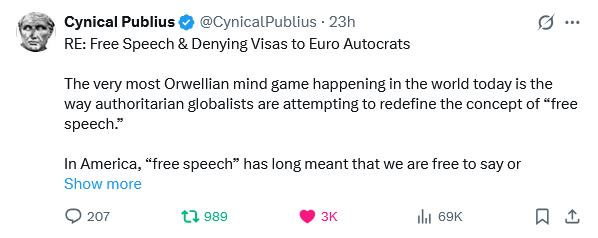
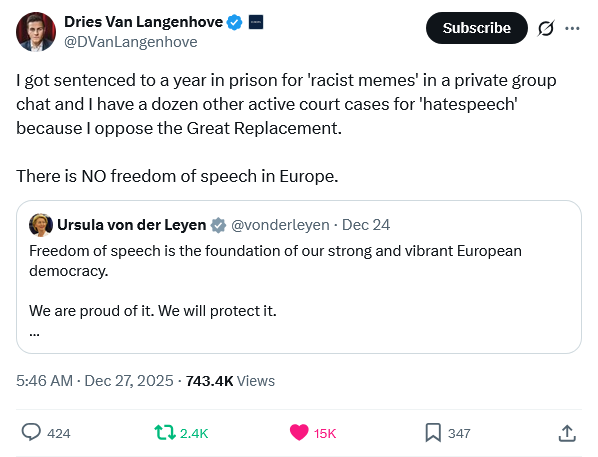
Britain slides further down the free speech rankings

At The Conservative Woman, Bruce Newsome reports on the parlous state of free speech in the United Kingdom:

SINCE 2021, the Index on Censorship has ranked Britain as “partially open” (the third tier). Britain ranks 20th for press freedom (worse than Trinidad and Tobago).

Just released: The US State Department concludes that in 2024, Britain’s human rights “worsened” and the British government is partial in protecting rights and freedoms: “Significant human rights issues included credible reports of serious restrictions on freedom of expression, including enforcement of or threat of criminal or civil laws in order to limit expression; and crimes, violence, or threats of violence motivated by antisemitism. The government sometimes took credible steps to identify and punish officials who committed human rights abuses, but prosecution and punishment for such abuses was inconsistent.”

There are three main categorical freedoms being routinely violated in Britain. In US Constitutional law, they are known as speech, assembly and press. British authorities need a reminder.

Let’s fully understand how this started, more than 25 years ago. In 1999, the Macpherson inquiry into the 1993 murder of Stephen Lawrence recommended that police should record hateful incidents as a matter of intelligence, even if the incidents were not criminal. Quangos led by the College of Policing encouraged police forces to record non-crime hate incidents (NCHIs). Police took it upon themselves to visit the supposed haters, to “correct your thinking“, to intimidate them with warnings of escalation, and even to strong-arm them into taking thought-correction classes with the police, at cost.

The 2006 Racial and Religious Hatred Act criminalises hatred of protected characteristics. It was once sold as a protection against violence, but was soon wielded to criminalise speech.

Police make more than 30 arrests a day (more than 10,000 per year) for online speech and record 66 non-crime hate incidents per day.

Despite several administrations claiming to review and restrict the definitions of hate speech and NCHIs, the definitions remain too vague to prevent police from repressing speech they don’t like. In 2024, the Free Speech Union submitted freedom of information (FoI) requests to all 43 police forces in England and Wales to see if recording went down since a new code of practice of June 2023. The number has actually increased. This year the current government sneakily signalled its appreciation of NCHIs in response to a petition to abolish them.

The latest statute aimed at free speech came into force on July 25: the Online Safety Act. The Bill was marketed as a necessary legislation to protect minors from harmful material such as pornography, self-harm forums, and bullying towards suicide. Like the Hatred Act, the Online Safety Act is being used to suppress politically inconvenient content.

British public authorities (and social media) are suppressing speech and the press selectively with political, religious and ethnic prejudice.

August 11, 2025

The problem with the theory that local government is more responsive is … people

Filed under: Government, Liberty, Politics, USA — Tags: , , — Nicholas @ 03:00

Poor Chris Bray is having a moment of deep cognitive dissonance over the vast chasm between his prior belief that local government is more sensible, more grounded, more responsive to the electorate than huge, distant, impersonal big government:

The more you deal with government, the more you are likely to agree with Thoreau

The problem of underlying principles and structural assumptions in a moment of profound cultural decay.

Like my old friend James Madison, the core of my understanding of political power is that authority becomes more rational and balanced as it gets closer to the people who are governed. Starting from home in my list of ideological priors, centralized power is usually going to be a steamroller, managed on top-down premises by people you’ve never met; local government, government by neighbors, is usually going to be more adept at listening and adapting. Your mayor is down the block, mowing his lawn. You can wave to him. When I worked at small town newspapers, I’d have breakfast with the city manager and the police chief — mostly so they could threaten to call my editor and have me fired, but still. They were here, right in front of me. I could talk to them. In the town where I’ve lived for a few years, now, I’ve waited at Trader Joe’s for a city councilman in cargo shorts and an old t-shirt to move over so I could get to the ground beef. They aren’t distant autocrats.

Sadly, though, a good few of them turn out to be proximate autocrats, and almost miraculously stupid. The problem with the theory of relatively well-balanced local authority is that some of the biggest goobers I’ve ever met have served on small town city councils and school boards, and your HOA board of literal neighbors makes Mussolini look like a hippie.

[Deleted a video here of an HOA officer being arrested, because it was staged.]

I wrote a quite carefully reported newspaper story about wasted money at a suburban school district, decades ago, that was critical but fair and elaborately sourced. The subsequent conversations I had with the members of the school board made me wonder if they had actual brain damage. No one on earth is more susceptible to psychotic conspiracy theories than small town elected officials, who respond to mild criticism by demanding to know WHO PUT YOU UP TO THIS, WHO ARE YOU REALLY WORKING FOR!?!?!?! WHAT’S YOUR TRUE AGENDA!?!?!?! WHO SENT YOU!?!?!?!? If you ask me for a list of the top ten people I’ve known personally and can’t stand at all, roughly eight of them were elected to local government positions in towns with low-five-figure populations, and I start grinding my teeth at the sound of their names. Wait, no: nine.

This topic is back on my mind this week because of Lina Hidalgo, though a county of five million people may be a bad example of real localism and neighborhood authority. Hidalgo is the county judge — in Texas, the chief executive officer — of Harris County. And she’s mad as a hatter. Click on the link to watch the video, but a tax increase is “not about politics, it’s about kids.” Never heard that one before.

[…]

Making appalling decisions at the head of broken institutions, they respond to criticism by hiring men with guns as a shield against ordinary human contact. Like I said, the mayor is down the block, mowing his lawn, so you can wave to hi—STOP RIGHT THERE, GET ON THE GROUND.

The spirit of the NSBA letter lives on in a thousand local offices, where the problem with running schools is that parents exist, and the problem with running cities is that they have people in them.

August 10, 2025

Nova Scotia rediscovers the joys of dictatorial power

Filed under: Cancon, Government, Law, Liberty — Tags: , , , , — Nicholas @ 03:00

Clearly hankering for those glorious days when Canadians cowered in their homes due to the government’s public health diktats, Nova Scotia has now banned almost all outdoor activities in wooded areas across the province:

Image from Junk Economics

Nova Scotia’s Premier has decided that walking in the woods — yes, walking — is now so dangerous it carries a $25,000 fine.

Not for lighting a campfire. Not for running your ATV through dry brush. Not for tossing a cigarette. Just walking. In a province where there are currently four active wildfires … all under control.

This is not about preventing wildfires. This is about the politics of safety — and how governments turn fear into obedience.

I was born in Halifax, and my family’s roots run deep in Nova Scotia — deeper than the roads and towns that stand there now. Generations of my parents, grandparents, and great-grandparents — along with uncles, aunts, and cousins — are buried in its soil. My family weathered centuries of storms, wars, and political upheavals there, carving out a life from raw wilderness. This isn’t some detached policy rant from a distance. It’s personal. And it’s infuriating to watch a government use “safety” as a smokescreen for inaction, punishing people for living their lives while leaving the real problem unsolved.


The Problem They Didn’t Solve

In 2023, Nova Scotia suffered its worst wildfire season in history. At the time, the province had four Airbus H125 helicopters to fight fires.

In 2025, after all the smoke cleared and the “lessons learned” speeches were made, Nova Scotia … still has four Airbus H125 helicopters. Newer paint jobs, slightly upgraded safety features, same firefighting capacity. No fixed-wing aircraft. No surge ability. No major investment in manpower or pre-positioned crews.

The province didn’t fix the problem. They just hit refresh on the equipment list.

[…]


The Legal Overreach

The ban covers 89% of provincial land (Crown land) plus private forested land. Even if you own it, you can’t invite your mother over to walk her dog in your woods.

Section 7 of the Charter protects liberty, and the Forests Act was never intended to give cabinet the power to impose a province-wide walking ban. That’s legislative overreach wrapped in administrative convenience.

And the $25,000 fine? Grossly disproportionate — and in practice, quietly plea-bargained down because it’s more for optics than enforcement. A scarecrow penalty to make the Premier look tough on camera.


The Snitch Line and the COVID Flashback

Just like pandemic tip lines, Nova Scotia has invited citizens to report on each other for the crime of going for a picnic.

It’s hard to overstate how corrosive this is: encouraging suspicion, legitimising neighbour-against-neighbour policing, and normalising the idea that the government can criminalise any movement it decides is risky.

Of course, the commentariat is having a wonderful time of it:

And what may be the first issued fine under the provincial ban went to Jeff Evely:

August 3, 2025

QotD: Undermining cultural taboos

One of the longest running debates on this side of the great divide is about how best to work through the thicket of taboos created and maintained by the ruling class. Because so much of observable reality is now off limits, it is nearly impossible to contradict the prevailing orthodoxy and maintain a position in the public square. For example, there can be nothing interesting said about crime, because no one is allowed to discuss the demographic reality of crime. The facts themselves are taboo.

One side of the debate argues that the only way to break a taboo is to break a taboo, so the only way forward to is to talk frankly about these things. In the case of crime, for example, the dissident must always interject the demographic facts about crime into the debate, even if it makes the beautiful people shriek. Since most people know the facts, the shrieking by the beautiful people actually advances the cause. This line of reasoning is extended to all taboo subjects universally.

The other side of the debate points out that the taboo breakers always end up in exile or condemned to some ghetto. In fact, their deliberate breaking of taboos ends up reinforcing the taboo, as no one wants to end up like the heretics. Instead, this camp argues the dissident must come up with clever language that subtly mocks the taboos, but narrowly adheres to the rules. The recent use of the word “jogger” is an example of complying with the taboo, while undermining it.

The taboo breakers counter that this just results in an endless search for approved language to hint at unapproved things. It is just a form of self-deception, where the clever think they are in revolt when in reality they are just asking permission. The optics guys counter this by pointing out the obvious. The taboo breakers are removed from the process, so in reality their tactic is just quitting the game. Rather than take on the system in a meaningful way, they mutter epithets in their ghetto.

The Z Man, “Strategy, Tactics & Discipline”, The Z Blog, 2020-05-19.

August 1, 2025

Australia saw Britain’s awful Online Safety Act and said “hold my beer”

In The Freeman, Nicole James discusses how Australia’s attempt to protect young, innocent eyes from the terrors of the internet seems to be having all kinds of unforeseen impacts on adults:

Commonwealth Coat of Arms of Australia (1912).
Quarterly of six, the first quarter Argent a Cross Gules charged with a Lion passant guardant between on each limb a Mullet of eight points Or; the second Azure five Mullets, one of eight, two of seven, one of six and one of five points of the first (representing the Constellation of the Southern Cross) ensigned with an Imperial Crown proper; the third of the first a Maltese Cross of the fourth, surmounted by a like Imperial Crown; the fourth of the third, on a Perch wreathed Vert and Gules an Australian Piping Shrike displayed also proper; the fifth also Or a Swan naiant to the sinister Sable; the last of the first, a Lion passant of the second, the whole within a Bordure Ermine; for the Crest on a Wreath Or and Azure A Seven-pointed Star Or, and for Supporters dexter a Kangaroo, sinister an Emu, both proper.

Once upon a time, not so long ago, children roamed freely through the pixelated wilderness of the Internet, posting dog memes, finding kindred spirits in weird little corners of Tumblr, and learning how to contour like Kylie Jenner. It was all chaotic, noisy, and entirely normal.

Now? Well, welcome to Australia in 2025, where the new Online Safety Amendment (Social Media Minimum Age) Bill has galloped through Parliament like a runaway Shetland pony, banning under-16s from social media. This is a full-blown digital eviction. And the ban isn’t limited just to TikTok and Snapchat. It also extends to YouTube (yes, YouTube), where apparently autoplay is now considered a gateway drug.

And how will they enforce this sweeping national grounding? Age verification, of course. Potentially through facial recognition. Not for the kids, mind you; they’ll simply be locked out. It’s everyone else who’ll need to prove they’re not children. Because nothing says “welcome to adulthood” like having to scan your actual face just to post a birthday shoutout or watch a slow-cooker recipe reel. All to reassure a tech platform that you’re not a rogue 14-year-old with strong opinions and a ring light.

The bill’s spiritual mother, eSafety Commissioner Julie Inman Grant, who, fun fact, once interviewed for a job at the CIA to analyze serial killers, gave a passionate speech at the National Press Club called “Swimming Between the Digital Flags”. It sounded very beachy and breezy until you realized she meant regulatory flags, and not the ones you’d use at Bondi. Her point was clear: the online world is full of rips and sharks and emotional jellyfish, and children must be protected from being dragged under.

Which is noble. Obviously. But somewhere between “protect the kids” and “build a biometric panopticon”, the line got a little smeared.

And where, you might ask, were parents in all this? Sitting quietly in the back, apparently, while Canberra (Australia’s Washington, DC) appointed itself Mum, Dad, the school principal, and possibly even the family dog. Because this isn’t just about safety; it’s about who decides what kids can see, say, share, and, in the case of a few bold young TikTokers, lip-sync while delivering motivational speeches to two mildly traumatized budgies.

The idea behind the project is that children are being harmed online, and honestly, yes, some are. The Internet is not all kittens and cake recipes. But rather than investing in education or digital literacy, the government has opted for a full blackout. It’s like banning scissors because one kid snipped their fringe into a reverse mullet.

And here’s the kicker. The bill had a consultation period of just 24 hours. That’s less time than it takes to read the terms and conditions you just agreed to without reading. (Don’t lie, we’ve all done it.)

In that tight little window, more than 15,000 submissions were made, and while some were supportive, the vast majority sounded the alarm. LGBTQIA+ organizations warned of disconnected teens losing safe spaces. Indigenous advocates pointed out the risks of further digital exclusion. Psychologists, educators, digital rights groups, and even a Community Soccer Club raised concerns.

July 31, 2025

The intent of Britain’s Online Safety Act … and the actual implementation

In The Conservative Woman, Dr. Frederick Attenborough discusses the gap between what the Online Safety Act was intended to do and how it’s actually being enforced now that it’s the law of the land:

X posts like this may not be visible to uses in the UK under the age verification rules of the Online Safety Act.

At the heart of the regime is a requirement to implement “highly effective” age checks. If a platform cannot establish with high confidence that a user is over 18, it must restrict access to a wide category of “sensitive” content, even when that content is entirely lawful. This has major implications for platforms where news footage and political commentary appear in real time.

Ofcom’s guidance makes clear that simple box-ticking exercises, such as declaring your age or agreeing to terms of service, will no longer suffice. Instead, platforms are expected to use tools such as facial age estimation, ID scans, open banking credentials and digital identity wallets.

The Act also pushes companies to filter harmful material before it appears in users’ feeds. Ofcom’s broader regulatory guidance warns that recommender systems can steer young users toward material they didn’t ask for. In response, platforms may now be expected to reconfigure their algorithms to filter out entire categories of lawful expression before it reaches underage or unverified users.

One platform already moving in this direction is X. Its approach offers a revealing – and potentially sobering – glimpse of where things may be heading. The company uses internal signals, including when an account was created, any prior verification, and behavioural data, to estimate a user’s age. If that process fails to confirm the user is over 18, he or she is automatically placed into a sensitive content filtering mode. As the platform’s Help Center explains: “Until we are able to determine if a user is 18 or over, they may be defaulted into sensitive media settings, and may not be able to access sensitive media”.

This system runs without user opt-in and applies at scale. Depending on how X classifies it, filtered material may include adult humour, graphic imagery, political commentary or footage of violence. Already there are signs that lawful content is quietly being screened out.

One example came on July 25, the day the Act’s age-verification duties took effect, during a protest outside the Britannia Hotel in Seacroft, Leeds, where asylum seekers are being housed. A video showing police officers restraining and arresting a protester was posted on X, but quickly became inaccessible to many UK-based users. Instead, viewers saw the message: “Due to local laws, we are temporarily restricting access to this content until X estimates your age”.

West Yorkshire Police denied any involvement in blocking the footage. X declined to comment, but its AI chatbot, Grok, indicated that the clip had been restricted under the Online Safety Act due to violent content. Though lawful and clearly newsworthy, the footage was likely flagged by automated systems intended to shield children from real-world violence.

In The Critic, Christopher Snowdon explains the breakdown of trust between the British public and their government that the implementation of the Online Safety Act only exacerbates:

People are right to be concerned about this slippery slope and yet it cannot be denied that it is pornography enthusiasts who have been hardest hit by the Online Safety Act in the short term. They must now verify themselves in one of three ways, each less appealing than the last. They can submit their credit card details, they can scan in proof of ID, such as a passport, or they can take a photo of their face and allow AI to judge how old they are. If they want to maximise their chances of being the victim of blackmail and identity theft, they could do all three.

While we might not think twice about submitting our credit card details to Amazon or posting our photos on Instagram, there is an understandable reluctance to hand over private data in order to access dubious websites for the purposes of sordid acts of self-pollution. The government assures us that the data will be kept confidential but it is only two weeks since we learned about a data breach that led to the names of 19,000 Afghans who wanted to flee the Taliban being given to the Taliban and it is less than two months since the names and addresses of 6.5 million Co-op customers were stolen in a cyber-attack. Rightly or wrongly, millions of British plank-spankers and rug-tuggers do not wish to identify themselves to anybody.

The result is a surge in interest in Virtual Private Networks (VPNs) which allow internet users to access websites as if they were in a less censorious country. Half of the top ten free apps in Apple’s app download charts yesterday were for VPNs. Google Trends data show that searches for “VPN” have gone through the roof since Friday. Readers can draw their own conclusions from the fact that these searches have been peaking between midnight and 2am.

Downloading random VPNs comes with risks of its own and opens up a whole new world of illicit online activity from free Premier League football to the Dark Web. But there is a deeper reason to feel uneasy about this unintended, albeit predictable, consequence of paternalistic regulation. By driving another wedge between the state and the individual, it further normalises rule-breaking in a country where casual lawlessness is becoming part of daily life. A law-abiding society cannot long endure if the median citizen thinks that the law is an ass.

The breakdown of trust can be seen most clearly when the ordinary man or woman does not share the moral certainties of the governing class. Among smokers, a collapse in tax morale — the intrinsic motivation to pay taxes — has led to a huge rise in the consumption of illegal tobacco in recent years. Smokers no longer feel any obligation to pay taxes that are designed to impoverish them to a government that vilifies them. Cannabis smokers learn from an early age to be suspicious of a police force that they might otherwise respect. Motorists who are faced with 20mph speed limits that were introduced by people who hate private transport have no scruples about flouting the law.

July 29, 2025

“The free and open internet has now ceased to exist in the UK”

Britain, like Canada, has been moving toward a less free internet experience for ordinary users, the key bit of legislation in the UK being the Online Safety Act, which like Canada’s proposed Online Harms Act, provides tools to the government to clamp down on online activities they deem “unsafe”:

The free and open internet has now ceased to exist in the UK. Since Friday, anyone in Britain logging on to social media will have been presented with a censored, restricted version – a “safe” internet, to borrow the UK government’s language. Vast swathes of even anodyne posts are now blocked for the overwhelming majority of users.

The Online Safety Act was passed by the last Conservative government and backed enthusiastically by Labour. Both parties insisted it is necessary to protect children. Supposedly, its aim is to shield them from pornography, violence, terrorist material and content promoting self-harm. Age-verification checks, we were assured, would ensure that children would not be exposed to inappropriate content, but adults could continue using the internet as they please. Yet as we have seen over the past few days, on many major tech platforms, UK-based adults are being treated as children by default, with supposedly “sensitive” content filtered from everyone’s view.

Predictably, what is deemed “sensitive” and therefore censored goes well beyond pornography and obviously illegal or adult material. Already UK users of X have been blocked from viewing footage of an anti-asylum protest, a tweet calling for single-sex spaces and a video of a speech in parliament on the grooming-gangs scandal. Historical trivia, such as a thread on Richard the Lionheart, and classic artworks like Goya’s Saturn Devouring His Son have been shielded by the tech censors. A thread on X of examples of what has been censored under the Online Safety Act, collated by Benjamin Jones of the Free Speech Union, has itself been partially censored due to the Online Safety Act. Open, political debate online is now a thing of the past.

When the Online Safety Act was first put before parliament, supporters from all parties insisted that fears about its impact on free speech were overblown. “The worst misrepresentation I’ve heard is that the [Online Safety Act] will force tech companies to censor legal social-media posts”, insisted Chris Philp, the then minister for tech and digital economy, now the shadow home secretary, back in 2022. Anyone who warned that this vast new architecture of online speech regulation was obviously going to curtail free speech was presented as a friend of paedophiles, terrorists or the far right. This gaslighting was kept up right until the point the age filters were implemented. “The UK’s online safety regime is here. Will anybody notice?”, asked Politico the day before much of the internet disappeared. The Guardian, on the same day, pondered whether the new rules would be censorious enough.

Despite my financial plight, I’d been considering getting a VPN subscription in advance of the Canadian government getting some version of the Online Harms Act onto the books. Clearly many Brits had already gone that route, and the British government reacts with the care and subtlety one would expect:

July 25, 2025

QotD: Evolved threat display mechanisms

Filed under: Government, History, Liberty, Quotations, Science, Weapons — Tags: , , , , — Nicholas @ 01:00

Every single bird and mammal I can think of, even some reptiles and fish, will exhibit something that ethologists call “threat display” whenever it feels menaced. Dogs and cats, horses and cattle, geese and pigs all engage in what amounts to a form of violence reducing behavior, growling, snarling, puffing up with poison spines, spitting, and assuming various combative postures that tell an enemy, a rival, or a predator, “Better back off, or you’re gonna get hurt”. I even had a cuddly big pet rabbit once, who would snort, bare his teeth, and charge you with his big front claws if he didn’t like the cut of your jib.

Animals, especially predators, are all pretty good at risk assessment. I’m absolutely certain, as an enthusiastic student of evolution, that dinosaurs had different kinds of threat display mechanisms, too. Maybe even trilobites. They do their thing and they stay alive.

On the other hand, just suppose you’re walking down a badly-lit sidewalk in any town or city in this or practically any other country, when you’re suddenly approached by half a dozen tough-looking young punks. They could be a murderous gang of thugs out to “make their bones” or just the local hockey team. But if you pull out your 6 1/2 inch nickel-plated Smith & Wesson Model 29 .44 Magnum, and simply hold it down beside your leg, you could be arrested for “brandishing” and your attractive, shiny, valuable weapon stolen from you by sticky-fingered cops.

When it comes to threat display — which could save your life as well as the lives of those who make you feel uneasy — you don’t have the rights of a lowly blow-fish. The insanity of ignorant government pencil-necks forbidding four billion year old violence-reducing behavior cannot be overstated.

L. Neil Smith, “Maybe Even Trilobites”, Libertarian Enterprise, 2018-10-14.

July 23, 2025

Javier Milei is delivering “a man-made miracle” for Argentina

Niall Ferguson‘s thread on the social media site formerly known as Twitter, thanks to the Thread Reader App:

While the world fixates on Donald Trump’s populist cocktail of reciprocal tariffs and big, beautiful deficits, @JMilei is delivering a man-made miracle that should gladden the heart of every classical economist and quicken the pulse of all political libertarians.

@JMilei has brought monthly inflation down from 13% to 2%. The economy is now growing at an annual rate of 7%. Investors no longer shun Argentine bonds and stocks — indeed, they were among the best investments you could have made over the past two years. After a brief upward jump, the poverty rate has fallen from 42%, when Milei was elected, to 31%

These are astonishing feats. And they have ramifications that go far beyond South America. Free-market economics and political libertarianism are sometimes dismissed as a fad of the “neoliberal” 1980s, long ago superseded by the new populisms of the left and the right. Not so. The world has never seen a government more radically libertarian than @JMilei. But the amazing thing is not that it is working economically. The true miracle is that Milei’s shock therapy is working politically.

With his leather jacket and late ’60s mop top, @JMilei is part–rock star, part–mad professor, dancing, singing, and screaming his catch phrase: ¡Viva la libertad, carajo! — “Long live liberty, damn it!” It’s as if Joe Cocker had gone onstage at Woodstock and sung “I’ll Get By with a Little Help from My Friedman”. Never in the history of democracy has a tribune of the people won power this way.

July 19, 2025

QotD: William Wilberforce and the anti-slavery movement

Filed under: Books, Britain, History, Liberty, Quotations — Tags: , , , , — Nicholas @ 01:00

“What Wilberforce vanquished was something even worse than slavery,” says [Eric] Metaxas [in Amazing Grace], “something that was much more fundamental and can hardly be seen from where we stand today: he vanquished the very mindset that made slavery acceptable and allowed it to survive and thrive for millennia. He destroyed an entire way of seeing the world, one that had held sway from the beginning of history, and he replaced it with another way of seeing the world.” Ownership of existing slaves continued in the British West Indies for another quarter-century, and in the United States for another 60 years, and slave trading continued in Turkey until Atatürk abolished it in the Twenties and in Saudi Arabia until it was (officially) banned in the Sixties, and it persists in Africa and other pockets of the world to this day. But not as a broadly accepted “human good”.

There was some hard-muscle enforcement that accompanied the new law: the Royal Navy announced that it would regard all slave ships as pirates, and thus they were liable to sinking and their crews to execution. There had been some important court decisions: in the reign of William and Mary, Justice Holt had ruled that “one may be a villeyn in England, but not a slave,” and in 1803 William Osgoode, Chief Justice of Lower Canada, ruled that the institution was not compatible with the principles of British law. But what was decisive was the way Wilberforce “murdered” (in Metaxas’ word) the old acceptance of slavery by the wider society. As he wrote in 1787, “God almighty has set before me two great objects: the suppression of the slave trade and the reformation of manners”.

The latter goal we would now formulate as “changing the culture” — which is what he did. The film of Amazing Grace shows the Duke of Clarence and other effete toffs reeling under a lot of lame bromides hurled by Wilberforce on behalf of “the people”. But, in fact, “the people” were a large part of the problem. Then as now, citizens of advanced democracies are easily distracted. The 18th-century Church of England preached “a tepid kind of moralism” disconnected both from any serious faith and from the great questions facing the nation. It was a sensualist culture amusing itself to death: Wilberforce goes to a performance of Don Juan, is shocked by a provocative dance, and is then further shocked to discover the rest of the audience is too blasé even to be shocked. The Paris Hilton of the age, the Prince of Wales, was celebrated for having bedded 7,000 women and snipped from each a keepsake hair. Twenty-five per cent of all unmarried females in London were whores; the average age of a prostitute was 16; and many brothels prided themselves on offering only girls under the age of 14. Many of these features — weedy faint-hearted mainstream churches, skanky celebs, weary provocations for jaded debauchees — will strike a chord in our own time.

“There is a great deal of ruin in a nation,” remarked Adam Smith. England survived the 18th century, and maybe we will survive the 21st. But the life of William Wilberforce and the bicentennial of his extraordinary achievement remind us that great men don’t shirk things because the focus-group numbers look unpromising. What we think of as “the Victorian era” was, in large part, an invention of Wilberforce which he succeeded in selling to his compatriots. We, children of the 20th century, mock our 19th-century forebears as uptight prudes, moralists and do-gooders. If they were, it’s because of Wilberforce. His legacy includes the very notion of a “social conscience”: in the 1790s, a good man could stroll past an 11-year-old prostitute on a London street without feeling a twinge of disgust or outrage; he accepted her as merely a feature of the landscape, like an ugly hill. By the 1890s, there were still child prostitutes, but there were also charities and improvement societies and orphanages. It is amazing to read a letter from Wilberforce and realize that he is, in fact, articulating precisely 220 years ago what New Yorkers came to know in the Nineties as the “broken windows” theory: “The most effectual way to prevent greater crimes is by punishing the smaller.”

Mark Steyn, The [Un]documented Mark Steyn, 2014.

July 17, 2025

A renewed push to ban AfD from contesting elections in Germany

Filed under: Germany, Government, Law, Liberty, Media, Politics — Tags: , , , , , , — Nicholas @ 03:00

eugyppius updates us on the state of play as the various smaller parties in Germany try to ban Alternative für Deutschland (AfD) which had risen from fringe status to being the most popular political party after the last federal election:

I’m far from a sensationalist, and I’ve repeatedly discounted the likelihood of an AfD ban – not least because the German establishment and the left in particular have good reasons to keep the AfD around. Lately, however, I’ve begun to appreciate that there are deeper, systemic forces working against the AfD in this case. These forces are beyond anybody’s control and if nobody does anything, they may well end in political catastrophe that is much bigger than any single party.

Since the end of the Merkel era, the German left has become thematically scattered, and so they have retreated to the only coordinating issue the German left has ever had, which is hating the right. As climatism started to fade, the social welfare state exceeded its limits and mass migration went sour, AfD bashing became the sole unifying principle for much of the SPD, Die Linke and the Greens. Hating the right is particularly important because it keeps leftist politicians and their activist class on the same page. Without a crusade against the right, a great chasm opens between the antifa thugs who want to smash the state and destroy capitalism on the one hand and the schoolmarm leftoid establishment functionaries in the Bundestag who want to mandate gender-neutral language for the civil service on the other hand. What is more, the firewall against the AfD splits the right and keeps the shrinking left in government. It is a win-win for leftoids everywhere.

Recent events, however, show why things cannot continue as they are now indefinitely. Over time, our Constitutional Court will begin to fill with leftist justices supported by the left parties, who like the rest of the left will also want to ban the AfD. Brosius-Gersdorf and Kaufhold are omens here. Right now the system is held in perfect balance; the left talks a big game about wanting to stamp out the AfD, but they can always justify their hesitation by saying the outcome of ban proceedings is too uncertain. When the necessary judicial majority for an AfD ban is finally secured in Karlsruhe, everything changes. At that point, there will be no excuse for not proceeding with a ban. The activists and the NGOs will take to the streets if their political masters in Berlin don’t begin the process. The CDU will be brought around by media smear campaigns and antifa intimidation.

Keep in mind that this is not about the AfD, but about imperatives within the left itself. No amount of moderation, polite messaging or triangulation on the part of the AfD can get the left to stop or pursue other goals. Unless some exogenous force introduces a new unifying obsession for the left parties and their activists, they will never stop gnawing on this particular chew toy.

Practically, this probably means that the AfD has an expiration date. If they can’t get into government at the federal level and if nothing else changes, they will find themselves facing ban proceedings before a court stacked with leftists who hate them in the next 10 or 15 years. The federal elections in 2029 seem like the last opportunity to normalise the AfD before this final escalation.

People in the CDU need to realise how serious this is, because their fate hangs in the balance as much as the fate of the populist opposition to the right of them. It is absolutely necessary that they break the firewall and enter some kind of arrangement with the AfD before it is too late. It doesn’t matter how much the press freaks out. It doesn’t matter how many violent antifa thugs take to the streets. It doesn’t matter how many party headquarters the leftists invade and vandalise. The firewall will fail in one direction or the other, and if it fails with an AfD ban, we are all in very deep shit.

July 16, 2025

QotD: Slavery in history

Filed under: Britain, Government, History, Liberty, Quotations — Tags: , — Nicholas @ 01:00

The British Empire’s principal association with slavery is that it abolished it. Until William Wilberforce, the British Parliament and the brave men of the Royal Navy took up the issue, slavery was an institution regarded by all cultures around the planet as a constant feature of life … Britain expunged it from most of the globe.

It is pathetic but unsurprising how ignorant all these brave “anti-fascists” are. Yet there is a lesson here not just for Britain but for America, too: when a society loses its memory, it descends inevitably into dementia.

Mark Steyn, After America: Get Ready for Armageddon, 2011.

July 14, 2025

QotD: The inevitable endgame of power-for-power’s-sake

Filed under: Books, Government, Liberty, Quotations — Tags: , , , — Nicholas @ 01:00

One reason Hobbes’s “state of nature” thought experiment is so seductive is because, though the premise is glaringly false, the conclusions are true. Every Dissident should memorize this, it’s the most important passage in modern philosophy (if not the whole of philosophy, from Socrates on):

    I put for a general inclination of all mankind a perpetual and restless desire of Power after power, that ceaseth only in Death. And the cause of this is not always that a man hopes for a more intensive delight than he has already attained to, or that he cannot be content with a moderate power: but because he cannot assure the power and means to live well, which he hath present, without the acquisition of more.

Or, if you prefer it in slightly more modern English:

    Now I will tell you the answer to my question. It is this. The Party seeks power entirely for its own sake. We are not interested in the good of others; we are interested solely in power. Not wealth or luxury or long life or happiness: only power, pure power … Power is not a means, it is an end. One does not establish a dictatorship in order to safeguard a revolution; one makes the revolution in order to establish the dictatorship. The object of persecution is persecution. The object of torture is torture. The object of power is power. Now do you begin to understand me?

That’s the bedrock of human existence, right there: Power. Everything that isn’t Power is nothing, until Power requires it; when it’s no longer useful to Power, it becomes nothing again. Nietzsche would’ve understood O’Brien perfectly.

But please note: Human existence.

Human — animals aren’t like that. They can’t be. They’re not mere automata, as Descartes would have it, but they’re obviously not self-conscious, either. All that Green hooey about animals living in harmony with their environment is, nonetheless, true. They can’t do any other, because they’re animals. Only humans can see that extra step ahead, all the potential dangers that will never let him rest content with the power he has.

And existence – not life, existence. The world Hobbes and O’Brien describe with such terrifying eloquence isn’t life, it’s mere existence. O’Brien couldn’t see where his philosophy led, but Hobbes could:

    Whatsoever therefore is consequent to a time of War, where every man is Enemy to every man; the same is consequent to the time, wherein men live without other security, than what their own strength, and their own invention shall furnish them withal. In such condition, there is no place for Industry; because the fruit thereof is uncertain; and consequently no Culture of the Earth; no Navigation, nor use of the commodities that may be imported by Sea; no commodious Building; no Instruments of moving, and removing such things as require much force; no Knowledge of the face of the Earth; no account of Time; no Arts; no Letters; no Society; and which is worst of all, continual fear, and danger of violent death; And the life of man, solitary, poor, nasty, brutish, and short.

This is the end of power-for-power’s-sake. O’Brien was wrong about that boot stomping on a human face, forever. The “state of nature” doesn’t actually exist IN nature, but Big Brother’s Party created it artificially.

But for such a creation to continue, as O’Brien shows, it must be completely static … and that’s impossible. The opposite of Power is Entropy, and Entropy always wins in the end.

Severian, “Salute the Hat”, Founding Questions, 2021-12-07.

July 12, 2025

Noah Smith on how surprisingly well free market policies are working in Argentina

In the headline, you should read the unstated “surprising to far too many mainstream economists and political commentators”, but full credit to Noah Smith for admitting that Milei’s radical agenda has started to make life much better for ordinary Argentinians:

Javier Milei at CPAC in National Harbor, Maryland 20 February, 2025.
Photo by Gage Skidmore via Wikimedia Commons.

So to be clear, when I say that criticism of free markets has been overdone, I’m partly talking to myself. A couple of months ago, horrified by Trump’s tariff policies, I wrote an apology to libertarians, admitting that I had failed to see the political usefulness of their project in terms of maintaining economic sanity on the Right.

But it’s not just the political benefits of free markets that have been undersold; I think the purely economic advantages are also too often ignored.

Exhibit A is Javier Milei’s track record in Argentina. A year and a half ago, when Milei was elected President of Argentina, a bunch of left-wing economists warned darkly that his radical free-market program would lead to economic devastation:

    The election of the radical rightwing economist Javier Milei as president of Argentina would probably inflict further economic “devastation” and social chaos on the South American country, a group of more than 100 leading economists has warned … [S]ignatories include influential economists such as France’s Thomas Piketty, India’s Jayati Ghosh, the Serbian-American Branko Milanović and Colombia’s former finance minister José Antonio Ocampo …

    The letter said Milei’s proposals – while presented as “a radical departure from traditional economic thinking” – were actually “rooted in laissez-faire economics” and “fraught with risks that make them potentially very harmful for the Argentine economy and the Argentine people” … [T]he economists warned that “a major reduction in government spending would increase already high levels of poverty and inequality, and could result in significantly increased social tensions and conflict.”

    “Javier Milei’s dollarization and fiscal austerity proposals overlook the complexities of modern economies, ignore lessons from historical crises, and open the door for accentuating already severe inequalities,” they wrote.

Milei won anyway. His first big policy, and the one the lefty economists fretted about the most, was deep fiscal austerity. Argentina’s long-standing economic model, created by dictator Juan Peron in the 1950s, involved a large and complex array of public works projects and subsidies for various consumer goods like energy and transportation. Milei slashed many of these, as well as cutting pensions, civil service employment, and transfers to provinces. Overall, he cut public spending by about 31%, resulting in a near-total elimination of Argentina’s chronic budget deficit:

The point of all this cutting wasn’t just to remove state intervention in the economy — it was to stop inflation. Basically, macroeconomic theory says that if deficits are high and persistent enough, then they convince everyone that the government will eventually inflate its debt away by printing money (which becomes a self-fulfilling prophecy). And most or all countries that experience hyperinflation end up escaping it only when they get their fiscal house in order. Perpetual deficits were part of Argentina’s “Peronist” system, and it’s probably a good bet that this has been responsible for the periodic bouts of hyperinflation that it experiences.

[…]

But still, Milei’s success so far should make us somewhat more confident about free-market policies — especially when we evaluate them against the new socialist ideas that have been gaining currency in the U.S. In the past, socialists and other left-leaning economic thinkers advocated central planning and nationalization of industry; in recent years, they have taken to calling for expansion of the state through fiscal policy, mixing macroeconomic justifications with micro. At all times, they call for deficit-financed expansion of social programs; when fiscal hawks want to tame the deficits, the lefties warn of the short-term macroeconomic harms of austerity.

If you’re always more terrified of austerity than you are of deficits, expansion of the state — and of the deficit — becomes a one-way ratchet. This approach is very different than Keynesianism, which advocates stimulus to overcome recessions, followed by austerity during boom times. You’ll recognize it as bearing a distinct similarity to MMT; that pseudo-theory has largely fallen out of favor, but there are plenty of more respectable progressive types whose ideas nonetheless have a lot of this “macroleftist” flavor.

July 9, 2025

Argentina after 18 months of Milei’s leadership

All the mainstream media folks were predicting that Argentina would be an utter economic disaster after the election of Javier Milei. A few of them are starting to come around to admitting that Argentina seems to have made the right move:

What’s happening in Argentina is super impressive, but it’s not a miracle.

Yes, Milei’s reforms are generating great results, but that is exactly what libertarians and small-government conservatives said would happen.

Let’s start with this celebration of the amazing growth of private-sector wages since Milei took office in late 2023.

Or how about the astounding way that Milei has conquered inflation (I also like how this tweet mocks the statists like Piketty who frantically and erroneously warned that Milei’s election would produce an economic catastrophe).

[…]

Let’s close with another tweet.

Here’s Noah Smith, who is not a libertarian, shared two days ago.

Give him credit for acknowledging Milei’s success.

I’ll add two comments about this tweet, one about economic data and the other about predicting whether Milei would get great results.

Regarding data, I don’t think anyone should get overly excited by one month or one quarter of economic data. Even one year of data might create a misleading impression (which is why my Anti-Convergence Club is always based on decades of data). That being said, there is every reason to expect continuing strong results for Argentina.

Regarding predictions, Smith’s tweet asserts that libertarians didn’t expect Milei to be so wildly successful. At the risk of sounding like a politician, I agree and disagree.

  • The “agree” part is that many libertarians were worried at the beginning of Milei’s presidency that he might face immovable opposition from the Peronist-controlled legislature. We also worried that the special interest groups might launch massive – and successful – protests that would derail necessary reforms. So if you asked me in December 2023 for my prediction, I would not have been overflowing with optimism.
  • The “disagree” part is that I have always had total and absolute confidence that radical pro-market policies will produce great results, anywhere and everywhere. And I assume other libertarians (as well as Reagan-type conservatives) share my faith that good policies lead to good outcomes. So if I was told in December 2023 what Milei would have accomplished in his first 18 months, I would have fully expected the great news we now see.

In other words, what’s miraculous is that the reforms happened. The subsequent economic renaissance has been boringly inevitable (but totally wonderful).

P.S. I am cautiously optimistic that Milei will get more allies in the legislature after Argentina’s mid-term elections later this year.

« Newer PostsOlder Posts »

Powered by WordPress