
Published on 22 Jan 2015
“…and then you invented dirt lumps.” More of what COULD have been said in the NFL.
January 23, 2015
“NFL 2015” — A Bad Lip Reading of The NFL
Comments Off on “NFL 2015” — A Bad Lip Reading of The NFL
January 21, 2015
Napping
James Lileks takes a nap. It therefore (of course) provides the basis of a “Bleat” posting:
Another item of no surprise to any readers of this site is my enjoyment of, and insistence upon, and devotion to, difficult sentence structures. Also naps. I love naps. Didn’t use to; then we had a child. At first I napped on the floor, thinking it Spartan and manly, but eventually I saw the case for sleeping on a surface that did not leave flat indentations on my skill if I slept for more than 20 minutes. I don’t believe in napping on the sofa, Dagwood style; I don’t believe in napping while reclining in a chair. There’s a reason we sleep in beds. No one ever says “I don’t know how much sleep I’ll get tonight, so maybe I’d better sit in a chair and see how it works.” Bed. The humidifier for white noise. Phone on Airplane Mode. Set the alarm, and see you later.
It’s never occurred to me to study my naps, or chart them, or pick them apart for quality. There are good naps and bad ones. There are short naps that leave you refreshed, and short ones that leave you groggy. Long ones that seem to add a year to your life, and long ones that make you feel as though you emerged from a bog of tar. To be fair, long naps never leave me logy. Short naps can make me feel angry, because they weren’t longer naps.
But. I read a review for an app called Power Nap HQ, and it seemed interesting: it took nap data, based on your movements. You entered how much time you wanted to sleep, set a backup alarm, chose a sequence of sounds, and laid it next to you. It would report back on your movements, indicating the depth of the nap, and it would also record any abrupt sounds you made. Nicely designed, too. A buck. Bought it.
Calibrated the device, set all the options, and pressed the button to start the nap. Laid it next to me.
Got itchy. Dry skin. Scratched a little, and wondered if this would register on the device. This was the signal for my upper lip to report in as “slightly chapped,” requiring more minor motion, and I thought I might be confusing the app, which thinks this is light sleep. Or perhaps it doesn’t take any motion seriously until I’m inert for a long period of time. So I laid still.
Then I thought: now it’s going to think I’m asleep.
This nap wasn’t working out very well. You start to think about napping, napping doesn’t happen. You start to wait for the between-two-worlds moment when you’re aware that you’re having a dream, or are thinking of something you certainly did start but grew out of something you’d already forgotten, then the moment never comes. But the next thing I knew I was awake.
Sort of. Half awake. The alarm had not gone off, so I had not reached the desired quantity of sleep. I was up because my body was done with the noon ration of Diet Lime Coke, and wished to offload it. This I did, wondering how the app would read my absence. It would detect the motion, then the absence of motion, then motion, then – providing I got back to sleep – the absence of motion. I did what a man’s gotta do, then returned to bed to complete the nap. Fell back asleep. No dreams.
Woke, and thought: damn, I beat the alarm. Must be close. If I have one superpower, it is the ability to gauge the passage of time; if I knew what time it was 35 minutes ago, I can tell you what time it is now within a minute or so. This extends to naps: if I wake before the alarm, I usually know what the time will be. I laid there, waking, considering how the rest of the day would play out, then realized that the app would interpret my motionlessness as sleep. THE DATA WOULD BE IMPRECISE.
So I picked up the phone to see how long I’d actually slept.
I had overslept by 40 minutes.
The alarm had not gone off. The backup alarm had not gone off. It had not collected data. Other than that, best dollar I ever spent. Now I can remove it from my phone and sleep without worries.
Comments Off on Napping
January 18, 2015
Being an artist requires a fine sense of balance
#art #creativity pic.twitter.com/8mJUAISiDm
— Daedalus Howell (@daedalushowell) January 17, 2015
Comments Off on Being an artist requires a fine sense of balance
The Origins of Spinal Tap
From Open Culture, the original clip that got the Spinal Tap movie greenlighted:
When This is Spinal Tap came out over 30 years ago, it went over a lot of people’s heads. “Everybody thought it was a real band,” recalled director Rob Reiner. “Everyone said, ‘Why would you make a movie about a band that no one has heard of?’”
It’s hard to believe that lines like “You can’t dust for vomit” failed to come off as anything but a joke. But, to be fair, Hollywood comedies were generally straight-forward affairs in the ‘80s. Think Blues Brothers or Fletch. Fake documentaries weren’t a thing. And This is Spinal Tap looks and feels exactly like a rock documentary – the hagiographic voiceover, the shaky camera, the awkward interviews. The movie was just as unscripted as rock docs like Don’t Look Back, The Song Remains the Same and The Kids Are All Right. The film is not only a parody of the generally overblown silliness of rock and roll, it is also, as Newsweek’s David Ansen notes, “a satire of the documentary form itself, complete with perfectly faded clips from old TV shows of the band in its mod and flower-child incarnations.”
Comments Off on The Origins of Spinal Tap
QotD: The power of advertising
On Monday afternoon Harris came round; he had a cycling paper in his hand.
I said: “If you take my advice, you will leave it alone.”
Harris said: “Leave what alone?”
I said: “That brand-new, patent, revolution in cycling, record-breaking, Tomfoolishness, whatever it may be, the advertisement of which you have there in your hand.”
He said: “Well, I don’t know; there will be some steep hills for us to negotiate; I guess we shall want a good brake.”
I said: “We shall want a brake, I agree; what we shall not want is a mechanical surprise that we don’t understand, and that never acts when it is wanted.”
“This thing,” he said, “acts automatically.”
“You needn’t tell me,” I said. “I know exactly what it will do, by instinct. Going uphill it will jamb the wheel so effectively that we shall have to carry the machine bodily. The air at the top of the hill will do it good, and it will suddenly come right again. Going downhill it will start reflecting what a nuisance it has been. This will lead to remorse, and finally to despair. It will say to itself: ‘I’m not fit to be a brake. I don’t help these fellows; I only hinder them. I’m a curse, that’s what I am;’ and, without a word of warning, it will ‘chuck’ the whole business. That is what that brake will do. Leave it alone. You are a good fellow,” I continued, “but you have one fault.”
“What?” he asked, indignantly.
“You have too much faith,” I answered. “If you read an advertisement, you go away and believe it. Every experiment that every fool has thought of in connection with cycling you have tried. Your guardian angel appears to be a capable and conscientious spirit, and hitherto she has seen you through; take my advice and don’t try her too far. She must have had a busy time since you started cycling. Don’t go on till you make her mad.”
Jerome K. Jerome, Three Men on the Bummel, 1914.
Comments Off on QotD: The power of advertising
January 16, 2015
Dressing up as a North Korean general is racist … even if you’re Korean
Margaret Cho gets into hot water with the perpetually offended for dressing up as a North Korean general:
Korean-American comedian Margaret Cho did an impression of a North Korean general at the Golden Globes that many on Liberal Twitter attacked as racist because apparently not even people of Korean descent are allowed to make fun of Kim Jong Un.
In one of many jokes aimed at the recent Sony cyber-hack, Cho wore a Korean general costume and made fun of the lack of spectacle at the event:
“You no have thousand baby playing guitar at the same time. You no have people holding up many card to make one big picture,” she said in a thick accent. “You no have Dennis Rodman.”
Predictably, people went nuts.
The Guardian editor-in-chief Katharine Viner said Cho was “like, totes racist.” Time deputy tech editor Alex Fitzpatrick questioned how anyone could have seen the bit as anything but “broadly racist.” The International Business Times managing editor called the decision to allow it a “bad call.” And that’s just to name a few.
Cho defended herself, tweeting: “I’m of mixed North/South Korean descent — you imprison, starve and brainwash my people you get made fun of by me #hatersgonhate.”
Comments Off on Dressing up as a North Korean general is racist … even if you’re Korean
It’s always a good time to cut taxes
In a column explaining why he’s terrified that the “Modern Monetary Theory” folks might get anywhere near the levers of power, Tim Worstall fits in the best reason to cut taxes:
Given that we are discussing monetary policy it seems appropriate to bring Milton Friedman in here. And he pointed out that if you ever have a chance to cut taxes just do so. On the basis that politicians, any group of politicians, will spend the bottom out of the Treasury and more however much there is. So, the only way to stop ever increasing amounts of the the entire economy flowing through government is simply to constrain the resources they can get their sticky little mits on. We could, for example, possibly imagine a Republican from the Neanderthal wing of the party arguing that what the US really needs is another 7 carrier battle groups. And one from the even more confused than usual Progressive end of the Democratic Party arguing that each college student needs her own personal carrier battle group to protect her from the microaggressions of being asked out for a coffee. You know. Sometime. Maybe. If you want to?
Comments Off on It’s always a good time to cut taxes
January 15, 2015
QotD: Gin one-upsmanship
Here are some further notes on boozemanship, the art of coming out ahead when any question of drinking expertise or experience arises. This time they come not under the heading of wine, the usual field for this kind of contest, but under spirits and beer, where less is generally known. It’s strange that we in this country tend to be better informed about a foreign import, confined until recently to a tiny elite, than what have been our national drinks for nearly three hundred years.
First, a simple ploy with gin, equally effective in private house and pub. Asked what you’d like to drink, say simply, “Gin, please.” Wave away tonic, lemon, even ice and accept only a little water — bottled, naturally. Someone’s sure to ask you if that’s all you really want, etc. Answer, “Yes, I must say I like to be able to taste the botanicals, which just means I like the taste of gin, I suppose. Of course, a lot of people only like the effect.” Any gin-and-tonic drinkers in earshot will long to hit you with a meat axe, which after all is the whole object.
Later, switch to Scotch, saying in tones of casual explanation, “I get sick of these fully rectified spirits after a bit, don’t you?” That should draw a fairly blank stare. Then, “I mean I like a bit of the old pot still. Well, I just enjoy the touch of malt.” If that doesn’t clear things up much, say, “I’m sorry, I didn’t realize,” making it clear that you’re adding under your breath, “that I was talking to a bunch of peasants.”
Kingsley Amis, Everyday Drinking: The Distilled Kingsley Amis, 2008.
Comments Off on QotD: Gin one-upsmanship
January 14, 2015
QotD: Opera snobbery
Opera makes things double tricky. A big swath of humanity regards fondness for opera as highbrow in itself. The merest acquaintance with truly dedicated opera buffs will set you right on that. To them, brow-height-wise, the bel canto style that owns my affections — which is to say, early 19th-century Italian opera — ranks somewhere down there with roller derby and monster truck shows.
John Derbyshire, “Confessions of a Middlebrow”, Taki’s Magazine, 2014-05-22
Comments Off on QotD: Opera snobbery
January 12, 2015
If you’ve used the term “Streisand Effect”, you need to pay royalties now…
Techdirt‘s Mike Masnick isn’t asking for a lot, he just wants to ensure that his intellectual property is respected … in a way that ensures that his kids won’t starve in the street:
I have to admit that I had no idea that it had been 10 years since I coined the term “The Streisand Effect” until the SkepticHistory Twitter feed called my attention to it earlier this week. I had thought about saving this for the weekend “this week in history” post, but it seems worth delving into today — especially with folks like the thieves at Gawker Media putting up a whole story about it and stealing all the attention and whatnot.
So, yeah, ten years ago this week, I coined “the Streisand Effect,” which was actually on a story about how the Marco Beach Ocean Resort was all offended by the fact that Urinal.net (a site that, yes, still exists and is still being updated) had posted a photo of a urinal from the resort, and the resort insisted that it was illegal to use its name. As we pointed out, this stupid takedown request would only draw more attention, and then we wrote:
How long is it going to take before lawyers realize that the simple act of trying to repress something they don’t like online is likely to make it so that something that most people would never, ever see (like a photo of a urinal in some random beach resort) is now seen by many more people? Let’s call it the Streisand Effect.
That last link then went back to a 2003 story about how Barbra Streisand had sued photographer Kenneth Adelman for photographing her house from a helicopter. Adelman had been photographing the entire California coastline, hoping to use it to document coastal erosion, and posted all the photographs online. Streisand got upset that her coastal home was shown, and sued. But, of course, before this, no one knew (or cared) that it was Streisand’s home. The image had been viewed six times (including twice by Streisand’s lawyers), but following the news of the lawsuit, hundreds of thousands of people went to see the photo. It was a story that stuck with me, and seemed to be repeated every few months in some form or another. So when I saw that Urinal.net threat, I just jokingly said we should call such things “The Streisand Effect.”
Comments Off on If you’ve used the term “Streisand Effect”, you need to pay royalties now…
January 11, 2015
QotD: Always make a list
The wheel business settled, there arose the ever-lasting luggage question.
“The usual list, I suppose,” said George, preparing to write.
That was wisdom I had taught them; I had learned it myself years ago from my Uncle Podger.
“Always before beginning to pack,” my Uncle would say, “make a list.”
He was a methodical man.
“Take a piece of paper” — he always began at the beginning — “put down on it everything you can possibly require, then go over it and see that it contains nothing you can possibly do without. Imagine yourself in bed; what have you got on? Very well, put it down — together with a change. You get up; what do you do? Wash yourself. What do you wash yourself with? Soap; put down soap. Go on till you have finished. Then take your clothes. Begin at your feet; what do you wear on your feet? Boots, shoes, socks; put them down. Work up till you get to your head. What else do you want besides clothes? A little brandy; put it down. A corkscrew, put it down. Put down everything, then you don’t forget anything.”
That is the plan he always pursued himself. The list made, he would go over it carefully, as he always advised, to see that he had forgotten nothing. Then he would go over it again, and strike out everything it was possible to dispense with.
Then he would lose the list.
Said George: “Just sufficient for a day or two we will take with us on our bikes. The bulk of our luggage we must send on from town to town.”
“We must be careful,” I said; “I knew a man once—”
Harris looked at his watch.
“We’ll hear about him on the boat,” said Harris; “I have got to meet Clara at Waterloo Station in half an hour.”
“It won’t take half an hour,” I said; “it’s a true story, and—”
“Don’t waste it,” said George: “I am told there are rainy evenings in the Black Forest; we may be glad of it. What we have to do now is to finish this list.”
Now I come to think of it, I never did get off that story; something always interrupted it. And it really was true.
Jerome K. Jerome, Three Men on the Bummel, 1914.
Comments Off on QotD: Always make a list
January 4, 2015
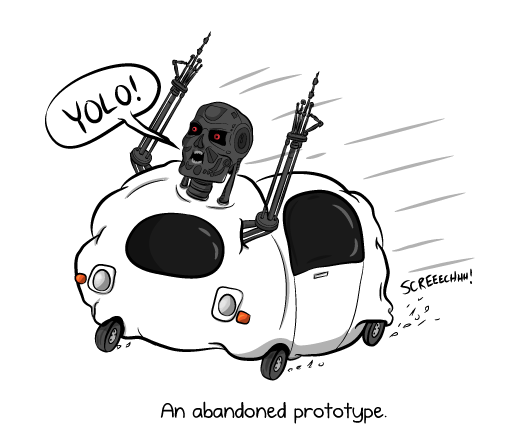
“Google self-driving cars are timid”
The Oatmeal got a chance to ride in one of Google’s self-driving cars, and learned six things from his experience:
2. Google self-driving cars are timid.
The car we rode in did not strike me as dangerous. It struck me as cautious. It drove slowly and deliberately, and I got the impression that it’s more likely to annoy other drivers than to harm them. Google can adjust the level of aggression in the software, and the self-driving prototypes currently tooling around Mountain View are throttled to act like nervous student drivers.
In the early versions they tested on closed courses, the vehicles were programmed to be highly aggressive. Apparently during these aggression tests, which involved obstacle courses full of traffic cones and inflatable crash-test objects, there were a lot of screeching brakes and roaring engines and terrified interns. Although impractical on the open road, part of me wishes I could have experienced that version as well.
Comments Off on “Google self-driving cars are timid”
QotD: Camping in the rain
Camping out in rainy weather is not pleasant.
It is evening. You are wet through, and there is a good two inches of water in the boat, and all the things are damp. You find a place on the banks that is not quite so puddly as other places you have seen, and you land and lug out the tent, and two of you proceed to fix it.
It is soaked and heavy, and it flops about, and tumbles down on you, and clings round your head and makes you mad. The rain is pouring steadily down all the time. It is difficult enough to fix a tent in dry weather: in wet, the task becomes herculean. Instead of helping you, it seems to you that the other man is simply playing the fool. Just as you get your side beautifully fixed, he gives it a hoist from his end, and spoils it all.
“Here! what are you up to?” you call out.
“What are you up to?” he retorts; “leggo, can’t you?”
“Don’t pull it; you’ve got it all wrong, you stupid ass!” you shout.
“No, I haven’t,” he yells back; “let go your side!”
“I tell you you’ve got it all wrong!” you roar, wishing that you could get at him; and you give your ropes a lug that pulls all his pegs out.
“Ah, the bally idiot!” you hear him mutter to himself; and then comes a savage haul, and away goes your side. You lay down the mallet and start to go round and tell him what you think about the whole business, and, at the same time, he starts round in the same direction to come and explain his views to you. And you follow each other round and round, swearing at one another, until the tent tumbles down in a heap, and leaves you looking at each other across its ruins, when you both indignantly exclaim, in the same breath:
“There you are! what did I tell you?”
Meanwhile the third man, who has been baling out the boat, and who has spilled the water down his sleeve, and has been cursing away to himself steadily for the last ten minutes, wants to know what the thundering blazes you’re playing at, and why the blarmed tent isn’t up yet.
At last, somehow or other, it does get up, and you land the things. It is hopeless attempting to make a wood fire, so you light the methylated spirit stove, and crowd round that.
Rainwater is the chief article of diet at supper. The bread is two-thirds rainwater, the beefsteak-pie is exceedingly rich in it, and the jam, and the butter, and the salt, and the coffee have all combined with it to make soup.
After supper, you find your tobacco is damp, and you cannot smoke. Luckily you have a bottle of the stuff that cheers and inebriates, if taken in proper quantity, and this restores to you sufficient interest in life to induce you to go to bed.
There you dream that an elephant has suddenly sat down on your chest, and that the volcano has exploded and thrown you down to the bottom of the sea — the elephant still sleeping peacefully on your bosom. You wake up and grasp the idea that something terrible really has happened. Your first impression is that the end of the world has come; and then you think that this cannot be, and that it is thieves and murderers, or else fire, and this opinion you express in the usual method. No help comes, however, and all you know is that thousands of people are kicking you, and you are being smothered.
Somebody else seems in trouble, too. You can hear his faint cries coming from underneath your bed. Determining, at all events, to sell your life dearly, you struggle frantically, hitting out right and left with arms and legs, and yelling lustily the while, and at last something gives way, and you find your head in the fresh air. Two feet off, you dimly observe a half-dressed ruffian, waiting to kill you, and you are preparing for a life-and-death struggle with him, when it begins to dawn upon you that it’s Jim.
“Oh, it’s you, is it?” he says, recognising you at the same moment.
“Yes,” you answer, rubbing your eyes; “what’s happened?”
“Bally tent’s blown down, I think,” he says. “Where’s Bill?”
Then you both raise up your voices and shout for “Bill!” and the ground beneath you heaves and rocks, and the muffled voice that you heard before replies from out the ruin:
“Get off my head, can’t you?”
And Bill struggles out, a muddy, trampled wreck, and in an unnecessarily aggressive mood — he being under the evident belief that the whole thing has been done on purpose.
In the morning you are all three speechless, owing to having caught severe colds in the night; you also feel very quarrelsome, and you swear at each other in hoarse whispers during the whole of breakfast time.
Jerome K. Jerome, Three Men in a Boat (to say nothing of the dog), 1889.
Comments Off on QotD: Camping in the rain
January 3, 2015
Urban Canada – where China’s one-child policy has been religiously observed
I can’t imagine what has gotten into David Warren to distract him from posts on the inner spirituality of the Catholic Church to suddenly turn to a bit of Canadian Ethnography:
… in a DINK household (“double income, no kids”) the rules subtly change, or rather change overtly, and no need remains for any sort of manliness. Indeed, should the woman make a substantial income, perhaps the man should consider living off her. She can claim him for a little break on her taxes, after all. Consider: housework, without kids, is a snip. And when his “partner” gets home, physically and emotionally exhausted from work, burning with the little humiliations she has suffered out there in the “real world,” and seriously hungry into the bargain — he can remind her that they are a “modern” couple. Tasks such as cooking should be shared equally.
This is old hat, of course. For the most part it also applies where the Red Chinese “one child policy” is obeyed, as across most of urban Canada.
I became exceptionally aware of the new arrangements in a visionary experience, twenty years ago. It consisted of attending a “bake sale” for the public school in which my sons were enrolled (temporarily, I assure you). I got to meet the whole “sorority” in my new liberal neighbourhood. (Kingston, Ontario: never go there.) This was mostly an “audio” vision, I should explain, though it had a video component. I’d never seen nor heard before so many whole-earth, left-wing, squeaky-voiced “house husbands,” all in one place. The immediate revelation was that spiritual emasculation actually changes a man’s voice in the same way physical emasculation does.
Among other discoveries was that the men had done most of the baking — which was good, for men often make better bakers. And we turn to the castrati to hit the highest notes.
The women, on the other hand, I could hear roar. The tone in which they addressed their squeakers was beyond instructive. I reflected that if a man spoke to his wife like that, in public, he’d be courting arrest. The feminists had now got exactly what they wanted.
There was more. The “gender” stereotypes had reversed at every other level. These women were now the sexual aggressors. I recall one in particular — an executive in a local “arts” operation — who had previously called me “fascist” as well as “sexist” in reference to something I had written in a newspaper. That she hated me still, I could take for granted. But right in front of her lamentable house-husband she was, unbelievably, “flirting” (although the term seemed over-refined). The wee fellow looked harmlessly outraged. He made sounds such as I imagine a gerbil makes when his mate shoves him aside. On his fidelity, I’m sure she could rely, for no other woman could want him. But she was trawling for something more masculine, herself.
Feminism alone could account for the collapse of the birth rate (which does, incidentally, have economic repercussions); for it operates at so many levels, from the neutering of males, to making females so extremely unattractive. But it cannot account for the rise of feminism. On that, I’m with Marx: it has a chiefly economic causation.
Comments Off on Urban Canada – where China’s one-child policy has been religiously observed
January 1, 2015
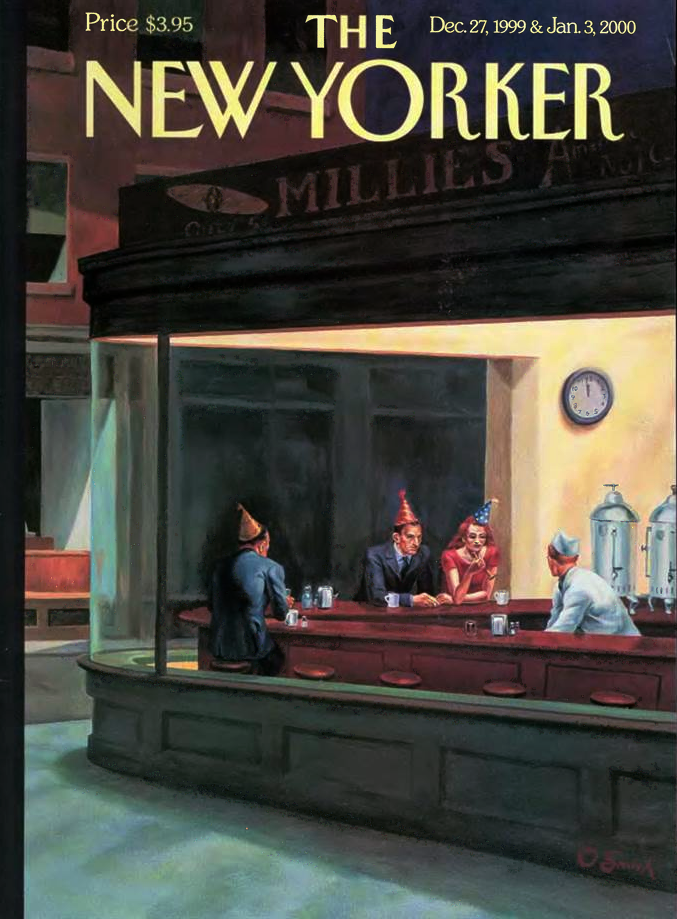
Oh, yeah … Happy New Year (with apologies to Edward Hopper)
Comments Off on Oh, yeah … Happy New Year (with apologies to Edward Hopper)


