
The shopkeeper in Germany does not fawn upon his customers. I accompanied an English lady once on a shopping excursion in Munich. She had been accustomed to shopping in London and New York, and she grumbled at everything the man showed her. It was not that she was really dissatisfied; this was her method. She explained that she could get most things cheaper and better elsewhere; not that she really thought she could, merely she held it good for the shopkeeper to say this. She told him that his stock lacked taste — she did not mean to be offensive; as I have explained, it was her method; — that there was no variety about it; that it was not up to date; that it was commonplace; that it looked as if it would not wear. He did not argue with her; he did not contradict her. He put the things back into their respective boxes, replaced the boxes on their respective shelves, walked into the little parlour behind the shop, and closed the door.
“Isn’t he ever coming back?” asked the lady, after a couple of minutes had elapsed.
Her tone did not imply a question, so much as an exclamation of mere impatience.
“I doubt it,” I replied.
“Why not?” she asked, much astonished.
“I expect,” I answered, “you have bored him. In all probability he is at this moment behind that door smoking a pipe and reading the paper.”
“What an extraordinary shopkeeper!” said my friend, as she gathered her parcels together and indignantly walked out.
“It is their way,” I explained. “There are the goods; if you want them, you can have them. If you do not want them, they would almost rather that you did not come and talk about them.”
Jerome K. Jerome, Three Men on the Bummel, 1914.
November 15, 2015
QotD: Shopping in Germany
November 14, 2015
QotD: Which religious group should organize your hypothetical rescue from terrorists?
Suppose you were kidnapped by terrorists, and you needed someone to organize a rescue. Would you prefer the task be delegated to the Unitarians, or the Mormons?
This question isn’t about whether you think an individual Unitarian or Mormon would make a better person to rush in Rambo-style and get you out of there. It’s about whether you would prefer the Unitarian Church or the Mormon Church to coordinate your rescue.
I would go with the Mormons. The Mormons seem effective in all sorts of ways. They’re effective evangelists. They’re effect[ive] fundraisers. They’re effective at keeping the average believer following their commandments. They would figure out a plan, implement it, and come in guns-blazing.
The Unitarians would be a disaster. First someone would interrupt the discussion to ask whether it’s fair to use the word “terrorists”, or whether we should use the less judgmental “militant”. Several people would note that until investigating the situation more clearly, they can’t even be sure the terrorists aren’t in the right in this case. In fact, what is “right” anyway? An attempt to shut down this discussion to focus more on the object-level problem would be met with cries of “censorship!”.
If anyone did come up with a plan, a hundred different pedants would try to display their intelligence by nitpicking meaningless details. Eventually some people would say that it’s an outrage that no one’s even considering whether the bullets being used are recyclable, and decide to split off and mount their own, ecologically-friendly rescue attempt. In the end, four different schismatic rescue attempts would run into each other, mistake each other for the enemy, and annhilate themselves while the actual terrorists never even hear about it.
(if it were Reform Jews, the story would be broadly similar, but with twenty different rescue attempts, and I say this fondly, as someone who attended a liberal synagogue for ten years)
One relevant difference between Mormons and Unitarians seems to be a cultural one. It’s not quite that the Mormons value conformity and the Unitarians value indivduality – that’s not exactly wrong, but it’s letting progressives bend language to their will, the same way as calling the two sides of the abortion debate “pro-freedom” and “anti-woman” or whatever they do nowadays. It’s more like a Mormon norm that the proper goal of a discussion is agreement, and a Unitarian norm that the proper goal of a discussion is disagreement.
There’s a saying I’ve heard in a lot of groups, which is something along the lines of “diversity is what unites us”. This is nice and memorable, but there are other groups where unity is what unites them, and they seem to be more, well, united.
Scott Alexander, “Reactionary Philosophy In An Enormous, Planet-Sized Nutshell”, Slate Star Codex, 2013-03-03.
November 10, 2015
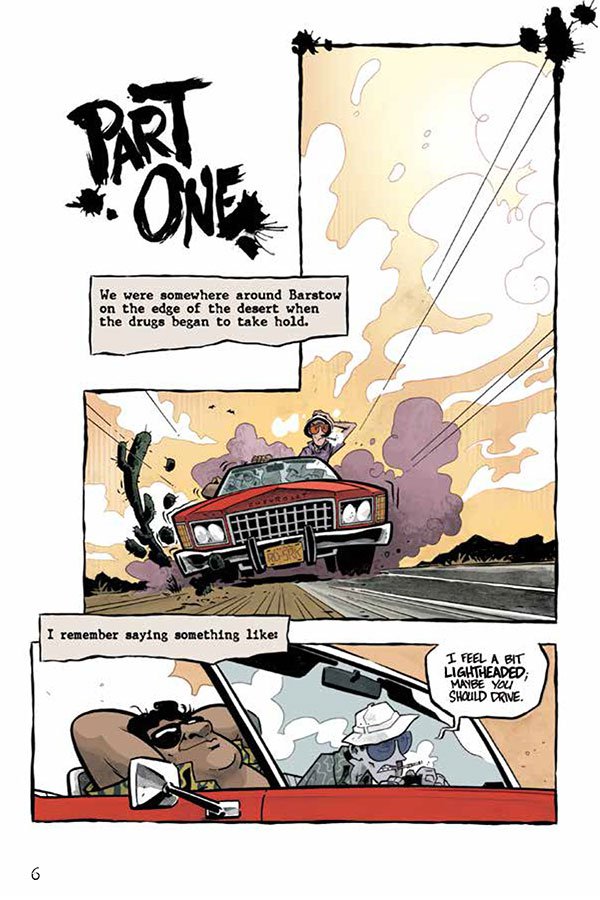
A graphic novelization of Fear and Loathing in Las Vegas
Hunter S. Thompson’s iconic book Fear and Loathing in Las Vegas has been re-imagined in Troy Little’s graphic novel:

November 9, 2015
Shocking cheese-related crime in France
Ace of Spades H.Q. has the details:
Sacre Vache! Thieves Steal 4 Tonnes of Comte Cheese, In What Police Are Calling “A Crime That Happened This Century”
Four tonnes of comte. Street value: almost one half of one million dollars, maybe more if you step on it and cut it with brie.
Police describe themselves as “vaguely interested” in this case.
Interpol has been called, but didn’t pick up a phone. So an email was sent. The email was marked, “When you get to it.”
Some thieves in France have made off with a rather odd prize recently — four tonnes of cheese.
Police were called to a break-in on Monday in which the owner of the Napier dairy in the town of Goux-les-Usiers discovered some crooks had stolen roughly 100 wheels of comte, a luxury cheese which can only be made in the Franche-Comte region using unpasteurised cow’s milk.
Unpasteurized — that’s the good shit. That’s what hooks you, that’s what makes you a junkie. Once you’re hooked on cheese made of unpasteurized milk, you’ll spend the rest of your life “Chasing the Cow,” walking down lonely streets and breaking into seedy fromageries looking to score your next “wheel.”
…
It might seem like a crime by someone with a fairly extreme dairy fetish, but police believe the cheese was stolen by a gang who will sell it on the black market.
Comte can sell for 40 [Euros] a pound, making it just as valuable to thieves as jewellery or electrical goods.
You can tell how “pure” cheese is by sticking your pinky into it and then rubbing the cream on your gums. If your gums feel like they’re on fire — that’s pure, baby.
November 8, 2015
The Legend of the Desk & the Far Ends of the Trenches I OUT OF THE TRENCHES
Published on 7 Nov 2015
Indy sits in the chair of wisdom again to answer your questions. And this time, we’re talking about the legend behind our desk and how the far ends of the trenches looked like. Don’t forget to ask us more questions.
Nobody wants to get on the Vikings bandwagon
Draw Play Dave finally came up with an idea for a comic about the Minnesota Vikings:
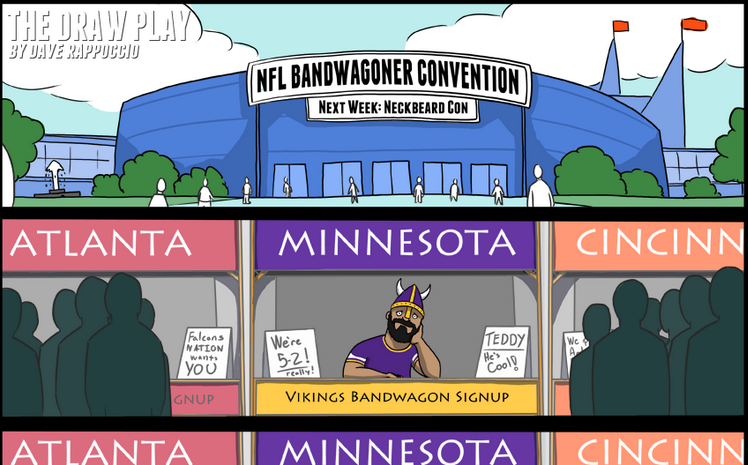
Click to see the full comic at The Draw Play
For a few months now I’ve been playfully jawing with a Vikings sportswriter on twitter (Arif Hasan, he’s good, you should read his stuff if you care about the Vikings) about making or not making a Vikings comic. He kept bugging me to make one. I actually wanted to, to be honest. The Vikings are one of the teams I’ve neglected over the past few years, and when there is no obvious comic material out there I usually try to pick a team I ignore and give it some love so people on reddit can call me an unfunny jerk because I mocked their team. So for months now I’ve been trying to come up with a Vikings comic, if only to give them some love and get Arif (who is the viking pictured here) to shut up. And I couldn’t do it, because the Vikings are the blandest, least interesting team I can possibly think of. How else can you explain the fact that they are currently 5-2 and are getting less media attention than basically every other team?
Every other team has interesting things about them that make them fun to follow. Some more than others obviously, but frankly every team seems to have something interesting going on. The Vikings don’t. Obviously Vikings fans are likely to disagree with me on that front because they are following the tiny minutiae more closely but from an outside fan perspective, even trying to find the Vikings interesting seems futile to the point where the only idea I can feasibly come up with is about how nobody cares. Teddy Bridgewater is progressing nicely, but he’s a boring QB. He’s got no personality, he’s got no quirks, no flair, and he’s not doing good enough or bad enough to really matter yet. The Defense is good, but not Denver good, or Seattle flashy, or Giants non-existent. Mike Zimmer was all sorts of hilariously blunt as a coordinator, but he never gives great soundbites anymore, or if he does nobody quotes him. About the only exciting thing going on right now is Stefon Diggs, who made the only interesting play of the season when he turned a Teddy overthrow into a beautiful lunging TD two weeks ago.
QotD: Small bits of French revenge
But [the German] is no gourmet. French cooks and French prices are not the rule at his restaurant. His beer or his inexpensive native white wine he prefers to the most costly clarets or champagnes. And, indeed, it is well for him he does; for one is inclined to think that every time a French grower sells a bottle of wine to a German hotel- or shop-keeper, Sedan is rankling in his mind. It is a foolish revenge, seeing that it is not the German who as a rule drinks it; the punishment falls upon some innocent travelling Englishman. Maybe, however, the French dealer remembers also Waterloo, and feels that in any event he scores.
Jerome K. Jerome, Three Men on the Bummel, 1914.
November 5, 2015
The koans of Zim Tzu – Bears edition
 It’s a great philosophical treat to get the words of Vikings head coach Mike Zimmer, as re-interpreted by the Daily Norseman‘s Ted Glover. Glover has made a life-long mission to understand the true meanings of the sometimes occult and difficult phrasing of Minnesota’s own warrior-poet, despite all the difficulties and problems of reducing the essence to the point that mere mortal sports fans can understand. Here’s Ted’s report after the Vikings barely managed to beat the Chicago Bears at Soldier Field last weekend:
November 4, 2015
QotD: Teaching old dogs new tricks
The older I get, the better I understand the saying “you can’t teach an old dog new tricks.” I used to think this referred to some weakness of the mind or obstinance, which I rejected as foolish and even cruel.
I’ve come to understand That saying differently. The older you get, the less patience, time, and energy you have with new things. You’ve seen decades of new things and are beginning to tire of their novelty. You only have so much time, and most of it is taken up with the rest of your life. And you have less energy to spend on something new.
In addition, the older you get, the more experience you have. Starting to learn a new operating system at 20 seems like just a matter of picking up some new tricks, but at 50 you realize just how long its going to take and how annoying its going to be after the previous 5 times through that process. And sometimes it feels like this old Far Side cartoon, where you’ve filled your mind up with 50+ years of stuff like old phone numbers, how to call information on a rotary phone, and the name of that character on Adam-12.
So its not so much you cannot teach an old dog new tricks. Its that the old dog has been through this once too often and has better things to do.
Christopher Taylor, “OLD DOGS”, Word Around the Net, 2014-10-20.
November 1, 2015
Every Press Conference Ever (ft. Weird Al Yankovic)
Published on 26 Oct 2015
Whether your team wins or loses, this is what the press conference sounds like after the game. Every time.
Terry Teachout on the great Victor Borge
Terry Teachout wrote about Danish comedian/pianist Victor Borge back in 2005:
I doubt that many people under the age of forty remember Victor Borge, the comedian-pianist who died in 2000 at the miraculous age of ninety-one. He was a star for a very long time, first on radio, then TV, and Comedy in Music, his 1953 one-man show, ran for 849 consecutive performances on Broadway, a record which so far as I know remains unbroken. From there he went on the road and stayed there, giving sixty-odd concerts in the season before his death. Borge spent his old age basically doing Comedy in Music over and over again, which never seemed to bother anybody. I reviewed it twice for the Kansas City Star in the Seventies, and loved it both times. His Danish-accented delivery was so droll and his timing so devastatingly exact that even the most familiar of his charming classical-music spoofs somehow remained fresh, as you can see by watching any of the various videos of his act.
It’s hard to imagine that there was a time when so popular a comedian started out as a serious musician, much less one who became popular by making witty fun of the classics. Such a thing could only have happened in the days when America’s middlebrow culture was still intact and at the height of its influence. Back then the mass media, especially TV, went out of their way to introduce ordinary people to classical music and encouraged them to take it seriously–which didn’t mean they couldn’t laugh at it, too, as Borge proved whenever he sat down to play.
Borge’s act resembled a straight piano recital gone wrong. He’d start to play a familiar piece like Clair de lune or the “Moonlight” Sonata, then swerve off in some improbable-sounding direction, never getting around to finishing what he started. Yet he was clearly an accomplished pianist, though few of his latter-day fans had any idea how good he’d been (he studied with Egon Petri, Busoni’s greatest pupil). He usually made a point of playing a piece from start to finish toward the end of every concert, and I remember how delighted I was each time I heard him ripple through one of Ignaz Friedman’s bittersweet Viennese-waltz arrangements, which he played with a deceptively nonchalant old-world panache that never failed to leave me longing for an encore. Alas, he never obliged, and in later years I found myself wondering whether he’d really been quite so fine as my memory told me.
QotD: Germany’s class system
As a trader, I am inclined to think the German will, unless his temperament considerably change, remain always a long way behind his Anglo-Saxon competitor; and this by reason of his virtues. To him life is something more important than a mere race for wealth. A country that closes its banks and post-offices for two hours in the middle of the day, while it goes home and enjoys a comfortable meal in the bosom of its family, with, perhaps, forty winks by way of dessert, cannot hope, and possibly has no wish, to compete with a people that takes its meals standing, and sleeps with a telephone over its bed. In Germany there is not, at all events as yet, sufficient distinction between the classes to make the struggle for position the life and death affair it is in England. Beyond the landed aristocracy, whose boundaries are impregnable, grade hardly counts. Frau Professor and Frau Candlestickmaker meet at the Weekly Kaffee-Klatsch and exchange scandal on terms of mutual equality. The livery-stable keeper and the doctor hobnob together at their favourite beer hall. The wealthy master builder, when he prepares his roomy waggon for an excursion into the country, invites his foreman and his tailor to join him with their families. Each brings his share of drink and provisions, and returning home they sing in chorus the same songs. So long as this state of things endures, a man is not induced to sacrifice the best years of his life to win a fortune for his dotage. His tastes, and, more to the point still, his wife’s, remain inexpensive. He likes to see his flat or villa furnished with much red plush upholstery and a profusion of gilt and lacquer. But that is his idea; and maybe it is in no worse taste than is a mixture of bastard Elizabethan with imitation Louis XV, the whole lit by electric light, and smothered with photographs. Possibly, he will have his outer walls painted by the local artist: a sanguinary battle, a good deal interfered with by the front door, taking place below, while Bismarck, as an angel, flutters vaguely about the bedroom windows. But for his Old Masters he is quite content to go to the public galleries; and “the Celebrity at Home” not having as yet taken its place amongst the institutions of the Fatherland, he is not impelled to waste his, money turning his house into an old curiosity shop.
Jerome K. Jerome, Three Men on the Bummel, 1914.
October 31, 2015
THE ORIGINAL Scary Mary Poppins Recut Trailer
Uploaded on 8 Oct 2006
This recut of the Disney classic Mary Poppins was made by myself, Christopher Rule
This contains the musical piece “A Violent Attack” composed by Caine Davidson for the film An American Haunting, “Stay Awake” written by Richard M. Sherman and Robert B. Sherman for Disney’s Mary Poppins, and stock sounds from iMovie. Clips filmed with a Panasonic MiniDV camera and edited on iMovie.
***** Please do not support the low-quality versions other people have uploaded to their channels against YouTube’s policy. Thanks to all! *****
October 30, 2015
State-by-state Google searches for Halloween costume ideas
Joey deVilla posted this earlier in October, and I now have to wonder about Illinois, too:

- It appears that the states of Louisiana and Arkansas are going as the primary hand-held weapons of World Wars 3 and 4: “gun” and “rock”.
- I had to look up “Doc McStuffins”, which sounded a lot like a male porn star name. It’s the name of a Disney show for kids, and its titular character, a seven year-old girl who’s a “doctor” for broken toys and doll.
- As a friend of mine commented earlier today: “I learned something new about Texas.”
- And finally, Illinois: “Slutty pumpkin?” Where’d that come from?
QotD: Maybe the Minnesota Vikings should also change their name
After the fiancée-punching scandal the NFL suffered this fall, the league is working on an anti-domestic-violence campaign; a new public-service announcement featuring about two dozen pro footballers debuted this Thursday during the Chargers–Broncos game. But the question persists: How can the NFL paint itself as progressive while it permits one of its franchises to use a patently offensive team name? Calling a team “the Vikings” is grotesquely insensitive to everyone concerned about domestic abuse. Minnesota might as well call its team “the Pillagers” or “the Rapists.”
Of course, the public’s attitude toward Vikings has changed over the years. According to a piece in The Spectator by Melanie McDonagh, “the Vikings-as-peaceful-traders approach has now been academic orthodoxy for two generations.” But according to an Aberdeen University historian named David Dumville, whom the piece quotes, “We’re being invited to forget vast amounts.” Dumville “puts the fashion for cuddly Vikings squarely down to ‘Swedish war guilt about not participating in the [second world] war and American political correctness.’” In fact, McDonagh writes, “the Vikings’ cruelty and joy in battle put them in a class of their own.” Per the article’s title, “the Vikings really were that bad.” And according to the Huffington Post, new research done at the University of Oslo suggests that Vikings’ slaves and sex slaves would be beheaded and buried with their deceased masters. Is the NFL promoting rape culture?
Josh Gelernter, “Cleaning up the NFL”, National Review, 2014-10-25.


