1 Stories of imagination tend to upset those without one.
2 A marriage is always made up of two people who are prepared to swear that only the other one snores.
3 Geography is just physics slowed down, with a couple of trees stuck in it.
4 An education was a bit like a communicable sexual disease. It made you unsuitable for a lot of jobs and then you had the urge to pass it on.
5 The truth may be out there, but the lies are inside your head.
6 Give a man a fire and he’s warm for the day. But set fire to him and he’s warm for the rest of his life.
7 Real stupidity beats artificial intelligence every time.
8 In ancient times cats were worshipped as gods. They have not forgotten this.
9 The space between the young readers eyeballs and the printed page is a holy place and officialdom should trample all over it at their peril.
10 “Educational” refers to the process, not the object. Although, come to think of it, some of my teachers could easily have been replaced by a cheeseburger.
Selected by Martin Chilton for The Telegraph, 2015-08-27.
December 6, 2015
QotD: A few selected Terry Pratchett quotes
December 5, 2015
The Terrible Mr. G
Uploaded on 26 Apr 2006
Guy playing CounterStrike gets recorded and remixed by someone at insoc.org.
Then I transcribed it, and a few years later, decided to make this subtitle video!
A life of crime … derailed
At American Digest, Gerard Van der Leun recalls how his budding teenage life of crime was brought to a sudden halt:
As a teenager my addiction to science fiction paperbacks often came into conflict with my ongoing cash-flow problem. To wit, I hadn’t any. But, for a few brief, shining weeks I did discover a resource better than cash for acquiring science-fiction paperbacks — my pants.
Yes, at some point it dawned on my tiny teenage brain that, if I could just get these piles of paper down the front of my pants and walk without a waddle out the door of the store, the latest Asimov or Heinlein would be free. What was even better was my discovery that I could, after reading these stolen gems, take them back to the bookstore from which I boosted them and sell them back to that dull owner for a credit to buy other paperbacks. Cost of stock: $0, Price received: $0.25, Profit — infinite. What a business! I was a confirmed capitalist. I even thought of a name for my company, World Wide Pants, and was quite upset years later when David Letterman stole it from me.
Of course I knew on some level that stuffing things down my pants, waddling out of a store and then coming back later to sell the purloined items back was …. a teeny bit wrong. But the bookstore owner had so many science fiction books and I had so few. “From bookstores according to their stock, to me according to my need to read,” seemed to be my moral code at the time. Besides, I wasn’t “really” stealing them because I “returned” them for a fee. It was a way of letting the bookstore owner sort of reverse-rent them to me.
I started small — maybe a slim collection of short stories like The Green Hills of Earth, or a novella such as “Children of the Atom,” would find their way to their temporary home between my belt and my underwear. But then I decided to expand. After all, it seemed to me that my pants had room to spare especially if I let my shirt tails hang out. Once that was in my mind, I started to up the ante and began to go for multiple copies of Ace Doubles. My pants became, in effect, a small bookshelf.
The owner of the bookstore down in the slums of Sacramento was, I was certain, clueless as to what was going on. He was a wispy simulacra of William Burroughs with the gray haze of alcohol hovering about him and a tendency to give me a smile that was a little too warm whenever I came into the shop. He’d often disappear into a curtained nook with the sign “Special Titles — Ask for admittance” thumbtacked to the bookshelf next to it.
My undoing came one day when I think I had probably added a full two inches to my waistline in the science fiction section. I waddled to the cash register with one tattered copy of some space opera and slid my quarter across the counter. He looked at it, looked at me, took the quarter and slid the book into a flimsy paper bag and handed it back. “See you soon,” he said with a wink. I turned and had gotten out the door and a couple of steps down the sidewalk when the bony hand of retribution clutched my shoulder. “I see you’re gaining a little weight,” he said in a voice that betrayed an unhealthy interest in Lucky Strikes. “I think we need to talk to your parents about this. Come on back in.”
There’s no way to describe the churning, burning hunk of fear that forms in your stomach the first time you’re busted. If, at that moment, you could chose between death and juju, death would win every time — but only because you don’t know that you’ll get death only after juju.
QotD: The modern dating scene … and texting
Last year I rejoined the ranks of the spouse-free. Things sure changed since the last time I was single.
For starters, it is not necessary for men to ask women for revealing selfies. Those photos just start showing up on your phone after you exchange numbers. A revealing selfie in 2014 is essentially just a digital business card for your dating life.
I have also discovered that the most-used characters on my phone keyboard are emoticons. When single people text each other, every sentence has to end with an exclamation mark or a smiley emoticon or else it looks like you lost interest since the last time you texted thirty seconds ago.
For the most part, texting is just a means of feeling connected at a distance. The content isn’t terribly important. But the pauses between text messages mean A LOT. Single people monitor the pauses between text replies to decipher real meaning in the content. For example, if I text “I really enjoyed our time together,” the real message is contained in the timing of the message not the content. If the text is sent while one person is still driving home from a date, that means you feel a strong connection. But if I text something nice and have to wait seven hours for a reply, the seven-hour wait is the message, not the content of the reply.
Single people in 2014 frequently break up with each other by text, but the words are only the punctuation at the end of the break up. The actual break-up happens with what is called “the taper.” The taper is when you are texting someone at a predictable rate, such as several times per day, and you gradually reduce your texting to one message every third day. That’s the taper, and it tells the other person your interest has tapered too.
Scott Adams, “The Tyranny of Expectations”, Scott Adams Blog, 2014-11-24.
November 30, 2015
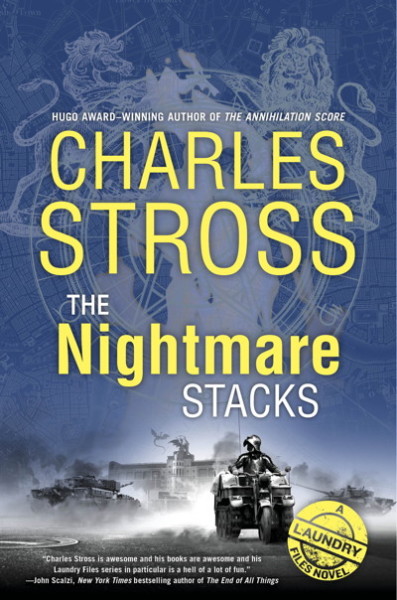
Charles Stross cover reveal for The Nightmare Stacks

The Nightmare Stacks (UK edition)

The Nightmare Stacks (North American edition)
Charlie Jane Anders talked to Charles about the book and the series:
How has the Laundry Files series changed and evolved in the dozen years or so that you’ve been writing it? Are there elements that you’re still surprised became so prominent?
I’ve been writing the Laundry Files series for 16 years at this point. When I began, I intended the short novel “The Atrocity Archive” (published with “The Concrete Jungle” in the book The Atrocity Archives — note the plural!) as a one-shot. It was only a few years later, when people began asking for more, that I had any idea of writing a sequel, and only with the third book, 8 years in, that I realized I needed a Plan. And because the book’s narrator, Bob, had been aging in line with the real world as I wrote the first three books, the most obvious plan was: track Bob’s career as he grows older, more senior, and more cynical.
This turned out to be a really fortuitous choice. It allowed me to fix some minor inconsistencies in the earlier books; because they’re Bob’s workplace memoir, he often gets the wrong end of the stick at first then learns better about some aspect of the job over time. It also allowed me to deepen him as a character, adding complexity to the narrative as he ages and possibly becomes more self-aware (although he doesn’t really have to grow up until books 8 or 9).
What I really wasn’t expecting was that Bob’s life would take over — and that the most important events in it would end up taking place off-screen, so far off-screen that I needed to pick new narrative voices! His wife Mo, for example, exhibits a very unvarnished perspective on Bob’s seemingly bottomless reserves of self-delusion in The Annihilation Score, and demonstrates that the series is very much about the Laundry as an organization, rather than just being Tales of Bob. And in The Nightmare Stacks I had to leave Bob behind entirely in order to give a worm’s eye view of the start of events that will give rise (eventually) to the climax of the series.
This book features a new character, Alex, instead of Bob. What’s the reason for switching focus?
In The Atrocity Archives Bob starts out as a twenty-something tech support guy who has blundered into a Len Deighton spy thriller (with added tentacles). By the start of The Rhesus Chart, Bob has leveled up so far that he can wade into a nest of vampires — admittedly rather inexperienced vampires — and escape with mildly damaged dignity and a stack of paperwork. Power-ups are a constant problem for any multi-book series that riffs off the Hero’s Journey: how do you engage with the underdog when your protagonist has risen from Midshipman to Admiral of the Fleet?
Alex is in some ways not dissimilar to Bob in his early incarnation. There are drastic differences: Alex has powers of his own — although they come at a drastic price. But Alex takes us back to the guy who gets sent to fix the cabling rather than spending all his time in policy meetings. And he’s got a young guy’s problems and social anxieties, unlike Bob (who by this point is in his early forties).
November 29, 2015
President Nero
Last month, David Warren wrote about the Emperor Nero as if he were a modern American president:
While Rome burned, it is said, the Emperor Nero golfed, partied, and selfied. This, anyway, is my updated account. In an earlier version, he played his fiddle. The fire, which broke out in the evening of 18th July, 64 anno Domini (or 817, ab urbe condita), continued for a week, levelling ten of pagan Rome’s fourteen districts, and leaving at least half a million homeless. I gather it started in the merchant quarter, where fires usually started, back then. There were lots of merchants; there were lots of warehouse fires. And this despite numerous municipal regulations.
Read your Tacitus, however, and you will see that this rumour has been corrected. In fact, Nero rushed back to Rome from his palace at Antium (just outside the Beltway), took charge of the fire-fighting operation from the first night, opened public buildings and his own gardens to shelter the dispossessed, and made immediate arrangements to import huge quantities of grain into the city, for distribution free or at nominal cost. Criticisms of his Department of Homeland Security were feverish and unfair.
There is another problem with this rumour. The violin was not invented for another fifteen hundred years. Those still circulating the story should say he was playing on his cythera, instead. Nero was an enthusiastic and accomplished amateur musician; perhaps some people resented it. He was a man of culture; an Ivy League guy. But he was also an accomplished politician, and nobody’s fool.
Rumours that he set this fire himself are about as likely as rumours that George Bush started Hurricane Katrina. It would not have been in the chief executive’s interest to do so, in either case. For Nero was already sinking in the polls — curiously not because he’d ascended to office by having his mother kill his uncle, then killing his mother in turn; or many similar instances of hardball. Politics was politics then as now; success is to the ruthless. No, Nero was unpopular thanks to his growing reputation for ineffectuality. His failure to stop the fire hurt him in the same way as Bush’s failure to stop the hurricane.
After consulting with a few focus groups, Nero decided upon a scapegoat. He chose the Christians. He accused them of complicity in setting the fire, and his subsequent persecution of them — which included the martyrdoms of Saint Peter and Saint Paul — probably improved his popularity rating, at least slightly. From what I can make out, the early Christians were not well liked. People thought they were spooky and weird.
QotD: German women
If anything change the German character, it will be the German woman. She herself is changing rapidly — advancing, as we call it. Ten years ago no German woman caring for her reputation, hoping for a husband, would have dared to ride a bicycle: to-day they spin about the country in their thousands. The old folks shake their heads at them; but the young men, I notice, overtake them and ride beside them. Not long ago it was considered unwomanly in Germany for a lady to be able to do the outside edge. Her proper skating attitude was thought to be that of clinging limpness to some male relative. Now she practises eights in a corner by herself, until some young man comes along to help her. She plays tennis, and, from a point of safety, I have even noticed her driving a dog-cart.
Brilliantly educated she always has been. At eighteen she speaks two or three languages, and has forgotten more than the average Englishwoman has ever read. Hitherto, this education has been utterly useless to her. On marriage she has retired into the kitchen, and made haste to clear her brain of everything else, in order to leave room for bad cooking. But suppose it begins to dawn upon her that a woman need not sacrifice her whole existence to household drudgery any more than a man need make himself nothing else than a business machine. Suppose she develop an ambition to take part in the social and national life. Then the influence of such a partner, healthy in body and therefore vigorous in mind, is bound to be both lasting and far-reaching.
For it must be borne in mind that the German man is exceptionally sentimental, and most easily influenced by his women folk. It is said of him, he is the best of lovers, the worst of husbands. This has been the woman’s fault. Once married, the German woman has done more than put romance behind her; she has taken a carpet-beater and driven it out of the house. As a girl, she never understood dressing; as a wife, she takes off such clothes even as she had, and proceeds to wrap herself up in any odd articles she may happen to find about the house; at all events, this is the impression she produces. The figure that might often be that of a Juno, the complexion that would sometimes do credit to a healthy angel, she proceeds of malice and intent to spoil. She sells her birth-right of admiration and devotion for a mess of sweets. Every afternoon you may see her at the café, loading herself with rich cream-covered cakes, washed down by copious draughts of chocolate. In a short time she becomes fat, pasty, placid, and utterly uninteresting.
When the German woman gives up her afternoon coffee and her evening beer, takes sufficient exercise to retain her shape, and continues to read after marriage something else than the cookery-book, the German Government will find it has a new and unknown force to deal with. And everywhere throughout Germany one is confronted by unmistakable signs that the old German Frauen are giving place to the newer Damen.
Jerome K. Jerome, Three Men on the Bummel, 1914.
November 28, 2015
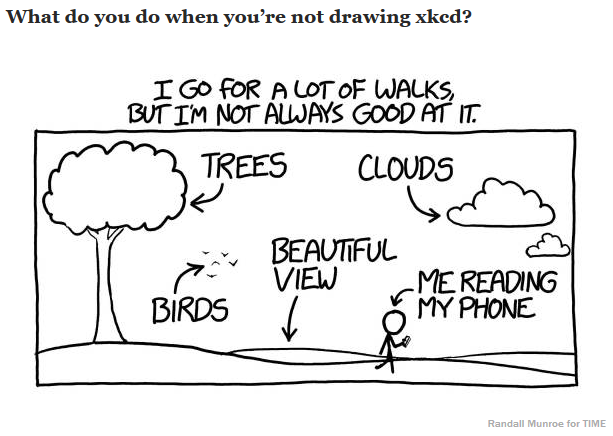
Time interviews Randall Munroe of xkcd
It’s an unusual interview, as Munroe responded to each question with a one-panel comic:
November 22, 2015
The Problem with Time & Timezones – Computerphile
Published on 30 Dec 2013
A web app that works out how many seconds ago something happened. How hard can coding that be? Tom Scott explains how time twists and turns like a twisty-turny thing. It’s not to be trifled with!
H/T to Jeremy for the link.
QotD: Bargaining in Germany
On another occasion I listened in the smoke-room of a German hotel to a small Englishman telling a tale which, had I been in his place, I should have kept to myself.
“It doesn’t do,” said the little Englishman, “to try and beat a German down. They don’t seem to understand it. I saw a first edition of The Robbers in a shop in the Georg Platz. I went in and asked the price. It was a rum old chap behind the counter. He said: ‘Twenty-five marks,’ and went on reading. I told him I had seen a better copy only a few days before for twenty — one talks like that when one is bargaining; it is understood. He asked me ‘Where?’ I told him in a shop at Leipsig. He suggested my returning there and getting it; he did not seem to care whether I bought the book or whether I didn’t. I said:
“‘What’s the least you will take for it?’
“‘I have told you once,’ he answered; ‘twenty-five marks.’ He was an irritable old chap.
“I said: ‘It’s not worth it.’
“‘I never said it was, did I?’ he snapped.
“I said: ‘I’ll give you ten marks for it.’ I thought, maybe, he would end by taking twenty.
“He rose. I took it he was coming round the counter to get the book out. Instead, he came straight up to me. He was a biggish sort of man. He took me by the two shoulders, walked me out into the street, and closed the door behind me with a bang. I was never more surprised in all my life.
“Maybe the book was worth twenty-five marks,” I suggested.
“Of course it was,” he replied; “well worth it. But what a notion of business!”
Jerome K. Jerome, Three Men on the Bummel, 1914.
November 20, 2015
QotD: Rolling Stone
… Rolling Stone morphed into AARP Magazine so slowly, I hardly even noticed.
Ed Driscoll, “Plutocrat Millionaires Insult Military Veterans”, PJ Media, 2014-11-14.
November 15, 2015
QotD: Shopping in Germany
The shopkeeper in Germany does not fawn upon his customers. I accompanied an English lady once on a shopping excursion in Munich. She had been accustomed to shopping in London and New York, and she grumbled at everything the man showed her. It was not that she was really dissatisfied; this was her method. She explained that she could get most things cheaper and better elsewhere; not that she really thought she could, merely she held it good for the shopkeeper to say this. She told him that his stock lacked taste — she did not mean to be offensive; as I have explained, it was her method; — that there was no variety about it; that it was not up to date; that it was commonplace; that it looked as if it would not wear. He did not argue with her; he did not contradict her. He put the things back into their respective boxes, replaced the boxes on their respective shelves, walked into the little parlour behind the shop, and closed the door.
“Isn’t he ever coming back?” asked the lady, after a couple of minutes had elapsed.
Her tone did not imply a question, so much as an exclamation of mere impatience.
“I doubt it,” I replied.
“Why not?” she asked, much astonished.
“I expect,” I answered, “you have bored him. In all probability he is at this moment behind that door smoking a pipe and reading the paper.”
“What an extraordinary shopkeeper!” said my friend, as she gathered her parcels together and indignantly walked out.
“It is their way,” I explained. “There are the goods; if you want them, you can have them. If you do not want them, they would almost rather that you did not come and talk about them.”
Jerome K. Jerome, Three Men on the Bummel, 1914.
November 14, 2015
QotD: Which religious group should organize your hypothetical rescue from terrorists?
Suppose you were kidnapped by terrorists, and you needed someone to organize a rescue. Would you prefer the task be delegated to the Unitarians, or the Mormons?
This question isn’t about whether you think an individual Unitarian or Mormon would make a better person to rush in Rambo-style and get you out of there. It’s about whether you would prefer the Unitarian Church or the Mormon Church to coordinate your rescue.
I would go with the Mormons. The Mormons seem effective in all sorts of ways. They’re effective evangelists. They’re effect[ive] fundraisers. They’re effective at keeping the average believer following their commandments. They would figure out a plan, implement it, and come in guns-blazing.
The Unitarians would be a disaster. First someone would interrupt the discussion to ask whether it’s fair to use the word “terrorists”, or whether we should use the less judgmental “militant”. Several people would note that until investigating the situation more clearly, they can’t even be sure the terrorists aren’t in the right in this case. In fact, what is “right” anyway? An attempt to shut down this discussion to focus more on the object-level problem would be met with cries of “censorship!”.
If anyone did come up with a plan, a hundred different pedants would try to display their intelligence by nitpicking meaningless details. Eventually some people would say that it’s an outrage that no one’s even considering whether the bullets being used are recyclable, and decide to split off and mount their own, ecologically-friendly rescue attempt. In the end, four different schismatic rescue attempts would run into each other, mistake each other for the enemy, and annhilate themselves while the actual terrorists never even hear about it.
(if it were Reform Jews, the story would be broadly similar, but with twenty different rescue attempts, and I say this fondly, as someone who attended a liberal synagogue for ten years)
One relevant difference between Mormons and Unitarians seems to be a cultural one. It’s not quite that the Mormons value conformity and the Unitarians value indivduality – that’s not exactly wrong, but it’s letting progressives bend language to their will, the same way as calling the two sides of the abortion debate “pro-freedom” and “anti-woman” or whatever they do nowadays. It’s more like a Mormon norm that the proper goal of a discussion is agreement, and a Unitarian norm that the proper goal of a discussion is disagreement.
There’s a saying I’ve heard in a lot of groups, which is something along the lines of “diversity is what unites us”. This is nice and memorable, but there are other groups where unity is what unites them, and they seem to be more, well, united.
Scott Alexander, “Reactionary Philosophy In An Enormous, Planet-Sized Nutshell”, Slate Star Codex, 2013-03-03.
November 10, 2015
A graphic novelization of Fear and Loathing in Las Vegas
Hunter S. Thompson’s iconic book Fear and Loathing in Las Vegas has been re-imagined in Troy Little’s graphic novel:


November 9, 2015
Shocking cheese-related crime in France
Ace of Spades H.Q. has the details:
Sacre Vache! Thieves Steal 4 Tonnes of Comte Cheese, In What Police Are Calling “A Crime That Happened This Century”
Four tonnes of comte. Street value: almost one half of one million dollars, maybe more if you step on it and cut it with brie.
Police describe themselves as “vaguely interested” in this case.
Interpol has been called, but didn’t pick up a phone. So an email was sent. The email was marked, “When you get to it.”
Some thieves in France have made off with a rather odd prize recently — four tonnes of cheese.
Police were called to a break-in on Monday in which the owner of the Napier dairy in the town of Goux-les-Usiers discovered some crooks had stolen roughly 100 wheels of comte, a luxury cheese which can only be made in the Franche-Comte region using unpasteurised cow’s milk.
Unpasteurized — that’s the good shit. That’s what hooks you, that’s what makes you a junkie. Once you’re hooked on cheese made of unpasteurized milk, you’ll spend the rest of your life “Chasing the Cow,” walking down lonely streets and breaking into seedy fromageries looking to score your next “wheel.”
…
It might seem like a crime by someone with a fairly extreme dairy fetish, but police believe the cheese was stolen by a gang who will sell it on the black market.
Comte can sell for 40 [Euros] a pound, making it just as valuable to thieves as jewellery or electrical goods.
You can tell how “pure” cheese is by sticking your pinky into it and then rubbing the cream on your gums. If your gums feel like they’re on fire — that’s pure, baby.