
One of the interesting things about being a participant-observer anthropologist, as I am, is that you often develop implicit knowledge that doesn’t become explicit until someone challenges you on it. The seed of this post was on a recent comment thread where I was challenged to specify the difference between a geek and a hacker. And I found that I knew the answer. Geeks are consumers of culture; hackers are producers.
Thus, one doesn’t expect a “gaming geek” or a “computer geek” or a “physics geek” to actually produce games or software or original physics — but a “computer hacker” is expected to produce software, or (less commonly) hardware customizations or homebrewing. I cannot attest to the use of the terms “gaming hacker” or “physics hacker”, but I am as certain as of what I had for breakfast that computer hackers would expect a person so labeled to originate games or physics rather than merely being a connoisseur of such things.
[. . .]
All hackers are, almost by definition, geeks — but the reverse is not true.
Eric S. Raymond, “Geeks, hackers, nerds, and crackers: on language boundaries”, Armed and Dangerous, 2011-01-09
January 10, 2011
QotD: Geeks and Hackers defined
Kelly McParland on the bad old LCBO
Kelly McParland contrasts the Ontario government’s treatment of alcohol and tobacco as they’ve reversed position over time:
Ontario’s government-owned liquor monopoly operated bleak little dispensaries that had all the allure of an all-night pharmacy. No actual booze was allowed to be displayed, for fear the merest glimpse might turn solid citizens into a blubbering mass of addiction. You elbowed your way up to utilitarian counters with display boards that listed the limited products deemed acceptable for purchase. Using stubby little pencils, you scribbled down the name and code of the offending brand, then stood in line with similarly sad-sack individuals and handed your little list to a disapproving civil servant, who sent someone off to fetch your bottle and wrap it in a brown paper bag so as not to alarm any passing school marms or Sunday school teachers.
That was before the Ontario government realized just what a gold mine it had on its hands, and began redesigning liquor stores to serve as candy stores for grown-ups. Now there are free samples when you enter, kitchens to pass on recipes that encourage you to eat your booze as well as drink it, snob sections for high-priced wines and whiskies, and aisles full of expensive imported brews and hard-to-obtain craft beers, for people who only drink beer but want to feel just as snooty as everyone else.
I wrote about the bad old days of the LCBO back in my first year of blogging:
A few elections ago, the Ontario government under Premier Mike Harris started talking about getting the government out of the liquor business. The LCBO, which up until that point had operated like a sluggish version of the Post Office, suddenly had plenty of incentive to try appealing to their customers. Until the threat of privatization, the LCBO was notorious for poor service, lousy retail practices, and surly staff. Until the 1980’s, many LCBO outlets were run exactly like a warehouse: you didn’t actually get to see what was for sale, you only had a grubby list of current stock from which to write down your selections on pick tickets, which were then (eventually) filled by the staff.
If the intent was to make buying a bottle of wine feel grubby, seamy, and uncomfortable, they were masters of the craft. No shopper freshly arrived from behind the Iron Curtain would fail to recognize the atmosphere in an old LCBO outlet.
During the 1980’s, most LCBO stores finally became self-service, which required some attempt by the staff to stock shelves, mop the floors, and generally behave a bit more like a normal retail operation. It took quite some time for the atmosphere to become any more congenial or welcoming, as the staff were all unionized and most had worked there for years under the old regime — you might almost say that they had to die off and be replaced by younger employees who didn’t remember the “good old days”.
Now, contrast that with the way tobacco products — which used to be sold just about everywhere (and to anyone) — are now the pariah of the retail world:
Meanwhile, anyone desperate enough to buy a pack of cigarettes has been reduced to the status of those sorry, forlorn customers who used to slip into LCBOs hoping not to be recognized. The latest government regulations will increase the size of the warning labels and the sheer gore of the illustrations. To catch a glimpse of the rotting teeth and ulcerated organs you have to ask someone to fetch you a pack from the nondescript, unlabelled shelves behind the counter, where they used to keep the dirty magazines before we started getting our porn free online. Fierce competition and viticultural advances have relentlessly pushed down the price of booze so that wholly acceptable products are available at ever more reasonable prices; tobacco prices, meanwhile, are so prohibitive they’ve spawned a cross-border smuggling trade that would have impressed Al Capone.
I’m not kidding about the “sold to anyone” line either: I was regularly sent to the store to buy cigarattes for my parents even before I was in my teens. The odd punctilious shopkeeper would occasionally require a note from an adult, but generally they didn’t even bother asking.
January 6, 2011
Mark Steyn on the state of Britain
From a longer column on the general state of decline in the Anglosphere, Mark Steyn points out the negative aspects of British public education on modern day “Britons”:
In cutting off two generations of students from their cultural inheritance, the British state has engaged in what we will one day come to see as a form of child abuse, one that puts a huge question mark over the future. Why be surprised that legions of British Muslims sign up for the Taliban? These are young men who went to school in Luton and West Bromwich and learned nothing of their country of nominal citizenship other than that it’s responsible for racism, imperialism, colonialism, and all the other bad -isms of the world. If that’s all you knew of Britain, why would you feel any allegiance to Queen and country? And what if you don’t have Islam to turn to? The transformation of the British people is, in its own malign way, a remarkable achievement. Raised in schools that teach them nothing, they nevertheless pick up the gist of the matter, which is that their society is a racket founded on various historical injustices. The virtues Hayek admired? Ha! Strictly for suckers.
When William Beveridge laid out his blueprint for the modern British welfare state in 1942, his goal was the “abolition of want,” to be accomplished by “cooperation between the State and the individual.” In attempting to insulate the citizenry from the vicissitudes of fate, Sir William succeeded beyond his wildest dreams: Want has been all but abolished. Today, fewer and fewer Britons want to work, want to marry, want to raise children, want to lead a life of any purpose or dignity. Churchill called his book The History of the English-Speaking Peoples — not the English-Speaking Nations. The extraordinary role played by those nations in the creation and maintenance of the modern world derived from their human capital.
What happens when, as a matter of state policy, you debauch your human capital? The United Kingdom has the highest drug use in Europe, the highest incidence of sexually transmitted disease, the highest number of single mothers; marriage is all but defunct, except for toffs, upscale gays, and Muslims. For Americans, the quickest way to understand modern Britain is to look at what LBJ’s Great Society did to the black family and imagine it applied to the general population. One-fifth of British children are raised in homes in which no adult works. Just under 900,000 people have been off sick for over a decade, claiming “sick benefits,” week in, week out, for ten years and counting. “Indolence,” as Machiavelli understood, is the greatest enemy of a free society, but rarely has any state embraced this oldest temptation as literally as Britain. There is almost nothing you can’t get the government to pay for.
And this bit where he shows that the British government defies parody:
For its worshippers, Big Government becomes a kind of religion: the state as church. After the London Tube bombings, Gordon Brown began mulling over the creation of what he called a “British equivalent of the U.S. Fourth of July,” a new national holiday to bolster British identity. The Labour Party think-tank, the Fabian Society, proposed that the new “British Day” should be July 5th, the day the National Health Service was created. Because the essence of contemporary British identity is waiting two years for a hip operation. A national holiday every July 5th: They can call it Dependence Day.
January 2, 2011
Dave Barry’s 2010 review
Who better than Dave Barry to recount to us the manifold miseries we endured and depths of despair we plumbed:
Let’s put things into perspective: 2010 was not the worst year ever. There have been MUCH worse years. For example, toward the end of the Cretaceous Period, Earth was struck by an asteroid that wiped out about 75 percent of all of the species on the planet. Can we honestly say that we had a worse year than those species did? Yes, we can, because they were not exposed to “Jersey Shore.”
So on second thought we see that this was, in fact, the worst year ever. The perfect symbol for the awfulness of 2010 was the BP oil spill, which oozed up from the depths and spread, totally out of control, like some kind of hideous uncontrollable metaphor. (Or “Jersey Shore.”) The scariest thing about the spill was, nobody in charge seemed to know what to do about it. Time and again, top political leaders personally flew down to the Gulf of Mexico to look at the situation firsthand and hold press availabilities. And yet somehow, despite these efforts, the oil continued to leak. This forced us to face the disturbing truth that even top policy thinkers with postgraduate degrees from Harvard University — Harvard University! — could not stop it.
The leak was eventually plugged by non-policy people using machinery of some kind. But by then our faith in our leaders had been shaken, especially because they also seemed to have no idea of what to do about this pesky recession. Congress tried every remedy it knows, ranging all the way from borrowing money from China and spending it on government programs, to borrowing MORE money from China and spending it on government programs. But in the end, all of this stimulus created few actual jobs, and most of those were in the field of tar-ball collecting.
January 1, 2011
QotD: The end of nerd subculture
That was the year the final issue of Watchmen came out, in October. After that, it seemed like everything that was part of my otaku world was out in the open and up for grabs, if only out of context. I wasn’t seeing the hard line between “nerds” and “normals” anymore. It was the last year that a T-shirt or music preference or pastime (Dungeons & Dragons had long since lost its dangerous, Satanic, suicide-inducing street cred) could set you apart from the surface dwellers. Pretty soon, being the only person who was into something didn’t make you outcast; it made you ahead of the curve and someone people were quicker to befriend than shun. Ironically, surface dwellers began repurposing the symbols and phrases and tokens of the erstwhile outcast underground.
Fast-forward to now: Boba Fett’s helmet emblazoned on sleeveless T-shirts worn by gym douches hefting dumbbells. The Glee kids performing the songs from The Rocky Horror Picture Show. And Toad the Wet Sprocket, a band that took its name from a Monty Python riff, joining the permanent soundtrack of a night out at Bennigan’s. Our below-the-topsoil passions have been rudely dug up and displayed in the noonday sun. The Lord of the Rings used to be ours and only ours simply because of the sheer goddamn thickness of the books. Twenty years later, the entire cast and crew would be trooping onstage at the Oscars to collect their statuettes, and replicas of the One Ring would be sold as bling.
The topsoil has been scraped away, forever, in 2010. In fact, it’s been dug up, thrown into the air, and allowed to rain down and coat everyone in a thin gray-brown mist called the Internet. Everyone considers themselves otaku about something — whether it’s the mythology of Lost or the minor intrigues of Top Chef. American Idol inspires — if not in depth, at least in length and passion — the same number of conversations as does The Wire. There are no more hidden thought-palaces — they’re easily accessed websites, or Facebook pages with thousands of fans. And I’m not going to bore you with the step-by-step specifics of how it happened. In the timeline of the upheaval, part of the graph should be interrupted by the words the Internet. And now here we are.
Patton Oswalt, “Wake Up, Geek Culture. Time to Die”, Wired, 2010-12-27
December 30, 2010
Cartographic explanation for the order of secession
A fascinating NYT post looks at one of the most influential maps of the US Civil War period:
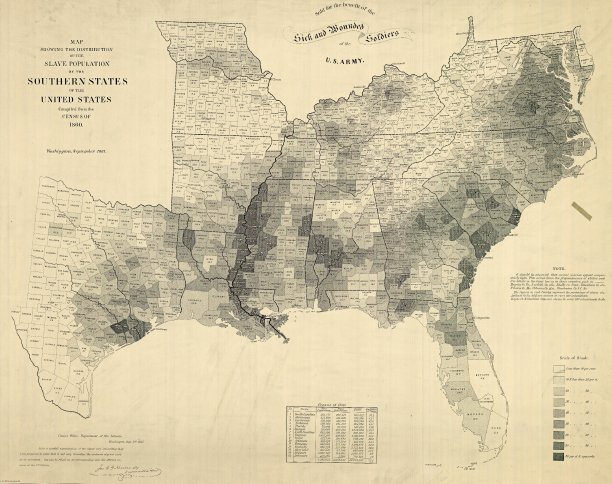
The 1860 Census was the last time the federal government took a count of the South’s vast slave population. Several months later, the United States Coast Survey — arguably the most important scientific agency in the nation at the time — issued two maps of slavery that drew on the Census data, the first of Virginia and the second of Southern states as a whole. Though many Americans knew that dependence on slave labor varied throughout the South, these maps uniquely captured the complexity of the institution and struck a chord with a public hungry for information about the rebellion.
The map uses what was then a new technique in statistical cartography: Each county not only displays its slave population numerically, but is shaded (the darker the shading, the higher the number of slaves) to visualize the concentration of slavery across the region. The counties along the Mississippi River and in coastal South Carolina are almost black, while Kentucky and the Appalachians are nearly white.
H/T to Walter Olson for the link.
December 18, 2010
The day the American Falls ran dry
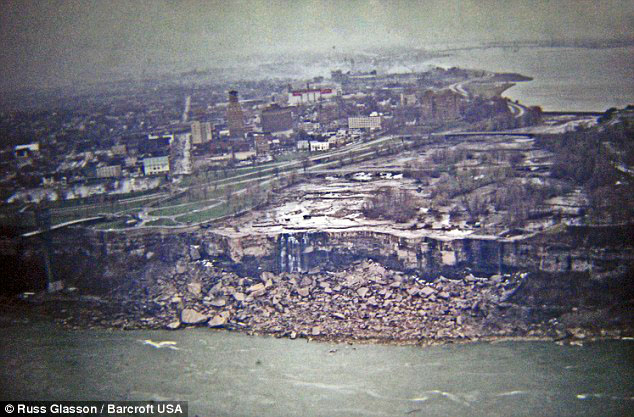
The day Niagara Falls ran dry:
“In June 1969, U.S. engineers diverted the flow of the Niagara River away from the American side of the falls for several months.
“Their plan was to remove the large amount of loose rock from the base of the waterfall, an idea which they eventually abandoned due to expense in November of that year.
[. . .]
To achieve this the army had to build a 600ft dam across the Niagara River, which meant that 60,000 gallons of water that flowed ever second was diverted over the larger Horseshoe Falls which flow entirely on the Canadian side of the border.
“The dam itself consisted of 27,800 tons of rock, and on June 12, 1969, after flowing continuously for over 12,000 years, the American Falls stopped. Over the course of the next six months thousands of visitors flocked to the falls to witness the historic occasion.
I remember seeing this, although as I was nine at the time, I can’t say with certainty that it was in person . . . I might be mistakenly remembering seeing it on TV, although my family visited Niagara Falls frequently during the late 1960s and early 1970s.
Unwelcome discoveries in China’s past
Strategy Page looks at some recent archaeological and DNA study results that are not popular with China’s government:
Chinese scientists, conducting genetic research in western China, recently tested the people in an ancient, and remote, village, and found that the DNA of the villagers was 56 percent Caucasian (Indo-European). The current theory is that these people are descendants of Roman soldiers who were long rumored to have established an outpost on this eastern end of the ancient Silk Road (the caravan route from China to the Middle East.) The Chinese are not happy with findings like this.
The Chinese government has long been uneasy about archeologists and anthropologists finding evidence of European peoples living, and settling, in western China thousands of years ago. The Chinese have a high opinion of themselves (often justified), but because of the European role in humiliating China in the 18th and 19th centuries, they are uncomfortable with the idea that the damn Europeans have been in their neighborhood even earlier. Earlier discoveries included very old (more than 3,000 years ago) burial sites containing tall, blonde, warriors. There was also a village of ancient Jews in western China, where the people had only stopped practicing Jewish religious rituals in the last century.
[. . .]
The Chinese may be unhappy simply because they have to give the “northern barbarians” credit for driving the Indo-Aryan tribes away, rather than letting Chinese soldiers do it. Thus it’s currently a big deal in China anytime Chinese technology, or diplomats, beats the Westerners. In the Chinese universe, it’s the supreme insult for foreigners to best the Chinese, militarily or otherwise. But for the last few centuries, that is what happened. China isn’t really looking for a war with the West, but politicians find it easy to win approval by playing up the might of the motherland, and what China can do (in theory) if anyone messes with us. That process induces some amnesia about what has really happened in the past, but that’s what nationalism and demagoguery are all about.
December 14, 2010
Christopher Hitchens on the real Henry Kissinger
I must admit that I never understood the adulation Henry Kissinger has attracted. I started paying attention to politics in the early 1970s, and Kissinger was one of the main players on the world political stage at that point. His connection to the deeply repugnant Richard Nixon should have been enough to keep him out of the limelight after his boss was forced out of the presidency. Yet he somehow managed not only to stay in the public eye, but to increase his popularity.
Christopher Hitchens thinks that the latest revelations from that era will finally bring Kissinger the odium he so richly deserves:
Henry Kissinger should have the door shut in his face by every decent person and should be shamed, ostracized and excluded. No more dinners in his honour; no more respectful audiences for his absurdly overpriced public appearances; no more smirking photographs with hostesses and celebrities; no more soliciting of his worthless opinions by sycophantic editors and producers. One could have demanded this at almost any time during the years since his role as the only unindicted conspirator in the Nixon/Watergate gang, and since the exposure of his war crimes and crimes against humanity in Indochina, Chile, Argentina, Cyprus, East Timor and several other places. But the latest revelations from the Nixon Library might perhaps turn the scale at last.
Chatting eagerly with his famously racist and foul-mouthed boss in March 1973, following an appeal from Golda Meir to press Moscow to allow the emigration of Soviet Jewry, Kissinger is heard on the tapes to say:
“The emigration of Jews from the Soviet Union is not an objective of American foreign policy. And if they put Jews into gas chambers in the Soviet Union, it is not an American concern. Maybe a humanitarian concern.”
(One has to love that uneasy afterthought….)
In the past, Kissinger has defended his role as enabler to Nixon’s psychopathic bigotry, saying that he acted as a restraining influence on his boss by playing along and making soothing remarks. This can now go straight into the lavatory pan, along with his other hysterical lies. Obsessed as he was with the Jews, Nixon never came close to saying that he’d be indifferent to a replay of Auschwitz. For this, Kissinger deserves sole recognition.
It’s hard to know how to classify this observation in the taxonomy of obscenity. Should it be counted as tactical Holocaust pre-denial? That would be too mild. It’s actually a bit more like advance permission for another Holocaust. Which is why I wonder how long the official spokesmen of American Jewry are going to keep so quiet. Nothing remotely as revolting as this was ever uttered by Jesse Jackson or even Mel Gibson, to name only two famous targets of the wrath of the Anti-Defamation League. Where is the outrage? Is Kissinger — normally beseeched for comments on subjects about which he knows little or nothing — going to be able to sit out requests from the media that he clarify this statement? Does he get to keep his op-ed perch in reputable newspapers with nothing said? Will the publishers of his mendacious and purloined memoirs continue to give him expensive lunches as if nothing has happened?
December 10, 2010
The people behind the original Doctor Who
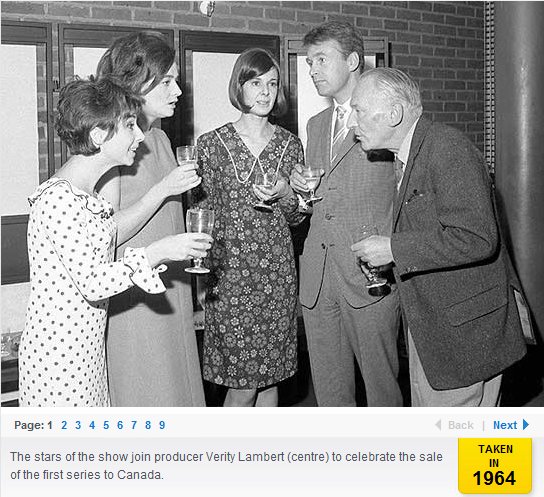
A photo set on the BBC Archive shows some of the folks who made the original Doctor Who series:
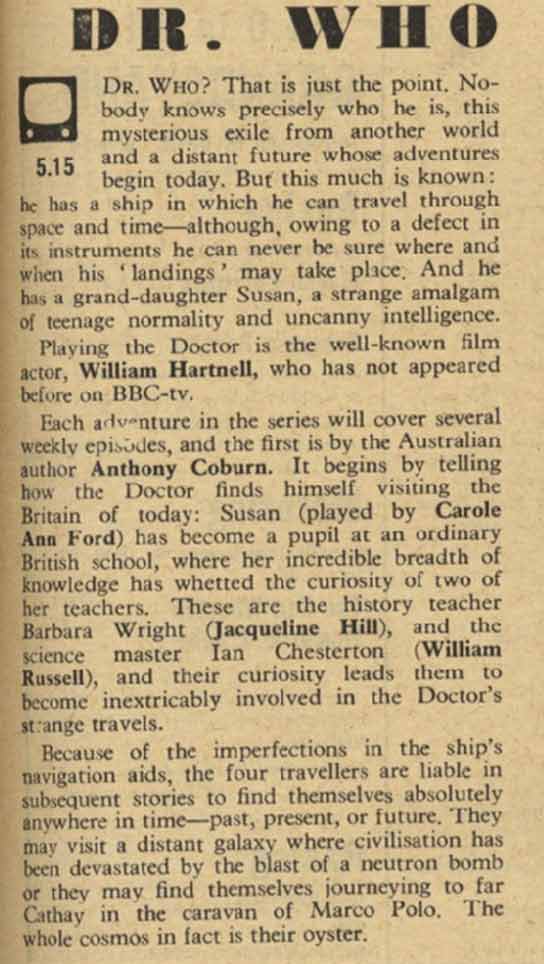
Also from BBC Archives, the Radio Times review of the first episode:
Also of interest, the original notes on creating a BBC science fiction series.
December 8, 2010
Repost: “What was I doing when I heard . . .”
Another year, another opportunity for some people to indulge in over-the-top, mawkish, ostentatious grief for someone the vast majority never actually met:
A post up at American Digest recounts what Gerard was doing when he heard that John Lennon had been shot. It’s a good posting: go read it.
What I was doing was a lot less interesting and profound: I was driving from Mississauga to Montreal that morning, and all I could get on the AM radio in the truck was endless playings of “Imagine” and other Lennon tunes I didn’t like to start with. To make it worse, I was going to be spending two weeks in Montreal (I don’t speak French), hanging off the side of an apartment building (I’m really not good with heights), learning how to install a master-antenna TV system. I certainly had enough worries of my own to occupy my thoughts.
I was born in 1960. By the time I started paying attention to popular music, the Beatles were about as current to me as the Monkees (and, truth to tell, I kinda preferred the latter, if only for the TV show reruns). John Lennon was some bearded weirdo with a whacky wife and they both spouted the sort of rhetoric that left me feeling that they really didn’t like the west at all. I was sorry that he was dead, but the wholesale public mourning struck me as being just plain over-the-top.
In retrospect, it was rather like the outpouring of public grief when Princess Diana got herself killed: unseemly, inappropriate, lavishly exhibitionistic displays of emotion. Perhaps I’m just not very sympathetic, at heart, but all it seemed to lack was ululations and slashing of cheeks to be a true primitive, tribal ceremony. I didn’t have the stones to say “Grow up” out loud, but that was what I thought then.
Originally posted on 8 December, 2004.
Worried about your upcoming citizenship test? Publius has the answers for you
Publius has done all the hard work for you so you can ace the new citizenship test:
So from the mouth of well meaning ignorance, how would a typical Canadian fare on Mr Kenney’s new immigration test? Thanks to the vast resources of this blog, and its network of agents and correspondents through out the Dominion, we have located the typical Canadian. He’s a male in his late thirties and lives in Kenora. Which I think is in Alberta. But from Toronto it’s hard to tell. We brought the typical Canadian to our high-tech testing center at the corner of Center St and Universe Ave, in downtown Toronto. Here is the test. And here is the typical Canadian’s answers:
– Identify four (4) rights that Canadians enjoy.
The right to complain about the weather. The right to complain about how taxes are too high. The right to complain that the government isn’t spending enough money on me or my community. The right to stand in the middle of the cookie aisle at Loblaws and block everybody’s way (I know who you are).
-Name four (4) fundamental freedoms that Canadians enjoy.
The freedom to speak, unless it offends a politically influential minority group. The freedom to own property, unless it offends a politically influential environmental group. The freedom to protest, unless it offends visiting dignitaries. The freedom to bitch about the weather, unless it offends a co-worker who is a ski-nut.
[. . .]
-What did the Canadian Pacific Railway symbolize?
That graft, corruption, political manipulation, juvenile anti-Americanism, and screwing over people who don’t live in Ontario and Quebec, has been a Canadian tradition since the beginning.
-What does Confederation mean?
Like federation but with more “con” in it. Like transfer payments.
[. . .]
-What is the role of the courts in Canada?
To uphold the laws of Canada, unless it conflicts with their personal political beliefs. At that point they just make stuff up, and then use some latin terms to cover their tracks.
-In Canada, are you allowed to question the police about their service or conduct?
Yes, but not during the APEC conference, the G20, or if you’re living in Caledonia.
December 5, 2010
Worst Autumn snowfall in Britain since 1963
Roger Henry sent me this link earlier this year, but it seems even more appropriate now:
I wonder how many budding documentarians will try to replicate the 1963 effort?
H/T to Ghost of a Flea for the reminder.
December 4, 2010
Looking for the remains of Zheng He’s treasure fleet
Virginia Postrel looks at the latest archaeological expedition in the Indian Ocean:
A team of Chinese archeologists arrived in Kenya last week, headed for waters surrounding the Lamu archipelago on the country’s northern coast. They hadn’t made the trip to study local history. They came to recover a lost Chinese past.
In the early 1400s, nearly a century before Vasco da Gama reached eastern Africa, Chinese records say that the great admiral Zheng He took his vast fleet of treasure ships as far as Kenya’s northern Swahili coast. Zheng visited the Sultan of Malindi, the most powerful local ruler, and brought back exotic gifts, including a giraffe. “Africa was China’s El Dorado — the land of rare and precious things, mysterious and unfathomable,” writes Louise Levathes in her 1994 history of Zheng’s voyages, “When China Ruled the Seas.”
Now the Chinese government is funding a three-year, $3 million project, in cooperation with the National Museums of Kenya, to find and analyze evidence of Zheng’s visits. The underwater search for shipwrecks follows a dig last summer in the village of Mambrui that unearthed a rare coin carried only by emissaries of the Chinese emperor, as well as a large fragment of a green-glazed porcelain bowl whose fine workmanship befits an imperial envoy. Although Ming-era porcelains are nothing new in Mambrui — Chinese porcelains fill the local museum and decorate a centuries-old tomb — the latest finds suggest that the wares came not through Arab merchants but directly from China.
China’s brief dabbling in overseas exploration ended fairly suddenly, but there was no technical reason that they could not have continued. It would be a very different world indeed if the Emperor hadn’t decided to ignore everything outside the Middle Kingdom.
The real problem with contemporary China’s version of the Zheng He story is that it omits the ending. In the century after Zheng’s death in 1433, emperors cut back on shipbuilding and exploration. When private merchants replaced the old tribute trade, the central authorities banned those ships as well. Building a ship with more than two masts became a crime punishable by death. Going to sea in a multimasted ship, even to trade, was also forbidden. Zheng’s logs were hidden or destroyed, lest they encourage future expeditions. To the Confucians who controlled the court, writes Ms. Levathes, “a desire for contact with the outside world meant that China itself needed something from abroad and was therefore not strong and self-sufficient.”
November 25, 2010
“They took more than 400, highly detailed photographs of the dig”
By way of A Blog About History, a story about a valuable set of over 400 photographs of the Sutton Hoo excavations:
Like the original ship burial, this remarkable find has laid unseen and forgotten for a long time. Tucked away in a dusty storeroom were a couple of fairly nondescript cardboard boxes.
Inside these unprepossessing packages were a photographic treasure trove which sheds new light on the discovery and the excavation of the Sutton Hoo ship burial.
Inside the boxes were more than 400 photographs taken during the summer of 1939 by two visiting school teachers Barbara Wagstaff and Mercie Lack.
It is believed that they had contacts with The British Museum which is why they were given access to the site but very little is known about them.
They took more than 400, highly detailed photographs of the dig — far more than the 29 official shots taken by the British Museum photographer.
The pictures have laid forgotten until now; as a selection of them are forming the centrepiece of a new exhibition at Sutton Hoo.
It’s hard to believe that the British Museum didn’t have a more comprehensive formal photographic record of the excavations.


