
Quotulatiousness

February 26, 2011

Views of a future that didn’t arrive

Filed under: History, Railways, Science, Technology — Tags: , , — Nicholas @ 11:35

The Future That Wasn’t: Failure to Perceive Hidden Costs and Risks

Two other entangled obstacles to technological inevitability must also be considered: unappreciated psychosocial reservations and genuine, but unappreciated hazards that either slow, or virtually inhibit the adoption of what would otherwise be hugely transforming technological advances.

As a child, I was told about what my future would be like and how much better it would be in almost every way, technologically, from the world I then inhabited. I was, literally, a child of the atomic age, and the molecules in the DNA of my brain still bear the 14Carbon isotope signature of the open-air nuclear testing era, just as surely as my bones, made radioactive in my infancy and childhood by the Strontium 90 (90Sr) in the milk I drank are still, ever so slightly, more radioactive today, than are those of people born before, or after, the era of atmospheric nuclear weapons testing.

But beyond these physical stigmata of the atomic age, my mind bears the stigmata of a world promised, but never delivered. Scientists and laymen alike were quick to understand the truly staggering potential benefits of what we now call nuclear power. Countless pronouncements were made that the arrival of an era of cheap, clean, safe, and virtually unlimited electric power was at hand. Electricity generated by ‘atomic power’ and nuclear fusion, we were told, would be so inexpensive to produce that it would not even be worth the expense of metering its use to bill the customer for. People would simply play a flat rate for the service, as is the case for long distance or computer telephony today. In a speech given by Lewis L. Strauss (1896-1974), Chairman of the U.S. Atomic Energy Commission to the National Association of Science Writers, in New York City on September 16th, 1954, Strauss commented on how scientific research then underway would transform life for the next generation of Americans, the generation that would be born in then and in the coming decade, my generation:

“Our children will enjoy in their homes electrical energy too cheap to meter…will travel effortlessly over the seas and under them and through the air with a minimum of danger and at great speeds, and will experience a lifespan far longer than ours, as disease yields and man comes to understand what causes him to age.”

The Santa Fe Railroad, then as commercially important and as technologically credible as Apple or Microsoft are today, anticipated fission reactor powered trains within 20 years, and ran ads in national magazines featuring a youngster only a few years older than me, asking to buy a ticket on an atomic powered version of the Super Chief which was then the preeminent way to travel across the country from Chicago to Los Angeles, in both speed and comfort.
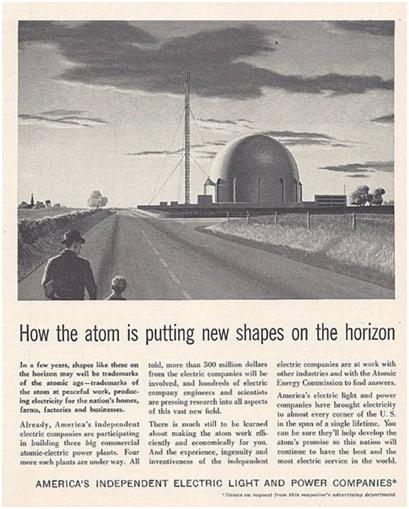
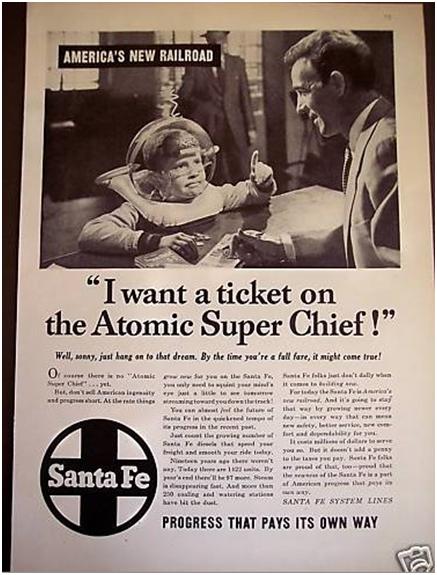
An excerpt from Cryonics and Technological Inevitability.

H/T to Andrew Coyne for the link.

February 11, 2011

How “those evil speculators” actually provide a very useful public service

Filed under: Economics, Food, History, Liberty, Politics — Tags: , , — Nicholas @ 07:59

Tim Worstall has a very good summary of Adam Smith’s explanation of the very useful public service provided by speculators:

Back to food: this is exactly the argument that Adam Smith put forward to explain the activities of a wheat merchant (Wealth of Nations, Book IV, Chapter V, start at para 40, here, for a decent dose of 18th century prose). When wheat is plentiful (although he calls it corn — the English did not call maize corn until some time later), say after a harvest, the merchant buys it up and stores it. He then waits until prices have risen before he sells it. If his expected shortage in the future doesn’t arrive then he’s shit out of luck and loses money. If it does, then the happy populace now have wheat to eat. For, and here’s the crucial point: what our merchant, our speculator, has done is move prices through time.

If we all ate wheat like it was that bounteous time just after harvest all the time then we would run out of wheat entirely before the next harvest. Prices would, at that point, become really rather high. However, by buying in the time of plenty, he’s raised prices in that time of plenty: thus making everyone consume a little less in that Harvest Festival gluttony. He’s also lowered prices in the Hungry Time (in medieval times, the six weeks before the harvest was indeed known as this, it was the worst time of year for food supplies) because he has at least some grain available rather than none.

So we’ve reduced price volatility, stretched the available supply over more time, possibly even stopped some starvation, by someone being enough of a bastard to speculate on food prices.

Now note, this is physical speculation, actual purchase, taking delivery and storage.

Derivatives speculation, using futures and options, has less effect on prices. It gives us information about what people think prices might be in the future, for sure, but it will only affect today’s prices if high future prices lead to that actual physical storage and hoarding. Which could happen, to be sure, but won’t necessarily.

All of this leads us to what people like M Sarkozy are trying to say and what the WDM are screaming about. The latter, in their report linked above, come right out and say that as more people are playing with food derivatives, this is what has been pushing up food prices. This is nonsensical, in the absence of any physical hoarding. For a start, WDM seems not to realise than a futures market is zero sum: for any profit made by someone then someone else must have made an equal and opposite loss. For everyone going long (betting on a price rise) someone else must have made an equal and opposite bet going short (betting that prices will fall). That’s just how these markets are. It really doesn’t matter to spot (current) prices whether three people are betting £50 or 30,000 are betting $50bn: there will be an equal and opposite number of people long as there are short, by definition.

So it absolutely cannot be that “more people speculating increases food prices”.

WDM’s second point is that more speculation means more volatility in prices: something that almost all economists would regard with a very jaundiced eye. For the general assumption is that futures act upon prices as does Smith’s wheat merchant: they reduce price volatility. Fortunately, the WDM, in its own report, provide us with an example of this. In the 2006/8 price rises, it notes that there’s a deep and liquid speculative market for wheat and corn (maize), while there’s only a very thin one for rice. And yet it was rice that was vastly more volatile in price in this period: despite the fact that it was wheat and maize which people were turning into ethanol for cars (the true cause of the price rises) rather than rice.

The price of a good is also a signal of availability: the more scarce the item is, the higher the price will go. The higher the price goes, the greater the incentive to either limit the use of the item or to search for substitute goods. This is a key feature of free markets: without the price change signalling, consumers cannot accurately guage whether to increase or decrease their use of a particular good. This is why the worst possible reaction to a sudden price increase is price controls: remember the first oil crisis in the 1970s? Price controls meant that people could still buy gasoline at the “old” price . . . until there wasn’t enough to go around. Controlling the price creates artificial shortages and fails to rationally indicate to consumers to conserve or limit their consumption.

February 9, 2011

QotD: (Historical) weather and climate

Filed under: Environment, History, Quotations — Tags: , , , — Nicholas @ 13:01

I read a lot of history and thus know a fair bit about how weather impact has been perceived by humans over time. It is a fact that the 20th century was an abnormally lucky hundred years, meteorologically speaking. The facts I managed to jam into tweets included (a) the superstorm that flooded 300 square miles of the Central Valley in California in the 1860s, (b) rainfall levels we’d consider drought conditions were normal in the U.S. Midwest before about 1905, and (c) storms of a violence we’d find hard to believe were commonly reported in the 1800s. I had specifically in mind something I learned from the book Wicked River: The Mississippi When It Last Ran Wild, which relays eyewitness accounts of thunderstorms so intense that travelers had to steeple their hands over their noses in order to breathe air instead of water; but a sense that storms of really theatrical violence were once common comes through in many other histories.

We had a quiet century geophysically as well — no earthquakes even nearly as bad as the New Madrid event of 1812, which broke windows as far north as Montreal. And no solar storms to compare with the Carrington Event of 1859, which seriously damaged the then-nascent telegraph infrastructure and if it recurred today would knock out power and telecomms so badly that we’d be years recovering and casualties would number in the hundreds of thousands, possibly the millions.

(I’m concentrating on 19th-century reports because those tended to be well-documented, but earlier records tell us it was the 20th century calm that was unusual, not the 19th-century violence.)

The awkward truth is that there are very large forces in play in the biosphere, and when they wander out of the ranges we’re adapted to, we suffer and die a lot and there really isn’t a great deal we can do about it; we don’t operate at the required energy scales. For that matter, I can think of several astronomical catastrophes that could be lurking just outside our light-cone only to wipe out all multicellular life on Earth next week. Reality is like that.

Eric S. Raymond, “Heavy weather and bad juju”, Armed and Dangerous, 2011-02-03

Fifteen years ago

Filed under: Government, History, Liberty, Technology — Tags: , , , — Nicholas @ 00:03

John Perry Barlow wrote the Declaration of the Independence of Cyberspace:

Governments of the Industrial World, you weary giants of flesh and steel, I come from Cyberspace, the new home of Mind. On behalf of the future, I ask you of the past to leave us alone. You are not welcome among us. You have no sovereignty where we gather.

We have no elected government, nor are we likely to have one, so I address you with no greater authority than that with which liberty itself always speaks. I declare the global social space we are building to be naturally independent of the tyrannies you seek to impose on us. You have no moral right to rule us nor do you possess any methods of enforcement we have true reason to fear.

Governments derive their just powers from the consent of the governed. You have neither solicited nor received ours. We did not invite you. You do not know us, nor do you know our world. Cyberspace does not lie within your borders. Do not think that you can build it, as though it were a public construction project. You cannot. It is an act of nature and it grows itself through our collective actions.

You have not engaged in our great and gathering conversation, nor did you create the wealth of our marketplaces. You do not know our culture, our ethics, or the unwritten codes that already provide our society more order than could be obtained by any of your impositions.

You claim there are problems among us that you need to solve. You use this claim as an excuse to invade our precincts. Many of these problems don’t exist. Where there are real conflicts, where there are wrongs, we will identify them and address them by our means. We are forming our own Social Contract. This governance will arise according to the conditions of our world, not yours. Our world is different.

Cyberspace consists of transactions, relationships, and thought itself, arrayed like a standing wave in the web of our communications. Ours is a world that is both everywhere and nowhere, but it is not where bodies live.

We are creating a world that all may enter without privilege or prejudice accorded by race, economic power, military force, or station of birth.

We are creating a world where anyone, anywhere may express his or her beliefs, no matter how singular, without fear of being coerced into silence or conformity.

Your legal concepts of property, expression, identity, movement, and context do not apply to us. They are based on matter, There is no matter here.

Our identities have no bodies, so, unlike you, we cannot obtain order by physical coercion. We believe that from ethics, enlightened self-interest, and the commonweal, our governance will emerge. Our identities may be distributed across many of your jurisdictions. The only law that all our constituent cultures would generally recognize is the Golden Rule. We hope we will be able to build our particular solutions on that basis. But we cannot accept the solutions you are attempting to impose.

In the United States, you have today created a law, the Telecommunications Reform Act, which repudiates your own Constitution and insults the dreams of Jefferson, Washington, Mill, Madison, DeToqueville, and Brandeis. These dreams must now be born anew in us.

You are terrified of your own children, since they are natives in a world where you will always be immigrants. Because you fear them, you entrust your bureaucracies with the parental responsibilities you are too cowardly to confront yourselves. In our world, all the sentiments and expressions of humanity, from the debasing to the angelic, are parts of a seamless whole, the global conversation of bits. We cannot separate the air that chokes from the air upon which wings beat.

In China, Germany, France, Russia, Singapore, Italy and the United States, you are trying to ward off the virus of liberty by erecting guard posts at the frontiers of Cyberspace. These may keep out the contagion for a small time, but they will not work in a world that will soon be blanketed in
bit-bearing media.

Your increasingly obsolete information industries would perpetuate themselves by proposing laws, in America and elsewhere, that claim to own speech itself throughout the world. These laws would declare ideas to be another industrial product, no more noble than pig iron. In our world, whatever the human mind may create can be reproduced and distributed infinitely at no cost. The global conveyance of thought no longer requires your factories to accomplish.

These increasingly hostile and colonial measures place us in the same position as those previous lovers of freedom and self-determination who had to reject the authorities of distant, uninformed powers. We must declare our virtual selves immune to your sovereignty, even as we continue to consent to your rule over our bodies. We will spread ourselves across the Planet so that no one can arrest our thoughts.

We will create a civilization of the Mind in Cyberspace. May it be more humane and fair than the world your governments have made before.

February 5, 2011

In praise of the venerable Lee-Enfield rifle

Filed under: Asia, Australia, History, Military, Weapons — Tags: , , , — Nicholas @ 10:19

Strategy Page talks about the weapons being found in Afghanistan:

Back before the Russians showed up, in the 1980s, the best an Afghan could hope to have was a World War II, or World War I, era bolt action rifle. These weapons were eclipsed in the 1980s by full automatic AK-47s and the RPG rocket launcher. The young guys took to the AK, and the thrill of emptying a 30 round magazine on full automatic. Not bad for a brief firefight, and suddenly hardly anyone, except a few old timers, wanted to use the old bolt action rifle.

What was not noticed much outside of Afghanistan, was that this shift in weaponry brought to an end a long Afghan tradition of precision, long range shooting.

[. . .]

The Lee-Enfield is one of the oldest, and still widely used, rifles on the planet. Over 17 million were manufactured between 1895 and the 1980s. While there are more AK-47s out there (over 20 million in private hands), these are looked down on by those who use their rifles for hunting, or killing with a minimum expenditure of ammunition. The 4 kg (8.8 pound) Lee-Enfield is a bolt-action rifle (with a ten round magazine) noted for its accuracy and sturdiness. The inaccurate AK-47 has a hard time hitting anything (with a single shot) more than a hundred meters away, while the Lee-Enfield can drop an animal, or a man, at over 400 meters.

[. . .]

One place where the Lee-Enfield found lots of fans was Afghanistan. There, the Afghans had been introduced to rifles in the 19th century, and they treasured these weapons. This was particularly true with the introduction of smokeless powder rifles in the late 19th century. Many Afghans were still using black powder rifles well into the 20th century. But once Lee-Enfields began show up in large numbers after World War I (1914-18), no one wanted the larger, heavier and less accurate black powder rifles (which always gave off your position, with all that smoke, after you fired a round.) Now, wealthy drug lords are buying expensive hunting and sniper rifles for their militias, but so far, many Taliban snipers appear to prefer using grandpa’s old Lee-Enfield.

Lee-Enfield ammunition is still manufactured, with the high quality stuff going for a dollar a round, and lesser quality for 25 cents a round. The rifles sell in the West for $500-1,000, but the hand-made copies, made new, go for more than twice that. The Lee-Enfield, both originals and copies, will carry on well into the 21st century.

Update, 9 February: Speaking of the 21st century, Australian International Arms is still producing new Lee-Enfield rifles:

Australian International Arms have manufactured the 5th generation of Lee-Enfield, for target shooting, military match and sporting markets. However, unlike the 4th generation, this is not a ‘converted’ Lee-Enfield. The AIA rifles are redesigned with modern techniques, but referencing more than a century of Lee-Enfield improvements and development… from Britain, North America and Australia.

[. . .]

Our production is limited in quantity as we
build
the rifles, they are not mass-produced items. We only construct about 1,000-1,200 units each year because of all the hand-work required for metal, wood, fitting & tuning of each rifle.

H/T to Small Dead Animals for the link.

February 2, 2011

Thousands are sailing flying

Filed under: Europe, History, Media — Tags: , , — Nicholas @ 12:31

Patricia Treble reports on the new wave of Irish emigration:

With their economy in a tailspin and bad financial news piling up, the Irish people are voting with their feet—they’re leaving the Emerald Isle at the rate of 1,000 a week. Last Thursday, the Economic and Social Research Institute (ESRI) published a grim forecast: net outward migration will reach 100,000 in the two years ending in April 2012.

Packing up and leaving in dire times is nothing new for Ireland. In the 1800s, millions fled the island’s famines and disease for the chance of a better life in countries such as Canada, the United States and Australia. Even recently, there have been waves of emigration. The last time the emigration numbers were as high as they are now was in 1989, when 44,000 fled the economically depressed nation. Soon after, Ireland cut taxes, attracted massive foreign investment and transformed itself into a Celtic Tiger. Property prices soared along with personal wealth.

It’s always a good time for some Pogues music:

January 29, 2011

A bit of history, from a Yeoman Warder at the Tower of London

Filed under: Britain, History, Humour — Tags: — Nicholas @ 10:39

H/T to Craig Zeni for the link.

January 28, 2011

QotD: If those were the “good old days” then to hell with them

Filed under: Economics, History, Politics, Quotations — Tags: , , — Nicholas @ 09:37

One of the difficulties progressives face is trying to make centralized planning sound like a good idea. Even the president, with all his rhetorical genius and majestic vagueness, can struggle with the task. So, from time to time, it’s important to mold history a bit to, you know, make a point.

Early on in his State of the Union, for instance, President Barack Obama reminisced of an age when “good jobs” meant “showing up at a nearby factory or a business downtown.” A time when you “didn’t always need a degree, and your competition was pretty much limited to your neighbors,” and, if you “worked hard, chances are you’d have a job for life, with a decent paycheck and good benefits and the occasional promotion. Maybe you’d even have the pride of seeing your kids work at the same company.”

Way to dream big! Really, was this country ever about being proud that your children ended up in the same plant you slaved in for 30 years? Even with a promise of a union pension and — if you’re lucky — an “occasional” promotion, it sounds like a soul-crushing grind you’d want your offspring to escape, tout de suite.

Luckily, in the real world, history tells of a story filled with dynamic movements of people, class climbing, churning innovation, booms and busts and widespread embrace of risk-taking.

Now, as the president explained, “painful” changes have crashed down on his revisionism and Americans have been forced to compete, find India on a map, move from town to town and study.

David Harsanyi, “Who are we in ‘Sputnik moment’?”, Denver Post, 2011-02-28

January 26, 2011

Nostalgia for the Dreadnought era?

Filed under: China, Economics, Germany, History, WW1 — Tags: — Nicholas @ 09:03

Ambrose Evans-Pritchard finds the parallels between the rise of Imperial Germany in the years leading up to the first world war and attitudes toward China today:

And we all learned how the Kaiser overplayed his hand. That much was obvious.

Yet it is difficult to pin-point exactly when the normal pattern of great power jostling began to metamorphose into something more dangerous, leading to two rival, entrenched, and heavily armed alliance structures unable or unwilling to avert the drift towards conflict. The Long Peace died by a thousand cuts, a snub here, a Dreadnought there, the race for oil.

[. . .]

Is China now where Germany was in 1900? Possibly. There are certainly hints of menace from some quarters in Beijing. Defence minister Liang Guanglie said over New Year that China’s armed forces are “pushing forward preparations for military conflict in every strategic direction”.

Professor Huang Jing from Singapore’s Lee Kwan Yew School and a former adviser to China’s Army, said Beijing is losing its grip on the colonels.

“The young officers are taking control of strategy and it is like young officers in Japan in the 1930s. This is very dangerous. They are on a collision course with a US-dominated system,” he said.

The problem with drawing parallels from history is that it’s never as neat and clean-cut as you’d expect. First, China is supposed to be like Kaiser Wilhelm’s Germany, then more like Japan after WW1. I have to say I’m not totally following this line of thought. But, getting back to today’s situation:

There is a new edge to Chinese naval policy in the South China Sea, causing Japan, Vietnam, Indonesia, and the Philippines to cleave closer to the US alliance. Has Beijing studied how German naval ambitions upset the careful diplomatic legacy of Bismarck and pushed an ambivalent Britain towards the Entente, even to the point of accepting alliance with Tsarist autocracy?

Factions in Beijing appear to think that China will win a trade war if Washington ever imposes sanctions to counter Chinese mercantilism. That is a fatal misjudgement. The lesson of Smoot-Hawley and the 1930s is that surplus states suffer crippling depressions when the guillotine comes down on free trade; while deficit states can muddle through, reviving their industries behind barriers. Demand is the most precious commodity of all in a world of excess supply.

H/T to Jon, my former virtual landlord, for the link.

January 25, 2011

Russian army still suffering from Soviet hangover

Filed under: History, Military, Russia — Tags: , , , — Nicholas @ 07:47

Strategy Page reports on the troubles the Russian army is still experiencing twenty years after the fall of the Soviet Union:

Russian efforts to reform and upgrade its armed forces have, so far, failed. The basic problem is that few Russian men are willing to join, even at good pay rates. Efforts to recruit women and foreigners have not made up for this. The Russian military has an image problem that just won’t go away. This resulted in the period of service for conscripts being lowered to one year (from two) in 2008. That was partly to placate the growing number of parents who were encouraging, and assisting, their kids in avoiding military service.

But there are other problems. The latest crop of draftees are those born after the Soviet Union dissolved. That was when the birth rate went south. Not so much because the Soviet Union was gone, but more because of the economic collapse (caused by decades of communist misrule) that precipitated the collapse of the communist government. The number of available draftees went from 1.5 million a year in the early 1990s, to 800,000 today. Less than half those potential conscripts are showing up, and many have criminal records (or tendencies) that help sustain the abuse of new recruits that has made military service so unsavory. With conscripts in for only a year, rather than two, the military is forced to take a lot of marginal (sickly, overweight, bad attitudes, drug users) recruits in order to keep the military and Ministry of Interior units up to strength. But this means that even elite airborne and commando units are using a lot of conscripts. Most of these young guys take a year to master the skills needed to be useful, and then they are discharged. Few choose to remain in uniform and become a career soldiers. That’s primarily because the Russian armed forces is seen as a crippled institution, and one not likely to get better any time soon. With so many of the troops now one year conscripts, an increasing number of the best officers and NCOs get tired of coping with all the alcoholics, drug users and petty criminals that are taken in just to make quotas. With the exodus of the best leaders, and growing number of ill-trained and unreliable conscripts, the Russian military is more of a mirage than an effective combat (or even police) organization.

The genomic treasure trove of Quebec

Filed under: Cancon, History, Science — Tags: , , , — Nicholas @ 07:36

Thanks to relatively thorough genealogical records, the people of Quebec are of great and growing interest to genetic researchers:

One of the great things about the mass personal genomic revolution is that it allows people to have direct access to their own information. This is important for the more than 90% of the human population which has sketchy genealogical records. But even with genealogical records there are often omissions and biases in transmission of information. This is one reason that HAP, Dodecad, and Eurogenes BGA are so interesting: they combine what people already know with scientific genealogy. This intersection can often be very inferentially fruitful.

But what about if you had a whole population with rich robust conventional genealogical records? Combined with the power of the new genomics you could really crank up the level of insight. Where to find these records? A reason that Jewish genetics is so useful and interesting is that there is often a relative dearth of records when it comes to the lineages of American Ashkenazi Jews. Many American Jews even today are often sketchy about the region of the “Old Country” from which their forebears arrived. Jews have been interesting from a genetic perspective because of the relative excess of ethnically distinctive Mendelian disorders within their population. There happens to be another group in North America with the same characteristic: the French Canadians. And importantly, in the French Canadian population you do have copious genealogical records. The origins of this group lay in the 17th and 18th century, and the Roman Catholic Church has often been a punctilious institution when it comes to preserving events under its purview such as baptisms and marriages. The genealogical archives are so robust that last fall a research group input centuries of ancestry for ~2,000 French Canadians, and used it to infer patterns of genetic relationships as a function of geography, as well as long term contribution by provenance.

January 24, 2011

Ten things you didn’t know about orgasm

Filed under: Health, History, Humour, Science — Tags: , — Nicholas @ 12:44

Probably NSFW, although it’s all science.

H/T to Radley Balko for the link.

January 12, 2011

Armenian discovery may be earliest winery

Filed under: History, Wine — Tags: , — Nicholas @ 01:47

A recent find in Armenia shows evidence of grape pressing, vine cuttings, and fermentation vessels. It may be the earliest winery ever discovered:

While older evidence of wine drinking has been found, this is the earliest example of complete wine production, according to Gregory Areshian of the University of California, Los Angeles, co-director of the excavation.

The findings, announced Tuesday by the National Geographic Society, are published in the online edition of the Journal of Archaeological Science.

“The evidence argues convincingly for a wine-making facility,” said Patrick McGovern, scientific director of the Biomolecular Archaeology Laboratory at the University of Pennsylvania Museum in Philadelphia, who was not part of the research team.

I don’t know how far back it goes, but the evidence at this site shows that even 6,000 years ago, Vitis vinifera vinifera was the best choice to turn into wine.

January 11, 2011

Amusing ad

Filed under: History, Humour, Technology — Tags: , — Nicholas @ 00:09

H/T to Megan McArdle for the link.

January 10, 2011

QotD: Geeks and Hackers defined

Filed under: History, Media, Quotations, Technology — Tags: , , , , — Nicholas @ 16:29

One of the interesting things about being a participant-observer anthropologist, as I am, is that you often develop implicit knowledge that doesn’t become explicit until someone challenges you on it. The seed of this post was on a recent comment thread where I was challenged to specify the difference between a geek and a hacker. And I found that I knew the answer. Geeks are consumers of culture; hackers are producers.

Thus, one doesn’t expect a “gaming geek” or a “computer geek” or a “physics geek” to actually produce games or software or original physics — but a “computer hacker” is expected to produce software, or (less commonly) hardware customizations or homebrewing. I cannot attest to the use of the terms “gaming hacker” or “physics hacker”, but I am as certain as of what I had for breakfast that computer hackers would expect a person so labeled to originate games or physics rather than merely being a connoisseur of such things.

[. . .]

All hackers are, almost by definition, geeks — but the reverse is not true.

Eric S. Raymond, “Geeks, hackers, nerds, and crackers: on language boundaries”, Armed and Dangerous, 2011-01-09

« Newer PostsOlder Posts »

Powered by WordPress

