Quotulatiousness

March 17, 2011

Steam narrowboat

Filed under: Britain, History, Technology — Tags: , , — Nicholas @ 09:40

H/T to Eric Kirkland, who noted:

Please note the compulsory requisites for ‘proper’ canal cruising:
1) The flat cap
2) The grey beard
3) The mucky overalls
4) Bloomin’ great boots
Prior to the current ‘Elf and Safety regime there would also be
5) Roll ups permanently attached to the lower lip or a blazing briar full of Ogdens’ Flake

Ever wonder how a sewing machine works?

Filed under: History, Technology — Tags: , — Nicholas @ 09:16

H/T to Jeff Scarbrough for the link.

March 16, 2011

The American “Pledge of Allegiance”

Filed under: Education, History, Liberty, Religion, USA — Tags: , , , , — Nicholas @ 00:09

Not being an American, I’ve always wondered why a country that always talked so much about being the “home of the free” had such an odd quasi-religious thing like the Pledge of Allegiance. It seemed to be such a contradiction to the notions of freedom of speech and freedom of thought, having such an authoritarian ritual being performed every day by school children.

Now, L. Neil Smith explains where it came from, and why it seems such an incongruous part of the American cultural expression:

The so-called “Pledge of Allegiance” is an oath of unquestioning fealty of a kind that Americans rightly junked when they kicked the King’s backside out in 1776.

It was written in 1892 — when the Republic was already more than a century old — by a socialist, Francis Bellamy, a preacher who got fired by his congregation for using the pulpit to preach socialism rather than whatever he’d been hired to preach.

Bellamy’s cousin and best friend was Edward Bellamy, who wrote America’s best-known socialist propaganda novel, the impossibly boring and stupid Looking Backward (which became my standard for how not to write a political novel when I started my first book, The Probability Broach in 1977).

Francis Bellamy recommended that children taking the pledge face the flag in a worshipful manner and offer it a salute which was later self-consciously copied by the Nazis.

The phrase “under God” was only added in the 1950s, in blatant violation of the First Amendment, by self-righteous twits in the Eisenhower Administration. If you want your rights respected, you must respect the rights of others, If you want the Second Amendment enforced to the letter, you must insist that the First Amendment be enforced to the letter, as well.

It is the government that owes its unquestioning fealty to Americans, not the other way around. That’s what makes America different from every other country in the world, from every other civilization in history. To paraphrase the immortal Alfonso Bedoya, “We don’ need no stinkin’ loyalty oath — especially one written by a stinkin’ socialist!”

March 14, 2011

Toledo, Ohio

Filed under: Economics, History, Railways, USA — Tags: — Nicholas @ 08:37

P.J. O’Rourke remembers his home town:

My hometown, Toledo, Ohio, is one of those junkyards of American capitalism, a deindustrialized old industrial city. The population has declined from 383,818 in 1970 to 316,851 today. The unemployment rate is 10.4 percent. Jeeps are still made there, but most Toledo factories are gone — Auto-Lite, Willys-Overland, Champion Spark Plug, the glass plants of Owens-Illinois and Libbey-Owens-Ford. Toledo Scales aren’t made in Toledo anymore.

Downtown, the department stores are closed, as are most of the shops, theaters, restaurants, and bars. The city’s center looks plucked. Half the buildings have been razed. Toledo is a failure.

Actually, Toledo always was a failure. Incorporated in 1837, with a fancy name for what had been called the Great Black Swamp, Toledo was a land scam. A canal joining the Ohio River to Lake Erie was supposed to have its terminus there. The scam collapsed that very year, in the Panic of 1837, when Andrew Jackson ended easy land-buying credit. The canal did open, but not until 1845, by which time railroads had taken over shipping.

Toledo tried to be a rail hub. In 1860 it had six railroads. They were all short-line operations, each with a different track gauge and none connected to long-haul routes. Toledo’s Erie and Kalamazoo Rail Road never reached Kalamazoo.

March 11, 2011

Amazon recommendation fail

Filed under: Books, Economics, Europe, France, History, Media — Tags: — Nicholas @ 08:45

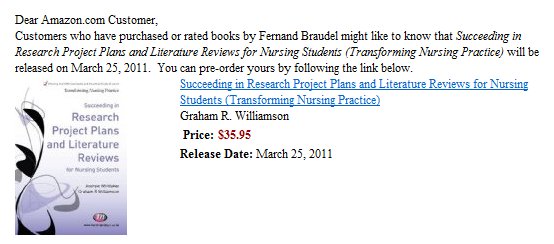
Like many of you, I’ve bought lots of books from Amazon over the years. Knowing a fair bit about my book-buying habits, their recommendations for books I might be interested in are usually pretty good. Today’s email rather missed the mark:

I’m not sure how that book relates in any way to the work of Fernand Braudel:

Fernand Braudel (24 August 1902 – 27 November 1985) was a French historian and a leader of the Annales School. His scholarship focused on three main projects, each representing several decades of intense study: The Mediterranean (1923–49, then 1949–66), Civilization and Capitalism (1955–79), and the unfinished Identity of France (1970–85). His reputation stems in part from his writings, but even more from his success in making the Annales School the most important engine of historical research in France and much of the world after 1950. As the dominant leader of the Annales School of historiography in the 1950s and 1960s, he exerted enormous influence on historical writing in France and other countries.

Braudel has been considered one of the greatest of the modern historians who have emphasized the role of large-scale socioeconomic factors in the making and writing of history.[1] He can also be considered as one of the precursors of World Systems Theory.

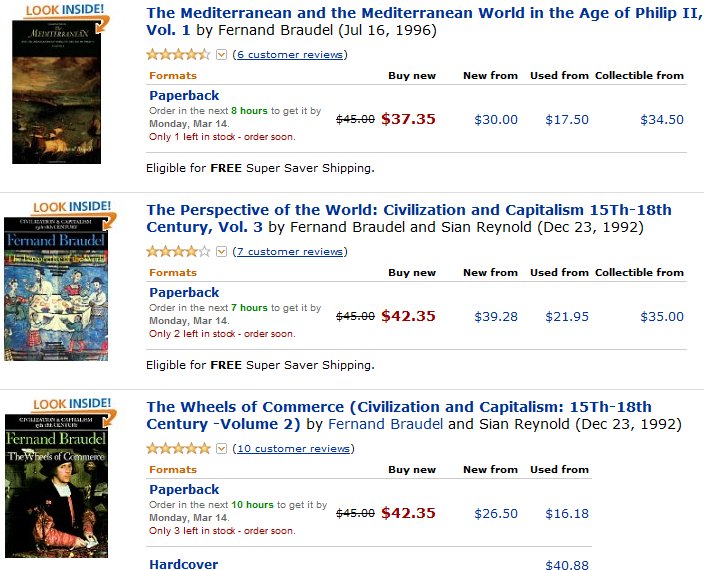
If you’ve browsed the history section, you’ll have seen them:

March 10, 2011

Very early railway film

Filed under: History, Media, Railways, Technology — Tags: , — Nicholas @ 10:12

H/T to “JtMc” for the link.

March 8, 2011

Helicopter footage of 9/11 just released

Filed under: History, USA — Tags: , , , , — Nicholas @ 12:21

The Guardian explains:

Previously unseen footage of the 9/11 attacks, filmed from a police helicopter hovering above the burning World Trade Centre, has emerged almost a decade after the terrorist atrocity.

The New York Police Department air and sea rescue helicopter was dispatched to the scene of the attack to see whether any survivors could be rescued from the rooftops.

[. . .]

The video is part of a cache of information about the attack handed over by city agencies to the National Institute of Standards and Technology, the federal agency that investigated the collapse.

It was released by NIST on 3 March under a Freedom of Information Act request, but it remains unclear who published the footage online.

March 7, 2011

QotD: Mercantilism

Filed under: Economics, History, Humour, Quotations — Tags: , , — Nicholas @ 09:56

You actually had a short, but interesting chapter in your book explaining why you think our trade balance with China is mostly irrelevant. Could you give people a short, but sweet synopsis of that argument?

Adam Smith was the first to point this out in the Wealth of Nations. The common wisdom at the time, mercantilism was the name it went by, was that the way a nation got rich was by exporting things. In return for the exports they’d get gold. And Smith’s going, I’m paraphrasing broadly here, “You can’t eat gold, you can’t kiss gold, and gold won’t keep you warm at night. Gold is just gold.”

He said the exports, that’s real stuff, and you’re giving it away in favor of gold. He said imports are the good thing. Imports are when you’re getting something you like. You’re getting French wine. You’re getting American tobacco. You’re getting furs from Russia, getting whatever they were getting back in those days. He said exports are the way you pay for those imports. So imports are Christmas morning. Exports are January’s Visa bill.

People getting so upset because everything seems to be made in China — I understand it on the level of the jobs have moved overseas. I think it’s probably an important thing to remember that if the jobs hadn’t moved overseas, they probably would have just gone away. So, it’s not like the Japanese have all of our car making jobs.

John Hawkins, “The P.J. O’Rourke Interview”, Grendel Report, 2010-10-11

March 5, 2011

Robert Fulford on feminism

Filed under: History, Law, Liberty, Politics — Tags: , , , — Nicholas @ 11:10

Coming up on the 100th observance of International Women’s Day, Robert Fulford takes a step back to view the feminist movement:

Some organized attempts to improve the lot of humanity claim limited victories; others do more harm than good. Only feminism can claim to have broadened, permanently, the lives of half the humans in the West. Its success, based on earnest arguments and improvised political strategies, is without parallel in the last century. Nothing since the Industrial Revolution has done so much to expand opportunity.

Feminism has altered a whole culture’s ideal version of sexual roles. It has changed the professions, most strikingly medicine and law. It has affected how children are raised, how the law deals with domestic life, how corporations and public institutions are staffed.

Like all revolutions, feminism is at war with itself. Many one-time feminists have quietly abandoned that term after watching former comrades flock behind every dubious new faction in the grievance culture. Radical feminists consider feminism a failure because it has not wiped out poverty, which should have been its goal. Events have so addled the radicals that they believe anyone who calls feminism a success is a covert enemy. Radicals believe we are living through a long dark night of conservatism and therefore have a right to be miserable, indefinitely. Celebrating anything, even the success of a movement they helped start, would rob them of their bitterness.

The world still needs the feminist spirit. It should shine a consistent light on the many millions of women who are caged by misogynistic religions and male-made dictatorships. Freeing them should become the central feminist project.

Local SCA group gets a bit of newspaper coverage

Filed under: Cancon, History, Randomness — Tags: , , — Nicholas @ 10:57

Actually, compared to a lot of newspaper articles on the SCA, this one isn’t too bad:

The Society is a global organization with some 30,000 registered members reliving the world before the 17th century. Most stick to European history, but there are plenty of katana-wielding Japan enthusiasts among the ranks. Members get together and do any and everything medieval and renaissance, from armored combat and blacksmithing to the craftier trades such as glass-etching and embroidery.

The Toronto group is know as the Canton of Eoforwicof, one chapter of the Kingdom of Ealdormere, which encompasses most of Ontario and is one of 19 worldwide kingdoms. Each kingdom has its own King, Queen and handful of other royals and nobility.

Unlike a Renaissance Faire, these gatherings are not for anyone’s entertainment but their own.

“We’re not playing to an audience, we’re just doing things for fun,” Ms. Carroll-Clark says.

No mention of rapier combat (my bit of the SCA), but that’s not surprising — even in the SCA it’s a minority interest.

March 4, 2011

Can you upgrade from Windows 1 to Windows 7?

Filed under: History, Technology — Tags: , , — Nicholas @ 09:59

I doubt very many of you ever used Windows 1.0 (I certainly didn’t: 3.0 was the first time I used Windows). Charles Arthur writes about an interesting experiment conducted by Andrew Tait to test how well your system would work if you somehow needed to upgrade through all the major Windows versions:

The question is: how robust is it? Can you really do all that updating? You have to start with MS-DOS 5.0, of course, because early versions of Windows needed that.

It’s a bit hairy and config.sys-y in the early versions up to 3.1.

But what’s really impressive is that Doom 2 and Monkey Island — installed right at the beginning — work all the way through, right up to Windows 7. Well, apart from in Windows 2000, where it hung at the start (lack of DOS support).

Well done Andrew Tait, alias Rasteri, the YouTube/Reddit user who had the enormous patience to do all this. Especially for sounding like Sean Connery all the way through. “It is indeed possible to upgrade through every version of Windows… and have some settings remain. This is nearly 20 years of application compatibility and Microsoft should be applauded.”

Of course, the real stumbling block to doing this would be the hardware: nothing that was available in the Windows 1.0 era would be able to run the far more demanding software of the Windows NT family of operating systems. To get around that, Tait used VMWare’s virtualization software:

March 3, 2011

Happy 25th anniversary to independent Australia

Filed under: Australia, Britain, History, Law, Pacific — Tags: , — Nicholas @ 09:30

I had been labouring under the impression that Australia had been freed from the colonial yoke in 1931, but I was mistaken:

TWENTY-FIVE years ago today, Australia became independent.

You might think this statement absurd. Surely Australia has been independent for a lot longer than that? Let me provide a lawyer’s answer: yes and no. Yes, Australia as a nation became independent at some unknown date after 1931. By 1931 it had the power to exercise independence but chose not to do so for some time. Arguably, having the capacity to exercise independence is enough to be classified as independent, although the parents of 20-something children who show no inclination to leave home may beg to differ.

The Australian states, however, did not gain their independence from Britain at that time. Bizarrely, they remained colonial dependencies of the British crown, despite being constituent parts of an independent nation. This meant state governors were appointed by the Queen on the advice of British ministers and that it was the Queen of the United Kingdom (not the Queen of Australia) who gave royal assent to state bills. When an Australian governor-general once complained to the British government about this anomaly, the response of British diplomats was that it was better to “let sleeping anomalies lie”.

H/T to Roger Henry for the link.

March 2, 2011

Why “Buy American” or “Buy Canadian” campaigns are bad economics

Filed under: Economics, History, Liberty, USA — Tags: , , , , , — Nicholas @ 12:26

Daniel Ikenson takes ABC to task for their misleading propaganda against international trade:

Back in the “golden age” of 1960, when imports were oddities to marvel over in a disdainful way, the per-capita U.S. income was $2,914. In 2009, with imports ubiquitous, per-capita income was $46,411. (Economic Report of the President, 2010, Tables B-1 and B-34). In real, inflation-adjusted terms, even with a U.S. population increase from 181 million to 307 million, per-capita incomes in 2009 were almost triple what they were in 1960 ($42,277 vs. $15,669 in 2005 dollars — ERP, 2010, Tables B-2 and B-34). Oh, if only we could replicate the relative poverty, the limited consumer choices, the inefficient production processes, the massive trade barriers that compelled Americans to buy American, and the uneconomic work rules and wages commanded by once-powerful private sector labor unions. In 1960, before real economic liberalization spawned cultural and social liberalization, Diane Sawyer would never have dreamed of being a network news anchor, if she even dared to entertain the concept of working outside of the home. How can she pine for such an era?

It’s frustrating that so much research refuting the myth of manufacturing decline and supporting the conclusion that U.S. manufacturing is thriving — and is in fact leading the world in terms of value of output — is simply neglected by a media that is more committed to scaring than informing. Today Americans are less likely to find in their homes products manufactured in the United States because U.S. manufacturers have moved on to producing higher value products. American manufacturing isn’t focused on products that consumers find in retail stores, like furniture, hand tools, sporting goods, flatware, draperies, carpeting and clothes. American factories produce more value than any other country’s factories by focusing on producing the highest value products: pharmaceuticals, chemicals, airplanes, sophisticated componentry, technical textiles, and other items often sold directly to other businesses.

I and others have been making these points for several years, as U.S. manufacturing continues to thrive in every metric . . . except employment. Manufacturing employment peaked in 1979 and has been on a downward trajectory ever since. But that is the point that eludes ABC and everyone else who thinks U.S. manufacturing’s best days are in the past. Making more with less is the goal! That’s how an economy grows! The political imperative of “putting people back to work” regardless of the economic value of that work — remember the so-called stimulus? — spits in the face of economics. The fact that Americans are unemployed speaks to a mismatch of skills demanded and skills available, as well as to a business and regulatory environment that dissuades investment and hiring.

QotD: Humour

Filed under: Britain, Europe, Germany, History, Humour, Quotations, WW2 — Nicholas @ 12:02

A German I know will on occasion tell you his father died in the concentration camps. He waits for the concerned and properly sympathetic faces and then adds that he got drunk and fell out of a watchtower. Europeans find that boorish, faintly crass and rather tasteless; the English love it. It’s a proper joke, and a German doing it is double bubble. The surprise is that neither the Europeans or the English realize that it’s not a joke at all, his father really did fall out of a watch tower and it’s poignant and sad because his son never knew him, never met his dad.

A.A. Gill, The Angry Island: Hunting the English, p. 112.

February 27, 2011

Sunday book post

Filed under: Books, Economics, History, Media, Military, Wine — Tags: , , , , , — Nicholas @ 10:09

No, not my books: I’ve written lots, but they’re all technical manuals for software products the vast majority of you will never have heard of, and wouldn’t want to read about even if you had. I mean books I’ve read recently that I consider to be very good. I’ll categorize for convenience (both yours and mine):

Science Fiction and Fantasy

  • Darwin’s Watch: The Science of Discworld III, Terry Pratchett, Ian Stewart and Jack Cohen. An entertaining romp through (real) science placed within a fictional context. I read the first Science of Discworld book and quite enjoyed it, and this one is possibly even better. The Discworld, riding happily balanced on the backs of the four great elephants, who are in turn supported by the shell of the great turtle, has very different scientific principles than our own “exotic” roundworld. The most amusing part of the book is the wizards of the Unseen University attempting to ensure that Charles Darwin writes the “correct” book on roundworld. You’ll learn more science than you expect . . .
  • I Shall Wear Midnight, Terry Pratchett. The fourth of the Tiffany Aching sequence in the Discworld series. Although written for a younger audience, Pratchett’s sense of humour and brilliant presentation make this book eminently readable for all ages.
  • Cryoburn, Lois McMaster Bujold. The latest adventure of Miles Vorkosigan deals with the political and social implications of cryogenic preservation. No soaring battles in space, no stunner shootouts, no alien invasions. Sounds deadly dull, I realize, but I don’t think Lois could write a boring shopping list. It perhaps doesn’t stand alone quite as well as it might, but even if you haven’t read any of the other books in the series, I think you’ll find this worth reading.

History

  • The Canadian Army and the Normandy Campaign, John A. English. A book that undermines several widely held beliefs about the efficiency and capability of the Canadian First Army in 1944-45. Between incompetent, scheming generals and political interference, the Canadian Army was less than the sum of its parts, and the importance of training methods and doctrine are highlighted (that is, the faulty training methods in use probably added to the casualty lists in combat). Field Marshal Montgomery didn’t like or trust General Harry Crerar, but was forced to keep him in command due to Canadian government sensitivities. Montgomery’s view of Crerar almost certainly was reflected in the roles assigned to First Canadian Army after the Normandy landings.
  • The Grand Strategy of the Byzantine Empire, Edward N. Luttwak. A fascinating book about the differences between the Byzantine empire’s military and political goals and practices and those of the Roman empire from which it descended. Unlike Rome, the Byzantines were never the “superpower” of their part of the world, and their survival often depended on carefully constructed alliances, allies-of-convenience, and outright bribery of “enemies of their enemies”. Although not well remembered in the west, the survival of Byzantium almost certainly saved central Europe from conquest by the armies of the Caliph during the initial expansion of the Muslim empire. Byzantine armies rarely had much technological or doctrinal advantage over their opponents, so war had to be conducted with the key concept of retention of force: ambush, raid, counter-attack, feint, and misdirection became specialties because they offered (relative) effectiveness at lower risk of outright defeat.
  • In the Name of Rome: The Men Who Won the Roman Empire, Adrian Goldsworthy. A selection of mini-biographies of some of the greatest generals of the Roman empire. What is amazing, in reading about some of their careers, is how little actual military instruction Roman officers received, yet how effective the army could be in spite of that. Being an army officer was viewed as just part of the normal public service — in fact, it would have been problematic for a Roman patrician to remain with the army for an extended period of time, as it would slow down his progress through the civil government ranks.
  • The Defence of the Realm: The Authorized History of MI5, Christopher Andrew. If you wanted a thrilling account of the exciting and dangerous life of counter-espionage, you need to stick to works of fiction. The actual life of an MI5 officer is apparently much less James Bond and much more careful investigation, observation, and data correlation. Not that it isn’t an interesting career, but perhaps the “double oh” agents will get their own book (just kidding).

Economics

  • The Ascent of Money, Niall Ferguson. I enjoyed reading this one far more than I expected to: the author has a knack for carrying you through the less interesting bits without boring or lecturing you. The evolution of the modern monetary system, and the heroic roles played by unlikely characters in the process.
  • The Rational Optimist: How Prosperity Evolves, Matt Ridley. It’s easy to find depressing statistics and dreary anecdotes. Ridley’s view is that progress is a good thing, and that we’re enjoying a golden age even if we don’t realize it right now.

Biography

  • Robert A. Heinlein: In dialogue with his century Volume 1, William H. Patterson, Jr. I’ve been a huge fan of Heinlein’s works since I read Starship Troopers at about age 11. This biography more than met my expectations: I’d always regretted never having met Robert Heinlein, but between this book and Heinlein’s own autobiographical writings (Tramp Royale and Grumbles from the grave) I feel I’ve gotten as close to knowing him as possible — until the publication of Volume 2, anyway.
  • Thomas Paine’s Rights of Man, Christopher Hitchens. A lively appreciation of Thomas Paine’s most influential work, and much detail on his life. Paine was far from being the disreputable bomb-throwing anarchist his enemies painted him to be, but he also wasn’t the plaster saint his fans might imagine.

Wine

  • Billy’s Best Bottles: Wines for 2011, Billy Munnelly. Still the best annual wine guide for the everyday wine drinker in Ontario. If you like an occasional bottle of wine, but don’t want to study dozens of books in order to make a decision on what to buy, this is the book for you. He likes more “rustic” wines than I do, so I don’t find his recommendations in that category to be as useful, but he does a great job of sorting through the plethora of $10-20 wines available at the LCBO and tells you which ones are worth buying (and when to serve them).
« Newer PostsOlder Posts »

Powered by WordPress