Quotulatiousness

July 2, 2011

“I remained somehow reluctant to conclude that the Communist Party of China would flat-out lie”

Filed under: China, History, Media, Politics — Tags: , , , , , — Nicholas @ 10:10

A tale of naivete about the Peoples’ Republic of China through the eyes of an American sympathizer:

The first time I tried to go to China was in 1967, the year after I graduated from college. My father was a radical leftist professor who admired Mao Zedong. And that influence, along with the Vietnam War protests — a movement in which I was not only a participant but an activist — led me to look at socialist China with very high hopes.

I was living in Hong Kong and wrote a letter to Beijing. A few months later I received a charming reply on two sheets of paper that looked like they had been labored over for days by a Red Guard with little English and a faulty typewriter. The letter explained that the Chinese people had nothing against me, but that I was from a predatory imperialist country and could not visit the People’s Republic. Before I left Hong Kong I bought four volumes of “The Selected Works of Mao Zedong,” and, rather grandiosely, ripped the covers off of them so that I might carry them safely back to the imperialist US.

In May, 1973, however, I got another chance. A year earlier, in April 1972, the Chinese ping-pong team had visited the US to break a twenty-three year freeze in diplomatic relations, and I had served as an interpreter. I made a good impression on Chinese officials on that US tour, in part because I led four of the six American interpreters in a boycott of the teams’ meeting with President Richard Nixon at the White House. (Nixon had ordered the bombing of Haiphong just the day before; to me, small talk in the Rose Garden just didn’t seem right.)

H/T to Tim Harford for the link.

July 1, 2011

Why Canadian students learn so little history

Filed under: Cancon, Education, History, Politics — Nicholas @ 12:33

An article in the newly launched Dorchester Review discusses the teaching of history:

Here in Canada the preoccupation with victimhood has mostly centred on Japanese Canadians and residential school “survivors.” Peter Seixas in Teaching Canada’s History (pp. 18-21) thinks children should be encouraged to condemn Caucasian writers who used terms like “Eskimo,” “primitive,” and “pagan.” What Seixas, a professor of education, seems not to appreciate is that schoolchildren are too young for this kind of academic pseudo-complexity and that their worldview is warped by pretentious classroom efforts to “heal the wounds.” Indeed what he advocates is what we have already had in many locales for a generation and counting.

[. . .]

In its more recent form, the classical model proposes that various integrated fields from science and math to English and second or classical languages should be covered at three stages (hence “trivium”), each time to a deeper, more systematic and engaging degree. For example, one approach for history could look like this, in four fields: (1) classical antiquity, (2) medieval-renaissance, (3) modern history, and (4) national, regional, and local history. Taught as a trivium, each of these four fields would be covered three times between grades one and twelve. Students today complain about repetition, but that is because they are tortured repetitively with the same introductory material by different uncoordinated teachers — rather than going into the subject more deeply and systematically as they grow older and more capable. As Anna Clark wrote in her 2008 paper on history teaching in Australia and Canada, “There is little point mandating the subject if it does not engage students and teachers.” Textbooks should be used as a guide not a crutch, as classical educators have long maintained.

[. . .]

We all have far to go. First, the evidence suggests that effective historical memory work is haphazard and unsystematic in public and many private schools. Students arrive at senior grades fundamentally culturally deprived and ignorant of facts. Even if narrative history is “compulsory” in Britain to age 14, in practice pupils lack “chronological understanding,” according to Ofsted, the agency that inspects school standards. Teachers have failed “to establish a clear mental map of the past.” Students “knew about particular events, characters and periods but did not have an overview.” In Canada, social studies curricula in the English-speaking provinces reveal a similar prevalence of disconnected, episodic case studies. In England (and presumably elsewhere), as Michael Gove’s critics admit, “The real problem is not with the curriculum, but with the schools’ failure to deliver it.”

Secondly, “critical skills” are introduced too early. “Where ignorance and scepticism meet, a course on British history becomes a course on running Britain down,” remarks one Financial Times writer: “By age 16, students will have as much cynicism and ‘distance’ as any educator could wish.” In Canada, a typical curriculum (Alberta’s) prescribes “historical thinking” in grade nine, “a process whereby students are challenged to rethink assumptions about the past.” But how can students “rethink” something they haven’t learned in the first place?

Regrettably, the British curriculum downgrades history to an elective after age 14, a premature cut-off that sabotages the three-stage process that classical educators promote. It reduces history to an elementary subject. It’s similar in Canada: after children are immersed in relativist “traditions and celebrations” (grade two in Ontario), they jump around in grades three to seven social studies from settlement in Upper Canada backwards to the middle ages; backwards again to antiquity, followed illogically by first nations and explorers and a survey of Canada. After grade seven, as in Britain, history becomes an elective. We have all seen the schoolbus with some banal motto painted on the side such as “On the Journey of Learning.” Most parents may never realize what this really means: “On a Journey to Nowhere in Particular.”

I went to school in the 60s and 70s and I loved history . . . just not the crap that was taught in history classes. It seemed to me that they deliberately tried to make Canadian history as boring as humanly possible. I had a few teachers who really seemed to enjoy teaching the subject, but for most of them it did appear to be just a tedious exercise they had to go through.

June 29, 2011

“Yes, of course, there is racism in Canada”

Filed under: Cancon, History, Politics — Tags: , , , — Nicholas @ 15:24

Publius has a go at a silly speech by Senator Don Oliver on the idea that black Canadians need to “rise up and address the deep racism in this country that keeps them out of positions of power”:

Yes, of course, there is racism in Canada. As there is where ever different racial groups are present. Some portion of the humanity will always insist on thinking in tribal terms. Of all the countries in the world where such attitudes are least persistent it is in Canada. Senator Oliver then goes onto make this utterly absurd statement:

     Oliver blames Canada’s experience with slavery for much of the black community’s inability to support each other and for the stereotypes old-stock Canadians continue to show.

    “It really flows from the days of slavery . . . because of the slave mentality,” he explained, when someone got ahead, they would get dragged down by the group.

The overwhelming majority of Canadians don’t even know slavery existed in this country. The Senator even alludes to this in the interview. So you’re influenced by something you thought happened elsewhere? To say nothing of the risible notion that old-stock Canadians are more bigoted than newer group. Seriously? Groups that spent generations slaughtering each other over trivial differences in physical appearance, religious beliefs and language are suppose to show up in Canada and have no problem with blacks? Is the Senator aware of the Indian caste system? Is he aware of the prejudice shown in many Caribbean countries for darker blacks by lighter skinned blacks? There is likely more systematic racism, if we can call it that, in Jamaica than Canada.

[. . .]

The vast majority of Canadian blacks, or their parents, emigrated to Canada in the last forty years. They came here like most Canadians and there ancestors were never held as slaves on Canadian soil. Many of those who came to Canada before 1970 did so to escape the systematic racism of the American South. While this country was hardly a picture of tolerance by modern standards, it was far preferable to what else was on offer.

June 21, 2011

American history, retold

Filed under: History, Humour, USA — Tags: , , — Nicholas @ 12:13

Frank J. Fleming reminds his readers about “the principles this country was founded on”:

Back before the Unites States was an independent nation, people lived in horrific conditions under British rule. The British weren’t providing very good free health care (wait time for a poor person to get an MRI was over 200 years), they were refusing to increase taxes on the rich, and they had very few laws dictating what colonists were allowed to eat, causing many to become obese on the high-fructose maize syrup the Indians taught them to make.

So the colonists kept demanding that the British give them big government to regulate their lives and provide for their basic needs while confiscating all their wealth. “We’re stupid,” they’d cry out to the British. “Please rule us and make us do what you think is best!” But the British kept refusing, saying, “No, you guys are doing okay by yourselves. We want you to have the freedom to run your own lives.”

It was this laissez-faire attitude that led to the Boston Massacre, in which five people died of heart attacks in Boston from eating fatty foods a proper government would never have let them eat in the first place. Finally the colonists had enough of not being bossed around and decided if the British weren’t going to provide them the all-encompassing government they wanted, they had to make it themselves.

They started by throwing tea into the Boston Harbor since they determined it had too much caffeine and people shouldn’t have been allowed to drink it. Then they formed militias to collect more taxes from the colonists to spend on welfare and government works projects. The British tried to strike back by ending regulations and giving tax rebates, but the colonists were now ready to fight to make sure some large entity would tell them what to do. And many were rallied to the cause by Patrick Henry’s cry of “Give me a large government telling me what I can and can’t do while spending most of my money, or give me death!”

June 20, 2011

Where map collections and railway fans intersect

Filed under: Cancon, Economics, History, Railways, Technology — Tags: — Nicholas @ 09:37

An interview with the author of Railway Maps of the World:

At its peak, there were 92,449 kilometres of rail lines criss-crossing Canada from coast to coast. That was in 1976. Today, almost half the lines have been destroyed, dug-up, or abandoned — only 49,422 km remain in operation. Worldwide, the numbers are just as grim: from a high of 2,500,000 km in 1920, the Golden Age of rail travel, to 1,370,782 km now. Yet, there are still those who prefer the charm of the train to its air or auto brethren. Mark Ovenden is one such man. Ovenden, who enjoyed unexpected success with his 2007 book Transit Maps of the World, has recently released Railway Maps of the World. It is a celebration of beautiful maps, he says, but also a reminder of what we’ve lost. He spoke to the Post’s Mark Medley from his home in Paris.

Although the absolute reduction in rail lines in Canada is quite true, the railway companies could not earn a profit today if they’d kept all of those lines in operation. Some of the lines were abandoned as sources of traffic declined, either through depletion of the resource or improvements to road transportation. Some of the lines were abandoned once passenger traffic dropped below operating costs. Technological improvements in both locomotives and in control and signalling equipment allowed better use of the tracks, allowing redundant lines to be taken out of service.

Railways have to pay taxes on their right-of-way, so once a length of track becomes uneconomic, it will very quickly be taken out of service so that the railway doesn’t pay for maintenance of unused routes and can sell the land. For all the “romance of the rails”, railways are businesses which have to earn profits to continue operating.

Q: What does it say, then, that we were able to turn our back on railways so easily?

A: It’s a very complex and a very sad picture on many levels, from which luckily only in the last five, 10, 15 years we’re beginning to turn the corner. When you look at the influence and the power of the oil companies, and the whole automotive industry, they really were responsible — they saw it as a very deliberate policy to run down the railway services, and buy up things like streetcars and run them down again. The oil companies have blood on their hands, really. They were the ones who forced the railways to shut. They were the ones that had the tracks torn up. Under their influence people were forced to buy cars.

*cough*Bullshit*cough*

This is a lively combination of wishful thinking and conspiracy theorizing. It also nicely conflates the real business of the railways in North America — massive amounts of freight traffic — with a much smaller and unprofitable side-line — passenger service. Few railways ever earned much of their revenues from passenger traffic, which is why most modern subways, streetcars, and light rail systems are in the public sector. The railways can be built to maximize freight traffic (and therefore profit) or they can be built to maximize passenger traffic. Only organizations that do not have to earn a profit can justify concentrating on passenger service.

In the 1920s, automobiles changed from being super-expensive, finicky toys for the rich to being affordable to middle class and even some working class famlies and far more reliable (so you didn’t need to have a dedicated driver/mechanic for each vehicle). Unlike trains, where you could only go where the rails went and only when the train was going in that direction, a car allowed you to go anywhere there was a road, whenever you wanted.

It is difficult for us to grasp just how liberating this was for millions of Americans and Canadians — we’re so used to being able to go where we want at any time that we rarely even think about what it was like before the heyday of the car. Passenger trains had that kind of transformative effect in Europe, but less so in North America, where moving freight was always the primary purpose for building railways (setting aside the Union Pacific and the Canadian Pacific, as the construction of both were more influenced by government policy than profit-seeking).

June 17, 2011

Sunspots and the Maunder Minimum

Filed under: Environment, History, Science — Tags: , , , — Nicholas @ 10:20

Don J. Easterbrook provides more background information on the historical situation at the time of the last low-to-no-sunspot period:

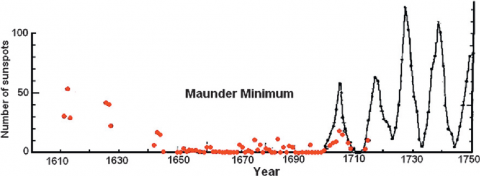
Galileo’s perfection of the telescope in 1609 allowed scientists to see sunspots for the first time. From 1610 A.D. to 1645 A.D., very few sunspots were seen, despite the fact that many scientists with telescopes were looking for them, and from 1645 to 1700 AD sunspots virtually disappeared from the sun (Fig. 1). During this interval of greatly reduced sunspot activity, known as the Maunder Minimum, global climates turned bitterly cold (the Little Ice Age), demonstrating a clear correspondence between sunspots and cool climate. After 1700 A.D., the number of observed sunspots increased sharply from nearly zero to more than 50 (Fig. 1) and the global climate warmed.


FIGURE 1. Sunspots during the Maunder Minimum (modified from Eddy, 1976).

The Maunder Minimum was not the beginning of The Little Ice Age — it actually began about 1300 AD — but it marked perhaps the bitterest part of the cooling. Temperatures dropped ~4º C (~7 º F) in ~20 years in mid-to high latitudes. The colder climate that ensued for several centuries was devastating. The population of Europe had become dependent on cereal grains as their main food supply during the Medieval Warm Period and when the colder climate, early snows, violent storms, and recurrent flooding swept Europe, massive crop failures occurred. Winters in Europe were bitterly cold, and summers were rainy and too cool for growing cereal crops, resulting in widespread famine and disease. About a third of the population of Europe perished.

Glaciers all over the world advanced and pack ice extended southward in the North Atlantic. Glaciers in the Alps advanced and overran farms and buried entire villages. The Thames River and canals and rivers of the Netherlands frequently froze over during the winter. New York Harbor froze in the winter of 1780 and people could walk from Manhattan to Staten Island. Sea ice surrounding Iceland extended for miles in every direction, closing many harbors. The population of Iceland decreased by half and the Viking colonies in Greenland died out in the 1400s because they could no longer grow enough food there. In parts of China, warm weather crops that had been grown for centuries were abandoned. In North America, early European settlers experienced exceptionally severe winters.

June 15, 2011

Daily link roundup

Filed under: Cancon, History, Media, Military — Tags: , , , , , — Nicholas @ 00:16

More links that don’t quite make it as separate blog entries.

  • North Carolina shipwreck officially recognized as being Queen Ann’s Revenge, the flagship of the infamous pirate Blackbeard. “The Queen Anne’s Revenge, a captured French slave ship, was part of a four-vessel pirate flotilla when it ran aground in 1718 beside the inlet leading to Beaufort and was abandoned. The wreck was found a little more than a mile off the beach in 1996 by Intersal, a private salvage company. The location precisely matched historical accounts of the grounding, and the ship appeared to be the right vintage and size and was armed to an unusual degree. And from the first, the artifacts brought up fit the origins of the ship, the crew and the places it was known to have visited.”
  • If more reporters (and bloggers) followed John Rentoul’s list of forbidden words and phrases the internet would be only a few megabytes in size (really, those phrases seem to appear in every article and blog post lately). “The original Banned List was, of course, George Orwell’s in 1946: dying metaphors (“Examples are: Ring the changes on, take up the cudgel for, toe the line, ride roughshod over, stand shoulder to shoulder with, play into the hands of, no axe to grind, grist to the mill, fishing in troubled waters, on the order of the day, Achilles’ heel, swan song, hotbed”); verbal false limbs (“Characteristic phrases are render inoperative, militate against, make contact with, be subjected to, give rise to, give grounds for, have the effect of, play a leading part (role) in, make itself felt, take effect, exhibit a tendency to, serve the purpose of”); pretentious diction (“Words like phenomenon, element, individual (as noun), objective, categorical, effective, virtual, basic, primary, promote, constitute, exhibit, exploit, utilise, eliminate, liquidate”); and meaningless words (his examples included “class, totalitarian, science, progressive, reactionary, bourgeois, equality”).”
  • Significantly different approaches by Canadian and British militaries to dealing with “operational security” over Libyan operations. “It is interesting to contrast the amount of information the Canadian Forces releases on its missions in Libya. It talks about the war in general terms but CF spokesman Brig. Gen. Richard Blanchette claims that detailing the type or numbers of bombs dropped on targets (or even naming specific targets) would violate operational security.” The British, in contrast, are eager to tell how many bombs (and of what type) were dropped from which aircraft and which Royal Navy vessels were involved in combat operations.
  • I was happy to see that Rogier van Bakel is now working with some co-bloggers at a new URL. Here’s the round-up of who, what, and where.

June 10, 2011

Cold War thinking on Chinese-US relations

Filed under: China, Economics, History, USA — Tags: , , — Nicholas @ 09:13

Brad Glosserman asks if China is using its new-found economic muscle to bankrupt the United States.

One popular narrative credits the end of the Cold War to a US strategy to bankrupt the Soviet Union. Well aware of the advantage conferred by its superior economic performance, Washington pushed Moscow into a military competition that drained the USSR of its resources. In this narrative, US President Ronald Reagan’s push to create a missile defence system — realistic or not — was the straw that broke the Soviet back.

Are Chinese strategists pursuing a similar approach to the United States? Is Beijing pushing US buttons, forcing it to spend increasingly scarce resources on defence assets and diverting them from other more productive uses? Far-fetched though it may seem — and the reasons to be sceptical are pretty compelling — there is evidence that China is doing just that: ringing American alarm bells, forcing the US to respond, and compounding fiscal dilemmas within the United States. Call it Cold War redux.

If that is indeed China’s strategy, then they’re wasting their efforts: without strong action in the very near term, the US government is going to bankrupt the country with no additional help from overseas required. The “popular narrative” Glosserman refers to handily glosses over the fact that the Soviet economy had been on a downward slide for decades. The Reagan-era military build-up merely hastened the end for Soviet economics, it did not bring it on in the first place. As Adam Smith famously noted, there is a lot of ruin in a nation, but eventually it does go smash — especially if no efforts are made to avert that nasty ending.

H/T to Jon, my former virtual landlord, for the link.

June 6, 2011

Colour footage of D-Day, 1944

Filed under: Britain, Cancon, France, Germany, History, Military, USA, WW2 — Tags: — Nicholas @ 17:25

H/T to Nick Gillespie for the link.

Tyler Cowen discusses “The Great Stagnation”

Filed under: Economics, History, Science, Technology, USA — Tags: , , — Nicholas @ 14:13

June 3, 2011

“The Amnesty film … was documentary as corporate hagiography”

Filed under: History, Liberty, Media — Tags: , , , , , — Nicholas @ 09:04

David Bowden reviews Amnesty! When They Are All Free, a BBC documentary on the 50th anniversary of Amnesty International:

The Amnesty film, by contrast, was documentary as corporate hagiography, evading nuance in favour of quick and easy narrative with a facile message: it ain’t easy being righteous.

It was a shame, because the story it told was potentially a fascinating one. Amnesty was born in the first wave of Sixties radicalism, and faced with the realisation that the apparently progressive politics of universal human rights adopted after the Second World War was being hijacked in the interests of Cold War realpolitik. The organisation began as a documentary news organisation, chronicling the disappearances and abuses under repressive regimes around the world. In the spirit of its famous torch image, Amnesty shone a light on human-rights abuses wherever it found them.

Certainly, as a product of the British postwar liberal intelligentsia, much of the organisation’s self-proclaimed apolitical stance smacked of naivety from the off; founder Peter Benenson was quickly forced to fall on his sword after accepting funding from the British government. Yet this overview of its early days was captivating stuff, offering a reminder of the genuine risks posed to its researchers and witnesses as this small organisation routinely found itself on the wrong side of Western and Soviet-backed juntas alike in its pursuit of accurate reporting of the human costs of the broader superpower struggle.

But Amnesty’s interventions were having distressing and unintended side effects — notably, the new tactic of ‘disappearing’ political prisoners before they became international causes célèbres. In the film, this raised interesting questions of journalistic ethics and apolitical campaigning, particularly pertinent in the context of the more cavalier instincts of the Wikileaks era.

Sadly, however, while willing to touch upon some of the uglier aspects of Amnesty’s growth from small, earnest campaign into the international China-baiting behemoth it is today, When They Are All Free tended to sideline difficult questions in favour of its heartwarming narrative. While there was a degree of soul-searching on offer, the problem with critiquing human rights as a political agenda today is that much of it is done by those on the inside. As Alex de Waal once remarked, ‘it is as though the sociological study of the church were undertaken by committed Christians only; criticism would be solely within the context of advancing the faith itself’.

June 1, 2011

More on the Greenland settlements

Filed under: Americas, Environment, History — Tags: , , , — Nicholas @ 12:08

In a follow-up to yesterday’s post on the end of the Viking settlements in Greenland, Sonya Porter provides more historical background:

In 891 AD. Eric The Red set off from Iceland with a few followers to explore a land to the west which they had probably spotted some time before while sailing out in their longboats, and then returned three years later with about 500 fellow Vikings. At first they settled on the south-east coast, close to the tip of this new land and then, as the population grew, created a further settlement to the south-west. They called their new home ‘Greenland’.

It has been said that this name was a ‘spin’, a publicity stunt to entice more Vikings to come to join the new settlers, but this would have been pointless if it had been impossible for them to survive. They must at least have been able to create their own dwellings, build their own fires, make their own clothes and above all, grow their own food. The settlers might have been able to trade such things as polar bear-skins and fox furs for iron and other necessities on occasional trips to Europe, but their compatriots in Denmark and Iceland would have been neither able nor willing to row their longboats out each month with groceries.

At present, the temperatures in Greenland range from a maximum of 7C in July to -9C in January. This is too cold for grain such as wheat and even rye to grow and ripen in the short summer of such northern latitudes. Nor are sheep and cattle happy at those temperatures. Hill sheep might be able to nibble away at moss and short grass, but cattle need lush meadows and hay to fatten and live through a winter. Solid wood is needed for building, boat building and warmth, but only bushes and such weak trees as birch now grow in Greenland.

In 1991, two caribou hunters stumbled over a log on a snowy Greenland riverbank, an unusual event because Greenland is now above the treeline. (1) Over the past century, further archaeological investigations found frozen sheep droppings, a cow barn, bones from pigs, sheep and goats and remains of rye, barley and wheat all of which indicate that the Vikings had large farmsteads with ample pastures. The Greenlanders obviously prospered, because from the number of farms in both settlements, whose 400 or so stone ruins still dot the landscape, archaeologists guess that the population may have risen to a peak of about five thousand. They also built a cathedral and churches with graves which means that the soil must have been soft enough to dig, but these graves are now well below the permafrost (2).

May 31, 2011

A bit of climate-change panic juxtaposition

First, the panic:

In a world of climate change, freak storms are the new normal. Newsweek‘s Sharon Begley on why we’re unprepared for the harrowing future, and how adapting to the inevitable might be our only option.
[. . .]
From these and other extreme-weather events, one lesson is sinking in with terrifying certainty. The stable climate of the last 12,000 years is gone. Which means you haven’t seen anything yet. And we are not prepared.

And, in the interests of balance, the eeeevil climate change denier:

Greenland’s early Viking settlers were subjected to rapidly changing climate. Temperatures plunged several degrees in a span of decades, according to research from Brown University. A reconstruction of 5,600 years of climate history from lakes near the Norse settlement in western Greenland also shows how climate affected the Dorset and Saqqaq cultures. Results appear in Proceedings of the National Academy of Sciences.

PROVIDENCE, R.I. [from Brown University] — The end of the Norse settlements on Greenland likely will remain shrouded in mystery. While there is scant written evidence of the colony’s demise in the 14th and early 15th centuries, archaeological remains can fill some of the blanks, but not all.

What climate scientists have been able to ascertain is that an extended cold snap, called the Little Ice Age, gripped Greenland beginning in the 1400s. This has been cited as a major cause of the Norse’s disappearance. Now researchers led by Brown University show the climate turned colder in an earlier span of several decades, setting in motion the end of the Greenland Norse.
[. . .]
The researchers also examined how climate affected the Saqqaq and Dorset peoples. The Saqqaq arrived in Greenland around 2500 B.C. While there were warm and cold swings in temperature for centuries after their arrival, the climate took a turn for the bitter beginning roughly 850 B.C., the scientists found. “There is a major climate shift at this time,” D’Andrea said. “It seems that it’s not as much the speed of the cooling as the amplitude of the cooling. It gets much colder.”

The Saqqaq exit coincides with the arrival of the Dorset people, who were more accustomed to hunting from the sea ice that would have accumulated with the colder climate at the time. Yet by around 50 B.C., the Dorset culture was waning in western Greenland, despite its affinity for cold weather. “It is possible that it got so cold they left, but there has to be more to it than that,” D’Andrea said.

May 28, 2011

Etymology of the word “buxom”

Filed under: History, Law, Randomness — Tags: — Nicholas @ 12:22

In a report on a lawyer’s attempt to become an internet laughing stock, there’s a brief digression into the word “buxom”:

To get back to “buxom” — I was surprised to learn that, according to the OED, this word originally had nothing specifically to do with women. It meant something like “obedient,” “pliant,” or “submissive,” but in reference to God, the Pope, or legal authority — e.g., c.1175 “Beo buhsome toward gode”; c.1523 “I shall be buxome and obeydient to iustice”; c. 1581 “The Consuls should sweare faythfully to become … buxome to the Pope.” (That last one especially I think is good evidence that the word didn’t mean what it means now.) The word also had the sense of “gracious,” “courteous,” or “kindly,” again without regard to gender.

By the 16th century, though, it was evolving into something like “lively” or “full of health,” still not exclusively as to women, but by the 19th century it looks like the dominant meaning had become “plump and comely … chiefly [to describe] women.” Given the word’s history of meaning “submissive” or “compliant,” though, this transition seems to make the word a lot more creepy and sexist than I had thought. I sweare faythfully not to use it anymore.

May 27, 2011

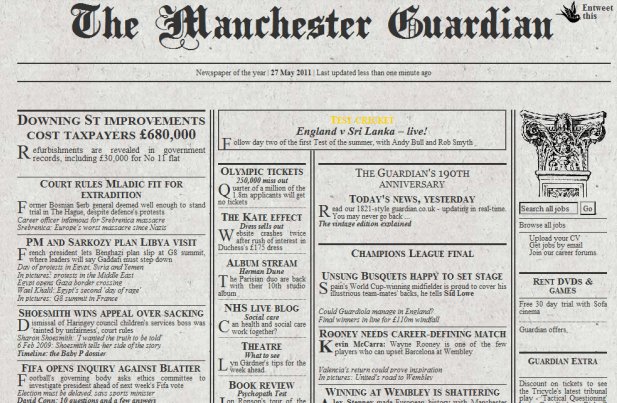
Happy 190th anniversary to the good old Grauniad

Filed under: Britain, History, Media — Tags: , — Nicholas @ 12:08

It’s the 190th anniversary, so the folks at The Guardian have virtually turned the calendar back:

More information about the “experiment in the typesetting of the mechanical facsimile we operate at guardian.co.uk” here.

« Newer PostsOlder Posts »

Powered by WordPress