
Quotulatiousness

August 9, 2011

(Temporarily) Drying out USS Monitor

Filed under: History, Technology, USA — Tags: , , — Nicholas @ 13:07

John Tierney reports on the conservation efforts on one of the most revolutionary warships in history:

[In 1861] a shipyard in Greenpoint, Brooklyn, launched not merely an ironclad but an entirely new kind of warship. The U.S.S. Monitor had no masts and no line of cannons. It was essentially a submarine beneath a revolving gun turret, something so tiny and bizarre-looking that many experts doubted the “cheese box on a raft” would float, much less fight.

But somehow it survived both the Navy bureaucracy and a broadside barrage to become one of the most celebrated ships in the world. Its designer and crew were the 19th-century celebrity equivalent of astronauts. Long after the ship sank in a storm off Cape Hatteras, N.C., the turret remained a cultural icon: an “armored tower” in Melville’s poetry, an image on book covers and film posters, a shape reproduced in items from toys to refrigerators.

Now the original turret, which was recovered from the ocean floor nine years ago and placed in a freshwater tank to protect it from corrosion, is on display again. It has been temporarily exposed to the air so that it can be scraped clean — very carefully, in front of museum visitors and a live webcam — by a team of researchers at the U.S.S. Monitor Center of the Mariners’ Museum here in Newport News. The team expects to have nearly all the barnacles and sediment removed by the end of this month, giving the public a new look at the dents from the Confederate cannonballs and shells that would have sunk any ordinary ship of its day. Then the turret will be submerged again in fresh water for 15 more years, until enough ocean salt has been removed from the metal to allow it to face the air permanently.
August 7, 2011

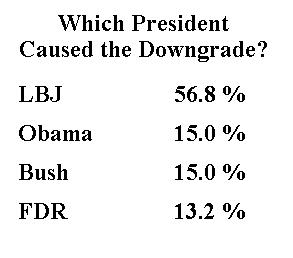
Mitchell: Obama bears only 15% of the blame for the downgrade

Filed under: Economics, Government, History, USA — Tags: , , , , , , , — Nicholas @ 17:57

In a blog post guaranteed to tick off members of both parties, Daniel Mitchell tries a first approximation of where the blame should be assigned:

Well, it turns out that Social Security is a relatively minor part of the problem, so even though President Roosevelt’s policies exacerbated and extended the Great Depression, the program he created is only responsible for a small share of the fiscal crisis. To give the illusion of scientific exactitude, let’s assign FDR 13.2 percent of the blame.



The health care numbers are much harder to disentangle because it’s not apparent how much of the increase is due to Medicare, Medicaid, Bush’s prescription drug entitlement, and Obamacare. A healthcare policy wonk may know these numbers, but the CBO long-run forecast didn’t provide much detail.

So with a big caveat that these are just wild estimations, I feel reasonably comfortable in saying that both Bush and Obama made matters worse with their reckless entitlement expansions, but that they merely deepened a fiscal hole that was created when President Johnson imposed Medicare and Medicaid.

“When I used to do this I broke my hand 14 times, and I’m a banjo player”

Filed under: Europe, History, Russia — Tags: , , , — Nicholas @ 17:13

Poland’s answer to the Society for Creative Anachronism, Knights’ Brotherhoods stage their own form of medieval recreation:

Compering and judging the hand-to-hand combat is Krzysztof Ptasinski, the son of a Polish diplomat who learnt English from an American teacher in Addis Ababa and insists I call him “Redneck Chris”.

His hooded robe and summer gear make him look like a monk in flip-flops.

“Whoa dude! Ouch! In your face!” he hollers as two knights wearing full body-plate armour weighing 35kg (77lb) lay into each other with double-handed swords.

To progress, a knight has to reach five points, each earned by laying a clean blow on an opponent above the knee.

The swords are blunt, of course, but that does not mean it is completely harmless.

“When I used to do this I broke my hand 14 times, and I’m a banjo player,” he says.

“I’ve got two screws in this finger. I had a cracked skull.

“When we were fighting the Belarusian guys, I had my kidney displaced.”

I ask him what the appeal is.

“Whenever you get hit in the helmet you almost lose consciousness because it’s so loud. It’s a thrill,” he says.

I used to work with a guy from St. Petersburg who told me all about the replica medieval armour and weapons he had to leave behind when he came to Canada. It sounds like this is a similar group.

From this description, the group doesn’t have quite the same concerns about participant safety that the SCA and other North American re-creationist/re-enactor groups have generally adopted.

July 31, 2011

Another book to add to the “to be read” pile

Filed under: Books, Economics, History, Media — Tags: , — Nicholas @ 18:00

From the current issue of Reason, a review of a pair of new books on the concept of “empire”:

The Rule of Empires, by the Washington University historian Timothy Parsons, explores the fundamental contradictions of imperial rule, making the case that empires have become increasingly difficult to maintain as potential subjects’ identities have become less fluid and more nationalistic. In Merchant Kings: When Companies Ruled the World, 1600–1900, the independent historian Stephen Bown takes a less systematic approach to the study of imperial power, but his book supplements Parsons’ by filling in the biographical details of the men who built Europe’s modern commercial empires. Both books demonstrate that while empire may seem a quick route to power and wealth, in the long run the idea is a military and financial loser.

[. . .]

Empires throughout history have claimed “to rule for the good of their subjects,” Parsons maintains, but this “was and always will be a cynical and hypocritical canard. Empire has never been more than naked self-interest masquerading as virtue.” To keep resources flowing from subjects to rulers, empires must walk a tightrope between subjugation and assimilation. If the state imposes draconian laws and taxes, it will face rebellion, so the rulers must seek out collaborators among their subjects who will assist in the domination of their fellow citizens. In return, collaborators are frequently brought into the imperial fold and given a portion of the spoils. But this leaves the empire vulnerable to conquering from the inside out, with many masters and few servants.

[. . .]

Empire building typically falls under the purview of governments, but in the 17th through 19th centuries, European states outsourced imperial conquest to quasi-private joint-stock companies. Governments granted these companies monopoly trading rights in distant regions and frequently offered their military might to ward off potential rivals. States rarely intended for the companies to become independent imperial powers, but the potential spoils of conquest proved hard for company officials to resist. After all, they had been freed from the discipline of competition, they were thousands of miles from political oversight, and their military risks were socialized by their state sponsors. As Bown points out in Merchant Kings, the EIC and similar corporations “were less the product of free-market capitalism than the commercial extension of European national wars and struggles for cultural and economic supremacy. They occupied the muddy grey zone that exists between government and enterprise.”

I’ve been looking for a good (recent) history of the East India Company for the last several months, so Merchant Kings sounds like it’d be of interest.

Is it time to update this to “16 (trillion) tons”?

Filed under: History, Media, USA — Tags: , — Nicholas @ 17:44

H/T to Gerard Vanderleun.

July 29, 2011

“This is the first global human rights legislation. How can people not know about it?”

Filed under: Cancon, History, Law, Liberty — Tags: , — Nicholas @ 10:54

I’m ashamed to say that this was news to me:

Monday, August 1, is a holiday in Canada. Everyone knows that. But what is the name of the holiday?

[. . .]

It is “Emancipation Day.”

You’re scratching your head, aren’t you? Don’t be embarrassed. Be angry — angry that you have been denied a truly majestic story all Canadians should know and cherish.

On August 1, 1834, slavery was abolished throughout the British Empire. “Emancipation Day” has been celebrated ever since in Jamaica, Trinidad, Barbados, and elsewhere.

[. . .]

In 1793, a free black man named Peter Martin – who had served with Butler’s Rangers in the American Revolution – told the legislature of the abduction of Chloe Cooley, a black slave who had been bound, gagged, thrown in a boat, and taken to the United States for sale. Simcoe seized the opportunity and moved to immediately abolish slavery.

It was a radical, audacious move. And it was too much. Wealthy slaveowners in the legislature resisted and Simcoe was forced to compromise: Existing slaves would be denied their freedom but the importation of slaves would stop and the children of slaves would be freed when they reached age 25. In effect, slavery would slowly vanish.

It was not the sweeping victory Simcoe wanted. But it was the abolitionists’ first legislative victory anywhere in the British Empire.

Boomer bashing: how the idea evolved

Filed under: Economics, History, Media — Tags: , , , , , , — Nicholas @ 10:20

Frank Furedi looks at the evolution of the “bash the boomers” meme, and how it differs from more traditional generational conflict:

Gone are the days when the baby boomers were perceived as the personification of a relaxed but enlightened 1960s live-and-let-live lifestyle.

This cohort of people, generally defined as those born between 1945 and 1965, are globally pathologised as the source of most forms of economic and environmental distress. Constantly accused of living way beyond their means, the baby boomers are blamed for depriving the young of opportunities for a good life. They are condemned for thoughtlessly destroying the environment through their mindless pursuit of material possessions and wealth, as well as resisting change, hanging on to their power and preventing the younger generations from progressing.

[. . .]

The idea that ‘it’s all their fault’ captures the intense sense of cultivated immaturity of the parent-basher. A sentiment that is usually associated with the intellectual universe of a truculent five-year-old is now embraced in earnest by biologically mature generational warriors. Paul Begala’s Esquire article ‘The Worst Generation’ captures this sense of uncontained resentment. ‘I hate the baby boomer’, he wrote, concluding that ‘they’re the most self-centred, self-seeking, self-interested, self-absorbed, self-indulgent, self-aggrandising generation in American history’.

[. . .]

The guilt-tripping of boomers is underwritten by an unusually philistine interpretation of the way society works. The 18th-century Malthusian obsessions about natural limits has been recycled as a warning to human ambition. From this standpoint, resources are fixed and the consumption of one generation reduces what’s available to the next. Accordingly, the flipside of boomer wealth is the poverty of the generations coming of age today. Catastrophic accounts of how young people have been deprived of opportunities for a comfortable life have fostered a cultural climate where the moral status of the elderly is continually questioned.

[. . .]

One of the most distinctive feature of the denunciation of the baby boomers is that it lacks any hint of a future-oriented idealism. It is principally driven by a sense of resentment against a generation that apparently had a really good time.

Instead of tackling the question of how to create a prosperous future, anti-boomers are more interested in gaining a larger slice of the wealth created in the past. Baby boomer self-indulgence pales into insignificance in comparison to the low horizons of their unambitious critics.

Never has the term ‘rebels without a cause’ had more meaning than today. At least Bazarov’s nihilism was in part motivated by the cause of ridding Russia of its feudal autocracy. Even the Lost Generation of the inter-war period were responding to a very real event that shaped their existence. Today’s anti-boomers are freed from the burden of a cause to fight for. As Tyler Durden remarked in the 1999 film Fight Club: ‘Our generation has had no Great Depression, no Great War’, before adding that ‘our depression is our lives’.

July 27, 2011

MS-DOS at thirty

Filed under: History, Technology — Tags: , , — Nicholas @ 07:25

It was indeed, according to The Register, thirty years ago that MS-DOS hit the market:

MS-DOS is 30 years old today. Well, kind of. On 27 July 1981, Microsoft gave the name MS-DOS to the disk operating system it acquired on that day from Seattle Computer Products (SCP), a hardware company owned and run by a fellow called Rod Brock.

SCP developed what it at various times called QDOS and 86-DOS to run on a CPU card it had built based on Intel’s 8086 processor.

July 26, 2011

$117,000 for a bottle of white wine

Filed under: History, Randomness, Wine — Tags: — Nicholas @ 08:46

A new record price paid for a single bottle of white wine:

Christian Vanneque fulfilled a long-held dream today by finally getting his hands on a bottle of 1811 Chateau d’Yquem. It just so happens that his $117,000 purchase has also put him in the history books.

His prized bottle is the most expensive white wine ever purchased, breaking the previous record of $100,000 in 2006 for a bottle of 1787 Chateau d’Yquem. Mr. Vanneque’s bottle is also a sweet Sauternes from the same Bordeaux chateau, though his purchase was produced in 1811, a year also known as the “comet year.” Oenophiles throughout history attribute the appearance of a comet for the reason why wines were extraordinary that year.

July 22, 2011

The wine industry’s nemesis, Phylloxera vastatrix

Filed under: Environment, Europe, France, History, Wine — Tags: — Nicholas @ 09:49

The Economist reviews a new book about the devastation to Europe’s wine makers caused by a tiny American invader:

These varieties are a reminder of the battle against phylloxera, a small, root-munching aphid that did incalculable damage to the wine business in the last 35 years of the 19th century. What George Gale, a philosophy professor at the University of Missouri-Kansas City, calls “the worst of all known invasive species disasters” swept across the viticultural landscape like a biblical plague. It destroyed vineyards from Rioja to Rheingau, Stellenbosch to Sicily. With good reason, Jules-Emile Planchon, the French botanist who helped to subdue the insect, dubbed it Phylloxera vastatrix.

[. . .]

In Europe, Gale’s research is no less assiduous. His coverage of the war between the largely Parisian scientific establishment, which believed that phylloxera was the effect, rather than the cause, of the devastation, and the so-called Américainistes of Montpellier and Bordeaux, who believed the opposite, is commendably detailed. The squabbling between the two sides stretched on into the 1880s, delaying the search for a solution.

Various remedies were proposed: flooding, planting on sandy soils and the use of carbon disulphide (a flammable, toxic chemical that was costly as well as tricky to apply). Growers then tried planting lower-quality American grapes, including Clinton and Noah, before switching, finally, to grafted vines combining phylloxera-resistant American rootstocks with European scions. This is still the practice in most of the world’s vineyards today.

July 18, 2011

Soviet tank battles

Filed under: Europe, Germany, History, Military, Russia, WW2 — Tags: , , , — Nicholas @ 00:06

I just picked up a copy of The Battle of Kursk by David M. Glantz and Jonathan M. House, based on a recommendation by Jim Dunnigan in his World War II Bookshelf. While any attempt to pick the top books about the Second World War is doomed to perpetual nit-picking by second-guessers and Monday Morning Quarterbacks, I’ve generally found the works he recommended to be worth reading.

Although I’ve read much about World War II, I haven’t read much about arguably the most critical part of the entire war: the gargantuan battles pitting the Soviet Red Army against Hitler’s Wehrmacht. Some of that is just sheer pig-headedness: I used to work for the biggest wargame store in Toronto, back when wargames meant cardboard counters, vast paper hexagonal maps, and charts and tables galore. The hardest of the hard-core gamers seemed to be either Napoleonic grognards (down to the secret stash of sabres and shakos in the gaming room) or even more dedicated junkies of the “Great Patriotic War”/”Operation Barbarossa”. Some of the latter were genuinely crazy, right down to the barely contained hints that “Hitler was just misunderstood”.

On the assumption that certain forms of craziness are contagious, I avoided most of the latter as much as I could, consistent with my duty to sell them the latest and greatest game involving their particular passion.

One day, perhaps in a fit of weakness, I allowed myself to get lectured by one of the fanatics about the details of the Battle of Kursk. The fan who felt the need to bend my ear was eager to impart information about some “famous battle” that turned out to have been a serious tactical miscalculation by a Soviet officer. The story, as he told it, had a very large formation of Soviet tanks “taking a shortcut” through a major minefield, resulting in many disabled/destroyed tanks and wounded or dead men. In the telling, this kind of thing could not be admitted as having happened without some enemy contact, so it was propagandized as being a major tank battle involving significant formations of German panzer troops and/or SS units (of whom, of course, the glorious defenders of the Motherland took a greater toll than they suffered themselves).

I’d heard a couple of variations of this story by this point, but none of them could name the general who led the formation, the location of the event, or the “battle” that was supposedly re-written for propaganda purposes.

Does this story ring a bell for anyone? I’d imagine if it had really happened in a way close to the way it was told to me, it would have been documented in great detail (especially after the fall of the Soviet Union, in that brief period that both the Soviet and the Nazi records were available to western researchers without direct censorship).

July 11, 2011

The long, quiet development of weaponry

Filed under: History, Military, Technology, Weapons — Tags: , — Nicholas @ 09:20

Strategy Page titled this one as “Four Decades To Become An Overnight Sensation”:

Wonder weapons, in general, aren’t. Those spiffy and seemingly magical new “wonder weapons” tend to be old weapons designs that finally got to the point where they lived up to the original hype. Take smart bombs. They were invented, and used quite successfully, during World War II. But these were radio controlled, and required skilled operators to succeed. Expensive as well, and no one wanted to spend the money to train effective operators in peacetime. In wartime, price was no object, and experience was easy to get.

Thus the U.S. dropped smart bombs from their arsenal after World War II, and didn’t revive them until the 1960s, when lasers (developed a decade earlier) were used to bounce their light off a target. A bomb was equipped with a seeker that could home on the reflected laser light, and a guidance kit (battery and motors to operate small wings) to hit the target without an operator. This was cheaper and more effective than the earlier smart bombs. The next big jump, in the 1990s, was the GPS guided bomb, which finally perfected the smart bomb. Thus this wonder weapon took four decades to become an overnight sensation.

Other examples are helicopters, which became iconic of the Vietnam War: first flown in 1904, used sparingly by both sides in World War II, but not in wide use until the 1950s.

While many of these systems are called “wonder weapons,” they aren’t. That’s because every new weapon quickly produces new tactics and combat techniques that reduce the improved capabilities of the new weapons. This is often ignored by historians. Self-preservation is a great motivator, and in the face of new weapons, the enemy will quickly find ways to diminish the wonder.

A need for speed in 1955 still has lingering influence

Filed under: History, Science, Technology, USA — Tags: , — Nicholas @ 09:01

Richard Black discusses the start of commercial nuclear power:

An experimental US reactor called EBR-1 generated the first nuclear electricity at its home in Argonne National Laboratory, sending current through a series of lightbulbs in 1951.

But the US did not open the world’s first civilian nuclear power station; that honour went to the USSR, whose tiny Obninsk reactor opened in 1953.

And the world’s first commercial-scale nuclear station was the UK’s Calder Hall, opened the following year.

The race for nuclear power — and with it, political influence — was underway.

“[Soviet President Nikita] Khrushchev… recognised that achievements in nuclear power made it possible to compete with the United States in the world arena — to say ‘our system, the socialist system, is the best — look who is first in areas of science and technology’,” relates Soviet historian Paul Josephson.

“You see a rebirth of hope that there will be a glorious communist future, perhaps a nuclear-powered future.”

All of these early reactors used different designs, with everyone except US scientists forced to work with natural uranium rather than the enriched variety developed during the Manhattan Project.

July 8, 2011

The Canadian right to free speech: not invented in 1982

Filed under: Cancon, History, Law, Liberty — Tags: , , , — Nicholas @ 10:03

Mark Steyn responds to former blogger Jason Cherniak about the free speech rights of Canadians:

You claim that the legal right to free speech “did not exist as a legal right before 1982”. This is bollocks de facto and de jure. When you say with all the blithe insouciance of a Dalhousie Law School alumnus that any right to free speech was “only respected by convention”, my response is what do you think the entire Canadian legal inheritance is, genius? It’s “convention”. That’s what the definition of Common Law is: a body of precedent, understandings of inherent authority — ie, “convention”. When Julian Porter, QC filed a motion objecting to the Canadian “Human Rights” Tribunal’s “secret trial”, he cited CBC vs New Brunswick, Ambard vs Attorney-General of Trinidad and Tobago – in other words, the accumulation of precedent, or, in your words, a respect for convention.

England, the mother of Common Law, has no written consititution, and thus no “constitutional rights” at all, but only “conventions”. Those “conventions” were the underpinning of the 1867 British North America Act and, more broadly, the third of a millennium of Canadian legal history before the Charter of Worthless Crap. As Blackstone put it, for lands “planted by English subjects”, “all the English laws then in being, which are the birthright of every subject, are immediately there in force”. In other words, long before 1982, free speech was a Canadian’s “birthright” — through convention. It’s all convention. In the English legal tradition, take away convention, and what’s left?

That’s why more countries have lived in liberty longer under Common Law than any other legal inheritance. Because what you dismiss as mere “convention” is, in fact, an understanding that “law” and laws are not the same thing. It’s not about the government writing down on a piece of paper everything that it will permit you, Jason the Barrister, to do. “Rights” are not those things granted by the sovereign and enumerated in statute, but the precise opposite: They’re restraints upon the sovereign. They’re not about what the state allows you to do, but about what the state is not allowed to do to you. The English legal tradition is imperfect (as all systems are) but it has been a better protector of this principle than any other. What part of that don’t you understand?

All of it, apparently. Because along comes that puffed up poseur Trudeau with all his modish contempt for the Canadian inheritance and he decides that, like you, he’s not big on convention and precedent and he’d rather have everything written down, all nice and “codified”. So now we have your 1982 Charter that, for the first time since Magna Carta, gives citizens what you call a “legal right” to free speech. And whaddaya know? Ever since we got a Trudeaupian “legal right” to it, there’s been less and less free speech than back in the bad old days when (according to you) we had no “legal right” to it at all. Ask yourself this, “Barrister and Solicitor”: Had Guy Earle delivered his lesbophobic putdowns at a Canadian comedy club in 1981, would he have had more or less “legal right” to free speech than he enjoys today?

I said in my post that, for you and yours, Trudeau is Year Zero. Your response confirms it. That a Canadian lawyer is willing to argue that a long, established, settled legal inheritance means nothing unless Father Pierre writes it down in his Napeoleonic Complex Code is bleak confirmation of how thoroughly he vacuumed Canada’s past — and, in doing so, perverted the very idea of what “rights” are. If yours is a typical Canadian lawyer’s view of the law, it certainly explains a lot. God help us all.

July 6, 2011

That lack of historical perspective, again

Filed under: Cancon, History, Humour, WW1, WW2 — Tags: , , — Nicholas @ 07:50

Mark Steyn pokes some fun at Tim Naumetz who managed to confuse the Vichy regime with Vimy Ridge, in an attempt to portray Stephen Harper as a history-distorting warmonger:

As Lilley points out, it was the Liberal Defence Minister John McCallum who made Vichy “a household name” in Canadian history when he confused France’s Second World War collaborationists with Canada’s greatest First World War battle: Vimy, Vichy, what’s the diff? (The Defence Minister made his error in seeking to explain an earlier confession that he’d never heard of the Dieppe Raid.) After blog-mockery from Lilley and others, Mr Naumetz and/or his somnolent editors have belatedly corrected his piece, although without acknowledging the error, never mind addressing the broader question of the cultural void in which he’s operating. I mean, it’s not even a particularly Canadian question: If you don’t know what Vichy is, it’s hard to figure out Casablanca.

[. . .]

I have no idea who “Tim Naumetz” is. (Any relation to Admiral Naumetz, whom the Bush-Cheney warmongers singlehandedly made a household name in the Pacific?) But truly he is a child of Trudeaupia. He belongs in the same category as Miles Hopper and Jason Cherniak, apparently grown men who write stuff like:

Canadians have a right to Freedom of Expression. We have that right because the Trudeau Government negotiated and passed the Charter of Rights and Freedoms.

Gotcha. So before 1982 Canadians had no right to Freedom of Expression? Thank you, Boy Genius. As I said of young Mr Cherniak:

One can only marvel at the near Maoist elimination of societal memory required to effect such a belief.

For these guys, Charter Day 1982 is Year Zero in Trudeaupia, and that’s that. You get a lot of that on the review pages, of course. When a critic says “This is the best sitcom since ‘Seinfeld””, all that means is “This is as far back as I remember.” But it’s the collectivization of “this is as far back as I remember” that’s so creepy about this crowd, as if they all went through the same historical vacuuming in school.

Which is presumably why it never even seems to occur to them that “this is as far back as I remember” is an inadequate argument when you’re attempting to argue that the current regime is attempting a wholesale makeover of national identity. I have no particular views on that one way or the other, but I notice that, consciously or otherwise, Mr Harper seems to have a tonal preference for pre-Trudeaupian language. For example, he welcomed Their Royal Highnesses to “our fair Dominion”. How often did that word pass Martin’s or Chrétien’s or Trudeau’s lips? I suppose Mr Naumetz would find that a bit déclassé, too, even though, in its political sense, it’s one of the few genuine Canadian contributions to the English language.

« Newer PostsOlder Posts »

Powered by WordPress