
Quotulatiousness

November 4, 2012

Even “Biblical views” change over time

Filed under: Health, History, Religion, USA — Tags: , , — Nicholas @ 10:39

An older post, but still rather informative:

The ‘biblical view’ that’s younger than the Happy Meal

In 1979, McDonald’s introduced the Happy Meal.

Sometime after that, it was decided that the Bible teaches that human life begins at conception.

Ask any American evangelical, today, what the Bible says about abortion and they will insist that this is what it says. (Many don’t actually believe this, but they know it is the only answer that won’t get them in trouble.) They’ll be a little fuzzy on where, exactly, the Bible says this, but they’ll insist that it does.

That’s new. If you had asked American evangelicals that same question the year I was born you would not have gotten the same answer.

That year, Christianity Today — edited by Harold Lindsell, champion of “inerrancy” and author of The Battle for the Bible — published a special issue devoted to the topics of contraception and abortion. That issue included many articles that today would get their authors, editors — probably even their readers — fired from almost any evangelical institution. For example, one article by a professor from Dallas Theological Seminary criticized the Roman Catholic position on abortion as unbiblical. Jonathan Dudley quotes from the article in his book Broken Words: The Abuse of Science and Faith in American Politics. Keep in mind that this is from a conservative evangelical seminary professor, writing in Billy Graham’s magazine for editor Harold Lindsell:

    God does not regard the fetus as a soul, no matter how far gestation has progressed. The Law plainly exacts: “If a man kills any human life he will be put to death” (Lev. 24:17). But according to Exodus 21:22-24, the destruction of the fetus is not a capital offense. … Clearly, then, in contrast to the mother, the fetus is not reckoned as a soul.

Christianity Today would not publish that article in 2012. They might not even let you write that in comments on their website. If you applied for a job in 2012 with Christianity Today or Dallas Theological Seminary and they found out that you had written something like that, ever, you would not be hired.

At some point between 1968 and 2012, the Bible began to say something different. That’s interesting.

Even more interesting is how thoroughly the record has been rewritten. We have always been at war with Eastasia.

Remembering the Toronto, Hamilton & Buffalo Railway

Filed under: Cancon, History, Railways — Tags: , , , — Nicholas @ 10:13

My friend John Spring is sharing some of his vast collection of railway film and photos with Canrail Video, and they’ve posted this excerpt of footage on the railway, including some of the last runs under steam on the TH&B:

TH&B Steam from the collection of John Spring. Copyrighted material ©2012 Canrail Video Productions. All rights reserved. You can however, link to this show from your site. This video will be shared for a short time only. You can view is and other John Spring films on future Canrail/Green Frog productions in the near future.

For more information on the railway, check the TH&B Railway Historical Society page or the Yahoo group (full disclosure: I founded the historical society, although I’m not currently active with the organization). I’m also the moderator for the discussion group.

The last of the Vulcan bombers to be grounded

Filed under: Britain, History, Technology — Tags: , , — Nicholas @ 00:02

The RAF took the Vulcan bomber out of service in the 1980s, and the last flying example of the aircraft has been kept up by a trust organization since 2005. The trust has concluded that they can’t afford the necessary repairs to keep the aircraft airworthy:

They were once the UK’s most potent nuclear deterrent and were on standby for a role in the Cuban missile crisis.

But in recent years there has been just one that kept the flag flying for the Vulcan Bombers.

XH558 is the final airworthy aircraft of its type and has been admired by thousands of people each year at air shows as a result.

But soon it too could be grounded like all those before it.

The “tin triangle”, which is more than 50 years old, needs “challenging modifications” to both wings which the trust that owns it has decided cannot be funded.

The Leicestershire-based Vulcan To The Sky trust, which bought the aircraft in 2005, says escalating costs and limited engine life mean soon it will be confined to the runway for limited displays.
[. . .]

The XH558 is now used to woo the crowds at air shows but keeping the 52-year-old aircraft in working order is a constant challenge for the engineers who work on her.

Chief engineer Mr Stone said he has had to have “words” with some of the pilots over the years who have pulled manoeuvres and airborne stunts which have made him “almost fall off his chair” as he watched from the ground.

November 3, 2012

Remembering the ill-starred Darien expedition

Filed under: Americas, Britain, History — Tags: , , , — Nicholas @ 09:18

History Today notes that the Darien Colony was founded by Scottish would-be colonists in what is now Panama on November 3, 1698:

On July 12th, 1698 five ships carrying 1,200 eager colonists left the Port of Leith in Scotland to a rapturous send-off. Most of the ill-fated emigrants did not know where they were going and did not find out until the sealed orders were opened at Madeira, but they were brimming with enthusiasm anyway.

A voyage of three months took them across the Atlantic to a harbour on the mangrove-studded Caribbean coast of Panama. On November 3rd, they took formal possession of their new territory, confidently naming it Caledonia and laying the foundations of the settlement of New Edinburgh. But it all went horribly wrong. Hundreds died of fever and dysentery before the colony was abandoned.

[. . .]

Scotland blamed the whole fiasco on the English. Paterson himself was bankrupt, but still believed in his scheme and tried vainly to revive it. Meanwhile, the Darien disaster seems to have persuaded hard-headed Scotsmen that their country could not prosper by itself, but needed access to England’s empire, and it helped to pave the way for the Act of Union between the two countries in 1707. Under the Act the investors in the Darien scheme were quietly compensated for their losses at taxpayers’ expense.

November 1, 2012

Recreational trench-building

Filed under: Britain, History, Military, WW1 — Tags: , , — Nicholas @ 14:06

I’ve dug trenches, in my long-past militia days, but I’ve never really thought about doing it as a hobby:

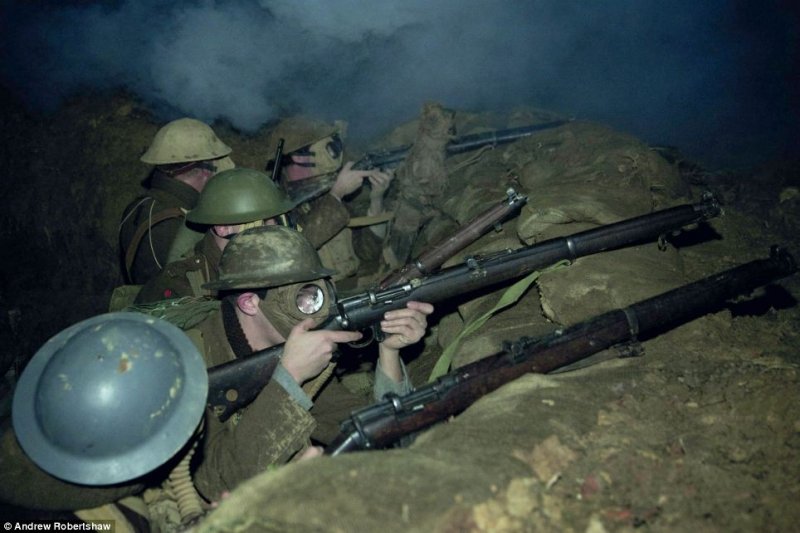
Surrounded by barbed wire, sandbags and mud, this 60ft trench is barely distinguishable from those occupied by British soldiers fighting in the First World War almost a century ago.

The enormous dugout has been painstakingly recreated by an ex-history teacher in his back garden in Surrey, and the dedicated 55-year-old even spent 24 hours living in its confines with a team of volunteers as part of his efforts to experience life as a WWI soldier.

Andrew Robertshaw and 30 helpers spent a month shifting around 200 tonnes of earth to build the enormous three-room trench, which he hopes will teach people more about the horrific living conditions endured by British troops during the Great War.

The only thing that struck me about this and other photos in the article is that the re-enactors look too clean. Digging a trench, then spending more than a short stretch of time therein leaves dirt everywhere:

The development of personal computing

Filed under: History, Technology — Tags: , — Nicholas @ 09:09

At The Register, Tony Smith charts twenty significant items that lead to modern personal computers:

Personal computing. Personal. Computing. We take both aspects so completely for granted these days, it’s almost impossible to think of a time when computing wasn’t personal — or when there was no electronic or mechanical computing.

To get from there to here, we’ve gone from a time when ‘computers’ were people able to do perform complex calculations themselves, through mechanical systems intended to do the work for them and then to powered machines able to automate the process. These led to systems that could be programmed to perform not only mathematical tasks but to store and retrieve other forms of data, taking us right up to desktop devices for a one-on-one interaction with computing power.

Since then, that power has been compressed into smaller, more convenient packages: laptops, tablets and smartphones.

What a trip. In memory of the many people who have help us along, here then are some of the key stages of that journey, represented by the 20 objects that, to us, most embody the steps that brought us to where we are today.

It’s not a comprehensive list — and feel free to comment with the devices you think we should have included — but here are the first ten of our 20 items, from the early days up to the end of the 1970s. Part two will bring us from the 1980s to the present day.

October 31, 2012

The science of “shaken, not stirred”

Filed under: Books, History, Media, Science — Tags: , , , — Nicholas @ 09:05

Ah, those dedicated researchers at The Register! This time, they’ve got Gavin Clarke looking into the famous dry martini of James Bond:

“A distressingly large amount of rubbish is talked about cocktails,” Noel Jackson, top boffin at the Life Science Centre in Newcastle-Upon-Tyne, tells The Reg.

Jackson, a Cambridge-University-educated chemist, has all the straight-up science on alcohol.

“We do a lot of debunking of things that people think are true,” he tells us. “There’s this business of shaken versus stirred. Once you heard it said from people in the cocktail world that shaking ‘bruises’ a liquid! That’s rubbish.”

The Reg, as part of our ongoing celebration of James Bond’s fiftieth year on film, was talking to Jackson about one of the signature elements of the 007 package: the dry vodka martini. Shaken, not stirred.

Jackson comes on the best of recommendations. We were put onto him by the boffins of the UK’s National Physical Laboratory, who have been instrumental in such developments as packet-switched networking and the “Dambuster” bouncing bomb of World War II fame.

“What he doesn’t know about drinks, doesn’t need to be known,” they told us.

We spoke to Jackson about chemicals and thermal dynamics. We start with flavour, and that means talking alcohol.

The pre-history of Halloween

Filed under: Britain, History, Religion — Tags: , , — Nicholas @ 08:33

In History Today, Maggie Black looks at the origins of current Halloween traditions:

…the feast which the early Church took [over] most completely from the great pagan, Celtic feast of Samhain which celebrated the end of summer and the harvest, together with the start of winter and the New Year. The Celts believed that, on the eve of the festival (our own Hallowe’en), the dead returned to walk the earth for a night and a day and with them came the spirits of evil, at their most potent. Fires blazed on every hilltop to purify the land, defeat the evil ones and encourage the wasting sun to revive. Ceremonial dancing, noisy games and harvest-end rituals took place around these fires with drinking of the herbal ales for which the Celts were renowned. Seizing their chance to question as well as to honour and propitiate their dead, the Celts chose this time for divination rituals too.

The force and vigour of the ancient beliefs overrode all newer ones and these practices survived the advent of Christianity, in barely translated form at first, and only very gradually died out. The evil spirits became witches, and the bonfires burned them in effigy (for instance the Shandy Dann at Balmoral where, we are told, Queen Victoria much enjoyed the fun). A great number of divining rituals and games, often involving apples, nuts and fire, persisted; apples and nuts were the last-harvested fruits. Even the old herbal ale: survived as mulled ale or punch with roasted apples floating in it.

The more significant pre-Christian practice of impersonating the dead and other spirits and by so doing protecting oneself and others from their spectral power also continued. Sometimes this was acted out by processions of young adults (later children) wearing or carrying grotesque masks and often headed by a youth carrying a horse’s skull (as, for example, the Lair Bhan in co Cork, or the Hodening Horse in Cheshire). They went from door to door or visited friends and neighbours, collecting money for food. Before Christian times, such largesse had no doubt been given to feast the dead spirits in return for the promise of fertility and protection from evil provided by the visit. But in pre-Reformation Christian Europe, it provided candles and masses for the dead and snacks for the living.

October 30, 2012

A source of obscure and unusual do-it-yourself books

Filed under: Books, History, Media, Technology — Tags: , — Nicholas @ 08:51

Michael Bradshaw‘s letter to the editor in the most recent Libertarian Enterprise alerted me to a possible source of interesting and unusual do-it-yourself books and pamphlets:

“The Lindsay” of Lindsay’s Books has announced his retirement “in 2013 or earlier” and the closing of his book store.

For many decades Mr. Lindsay has been the premier supplier of technical books to the do-it-yourself crowd, machine shop mavens, foundry sand-crabs, eccentrics, nut cases (like me) and geniuses at large (like “Uncle Dave” Gingery).

It ain’t all Uncle Dave.

He (Lindsay, not Dave) has titles from all over and back to the mid nineteenth century. He used to have De Re Metallica by Agricola in the Hoover English translation, but I don’t know if it is still cataloged. There are tech-school text books, how-to volumes from some of the best industrial arts guys around and collections of articles from technical manuals and magazines back to the early twentieth century. Get a 1940’s version of “How to Run a Lathe” by the South Bend Machine Tool Company.

His titles cover a plethora (really!) of stuff, such as:

  • Machine shop practices, building the major tools from scratch — from scrap (the Gingery series), building EDM machines and other shop tools and techniques.
  • Foundry tools and methods. Make your own molding shop and blast furnaces for the back yard. Fuel them with charcoal, propane or natural gas. Pour castings in aluminum, zinc and pot metal, copper alloys, iron alloys. Design and build centrifugal fans to power your crucible and cupola furnaces. Make your own crucibles. Dig ore for your cupola furnace, with a sharp stick, while wearing a leather breech-clout, a tie and a top hat! (OK, that last one was a joke. Lame.)
  • Sheet metal shop tools and methods. Make your own brake and slip-roll. Books of projects. Start a local sheet metal fabricating business.
  • Make electric generators, modify alternators, re-build or modify motors, make electro- and permanent magnets. Make radios from scratch. Emulate Nicola Tesla. Short circuit yourself and go up in a puff of smoke!
  • Learn about old-time chemistry. Set up a chem-lab. Screw up and dissolve, stain, burn, poison, blow-up and generally kill yourself in the most ingenious ways! Go up in another puff of (green) smoke!
  • Make wooden toys for kids. Make ship models for yourself.
  • Make steam, sterling, turbines and other kinds of engines. Build boilers from scratch and blow yourself (and the garage) up again! Build locomotives from scratch. Well, “maybe” on that last one.
  • Make wind and water turbines to power your generators or shop. Recycle waste oils.
  • Other stuff that I forgot to mention.

Basically, if you drop a bunch of money (including postage) on Lindsay, he will show you how to make a very complete industrial revolution. You may even have some fun. While killing yourself in the most ingenious ways. Count your fingers at the end of the day.

[. . .]

Get a catalog for $2 from Lindsay at lindsaybks.com Order some books. Do it NOW while you still can. The complete machine shop from scratch series is available in a package deal at a discount. There are some other package discounts. Check out the trauma center and links to other book dealers. Some are available on Amazon.com, but not many.

You can also buy Uncle Dave’s books (and his son Vince’s, too) direct, at the Gingery book store.

Note: I just received a note from Lindsay Books. Here is the pertinent part:

    “In the future, you may want to visit our new associate e-store:

    Your Old Time Bookstore
    youroldtimebookstore.com
    YOTB’s site offers all books printed by Lindsay and provides decline/error notification before processing…

    Thanks!
    Lindsay Publications, Inc.

    PO Box 538
    Bradley, IL 60915
    Fax: 815-935-5477″

See you in the shop.

October 28, 2012

Yup. Nastiest political rhetoric ever. Or not.

Filed under: History, Media, Politics, USA — Tags: , , — Nicholas @ 12:43

Got Milk (mutation)?

Filed under: Environment, Food, Health, History, Science — Tags: , — Nicholas @ 12:33

Lactose intolerance is part of humankind’s genetic inheritance, which is why the mutation that allowed (some) adult humans to digest milk is of great interest to geneticists:

A genetic mutation appeared, somewhere near modern-day Turkey, that jammed the lactase-production gene permanently in the “on” position. The original mutant was probably a male who passed the gene on to his children. People carrying the mutation could drink milk their entire lives. Genomic analyses have shown that within a few thousand years, at a rate that evolutionary biologists had thought impossibly rapid, this mutation spread throughout Eurasia, to Great Britain, Scandinavia, the Mediterranean, India and all points in between, stopping only at the Himalayas. Independently, other mutations for lactose tolerance arose in Africa and the Middle East, though not in the Americas, Australia, or the Far East.

In an evolutionary eye-blink, 80 percent of Europeans became milk-drinkers; in some populations, the proportion is close to 100 percent. (Though globally, lactose intolerance is the norm; around two-thirds of humans cannot drink milk in adulthood.) The speed of this transformation is one of the weirder mysteries in the story of human evolution, more so because it’s not clear why anybody needed the mutation to begin with. Through their cleverness, our lactose-intolerant forebears had already found a way to consume dairy without getting sick, irrespective of genetics.

[. . .]

A “high selection differential” is something of a Darwinian euphemism. It means that those who couldn’t drink milk were apt to die before they could reproduce. At best they were having fewer, sicklier children. That kind of life-or-death selection differential seems necessary to explain the speed with which the mutation swept across Eurasia and spread even faster in Africa. The unfit must have been taking their lactose-intolerant genomes to the grave.

Milk, by itself, somehow saved lives. This is odd, because milk is just food, just one source of nutrients and calories among many others. It’s not medicine. But there was a time in human history when our diet and environment conspired to create conditions that mimicked those of a disease epidemic. Milk, in such circumstances, may well have performed the function of a life-saving drug.

H/T to Marginal Revolution for the link.

October 23, 2012

Bilingualism and multiculturalism, “the Siamese twins of Canadian social policy”

Filed under: Cancon, History — Tags: , , , — Nicholas @ 09:34

In Maclean’s, Heather Scoffield wonders if the twin keystones of “official” Canadian identity (as defined by the Liberal party in 1969) are actually in opposition to one another:

Have the two forces that have defined Canadian culture for the past 40 years — multiculturalism and bilingualism — turned on each other?

The final release of 2011 census data this week will offer Canadians some insight into the answer.

On Wednesday, Statistics Canada will publish language data showing how many people speak English, how many speak French, and how many speak a myriad of other languages — a consequence of increasingly diverse immigration.

In the last census, in 2006, the number of people who called French their mother tongue was almost — but not quite — on par with the number of people who identify other languages as their first.

If the trend lines continue, as the experts expect they will, they could cross come Wednesday. Measured in terms of percentage of the total population in Canada, French is expected to continue its long, slow decline as a mother tongue and “other” languages will continue their ascent, with the number of allophones — those with a mother tongue other than Canada’s two official languages — surpassing their francophone counterparts.

So have we reached the point where the twin forces unleashed during the 1970s are now competing forces, with multiculturalism drowning out bilingualism?

October 22, 2012

Want to learn a new language? How about proto-Elamite?

Filed under: History, Middle East, Science — Tags: , , , — Nicholas @ 09:10

If you have the ability to decode the world’s oldest undeciphered texts, you can be our first proto-Elamite scholar:

“I think we are finally on the point of making a breakthrough,” says Jacob Dahl, fellow of Wolfson College, Oxford and director of the Ancient World Research Cluster.

Dr Dahl’s secret weapon is being able to see this writing more clearly than ever before.

In a room high up in the Ashmolean Museum in Oxford, above the Egyptian mummies and fragments of early civilisations, a big black dome is clicking away and flashing out light.

This device, part sci-fi, part-DIY, is providing the most detailed and high quality images ever taken of these elusive symbols cut into clay tablets. This is Indiana Jones with software.

It’s being used to help decode a writing system called proto-Elamite, used between around 3200BC and 2900BC in a region now in the south west of modern Iran.

And the Oxford team think that they could be on the brink of understanding this last great remaining cache of undeciphered texts from the ancient world.

October 21, 2012

Nick Gillespie: A libertarian appreciation for the late George McGovern

Filed under: History, Politics, USA — Tags: , , , , , — Nicholas @ 11:22

George McGovern will, unfortunately, be best known to most people as the poor beggar who lost the 1972 election to Richard Nixon in a blowout. Nick Gillespie says there was much more to McGovern than just being on the wrong side of an electoral landslide:

McGovern’s early criticism of the Vietnam War (he first spoke against it as a newly elected Democratic senator from South Dakota in 1963) was out of step with a bipartisan Cold War consensus that smothered serious debate for too long.

Yet when you take a longer view of his career — especially after he got bounced from the Senate in 1980 during the Republican landslide he helped create — what emerges is a rare public figure whose policy positions shifted to an increasingly libertarian stance in response to a world that’s far more complicated than most politicians can ever allow.

Born in 1922 and raised during the Depression, McGovern eventually earned a doctorate in American history before becoming a politician. But it was as a private citizen he became an expert in the law of unintended consequences, which elected officials ignore routinely. He came to recognize that attempts to control the economic and lifestyle choices of Americans aren’t only destructive to cherished national ideals, but ineffective as well. That legacy is more relevant now than ever.

[. . .]

In a 1997 New York Times op-ed article, he emphasized that simply because some people abuse freedom of choice is no reason to reduce it. “Despite the death of my daughter,” he argued, “I still appreciate the differences between use and abuse.” He rightly worried that lifestyle freedom, like economic freedom, was everywhere under attack: “New attempts to regulate behavior are coming from both the right and the left, depending only on the cause. But there are those of us who don’t want the tyranny of the majority (or the outspoken minority) to stop us from leading our lives in ways that have little impact on others.”

McGovern believed that attempts to impose single-value standards were profoundly un-American and “that we cannot allow the micromanaging of each other’s lives.” But as governments at various levels expand their control of everything from health-care to mortgages to the consumption of soda pop and so much more, that’s exactly what’s happening.

Animated map of the Battle of Trafalgar, 21 October, 1805

Filed under: Britain, France, History, Military — Tags: , — Nicholas @ 10:51

The BBC created an animated map you can view either with interpretations or non-stop, showing the tactics of Vice Admiral Nelson and Vice Admiral Villeneuve at the Battle of Trafalgar.

On 21 October 1805, the Royal Navy clashed with the Combined French and Spanish fleet at Cape Trafalgar, off the coast of Spain. The battle had massive repercussions for Napoleon’s France and the future of the British Empire.

« Newer PostsOlder Posts »

Powered by WordPress


