Quotulatiousness

November 21, 2012

Piltdown Man

Filed under: Britain, History, Science — Tags: , , — Nicholas @ 09:33

History Today tweeted that today is the anniversary of the exposure of the Piltdown Man hoax in 1953:

Once cited as the ‘missing link’ between man and beast and definitive proof of the theory of evolution, the Piltdown Man was exposed as a hoax in 1953. Eoanthropus Dawsoni was ‘excavated’ in 1912 by amateur archaeologist Charles Dawson from a shallow gravel pit in Piltdown, Sussex. Great excitement greeted his find, as at the time fewer than five human fossils had been discovered and most of those were incomplete, their dates uncertain and — almost worst of all at a time of intense imperial rivalry — they were foreign. France and Belgium had long boasted Neanderthal skeletons. Germany had Heidelburg Man. Now here, at last, was the first great British palaeoanthropological find. The Piltdown Man, as he was immediately dubbed, was the ‘first Englishman’ and he caused a world sensation.

[. . .]

As time passed and more evidence was disinterred, Piltdown Man became more and more of an anomaly, marginalised in evolutionary theory but remaining on the syllabus. Students were writing dissertations on Piltdown in the 1950s. Then in 1953, following a lecture on Piltdown at the British Museum, South African born Doctor Joseph S. Weiner had an epiphany on the train home to Oxford: Piltdown had to be a fraud.

With his friend and colleague Geoffrey Ainsworth Harrison, who is now the Professor of Biological Anthropology at Oxford, Weiner set about collecting as much evidence as he could before approaching the Head of the Anatomy Department at Oxford, Professor Wilfrid Edward Le Gros Clark. Using the latest scientific techniques, including fluorine measurement and radiocarbon dating, the team proved that the mandible of Eoanthropus Dawsoni had been deliberately stained with potassium bichromate and the teeth filed down. The jaw was later shown to have come from an orangutan.
November 20, 2012

50 years later: Solzhenitsyn’s One Day in the Life of Ivan Denisovich

Filed under: Books, History, Media, Russia — Tags: , , — Nicholas @ 12:04

It’s being called “one of the most significant books of the 20th Century”, and it was published 50 years ago this month:

The character was fictional. But there were millions like him — innocent citizens who, like Solzhenitsyn himself, had been sent to the Gulag in Joseph Stalin’s wave of terror.

Censorship and fear had prevented the truth about the camps from being published, but this story made it into print. The USSR would never be the same again.

“We were absolutely isolated from information, and he started to open our eyes,” remembers writer and journalist Vitaly Korotich.

[. . .]

It was Soviet leader Nikita Khrushchev who had sanctioned publication of Solzhenitsyn’s novel nearly a decade after Stalin’s death. Allowing a book on the Gulag, he thought, would help debunk Stalin’s personality cult. However, one story sparked many more.

“After it was published, it was impossible to stop it,” Korotich recalls. “Immediately we received a lot of illegal publications. A lot of people who were in prison started to remember how it was.

November 18, 2012

Having (in)famous ancestors

Filed under: History, Humour, USA — Tags: , , , — Nicholas @ 11:40

John Scalzi is having mixed reactions to all the Twitter updates about Lincoln and theatres:

And he wrote about his infamous relative a few years ago:

Every family should have an interesting skeleton in the family closet. In my family, it’s John Wilkes Booth, assassin of Abraham Lincoln, who, of course, was the President of the United States during the American Civil War. Booth assassinated Lincoln not long after the cessation of hostilities between the Union and the Confederacy, by sneaking into the President’s box at Ford’s Theater (the show: Our American Cousin) and shooting him in the back of the head with a pistol. Booth then leaped from the box to the stage, shouting “Sic semper tyrannis” (“Thus it is with tyrants”) and “The South is avenged.” He broke his leg but managed to escape nevertheless. However, eleven days later, he was discovered in a barn, burned out, and then shot (by himself or by a soldier, it’s unclear). He died shortly thereafter. Some maintain that Booth’s body was never positively identified, so it’s possible he actually escaped. Either way, he’s dead now.

For the record, I’m not a direct descendant — my line goes through one of his nine other siblings, making him something along the lines of a great-great-great-great-great-grand-uncle. Whenever I mention my relationship to him, though, people’s eyes get wide, their jaws go momentarily slack, and some people actually back up a step, as if a long dormant assassination gene might suddenly fire up, and they’d be the unlucky recipient. I get a kick out of that. Then I go for the extra point my mentioning that John Wilkes and I have the same birthday: May 10, 131 years apart. By the time I mention I get edgy handling pennies and five dollar bills, people begin to wend their way to the nearest door.

November 13, 2012

QotD: British women in WW2

Filed under: Britain, History, Military, Quotations, USA, WW2 — Tags: , , , — Nicholas @ 12:24

A British woman officer or non-commissioned officer can and often does give orders to a man private. The men obey smartly and know it is no shame. For British women have proven themselves in this war. They have stuck to their posts near burning ammunition dumps, delivered messages afoot after their motorcycles have been blasted from under them. They have pulled aviators from burning planes. They have died at the gun posts and as they fell another girl has stepped directly into the position and “carried on.” There is not a single record in this war of any British woman in uniformed service quitting her post or failing in her duty under fire.

Now you understand why British soldiers respect the women in uniform. They have won the right to the utmost respect. When you see a girl in khaki or air-force blue with a bit of ribbon on her tunic — remember she didn’t get it for knitting more socks than anyone else in Ipswich.

Instructions for American Servicemen in Britain, 1942

November 11, 2012

In memorium

Filed under: Britain, History, Military, WW1, WW2 — Tags: , , — Nicholas @ 11:00

A simple recognition of some of our family members who served in the First and Second World Wars:

The Great War

  • Private William Penman, Scots Guards, died 1915 at Le Touret, age 25
    (Elizabeth’s great uncle)
  • Private David Buller, Highland Light Infantry, died 1915 at Loos, age 35
    (Elizabeth’s great grandfather)
  • Private Walter Porteous, Northumberland Fusiliers, died 1917 at Passchendaele, age 18
    (my great uncle)
  • Corporal John Mulholland, Royal Tank Corps, died 1918 at Harbonnieres, age 24
    (Elizabeth’s great uncle)

The Second World War

  • Flying Officer Richard Porteous, RAF, survived the defeat in Malaya and lived through the war
    (my uncle)
  • Able Seaman John Penman, RN, served in the Defensively Equipped Merchant fleet on the Murmansk Run (and other convoy routes), lived through the war
    (Elizabeth’s father)
  • Private Archie Black (commissioned after the war and retired as a Major), Gordon Highlanders, captured at Singapore (aged 15) and survived a Japanese POW camp
    (Elizabeth’s uncle)
  • Elizabeth Buller, “Lumberjill” in the Women’s Land Army in Scotland through the war.
    (Elizabeth’s mother)

In Flanders fields the poppies blow
Between the crosses row on row,
That mark our place; and in the sky
The larks, still bravely singing, fly
Scarce heard amid the guns below.

We are the Dead. Short days ago
We lived, felt dawn, saw sunset glow,
Loved and were loved, and now we lie
In Flanders fields.

Take up our quarrel with the foe:
To you from failing hands we throw
The torch; be yours to hold it high.
If ye break faith with us who die
We shall not sleep, though poppies grow
In Flanders fields.

Lieutenant Colonel John McCrae, MD (1872-1918)

November 10, 2012

What Ataturk accomplished to create modern Turkey

Filed under: Europe, Greece, History, Middle East, WW1 — Tags: , , , — Nicholas @ 11:35

History Today posted that today is the anniversary of the death of Mustafa Kemal Ataturk, the man who carved modern Turkey out of the ruins of the Ottoman empire:

Mustapha Kemal Pasha was given the honorific title ‘father of the Turks’ at the height of a revolution which he was pushing forward intuitively and idiosyncratically, there being no precedent for such a fundamental sea change in a Muslim state.

Inevitably, it took someone standing outside the Islamic tradition of Ottoman Turkey to create a new state out of Anatolia — rising from the wreck of the empire. But as The Times was to say in its obituary, this was a man of extraordinary qualities; a Cromwell of the Middle East and also a maverick with an almost feminine subtlety in handling crises on the path to supreme power. He had an iron will and displayed single-mindedness when it came to ensuring the security of the state, even to hanging former confederates who plotted against his revolution.

Ataturk was born of an Albanian mother in Salonika and, without connections followed a military career in which, after being involved with the Young Turks reformist movement, he made his name in 1915 by rushing reinforcements to the Gallipoli beach-head and holding the ANZAC assault.

[. . .]

The Kemalists formed a provisional government in the small town of Ankara, in the middle of the desolate Anatolian plateau. On the Aegean and Mediterranean coasts the Greeks and Italians laid claim to what they regarded as their Asia Minor birthright, hoping to recreate some sort of classical empire. Kemal disabused the Greeks, who soon, of all the Allies hoping for a piece of Anatolia, were alone in arms against the nationalist forces. Halted in a blistering hot wilderness just short of Ankara, the Greeks, who had out-marched their supply lines, were outflanked and thrown back by Kemal’s outnumbered and ragged levies at the Sakaria river. A retreat became a headlong flight and the Greek forces joined their fellow nationals and the Armenians and foreigners who had formed the mercantile community of Smyrna, in a panic-stricken evacuation of the sacked and blazing port. Kemal is supposed to have indulged in a drinking orgy as Smyrna went up in flames — a Tartar conqueror’s celebration of total victory.

The Greeks quit the struggle and their sponsor, the British Prime Minister, Lloyd George, who had threatened armed British intervention backed by the fleet to keep Constantinople an open port under British protection, followed suit. The French and Russians signed separate treaties, giving the Kemalists recognition and aid.

November 9, 2012

Tomb discoveries cast light on Thracian culture

Filed under: Europe, History, Science — Tags: , , , , — Nicholas @ 10:16

A recent discovery in Bulgaria promises to tell us more about the culture of the Getae, a powerful tribe in Thrace:

Archaeologists in Bulgaria are chuffed today to announce that golden treasures and artifacts produced by the ancient Thracians have been discovered in a subterranean tomb complex in the north of the country.

The treasures include snake-headed bracelets, a golden crown or tiara type affair, a golden horse head and piles of smaller solid gold items including rings, statuettes and buttons. They’re thought to date from the third century BC and to have been produced by the Getae, a tribe among the ancient Thracians.

[. . .]

Thracian warriors played prominent parts in many of the wars of antiquity. The peltast javelineer style of fighting was said to have originated in Thrace, gradually superseding the armoured hoplite warrior: an entire phalanx of the formidable Spartans was crushed by peltasts fighting for Athens during the Peloponnesian War, and the lightly armoured Greek/Thracian warriors are also said to have inflicted severe damage on heavy Persian cavalry.

Alexander the Great — from the neighbouring area of Macedonia — is also said to have used Thracian mercenaries in his world-spanning campaigns, and later on Thracian warriors were prominent in the armies of Rome and then the Eastern empire. In particular, the famous gladiator and rebel Spartacus had originally been a Roman auxiliary soldier from Thrace. Later on — after the fall of Rome, when the Empire was ruled from Constantinople — both the emperor Justinian and the great general Belisarius are said to have been Thracians.

Deception and counter-deception

Filed under: Europe, Germany, History, Military, WW2 — Tags: , , , , , — Nicholas @ 09:08

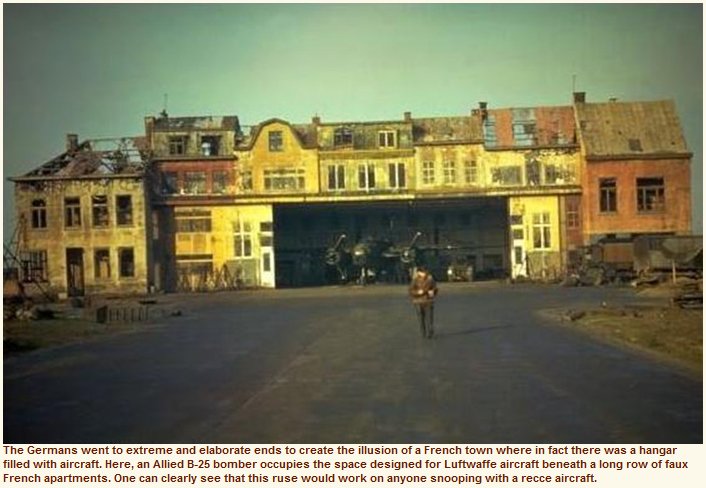
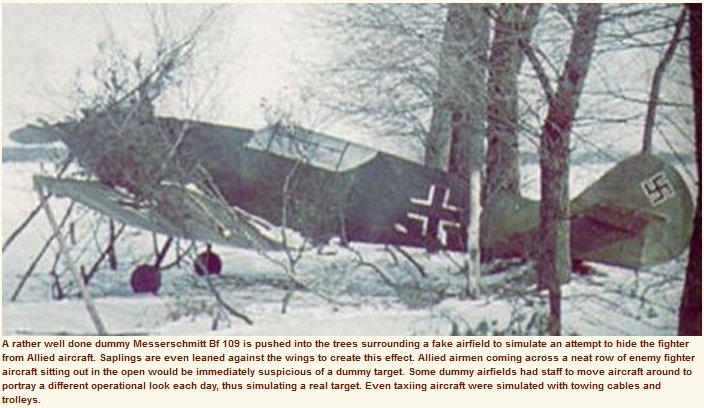
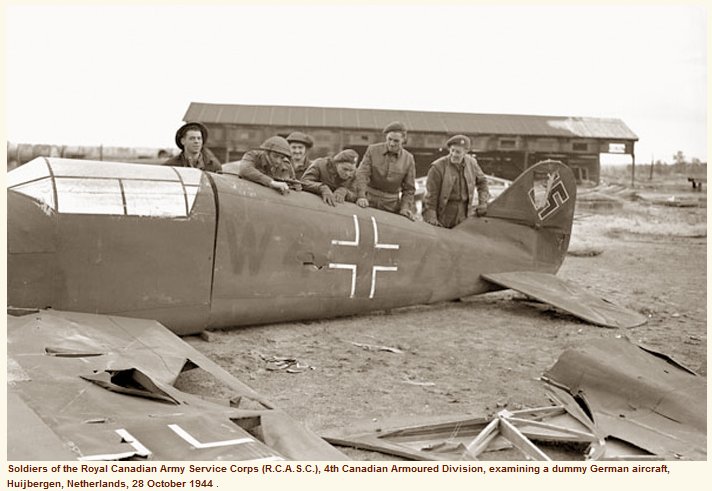
Deception in war reached a crescendo in the latter stages of World War 2, with the allies’ use of General George S. Patton’s imaginary First US Army Group (FUSAG) to pin German attention on the Pas de Calais for more than a month after the real D-Day landings in Normandy. In addition to direct propaganda and an extensive radio network generating fake messages to show the size of FUSAG, the allies also created entire dummy airfields and flotillas of fake landing craft to show up on German air recon photos. The fake planes, aircraft, and buildings were a key part of maintaining the fictitious threat of another, bigger invasion — which successfully kept a large German force away from the real landings.

Less well-known is that the Germans also indulged in this kind of deception:

In what could easily be the finest and boldest example of death-defying and cheeky nose-thumbing during the Second World War or any conflict for that matter, bomber and intruder crews of the Royal Air Force and USAAF are reputed to have bombed the Luftwaffe’s decoy airfields and dummy aircraft, not with high explosives or incendiaries, but with nothing more than dummy bombs made of wood, and painted with the smug remark “Wood for Wood”… all just to make a point.

Throughout all theatres of war, during the Second World War, from China to Holland to Kent, air forces, phsy-ops units and logistics people constructed dummy targets such as airfields, factories, truck parks, convoys and even ships, out of wood, canvas, burlap, or inflatable rubber. The decoy airfields were often populated with dummy aircraft and vehicles of such high quality, that even low flying recce aircraft with photographic equipment would have hard time telling the difference between the dummies and the real thing. The decoy airfields and dummy aircraft served several purposes simultaneously. They confused snooping enemy aircraft and hence planners as to the number of aircraft available to the opposing forces as well as to their displacement. They provided decoy targets for enemy bombers which, if attacked would prevent real aircraft from being destroyed. Often, these airfields were built near real airports in the path of attacking aircraft in the hopes that they would then drop their bombs and strafe the dummies, thereby saving the real aircraft.

H/T to Roger Henry for the original link.

November 8, 2012

QotD: The English Gentleman

Filed under: Britain, Education, History, Quotations, Religion — Tags: , — Nicholas @ 09:26

The idea of a gentleman was a more inclusive one than it sounds to modern ears. One of its greatest advantages was that you could define it so as to include yourself. You could behave like a gentleman, without possessing any of the social attributes which a gentleman might have: there was no need to possess a coat of arms, or a country estate, or engage in field sports, or wear evening dress. At least since Chaucer’s time, there had been a distinction between the social meaning of the word, and the moral. It was evident that well-born people, who ought to know how to behave like gentlemen, did not always do so, while others sometimes did.

Philip Mason, whose perceptive study, The English Gentleman, was published in 1982, argues that “the desire to be a gentleman” runs through and illuminates English history from the time of Chaucer until the early 20th century. He suggests that “for most of the 19th century and until the Second World War” the idea of the gentleman “provided the English with a second religion, one less demanding than Christianity. It influenced their politics. It influenced their system of education; it made them endow new public schools and raise the status of old grammar schools. It inspired the lesser landed gentry as well as the professional and middle classes to give their children an upbringing of which the object was to make them ladies and gentlemen, even if only a few of them also became scholars.”

Andrew Gimson, “Strange Death of the English Gentleman”, Standpoint, 2012-09

November 6, 2012

It’s official: Morris Dancers are “offensive”

Filed under: Britain, History, Media — Tags: , , , , — Nicholas @ 11:19

Well, they’re “offensive” to a couple of Police Constables in Surrey, anyway:

A group of Morris Dancers were ordered to stop performing in the middle of a routine after police received a complaint that their dancing was ‘offensive’.

The 15-strong group of English folk dancers from the respected Wild Hunt Bedlam Morris troupe were told to ‘stop making a din’ during a performance outside The White Lion pub in Warlingham, Surrey.

The folk dancers were performing in spooky costumes for a free Halloween show outside the 15th century pub to an audience of around 30 customers, but were cut short after just six dances.

The group had planned at least 10 other dances, but were interrupted by two police officers who told them to ‘down’ their handkerchiefs and sticks and ‘move on’ as they were causing a noise nuisance.

Despite pleading with the officers to continue their routine – which includes songs like Thor’s Hammer, Maiden Castle and Half a Farthing Candle, they were told to leave in the ‘interest of community relations’ last Tuesday.

Apparently the campaign against the evil Morris Dancers has been going on for a while:

In August last year a group of Morris dancers from the Slubbing Billys troupe were booted out of the Swan and Three Cygnets pub in Durham after a barmaid said the bells on their shoes broke the bar’s music ban.

H/T to Nick Packwood for the link.

Adam Smith’s “invisible hand”

Filed under: Books, Economics, History, Liberty — Tags: , , , — Nicholas @ 00:01

From LearnLiberty.org

Why are some countries wealthy while other nations are poor? Prof. James Otteson, using the ideas of Adam Smith, explains how the division of labor is a necessary and crucial element of wealthy nations. Additionally, Otteson explains Smith’s idea of the invisible hand, which explains how human beings acting to satisfy their own self interest often unintentionally benefit others.

November 5, 2012

The three VC winners from one block in Winnipeg

Filed under: Cancon, History, Military, WW1 — Tags: , — Nicholas @ 14:18

The Canadian War Museum now boasts all three Victoria Crosses won by Winnipeg soldiers during World War 1 … who all lived on the same block of Pine Street (now Valour Road):

Victoria Cross Medal Ribbon & BarWhen Acting Cpl. Lionel B. (“Leo”) Clarke was faced with the choice to surrender to the enemy, or to fight his way out of the trenches against all odds, he chose the latter. And, for that act of valour on Sept. 9, 1916, in which he killed or captured 18 German soldiers and two officers, Clarke — then 24 years old — received the highest honour awarded to Canadian soldiers: The Victoria Cross.

Less than two months later he was dead, dying in the arms of his brother Charles at the Battle of the Somme.

On Monday, Clarke, a native of Waterdown, Ont., who volunteered to go to war in 1915 as a bomber, was again honoured in a ceremony at the Canadian War Museum in Ottawa.

It marks an extraordinary occurrence in Canadian military history: in different years and different battles during the First World War, three men from the same block of Winnipeg’s west-end Pine Street earned the Commonwealth’s highest military honour. And with the acquisition of Clarke’s medal, the War Museum now owns all three Victoria Crosses awarded to the men of Pine Street, which in 1925 was renamed Valour Road.

Each of the three men — and the 96 other Canadians who bear the honour — won it for “the most conspicuous bravery, a daring or pre-eminent act of valour or self-sacrifice or extreme devotion to duty, in the presence of the enemy.”

Update: And, if I watched a bit more TV, I’d have known what David Stamper just pointed out to me on Facebook … that they were featured in a Heritage Moment TV spot:

Remember, Remember the Fifth of November

Filed under: Britain, History, Religion — Tags: , , , , , — Nicholas @ 11:20

Today is the anniversary of the Gunpowder Plot:

Everyone knows what the Gunpowder Plotters looked like. Thanks to one of the best-known etchings of the seventeenth century we see them ‘plotting’, broad brims of their hats over their noses, cloaks on their shoulders, mustachios and beards bristling — the archetypical band of desperados. Almost as well known are the broad outlines of the discovery of the ‘plot’: the mysterious warning sent to Lord Monteagle on October 26th, 1605, the investigation of the cellars under the Palace of Westminster on November 4th, the discovery of the gunpowder and Guy Fawkes, the flight of the other conspirators, the shoot-out at Holbeach in Staffordshire on November 8th in which four (Robert Catesby, Thomas Percy and the brothers Christopher and John Wright) were killed, and then the trial and execution of Fawkes and seven others in January 1606.

However, there was a more obscure sequel. Also implicated were the 9th Earl of Northumberland, three other peers (Viscount Montague and Lords Stourton and Mordaunt) and three members of the Society of Jesus. Two of the Jesuits, Fr Oswald Tesimond and Fr John Gerard, were able to escape abroad, but the third, the superior of the order in England, Fr Henry Garnet, was arrested just before the main trial. Garnet was tried separately on March 28th, 1606 and executed in May. The peers were tried in the court of Star Chamber: three were merely fined, but Northumberland was imprisoned in the Tower at pleasure and not released until 1621.

[. . .]

Thanks to the fact that nothing actually happened, it is not surprising that the plot has been the subject of running dispute since November 5th, 1605. James I’s privy council appears to have been genuinely unable to make any sense of it. The Attorney-General, Sir Edward Coke, observed at the trial that succeeding generations would wonder whether it was fact or fiction. There were claims from the start that the plot was a put-up job — if not a complete fabrication, then at least exaggerated for his own devious ends by Robert Cecil, Earl of Salisbury, James’s secretary of state. The government’s presentation of the case against the plotters had its awkward aspects, caused in part by the desire to shield Monteagle, now a national hero, from the exposure of his earlier association with them. The two official accounts published in 1606 were patently spins. One, The Discourse of the Manner, was intended to give James a more commanding role in the uncovering of the plot than he deserved. The other, A True and Perfect Relation, was intended to lay the blame on Garnet.

But Catesby had form. He and several of the plotters as well as Lord Monteagle had been implicated in the Earl of Essex’s rebellion in 1601. Subsequently he and the others (including Monteagle) had approached Philip III of Spain to support a rebellion to prevent James I’s accession. This raises the central question of what the plot was about. Was it the product of Catholic discontent with James I or was it the last episode in what the late Hugh Trevor-Roper and Professor John Bossy have termed ‘Elizabethan extremism’?

Commemorating the “Great War”

Filed under: Britain, Education, Europe, France, Germany, History, Military, WW1 — Tags: , — Nicholas @ 09:16

“Sir Humphrey” is on what he terms as his “very late Summer Holidays”, but left a thoughtful-as-always post on the British government’s recently announced World War 1 commemoration program:

It was announced that over £50 million of public funding will be provided to commemorate the 100th anniversary of the start of the First World War in 2014. This high profile event will include commemoration, remembrance, and a chance for every school in the country to send students to the battlefields of the Western Front in order to see first-hand ‘Flanders Fields’.

Rarely do wars have such a dramatic impact on a national psyche, but the First world War continues to occupy a place in the heart of the British consciousness which will take generations to reduce. It is sobering to contemplate that across the whole of the UK, there were fewer than 50 ‘Thankful villages’ (locations where everyone who served came back alive). Even today, as a nation we have only just seen the last veterans of the conflict pass on, and there are still plenty of people alive who were born in this time. In Government, it is often forgotten that Lord Astor, who acts as the spokesman for Defence in the House of Lords, is the grandchild of Field Marshal Haig. Even now, almost a century on, our current links to the war remain tangible.

Humphrey has long been a ‘revisionist’ when it comes to WW1, and believes that what should be remembered as not only a violent and bloody war, also represented many of the finest feats of arms in British history. While the conventional view of the 1960s and beyond was of a war that comprised senseless slaughter, where legions of troops were thrown into battle by an uncaring General Staff, the reality is far different. Arguably WW1 represented a supreme accomplishment by the General Staff, who had to take a tiny professional army, expend it and buy time using the TA to mould a new citizen based force, which within five years became the world’s most accomplished fighting force. They did this in a backdrop of expanding the military far beyond what any would have thought possible, while adapting to technological changes at a vast rate. By the start of the One Hundred Days campaign in 1918, there is no doubt that the British Army was probably the best trained equipped and operationally effective army in the world.

This is not to diminish the slaughter or the losses felt, but it often feels that the emphasis is too greatly placed on the hellish experiences of the trenches, and not that of understanding the war, nor decision making as a whole. It is perhaps telling that the most popular public memory of WW1 comes not from primary sources, but from the comedy ‘Blackadder Goes Fourth’, clips of which to this day brighten up innumerable MOD presentations.

The Canadian memories of WW1 are a bit different from those of Britain, although shaped by the same forces: before the war started, Canada was still psychologically a colony of the Mother Country. At the end of the war, Canada stood as a recognized independent entity from Britain (though still recognizing the importance of Britain and the Empire and a proud member of the Empire), with a very hard-earned military reputation. The legalities of full independence still lay in the future (the Statute of Westminster, 1931), but the Canada of 1918 was not the same place it had been in 1914. It saw itself as a nation, not a colony.

November 4, 2012

Invasive Albion disorder: only 10% of countries have never been invaded by Britain

Filed under: Africa, Americas, Asia, Books, Britain, Europe, History, Pacific — Tags: , — Nicholas @ 11:21

In the Telegraph, Jasper Copping explains why all those taunts about “perfidious Albion” are at least 90% deserved:

Every schoolboy used to know that at the height of the empire, almost a quarter of the atlas was coloured pink, showing the extent of British rule.

But that oft recited fact dramatically understates the remarkable global reach achieved by this country.

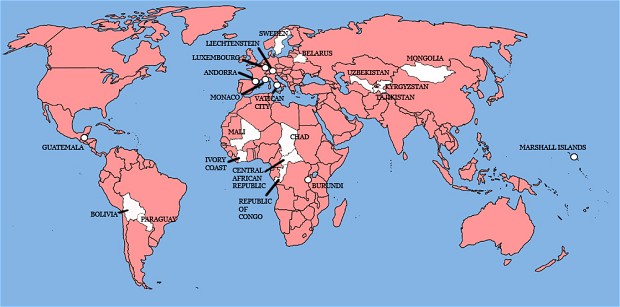
A new study has found that at various times the British have invaded almost 90 per cent of the countries around the globe.

The analysis of the histories of the almost 200 countries in the world found only 22 which have never experienced an invasion by the British.

Among this select group of nations are far-off destinations such as Guatemala, Tajikistan and the Marshall Islands, as well some slightly closer to home, such as Luxembourg.

The analysis is contained in a new book, All the Countries We’ve Ever Invaded: And the Few We Never Got Round To.

Stuart Laycock, the author, has worked his way around the globe, through each country alphabetically, researching its history to establish whether, at any point, they have experienced an incursion by Britain.

H/T to Colby Cosh for the link.

« Newer PostsOlder Posts »

Powered by WordPress