Quotulatiousness

October 21, 2012

Animated map of the Battle of Trafalgar, 21 October, 1805

Filed under: Britain, France, History, Military — Tags: , — Nicholas @ 10:51

The BBC created an animated map you can view either with interpretations or non-stop, showing the tactics of Vice Admiral Nelson and Vice Admiral Villeneuve at the Battle of Trafalgar.

On 21 October 1805, the Royal Navy clashed with the Combined French and Spanish fleet at Cape Trafalgar, off the coast of Spain. The battle had massive repercussions for Napoleon’s France and the future of the British Empire.

October 20, 2012

The Himalayan fault line of 1962

Filed under: China, History, India, Military — Tags: , , , , — Nicholas @ 00:02

In a brief but bloody altercation high up in the Himalayan mountains, Chinese forces attacked and defeated Indian troops along part of the extensive border between the two nations. In History Today, Gyanesh Kudaisya looks back at the events of 50 years ago:

China and India share the longest disputed frontier in the world, extending over 4,000 km, with a contentious Line of Actual Control across the Himalayas. Fifty years ago, on October 19th, 1962, border skirmishes between China and India escalated into a full-scale war across the mountainous border. Hostilities continued for over a month, during which China wrestled 23,200 sq kms of territory from India and inflicted heavy casualties. The Indian government acknowledged the loss of over 7,000 personnel, with 1,383 dead, 1,696 missing in action and 3,968 captured by the enemy. The Chinese also conceded ‘very heavy’ losses. Then, quite suddenly, on November 21st, China announced a unilateral ceasefire and a return to border posts held by its army prior to the conflict, while retaining some 4,023 sq km of territory in the Ladakh region.

This brief war has come to define relations between Asia’s two largest countries and the border issue remains unresolved. Beijing still claims over 92,000 sq km of territory, mainly in the northeastern Indian state of Arunachal Pradesh.

The war was a dramatic turning point for India. Most Indians saw it as a ‘stab in the back’, a grave act of betrayal by the Chinese leadership, whom Jawaharlal Nehru, India’s first prime minister (1947-64), had lauded as brothers in the heyday of a friendly relationship in the mid-1950s. This was reflected in Panchsheel, ‘Five Principles of Peaceful Coexistence’, upon which in 1954 China and India inked a bilateral treaty, and the 1955 Bandung conference, where Nehru had personally introduced Chinese premier Zhou Enlai to Afro-Asian delegates in order to minimise China’s isolation.

October 19, 2012

Vegemite: it’s not just Australian for Marmite

Filed under: Australia, Cancon, Food, History, WW1, WW2 — Tags: , — Nicholas @ 00:01

BBC News celebrates the 90th birthday of that uniquely Australian spread, Vegemite:

Vegemite and Marmite
Photo via Wikimedia

Vegemite started as a wartime substitute for Marmite, but it’s now as symbolic of Australia as Sydney Harbour Bridge and the koala. How did this salty spread become so popular?

What’s the link between German U-boats, the beer industry, processed cheese and the Men At Work’s 1983 hit, Down Under?

The answer is, they all played a part in turning Vegemite from a humble yeast spread into an Australian icon. Stop any Aussie on any street, anywhere in the world, and they will have a view on Vegemite – for, or against.

Now, on the eve of its 90th birthday, the first official history has just been published. The Man Who Invented Vegemite is written by Jamie Callister, grandson of the man who created it.

[…]

Walker put Callister on the case in 1923, and by the end of the year, the pair were confident they had a finished product. Walker decided to launch a competition so the public could name it and claim a £50 prize. Hundreds entered and it was Walker’s daughter Sheila who pulled the word Vegemite out of a hat.

Like the product itself, the name stuck. But sales were sluggish.

Walker had heard about an ingenious Canadian called James Kraft, who had perfected what came to be known as processed cheese. It was a sensation, as it allowed people who couldn’t afford fridges to store cheese for much longer periods.

In 1924, Walker met Kraft in Chicago. The two men got on well and Walker persuaded Kraft to grant him rights to sell his cheeses in Australia.

[…]

As World War II unfolded, Vegemite became associated with the national interest. Posters put up in Australia had pictures of it with the slogan, “Vegemite: Keeping fighting men fighting fit.”

For Vegemite, the war was a turning point, marking its entry deep into the hearts and consciousness of the Australian public.

October 18, 2012

Domestic terrorism less common in the US now than in the past

Filed under: History, USA — Tags: , , , , — Nicholas @ 10:42

At the Cato@Liberty blog, Benjamin Friedman looks at the history and compares it with today’s constant worry about US domestic terror operations:

Homegrown terrorism is not becoming more common and dangerous in the United States, contrary to warnings issued regularly from Washington. American jihadists attempting local attacks are predictably incompetent, making them even less dangerous than their rarity suggests.

Janet Napolitano, Secretary of Homeland Security, and Robert Mueller, Director of the Federal Bureau of Investigation, are among legions of experts and officials who have recently warned of a rise in homegrown terrorism, meaning terrorist acts or plots carried out by American citizens or long-term residents, often without guidance from foreign organisations.

But homegrown American terrorism is not new.

Leon Czolgosz, the anarchist who assassinated President McKinley in 1901, was a native-born American who got no foreign help. The same goes for John Wilkes Booth, Lee Harvey Oswald and James Earl Ray. The deadliest act of domestic terrorism in U.S. history, the 1995 Oklahoma City Bombing, was largely the work of New York-born Gulf War vet, Timothy McVeigh.

As Brian Michael Jenkins of RAND notes, there is far less homegrown terrorism today than in the 1970s, when the Weather Underground, the Jewish Defense League, anti-Castro Cuban exile groups, and the Puerto Rican Nationalists of the FALN were setting off bombs on U.S. soil.

[. . .]

After the September 11, the FBI received a massive boost in counterterrorism funding and shifted a small army of agents from crime-fighting to counterterrorism. Many joined new Joint Terrorism Task Forces. Ambitious prosecutors increasingly looked for terrorists to indict. Most states stood up intelligence fusion centers, which the Department of Homeland Security (DHS) soon fed with threat intelligence.

The intensification of the search was bound to produce more arrests, even without more terrorism, just as the Inquisition was sure to find more witches. Of course, unlike the witches, only a minority of those found by this search are innocent. But many seem like suggestible idiots unlikely to have produced workable plots without the help of FBI informants or undercover agents taught to induce criminal conduct without engaging in entrapment.

October 17, 2012

The real story of the London Beer Flood of 1814

Filed under: Books, Britain, History, Media — Tags: , , , — Nicholas @ 08:40

When the story isn’t quite as juicy as the recounter would like, there is a common tendency to make shit up to amp up the tale:

I can stake a tenuous family link to the Great London Beer Flood disaster of 1814, which took place exactly 196 years ago today. My great-great-great-great grandfather on my mother’s side, Maurice Donno, was living in Soho, a minute or three’s walk from the Horse Shoe Brewery off Tottenham Court Road, when a huge vat of maturing porter at the brewery collapsed violently and flooded the surrounding tenements, killing eight people. Most, if not all, of those who died were poor Irish immigrants to London, part of a mass of people living in the slums around St Giles’s Church, the infamous St Giles “rookeries” (later to be cleaned away by the building of New Oxford Street in 1847). Maurice Donno was very probably Irish, his surname most likely a variation of Donough or something similar (which would make his first name a common Anglicisation of the Irish Muirgheas). Perhaps he knew some of those who died, or were injured, in the Great Beer Flood, or knew people who knew them. It seems very likely he would have gone across the road at some point after the tragedy, to join the hundreds who came to see the destruction wreaked by that dreadful black tsunami of beer.

[. . .]

Thank you, Eugene Tolstov, for pointing to my mistake, and for not laughing too much at my inability to multiply 3,555 by 36 by 10 and divide by 2,240. But at least my narrative on probably the worst industrial accident involving a British brewery was more accurate than many. The late Alan Eames, for example, in The Secret Life of Beer, claimed that the vat burst “with a boom heard five miles away” – not mentioned in any of the many sources from the time that I’ve read – while “eyewitnesses told of besotted mobs flinging themselves into gutters full of beer, hampering rescue efforts” – no, newspaper reports of the rescue don’t support this at all – and “many were killed suffocated in the crush of hundreds trying to get a free beer” – again, the contemporary reports don’t say this – while “the death toll eventually reached 20, including some deaths from alcohol coma” – no, the newspaper reports from the time make it clear that only eight people died, all women and children, and all killed by the initial huge wave of beer and the destruction it caused to the buildings in the tenements behind the brewery.

Similarly there’s a myth arisen that when those injured after the vat burst were taken to the nearby Middlesex Hospital, “patients already there for illnesses unrelated to the beer disaster smelled the ale and began a riot, accusing doctors and nurses of holding out on the beer they thought was being served elsewhere in the hospital”, while another myth claims that when bodies of those killed were taken “to a nearby house for identification”, so many people turned up to see them that “the floor collapsed under the sheer weight of onlookers” and “many inside the building perished in the collapse.” None of this is in any reports of the accident from newspapers in 1814, and if any of it had happened, you can bet one of them would have written about it.

October 16, 2012

Sorting out the real Ada Lovelace from the legend

Filed under: Britain, History, Science, Technology — Tags: , , — Nicholas @ 08:18

At The Register, Dave Wilby tries to get to the real contributions of Ada Lovelace:

Ada Lovelace is a compellingly romantic figure, irresistible in today’s age of equal geeky opportunities.

The daughter of “mad, bad and dangerous to know” Lord Byron, her mathematics-loving mother Annabella Milibanke purportedly beat the poet out of her with relentless studies in science, maths and logic.

A beauty enthralled by scientific progress, cut down in her prime after the publication of her most notable work, Lovelace is often easily romanticised and reimagined as a steam punk heroine spearheading female invention and scientific emancipation.

Such claims are sure to be made again with Ada Lovelace Day today.

This image is fanciful, though, and to the unfortunate detriment of her genuine contribution to British technology.

So what are the facts? What did Ada Lovelace really achieve? Did she outshine her female contemporaries in the scientific field? And what debt do today’s female scientists really owe her?

October 15, 2012

“[T]he Nobel Peace Prize Committee [wouldn’t] recognize absurdity if it slapped them in the face and did a Macarena”

Filed under: Bureaucracy, Europe, History, Humour — Tags: , , — Nicholas @ 09:37

Marian L. Tupy writes about the absurdity of awarding this year’s Nobel Peace Prize to the European Union at the Cato@Liberty blog:

The esteemed members of the Nobel Peace Prize Committee have awarded the 2012 prize to the European Union. So, if you thought that awarding it to President Barack Obama for the sole reason of not being George W. Bush was strange and unusual, think again. (By the way, I have nothing against our president. I am sure he was just as embarrassed as everyone else.)

[. . .]

As for democracy, the Peace Prize award to the EU drips with irony. The EU is not only un-democratic, in the sense that it is run by unelected and unaccountable bureaucrats, it is positively anti-democratic, in the sense that the democratically expressed wishes of the European peoples are either ignored or treated with contempt. When the Danes voted against the Maastricht Treaty, they were forced to vote again. When the Irish sunk the Lisbon treaty, they too had to repeat the vote. And when the Dutch and the French said no to the EU Constitution, they were simply ignored.

Here is how the president of the eurozone, Jean-Claude Juncker, sums up the decision-making process in the great bastion of democracy that is today’s EU: “We decide on something, leave it lying around and wait and see what happens. If no one kicks up a fuss, because most people don’t understand what has been decided, we continue step by step until there is no turning back.”

I could write about the overgrown and arrogant bureaucracy in Brussels; about the monstrously high and recession-proof salaries of European decision makers; about widespread and widely tolerated corruption; about the prosecution and silencing of whistleblowers, and about many other ways in which the EU does not deserve the Nobel Peace Prize. Suffice it to say that those have been widely documented and are available to anyone interested.

October 14, 2012

Imagine if Eric Hobsbawm had been a Nazi apologist rather than a Communist apologist

Filed under: Books, Europe, History, Media — Tags: , , , — Nicholas @ 11:25

Jeff Jacoby in the Boston Globe:

Hobsbawm […] was a lifelong Marxist, a card-carrying member of the Communist Party from his teens until the collapse of the Soviet Union in 1991. Long after it was evident to even true believers that the Bolshevik Revolution had unleashed a nightmare of blood, Hobsbawm went on defending, minimizing, and excusing the crimes of communism.

Interviewed on the BBC in 1994, he was asked whether he would have shunned the Communist Party had he known in 1934 that Stalin was butchering innocent human beings by the millions. “Probably not,” he answered — after all, at the time he believed he was signing up for world revolution. Taken aback by such indifference to carnage, the interviewer pressed the point. Was Hobsbawm saying that if a communist paradise had actually been created, “the loss of 15, 20 million people might have been justified?” Hobsbawm’s answer: “Yes.”

Imagine that Hobsbawm had fallen in love with Nazism as a youth and spent the rest of his career whitewashing Hitler’s atrocities. Suppose he’d refused for decades to let his Nazi Party membership lapse, and argued that the Holocaust would have been an acceptable price to pay for the realization of a true Thousand-Year Reich. It is inconceivable that he would have been hailed as a brilliant thinker or basked in acclaim; no self-respecting university would have hired him to teach; politicians and pundits would not have lined up to shower him with accolades during his life and tributes after his death.

Yet Hobsbawm was fawned over, lionized in the media, made a tenured professor at a prestigious university, invited to lecture around the world. He was heaped with glories, including the Order of the Companions of Honour — one of Britain’s highest civilian awards — and the lucrative Balzan Prize, worth 1 million Swiss francs. His death was given huge play in the British media — the BBC aired an hour-long tribute and the Guardian led its front page with the news — and political leaders waxed fulsome. Former Prime Minister Tony Blair called him “a giant … a tireless agitator for a better world.”

Germany’s ambivalent relationship with their modern armed forces

Filed under: Europe, Germany, History, Military — Tags: , , — Nicholas @ 11:09

October 13, 2012

HMS Conqueror and “Operation Barmaid”

Filed under: Britain, History, Military — Tags: , , , , — Nicholas @ 00:01

In spite of the name, it had nothing to do with a crew booze-up in town:

HMS Conqueror is famous, some would say notorious, for sinking the Argentinian cruiser General Belgrano. The nuclear-powered attack submarine, a type also known menacingly as a hunter-killer, that year became the first of her kind to fire in anger. The Belgrano was sent to bottom in short order, her ancient hull rent by two torpedoes: 323 men, many of them young conscripts, died. The Falklands war began in earnest that day, May 2 1982.

But the ship now in the crosswires was not the Belgrano. This was August, almost two months after the liberation of the Falklands, and on the other side of the world, in the Barents Sea, backyard of the mighty Soviet Northern Fleet. Conqueror was sailing as close to Russian territorial waters as was legally allowed — or maybe closer. Submariners, a tight-knit community, politely disdainful of their surface counterparts, joke that there are two types of naval vessel: submarines and targets. Wreford-Brown’s target was a spy trawler — an AGI in Nato parlance, meaning Auxiliary General Intelligence. Crammed with interception and detection equipment, they were a ubiquitous presence during the Cold War, shadowing Nato exercises or loitering off naval bases.

This one was special: Polish-flagged, she was pulling a device long coveted by the British and Americans, a two-mile string of hydrophones known as a towed-array sonar. It was the latest thing in Soviet submarine-detection technology and Conqueror’s job was to steal it. To do so, the bow was equipped with electronically controlled pincers, provided by the Americans, to gnaw through the three-inch-thick steel cable connecting it to the trawler. The name of this audacious exercise in piracy? Operation Barmaid.

October 12, 2012

Winston Churchill’s papers now available online

Filed under: Britain, History, Media, WW2 — Tags: — Nicholas @ 09:41

Anna Leach at The Register on the newly available writings of Winston Churchill:

The man who famously stated that the British would “fight them on the beaches” in the event of a German invasion has had some of his less-often quoted words including his private letters (and his receipts for cigars) fully digitised and made available online in the Churchill archive.

Winston Churchill’s private musings, letters to Stalin, doodles and appointments diaries are now on the internet after two years of painstaking digitisation at Churchill College, Cambridge.

The haul of papers documents all areas of the great man’s life and times from the most trivial to the most important.

One for the heralds

Filed under: Education, History, Humour — Tags: , — Nicholas @ 07:46

On the Lois McMaster Bujold mailing list (http://lists.herald.co.uk/cgi-bin/mailman/listinfo/lois-bujold), Eric Oppen posted this in an off-topic thread about clothing trends:

Whenever someone starts waxing envious in my presence about foreign countries’ practice of wearing school uniforms, and wishes the same on American kids, I like to respond:

“That’s a wonderful idea! And I know just the sort needed! The colors would be “barry argent and sable, semee’ of pheons, countercharged.”

Most people don’t get the joke, but I said that in front of several SCA heralds once, who were all highly amused and said I was being quite multicultural.

(For those not familiar with heraldic language, what I am suggesting is uniforms featuring horizontal black-and-white stripes, scattered with “broad arrowheads” white on black and black on white. IOW, combining the features of traditional US and UK prison uniforms.)

Posted with Eric’s permission, of course.

October 11, 2012

50th anniversary of the Light Emitting Diode (sort of)

Filed under: History, Technology — Tags: — Nicholas @ 08:39

Tony Smith at The Register:

The Light Emitting Diode (LED) is 50 years old. Well, kind of…

It’s certainly 50 years since Nick Holonyak, working at GEC’s Syracuse, New York facility, developed what is considered the first LED capable of generating visible light. Holonyak’s LED was also the first to be in form ready for commercial usage. He wrote up his work and sent it off to Applied Physics Letters on 17 October 1962. The journal published the work in December 1962 under the headline ‘Coherent (visible) Light Emission from GaAs xPx Junctions’.

However, Holonyak’s work followed that of Gary Pittman and Robert Baird who, in 1961, observed the emission of infrared light by Gallium Arsenide — the GaAs in Holonyak’s headline — and, on the back of it, applied for and gained a patent — US number 3,025,589 — for the infrared LED.

[. . .]

Follow the literature back and you end up in Britain in February 1907, with the work of Marconi assistant Henry Round, who first observed the emission of light from a crystal of silicon carbide when a current was applied to it, a phenomenon called electroluminescence. In that sense, the LED is more than 100 years old. Round, however, never wrote a report on his findings.

October 10, 2012

Macdonell on the Heights

Filed under: Cancon, History, Military — Tags: , , , — Nicholas @ 16:50

One of my favourite Stan Rogers songs is “Macdonell on the Heights”. Here’s the history behind the song, courtesy of the Niagara 1812 Legacy Council:

John Macdonell was born in April 1785 in Scotland. At the age of seven he came with his family to Canada where at the age of 23 he became a lawyer. He later earned a seat in the legislature and in September 1811 he was appointed attorney-general.

Macdonell was not loved by all, especially William Baldwin who duelled with the attorney-general, but his position brought him closer to Isaac Brock, who asked Macdonell to serve as his aide. Macdonell was a lieutenant-colonel in the York Militia where he served as Brock’s aide with energy and poise.

During the Battle of Queenston Heights Macdonell was not far behind Brock, who had left in the early hours from Fort George to the site of the American invasion. It was not long after Brock’s failed advance up the heights that Macdonell led his own desperate charge to retake the redan battery. Macdonell’s small force did push the Americans back briefly, but a musket ball hit Macdonell’s horse, which reared up as a second musket ball struck Macdonell’s back. Macdonell was shot four times but it did not prevent him from attempting to stand and continue the attack. Fellow officers pulled the lieutenant-colonel from the battlefield as the attack failed to capture the redan battery.

October 2, 2012

Warship spending then and now

Filed under: History, Military, Technology — Tags: — Nicholas @ 08:39

An article at Strategy Page looks at the much-higher cost of modern weapons systems and compares a few modern items to their historical predecessors. An eye-opening example is the comparison of a battleship to a modern US Navy destroyer:

A new U.S. destroyer design, the DDG-1000, displaces 14,000 tons, is 193.5 meters (600 feet) long and 25.5 meters (79 feet) wide. A crew of 150 sailors operates a variety of weapons, including two 155mm guns, two 40mm automatic cannon for close in defense, 80 Vertical Launch Tubes (containing either anti-ship, cruise or anti-aircraft missiles), six torpedo tubes, a helicopter and three helicopter UAVs. The DDG-1000 was to cost $2 billion each, but it has been cut back to just three ships, which drives the cost up to $6 billion each.

A century ago, a Mississippi class battleship displaced 14,400 tons, was 123.2 meters (382 feet) long and 24.8 meters (77 feet) wide. Adjusted for inflation, it cost $150 million. A crew of 800 operated a variety of weapons, including four 12 inch (300mm), eight 8 inch (200mm), eight 7 inch (177mm), twelve 3 inch (76mm), twelve 47mm and four 37mm guns, plus four 7.62mm machine-guns. There were also four torpedo tubes. The Mississippi had a top speed of 31 kilometers an hour, versus 54 for DDG-1000. But the Mississippi had one thing DDG-1000 lacked, armor. Along the side there was a belt of 226mm (9 inch) armor and the main turrets had 300mm (12 inch) thick armor. The Mississippi had radio, but the DDG-1000 has radio, GPS, sonar, radar and electronic warfare equipment.

Each of the three DDG-1000’s being built cost 40 times more than the two Mississippi class battleships. Is the DDG-1000 40 times more effective? The DDG-1000 would make quick work of the Mississippi, spotting the slower battleship by radar or helicopter, and dispatching her with a few missiles. The Mississippi’s 12 inch guns had a maximum range of 18 kilometers, versus 130 kilometers for the Harpoon anti-ship missile. There has always been some debate if modern anti-ship missiles could really take down a battleship, what with all that armor and plenty of sailors for damage control work. The USS Mississippi ended its career in the Greek navy, and was sunk by German aircraft in 1941. Many battleships have been sunk, usually by bombs and torpedoes delivered by aircraft.

Although the last two American World War II era battleships were only sold off six years ago, battleship advocates keep coming with ways to revive these massive (45,000 ton) armored ships. The boldest proposals had most of the World War II era mechanical equipment and replaced with gas turbine engines and modern generators and electronics. This would reduce crew size from 2,700 to 600. But what really killed the battleship was the smart bomb, especially the GPS guided ones. The 16 inch battleship guns could not match this accuracy, unless a GPS guided shell were developed (a major cost). What really killed the battleship was massive innovation.

The DDG-1000 is still “pre” whatever the next dominant type of warship will be. But it’s ironic that a hundred years later, the descendent of the 14,000 ton Mississippi is a 14,000 ton surface ship that has more firepower, a longer reach and the ability to see targets hundreds of kilometers away, and is called a destroyer. And what kind of destroyers escorted the Mississippi? They were ships of under a thousand tons displacement, with crews of about a hundred sailors. Armed with a few 3 inch guns and some torpedoes, no one at the time expected them to evolve into a 14,000 ton warship.
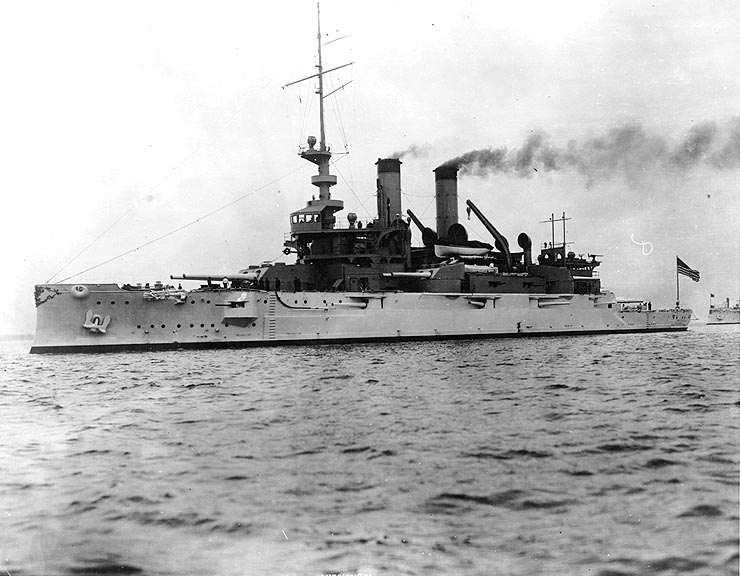

USS Mississippi (BB-23), from the Wikipedia entry
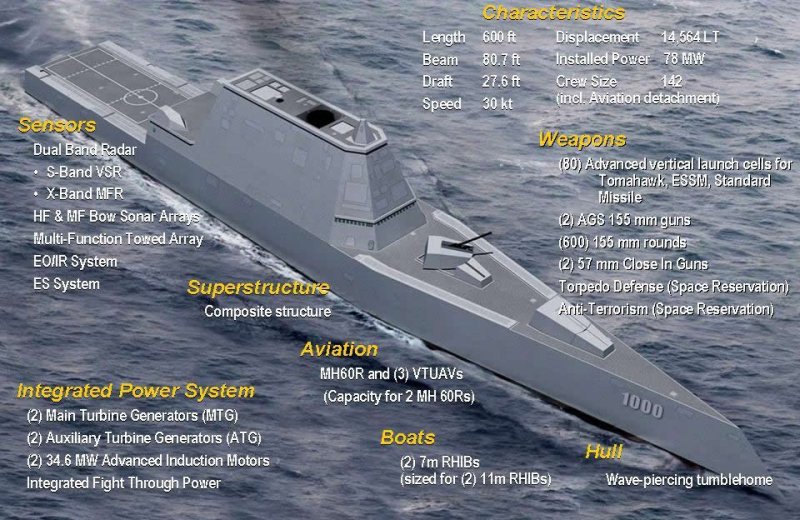

Artist’s conception of the DDG-1000 class lead ship USS Zumwalt. Full-size image at Defence Industry Daily.


« Newer PostsOlder Posts »

Powered by WordPress


