
Quotulatiousness

October 2, 2012

Warship spending then and now

Filed under: History, Military, Technology — Tags: — Nicholas @ 08:39

An article at Strategy Page looks at the much-higher cost of modern weapons systems and compares a few modern items to their historical predecessors. An eye-opening example is the comparison of a battleship to a modern US Navy destroyer:

A new U.S. destroyer design, the DDG-1000, displaces 14,000 tons, is 193.5 meters (600 feet) long and 25.5 meters (79 feet) wide. A crew of 150 sailors operates a variety of weapons, including two 155mm guns, two 40mm automatic cannon for close in defense, 80 Vertical Launch Tubes (containing either anti-ship, cruise or anti-aircraft missiles), six torpedo tubes, a helicopter and three helicopter UAVs. The DDG-1000 was to cost $2 billion each, but it has been cut back to just three ships, which drives the cost up to $6 billion each.

A century ago, a Mississippi class battleship displaced 14,400 tons, was 123.2 meters (382 feet) long and 24.8 meters (77 feet) wide. Adjusted for inflation, it cost $150 million. A crew of 800 operated a variety of weapons, including four 12 inch (300mm), eight 8 inch (200mm), eight 7 inch (177mm), twelve 3 inch (76mm), twelve 47mm and four 37mm guns, plus four 7.62mm machine-guns. There were also four torpedo tubes. The Mississippi had a top speed of 31 kilometers an hour, versus 54 for DDG-1000. But the Mississippi had one thing DDG-1000 lacked, armor. Along the side there was a belt of 226mm (9 inch) armor and the main turrets had 300mm (12 inch) thick armor. The Mississippi had radio, but the DDG-1000 has radio, GPS, sonar, radar and electronic warfare equipment.

Each of the three DDG-1000’s being built cost 40 times more than the two Mississippi class battleships. Is the DDG-1000 40 times more effective? The DDG-1000 would make quick work of the Mississippi, spotting the slower battleship by radar or helicopter, and dispatching her with a few missiles. The Mississippi’s 12 inch guns had a maximum range of 18 kilometers, versus 130 kilometers for the Harpoon anti-ship missile. There has always been some debate if modern anti-ship missiles could really take down a battleship, what with all that armor and plenty of sailors for damage control work. The USS Mississippi ended its career in the Greek navy, and was sunk by German aircraft in 1941. Many battleships have been sunk, usually by bombs and torpedoes delivered by aircraft.

Although the last two American World War II era battleships were only sold off six years ago, battleship advocates keep coming with ways to revive these massive (45,000 ton) armored ships. The boldest proposals had most of the World War II era mechanical equipment and replaced with gas turbine engines and modern generators and electronics. This would reduce crew size from 2,700 to 600. But what really killed the battleship was the smart bomb, especially the GPS guided ones. The 16 inch battleship guns could not match this accuracy, unless a GPS guided shell were developed (a major cost). What really killed the battleship was massive innovation.

The DDG-1000 is still “pre” whatever the next dominant type of warship will be. But it’s ironic that a hundred years later, the descendent of the 14,000 ton Mississippi is a 14,000 ton surface ship that has more firepower, a longer reach and the ability to see targets hundreds of kilometers away, and is called a destroyer. And what kind of destroyers escorted the Mississippi? They were ships of under a thousand tons displacement, with crews of about a hundred sailors. Armed with a few 3 inch guns and some torpedoes, no one at the time expected them to evolve into a 14,000 ton warship.
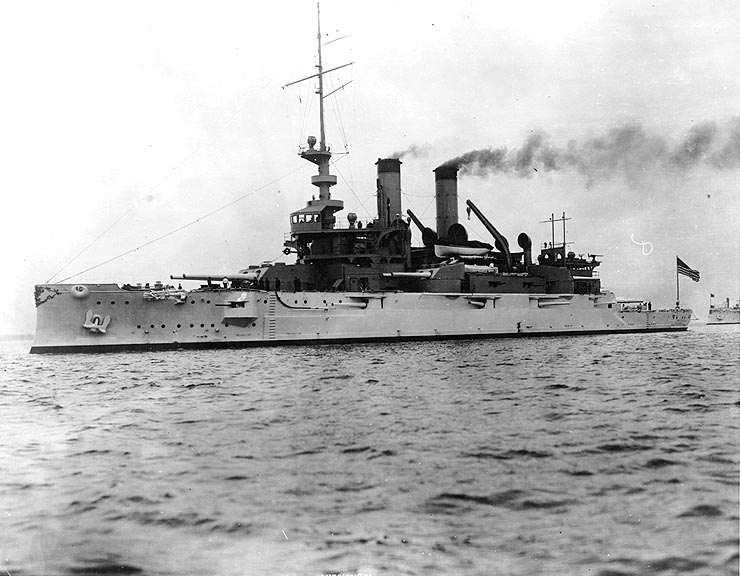

USS Mississippi (BB-23), from the Wikipedia entry


Artist’s conception of the DDG-1000 class lead ship USS Zumwalt. Full-size image at Defence Industry Daily.

Eric Hobsbawm is about to be beatified as “the most celebrated British historian of the 20th century”

Filed under: Britain, History, Media — Tags: , , , , , — Nicholas @ 08:14

Michael Burleigh on the recently deceased — and totally unrepentant Communist — Eric Hobsbawm:

I can almost hear the wave of mourning that is about to fix Hobsbawm in the public consciousness as “the most celebrated British historian of the 20th century”. You have to understand the British Left, which is still near hegemonic in the humanities and social science departments in our universities, to grasp why those of a more liberal conservative persuasion will disagree.

First there is the tendency to worship at the feet of foreign gurus, a failing George Orwell (or as Hobsbawm had it, the “upper-class Englishman Eric Blair”) attributed to Britain’s alienated intellectuals taking “their cookery from Paris and their opinions from Moscow”. This led them to give credibility to such evanescent charlatans as Michel Foucault, the chief exponent of “knowledge as power”, and the Palestinian activist and literary critic Edward Said.

[. . .]

Throughout, there was a dogmatic refusal to accept that the Bolshevik Revolution had been a murderous failure. Asked by the Canadian academic and politician Michael Ignatieff on television whether the deaths of 20 million people in the USSR — not to mention the 55 to 65 million victims of Mao’s Great Leap Forward — might have been justified if this Red utopia had been realised, Hobsbawm muttered in the affirmative.

Everything Hobsbawm wrote deceitfully downplayed the grim role of the Communists in Spain in the Thirties or the forcible nature of the coups the Soviets carried out in Eastern Europe after 1945. Such a cosmopolitan thinker had ironically become imprisoned within a deeply provincial ideological ghetto, knowing or caring nothing for the brave Czechs or Poles who resisted Stalin’s stooges, while being manifestly nonplussed by the democratic transformations of Central Europe since 1989-90. That the secret police — the Sword and Shield of the Revolution — would end up running Vladimir Putin’s FSB-mafia state was literally inexplicable to him.

October 1, 2012

France, 1940: If you can’t beat ’em, sleep with them?

Filed under: Europe, France, Germany, History, WW2 — Tags: , — Nicholas @ 14:16

The ignominy of military defeat and occupation in 1940 was bad for French civilian morale, but according to Patrick Buisson, the female population adapted to the new reality much faster than anyone would have expected:

Everyone was surprised the tall, blond invading newcomers did not set about raping the population as the French had expected. Instead, they handed out bread and tarts.

Moreover, they were so handsome and so brave in comparison with the drunken French soldiers who had surrendered the fight.

Soon, every French child was crying out that he wanted to be German, while every young French girl was lusting after the newcomers as though they were allies, not enemies, offering them oranges and standing on tip-toe to look into the plush interior of their limousines.

And French housewives, deprived of companionship while their soldier husbands were held prisoner, were happily sleeping with the enemy.

The French have long sought to draw a veil over these aspects of the occupation, claiming heroic acts of resistance during the period when, in fact, they were little more than collaborators.

Now, with uncharacteristic daring, Patrick Buisson, director of France’s History Channel, TF1, has set the record straight by writing a book, whose titillating title — 1940-1945: The Erotic Years — shows the extent to which his fellow countrymen actually enjoyed their wartime experiences.

[. . .]

Naturally, there were the inevitable consequences. While the British birth-rate fell during the dark days of the Blitz, the French birth-rate soared in the years after the Germans arrived, despite the fact that more than two million redblooded French men were locked away in prison camps.

Up to 30 per cent of live births were illegitimate in some parts of Paris. This gave the French authorities a particular headache. For a long time, they had been lamenting that France was underpopulated; now they did not know whether to rejoice or deplore each new arrival.

Update: Just realized the original story is actually from a few years back, so I omitted the phrase “a new book”.

September 28, 2012

Reason.tv: Rachel Carson’s Silent Spring at 50 Years

Filed under: Books, Environment, History, Media, USA — Tags: , , — Nicholas @ 07:57

“It’s not polite to talk about brown and black people dying because rich white people in America feel better about themselves when the brown and black people don’t get to use DDT,” says the University of Alabama’s Andrew Morriss, co-editor of the new book Silent Spring at 50: The False Crises of Rachel Carson.

Published by the Cato Institute, the collection of essays by environmentalists, law professors, economists, and other analysts argues that the legacy of Carson’s best-known book — widely considered the starting point of the modern environmentalist movement and the international ban on the malaria-fighting pesticide DDT — has caused many more problems than it has solved.

Reason‘s Katherine Mangu-Ward sat down with Morriss to talk about Carson’s work and influence on environmental policy.

September 27, 2012

Duelling reading lists for military science

Filed under: Books, History, Media, Military — Tags: — Nicholas @ 12:46

Foreign Policy listed the “Top 10” books as recommended by the US Military Academy at West Point:

  • On War, Carl von Clausewitz, 1832. I’ve read this, but perhaps it’s better in the original than in translation.
  • Some Principles of Maritime Strategy, Julian Stafford Corbett, 1911.
  • History of the Art of War Within the Framework of Political History (4 volumes), Hans Delbruck, 1920. I’ve read the first three volumes, and keep meaning to dig out the fourth to finish the series.
  • The Command of the Air, Giulio Douhet, 1921.
  • Battle Studies, Ardant Du Picq (Du Picq died in 1870 with the book incomplete: it was finished after his death based on his notes.)
  • The Art of War, Antoine Henri Jomini, 1838.
  • The Art of War, Niccolo Machiavelli, 1521.
  • The Influence of Sea Power Upon History 1660-1783, Alfred Thayer Mahan, 1890. I started reading this one several years back and never got back to it. Another one I should dig up and finish.
  • The Art of War, Sun Tzu, 4th century BC. I never read this, partly because it was pushed relentlessly as a “business book” in the 1980s, so I just avoided it. The excerpts I’ve seen quoted do seem to show its value for pulling out vague aphorisms…
  • The Peloponnesian War, Thucydides, 4th century BC. Thucydides did not complete the work, with the last several years of the war still to be fought. Xenophon’s Hellenika picks up the thread (literally the first words of the book are “And after this”.

John Arquilla comments on the list and adds some recommendations of his own:

For those drawn to West Point’s recommendation to read Thucydides, I suggest taking a look also at Sallust’s The Jugurthine War. Jugurtha of Numidia (today’s northern Algeria) fought a bitter guerrilla war against Rome, some 50 years before Julius Caesar’s great campaigns, that Sallust captured with verve. He also spoke to the corruption of Roman character that came with protracted exposure to this kind of fighting.

Hans Delbrück, whose four-volume history of ancient, medieval and early modern warfare that West Point selected, can be nicely complemented by Lt. Gen. John Bagot Glubb’s The Great Arab Conquests. His survey of the sweeping seventh-century victories of Muslim warriors is of the highest analytic and literary quality, a principal observation being that much of the world of that time was shaped by the irregular “pirate strategy” the Arabs adopted. That is, they used the desert as an ocean and came raiding from it, again and again, with startling success.

[. . .]

I’ll conclude with recommendations that reflect an important debate. Robert Taber’s War of the Flea argues that little can stop the weak from wearing down the strong with insurgent warfare; Lewis Gann’s Guerrillas in History is a brief but thorough survey that shows how often irregulars have been beaten in the past. Both books were written over 40 years ago, and both remain exceptionally timely. Indeed, Abu Musab al-Suri, al Qaida’s deepest strategic thinker, lectured on Taber at the “university of terror” that used to operate in Afghanistan.

I can second the recommendation for Taber’s War of the Flea, but most of the others he recommends are new to me … more to add to the reading list.

September 26, 2012

Shakespeare’s Henry V: public choice theory in the 15th century

In The Freeman, Sarah Skwire points out that the opening act of Shakespeare’s Henry V — while boring to those hoping for battle and carnage — explains the public choice economic theory of rent-seeking:

Shakespeare’s Henry V — a favorite of theater companies and movie studios — begins with an invocation of the muse of fire, presumably because only her powerful heat and light can provide the inspiration necessary for Shakespeare’s great task of bringing forth so “great an object” on “this unworthy scaffold.” The prologue promises, after all, that we are about to see the armies of two great monarchies clash at the famous battle of Agincourt. A plea for divine aid seems only reasonable.

After all that buildup, however, the opening scene of the play has to be one of the dullest stretches in all of Shakespeare’s writing. Promised a ferocious battle with knights and horses and blood and thunder, we are given instead more than one hundred straight lines of a highly technical legal discussion between the Bishop of Canterbury and the Bishop of Ely. It is historically accurate. It is important. And it is exceptionally tedious.

It is tedious, that is, unless you are familiar with one basic piece of Public Choice theory.

Gain without Mutual Benefit

One its core concepts is the idea of rent-seeking. Unlike profit-seeking, which aims at mutually beneficial trade, rent-seeking is the attempt to use the political process to capture a bigger slice of wealth for oneself. Unlike trade, there is no mutual benefit. No wealth is created. The only profit is to the rent-seeker, and possibly his cronies. With that in mind, the opening scene of Henry V is gripping. It is no longer more than one hundred lines of fifteenth-century legal trivia. It is more than one hundred lines of some of the most explicit, uncensored, behind-the-scenes rent-seeking action in literary history.

September 23, 2012

Are we really smarter than our great-grandparents?

Filed under: History, Science — Tags: , , , , — Nicholas @ 09:48

An interesting article in the Wall Street Journal looks at the documented phenomenon of rapidly rising IQ in modern humans:

Advanced nations like the U.S. have experienced massive IQ gains over time (a phenomenon that I first noted in a 1984 study and is now known as the “Flynn Effect”). From the early 1900s to today, Americans have gained three IQ points per decade on both the Stanford-Binet Intelligence Scales and the Wechsler Intelligence Scales. These tests have been around since the early 20th century in some form, though they have been updated over time. Another test, Raven’s Progressive Matrices, was invented in 1938, but there are scores for people whose birth dates go back to 1872. It shows gains of five points per decade.

In 1910, scored against today’s norms, our ancestors would have had an average IQ of 70 (or 50 if we tested with Raven’s). By comparison, our mean IQ today is 130 to 150, depending on the test. Are we geniuses or were they just dense?

[. . .]

Modern people do so well on these tests because we are new and peculiar. We are the first of our species to live in a world dominated by categories, hypotheticals, nonverbal symbols and visual images that paint alternative realities. We have evolved to deal with a world that would have been alien to previous generations.

A century ago, people mostly used their minds to manipulate the concrete world for advantage. They wore what I call “utilitarian spectacles.” Our minds now tend toward logical analysis of abstract symbols — what I call “scientific spectacles.” Today we tend to classify things rather than to be obsessed with their differences. We take the hypothetical seriously and easily discern symbolic relationships.

September 20, 2012

Potentially deadly legacies of war

Filed under: Environment, History, Military, Weapons, WW1, WW2 — Tags: — Nicholas @ 15:41

A long, fascinating, disturbing blog post at SciencePunk on unexploded munitions from both World War 1 and World War 2, still showing up unexpectedly:

The WMD was discovered, quite by chance, lying by the side of a Bridgeville road in late July by a Delaware state trooper on an unrelated callout. Jutting out of the ground, the 75mm shell was encrusted in barnacles and pitted with rust; barely recognisable as a munition at all. The trooper called in his find and a military team took the bomb to Dover Air Force Base for disposal. As with most conventional rounds, a small charge was placed on the side of the shell and detonated to trigger the vintage munition’s own explosive. But something went wrong, and the bomb failed to explode.

When the two staff sergeants and technician walked over to inspect the failed detonation, they found a strange black liquid seeping out of the cracked mortar. Given that the shell had been under the sea for the better part of fifty years, the men thought little of the foul-smelling substance until hours later, when their skin began to erupt in agonising blisters. All three were rushed to Kent General hospital, where two were released later after minor treatment. A third, more seriously injured serviceman was transported to Temple University Hospital in Philadelphia, where he remained in serious but stable condition with what were only described as “burns or blisters” in a statement issued by the Army later that week. A scientific team were sent to Dover to collect soil samples from the area. The results were clear: the shell had been filled with mustard gas. The United States’ forgotten weapons of mass destruction had returned to haunt it.

[. . .]

With three servicemen now lying in hospital, injured by a weapon of mass destruction, officials could no longer ignore the problem of the rogue munitions. On August 4, the U.S. Army announced a $6 million plan to locate and stem the source of the clamshell ordnance. The investigation was led by Robert Williams Jnr of the Army’s Corps of Engineers. It seemed like an impossible task – Williams couldn’t search every clamshell-topped road in the state, and even if he did, there’d be no guarantee he could complete the survey before one of the hidden weapons detonated. Worse still, nobody knew how the munitions were getting from the ocean into driveways, and how to stop more arriving. Then Williams was handed a gigantic stroke of luck: interviews with everyone who discovered ordnance in their driveways revealed that they had all purchased their clamshell mix from one hauler, Perry Butler. And Perry Butler had an exclusive contract to collect waste clamshells from one Milford clam processing plant: SeaWatch International.

As Delaware’s only clam processor, suspicion had already been placed on the Milford plant. In spite of initial claims that no ordnance had been found on site, when the U.S. Army turned their attention to the factory, it was already the subject of an ongoing investigation by the Occupational Safety & Health Administration. On inspecting the facility, their suspicions were confirmed: twelve munitions were recovered onsite. Workers had picked the highly unstable ordnance off the conveyor lines and stored them in a bucket of water in the basement. The munitions that they did not spot had been first plunged into conditioning tanks with the live clams, passed through steam cookers, and then raked across an industrial shucker that violently shakes the cooked meat from the shells. From there, the ordnance was picked up by Perry Butler, hidden in containers of empty clamshells, who passed them through a grinder that pulverised the shells into gravel before selling the fill on to various downstate residents. That none of the munitions exploded at any point was nothing short of miraculous. That no chemical rounds had broken open or leaked, even more so. SeaWatch International was fined $9,000 by OSHA for endangering staff and only permitted to continue business with the installation of $15,000 metal detector. Just three days later, the buzzer sounded. Workers reported the discovery of a 75mm shell, identical to the one that had injured three servicemen at Dover.

The problem is much bigger than the incidents in Delaware, however, as all the combatant nations of WW1 dumped their unused chemical weapons into the sea … and not always safely (and that really deserves scare quotes: “safely”).

With the close of the First World War, both defeated and victorious nations of the world were left holding thousands of tonnes of lethal chemical weaponry and no one to launch them at. The weapons were dangerous to transport and difficult to store. And nobody really knew how to neutralize their contents. So it’s easy to see how dumping the weapons in the deep ocean, out of harm’s way, was seen as a sensible solution. Entire ships were loaded with munitions, chemical and conventional alike, and sailed out to sea where the cargo was thrown overboard. As part of the CHASE program (“Cut Holes And Sink ‘Em), entire ships filled with weapons and unwanted hardware were scuttled, some detonating on their way to the seabed. For many decades, countries cast their surplus chemical weapons into ocean water and forgot about them. Over a quarter million tonnes of British bombs filled with mustard and phosgene gas and the nerve agent Tabun lie in the waters around the UK, concentrated off the west coast of Scotland. Somewhere between 50,000 and 300,000 tonnes of German, Soviet, US and British chemical agent lies in the shallow Baltic Sea. The USA has also admitted to dumping toxic materiel off the coastlines of other nations rather than risk carrying the volatile cargo home. The James Martin Centre for Non-Proliferation Studies lists 127 known dumpsites across the world, it’s likely even more exist.

Rewriting a crucial moment in WW2: 9th Canadian Infantry Brigade on D+1

Filed under: Cancon, France, Germany, History, Military, WW2 — Tags: , , , — Nicholas @ 09:30

If you’re interested in the Canadian part of the D-Day landings and the days that followed, you’ll probably want to visit the Canadian Military History site:

Marc Milner’s Chapter, “No Ambush, No Defeat: The Advance of the Vanguard of the 9th Canadian Infantry Brigade, 7 June 1944″ in Canada and the Second World War: Essays in Honour of Terry Copp rewrites the history of 9 Brigade on D-Day+1. The defeat of 9 Brigade has always been used a prime example of the flawed nature of Allied leadership and combat capability and proof of the superior fighting skill of German forces. Milner challenges this assessment, arguing “the vanguard of 9 Brigade fought an enemy at least three times its size to a standstill, and did so largely without the crucial component of Anglo-Canadian doctrine: artillery support … in the process 9 Brigade met and defeated a portion of the panzer forces that the 3rd Canadian Division had been tasked with destroying. So maybe 9 Brigade did all right on D+1 after all.”

The revised chapter to the book has been made available as a freely downloadable PDF.

Over-hyping the importance of the Richard III archaeological dig

Filed under: Britain, History — Tags: , , , , — Nicholas @ 08:50

At the History Today blog, Linda Porter points out that some of the breathless claims about the historical significance of the Leicester archaeological dig are rather overblown:

Major finds don’t come along very often and this would certainly be one of the most significant in the last hundred years. But the huge claims being made for it are not the sort that sit well with most historians. Assertions that, if DNA tests prove positive, this discovery ‘has the potential to rewrite history’ and is of ‘global importance’ make me sigh.

Historians have long known that the Tudor narratives on Richard III are propaganda. Shakespeare’s compelling villain may still resonate with the man on the street but has nothing to do with a measured analysis of the past and anyone with even a general interest in the late fifteenth century will be aware of this. And ‘global significance’? Cross the Channel and I’d be surprised if you found anyone outside the academic world who knew about Richard III and the saga of the Princes in the Tower. Those involved in the project, which appears to have been rigorously conducted from the archaeological perspective, clearly want headlines. As someone who has worked in public relations herself I congratulate them on a successful communications campaign — it has to be acknowledged that the Richard III Society is very good at this kind of thing — but wearing my historian’s hat extravagant claims make me uncomfortable.

September 15, 2012

The Richard III debate moves to “where should we bury him this time”

Filed under: Britain, History — Tags: , , , — Nicholas @ 10:33

In the Telegraph, Dan Hodges calls for giving Richard III “a last, glorious summer”:

It’s a brilliant idea. Seriously. Think of where Richard stands. At the centre of our history, our art, our education, our national identity. What a staggering opportunity this represents.

Let’s give him a full, no-holds-barred state funeral. Everyone’s been banging on about preserving the Olympic spirit; well here — DNA tests permitting — is our chance. This is a once in a generation opportunity. In fact, it’s a once in about 20 generations opportunity. Let’s bring our history alive.

Just imagine the crowds that would gather for the chance of watching a 21st century ceremonial to a Plantagenet king. And not just an English king, but thanks to Shakespeare, a global monarch.

Picture the moment. A silent Mall. A slow drum beat. An honor guard, heads bowed in tribute to their leader who fell 500 years before. Richard, making his last journey, laid upon a ceremonial gun carriage, draped in the flag of the kingdom he died fighting for. And ahead of him walks a riderless horse. The horse that in his last moments, he would have swapped that kingdom for.

Bloody hell, I’d miss an episode of Strictly for that. And I bet a few million others would as well.

Okay, there’s the slightly unfortunate business of the Princes and the Tower. But we’ve all made the odd mistake. Plus, if you read Josephine Tay’s the Daughter of Time, it was a fit up anyway.

If there’s one thing we’ve learnt over the past couple of months it’s that — to borrow a phrase from another high profile if much maligned senior statesman — we are at our best when at our boldest. Or more accurately, when we say “damn it, let’s do it”.

Now is one of those moments. Damn it. Let’s give Richard III one last, glorious summer.

September 14, 2012

Colby Cosh on Peter Lougheed

Filed under: Cancon, Government, History — Tags: , , — Nicholas @ 10:30

An appreciation of the late Peter Lougheed at Maclean’s:

The leadership of the federal Progressive Conservatives was Peter Lougheed’s for the asking from about 1973 onwards. Bob Stanfield approached him almost immediately after his 1974 election defeat, and Joe Clark, who had started political life as a gopher for Lougheed’s election team, made sure to get his all-clear before launching his own campaign. Later, after Clark’s vote-counting powers failed him in 1983, Lougheed was drafted again. That time, he thought about it a little longer. He concluded — and notice how little self-delusion the man exhibited, compared to many who came after him — that his lack of French was a dealbreaker. Even a man who had once been well-organized enough to combine professional football with law school was unlikely to be able to remedy that in his fifties.

In truth, he could sincerely see no more satisfying use of his abilities than to be Premier of Alberta. That probably still sounds ridiculous to some. It sounded half-crazy to everybody, when Lougheed was a young man. But his political comrades remember him talking about it when he was still nothing but a bundle of ambition — before he had even decided what the particular vehicle for his political ascendancy was going to be.

Look at our constitution, he would tell them. Who has more power, more specific ability, to guard and improve the welfare of the people — a prime minister, or a premier? Forget which job comes with more glory. Who can do the most good? Very well, a prime minister makes treaties and commands armies. But the premier of a province must decide on the wise use of natural resources; he must set policy for schools, and hospitals, and the care of the aged. One does not sense that Lougheed made this argument out of any particular abundance of saintliness. The less glamorous job just seemed more interesting as a business proposition, more gratifying as a way to pass the time.

Why did people travel all over the ancient Greek world to consult the Oracle at Delphi?

Filed under: Books, Europe, Greece, History — Tags: , — Nicholas @ 00:01

Megan McArdle on self-help, self-help books, and a good guess about why the Oracle at Delphi was so influential:

I must have read dozens — hundreds — of melancholy laments about the process of aging when I was in my twenties. I enjoyed the writing of many, and even managed to eke a wistful moment out of a few of them. But then one day, in my mid-thirties, I found myself reading another — and resonating to its message of lost youth like a finely tuned wind-chime. Suddenly I shared the wistful and slightly angry sense of a profound loss of possibility; I too had realized that there was no longer time for me to try another career, take up ballet, or enlist in the military. For the rest of my life, I was going to be basically what I am now. I also shared the sense of comfort that that realization brings; I wasted far too much of my twenties trying to construct unlikely selves from the basic starting material I was given.

Some messages can only be heard when you are ready. And some can only be taken from a stranger, as witness the dismal record of friends who try to “help” each other with their marriages. “Practice makes perfect” may not be any more true because someone did a study demonstrating it — but the edict may be easier to swallow coming from Malcolm Gladwell than from your mother.

[. . .]

Hale was part of the team that investigated the Oracle at Delphi, and found that the oracle seems to have sat directly above a crack in the earth which emitted psychoactive gases, putting her in an altered state from which she delivered her pronouncements. He gave us a stunning lecture on the topic of the Oracle (you can get a taste of what it was like here). And one of the topics he explored was what role the oracle played in Greek society. Why did people come to this remote place from all over the Mediterranean, and even beyond, in order to ask her a question? Not just to ask — to act on it. People seemed to have believed that the Oracle was really pointing the way for them.

One possibility, of course, is that the psychoactive gasses actually allowed the Oracle to see the future, and thus provide a very useful service. But I think we can assume arguendo that this is probably not the case. So why were people so interested in what she had to say?

Perhaps they were just all stupid — this is a popular theory about the past. But Hale offered another possibility. He suggested that even cryptic, elusive statements such as the oracle liked to make can be very valuable, because they snap us out of our current mode of thinking. When you are stuck in a rut, rehearsing the same arguments (or behaviors) over and over again, just having someone offer you new food for thought may open up possibilities that you previously hadn’t considered.

September 13, 2012

Cutty Sark now housed in “worst new building in Britain”

Filed under: Architecture, Britain, History — Tags: , , , — Nicholas @ 10:33

Andrew Gilligan tells the sad story of the Cutty Sark‘s new “home”:

The architectural trade journal, Building Design, has announced that the historic tea clipper is the 2012 winner of the Carbuncle Cup, the wooden spoon for the dregs of British architecture.

The architects, Grimshaw, have taken something delicate and beautiful and surrounded it with a building that looks like a 1980s bus station. Clumsy and ineptly detailed, their new glass greenhouse around the Cutty Sark totally ruins her thrilling lines, obscures much of her exquisite gilding and cynically forces anyone who actually wants to see her to pay their £12 and go inside. The sight of people pressing their faces forlornly against the smoked glass to try to see something of the ship is one of the sadder in London.

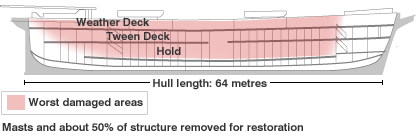
Grimshaw have also punched a shopping centre-style glass lift up through the middle of the ship — and put two more lifts in a new square building, the size of a small block of flats, next to and towering over the ship herself. They’ve plonked a glass pod on the open main deck for a staircase (the old housing was wood, but that’s so nineteenth-century). They’ve installed lights on the masts which make it look like a Christmas tree. Above all, of course, they’ve hoicked the ship up on girders, dangling above the dry dock to create an “unparalleled corporate entertaining space” underneath — an act of vandalism that prompted the resignation of the chief engineer, who said it would place the vessel under unacceptable strain and end in its destruction.

Cutty Sark was severely damaged in a drydock fire in May 2007.

Margaret Thatcher: not quite the hawk of popular memory

History Today has an Archie Brown review of Reagan and Thatcher: The Difficult Relationship by Richard Aldous:

… Thatcher had serious reservations about Reagan’s Strategic Defence Initiative project (SDI — soon popularly referred to as ‘Star Wars’). In particular she rejected his idea that this hypothetical anti-missile defence system would make nuclear weapons — and the concept of deterrence — obsolete. When, at the Reykjavik summit in 1986, only Reagan’s determination to continue with SDI prevented his agreeing with Mikhail Gorbachev on a plan for total removal of nuclear weapons from global arsenals, the British prime minister became incandescent with rage.

Her strong attachment to nuclear weapons as a deterrent, in the belief that they would never be used, went alongside a foreign policy that was less bellicose than her popular image might suggest. Thatcher’s willingness to use force to take back the Falkland Islands, following their takeover by Galtieri’s Argentina, should not obscure her extreme reluctance to endorse military intervention where there had been no external attack on Britain or on a British dependency. Aldous cites her clearly-expressed opposition to military interventions for the sake of ‘regime change’:

    We in the Western democracies use our force to defend our way of life … We do not use it to walk into independent sovereign territories … If you’re going to pronounce a new law that wherever communism reigns against the will of the people, even though it’s happened internally, there the USA shall enter, then we are going to have really terrible wars in the world.

That was provoked by the American invasion of Grenada to reverse an internal coup. Thatcher also took a sceptical view of American military strikes in Lebanon and Libya, saying: ‘Once you start to go across borders, then I do not see an end to it and I uphold international law very firmly’.

« Newer PostsOlder Posts »

Powered by WordPress

