
The Great War
Published 24 Feb 2023The Rif War between Spain and the Rif Republic gave rise to a young Spanish officer named Francisco Franco — who later would become Spanish dictator. After Spain had almost lost the war against the Rifi people, they got help from France and WW1 hero Philippe Pétain.
(more…)
February 25, 2023
Rise of Franco – The Spanish Rif War 1921-1926
Comments Off on Rise of Franco – The Spanish Rif War 1921-1926
QotD: Feudalism versus “Manorialism”
… the economic system in much of medieval Europe is better understood under this term, manorialism, rather than “feudalism”. Feudalism, as a term, has been generally going out of style among medievalists for a long time, but it is especially inapt here. In a lot of popular discourse (and high school classrooms), feudalism gets used as a catch-all to mean both the political relationships between aristocrats and other aristocrats, and the economic relationships between peasants and aristocrats, but these were very different relationships. Peasants did not have fiefs, they did not enter into vassalage agreements (the feodum of feudalism). Thus in practice my impression is that the experts in medieval European economics and politics tend to eschew “feudalism” as an unhelpful term, preferring “manoralism” to describe the economic system (including the political subordination of the peasantry) and “vassalage” to describe the system of aristocratic political relationships.
Bret Devereaux, “Collections: Bread, How Did They Make It? Part IV: Markets, Merchants and the Tax Man”, A Collection of Unmitigated Pedantry, 2020-08-21.
Comments Off on QotD: Feudalism versus “Manorialism”
February 24, 2023
Up Close and Personal – Mountain Warfare in Italy – WW2 Special
World War Two
Published 23 Feb 2023Thanks to Curiosity Stream for sponsoring today’s video
Even as the Allied and Axis commanders focus on the sweeping warfare of the Eastern Front and the planning for the invasion of Europe, their men continue to fight a grinding war of attrition high in the Italian mountains. It’s a war of merciless terrain, brutal close-quarters combat, and vast quantities of artillery and bombs. They may be playing second fiddle, but the soldiers on the Italian front will never forget these battles.
(more…)
Comments Off on Up Close and Personal – Mountain Warfare in Italy – WW2 Special
War of 1812 – Freshwater Edition
Drachinifel
Published 4 Sept 2019Today we take a look at the War of 1812 as it progressed on the Great Lakes.
(more…)
Comments Off on War of 1812 – Freshwater Edition
QotD: Relearning lessons as old as warfare
The people of Asia had changed, true. The day of the gunboat and a few Marines would never return. But that was not the whole story. The people of the West had changed, too. They forgot that the West had dominated not only by arms, but by superior force of will.
During the summer of 1950, and later, Asians would watch. Some, friends of the West, would even smile. And none of them would ever forget.
News reports in 1950 talked of vast numbers, overwhelming hordes of fanatic North Koreans, hundreds of monstrous tanks, against which the thin United States forces could not stand. In these reports there was truth, but not the whole truth.
The American units were outnumbered. They were outgunned. They were given an impossible task at the outset.
But they were also outfought.
In July, 1950, one news commentator rather plaintively remarked that warfare had not changed so much, after all. For some reason, ground troops still seemed to be necessary, in spite of the atom bomb. And oddly and unfortunately, to this gentleman, man still seemed to be an important ingredient in battle. Troops were getting killed, in pain and fury and dust and filth. What had happened to the widely heralded pushbutton warfare where skilled, immaculate technicians who had never suffered the misery and ignominy of basic training blew each other to kingdom come like gentlemen?
In this unconsciously plaintive cry lies buried a great deal of the truth why the United States was almost defeated.
Nothing had happened to pushbutton warfare; its emergence was at hand. Horrible weapons that could destroy every city on earth were at hand — at too many hands. But pushbutton warfare meant Armageddon, and Armageddon, hopefully, will never be an end of national policy.
Americans in 1950 rediscovered something that since Hiroshima they had forgotten: you may fly over a land forever; you may bomb it, atomize it, pulverize it and wipe it clean of life — but if you desire to defend it, protect it, and keep it for civilization, you must do this on the ground, the way the Roman legions did, by putting your young men into the mud.
T.R. Fehrenbach, This Kind of War: A Study in Unpreparedness, 1963
Comments Off on QotD: Relearning lessons as old as warfare
February 23, 2023
Type 99 Arisaka Sniper Rifles
Forgotten Weapons
Published 29 Nov 2016The Japanese Army made significant use of snipers (or in today’s terminology, designated marksmen) as part of its infantry combined arms doctrine, and produced about 22,000 Type 97 sniper rifles for use in WWII and the Sino-Japanese War. In 1941, shortly after the adoption of the new 7.7mm rifle cartridge, it was decided that a sniper rifle variant of the Type 99 should be made in addition to the Type 97 (which was basically a scoped Type 38).
Testing through 1941 determined that there was almost no practical difference in accuracy between scoped examples of the Type 99 long and short rifles, and so the short rifle was chosen to be the basis for the Type 99 sniper (the Type 99 long rifles would drop from production altogether pretty quickly anyway). About 1,000 of the scoped 99s were manufactured by the Kokura Arsenal using the same 2.5x scope as on the Type 97 sniper, while the Nagoya Arsenal instead used a 4x scope, offering more magnification at the expense of a narrower field of view. Nagoya would produce approximately 10,000 of these rifles, with 4x scopes except for a period between serial numbers 5,000 and 7,000 with 2.5x scopes (most likely the remainder stored at Kokura when that plant ceased production). The rifles made into snipers were given no special selection criteria; simply taken at random from normal production. The utility of the weapon in Japanese practice came not from it being mechanically more accurate than any other issue rifle, but rather from the optical sight allowing better exploitation of that standard rifle’s inherent accuracy.
(more…)
Comments Off on Type 99 Arisaka Sniper Rifles
February 22, 2023
Mosquito Bombers Bust Out French Resistance – War Against Humanity 098
World War Two
Published 21 Feb 2023Across Europe the anti-Nazi Resistance continues to rise as does the infighting. In France the RAF carry out Operation Jericho to break out captured resistance members held at the prison in Amiens.
(more…)
Comments Off on Mosquito Bombers Bust Out French Resistance – War Against Humanity 098
True Size of a Roman Legion
Invicta
Published 29 Oct 2022The True Size of a Roman Legion.
A history documentary on the True Size of a Roman Legion. This is our first episode in the new True Size series which seeks to bring history to life in 3D using Unreal Engine 5. In this episode we cover the organization of a Roman Legion from the soldier to the Contubernium, the Century, the Cohort, and the Legion. Along the way we not only include the troops and their officers but all the slaves, mules, support, staff, and gear which accompanied them. This makes for a much better understanding of the Roman army structure.
We then put these into context by looking at a Roman army camp, a Roman army on the march, and a Roman army in battle order. This gives the viewer a full 3D history of a legion like never before.
(more…)
Comments Off on True Size of a Roman Legion
February 21, 2023
Medieval Mardi Gras
Tasting History with Max Miller
Published 22 Feb 2022
(more…)
Comments Off on Medieval Mardi Gras
QotD: The Gods as (literal) machines
But what do we offer? What do we ask for? How do we ask? This isn’t write-your-own-religion, after all: you can’t just offer whatever you feel like (or more correctly, you can, and the god’s silent disapproval will be the response). After all, if your plan is to get me to do something, and you show up at my door with awful, nasty Cherry Pepsi, you are bound to be disappointed; if you show up with some delicious Dr. Pepper, you may have better luck. That’s how people work – why would the gods be any different?
So different gods prefer different things, delivered in different ways, with different words, at different times. There are so many possible details and permutations – but this is important, it matters and you must get it right! So how can you be sure that you are offering the right thing, at the right time, in the right way, to the right god, for the right result?
And that’s where our knowledge from last week comes in. You aren’t left trying to figure this out on your own from scratch, because you can draw on the long history and memory of your community and thus perform a ritual which worked in the past, for the same sort of thing.
The thing to understand about that kind of knowledge is that it’s a form of black box tech; the practitioner doesn’t know why it works, only that it works because – as we discussed – the ritual wasn’t derived from some abstract first-principles understanding of the gods, but by trial and error. Thinking about the ritual as a form of functional, but not understood, technology can help us understand the ancient attitude towards ritual.
Let’s say we discovered a functioning alien spaceship with faster-than-light propulsion, but no aliens and no manual. We don’t understand anything about how it works. What would we do? We might try to copy the ship, but remember: we don’t know what parts are functional and what parts are just cosmetic or what does what. So we’d have to copy the ship exactly, bolt for bolt, to be sure that it would work when we turned it on.
Ritual in ancient polytheistic religions is typically treated the same way: given an unknowable, but functional system, exactitude is prized over understanding. After all, understanding why the ritual works does not help it work any better – only performing it correctly. An error in performance might offend the god, or create confusion about what effect is desired, or for whom. But an error in understanding causes no problems, so long as the ritual was performed exactly anyway. Just as it doesn’t matter what you think is happening when you, say, turn on your TV – it turns on anyway – it doesn’t matter what you think is happening in the ritual. It happens anyway.
Bret Devereaux, “Collections: Practical Polytheism, Part II: Practice”, A Collection of Unmitigated Pedantry, 2019-11-01.
Comments Off on QotD: The Gods as (literal) machines
February 20, 2023
Thirteen reasons the Dutch did better financially than the English in the Seventeenth Century
In the latest Age of Invention newsletter, Anton Howes investigates the huge differences between the rival English and Dutch financial markets in the 17th century:
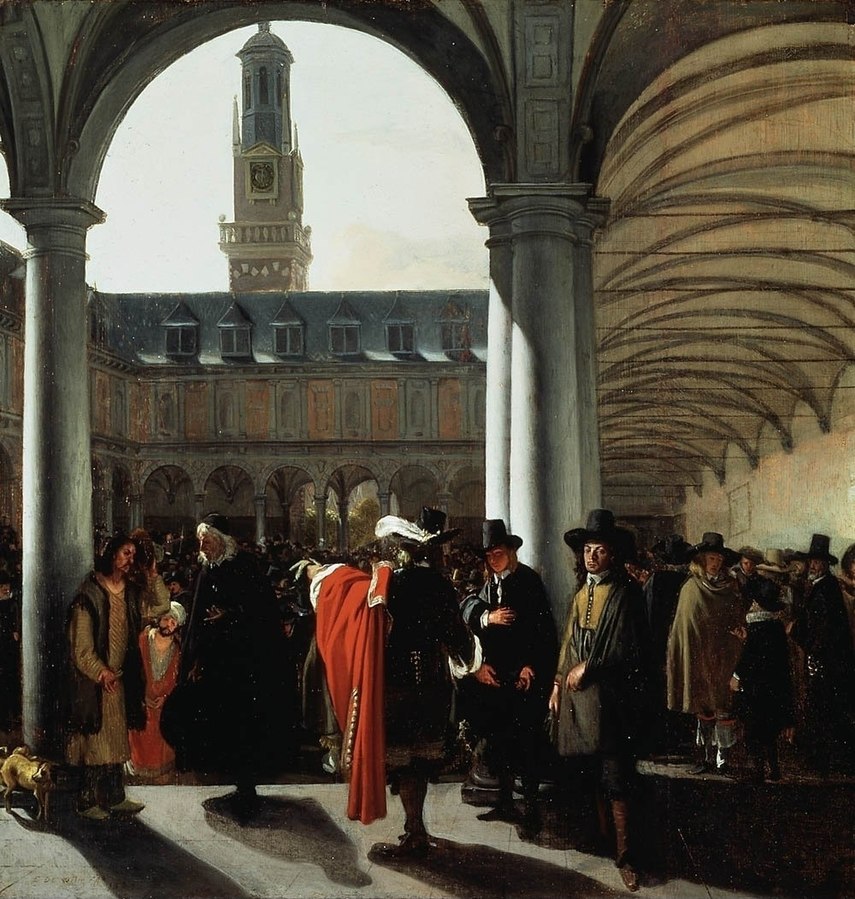
The courtyard of the exchange in Amsterdam (De binnenplaats van de beurs te Amsterdam), 1653.
Oil painting by Emanuel de Witte (1617-1692) from the Museum Boijmans Van Beuningen collection via Wikimedia Commons.
One of the weird things about Britain, despite its being the birthplace of the Industrial Revolution, is that its financial infrastructure was for a long time remarkably backward. Its “Financial Revolution”, by which both people and the state began to borrow at ever lower interest rates, only really took off in the early eighteenth century — long after London’s extraordinary growth in 1550-1650, when it had suddenly expanded eightfold to become one of Europe’s most important commercial hubs. Indeed, even for much of the late seventeenth century, England lacked many of the most basic financial institutions that had been used for decades and decades by their most important rival and trading partner, the Dutch Republic.
I was especially intrigued when I stumbled across a discussion of Dutch policies and customs, written up in around 1665 by the young merchant Josiah Child, and published a few years later: a kind of wishlist of many of the things that made the Dutch so wealthy, and which the English continually failed to emulate:
- The Dutch councils of state and war always included merchants who had experience of trading and living abroad — Child was perhaps just angling for some influence here, but for all that merchants were getting more influential, in England they were not actually in charge.
- Gavel-kind succession laws, whereby all children got an equal share of their parents’ estates, rather than it all going to the eldest. English primogeniture, by contrast, apparently left a lot of gentlemen’s younger sons having to become apprenticed to merchants.
- High regulatory standards for goods. A barrel of Dutch-packed herring or cod would apparently be accepted by buyers just by viewing the marks, without having to open them up to check. English-packed goods, by contrast, were rarely trusted because the fish would turn out to be rotten or even missing — the English regulators’ stamps of approval were reputedly given to anyone who would pay.
- Encouragement for inventors of new products, techniques, and import trades, who received rewards from the state, and not just temporary monopoly patents.
- Ships, called fluyt, which were cheaper to build, required fewer sailors, and were easier to handle. Despite being only very lightly armed, they sailed in fleets for protection, when necessary being convoyed by ships of war. English trading ships, by contrast, were each heavily armed, but with those cannon taking up room and weight that could have been used for carrying merchandise.
- Education of all children, even girls, in arithmetic and keeping accounts. As Child put it, this infused in the Dutch “a strong aptitude, love, and delight” for commerce. It also meant that husbands and wives were real partners in many businesses — something that impressed almost all foreign visitors to the Netherlands.
- Low customs duties, but high consumption taxes. Very low customs duties, on both imports and exports, meant that it was often very profitable to trade with the Netherlands. The Dutch were famed for their many ships, and for their granaries bursting with grain, despite growing hardly any trees or crops themselves. To fund their state, they instead overwhelmingly relied on the gemene middelen — taxes on the sale of wine, beer, meat, fuel, candles, salt, soap, flour, cloth, and a host of other goods, with many of the higher rates reserved for expensive luxuries. Much like modern value-added taxes, these taxes on consumption raised revenue while preserving the all-important incentive to save and invest.
- Thrifty living — which, come to think of it, was probably related to the high consumption taxes, although Childs doesn’t seem to have noticed the connection. Dutch thrift was thought by the English to be especially useful because it allowed wage costs to be kept low — essential for maintaining competitiveness in international markets — while preventing the country having a trade deficit. The English always worried they were sending too much of their silver abroad to pay for French wines and other luxuries, but the Dutch appeared to have prevented this without resorting to import tariffs that might annoy trading partners and prompt retaliation.
- Religious toleration, which attracted all sorts of industrious immigrants to bring their families and wealth. (Incidentally, as I’ve mentioned before, this was also one of the key attractions of Livorno, set up by the Medici Dukes of Tuscany to be a major trading hub.)
- The use of the Law-Merchant, which meant that all controversies between merchants and tradesmen were decided in just 3 or 4 days’ time. England, rather strangely for such an increasingly commercial nation, did not develop merchant courts with a specific jurisdiction or a distinct body of merchant law — disputes instead had to be resolved in the royal common-law or equity courts, in the Admiralty court, or else abroad. The English courts, however, were often slow. Child complained that cases often took half a year, and often much longer. (Incidentally, slow and rotten justice in the Court of Chancery, the key equity court used by merchants in England, was one of the reasons Francis Bacon was impeached by Parliament and sacked as Lord Chancellor.)
- Transferrable bills of exchange — in other words, the circulation of credit notes as a currency. These were not properly supported by English laws, but allowed Dutch merchants to trade a lot more frequently. English merchants often had to wait some six months to a year before receiving all the coin from selling their foreign goods in London, so as to purchase goods again to make fresh trades. They spent much of their time chasing shopkeepers for payment. But the Dutch, by being able to easily buy and sell their credit notes, could “turn their stocks twice or thrice in trade”, immediately settling their accounts and making fresh purchases. (I intend to look into this in a lot more detail soon, as finding a way to bills of exchange transferrable in England appears to have been a major project for many of the mid-seventeenth-century inventors and improvers — after just a cursory glance, transferability was only secured in law as late as 1704.)
- Banks. Or rather, as Child actually put it, “BANKS”. In England many of the functions of banks gradually evolved from the practices of individual goldsmiths and the scriveners — legal clerks who specialised in property transfers and mortgages. There was certainly nothing so secure as the municipal Wisselbank of Amsterdam, established in 1609, which had various monopoly powers as a clearing-house for bills of exchange and was backed by a vault full of bullion. Nor the municipal Bank van Lening, established in 1614, which was a pawnbroker modelled on the Italian Monte di Pietà, or mounts of piety, designed to make small and low-cost loans to the poor.
- “PUBLIC REGISTERS” — again capitalised by Child — of all lands and houses sold or mortgaged. This item on the policy wishlist would not be ticked off for England until two centuries later, but the key advantage was to prevent lawsuits over land titles — still cited as a major problem even in the 1690s — and so make land more genuinely secure for mortgages.
Finally, the result of many of these policies was the Dutch had significantly lower interest rates — often just 3-4% when the English were still lending and borrowing at 6-8%. Indeed, this list was made because of a long-standing English policy debate I’ve been researching, on whether to lower the legal maximum rate of interest.
Comments Off on Thirteen reasons the Dutch did better financially than the English in the Seventeenth Century
Garate Anitua y Cia “El Tigre” – Winchester 1892 Copy
Forgotten Weapons
Published 5 Jun 2016Spain was historically a major center of patent infringement in firearms manufacture because its patent law left open a big loophole: patents were only enforceable if the patent holder actually manufactured their guns in Spain. The major European and American firearms manufacturers were not interested in setting up plants in Spain, and so their patents were not enforced there, leaving Spanish shops and factories legally free to copy them.
One of the more successful copies was the “El Tigre“, a clone of the Winchester 1892 lever action rifle made by Garate Anitua y Cia. Ironically, Garate actually registered their own patent on the design since Winchester hadn’t bothered to, and that patent was enforced, since Garate did make the guns in Spain. Their copy was chambered for the .44-40 Winchester cartridge, known in Spain as the .44 Largo. This made it compatible with many of the revolvers in the country of American, Spanish, and Belgian origin, and thus quite popular with a wide variety of groups. Rural citizen militias and the Guardia Civil both used significant numbers of El Tigre carbines. They were also fairly popular in the United States, as the cost was substantially lower than a true Winchester. Many Hollywood films and shows used them as less expensive prop guns, especially for scenes where guns would be handled roughly.
Despite their competitive cost, the El Tigres were actually quite good guns, and served their owners well.
Comments Off on Garate Anitua y Cia “El Tigre” – Winchester 1892 Copy
QotD: The early “cyberpunk” writers versus the folks who built the internet
We’re not thrilled by people who rave endlessly about the wonder of the net. We’re not impressed by brow-furrowing think-pieces about how it ought to written by people who aren’t doing the design and coding to make stuff work. We’d be far happier if pretty much everybody who has ever been described as “digerati” were dropped in a deep hole where they can blabber at each other without inflicting their pompous vacuities on us or the rest of the world.
In our experience, generally the only non-engineers whose net-related speculations are worth listening to are science-fiction writers, and by no means all of those; anybody to whom the label “cyberpunk” has been attached usually deserves to be dropped in that deep hole along with the so-called digerati. We do respect the likes of John Brunner, Vernor Vinge, Neal Stephenson, and Charles Stross, and we’re occasionally inspired by them – but this just emphasizes what an uninspiring lot the non-fiction “serious thinkers” attaching themselves to the Internet usually are.
There are specific recurring kinds of errors in speculative writing about the Internet that we get exceedingly tired of seeing over and over again. One is blindness to problems of scale; another is handwaving about deployment costs; and a third is inability to notice when a proposed cooperative “solution” is ruined by misalignment of incentives. There are others, but these will stand as representative for why we very seldom find any value in the writings of people who talk but don’t build.
We seldom complain about this in public because, really, how would it help? The world seems to be oversupplied with publishers willing to drop money on journalists, communications majors, lawyers, marketers manqué, and other glib riff-raff who have persuaded themselves that they have deep insights about the net. Beneath their verbal razzle-dazzle and coining of pointless neologisms it’s extremely uncommon for such people to think up anything true that hasn’t been old hat to us for decades, but we can’t see how to do anything to dampen the demand for their vaporous musings. So we just sigh and go back to work.
Yes, we have our own shining visions of the Internet future, and if you ask us we might well tell you about them. It’s even fair to say we have a broadly shared vision of that future; design principles like end-to-end, an allergy to systems with single-point failure modes, and a tradition of open source imply that much. But, with a limited exception during crisis periods imposed by external politics, we don’t normally make a lot of public noise about that vision. Because talk is cheap, and we believe we teach the vision best by making it live in what we design and deploy.
Here are some of the principles we live by: An ounce of technical specification beats a pound of manifesto. The superior man underpromises and overperforms. Mechanism outlasts policy. If a picture is worth a thousand words, a pilot deployment is worth a million. The future belongs to those who show up to build it. Shut up and show us the code.
If you can live by these principles too, roll up your sleeves and join us; there’s plenty of work to be done. Otherwise, do everybody a favor and stop with the writing and the speeches. You aren’t special, you aren’t precious, and you aren’t helping.
Eric S. Raymond, “Those who can’t build, talk”, Armed and Dangerous, 2011-07-28.
Comments Off on QotD: The early “cyberpunk” writers versus the folks who built the internet
February 19, 2023
The Destruction of Monte Cassino – Week 234 – February 18, 1944
World War Two
Published 18 Feb 2023The Allies bomb the monastery atop Monte Cassino in Italy, but just to the Northwest it’s the Germans attacking them at Anzio this week. In the Soviet Union, the Axis break out of the Korsun Pocket, but at great cost, and in the Pacific comes a major Allied raid on the Japanese base at Truk and landings on Eniwetok Atoll.
(more…)
Comments Off on The Destruction of Monte Cassino – Week 234 – February 18, 1944
Flower-Class Corvettes – WW2 Atlantic Defender
Matsimus
Published 29 Jun 2020The Flower-class corvette (also referred to as the Gladiolus class after the lead ship) was a British class of 294 corvettes used during World War II, specifically with the Allied navies as anti-submarine convoy escorts during the Battle of the Atlantic. Royal Navy ships of this class were named after flowers, hence the name of the class.
The majority served during World War II with the Royal Navy (RN) and Royal Canadian Navy (RCN). Several ships built largely in Canada were transferred from the RN to the United States Navy (USN) under the lend-lease programme, seeing service in both navies. Some corvettes transferred to the USN were manned by the US Coast Guard. The vessels serving with the US Navy were known as Temptress and Action-class patrol gunboats. Other Flower-class corvettes served with the Free French Naval Forces, the Royal Netherlands Navy, the Royal Norwegian Navy, the Royal Indian Navy, the Royal Hellenic Navy, the Royal New Zealand Navy, the Royal Yugoslav Navy, and, immediately post-war, the South African Navy.
After World War II many surplus Flower-class vessels saw worldwide use in other navies, as well as civilian use. HMCS Sackville is the only member of the class to be preserved as a museum ship. Flower Class corvettes were originally intended for coastal escort and mine clearing work. Derived from a whaler design, they were simple, highly seaworthy vessels that could be constructed in secondary yards. The dire lack of ocean escorts early in the war necessitated their being used to screen convoys traversing the North Atlantic between Nova Scotia and the UK. This was a role for which they were ill-designed, and their crews suffered accordingly. The Flowers were wet, highly cramped and impossibly lively. Many sailors could not adjust to the exhausting routine. Compounding the misery was the inexperience of the crews, most of whom had never been to sea. But any escort was better than none at all, so the yards continued to turn out corvettes. 120 were built in Canadian yards, and slightly more in the UK.
(more…)
Comments Off on Flower-Class Corvettes – WW2 Atlantic Defender


