
The Korean War by Indy Neidell
Published 28 Jan 2025Peng Dehuai’s armies rest and recuperate on the banks of the Han River, nursing their supply issues, and the initiative has firmly swung in favor of the UN side. The North Koreans in the east are fleeing, and Matt Ridgway’s latest offensive in the west gets underway without a hitch. Are we about to see yet another reversal of fortune and pursuit up the Korean Peninsula?
Chapters
00:00 Intro
01:11 Recap
01:33 An Aggressor Nation?
07:38 Chinese Sit-Rep
10:59 Operation Thunderbolt
14:56 Summary
15:14 Conclusion
(more…)
January 29, 2025
The Korean War 032 – Thunderbolt! US Troops Go On the Offensive – January 28, 1951
Comments Off on The Korean War 032 – Thunderbolt! US Troops Go On the Offensive – January 28, 1951
Gewehr 98: The German WWI Standard Rifle
Forgotten Weapons
Published 11 Jun 2016The Gewehr 1898 was the product of a decade of bolt action repeating rifle improvements by the Mauser company, and would be the standard German infantry rifle through both World Wars. Today we are looking at a pre-WWI example (1905 production) that shows all the features of what a German soldier would have taken to war in 1914.
Comments Off on Gewehr 98: The German WWI Standard Rifle
QotD: Did the customary Dictatorship work in the Roman Republic?
Yes, frankly.
Of the roughly 85 dictatorships in the “customary” period from 501 to 202, 0% of them seized control of the state, led or participated in a major violent insurrection. […]
How could an office with such extensive powers be so apparently stable? Dictators under the customary system simply lacked the tools necessary to overthrow the state even if they wanted to. As noted, all of the other magistrates remained in office and while they were notionally subordinate to the dictator, they didn’t need to be cooperative (and surely wouldn’t be if a dictator announced he was staying on after the end of his term). Dictators couldn’t legislate on their own and so couldn’t alter the constitutional structure of the Republic itself. Moreover, one key magistracy, that of the tribunes of the plebs, remained distinctly outside of the dictator’s power and by the third century were equipped with a range of highly disruptive powers and a mandate to protect the interests of the Roman people which would justify them blocking a dictator’s efforts to seize power.
The dictator’s command of the army was likewise not an effective tool to dominate the state. The Roman army of the early and middle republics was a citizen militia, so the dictator would need to convince the Roman voting assemblies to abolish themselves. Moreover, with a mere six-month command, no dictator was likely to remain in command of his army long enough to foster the kind of iron-clad loyalty he would need to then direct that army against the rest of the state.
In terms of allowing rapid and unified response to a fast-moving crisis, the dictatorship also seems generally to have worked well, allowing the Romans to temporarily suspend whatever political gridlock might exist, but in a context that rarely allowed for one side to win the gridlock by suspending it, since the causa [the specific, named problem that triggered the appointment] of the dictator was limited and generally externally directed. In cases where a dictator was appointed to deal with internal dissent, they often still had to compromise in the face of popular discontent because they lacked the tools to coerce the political system; P. Manlius Capitolinus (dict. 368) had to push a major compromise in order to get the plebs back on board after the previous dictator, M. Furius Camillus, had attempted to strong-arm the issue. On the flipside, Manius Valerius (dict. 494), being appointed dictator in 494 to deal with a military crisis and a successio plebis, defeated the external enemy and then suggested the senate compromise internally, which it refused to do. He simply resigned his dictatorship, to the acclaim of the people.
While the powers of the dictator are often stated as being “absolute” or “extreme” (and were, compared to the power of a consul), the customary dictatorship was essentially just a unitary executive, something that quite a lot of modern governments have. Customary Roman dictators were, if anything, less powerful than most modern Prime Ministers or the modern President of the United States. Like many ancient civic governments, the Roman Republic was constructed with a lot of worry about monarchy and thus tended to keep its offices short in duration and institutionally weak and the dictatorship was no exception.
Bret Devereaux, “Collections: The Roman Dictatorship: How Did It Work? Did It Work?”, A Collection of Unmitigated Pedantry, 2022-03-18.
Comments Off on QotD: Did the customary Dictatorship work in the Roman Republic?
January 28, 2025
AI, the iPhone, and other tech whizzery are not the most important inventions ever
Freddie deBoer reacts to so, so many technically illiterate hot takes about this or that latest bit of techno-woo bling being given accolades as “the most important invention”:

Years ago, I think in 2010, Business Insider invested a great deal of hype and hoopla into a list they developed of the one hundred most important inventions of all time. I have tried and tried to find a link, including via the Internet Archive, but no dice; I’ll chalk it up to linkrot, the endless deterioration of the web over time, Business Insider‘s paywall, and their convoluted publishing history. You’ll have to take my word for it that, in a list that was released with great fanfare, they rated the iPhone as the most important invention of all time. Not antibiotics, the plow, or alternating current, not anesthesia or the lightbulb, but the iPhone, which took a bunch of things that already existed (cellular telephone service, email on the go, a touchscreen) and put them in one remarkably profitable package. The Business Insider list isn’t alone in putting the iPhone so high on ranked lists of human achievement. There’s plenty you can find, including a British survey that put the iPhone at number eight, ahead of the internal combustion engine, or this New York Times podcast which puts the iPhone at number three, although the list seems to be partially tongue in cheek. There’s a lot you could ask about such a choice, including epistemological questions inherent to putting a cellphone above the electricity-generating technologies that power it. But my visceral response to this kind of thinking — and even aside from ordinal lists of importance, the smartphone-supremacy attitude is very common — is to say, wow, these people must really enjoy shitting in the yard.
Plumbing — bringing fresh water from one place to another and disposing of human waste via engineering — goes back to antiquity, and you occasionally find claims of affordances like flush toilets in ancient times. Today, modern people in most developed parts of the world have constant access to free-running clean water and toilets that can remove physical waste to a secure processing facility or holding unit, with heated water on demand a very nice extra. That’s largely a 20th-century and forward phenomenon. There were pretty sophisticated sewer systems in Victorian London, the White House got running water in the Jackson administration, and as usual major metropolitan areas in rich countries were ahead of the game generally. But it wasn’t until the 1920s or so that indoor plumbing became a true mass phenomenon, again only in wealthy countries, and it was perfectly common for a soldier coming home from World War II in 1945 to be coming home to a house with a well and an outhouse. It wasn’t until the 1960s that a majority of American homes had indoor plumbing, which means that the beginning of the Space Age overlapped with a period where most Americans couldn’t wash their hands whenever they wanted to. And, as cool as NASA and launching satellites and orbiting the Earth and traveling to the Moon are, their practical impacts on human life pale in comparison to modern plumbing.
So when I read people putting the iPhone as the pinnacle of human ingenuity, I have to imagine that they’re big fans of shitting in their yard. Because if faced with a choice, they’ve indicated that they’d choose their smartphone over their toilet! And that’s quite a choice. It might be worth doing a little reality check in that regard by spending a month without one and then a month without the other. So you see how life feels without your smart phone for 30 days, and then you see what it’s like to not be able to access indoor plumbing for 30 days. You have to piss and shit outside. You have to walk to a well, if you can find one, to get (hopefully clean) water, and then you have to heat it up on your stove if you want it hot. You can’t shower, and taking a bath would be a remarkably laborious process that still left you with tepid water. And this isn’t just a question of comfort but a question of essential hygiene, by which I mean medically-relevant hygine — cholera, typhoid, gastrointestinal worms, scarlet fever, hepatitis, and many more diseases were massively harder to avoid before mass indoor plumbing. I don’t know you, personally, but I feel considerable confidence in suggesting that your desire to avoid those diseases is greater than your attachment to Instagram.
That’s the shitting in the yard test, or the indoor plumbing test, for those who prefer to avoid vulgarity. The test requires you to compare the hype about a particular tech product up against the actual brick-and-mortar changes wrought in the great period of human advancement that began sometime in the late 19th century and ended sometime in the late 20th; the modern flush toilet is just a particularly relevant example. Is Zoom really a bigger part of your life than food refrigeration, a technology that has saved untold millions of lives over the decades by dramatically reducing deaths from foodborne illness? Is cloud storage really a bigger deal than infant vaccines, which save six lives a minute? Does Android Auto really rate when compared to the airbag? You can call these questions obtuse, and some do, but they are natural and necessary things to think about in an era of obsession with artificial intelligence. (By which people mean LLM/neural net-based artificial intelligence, which is a whole other thing.) When you say that AI is the most important invention in human history, you’re making some really, really powerful claims. And yes, you have to then justify saying that AI is more important than, for example, the transistor, self-negating claims that deny the importance of technologies that make large language models possible. But you also have to justify saying that AI is more important than, like, the bowl. By which I mean, bowls. To put food in. To eat out of. Try and spend the rest of your life without ever using another food container and get back to me about whether ChatGPT is more important. Food containers are inventions!
Comments Off on AI, the iPhone, and other tech whizzery are not the most important inventions ever
“Like Sulla, [Trump]’s been taking names, and he has a list”

So-called “Sulla” (probably from the time of Augustus) after a portrait of an important Roman from the 2nd century BC.
From the Glyptothek collection via Wikimedia Commons.
The comparison of Trump to the man who prefigured Julius Caesar in the final years of the Roman Republic is, we should all passionately hope, more rhetorical than realistic. Sulla came to power in Rome after being, in his view, illegally removed from his rightful position, and he came wading through the blood of his enemies. He then created a brand new position for himself, using the old and disused title of “dictator”, but piling on far more power than any earlier dictator had held (the irregular election was held in hearing distance of where Sulla’s army was busy executing many of his captured enemies). He used his power to reconfigure and codify the rules by which the Republic was run, to “restore the Republic” to what he imagined was a purer, better nation. He set a precedent that would be followed a generation later by Julius Caesar and the end of the Republic was clearly in sight.
Trump has come again to power, from which he believes he was illegally removed, although he has not been wading through the blood of his enemies. He has been using the powers of his position very actively, but thus far seems to be staying within the bounds of the Constitution (mostly). On his Substack, Glenn Reynolds says that the second Trump presidency will be much worse for his political opponents than if he’d won his second term in 2020, and I think that’s the right analysis:
Well, if you follow me here, you probably don’t need to be told how fast Trump is moving. But I have a few other thoughts here that didn’t fit the column. The main point is that the Democrats’ over-the-top rule-breaking, norm-busting attacks on Trump have backfired bigly. I like to use the Tolkien quote, “oft evil will shall evil mar”, and that happened here for sure.
A second consecutive Trump term would have been better, from my perspective, than Biden’s sham administration, obviously. But it certainly would have been better for the Democrats than this second non-consecutive term. Trump spent the past four years not only planning his comeback, but planning what he would do after his comeback.
In his first term he was too busy running to plan, and he was naïve about how Washington and the federal government – and the Republican Party – actually work. Not so much anymore. I’ve seen people – to continue the Tolkien reference – compare him to Gandalf the White coming back after battling the Balrog, and that’s not a bad analogy.
Then there’s this one, which pretty much sums up what I’m saying here. Like Sulla, he’s been taking names, and he has a list.
And there’s this:
It really is. Trump could get carried away with this stuff at some point, but at present he seems to be settling all family business in a very measured way. Where the opening months of the first Trump Administration were confused – Omarosa in the White House? – this time around he’s realized that personnel is policy, and he’s clearly done a lot of thinking about who his personnel will be. And it’s no coincidence that he’s put a lot of people who were victims of various government agencies in charge of those same agencies. Not much danger of them going native, I think.
A second consecutive Trump term would have delayed the advance of the left/Democrat agenda, and pushed it back in some minor ways, but would probably have ultimately been no more than a bump in the road for that agenda. This Trump term will likely burn it down.


Comments Off on “Like Sulla, [Trump]’s been taking names, and he has a list”
Dining at the Wild Parties of Regency England
Tasting History with Max Miller
Published 24 Sep 2024Drop biscuit-style cakes with dried currants
City/Region: London, England
Time Period: 1806In the 18th and 19th centuries, members of the aristocracy threw wild parties called routs. These parties, which sound akin to a modern frat party, eventually devolved to rooms stuffed with way too many people, so that attendance consisted of jostling from room to room before leaving. If you were lucky, you could grab a rout cake to help sustain you while you party hopped.
These cakes are dense and dry, but not unpleasantly so. While they are delicious, because of the dryness I recommend enjoying them with a cup of coffee, tea, or party beverage of your choice. They’re just sweet enough, and the flavors of the brandy and the flower waters shine through.
Rout Drop Cakes
Mix two pounds of flour, one ditto butter, one ditto sugar, one ditto currants, clean and dry; then wet into a stiff paste, with two eggs, a large spoon of orange-flower water, ditto rose-water, ditto sweet wine, ditto brandy, drop on a tin-plate floured; a very short time bakes them.
— A New System of Domestic Cookery by A Lady (Maria Rundell), 1806.
Comments Off on Dining at the Wild Parties of Regency England
QotD: Was Einstein a science-denier?
Even if there were absolutely no light deflection, no perihelion motion and no redshift, the gravitational equations would still be convincing because they avoid the inertial system … It is really quite strange that humans are usually deaf towards the strongest arguments, while they are constantly inclined to overestimate the accuracy of measurement.
In a few short sentences Einstein completely repudiates the empiricist spirit which has ostensibly guided scientific inquiry since Francis Bacon. He doesn’t care what the data says. If the experiment hadn’t been run, he would still believe the theory. Moreover, should the data have disconfirmed his theory, who cares? Data are often wrong.
This is not, to put it mildly, the official story of how science gets made. In the version most of us were taught, the process starts with somebody noticing patterns or regularities in experimental data. Scientists then hypothesize laws, principles, and causal mechanisms that abstract and explain the observed patterns. Finally, these hypotheses are put to the test by new experiments and discarded if they contradict their results. Simple, straightforward, and respectful of official pieties. The Schoolhouse Rock of science. Or as Einstein once described it:
The simplest idea about the development of science is that it follows the inductive method. Individual facts are chosen and grouped in such a way that the law, which connects them, becomes evident. By grouping these laws more general ones can be derived until a more or less homogeneous system would have been created for this set of individual facts.
See? It’s as easy as that. But then, Einstein finishes that thought with: “[t]he truly great advances in our understanding of nature originated in a manner almost diametrically opposed to induction”.
Was Einstein a science-denier? I’m obviously kidding, but this is still pretty jarring stuff to read. How did he get this way? Einstein’s Unification is the story of the evolution of Einstein’s philosophical views, disguised as a story about his discovery of general relativity and his quixotic attempts at a unified field theory. It’s a gripping tale about how Einstein tried to do science “correctly”, experienced years of frustration, almost had priority for his discoveries snatched away from him, then committed some Bad Rationalist Sins at which point things immediately began to work. This experience changed him profoundly, and maybe it should change us too.
John Psmith, “REVIEW: Einstein’s Unification, by Jeroen van Dongen”, Mr. and Mrs. Psmith’s Bookshelf, 2024-05-27.
Comments Off on QotD: Was Einstein a science-denier?
January 27, 2025
The Bismarck‘s First Adventure – The Bismarck Part 1
World War Two
Published 26 Jan 2025At 02:00 on May 19, 1941, Germany’s most powerful battleship ever sets sail. Bismarck will sail out into the North Atlantic, evade the Royal Navy and tear apart Britain’s Atlantic convoys. At least that’s the plan … pretty soon things start to go wrong.
(more…)
Comments Off on The Bismarck‘s First Adventure – The Bismarck Part 1
The Rise of Augustus – The Conquered And The Proud 12
Adrian Goldsworthy. Historian and Novelist
Published 4 Sept 2024Continiung the series “The Conquered and the proud”, we come to the early days of the young Octavian, the man who would become Caesar Augustus and found the Principate, the rule of emperors — a system that would last for centuries and see the Roman empire reach the pinnacle of its prosperity and population.
Just eighteen years old when Julius Caesar was murdered, his great nephew was named as principal heir in his will. This mean that he took his name and the bulk of his property. However, this ambitious teenager took it to mean that he should also succeed to Caesar’s power. Incredibly, after fourteen years of bloody struggle, he did just that.
Comments Off on The Rise of Augustus – The Conquered And The Proud 12
January 26, 2025
Imperial reparations to India are not economically or historically realistic
Apparently the idea of demanding financial reparations from Britain has once again become a talking point among India’s chattering classes. In The Critic, Tirthankar Roy explains why the basis for the demands do not meet economic or historic criteria necessary for the demands to be justified:

The State Entry into Delhi – Leading the 1903 Delhi durbar parade, on the first elephant, “Lakshman Prasad”, the Viceroy and Vicereine of India, Lord and Lady Curzon. Their elephant was lent by the Maharaja of Benares. On the second elephant, “Maula Bakhsh”, the Duke and Duchess of Connaught representing the British royal family. Their elephant lent by the Maharaja of Jaipur. There were 48 elephants of the Main Procession, shown winding its way past the north side of the Jama Masjid.
Painting by Roderick MacKenzie from the Bristol City Museum and Art Gallery via Wikimedia Commons.
Oxfam, in its report “Takers not Makers” claims that imperialist Britain “extracted” $85 trillion from India, “enough to carpet London with £50 notes” four times over. Oxfam took this number from calculations others have done before. The origin of the claim goes back to Dadabhai Naoroji writing 125 years ago, who called the outflow drain. Oxfam uses the number to support a modern movement: a case for reparations that Britain should pay India. With British public finances in a rut, the report’s timing is not ideal. But how good is the case?
[…]
Why did Chaudhuri say drain was “confused” economics? The figure of $85 trillion builds on three bases. First, in the 1760s, as the East India Company started sharing the governance of Bengal with the Nawab’s regime, a part of the taxes of Bengal was used to fund business investment (export of textiles). Second, in the nineteenth century, Indian taxes were used to fund an army that fought imperialist wars to no benefit of India. Third, India maintained an export surplus, which went to fund payments to Britain on mainly four heads: debt service, railway guarantees, pensions to expatriate officers, and repatriated profits on private investment. Naoroji said that these outflows were payment without benefit to India, a drain, and happened because India was a colony. Did he discount the benefits of these transactions?
The Company was a body of merchants who became kingmakers between 1757 and 1765, resulting in a government in Bengal where private and public interests often conflicted. No one knows how serious the conflict was since the Nawab was a partner in the rule. No matter, the case that tax was used for commerce is weak. Within a few years after the transition, the Parliament started taking control of Indian governance, which meant refusing to fund business with taxes. By 1805, the process was complete when Governor Cornwallis declared that “the duties of territorial government [would take] the place of buying and selling”. In between, public finance data are so patchy that it is impossible to find out how much of the Company’s commercial investment was funded by a budgetary grant, borrowings, and profits.
What is the big deal anyway? The Company’s investment of $60 million around 1800 was a tiny 0.06% of India’s GDP. Its textile business generated employment and externalities in India. And the real drain was not the export, but the profits upon exports. We are dealing with an almost invisible transaction, so small it was.
Consider the criticism of the army. British Indian budget, the argument went, paid for the Indian army, which fought wars beyond Indian borders, a subsidy Indian taxpayers paid to the Empire. This claim misreads what the land army really did. The reason it was very big and funded by India was that it was a deterrent to potential conflict amongst the 550 princely states. Interstate conflicts claimed enormous human and economic cost in the late-eighteenth century. The army ended that and effectively subsidised the defences of the princely states. Similarly, the British state subsidised Indian naval capability. Until World War I, the deployment of the army beyond India caused little controversy. The army protected the huge diaspora of Indian merchants and workers. Without the empire’s military might, we would not get Indians doing business in Hong Kong, Aden, Mombasa, or Natal. The War changed the benefit-cost estimates, and in the 1920s, the arrangement ended.
The third point, that export surplus was drain, is the most bizarre. India normally had a commodity export surplus, in effect payment for services purchased by India from Britain. Naoroji thought this was a waste of money. His followers insisted it was. But these claims follow no economic logic. No economics in the world will tell us that an outflow makes a country poor. That assessment depends on what value the payment creates at home. In activist history, there is no discussion of the value, because there is no acknowledgement there could be a value.
Comments Off on Imperial reparations to India are not economically or historically realistic
The FAL in Cuba: Left Arm of the Communist World?
Forgotten Weapons
Published 7 Oct 2024The full version of this video, including the fully automatic fire not permitted on YouTube, is available on History of Weapons & War here:
https://forgottenweapons.vhx.tv/video…
In 1958, Cuban dictator Fulgencio Batista ordered some 35,000 FAL rifles from FN, including both regular infantry rifles have heavy-barreled FALO light machine guns. Before any of them could arrive, however, Batista fled the country and his guns were delivered to Fidel Castro beginning in July 1959.At this time, the FAL was still a fairly new rifle, having been first adopted by Venezuela in 1954 and Belgium in 1954/55. A few changes had been made by the time of the Cuban contract (like the slightly taller sights requested by the Germans), but these were still Type 1 receivers with early features.
The first consignment of rifles arrived from Belgium to Havana July 9, 1959 and this consisted of 8,000 rifles and ten LMGs. A second shipment of 2,000 rifles arrived October 15th, and a third of 2,500 rifles and 500 LMGs on December 1st. The final ship bringing FALs to Cuba (the French freighter La Courbe) docked in Havana March 4th 1960, and suffered a pair of explosions while bring unloaded. Several hundred people were killed or injured, and Castro blamed the CIA for the event. In total, the Cubans received 12,500 FAL rifles and 510 FALO light machine guns.
The FALs were used, but many ended up being exported to other parties, as Cuba generally moved to Soviet bloc small arms starting in 1960 (when they began receiving weapons from the USSR and Czechoslovakia). These were often scrubbed of their Cuban markings before shipment, and can be found with a round hole milled in the magazine well where the Cuban crest originally was, similar to how some South African FALs were scrubbed before being sent to Rhodesia.
Thanks to Sellier & Bellot for giving me access to this pair of very scarce Cuban FALs to film for you!
(more…)
Comments Off on The FAL in Cuba: Left Arm of the Communist World?
January 24, 2025
The end of “affirmative action” in US government hiring
In The Free Press, Coleman Hughes outlines how the US federal government got into the formal habit of hiring and promoting staff based on things other than ability and merit during the Nixon administration:

Trump’s Executive Order 14171 is titled Ending Illegal Discrimination and Restoring Merit-Based Opportunity. It describes how vast swaths of society, including the “Federal Government, major corporations, financial institutions, the medical industry, large commercial airlines, law enforcement agencies, and institutions of higher education have adopted and actively use dangerous, demeaning, and immoral race- and sex-based preferences under the guise of so-called ‘diversity, equity, and inclusion’ (DEI)”.
In response, Trump has ordered the executive branch and its agencies “to terminate all discriminatory and illegal preferences, mandates, policies, programs, activities, guidance, regulations, enforcement actions, consent orders, and requirements”.
That is a lot of preferences and mandates. Trump’s executive order accurately describes the enormousness of the DEI bureaucracy that has arisen in government and private industry to infuse race in hiring, promotion, and training. Take, for example, the virtue-signaling announcements made by big corporations in recent years — such as CBS’s promise that the writers of its television shows would meet a quota of being 40 percent non-white.
And so, we will now see what federal enforcement of a color-blind society looks like. We’ll certainly see how many federal employees were assigned to monitor and enforce DEI — Trump has just demanded they all be laid off.
The most controversial part of this executive order is that it repeals the storied, 60-year-old Executive Order 11246, signed by President Lyndon Johnson in 1965. Johnson’s original order mandated that government contractors take “affirmative action” to ensure that employees are hired “without regard to their race, color, religion, or national origin”.
The phrase affirmative action, however, has come to have a profoundly different meaning for us than it did during the 1960s civil rights era. Back then, it simply meant that companies had to make an active effort to stop discriminating against blacks, since antiblack discrimination was, in many places, the norm. Only later did the phrase come to be associated with the requirement to actively discriminate in favor of blacks and other minorities.
One of the great ironies of affirmative action is that it was not a Democrat but a Republican president, Richard Nixon, who did more than anyone to enshrine reverse racism at the federal level by establishing racial quotas. According to the Richard Nixon Foundation, “The Nixon administration ended discrimination in companies and labor unions that received federal contracts, and set guidelines and goals for affirmative action hiring for African Americans”. It was called the “Philadelphia Plan” — the city of its origin.
For the first time in American history, private companies had to meet strict numerical targets in order to do business with the federal government. Philadelphia iron trades had to be at least 22 percent non-white by 1973; plumbing trades had to be at least 20 percent non-white by the same year; electrical trades had to be 19 percent non-white, and so forth.
In the intervening decades, this racial spoils system has not only caused grief for countless members of the unfavored races — it has also created incentives for business owners to commit racial fraud, or else to legally restructure so as to be technically “minority-owned”. As far back as 1992, The New York Times reported that such fraud was “a problem everywhere” — for instance, with companies falsely claiming to be 51 percent minority-owned in order to secure government contracts. In a more recent case, a Seattle man sued both the state and federal government, claiming to run a minority-owned business on account of being 4 percent African.
Was WW1 Pointless? – War Goals Of Every Major Nation
The Great War
Published 13 Sept 2024The First World War is often seen as futile and pointless. Millions of men fought and died for years, but no one was satisfied with the outcome, which did not bring a lasting peace. But that is not how governments and many people saw the war as it was being fought. So what did the countries fighting actually want to achieve? In other words, what was the purpose of the First World War?
(more…)
Comments Off on Was WW1 Pointless? – War Goals Of Every Major Nation
January 23, 2025
The Google of the early modern era
Ted Gioia compares the modern market power of the Google behemoth to the only commercial enterprise in human history to control half of the world’s trade — Britain’s “John Company”, or formally, the East India Company which lasted over 250 years growing from an also-ran to Dutch and Portuguese EICs to the biggest ever to sail the seas:
No business ever matched the power of the East India Company. It dominated global trade routes, and used that power to control entire nations. Yet it eventually collapsed — ruined by the consequences of its own extreme ambitions.
Anybody who wants to understand how big businesses destroy themselves through greed and overreaching needs to know this case study. And that’s especially true right now — because huge web platforms are trying to do the exact same thing in the digital economy that the East India Company did in the real world.
Google is the closest thing I’ve ever seen to the East India Company. And it will encounter the exact same problems, and perhaps meet the same fate.
The concept is simple. If you control how people connect to the economy, you have enormous power over them.
You don’t even need to run factories or set up retail stores. You don’t need to manufacture anything, or create any object with intrinsic value.
You just control the links between buyers and sellers — and then you squeeze them as hard as you can.
That’s why the East India Company focused on trade routes. They were the hyperlinks of that era.
So it needed ships the way Google needs servers.
The launch of the massive East India merchant ship, the Edinburgh — which brought tea from China.
The seeds for this rapacious business were planted when the British captured a huge Portuguese ship in 1592. The boat, called the Madre de Deus, was three times larger than anything the Brits had ever built.
But it was NOT a military vessel. The Portuguese ship was filled with cargo.
The sailors couldn’t believe what they had captured. They found chests of gold and silver coins, diamond-set jewelry, pearls as big as your thumb, all sorts of silks and tapestries, and 15 tons of ebony.
The spices alone weighed a staggering 50 tons — cinnamon, nutmeg, cloves, pepper, and other magical substances rarely seen in British kitchens.
This one cargo ship represented as much wealth as half of the entire English treasury.
And it raised an obvious question. Why should the English worry about military ships — or anything else, really — when you could make so much money trading all this stuff?
Not long after, a group of merchants and explorers started hatching plans to launch a trading company — and finally received a charter from Queen Elizabeth in 1600.
The East India Company was now a reality, but it needed to play catchup. The Dutch and the Portuguese were already established in the merchant shipping business.
By 1603, the East India Company had three ships. A decade later that had grown to eight. But the bigger it got, the more ambitious it became.
The rates of return were enormous — an average of 138% on the first dozen voyages. So the management was obsessed with expanding as rapidly as possible.
They call it scalability nowadays.
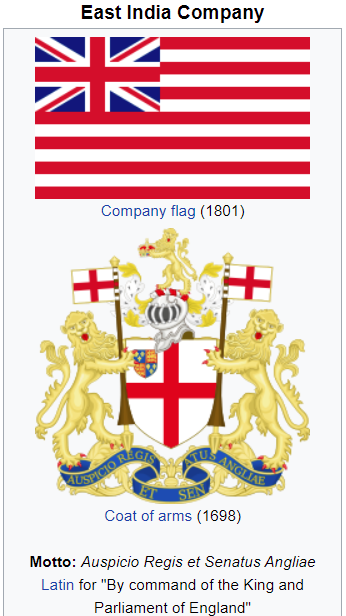
But even if they dominated and oppressed like bullies, these corporate bosses still craved a veneer of respectability and legitimacy — just like Google’s CEO at the innauguration yesterday. So the company got a Coat of Arms, playacting as if it were a royal family or noble clan.

As a royally chartered company, I believe the EIC was automatically entitled to create and use a coat of arms. Here’s the original from the reign of Queen Elizabeth I:

Comments Off on The Google of the early modern era
Guycot 40-shot Chain Pistol
Forgotten Weapons
Published 19 Dec 2016The Guycot chain pistol was the development of two Frenchmen, Henri Guenot and Paulin Gay in 1879. It is chambered for a unique 6.5mm caseless rocket ball type cartridge in which the base of the projectile is hollowed out and contains the propellant powder and a primer. Upon firing, the entirely of the projectile exits, leaving nothing to be extracted or ejected from the chamber. Unfortunately for the Guycot’s military aspirations, this cartridge was far too small and underpowered to attract and serious interest and only a few hundred at most were made. These were divided between several models, including a 25-shot pistol, a 40-shot pistol like this one, and an 80-shot carbine.


