Quotulatiousness

May 20, 2014

India Pale Ale – the first “global” beer

Filed under: Britain, History, India — Tags: , , — Nicholas @ 07:05

The Economist looks back at the history of India Pale Ale, the first truly global beer:

INDIA pale ale (IPA) had a good claim to be the first global beer, before lager took a grip on the world’s tipplers. Now IPA, an amber, hop-laden brew, high in alcohol, is regaining its global footprint. Arguments rage about the origins and history of IPA. Britain’s territories on the Indian subcontinent were generally too hot for brewing. So a couple of hundred years ago, to keep army officers and officials of the East India Company away from the fearsome local firewater, beer was exported from Britain to take its place. Whether a beer already existed that had the characteristics of IPA or whether it was developed for the purpose is a matter of heated debate among beer historians. What is clear is that hops, which act as a preservative as well as a flavouring, combined with a hefty dose of alcohol for added robustness, ensured that the beer survived the long sea journey to India. Indeed, the months jiggling in a barrel onboard seemed only to improve the flavour. The style caught on at home, as the brew seeped onto the domestic market.

IPA’s popularity waned as the brewing industry changed. After the second world war, big brewers in Britain and America bought smaller competitors and flooded the market with bland, mass-market beers as old styles were abandoned in favour of a pint that would not offend anyone. In the 1980s brewing began to change again.

A minor quibble: in the snobby world of the British Raj, it wasn’t company concern for army officers and officials — it was those men being concerned that the troops in company army service or the lower-ranking clerks and functionaries not get too fuddled on local firewater. The officers and officials had their regimental officers’ messes and clubs which catered nearly as well as fancy gentlemens’ clubs in London. No beer for those chaps! Wine, whisky, and gin certainly (and in great supply) but beer was for the sweaty lads in the lower orders.

The beer that craft brewers like making the most is IPA. Artisan beermakers in America adopted old recipes from Britain for their IPAs but gradually began to adapt the brews to their own tastes. The heavy use of hops allows them to show off their skills in blending different flavours. Some parts of America, like Britain, have an excellent climate for growing top-quality hops. The bold flavours and high alcohol content create a beer that has a distinct style and bold taste, yet can come in many shades. The passion for hops in American craft beers has taken on the characteristics of an arms race, as brewers try to outdo each other in hoppiness.

The hop-addiction among craft brewers is well known. In fact, the demand for high quality aromatic hops is threatening to create shortages of the “good stuff” in the immediate future, as more craft brewers enter the market and try to out-hop the Joneses.

May 19, 2014

Exercising your ears – accents in Sherlock

Filed under: Britain, Media — Tags: , , — Nicholas @ 09:16

I’m a fan of the ongoing BBC series Sherlock starring Martin Freeman and Benedict Cumberbatch (or “Cummerband Bandersnatch” as his name seems to cause the yips in some people). At Firestorm over London there’s a brief discussion of British accents in general, and the specific variants in use among the actors in the show:

An introduction to the rich variety of British accents and an analysis of accents used in Sherlock. I explore the distinctive regional accents and of course the ubiquitous BBC pronunciation, what the accents can tell us about the characters. A short, not too serious guide by someone who has no linguistics expertise.

Islands of Contrast

An accent for the purposes of this essay is a manner of pronunciation that is particular to an individual, community or location.

The British Isles are geographically small but the accents that have evolved are incredibly diverse. I grew up in the North West of England where, even though the motorway links are brilliant, travelling a mere 60 miles or so will completely change the accents that you hear.

The most ubiquitous accent in the UK is BBC pronunciation. It used to be called “Received Pronunciation” but that term has fallen out of favour. If you’ve ever watched BBC News or listened to the English programs on the BBC World Service that is the accent I am referring to. This is not a regional accent — although it is more common in South of England. When people in the UK say that someone doesn’t have an accent, they really mean the person uses BBC pronunciation.

I haven’t been back to visit England in several years, but on my last few visits the number of times I heard RP seemed fewer than any regional accent everywhere we went. Even the BBC News presenters all seemed to have regional accents rather than speaking in RP. I’m originally from Middlesbrough, which boasts one of the least attractive regional accents you’ll ever hear (the closest you’d find would be a Newcastle “Geordie” accent … but less comprehensible). It’s been so long since I lived there that I now have trouble understanding it myself…

Many fans have identified Mycroft Holmes’ accent as “posh”. There is not an official “posh accent” — and even if there was Mycroft Holmes does not have it.

Posh is a very subjective description. Where I grew up anyone who didn’t have a regional accent was “posh”. After coming to University in the South, I have realised that BBC pronunciation is not considered “posh” but “standard”. Posh was defined as the rather over-exaggerated accent people often use to pantomime the rich. There are a small minority of people who have that stereotypical accent but “posh” on its own is not a very good way of describing anyone’s accent.

If we are going to talk about poshness — I believe it’s better to view it as a “gradation of poshness” which is superimposed on BBC pronunciation, rather than a distinct “posh accent”.

BBC pronunciation and the “gradation of poshness” are not good reflectors of social status in today’s society.

Traditionally BBC pronunciation was considered the preserve of the middle classes. It was something that set you apart from the common masses with their regional accents. I wouldn’t say that class has no role in today’s society, but BBC pronunciation itself has become less of a hallmark of class. Many people who would identify themselves as working class do not have a regional accent, whilst the middle-classes are more accepting of regional accents. The BBC has worked hard to introduce presenters with regional accents onto prime time television. Therefore it is hard to judge the social status of a person purely based on how “posh” they sound. Their accent will not always match your expectations of their material circumstances.

[…]

John Watson

John had me rather puzzled but my conclusion is that his accent qualifies as BBC pronunciation but unlike Mycroft or Sherlock, he has not superimposed any of those “upper class” vowels on his pronunciation. For example his “a” vowel sounds are much shorter as evidenced in words such as “pass”. John is a much better presentation of what a great number of people in the UK actually sound like.

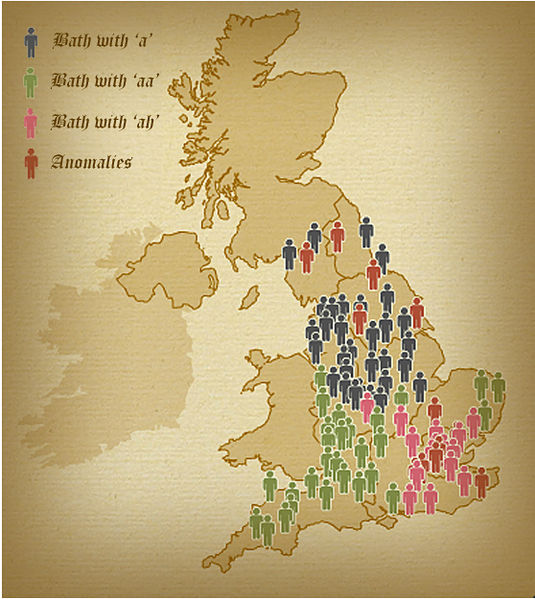
Here is an amusing map of how the “a” vowel varies in pronunciation between different geographic areas:

British pronunciation of the letter a

John fits in very much with the blue group. His rendition of the “a” vowel is still correct and technically BBC pronunciation. However it is considered less “posh” than pronouncing the “a” vowel as “ah”.

His rhythm of speech and accentuations within words may contribute to the overall impression that his accent is different to Sherlock’s. This is true because Sherlock doesn’t have exact BBC pronunciation and neither does John. Though they deviate in different ways I would say their accents overall qualify as BBC pronunciation. It is certainly hard to pinpoint a location for the original of John’s accent.

H/T to ESR, who asked about the Sherlock accents on Google+ (the link to Firestorm was provided in the comments to his post).

May 18, 2014

The Past at Work Railway Mania (1980)

Filed under: Britain, History, Railways — Tags: , , — Nicholas @ 12:33

Uploaded on 25 Oct 2011

Part 8 of the 8-part series “The Past at Work”
Written & Presented by Anthony Burton
First broadcast 13th May 1980 (BBC 2)
See also: http://www.bbc.co.uk/archive/steamtrains/7309.shtml and http://www.imdb.com/title/tt1718607/episodes

H/T to Eric Kirkland for the link.

May 17, 2014

Even the Times thinks the latest climate scandal is damaging to the cause

Filed under: Britain, Environment, Science — Tags: , , — Nicholas @ 09:22

The Times article titled “Scientists in Cover Up of ‘Damaging’ Climate View” is behind the usual paywall, but Steven Hayward has a longer excerpt that gets the key element across:

Research which heaped doubt on the rate of global warming was deliberately suppressed by scientists because it was “less than helpful” to their cause, it was claimed last night.

In an echo of the infamous “Climategate” scandal at the University of East Anglia, one of the world’s top academic journals rejected the work of five experts after a reviewer privately denounced it as “harmful”.

Lennart Bengtsson, a research fellow at the University of Reading and one of the authors of the study, said he suspected that intolerance of dissenting views on climate science was preventing his paper from being published. “The problem we now have in the climate community is that some scientists are mixing up their scientific role with that of a climate activist,” he added.

Professor Bengtsson’s paper challenged the finding of the UN’s Intergovernmental Panel on Climate Change (IPCC) that the global average temperature would rise by up to 4.5C if greenhouse gases in the atmosphere were allowed to double. It suggested that the climate might be much less sensitive to greenhouse gases than had been claimed by the IPCC in its report last September, and recommended that more work be carried out “to reduce the underlying uncertainty”.

[…]

Professor Bengtsson, the former director of the Max Planck Institute for Meteorology in Hamburg, said he accepted that emissions would increase the global average temperature but the key question was how quickly.

He added that it was “utterly unacceptable” to advise against publishing a paper on the ground that the findings might be used by climate sceptics to advance their arguments. “It is an indication of how science is gradually being influenced by political views. The reality hasn’t been keeping up with the [computer] models. Therefore, if people are proposing to do major changes to the world’s economic system we must have much more solid information.”

The genesis of George MacDonald Fraser’s Flashman

Filed under: Books, Britain, History, Media — Tags: — Nicholas @ 08:59

In the Telegraph, Harry Mount has the story of how George MacDonald Fraser came to create his most memorable fictional character, Harry Flashman:

“I had written what might be called an introductory chapter about this boozy old veteran pouring out his soul on Mafeking Night to some anonymous listener; I think, but I’m not sure, that I called the veteran Flashman, having in mind Thomas Hughes’s character. Anyway, I discarded the introduction, which wasn’t good, and it has probably been destroyed, unless it’s in a trunk somewhere,” MacDonald Fraser wrote in the unpublished account.

“‘How did you get the idea?’ is a question I have been asked ad nauseam, and the answer is that I don’t know. I read Tom Brown’s Schooldays as a child, and possibly on later occasions; I found Flashman the most striking character in the book, and suspect that Hughes did, too — and probably wrote Flashman out of the story because he realised that, if he didn’t, the deplorable lout would take over the book.”

“Possibly it was simply boyhood recollection that prompted it. I certainly don’t remember thinking, ‘Flashman – eureka!’ Anyway, somewhere around April ’66, when I was 41 years old, I sat down to write Flashman, working in the kitchen after I came home from work in the small hours.”

“I began where Hughes had left off, in the style of a memoir; since I knew from internal evidence in Tom Brown the date of Flashman’s expulsion from Rugby, and, since I had determined that he was the kind of rotter whose career was bound to lie in the army, various plot points suggested themselves at once — Lord Cardigan, the First Afghan War, etc. But I had no idea, when I started, of any coherent storyline: Flashman would be a cad and a coward, but I would just plunge ahead and see where my imagination took me.”

Fraser’s Flashman and the following books will tell you more about British history in the Victorian era than you’d learn in a proper history undergrad program, but no university course could be as entertaining as Flashman’s recounting of episodes in his own career. One of the books (and in my opinion the weakest) was turned into a movie, but it didn’t do well enough at the box office, so no more were made. I doubt that a modern movie could be made, as Flashman has all the vices of “his” era, most of which are now so politically incorrect that no studio would dare touch them.

QotD: Modern echoes of 1914

Filed under: Europe, History, WW1 — Tags: , , , , — Nicholas @ 00:01

Though the debate on this subject is now nearly a century old, there is no reason to believe that it has run its course.

But if the debate is old, the subject is still fresh — in fact it is fresher and more relevant now than it was twenty or thirty years ago. The changes in our own world have altered our perspective on the events of 1914. In the 1960s-80s, a kind of period charm accumulated in popular awareness around the events of 1914. It was easy to imagine the disaster of Europe’s ‘last summer’ as an Edwardian costume drama. The effete rituals and gaudy uniforms, the ‘ornamentalism’ of a world still largely organized around hereditary monarchy had a distancing effect on present-day recollection. They seemed to signal that the protagonists were people from another, vanished world. The presumption stealthily asserted itself that if the actors’ hats had gaudy green ostrich feathers on them, then their thoughts and motivations probably did too.

And yet what must strike any twenty-first-century reader who follows the course of the summer crisis of 1914 is its raw modernity. It began with a squad of suicide bombers and a cavalcade of automobiles. Behind the outrage at Sarajevo was an avowedly terrorist organization with a cult of sacrifice, death and revenge; but this organization was extra-territorial, without a clear geographical or political location; it was scattered in cells across political borders, it was unaccountable, its links to any sovereign government were oblique, hidden and certainly very difficult to discern from outside the organization. Indeed, one could even say that July 1914 is less remove from us — less illegible — now than it was in the 1980s. Since the end of the Cold War, a system of global bipolar stability has made way for a more complex and unpredictable array of forces, including declining empires and rising powers — a state of affairs that invites comparison with the Europe of 1914. These shifts in perspective prompt us to rethink the story of how war came to Europe. Accepting this challenge does not mean embracing a vulgar presentism that remakes the past to meet the needs of the present but rather acknowledging those features of the past of which our changed vantage point can afford us a clearer view.

Among these is the Balkan context of the war’s inception. Serbia is one of the blind spots in the historiography of the July Crisis. The assassination at Sarajevo is treated in many accounts as a mere pretext, an event with little bearing on the real forces whose interaction brought about the conflict. In an excellent recent account of the outbreak of war in 1914, the authors declare that ‘the killings [at Sarajevo] by themselves caused nothing. It was the use made of this event that brought the nations to war.’ The marginalization of the Serbian and thereby of the larger Balkan dimension of the story began during the July Crisis itself, which opened as a response to the murders at Sarajevo, but later changed gear, entering a geopolitical phase in which Serbia and its actions occupied a subordinate place.

Our moral compass has shifted, too. The fact that Serbian-dominated Yugoslavia emerged as one of the victor states of the war seemed implicitly to vindicate the act of the man who pulled the trigger on 28 June — certainly that was the view of the Yugoslav authorities, who marked the spot where he did so with bronze footprints and a plaque celebrating the assassin’s ‘first steps into Yugoslav freedom’. In an era when the national idea was still full of promise, there was an intuitive sympathy with South Slav nationalism and little affection for the ponderous multinational commonwealth of the Habsburg Empire. The Yugoslav wars of the 1990s have reminded us of the lethality of Balkan nationalism. Since Srebrenica and the siege of Sarajevo, it has become harder to think of Serbia as the mere object or victim of great power politics and easier to conceive of Serbian nationalism as an historical force in its own right. From the perspective of today’s European Union we are inclined to look more sympathetically — or at least less contemptuously — than we used to on the vanished imperial patchwork of Habsburg Austria-Hungary.

Christopher Clark, The Sleepwalkers: How Europe Went To War In 1914, 2012.

May 14, 2014

Russia, the United States, and the ISS – an opening for SpaceX

Filed under: Europe, Russia, Space, USA — Tags: , , — Nicholas @ 11:48

Motherboard‘s Jason Koebler says that Russia’s threat to ban companies from shipping rocket engines to the US represents a great chance for SpaceX to cash in:

Russia just announced plans to shut down the International Space Station in 2020, and prohibited companies in the country from selling engines to Lockheed Martin and Boeing for military launch purposes. If this is more than just posturing, there’s at least one takeaway: SpaceX is about to get paid.

It was just a month ago that NASA Administrator Charles Bolden said that Russia would never ban the United States from the ISS, and that his “contingency plan” for getting astronauts to and from the ISS was to continue working with Russia as normal until an American company is ready to fly manned flights to the ISS in roughly three years.

[…]

And that brings us to SpaceX. The company stands to gain greatly from both bits of news Rogozin announced today.

The company recently won (and then subsequently lost) an injunction to force the United States Air Force to compete for military satellite launch contracts. If Boeing and Lockheed Martin are blocked from buying Russian engines for their Atlas V and Delta IV from the other side (it’s worth noting that both countries have threatened to ban the companies from buying Russian engines), the Air Force once again has incentive to look at SpaceX as a legitimate option to launch military satellites.

The Air Force’s contract with the Boeing-Lockheed cooperative United Launch Alliance is worth roughly $70 billion through 2030 — SpaceX could potentially swoop in and take some of that amid the uncertainty.

The rich boozehound’s guide to globetrotting

Filed under: Britain, Business, Randomness — Tags: , , , , — Nicholas @ 11:07

Got lots of money burning a hole in your bank account? Want to show off just how filthy stinking rich you are? Like spending your however-earned-or-inherited loot on fancy booze? Then there’s a million-dollar booze vacation you’ll probably like:

UK-based travel company Holidaysplease is offering a luxury world drinking tour in which you can learn and demonstrate the art of conspicuous consumption.

Starting and ending in London — although pickups are possible elsewhere — the ultimate hedonistic, money-no-object vacation takes in the world’s best hotels, swankiest restaurants and most exclusive bars in 10 upmarket destinations.

En route, drinkers take in the universe’s most ludicrously expensive niche beverages.

In Monaco, members of the bottomless budget brigade will mingle with other surreally high net individuals at the high end Hotel Hermitage Monte-Carlo and party at Flavio Briatore’s Billionaire Sunset Lounge in the hotel Fairmont Monte Carlo, quaffing selections from the $565,000 “in-house Armand de Brignac Dynastie” champagne collection.

It all comes complete with fawning waiters and diamond-filled ice buckets.

“We spend the first three nights in London in the five-star Corinthia Hotel and hang out in the Playboy Club, Park Lane, Mayfair,” says Byron Warmington of Holidaysplease.

Hef once said: “Life needs to be lived with a sense of style.”

As a taste of things to come, surrounded by grinning Bunnies, guests will sample the glam high life and swallow what’s reported to be the second most expensive drink in the history of mixology.

The Legacy cocktail includes 1788 Clos de Griffier Vieux Cognac, which comes in at $21,000 for a 40 ml shot.

It also includes ancient Kummel liqueur, vintage orange Curacao and four dashes of circa 1900 Angostura bitters.

May 12, 2014

Thumbnail sketch of Russian history

Filed under: Europe, History, Humour, Russia — Tags: , — Nicholas @ 14:10

P.J. O’Rourke says we need to take the long view in regard to Vladimir Putin, and provides a rough history of Russia to back up his contention:

In the sixth century A.D. Russia was the middle of nowhere in the great Eurasian flat spot bounded by fuck-all on the north and east, barbarian hordes and the remains of the Byzantine Empire on the south, and the Dark Ages on the west.

Wandering around in here, up and down the watershed of the Dnieper River from Novgorod (which hadn’t been built yet) to Kiev (ditto) were disorganized tribes of Slavic pastoral herdsmen herding whatever was available, pastorally. They were harried by Goths, Huns, Khazars, and other people who had the name and nature of outlaw motorcycle gangs long before the motorcycle was invented.

The original Russian state, “Old Russia,” was established at Novgorod in A.D. 862 by marauding Vikings. They’d set off to discover Iceland, Greenland, and America, took a wrong turn, and wound up with their dragon boat stuck on a mud bar in the Dnieper. (Historians have their own theories, involving trade and colonization, but this sounds more likely.)

The first ruler of Old Russia was the Viking Prince Ryurik. Imagine being so disorganized that you need marauding Vikings to found your nation — them with their battle axes, crazed pillaging, riotous Meade Hall feasts, and horns on their helmets. (Actually, Vikings didn’t wear horns on their helmets — but they would have if they’d thought of it, just like they would have worn meade helmets if they’d thought of it.) Some government it must have been.

Viking Prince Ryurik: “Yah, let’s build Novgorod!”

Viking Chieftain Sven: “Yah, so we can burn it down and loot!”

May 9, 2014

Shakespeare: Original pronunciation

Filed under: Britain, History, Media — Tags: , , , — Nicholas @ 13:04

Jon, my former virtual landlord sent along an interesting link:

An introduction by David and Ben Crystal to the ‘Original Pronunciation’ production of Shakespeare and what they reveal about the history of the English language.

May 7, 2014

Peak inequality in England – about 200 years ago

Filed under: Books, Britain, Economics, History — Tags: , , , — Nicholas @ 10:18

An interesting article that starts and ends talking about Thomas Piketty’s new book, but in the middle goes a long way to explain what happened to English aristocracy over the last few hundred years:

Extravagances like the stately homes of England made economic sense before the 19th century because the relative wages of servants and construction workers mostly fell from 1500 to 1800 as the supply of English workers slowly recovered in size from the Black Death of the 1340s.

But, outside of economic theory, the rich have often tended to get poorer, especially when they spend more than they make. It’s a common theme in English literature (Evelyn Waugh’s A Handful of Dust) and television (Downton Abbey). For instance, by the time of Winston Churchill’s birth in 1874, the English ultra-rich weren’t getting richer.

[…]

The long agricultural depression of 1873-1896 meant the great houses of England began falling apart. Wings had to be shut as servants found higher paying jobs in factories. Repairs could not be paid for.

The usual solutions were to first auction off the art collection, then marry American heiresses, as in Downton Abbey, where Countess Cora, played by Elizabeth McGovern, is from the Chicago Levinsons. Winston’s mother Jenny was from the Jeromes of Wall Street.

[…]

Servants had steadily become more expensive in England. One reason was the increase in jobs elsewhere in a modernizing economy. On Downton Abbey, to illustrate, a maid applies for a job in town as a secretary, which is a much better post.

A forgotten reason, though, was that the massive emigration from the British Isles reduced the supply of workers and thus raised their wages. While Tony Blair’s Labor Government liked to claim that Britain had always been a nation of immigrants, it was in truth a nation of emigrants. Today, there are perhaps two or even three times as many people descended from the British Isles living in the United States, Canada, Australia, New Zealand, South Africa, and Argentina as there are in Britain and Ireland. Without all that outflow, wages in Britain would be lower and land prices astronomical.

H/T to Kathy Shaidle for the link.

May 6, 2014

Rick Wakeman on the best financial advice he ever received

Filed under: Britain, Business, Media — Tags: , , — Nicholas @ 09:17

Lorraine McBride talks to Rick Wakeman about his career.

Has there ever been a time when you worried how you were going to pay the bills?

Yes, there have always been times like that. In the late Sixties, when I played at the Top Rank ballroom, being an organist meant carting my organ around to sessions, which cost two thirds of my earnings, on top of running a car, which was when I learnt the word “expenses”.

My rent cost £8 a week and I can remember being really short. In 1970, I was up in London looking for session work and Marc Bolan who was a great mate, gave me a session for Get It On. All I had to do was a glissando on the piano. I said to him afterwards, “You could have done that,” and he replied, “Well, you want your rent money don’t you?” Tough times, but when I joined Yes, I went from £18 a week to £50 a week.

Yes made a fortune, what did you spend it on?

We were all told to go out and buy a nice house, which was an eye-opener because I’d only known a two-up, two-down and a Ford Anglia. Suddenly we were talking five-bed, des-res. I remember looking around one house for sale in Gerrards Cross and the lady said, “This is the breakfast room.” I said: “What, just for breakfast?” because it was just a different world.

Lots of rock stars get ripped off, did you learn any tough lessons?

Yes, everybody in the business did. One thing you start to learn, usually too late, is that being top of the tree doesn’t last forever. You drop down a few branches and find your position but you set yourself a lifestyle that requires “top of the tree” earnings to pay for it. Then of course, you have the unexpected events like a divorce of which I’ve had three.

Suddenly you grow up very quickly and certainly when a problem hits, you back-pedal to try and work out how to sort it out. I was lucky. I had a very good accountant who helped tremendously and I learnt to listen but it took a long time. It probably wasn’t until the turn of the millennium when I found myself in yet another divorce, when the situation seems unbelievable, you really start to listen.

[…]

What’s been your best financial move?

Undoubtedly listening to David Bowie who said: “Be your own man and don’t listen to people who don’t know a hatchet from a crotchet and try to fulfil their own ideas through you because they haven’t got any.” I wanted to do Journey to the Centre of the Earth with an orchestra but there wasn’t enough money from the record company. I ended up mortgaging my house, selling everything I owned. I begged, borrowed and stole to do it. But the record company didn’t want it and I faced losing everything because I was so heavily in debt.

Eventually my record company in America loved it, insisted it was released and it sold 15 million copies and that really taught me to be my own man. Spending money I didn’t have was simply my best financial decision because if I hadn’t done it, 40 years on, I wouldn’t be doing my shows now.

What is Canada’s interest in Ukraine?

Filed under: Cancon, Europe, Military, Russia — Tags: , , , — Nicholas @ 08:41

In the Globe and Mail, J.L. Granatstein spells out why the situation in Ukraine deserves the attention of the Canadian government:

Canada has no direct economic or political interest in Ukraine. Canadians of Ukrainian descent surely do, but Canada’s national interests cannot and should not be determined by components of our multicultural society. Our national interests are, first and foremost, the protection of our people, territory, and national unity, co-operation with our great neighbour and economic growth and well-being.

But there is another precept in any list of Canadian national interests – co-operation with our allies in the defence and advancement of freedom and democracy. Canadians have fought wars for that principle in the past, and more than 100,000 Canadians have died for it. The Russian threat to Ukraine surely is a challenge to this Canadian national interest.

Nothing here suggests that Ukraine is a perfect democracy threatened by an expansionist Russia. The Kiev government has been a badly run kleptocracy, corrupt, and incompetent, as the pathetic present state of its military suggests. The toppling of the regime of Viktor Yanukovych was a populist, largely democratic revolt, led by democratic forces but with a sprinkling of far right nationalist groups. The presence of these quasi-fascist and anti-Semitic elements provided the Vladimir Putin government in Moscow with the pretext it needed to rescue Crimea from the clutches of anti-Russia forces and to claim, as it backs pro-Moscow elements in eastern Ukraine, that it is supporting the legitimacy of the Yanukovych government.

[…]

The Canadian government has not received much praise for its tough-talking stance. Though tepidly supported by the Opposition parties, Ottawa’s position has widely been seen as pandering to the large Ukrainian-Canadian vote, and many on the left and right have attacked the ultra-nationalist tilt of the “democratic” groups in Ukraine or called for isolationism to be the only proper Canadian stance. Their strictures may even be correct, and certainly none can deny that the Harper government plays domestic ethnic politics with skill.

But there remains that Canadian national interest in supporting freedom. Ukraine is no democracy but it might become one; it deserves the opportunity to find its place as part of the European Union, as a neutral state trading both east and west, or even as a federation with its eastern provinces leaning to Russia. But whatever the choice, that ought to be made by Ukrainians, not by Moscow’s agitators. The Canadian political response, while not exactly measured in its decibel count, has been appropriate, and so too are the Canadian and allied military moves. Mr. Putin has behaved like the KGB thug he was and remains, and the caution sign needed to be displayed lest he look beyond Ukraine.

May 5, 2014

Dien Bien Phu and the end of French Indochina

Filed under: Asia, France, History, Military — Tags: , , , — Nicholas @ 07:16

BBC News Magazine looks back 60 years to the end of French colonial government and the military defeat at Dien Bien Phu which made it inevitable:

Sixty years ago this week, French troops were defeated by Vietnamese forces at Dien Bien Phu. As historian Julian Jackson explains, it was a turning point in the history of both nations, and in the Cold War — and a battle where some in the US appear to have contemplated the use of nuclear weapons.

“Would you like two atomic bombs?” These are the words that a senior French diplomat remembered US Secretary of State John Foster Dulles asking the French Foreign Minister, Georges Bidault, in April 1954. The context of this extraordinary offer was the critical plight of the French army fighting the nationalist forces of Ho Chi Minh at Dien Bien Phu in the highlands of north-west Vietnam.

The battle of Dien Bien Phu is today overshadowed by the later involvement of the Americans in Vietnam in the 1960s. But for eight years between 1946 and 1954 the French had fought their own bloody war to hold on to their Empire in the Far East. After the seizure of power by the Communists in China in 1949, this colonial conflict had become a key battleground of the Cold War. The Chinese provided the Vietnamese with arms and supplies while most of the costs of the French war effort were borne by America. But it was French soldiers who were fighting and dying. By 1954, French forces in Indochina totalled over 55,000.

[…]

Saturday 3 April 1954 has gone down in American history as “the day we didn’t go to war”. On that day Dulles met Congressional leaders who were adamant they would not support any military intervention unless Britain was also involved. Eisenhower sent a letter to the British Prime Minister Winston Churchill warning of the consequences for the West if Dien Bien Phu fell. It was around this time, at a meeting in Paris, that Dulles supposedly made his astonishing offer to the French of tactical nuclear weapons.

In fact, Dulles was never authorised to make such an offer and there is no hard evidence that he did so. It seems possible that in the febrile atmosphere of those days the panic-stricken French may simply have misunderstood him. Or his words may have got lost in translation.

Dien Bien Phu map

“He didn’t really offer. He made a suggestion and asked a question. He uttered the two fatal words ‘nuclear bomb’,” Maurice Schumann, a former foreign minister, said before his death in 1998. “Bidault immediately reacted as if he didn’t take this offer seriously.”

According to Professor Fred Logevall of Cornell University, Dulles “at least talked in very general terms about the possibility, what did the French think about potentially using two or three tactical nuclear weapons against these enemy positions”.

Bidault declined, he says, “because he knew… that if this killed a lot of Viet Minh troops then it would also basically destroy the garrison itself”.

In the end, there was no American intervention of any kind, as the British refused to go along with it.

May 4, 2014

The Battle of the Atlantic

Filed under: Cancon, Germany, History, Military, WW2 — Tags: , , , — Nicholas @ 00:01

On the first Sunday in May every year, we remember the Battle of the Atlantic, one of the major contributions to allied victory in World War 2, and the Canadian part in that multi-year battle:

The Battle of the Atlantic campaign was fought at sea from 1939 to 1945 with the strategic outcome being sea-control of the North Atlantic Ocean. It was the longest, largest, and arguably the most complex campaign of the Second World War. Over the course of 2,075 days, Allied naval and air forces fought more than 100 convoy battles and perhaps 1,000 single ship actions against the submarines and warships of the German and Italian navies. Enemy vessels targeted mainly the convoys of merchant ships transporting material and troops vital to safeguarding the freedom of the peoples of North America and Europe.

On any given day, up to 125 merchant vessels were sailing in convoy across the North Atlantic. It was during these treacherous, stormy crossings that Canada’s navy matured and won the mantle of a professional service. Our navy escorted more than 25,000 merchant vessels across the Atlantic. These ships carried some 182,000,000 tonnes of cargo to Europe — the equivalent of eleven lines of freight cars, each stretching from Vancouver to Halifax. Without these supplies, the war effort would have collapsed.

Thousands of Canadian men and women – members of the Royal Canadian Navy (RCN), the Merchant Navy (MN) and the Royal Canadian Air Force (RCAF), mostly volunteers from small town Canada – had to face situations so perilous they are difficult for us to imagine. As Canadians, we should be proud of their courage.

Although largely unprepared for war in 1939, Canada’s navy grew at an unparalleled rate eventually providing 47 percent of all convoy escorts. Rear Admiral Leonard Murray, who as Commander-in-Chief Northwest Atlantic from March 1943, would become the only Canadian to hold an Allied theatre command during the war and direct the convoy battles out of his headquarters in Halifax.

During the Second World War the RCN grew from 13 vessels to a strength of nearly 100,000 uniformed men and women and nearly 400 vessels, the fourth largest navy in the world. It had suffered 2,210 fatalities, including six women, and had lost 33 vessels. It had destroyed or shared in the destruction of 33 U-Boats and 42 enemy surface craft. In partnership with Canada’s maritime air forces and merchant navy, it had played a pivotal and successful role in the contest for seaward supremacy.

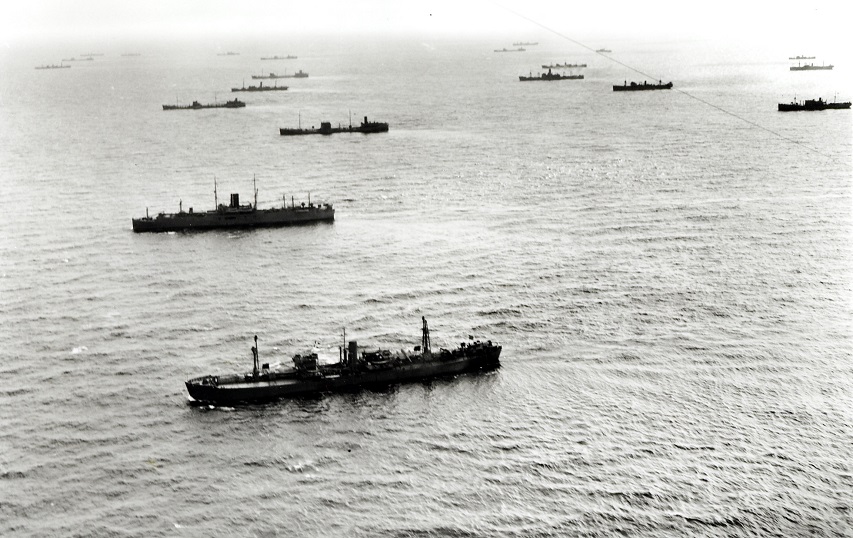
Merchant ships of Convoy HX188 en route to Britain. Photo: Library and Archives Canada PA-115006

Merchant ships of Convoy HX188 en route to Britain.
Photo: Library and Archives Canada PA-115006

« Newer PostsOlder Posts »

Powered by WordPress