Quotulatiousness

July 26, 2014

Royal Navy commander may have had affair with crew member

Filed under: Britain, Military — Tags: , — Nicholas @ 11:04

From the Guardian, a report on a current investigation into a Royal Navy officer who may have had an affair with a subordinate:

The first female commander of a major Royal Navy warship has left her vessel after claims she had an affair with a shipmate.

Commander Sarah West, 42, took charge of Type 23 frigate HMS Portland in May 2012.

It is understood she has left the ship while the navy investigates the claims. Her second-in-command has taken over the running of the vessel, but West is still the commanding officer.

The navy inquiry will consider whether West breached the armed forces’ code of social conduct, which governs personal relationships within the military. Possible punishments for a breach include a formal warning, reassignment and even termination of service.

A Royal Navy spokesman said: “We are aware of an allegation of a breach of the code of social conduct on board HMS Portland, which we are treating seriously.

“Anyone who is found to fall short of the Royal Navy’s high standards can expect to face appropriate action. It would be inappropriate to comment further.”

West made headlines when she became the first female commander of a frontline warship in the 500-year history of the service.

But earlier this year she explained how work commitments made it difficult to have a relationship.

QotD: French “ultra-liberalism”

The French press, media and intellectuals castigate ad nauseam what they call the ‘ultra-liberalism’ of the present-day western world: and their characterization, as intellectually lazy as it is inaccurate, now goes virtually by default. Very few are the commentators who see through its inaccuracy. That a country whose public sector accounts for more than half of economic activity, and which is as highly-administered as France (and, it must be said, often well-administered, for who would not rather go on the Paris Metro than the New York Subway?), cannot plausibly be described as ‘ultra-liberal,’ ought to be perfectly obvious even on the most casual reflection, but alas it is not. If France is ultra-anything it is ultra-corporatist, but even that would be an exaggeration. And so present discontents are laid at the door of ultra-liberalism, though in fact a considerable proportion of the resentments and discontents of the young who approve of M’Bala M’Bala are attributable to the rigidity of the French labor market, which is caused precisely by an illiberal nexus of protections and restrictions.

The problem, then, is not ultra-liberalism but insufficient liberalism. The difference between France and other western countries, incidentally, is one of degree and not of type, though even degree can be important: illiberalism in the French labor market has in a matter of a few years turned London into one of the largest French-speaking cities in the world.

Theodore Dalrymple, “Illusions of Control in the Omnicompetent French State”, Library of Law and Liberty, 2014-01-07

July 23, 2014

Closing the Eastern Ukraine pocket

Filed under: Europe, Military, Russia — Tags: , , , — Nicholas @ 10:28

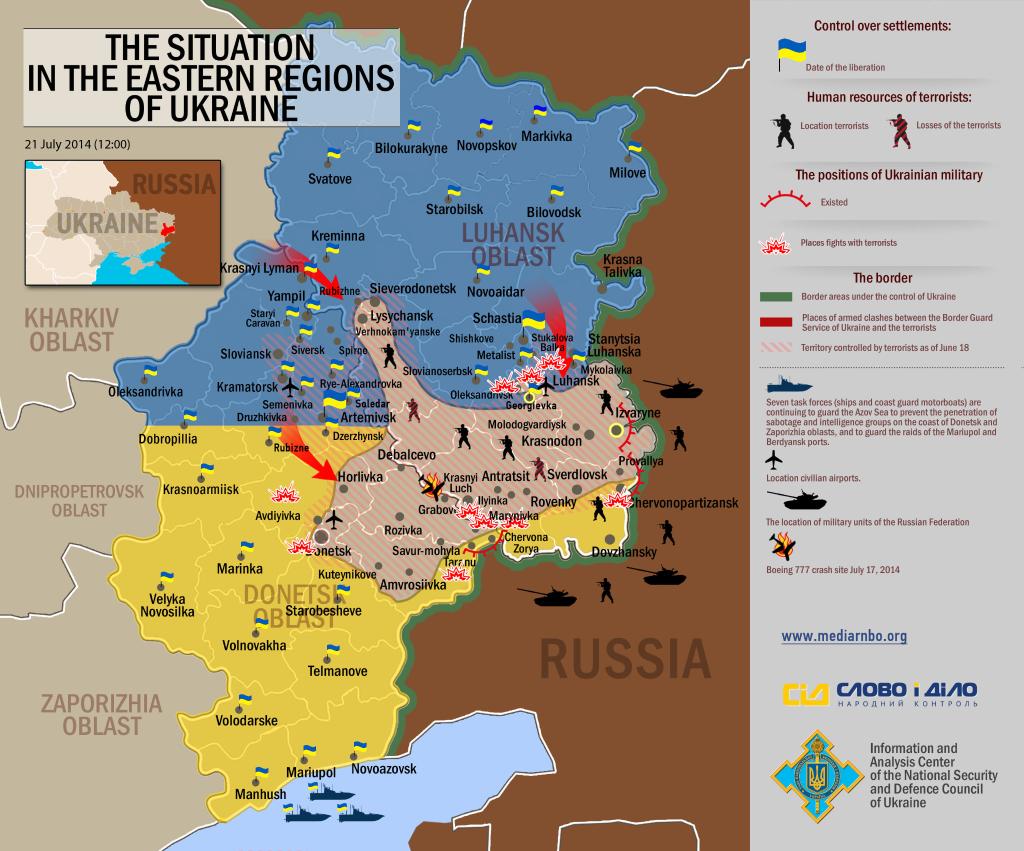
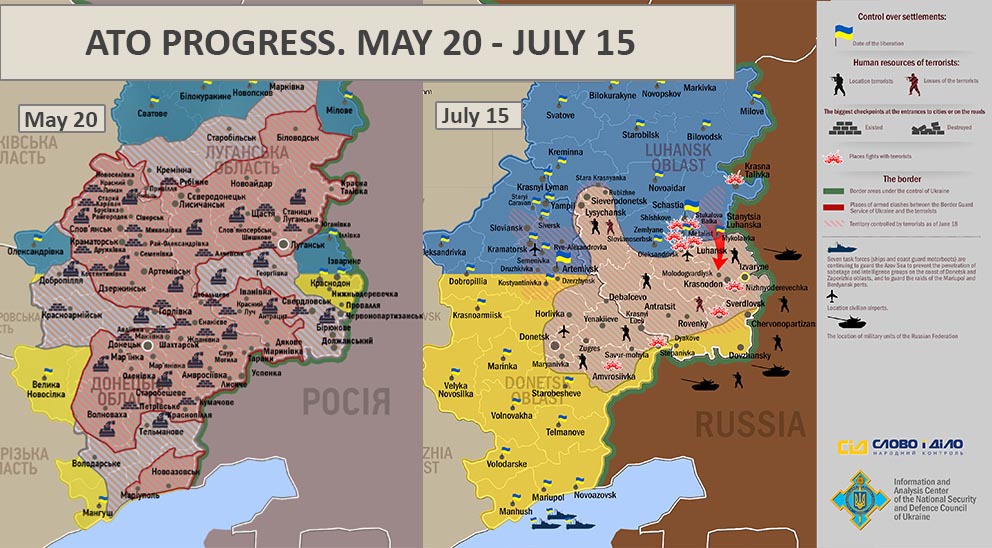
CDR Salamander links to a recent Ukrainian report that seems to show how far the Ukraine forces have come since May in reclaiming territory from the “separatists”:

Click to see full-size image

Click to see full-size image

Look at what has happened in the last two months.

1. Ukraine secured its maritime territory.
2. Ukraine managed to re-establish control over most of its borders – though in a thin salient in some places. Not firm control as we know traffic is getting through, but at least partial control to the point they are willing to claim it.
3. They are pushing to widen the salient in the south while increasing its SE bulge, pushing north along the Russian border.
4. From the north, they are pushing south along the Russian border.
5. Yes kiddies, we have a classic pincer movement to envelope a pocket of the enemy, nee – a double envelopment at that. As a matter of fact, a secondary double envelopment is about to take place in that middle thumb centered on Lysychansk – or at least there is an opportunity for one.

Cut off the Lysychansk based separatists there while at the same time cutting off their unopposed access to the Russian border – and then you can destroy the pro-Russian separatists piecemeal at your leisure.

A quick Google search for “ATO progress map” also turned up this map posted to Twitter a couple of days ago by Viktor Kovalenko:

Click to see full size image

Click to see full size image

As the original CDR Salamander post points out, these are based on claims by one side so apply whatever filters you feel are needed to counteract any PR or propaganda bias.

July 22, 2014

What happened to the top universities outside the Anglosphere?

Filed under: Europe, France, Germany, History, Politics, USA, WW2 — Tags: , — Nicholas @ 08:29

Steve Sailer has an interesting take on the rise of the top universities in the Anglosphere:

The reality is that the top U.S. (and British) universities have been winning the global competition for talent since the middle of the 20th Century. Look at Nobel Prizes. It wasn’t always like this. Go back to the summer of 1914 and the best research universities tended to be German, with other Continental countries in competition.

What happened to bring about Anglo-American dominance of universities?

I’m sure there are many reasons, but I want to fixate on just two. Namely, we won the Big Ones: WWI and WWII. In the postwar era, the losers, such as Germany and Austria (1918 and 1945), Italy (1943) and France (1940) smashed up their great colleges for being epitomizations of anti-democratic elitism.

The Continentals converted their famous universities to open admissions with virtually no tuition: giant lecture halls with a few thousand students taking notes or dozing.

The French government, not being stupid, kept some small, low profile, ultra-elitist Écoles to train the people who actually run France, while trashing grand old names like the Sorbonne. Piketty, for example, did his undergrad at the École normale supérieure, which is immensely prestigious in the right circles in France, but us big dumb Americans hardly know about it because it only has 600 undergrads. And few Tiger Moms in Seoul, Shanghai, or Mumbai care about it either.

For a French culture that believes itself normally superior, this is annoying.

In contrast, the winning Americans poured even more money into Harvard and Yale. When 1968 happened, only CCNY in the U.S. was dumb enough to fall for the reigning ideology rather than just give it lip service. Instead, Harvard devoted ample resources to modeling admissions and perfected a system of affirmative action for buying off complainers (see Robert Klitgaard’s 1985 book Choosing Elites) without damaging Harvard as the prime pipeline to Wall Street.

Similarly, Oxford and Cambridge survived the Socialist governments with elitist prestige largely intact, mostly because Britain, though almost ruined by the expense, was on the winning side in WW I/II. And winning isn’t everything, it’s the only thing.

July 21, 2014

QotD: Algis Budrys on Hitler’s impact on audiences

Filed under: Europe, Germany, History, Quotations — Tags: , , — Nicholas @ 06:56

Algirdas Jonas Budrys was born in 1931 in Lithuania, but he didn’t stay there long. His father was an official in Lithuania’s diplomatic corps and while A J was still small the family was posted to Konigsberg in the German province of East Prussia. A J, who had just about got a good handle on the Lithuanian language, began to learn German. His adult memories of East Prussia — which, like the rest of Germany, had been Nazified with the accession of Adolf Hitler a few years earlier — were troublesome.

He particularly recalled Hitler himself parading right past the Budrys apartment when he was five, he told Mark Williams in an interview shortly before he died. “After the Hitlerjugend walked through, Hitler came by in an open black Mercedes with his arm propped up.” The crowds made “indescribable” sounds. Men lost control of their bowels and had to race for the bushes or writhed and rolled on the ground.

Fred Pohl, “A J”, The Way The Future Blogs, 2010-07-26

July 20, 2014

QotD: The Kaiser and the genesis of the High Seas Fleet

Filed under: Europe, Germany, History, Military, Quotations — Tags: , — Nicholas @ 00:01

The 1890s were […] a period of deepening German isolation. A commitment from Britain remained elusive and the Franco-Russian Alliance seemed to narrow considerably the room for movement on the continent. Yet Germany’s statesmen were extraordinarily slow to see the scale of the problem, mainly because they believed that the continuing tension between the world empires was in itself a guarantee that these would never combine against Germany. Far from countering their isolation through a policy of rapprochement, German policy-makers raised the quest for self-reliance to the status of a guiding principle. The most consequential manifestation of this development was the decision to build a large navy.

In the mid-1890s, after a long period of stagnation and relative decline, naval construction and strategy came to occupy a central place in German security and foreign policy. Public opinion played a role here — in Germany, as in Britain, big ships were the fetish of the quality press and its educated middle-class readers. The immensely fashionable “navalism” of the American writer Alfred Thayer Mahan also played a part. Mahan foretold in The Influence of Sea Power upon History (1890) a struggle for global power that would be decided by vast fleets of heavy battleships and cruisers. Kaiser Wilhelm II, who supported the naval programme, was a keen nautical hobbyist and an avid reader of Mahan; in the sketchbooks of the young Wilhelm we find many battleships — lovingly pencilled floating fortresses bristling with enormous guns. But the international dimension was also crucial: it was above all the sequence of peripheral clashes with Britain that triggered the decision to acquire a more formidable naval weapon. After the Transvaal episode, the Kaiser became obsessed with the need for ships, to the point where he began to see virtually every international crisis as a lesson in the primacy of naval power.

Christopher Clark, The Sleepwalkers: How Europe Went To War In 1914, 2012.

July 18, 2014

Despite reports, Canada is not “donating” surplus CF-18 fighters to Ukraine

Filed under: Cancon, Europe, Military — Tags: , , — Nicholas @ 07:48

In the Ottawa Citizen, David Pugliese says there’s little chance of any such transaction taking place:

Media in Russia are reporting that Canada will provide for free surplus CF-18 fighter jets to Ukraine’s military. In addition, an offer has been made to provide RCAF personnel to train Ukraine pilots on the aircraft, according to the reports.

Officials with the Department of National Defence officials as well as Defence Minister Rob Nicholson’s spokesperson, however, tell Defence Watch that is not the case.

“This report is false,” said Johanna Quinney, the minister’s spokeswoman.

Unlike the vast inventory of aircraft maintained by the US Air Force, the RCAF does not have thousands of acres of desert littered with functional-but-unused aircraft. Any surplus CF-18 airframes are candidates for cannibalization to keep the rest of the fleet airworthy. This almost certainly means that these aircraft in question are not in a flyable condition, so their immediate military value — to Ukraine or other nations — is close to zero. Add in the required time, labour, and parts to bring them to operational levels and it probably amounts to a negative value.

Update: On Facebook, Chris Taylor points out that there’s a difference between what most militaries might consider surplus and what the Canadian Forces consider surplus:

Canada never retires weapon systems before they become antiques. By Ottawa reckoning, there’s at least 30 years left in the CF-18s. Pay no attention to airframe fatigue or metallurgical studies, these are airy-fairy abstractions that will bend to the will of the PMO.

Russia’s foreign policy just went over the ledge

Filed under: Europe, Media, Military, Russia — Tags: , , , , — Nicholas @ 07:24

Tom Nichols discusses what the destruction of Malaysian Airlines flight 17 means for Russia:

Here’s what the shootdown of Malaysian Airlines Flight 17 means: Russia, with Vladimir Putin at the wheel, just drove off the edge of a cliff.

Now, by this I don’t mean that the United States and the European Union are going to charge in with a new round of sanctions, provide lethal aid to Ukraine, patrol the skies of Ukraine, or anything of that nature. The West didn’t react in time, or with enough resolve, to the initial invasion and partition of Ukraine last spring, and there’s no reason to think our reaction will be any more effective or resolute this time. It would be reassuring to think America and Europe will now fully engage on the problem of Russian aggression, but it’s unlikely.

As far as Russia’s future is concerned, however, it doesn’t matter. The moment Flight 17 exploded was the moment that Putin’s foreign policy officially went over the ledge, and with it his dreams of restored Russian greatness.

Until now, Moscow claimed it was protecting the interests of Russian-speakers in eastern Ukraine. That was nonsense right from the start, but it was nonsense the Americans and Europeans decided they could live with, as galling as it was. (Who, after all, protects the rights of Russians in Russia? Certainly not Putin.) The West looked away as Putin seized Crimea, as we conveniently convinced ourselves that this was some odd ethnic quarrel in which we had no say. Now that a civilian airliner has been blown out of the sky by a Russian missile, however, there can be no further denial that Russia is actively pursuing a major proxy war against its neighbor in the center of Europe, and with a brutality that would make the now-departed marshals of the old Soviet high command smile with approval. This is no longer a war on Ukraine, but a war on the entire post-Cold War international order.

July 17, 2014

Venice as an urban model

Filed under: Europe, History, Humour, Italy — Tags: — Nicholas @ 08:46

James Lileks just spent a few weeks in Venice and he says it’s (still) an astonishing place:

Urbanists often use European cities as a model for everything that’s right and true and good about cities. American cities are spread out, so people have to drive along, instead of standing on a public transport next to a man who is muttering about chemtrails and has the personal funk of a Dumpster outside a urinalysis lab. European cities are compact, with everyone living on top of one another in picturesque piles with the square footage of the average American auto trunk. European cities are Walkable, which is the chief virtue nowadays. Well, ancient Rome was Walkable. A collection of Neolithic huts was Walkable. Apparently American cities are strewn with tacks and rattlesnakes and feature large open pits with spikes on the bottom. No one can walk there.

There’s one city no one seems to hold up as a model, and that’s Venice. I was just there for a while, and it’s an astonishing place — for reasons we can surely adapt here.

One. No cars. It is simple to ban cars from all streets with Venice-style zoning, which ensures that most streets are three feet wide. You couldn’t get Orson Welles down these passageways without greasing both sides and shooting him out of a cannon. There are streets in this town where two people who meet going the opposite way cannot pass, but local customs dictate that the person who is taller gets down on hands and knees and the other person climbs over him. No car can enter the streets of Venice unless you lower it into a plaza with a helicopter.

Two. It is quite walkable, and your journeys will give you that marvelous sense of discovery and surprise the urbanists seek. By which I mean, you will be lost. The maps are no help; you’re on a small street named Contradore Della Caravaggissimo Magiori di Luchese, and the map shows C. del Car.Ma.Lu, if you’re lucky. And it’s in the type that makes the bottom line of an eye chart look like a tabloid headline the day war is declared.

Three. It is better than walkable: it is swimmable, and thus provides an excellent form of exercise. Remarkably, the concept of swimming from your house to work never seems to have been popular, for the same reason most people don’t bike to work: You arrive at the office wet and smelly.

Geddy Lee, wine fan

Filed under: Cancon, France, Media, Wine — Tags: , — Nicholas @ 07:12

I don’t recall a lot of wine references in Rush songs, but perhaps I’m not listening hard enough: Geddy Lee is a huge wine fan and has a recent interview in Terroni Magazine (transcribed by Power Windows).

How long have you been collecting wine?

I was trying to think about that this morning actually, because I knew you’d ask me. I started collecting wine probably in the mid ’80s but not in a serious way. It wasn’t until the late ’80S that I got more serious about it.

I read that you built a modest cellar in your home but your collection quickly outgrew that one so you had to construct a second. Has your collection outgrown your cellar space or is it still hovering at around 5,000 bottles?

I don’t like to talk about how much wine I have [laughing] but I have surpassed that. I also spend a lot of time out of the country so I have wine in those places, too.

Was it love at first sip or was a taste for wine something that you acquired over time?

Well, what happened with me was when I was touring in the late ’70s, we were starting to get a little successful in America and promoters would always ask our manager, “What can I buy the guys and leave in their dressing room?” So Alex, my guitar player/partner, he was always into wine before I was so he would always say, “Great wine. Great Bordeaux.” So we would get these great bottles left for us. He would drink his and I would take all mine home because I wasn’t really fanatical About wine yet and I had a little wine fridge and I kept them safe and sound. At first I acquired a taste for Bordeaux but after many years of trying different wines, I discovered Burgundy and it changed my life, my palate and I completely crossed over to the other side-the pinot side.

[…]

I’ve read that you’re an avid traveler. Is sampling locally produced wine, if the country you’re in indeed produces it, import ant to you?

Yes it is. I’ll give you an example: last year my wife and I spent a month in New Zealand. And I’m not a big New World wine fan but seeing as we were going to be there for a month 1 thought, well you know, I should try. So every night I made it a project to try a different pinot noir. I came away from the country with about four or five New Zealand pinots that I absolutely love. It was good for me, helping to lose that French wine snobbishness that I happen to have. New Zealand makes, in my view, the best pinot noir outside of France.

Now bear with me here, but Louis Pasteur once said, “A bottle of wine contains more philosophy than all the books in the world.” And Rush lyrics are famously philosophical. Any chance that you imbibe in wine to help fuel the writing process?

Absolutely not! [Laughing] I imbibe in wine to forget the writing process! I drink coffee to inspire the writing.

July 15, 2014

QotD: King George III’s minor fit of barking

Filed under: Britain, Government, History, Quotations, USA — Tags: , , , , — Nicholas @ 00:01

It is a painful thing to confront someone whom one is accustomed to respecting, and to tell that person they are barking mad. Usually one avoids it, or dismisses the other’s strange behavior as “a difference of opinion,” and speaks platitudes about “the importance of diversity,” however when a person is going, “Arf! Arf!” right in your face, there is no way around it. This includes governments, when they become barking mad.

Thomas Jefferson knew this, when he quilled the Declaration of Independence, listing King George’s barking mad behaviors, however there has been a recent, revisionist effort to show that King George the Third wasn’t all that bad, and his blue urine wasn’t due to porphuria, and his spells of foaming at the mouth were but minor episodes, especially when he was young and was busily losing the American colonies. (I think this may in part be due to the fact that porphuria is hereditary, and certain people don’t want the rabble giving Prince Charles appraising looks.)

The argument states that, if you could get an audience at his glittering palace, King George was quite lucid, and even charming, and that the points he raised, about the government’s right to tax, are valid to this day. There is even some reproach towards America and Jefferson for failing to understand King George’s points.

However taxation was not the issue. Taxation without representation was the issue. When one looks back with twenty-twenty hindsight, the solution to the problem seems simple: Simply give the thirteen colony’s thirteen elected representatives in Parliament. It seems like such an obvious thing, to give Englishmen abroad the same rights as Englishmen at home, and seems so conducive to unity and the expansion of an unified kingdom, that to switch the subject to the-right-of-the-government-to-tax seems a sleight of hand bound to stub thumbs, to lead to schism, and to create discord out of harmony. It was, in fact, a barking mad thing for King George to do.

Caleb Shaw, “Barking Mad – A rave, prompted by facing insane heating costs”, Watts Up With That?, 2014-07-14.

July 14, 2014

They may have been terrorists, but they weren’t particularly religious

Filed under: Books, Britain, Middle East, Religion — Tags: , , , — Nicholas @ 09:38

Janet Daley talks about two recently arrested “jihadis” in Britain:

In the midst of the deeply unfunny news coverage of the two young British jihadi volunteers who were arrested on terror charges when they arrived back from Syria, there was one moment of comic absurdity. It seems that before setting off on their mission, Mohammed Ahmed and Yusuf Sarwar found it necessary to place orders with Amazon for those invaluable scholarly treatises, Islam for Dummies, The Koran for Dummies and Arabic for Dummies. Hilarity aside, there is something important to be noted here.

First, these 22-year-olds were obviously not the products of some extreme mosque which had drilled them in Islamist fundamentalism. In fact, they were so untutored in the religion to which they were nominally affiliated that they had to equip themselves with a crash course in its basic principles. Nor had they come from families which were inclined to endorse their terrorist fantasies. Indeed, their own parents were so horrified when they learned of the men’s activities that they turned them in to the police. So we need to ask, as a matter of urgency, where it came from, this bizarre determination to be inducted into a campaign of seditious murder that (we can assume from their decision to plead guilty to the terror charges) they fully intended to bring home with them. What causes young men to risk their own lives, and those of who knows how many others, for a cause about which they know so little that they have to mug it up before they catch the plane?

[…]

There has come to be something of a consensus that this is a problem that only the moderate Muslim community can deal with through its own moral authority. But parents as courageous and civically responsible as these two would-be jihadis had are not going to be ten-a-penny. And it is unfair for the society at large to wash its hands and leave it all to the families and the neighbours, most of whom are as new to all this as we are. If too many young Britons are drawn to a hateful, barely understood dogma because it seems to bring some magical sense of belonging, then something is clearly wrong with their lives in this country. There is apparently nothing on offer here that can compete with the promise of exaltation that is available for the price of a plane ticket.

Contrary to all the educational shibboleths of our time, young men are motivated by aggression and power: their dreams are of glorious triumph over rivals. If they are denied these things — even in the ritualised forms that used to be provided by an education system that understood how dangerous male adolescence was — then they will seek them wherever they can be found. Gang violence, with its criminal initiation rites, or Muslim fanaticism can fill a void, offering not just a licence for brutality but for banding together into hostile tribes. There was a time — before characteristically male behaviour was devalued in favour of the female virtues of empathy and conciliation — when these proclivities were dealt with quite effectively by combative team sports and military cadet corps. Institutionalised aggression was supervised by adult authority until the young men grew up and became responsible for their own impulses.

H/T to Mark Collins for the link.

QotD: Revolutionary formula

Filed under: Europe, France, History, Humour, Quotations — Tags: — Nicholas @ 07:41

Bastille Day! A day to remind ourselves yet again of the age-old formula that Revolution equals Political Inexperience times Zeal times Stupid Theory times Testosterone. Or R = PIZST2, if you prefer.

The French Revolution — in which virtually all the revolutionary leaders were men under 40 — makes the point perfectly. But you can try the same game with revolutions of your own choice, and in the privacy of your home.

Jesse Norman, “Bastille Day! A time to remember the ‘magazine of wisdom’ that was Edmund Burke”, Telegraph, 2014-07-14.

July 13, 2014

Security theatre still running at peak farcicality – no end in sight

Filed under: Britain, Bureaucracy, Government, Liberty — Tags: , , , , — Nicholas @ 10:59

In the Daily Mail, Peter Hitchins sums up all the individual losses to personal liberty, actual security, and civil discourse bound up in the never-ending security theatre performances at airports and other travel centres:

We have become a nation of suspects. The last wisps of British liberty are being stripped away and, as usual, this is happening with the keen support of millions.

[…]

Then there are the comical new ordeals travellers must face if they are foolish enough to want to go anywhere by plane.

At least they would be comical if we were allowed to laugh at them, but even to joke about ‘security’ in the hearing of some grim-jawed official is to risk detention and a flight ban.

There’s an odd thing about this. We are constantly told that our vast, sour-faced and costly ‘security’ services, and various ‘British FBIs’ and ‘British KGBs’ are fully on top of the terror threat, and ceaselessly halting plots.

How is it then that they claim not to know if harmless aunties from Cleethorpes or Worthing are planning to manufacture an airborne bomb with the ingredients of a make-up bag?

Just in case such a person is a jihadi sleeper agent, she, and thousands of other innocents, must be treated as criminal suspects.

Like newly registered convicts, they must stand in humble queues, meek before arbitrary power.

They must remove clothing, allow strangers to peer at their nakedness in scanning machines, permit inspections of their private possessions and answer stupid questions with a straight face.

They must be compelled to accept this treatment without protest or complaint.

In fact, when we enter an airport these days, we enter a prototype totalitarian state, a glimpse of how it will eventually be everywhere if we do not find a way of resisting this horrible change.

July 9, 2014

Thoughts on the “blitzkreig of Belo Horizonte”

Filed under: Americas, Europe, Germany, History, Soccer — Tags: , , — Nicholas @ 14:59

Colby Cosh, self described as having descended from “multiple generations of German-killers” explains why he’s content with Brazil’s soccer disaster at the hands of the German national team yesterday:

It’s already being called “The Mineiraço. Yesterday’s 7-1 slaughter of Brazil by Germany in the semifinals of the World Cup seemed an awful lot like a historical turning point, and the political ripples are already being discussed. Perhaps they are not even confined to Brazil, although the recriminations there are bound to be awesome: the government spent untold billions on a golden stage for Brazilian glory, and ended up with the sporting equivalent of the Challenger disaster, if Challenger had crashed intact into a packed stadium where the Pope was giving a homily.

What seems most remarkable to me is not the match itself but the prelude. I grew up in a colony of Anglo-Saxon Soccer World in which Germany was inevitably cast as a cartoon villain and Brazil was everybody’s second favourite national side. Brazil were what Canada fancies itself to be in hockey: the native “speakers” of the prestige dialect of the game — a national noblesse, possessing self-conscious power to establish, dictate, and impose its ideal form on lesser breeds. (Even Canadian children who played soccer were dimly aware of this: the rich ones would signify their coolness by wearing Brazil kit to practices, as I’m sure Bulgarian youth hockey players must signify to their mates by flaunting expensive Crosbiana.)

[…]

Anglo Soccer World seemed to be very much leaning toward Germany in the run-up to the Mineiraço. No doubt this is partly because we are getting ever further from the Second World War. Germany has been mostly tame, friendly, and progressive for 70 years, the Biblical specification of a human lifetime. The length of this period is approaching the duration of the trouble to which German hyper-German-ness subjected Europe between the Battle of Sedan and the Holocaust. It is hard to see any lingering trace of the old ills of the German national character in contemporary Germany.

Update: Compare the responses to yesterday’s game to the reaction after the 1954 West German team’s victory:

… the West German victory was hardly something that was welcome elsewhere in Europe, particularly to the authorities in East Berlin. Less than ten years after the end of a world war for which the Germans were held responsible, there was understandably little public enthusiasm in Britain and France at the outcome of the competition. Nonetheless the extent of the dismay and even vitriol at the time expressed in the media of both countries requires further explanation and points to deep-seated concerns in Britain and France about the speed of German economic recovery and re-armament in the mid-1950s.

For the East German regime, West Germany’s victory at the World Cup was the worst possible outcome. Communist leaders had been praying for a Hungarian win in order to prove the much-claimed ‘superiority of socialist sport’ and, by implication, the Communist form of government. Hungary’s defeat appeared to prove that the opposite was true, just at a time when East German leaders were trying to promote their state as the ‘progressive option’ for all Germans, as opposed to what they called the ‘Nazi successor state’ of the Federal Republic.

[…]

It was two events off the pitch – one immediately after the final and the other a few days later – that were to give ammunition to those keen to link the West German victory to allegations of resurgent German nationalism. First, as a rain-soaked Fritz Walter led his team up to collect the Jules Rimet trophy from the man whose name it bore and a Swiss band played the German national anthem, a boozy section of the German fans began singing the banned first verse of the national anthem – ‘Deutschland, Deutschland, über alles’ rather than the Federal Republic’s officially sanctioned third verse – ‘Einigkeit und Recht und Freiheit’ (unity, justice and freedom). Foreign journalists present immediately took note.

A few days later the damage was compounded by a speech given at the official victory celebration in a Munich beer cellar by the President of the German Football Association (Deutscher Fussball-Bund), ‘Peco’ Bauwens. In an atmosphere heavy with alcohol and emotion, Bauwens – who had joined the Nazi Party as early as 1933 – told the reportedly bemused players not only that they had been inspired by the spirit of the Nordic God, Wotan, but that victory had been made possible by their adherence to Der Führerprinzip. By this he appears to have meant unflinching obedience to a strategy worked out by the coach, Josef (Sepp) Herberger. The speech, which was being broadcast live by Bavarian Radio, was mysteriously cut short at this point and the tapes subsequently lost, but foreign reporters monitoring the coverage had already heard enough.

« Newer PostsOlder Posts »

Powered by WordPress