
Published on 23 Feb 2017
After the humiliating defeat at Kut last year, the British upped their game in Mesopotamia and this week 100 years ago the British Indian Army starts making gains towards Baghdad. In the occupied territories of Serbia the local population is rising up against the Bulgarian and Austro-Hungarian occupants and on the Western Front, the British make surprisingly easy progress against the German Army.
February 24, 2017
Mechanised War In Mesopotamia – Toplica Uprising I THE GREAT WAR Week 135
Comments Off on Mechanised War In Mesopotamia – Toplica Uprising I THE GREAT WAR Week 135
February 23, 2017
Catherine the Great – I: Not Quite Catherine Yet – Extra History
Published on Jan 28, 2017
Before she became Catherine the Great, legendary empress of Russia, she was a smart but lonely girl named Sophia. Her mother ignored her until family connections proposed a marriage between Sophia and the presumptive heir to the Russian throne – and suddenly she was thrown from her quiet life in a backwoods mansion to the center of a cutthroat political world.
Comments Off on Catherine the Great – I: Not Quite Catherine Yet – Extra History
February 21, 2017
Medical Treatment in World War 1 I THE GREAT WAR Special
Published on 20 Feb 2017
Some sources say that during the four years of World War 1, medicine and medical treatments advances more than during any other four year period in human history. The chances for a soldier to survive his injury were far greater in 1918 than in 1914.
Comments Off on Medical Treatment in World War 1 I THE GREAT WAR Special
HMS Queen Elizabeth to be commissioned in May
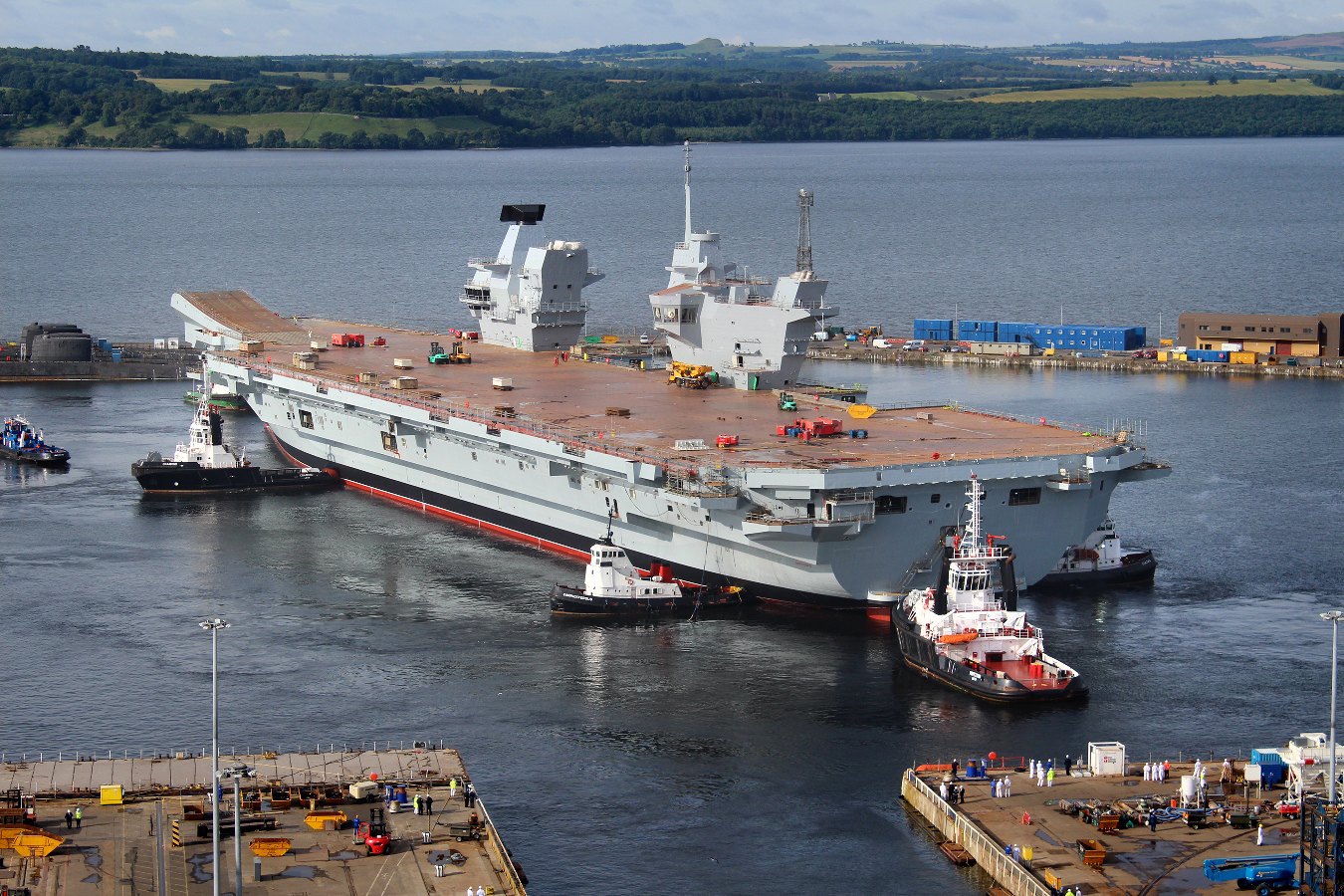
The Royal Navy’s largest ever warship HMS Queen Elizabeth is gently floated out of her dock for the first time in Rosyth, Scotland in July 2014. In an operation that started earlier that week, the dry dock in Rosyth near Edinburgh was flooded for the first time to allow the 65,000 tonne aircraft carrier to float. It then took only three hours to carefully manoeuvre HMS Queen Elizabeth out of the dock with just two metres clearance at either side and then berth her alongside a nearby jetty. Teams continued to outfit the ship and steadily bring her systems to life in preparation for sea trials in 2016. The dock she vacated will be used for final assembly of her sister ship, HMS Prince of Wales.
Source: Wikimedia.
The Royal Navy’s newest aircraft carrier is scheduled to be brought into commission in May this year:
The first new Royal Navy aircraft carrier in thirty years is nearing sea trials. After a brief absence from the world of fixed-wing naval aviation the Royal Navy’s brand new flattop HMS Queen Elizabeth and its sister ship, Prince of Wales, will soon sail the seas, their decks full of new F-35 Joint Strike Fighters. The result will be the most powerful “Senior Service” in generations.
The Royal Navy was one of the first naval warfare forces to explore the nascent world of naval aviation. HMS Argus, commissioned in September 1918, was arguably the first aircraft carrier with a full-length flight deck. The UK was one of the major aircraft carrier powers throughout World War II, and continued to operate carriers in the postwar period.
By 1982, the Royal Navy had committed to building three Invincible-class carriers. Somewhat scaled back from earlier ships, and dwarfed by the U.S. Navy’s Nimitz-class carriers, the Invincible class was more suited to antisubmarine warfare duties against the Soviet Navy, keeping the sea lines of communication between North America and Europe clear in the event of World War III. The Invincibles could sail with a complement of up to twenty-two aircraft, typically a mixture of Sea Harrier fighters and Sea King helicopters.
The 1982 Falklands War demonstrated the shortcomings of relying upon such small carriers. HMS Invincible, along with the older HMS Hermes, struggled to provide early warning and combat air patrol over the UK task force sent to reclaim the islands, and were unable to prevent Argentine air power from sinking six friendly warships and supply ships and damaging another nine.
In 2007, despite the general downturn in the size and scope of the navy, plans were announced in 2007 to construct two brand-new aircraft carriers. Each would be stocked with brand-new F-35 Joint Strike Fighters and helicopters, and would be up more than three times larger than their predecessors by displacement. The carriers, Queen Elizabeth and Prince of Wales, would be the largest warships ever built by the UK, bigger even than the World War II battleship HMS Vanguard.
Unfortunately, in order to free up funding for the new carriers the older ships had to be retired, and decommissioning of the Invincible class carriers and their Sea Harrier jets during the 2010s was a huge blow to the Fleet Air Arm. The three warships were broken up for scrap, and the remaining Harrier jets, which by now included RAF Harriers, were purchased by the U.S. Marines to provide spare parts for their own fleet of AV-8B Harriers.
Comments Off on HMS Queen Elizabeth to be commissioned in May
QotD: Leaving the European Union
In the 25 years since I began writing seriously here about the European Union and what our membership of it has been doing to Britain, I have learnt (among much else) three things.
The first, which came quite early as I began to understand the real nature of the supranational system of government we now lived under, was that we should one day have to leave it.
A second, as I came to appreciate just how enmeshed we were becoming with that system of government, was that extricating ourselves from it would be far more fiendishly complicated than most people realised.
The third, as I listened and talked to politicians, was how astonishingly little they seemed really to know about how it worked. Having outsourced ever more of our lawmaking and policy to a higher power, it was as if our political class had switched off from ever really trying to understand it.
Christopher Booker, “Our politicians want to lead us out of the EU, but they don’t seem to have a clue how it works”, Telegraph, 2017-02-04.
Comments Off on QotD: Leaving the European Union
February 20, 2017
Terry Pratchett Back in Black
No embedding allowed, so you’ll have to click here.
H/T to Jerrie Adkins for the link.
Comments Off on Terry Pratchett Back in Black
February 19, 2017
French Railway Guns – Physical Requirements For WW1 Pilots I OUT OF THE ETHER
Published on 18 Feb 2017
It’s time for another episode of Out Of The Ether – Indy reads the best and most insightful comments of recent weeks. This week we talk about French railway guns and the physical and mental requirements of World War 1 pilots.
Comments Off on French Railway Guns – Physical Requirements For WW1 Pilots I OUT OF THE ETHER
February 17, 2017
Industrial policy example – Kingston, Ontario
David Warren remembers when the government tampered with the free market to “save an industry” in Kingston:
Once upon a time, many years ago, I scrapped into one of these “no-brainer” political deals. The remains of the locomotive manufacturing business in Kingston, Ontario — whose century-old products I had glimpsed, still on the rails in India — were now on the block. A monster German corporation was offering to buy them, for the very purpose of competing, in Canada, with a (hugely subsidized, monopolist) Canadian corporation. The government stepped in, to “save” a Canadian industry, retroactively change the ground rules, and kick in more subsidies so that the Canadian monopolists, based in Montreal, could take over instead. This was accompanied by nationalist rhetoric, and Kingston was thrilled. Critics like me were unofficially deflected with bigoted anti-German blather held over from the last World War.
But I knew exactly what was going to happen. The local works, which would have been expanded by the foreign owner, were soon closed by the new Canadian owner, after studies had been commissioned to “prove” it was uneconomic. The latter’s last possible domestic competitor was thus snuffed out. The locals, whose lives had been for generations part of a proud Kingston enterprise, had been suckered. The politicians had told them it was little Canada versus big Germany. In reality, it was pretty little Kingston versus big ugly Montreal.
That is how the world works, with politics, so that whenever I hear of a big new national no-brainer scheme, my first thought is, which innocents are getting mooshed today?
Comments Off on Industrial policy example – Kingston, Ontario
Russian Bombing On The Eastern Front – US Prisoners of War I THE GREAT WAR Week 134
Published on 16 Feb 2017
After breaking off diplomatic relations, the tensions between the US and Germany are still strong. This week the so called Yarrowdale prisoners become pawns in the power play between the great powers. At the same time, the Russian air force is bombing targets all over the north Eastern Front and little skirmishes happen on the overall quiet Western Front.
Comments Off on Russian Bombing On The Eastern Front – US Prisoners of War I THE GREAT WAR Week 134
Railways Of The Great War With Michael Portillo Part 1 A Railway War Begins
Published on 9 Feb 2015
In the run up to the 100 yr anniversary of the end of the First World War Michael Portillo travels across France and Belgium to find out the history of raiways of the past and present….
Comments Off on Railways Of The Great War With Michael Portillo Part 1 A Railway War Begins
February 16, 2017
60163 Tornado Settle to Carlisle 14th Feb 2017
Published on 14 Feb 2017
BBC News report on 60163 Tornado’s run on the Settle to Carlisle line this morning, the first Steam Loco to do the service run in nearly 50 years.
H/T to Jim Guthrie for the link.
Comments Off on 60163 Tornado Settle to Carlisle 14th Feb 2017
February 15, 2017
CANZUK gets a boost from the Financial Post
Andrew Lilico discusses the potential benefits to Canada, Australia, New Zealand, and the UK if these countries work on forming a four-way free trade deal:
The idea of CANZUK begins with a free-trade agreement, free-movement area (the freedom to live and work in each others’ countries) and defence-partnership agreement. O’Toole favours all three of these main planks, and he’s right that it all makes perfect sense.
The CANZUK countries, working closely together, would make a formidable contribution to world affairs. They would have the largest total landmass of any free-trade zone. They would collectively constitute the fourth-largest market in the world, after the U.S., EU and China.
Their combined military spending would be the world’s third largest, well ahead of Russia, and on European Geostrategy’s geopolitical power index, the CANZUK countries collectively have a strength around 70 per cent of that of the U.S. — and nearly twice that of China or France. With a combined global trade footprint nearly twice as big as Japan’s, the CANZUK countries would have substantial influence in opening up global markets and guiding global regulation across a range of issues from banking to shipping to the environment.
What makes CANZUK a natural union is perhaps self-evident. Canada, the U.K., Australia and New Zealand share a similar culture, similar values, and analogous legal, business and social systems that allow us to get along easily and interchangeably. (The term CANZUK was originally a term diplomats used to refer to these four countries because of how frequently they would vote the same way at the UN.)
Most of the main issues our political parties focus upon are instantly comprehensible to anyone from another CANZUK state. Our laws and constitutions share many features, making trade deals and mutual regulatory recognition a relatively straightforward matter. Our citizens enjoy a roughly similar per capita GDP (which is just not true of the other Commonwealth nations with similar constitutions) and face few hurdles in integrating into another CANZUK country’s labour market. Our societies are peaceful and orderly.
Comments Off on CANZUK gets a boost from the Financial Post
February 14, 2017
Reconstructive and Plastic Surgery During World War 1 I THE GREAT WAR Special
Published on 13 Feb 2017
Filmed at Romagne 14-18 museum: http://romagne14-18.com
Plastic and reconstructive surgery saw rapid development during World War 1. Modern medical care and better equipment increased the chances of survival for the soldiers. But these survivors were often disfigured or lost limbs as a result. To help them return to a somewhat normal life, reconstructive surgeons developed methods to restore their faces and aided them with prosthetics.
Comments Off on Reconstructive and Plastic Surgery During World War 1 I THE GREAT WAR Special


