Quotulatiousness

July 18, 2019

Andrew Coyne interviews NATO Secretary General Jens Stoltenberg

Filed under: Cancon, Europe, Military, Russia, USA — Tags: , , , , , — Nicholas @ 05:00

In the National Post, Andrew Coyne discusses NATO, Donald Trump, and Russia with the current Secretary General of NATO, Jens Stoltenberg:

General Hastings “Pug” Ismay, later the first Secretary General of NATO during his military service as Winston Churchill’s chief military assistant in 1941.
Official British government photograph via Wikimedia Commons.

Throughout their term in government — and especially since Donald Trump’s victory in America’s 2016 election — Prime Minister Justin Trudeau’s Liberals have taken every opportunity to pay tribute to the “rules-based international order,” the consensus among countries that everyone’s interests are best served by following a set of rules and guiding principles that have evolved through the decades, expressed through things such as trade agreements and international alliances like the United Nations. If this consensus has a face it may be that of Jens Stoltenberg. The urbane former prime minister of Norway has been Secretary General of the North Atlantic Treaty Organization (NATO) since 2014, and through tough times for the international consensus he’s been one of the loudest voices defending it. This week he was in Canada to meet with Trudeau, to tour the Canadian Forces’ Garrison Petawawa and to discuss Canada’s NATO deployments in Latvia and Iraq. He sat down for an interview with the National Post‘s Andrew Coyne.

Q. Lord Ismay, NATO’s first secretary-general, famously defined the alliance’s mission as “keeping the Soviet Union out, the Americans in, and the Germans down.” When you hear some of the things Donald Trump says about NATO, about Article 5 (the collective defence provision) — are the Americans still in?

A. Yes. And they are more in now than they have been for a long time — meaning that they are actually increasing their NATO presence in Europe. After the end of the Cold War, Canada and the United States, for natural reasons, reduced their military presence in Europe. Because tensions went down, there was less need… Now tensions are increasing again, and both Canada and the United States are now increasing their military presence in Europe: Canada with a Canadian-led battle group in Latvia, and the United States with a battle group in Poland and also with a new armoured brigade. So what we see is that the United States is actually investing more in NATO, more military presence in Europe, more U.S. investments in infrastructure, in pre-positioned equipment, more exercises. So the message from the United States is that they are committed to NATO and we see that not only in words but also in deeds.

Q. But when you see Trump questioning the value of multilateral institutions, asserting “America First,” his chumminess with Putin, does it risk sending a signal that, if push came to shove — if Russia got up to no good in the Baltics or what have you — that America’s resolution to resist that would be less than certain?

A. For me the strongest possible signal to send is the presence of U.S. forces in Europe. The fact that we now, for the first time in the history of NATO, have U.S. troops in the eastern part of the alliance, in Poland and the Baltic countries. There is no way to send a clearer signal than that. And the Canadian troops because they are part of the picture. To have American troops in the Baltic countries sends a very clear signal that if a Baltic country is attacked it will trigger a response from the whole alliance… It’s not possible to imagine a stronger and clearer signal than that.

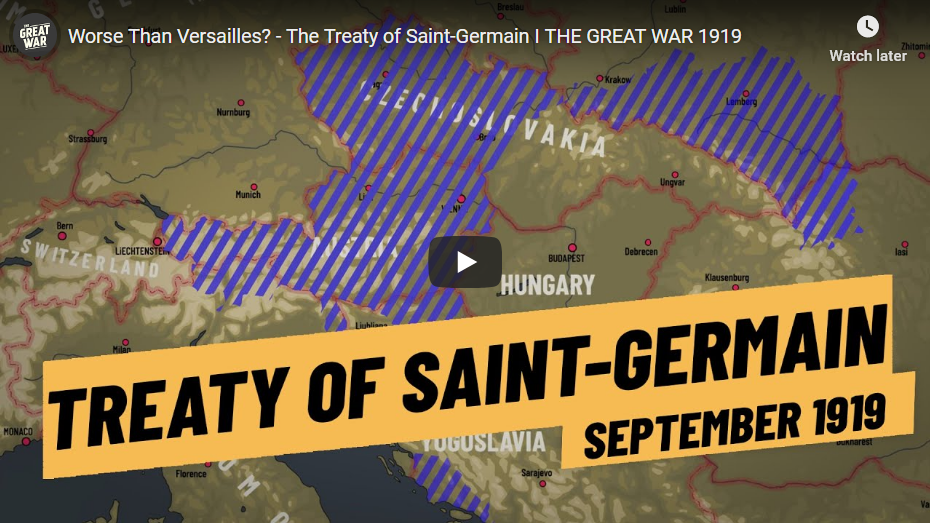
The Allied Occupation of Germany After The Treaty of Versailles I THE GREAT WAR July 1919

Filed under: Britain, France, Germany, History, Military, WW1 — Tags: , , , , , — Nicholas @ 04:00

The Great War
Published on 17 Jul 2019

When the Allied armies marched into German territory in late 1918 under the terms of the armistice, they were surprised to see a relatively untouched land. After the signing of the Treaty of Versailles, the Allied Occupation was made permanent and the troops settled in to stay in a country that did not want them there initially.

» SUPPORT THE CHANNEL
Patreon: https://www.patreon.com/thegreatwar
Merchandise: https://shop.spreadshirt.de/thegreatwar/

» SOURCES
Leonhard, Jörn. Der überforderte Frieden. Versailles und die Welt 1918-1923 (CH Beck, 2018)
Macmillan, Margaret. The Peacemakers: Six Months that Changed the World (London: John Murray, 2001).
Le Naour, Jean-Yves. La Honte noire (Hachette, 2004).
Schröder, Joachim, Watson, Alexander. “Occupation during and after the War (Germany)” in: 1914-1918-online. International Encyclopedia of the First World War https://encyclopedia.1914-1918-online…
Roos, Julia. “Schwarze Schmach” in: 1914-1918-online. International Encyclopedia of the First World War https://encyclopedia.1914-1918-online…
Godfroid, Anne. “Occupation after the War (Belgium and France)” in: 1914-1918-online. International Encyclopedia of the First World War https://encyclopedia.1914-1918-online…
Pawley, Margaret. The Watch on the Rhine: The Military Occupation of the Rhineland, 1918-1930 (I.B.Tauris, 2007).
Hart, Keith. “A Note on the Military Participation of Siam in WWI.” Journal of the Siam Society (ndp): 133–136.
Lauter, Anna-Monika. Sicherheit und Reparationen. Die französische Öffentlichkeit, der Rhein und die Ruhr (1919-1923) (Essen: Klartext, 2006).
Krugler, Gilles. “Allemagne decembre 1918. Les premières heures de l’occupation“. In Revue historique des armées 254 (2009): 76-81. https://journals.openedition.org/rha/…
Mignon, Nicolas. “Boche, ex-ennemie ou simplement femme? Le point de vue des responsables politiques et militaires sur la question des mariages entre militaires belges et femmes allemandes pendant les occupations de la Rhénanie et de la Ruhr (1918-1929).” In Revue belge de Philologie et d’Histoire (2013) 91-4 : 1259-1283.

»CREDITS

Presented by: Jesse Alexander
Written by: Jesse Alexander
Director: Toni Steller & Florian Wittig
Director of Photography: Toni Steller
Sound: Toni Steller
Editing: Toni Steller
Mixing, Mastering & Sound Design: http://above-zero.com
Motion Design: Christian Graef – GRAEFX
Maps: Daniel Kogosov (https://www.patreon.com/Zalezsky)
Research by: Jesse Alexander
Fact checking: Florian Wittig

Channel Design: Alexander Clark
Original Logo: David van Stephold

A Mediakraft Networks Original Channel

Contains licensed material by getty images
All rights reserved – Real Time History GmbH 2019

July 17, 2019

V Bombers – Vulcan, Victor & Valiant – The Last British Bombers

Filed under: Britain, History, Military, Technology — Tags: , , , , — Nicholas @ 04:00

Curious Droid
Published on 28 Nov 2017

It took just 11 years to go from the first flight of the Lancaster Bomber in 1941 to the first flight of the VX770, the prototype Vulcan bomber in 1952. Yet the difference between them could hardly be greater, the Vulcan along with the Victor and Valiant were a new generation of the new planes known as the “V” bombers, planes for a new era and a newly, nuclear-armed Britain.

Patreon : https://www.patreon.com/curiousdroid
Paypal.me : https://www.paypal.me/curiousdroid

Sponsers: Drew Hendrix, Symon Hamer, Florian Hesse, Lucius Kwok, Hunter Schwisow, Pyloric, Seb Stoodley, Oscar Anderson, Peter Cote, Cody Belichesky, Mogoreanu Daniel, Douglas Gustafson, Marcus Chiado, Jorn Magnus Karlsen.

This episode’s shirt was the was the Tabla Paisley by Madcap England and is available from https://www.atomretro.com/madcap_england.
Get 10% discount with the code DROID10.

Presented by Paul Shillito

Written and Researched by Andy Munzer

Additional material by Paul Shillito

Images and footage: Avro, Handley-Page, Vickers-Armstrong
Jim Debinham, Pathe.

Music – Machiotil by Seclorance is licensed under an Attribution License.
Source : http://freemusicarchive.org/music/Sec…

July 16, 2019

QotD: Wartime atrocities

Orwell’s press card portrait, 1943

I have little direct evidence about the atrocities in the Spanish civil war. I know that some were committed by the Republicans, and far more (they are still continuing) by the Fascists. But what impressed me then, and has impressed me ever since, is that atrocities are believed in or disbelieved in solely on grounds of political predilection. Everyone believes in the atrocities of the enemy and disbelieves in those of his own side, without ever bothering to examine the evidence. Recently I drew up a table of atrocities during the period between 1918 and the present; there was never a year when atrocities were not occurring somewhere or other, and there was hardly a single case when the Left and the Right believed in the same stories simultaneously. And stranger yet, at any moment the situation can suddenly reverse itself and yesterday’s proved-to-the-hilt atrocity story can become a ridiculous lie, merely because the political landscape has changed.

In the present war we are in the curious situation that our “atrocity campaign” was done largely before the war started, and done mostly by the Left, the people who normally pride themselves on their incredulity. In the same period the Right, the atrocity-mongers of 1914-18, were gazing at Nazi Germany and flatly refusing to see any evil in it. Then as soon as war broke out it was the pro-Nazis of yesterday who were repeating horror stories, while the anti-Nazis suddenly found themselves doubting whether the Gestapo really existed. Nor was this solely the result of the Russo-German Pact. It was partly because before the war the Left had wrongly believed that Britain and Germany would never fight and were therefore able to be anti-German and anti-British simultaneously; partly also because official war-propaganda, with its disgusting hypocrisy and self-righteousness, always tends to make thinking people sympathize with the enemy. Part of the price we paid for the systematic lying of 1914-17 was the exaggerated pro-German reaction which followed. During the years 1918-33 you were hooted at in left-wing circles if you suggested that Germany bore even a fraction of responsibility for the war. In all the denunciations of Versailles I listened to during those years I don’t think I ever once heard the question, “What would have happened if Germany had won?” even mentioned, let alone discussed. So also with atrocities. The truth, it is felt, becomes untruth when your enemy utters it. Recently I noticed that the very people who swallowed any and every horror story about the Japanese in Nanking in 1937 refused to believe exactly the same stories about Hong Kong in 1942. There was even a tendency to feel that the Nanking atrocities had become, as it were, retrospectively untrue because the British Government now drew attention to them.

But unfortunately the truth about atrocities is far worse than that they are lied about and made into propaganda. The truth is that they happen. The fact often adduced as a reason for scepticism — that the same horror stories come up in war after war — merely makes it rather more likely that these stories are true. Evidently they are widespread fantasies, and war provides an opportunity of putting them into practice. Also, although it has ceased to be fashionable to say so, there is little question that what one may roughly call the “whites” commit far more and worse atrocities than the “reds”. There is not the slightest doubt, for instance, about the behaviour of the Japanese in China. Nor is there much doubt about the long tale of Fascist outrages during the last ten years in Europe. The volume of testimony is enormous, and a respectable proportion of it comes from the German press and radio. These things really happened, that is the thing to keep one’s eye on. They happened even though Lord Halifax said they happened. The raping and butchering in Chinese cities, the tortures in the cellars of the Gestapo, the elderly Jewish professors flung into cesspools, the machine-gunning of refugees along the Spanish roads — they all happened, and they did not happen any the less because the Daily Telegraph has suddenly found out about them when it is five years too late.

George Orwell, “Looking back on the Spanish War”, New Road, 1943 (republished in England, Your England and Other Essays, 1953).

July 15, 2019

Fire and Ice: The Winter War of Finland and Russia (2006)

Filed under: Europe, History, Military, Russia, WW2 — Tags: , , , — Nicholas @ 04:00

DutchRanger
Published on 13 Aug 2013

A nice documentary of the winter war.

July 14, 2019

Joan of Arc – Angels and Demons – Extra History – #2

Filed under: France, History, Military, Religion — Tags: , , , , — Nicholas @ 06:00

Extra Credits
Published on 13 Jul 2019

Joan of Arc was on a mission from God — a mission to guide the Armagnacs into a holy war.
Follow us on Instagram: http://bit.ly/ECisonInstagram

Join us on Patreon! http://bit.ly/EHPatreon

The Dictator of France – WW2 – 046 – July 13 1940

Filed under: Britain, France, History, Military, WW2 — Tags: , , , , , , — Nicholas @ 04:00

World War Two
Published on 13 Jul 2019

The Germans and the French in Vichy consolidate their newly acquired power as the British deal with the remnants of the French navy. The Battle of Britain begins with fighting above the English Channel, a battle with great consequences for the future of Europe.

Join us on Patreon: https://www.patreon.com/TimeGhostHistory
Or join The TimeGhost Army directly at: https://timeghost.tv

Follow WW2 day by day on Instagram @World_war_two_realtime https://www.instagram.com/world_war_t…
Join our Discord Server: https://discord.gg/D6D2aYN.
Between 2 Wars: https://www.youtube.com/playlist?list…
Source list: http://bit.ly/WW2sources

Written and Hosted by: Indy Neidell
Produced and Directed by: Spartacus Olsson and Astrid Deinhard
Executive Producers: Bodo Rittenauer, Astrid Deinhard, Indy Neidell, Spartacus Olsson
Creative Producer: Joram Appel
Research by: Indy Neidell
Edited by: Iryna Dulka
Map animations: Eastory

Colorisations by Norman Stewart and Julius Jääskeläinen https://www.facebook.com/JJcolorization/

Eastory’s channel: https://www.youtube.com/channel/UCEly…
Archive by Screenocean/Reuters https://www.screenocean.com.

Sources:
– IWM: HU 25966, D 734, HU 104721, D 735,
A 18492, HU 52333, Q 69694, A 18284, AMY 450, MH 4560
– Collection of Adolph B. Miller/COLL1068, USMC Archives & Special Collections
– Lloyd W. Williams Collection (COLL/77), USMC Archives & Special Collections

A TimeGhost chronological documentary produced by OnLion Entertainment GmbH.

From the comments:

World War Two
3 days ago (edited)
“You either die a hero or live long enough to see yourself become the villain,” could very well describe the life of Philippe Pétain. Or at least, thats what many generally agree on in hindsight. For the people living in France in 1940, it wasn’t that black or white. “Saving France” didn’t necessarily mean fighting from exile, and establishing a French state with approval of the German victors might have seemed like the best option to protect French interests, people and identity. It’s hard to place yourself in the shoes of people who lived through hard times and had to make tough decisions. Thats why we try to report and describe what happened as unbiased as we can. Keep that in mind when commenting, as well as our rules and guidelines.

The only WW2 battle with its own – fanatical – volunteer PR department

Filed under: Germany, History, Military, Russia, WW2 — Tags: , , , — Nicholas @ 03:00

The 1943 battle of Kursk has been called “the most overhyped battle in history”. I’ve read many, many books and articles about the events of World War 2, I’ve generally avoided reading much about Kursk, because reasons. As I wrote nearly a decade back:

Советские бойцы и командиры осматривают немецкие САУ «Фердинанд», подбитые на Орловском участке фронта (“Soviet fighters and commanders examine German self-propelled guns Ferdinand, shot down on the Orel front”).
Photo by Pavel Troshkin, July 1943 via Wikimedia Commons.

Although I’ve read much about World War II, I haven’t read much about arguably the most critical part of the entire war: the gargantuan battles pitting the Soviet Red Army against Hitler’s Wehrmacht. Some of that is just sheer pig-headedness: I used to work for the biggest wargame store in Toronto, back when wargames meant cardboard counters, vast paper hexagonal maps, and charts and tables galore. The hardest of the hard-core gamers seemed to be either Napoleonic grognards (down to the secret stash of sabres and shakos in the gaming room) or even more dedicated junkies of the “Great Patriotic War”/”Operation Barbarossa”. Some of the latter were genuinely crazy, right down to the barely contained hints that “Hitler was just misunderstood”.

Battle of Kursk – 4 July-1 August 1943
Map drawn by Frank Martini for the Department of History at the United States Military Academy (http://www.dean.usma.edu/history/web03/atlases/ww2%20europe/ww2%20europe%20pages/ww2%20europe%20map%2027.htm), via Wikimedia Commons.

On the assumption that certain forms of craziness are contagious, I avoided most of the latter as much as I could, consistent with my duty to sell them the latest and greatest game involving their particular passion.

One day, perhaps in a fit of weakness, I allowed myself to get lectured by one of the fanatics about the details of the Battle of Kursk. The fan who felt the need to bend my ear was eager to impart information about some “famous battle” that turned out to have been a serious tactical miscalculation by a Soviet officer. The story, as he told it, had a very large formation of Soviet tanks “taking a shortcut” through a major minefield, resulting in many disabled/destroyed tanks and wounded or dead men. In the telling, this kind of thing could not be admitted as having happened without some enemy contact, so it was propagandized as being a major tank battle involving significant formations of German panzer troops and/or SS units (of whom, of course, the glorious defenders of the Motherland took a greater toll than they suffered themselves).

The twitchy-eyed Panzertruppe fanboys helped keep my interest firmly directed away from much of the WW2 Eastern Front aside from the initial 1941 German invasion. A post at Blazing Cat Fur included a link to a BBC article discussing furious Russian reaction to an article recently published in Die Welt, but also indicates that there was actually some factual basis for the lecture I endured all those years ago:

The wider Battle of Kursk – from 5 July to 23 August 1943 – was indeed a turning-point in World War Two. Soviet forces thwarted a huge Nazi counter-attack, after Adolf Hitler’s troops had suffered a colossal defeat at Stalingrad in the winter of 1942-43.

But recently a British historian, Ben Wheatley, analysed German Luftwaffe aerial photos of the Prokhorovka battlefield, taken on 14-16 July, when the area was still in German hands. The photos were found in the US National Archives at College Park, Maryland.

T-34/85 at musée des blindés de Saumur (via Wikipedia)

Wheatley’s assessment, backed by detailed study of battle reports and historical archives, is that on 12 July the Germans lost just five Panzer IV tanks at Prokhorovka, but decimated “kamikaze” Soviet tank formations, turning more than 200 Soviet tanks into smouldering wrecks.

He writes that dozens of Soviet T-34 tanks tumbled into an anti-tank ditch 4.5m (15ft) deep, dug by Soviet infantry, and when the Red Army realised its mistake other T-34s started queuing up to cross a bridge. German tanks were easily able to pick them off at the bridge.

Wheatley and a German military historian, Karl-Heinz Frieser, were cited in a feature in the German daily Die Welt, which hit a Russian raw nerve.

The writer, Sven Felix Kellerhoff, argued that the evidence of Soviet humiliation at Prokhorovka was so convincing that Russia ought to tear down its memorial there, which celebrates the heroism of Soviet tank crews on 12 July.

[…]

War photographer Anatoly Yegorov was in the thick of the fighting at Kursk. His nephew Mikhail Yegorov spoke to the daily Moskovsky Komsomolets, recalling what Anatoly told him about his work there.

“Most of those photos were not published. ‘Do you know why no panoramic photos of the Prokhorovka battlefield were ever shown in our country?’ my uncle asked me. ‘Because for every burning Tiger there were 10 of our smashed up T-34s! How could you publish such photos in the papers?'”

BCF also linked to this artice from a few years ago at The National Interest:

Kursk is the Santa Claus and Easter Bunny of World War II battles, whose popular history was constructed from German and Soviet propaganda, and based on early accounts lacking vital information buried in Russian archives until after the fall of the Soviet Union. Kursk was indeed an epic battle, that pitted 3 million German and Soviet soldiers and 8,000 tanks, all crammed into a small portion of southern Russia.

[…]

Top commanders such as Erich Von Manstein wanted to attack in May, before the Soviets had time to dig in and reinforce the salient. But a nervous and indecisive Hitler decided to postpone Operation Citadel until July, to allow time to deploy his vaunted new Panther, Tiger and Elefant tanks. While the big cats lumbered off the railroad cars near the front lines, the Germans managed to amass nearly 800,000 men, 3,000 tanks, 10,000 guns and mortars, and 2,000 aircraft. It would be the last time the Germans could concentrate such an attack force (by comparison, at the Battle of the Bulge, the Germans had 400,000 men and 600 tanks). Yet as usual, the Germans were outnumbered. They faced 1.9 million Soviet soldiers, 5,000 tanks, 25,000 guns and mortars and more than 3,000 aircraft.

Citadel was a prophetic name for the German offensive. The Soviets used the extra time to build an incredibly dense defense system of multiple layers of fortifications, including trenches, bunkers, tank traps and machine gun nests 25 miles deep, as well as minefields that averaged more than 3,000 mines per kilometer.

Kursk was not an imaginative battle. The Germans attacked an obvious target, the Soviets fortified the obvious target, and the German offensive on July 4, 1943 was a traditional pincer move against the north and south base of the salient to cut off the defenders inside. Despite support by 89 Elefants (a Porsche version of the Tiger that the German army rejected), the northern pincer quickly bogged down after advancing just a few miles. But the southern pincer, led by the II SS Panzer Corps, managed to advance 20 miles to the town of Prokhorovka, until its advance was checked by the Soviet Fifth Guards Tank Army.

The article then goes on to address many of the myths and legends that have grown up around the battle, including:

  • The Tigers didn’t burn. Soviet tanks did
  • Kursk was not a turning point of the war
  • Prokhorovka was not the Greatest Tank Battle in History
  • The Red Army was still not as good as the German Army
  • It was the Soviet counteroffensive that bled the Germans
  • Soviet tanks didn’t ram German tanks at Kursk
  • Kursk was an Anglo-American victory as well as a Soviet one

July 13, 2019

Legends Summarized: Atlantis

Filed under: Europe, Greece, History, Middle East — Tags: , , , — Nicholas @ 06:00

Overly Sarcastic Productions
Published on 12 Jul 2019

THE MAP OF ATLANTIS IS AVAILABLE ON A WIDE ARRAY OF MERCH: https://www.redbubble.com/people/ospy…

Don’t get TOO excited, Plato’s pretty dry.
Eh? Eh? Geddit? But seriously.

(Won’t it be fun if the conspiracy algorithms pick this one up?)

No, the ending song isn’t “under the sea”, I already did it twice.

PATREON: https://www.Patreon.com/OSP

OUR WEBSITE: https://www.OverlySarcasticProductions.com
Find us on Twitter https://www.Twitter.com/OSPYouTube
Find us on Reddit https://www.Reddit.com/r/OSP/

July 12, 2019

“Devil Dogs” – U.S. Marines – Sabaton History 023 [Official]

Filed under: Germany, History, Media, Military, USA, WW1 — Tags: , , , — Nicholas @ 06:00

Sabaton History
Published on 11 Jul 2019

The United States entered the battlefields of Europe in 1918. Among the first Americans to participate in the fight were the U.S. Marines, who quickly adopted the name “Devil Dogs”. One of their most notable engagements is the Battle of Belleau Wood in June 1918, where the Marines fought the battle-hardened Germans for 26 days.

Support Sabaton History on Patreon (and possibly get a History Channel special edition): https://www.patreon.com/sabatonhistory

Pre-order The Great War here: https://www.sabaton.net/pre-order-of-…

Check out the trailer for Sabaton’s new album The Great War right here: https://www.youtube.com/watch?v=HCZP1…

Watch more videos on the Sabaton YouTube channel: https://www.youtube.com/user/Sabaton?…
Listen to Sabaton on Spotify: http://smarturl.it/SabatonSpotify
Official Sabaton Merchandise Shop: http://bit.ly/SabatonOfficialShop

Hosted by: Indy Neidell
Written by: Markus Linke and Indy Neidell
Directed by: Astrid Deinhard and Wieke Kapteijns
Produced by: Pär Sundström, Astrid Deinhard and Spartacus Olsson
Creative Producer: Joram Appel
Executive Producers: Pär Sundström, Joakim Broden, Tomas Sunmo, Indy Neidell, Astrid Deinhard, and Spartacus Olsson
Maps by: Eastory
Edited by: Iryna Dulka
Sound Editing by: Marek Kaminski

Eastory YouTube Channel: https://www.youtube.com/channel/UCEly…
Archive by: Reuters/Screenocean https://www.screenocean.com
Music by Sabaton.

Sources:
IWM: Q 61342, Q 70181, NTB 319-2, IWM 687, 1061-08e, IWM 508-67, IWM 501-9, IWM 435, IWM 778, Q 98994, IWM 484

An OnLion Entertainment GmbH and Raging Beaver Publishing AB co-Production.

© Raging Beaver Publishing AB, 2019 – all rights reserved.

From the comments:

Sabaton History
2 days ago
This episode is about the US Marines and their actions during the Battle of Belleau Wood in 1918. While most of the footage in this episode is depicting the Marines and the Germans in 1918, and some of it is even depicting the actual fighting in Belleau wood, there is not a whole lot footage or imagery from the action. So for whoever is enough of a history buff to spot that some of our illustrative material is in fact depicting other engagements, well spotted! We try to use authentic material whenever we can, but in the end we have to make an episode visually attractive and dramatic, and we can’t do that with just looking at Indy’s head for 15 minutes (although I’m sure that many of you wouldn’t mind). That was the announcement. Peace, rock on and cheers!

NEW VERSION – 107 Abandoned French Soldiers Killed for Propaganda – France 1940 – 02

Filed under: France, Germany, History, Military, WW2 — Tags: , , — Nicholas @ 05:00

World War Two
Published on 11 Jul 2019

We stumbled on some of the propaganda footage shot by the Wehrmacht film teams during the actual attack at the Ouvrage de La Ferté, and we figured that it would do the topic justice to make an improved version of this video.

After the German army breaks through the French lines at Sedan, the left flank of the moving army has to be secured. The French Ouvrage la Ferté, part of the Maginot Line defense works, is subject to this consolidation. But the Germans move with ulterior motives, as to them capturing a Maginot Line fort in the first week of the offensive has a huge propaganda value. Tour guide Richard Tucker shows Indy the grounds of a modern tragedy, where 107 French soldiers gave their lives.

Join us on Patreon: https://www.patreon.com/TimeGhostHistory
Or join The TimeGhost Army directly at: https://timeghost.tv

Check out (and book!) Richard Tucker here: https://www.tripadvisor.nl/Attraction…

Follow WW2 day by day on Instagram @World_war_two_realtime https://www.instagram.com/world_war_t…
Join our Discord Server: https://discord.gg/D6D2aYN.
Between 2 Wars: https://www.youtube.com/playlist?list…
Source list: http://bit.ly/WW2sources

Written and Hosted by: Indy Neidell
Produced and Directed by: Spartacus Olsson and Astrid Deinhard
Executive Producers: Bodo Rittenauer, Astrid Deinhard, Indy Neidell, Spartacus Olsson
Creative Producer: Joram Appel
Research by: Indy Neidell
Edited by: Iryna Dulka
Map animations: Eastory

Colorisations by Norman Stewart and Julius Jääskeläinen https://www.facebook.com/JJcolorization/

Eastory’s channel: https://www.youtube.com/channel/UCEly…
Archive by Screenocean/Reuters https://www.screenocean.com.

A TimeGhost chronological documentary produced by OnLion Entertainment GmbH.

From the comments:

World War Two
1 hour ago
Some of you might be getting flashbacks seeing this episode pop up. We published a version of this video already, but since we did that, we found some great footage depicting the actual fighting at Ouvrage de la Ferté. As we love history, we also love how this footage brings the story and the memorial to life. We wanted to share this experience with you, and decided to upload an improved version with new archive footage. We hope you like it as much as we do!

Cheers,
Joram

The European Migration Crisis – WW2 – WaH 004 – June 1940

Filed under: Europe, Germany, History, Military, Russia, WW2 — Tags: , , , , , , , — Nicholas @ 04:00

World War Two
Published on 11 Jul 2019

When the Nazi German Reich invades western and northern Europe this creates a massive refugee and forced migration crisis all across Europe. In eastern Europe, The Nazis and the Soviets have already been forcing families out of their homes to be relocated, incarcerated and murdered for nine months by now.

Join us on Patreon: https://www.patreon.com/TimeGhostHistory
Or join The TimeGhost Army directly at: https://timeghost.tv

Follow WW2 day by day on Instagram @World_war_two_realtime https://www.instagram.com/world_war_t…
Join our Discord Server: https://discord.gg/D6D2aYN.
Between 2 Wars: https://www.youtube.com/playlist?list…
Source list: http://bit.ly/WW2sources

Written and Hosted by: Spartacus Olsson
Produced and Directed by: Spartacus Olsson and Astrid Deinhard
Executive Producers: Bodo Rittenauer, Astrid Deinhard, Indy Neidell, Spartacus Olsson
Creative Producer: Joram Appel
Post Production Director Wieke Kapteijns
Research by: Spartacus Olsson
Edited by:Spartacus Olsson
Map animations: Eastory

Eastory’s channel: https://www.youtube.com/channel/UCEly…
Archive by Screenocean/Reuters https://www.screenocean.com.

A TimeGhost chronological documentary produced by OnLion Entertainment GmbH.

QotD: Warmongers, propaganda, and the intelligentsia

Filed under: Europe, History, Military, Quotations — Tags: , , , , , , — Nicholas @ 01:00

Orwell’s press card portrait, 1943

Our memories are short nowadays, but look back a bit, dig out the files of New Masses or the Daily Worker, and just have a look at the romantic warmongering muck that our left-wingers were spilling at that time. All the stale old phrases! And the unimaginative callousness of it! The sang-froid with which London faced the bombing of Madrid! Here I am not bothering about the counter-propagandists of the Right […]; they go without saying. But here were the very people who for twenty years had hooted and jeered at the “glory” of war, at atrocity stories, at patriotism, even at physical courage, coming out with stuff that with the alteration of a few names would have fitted into the Daily Mail of 1918. If there was one thing that the British intelligentsia were committed to, it was the debunking version of war, the theory that war is all corpses and latrines and never leads to any good result. Well, the same people who in 1933 sniggered pityingly if you said that in certain circumstances you would fight for your country, in 1937 were denouncing you as a Trotsky-Fascist if you suggested that the stories in New Masses about freshly wounded men clamouring to get back into the fighting might be exaggerated. And the Left intelligentsia made their swing-over from “War is hell” to “War is glorious” not only with no sense of incongruity but almost without any intervening stage. Later the bulk of them were to make other transitions equally violent. There must be a quite large number of people, a sort of central core of the intelligentsia, who approved the “King and Country” declaration in 1935, shouted for a “firm line against Germany” in 1937, supported the People’s Convention in 1940, and are demanding a Second Front now.

As far as the mass of the people go, the extraordinary swings of opinion which occur nowadays, the emotions which can be turned on and off like a tap, are the result of newspaper and radio hypnosis. In the intelligentsia I should say they result rather from money and mere physical safety. At a given moment they may be “pro-war” or “anti-war”, but in either case they have no realistic picture of war in their minds. When they enthused over the Spanish war they knew, of course, that people were being killed and that to be killed is unpleasant, but they did feel that for a soldier in the Spanish Republican army the experience of war was somehow not degrading. Somehow the latrines stank less, discipline was less irksome. You have only to glance at the New Statesman to see that they believed that; exactly similar blah is being written about the Red Army at this moment. We have become too civilized to grasp the obvious. For the truth is very simple. To survive you often have to fight, and to fight you have to dirty yourself. War is evil, and it is often the lesser evil. Those who take the sword perish by the sword, and those who don’t take the sword perish by smelly diseases. The fact that such a platitude is worth writing down shows what the years of rentier capitalism have done to us.

George Orwell, “Looking back on the Spanish War”, New Road, 1943 (republished in England, Your England and Other Essays, 1953).

July 11, 2019

QotD: English is weird

Filed under: Britain, Europe, History, Quotations — Tags: , , , — Nicholas @ 01:00

English started out as, essentially, a kind of German. Old English is so unlike the modern version that it feels like a stretch to think of them as the same language at all. Hwæt, we gardena in geardagum þeodcyninga þrym gefrunon – does that really mean “So, we Spear-Danes have heard of the tribe-kings’ glory in days of yore”? Icelanders can still read similar stories written in the Old Norse ancestor of their language 1,000 years ago, and yet, to the untrained eye, Beowulf might as well be in Turkish.

The first thing that got us from there to here was the fact that, when the Angles, Saxons and Jutes (and also Frisians) brought their language to England, the island was already inhabited by people who spoke very different tongues. Their languages were Celtic ones, today represented by Welsh, Irish and Breton across the Channel in France. The Celts were subjugated but survived, and since there were only about 250,000 Germanic invaders – roughly the population of a modest burg such as Jersey City – very quickly most of the people speaking Old English were Celts.

Crucially, their languages were quite unlike English. For one thing, the verb came first (came first the verb). But also, they had an odd construction with the verb do: they used it to form a question, to make a sentence negative, and even just as a kind of seasoning before any verb. Do you walk? I do not walk. I do walk. That looks familiar now because the Celts started doing it in their rendition of English. But before that, such sentences would have seemed bizarre to an English speaker – as they would today in just about any language other than our own and the surviving Celtic ones. Notice how even to dwell upon this queer usage of do is to realise something odd in oneself, like being made aware that there is always a tongue in your mouth.

John McWhorter, “English is not normal”, Aion, 2015-11-13.

July 10, 2019

An Overview of the Pinfire Revolver System

Filed under: Europe, France, History, Technology, Weapons — Tags: , , , , , — Nicholas @ 02:00

Forgotten Weapons
Published on 4 May 2019

(Video reuploaded to removed an allegedly copyrighted still image)

http://www.patreon.com/ForgottenWeapons
Cool Forgotten Weapons merch! http://shop.bbtv.com/collections/forg…

The pinfire system was an early cartridge type which saw widespread use in Europe, but was not widely adopted in the United States. First invented by a French designer named Pauly, it was made commercially feasible by Casimir Lefacheaux. It was Casimir’s son Eugene, however, who took the pinfire cartridge to its full potential, garnering a French military contract in the 1850s and building Lefacheaux into one of the largest French/Belgian non-government arms manufacturers in the mid 1800s.

Todays we are looking at an assortment of pinfire revolvers, to get some basic idea for the sort of variety that was made over the decades. Small to large, plain to fancy, and with all manner of quirky details (like folding bayonets and Lefacheaux’s triple-action fire control system).

Contact:
Forgotten Weapons
PO Box 87647
Tucson, AZ 85754

« Newer PostsOlder Posts »

Powered by WordPress