
This, attributed to Goering but rather indited by some other nutjob mediocrity, is among my favourite phrases. Often I cite it with glee. I know just what he meant; rarely has one the chance to empathize with Nazis. Monsters they were, but also human, and if we lose the means to recall what made them tick, we are disadvantaged against their successors.
Ditto with Islamic terrorists, incidentally. Unless we can see them, sometimes, from the angle that makes them most attractive, we miss the whole picture. Know the enemy, I say. The worst psychopath may offer to share some droll humour. It is my firm belief that even liberals and progressives can be charming, sometimes.
I wonder which part of Mr Browning’s works Herr Goering would reach for? Would it be an earlier work, as Paracelsus or Sordello? A later, such as Jocoseria or Asolando? Me, I think I would start with a dilatory romp through the Dramatic Idylls, then hunker down with The Ring and the Book.
David Warren, “Include me in”, Essays in Idleness, 2017-08-30.
September 15, 2019
QotD: “Whenever I hear the word ‘culture’ I reach for my Browning”
September 14, 2019
Stalin’s 5 Year Plan for Economic Mass Murder | BETWEEN 2 WARS I 1932 Part 1 of 4
TimeGhost History
Stalin has to deal with the consequences of forcibly changing the Soviet Union from an agrarian economy into a modern industrialized society as his first five-years plan reaches its final year.
Join us on Patreon: https://www.patreon.com/TimeGhostHistory
Hosted by: Indy Neidell
Written by: Spartacus Olsson and Naman Habtom
Directed by: Spartacus Olsson and Astrid Deinhard
Executive Producers: Bodo Rittenauer, Astrid Deinhard, Indy Neidell, Spartacus Olsson
Creative Producer: Joram Appel
Post-Production Director: Wieke Kapteijns
Research by: Naman Habtom
Edited by: Daniel Weiss en Wieke Kapteijns
Sound design: Marek KaminskiA TimeGhost chronological documentary produced by OnLion Entertainment GmbH.
From the comments:
TimeGhost History
1 hour ago (edited)
Debating the concepts, definition and framework of Marxism, Communism and Socialism is something that historians don’t seem to get enough of, much like applying these theories to historical and contemporary phenomena. The study of how these theories turned into ideology and what effect that had on nations, cultures, peoples and wars is a very interesting field of history, which can be debated to great lengths, which we ourselves also like to engage and participate in. However, we want to once again emphasise that we will only allow debate within the generally accepted rules of academic debate. Keep it civil, substantiated, name your sources whenever possible and stay away from pseudo-science and contemporary politics. We are fierce believers in the benefits of academic debate and don’t want to resort to turning off the comments, as other channels might do when talking about subjects like the 5-year plan or the Holodomor.Cheers, Joram
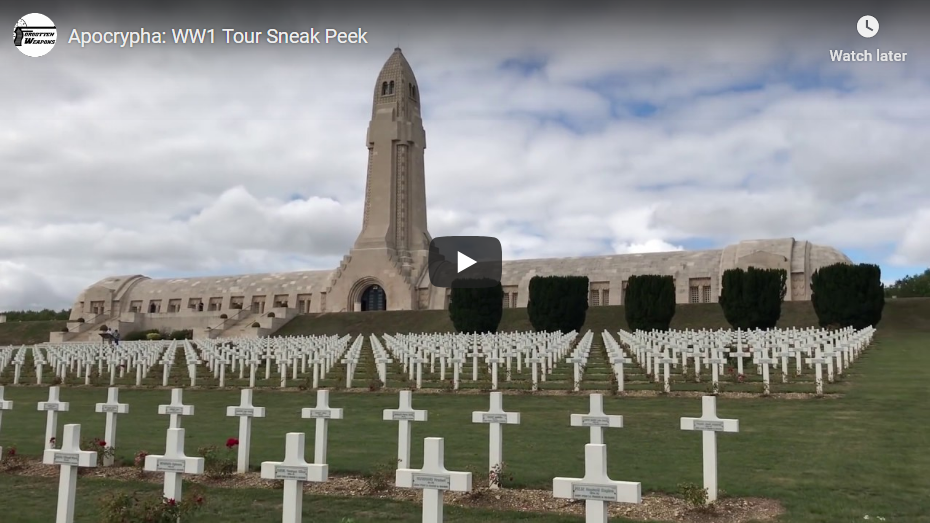
Apocrypha: WW1 Tour Sneak Peek
Forgotten Weapons
Want to see all of my Apocrypha behind-the-scenes videos? They are a perk for Patrons who help directly support Forgotten Weapons:
http://www.patreon.com/ForgottenWeapons
Cool Forgotten Weapons merch! http://shop.bbtv.com/collections/forg…
I partnered up with Military Historical Tours to guide a World War One battlefield tour this week, and I figured I’d give you a bit of a peek into it. We are looking at the war chronologically, starting with a day in Belgium to look at the German attack in 1914, visiting the remains of Fort de Loncin in Liege and the Mons cemetery. Next was a day in Ypres for the stagnation into trench warfare in 1915, seeing the Dodengang up on the Yser and then the Bayernwald trenches, Passchendaele Museum, and Kitchener’s Wood. The year of 1916 marks two of the huge Western Front offensives, and we took one day on the Somme (Beaumont-Hamel and Lochnagar Crater) and a day at Verdun (Driant’s command post and tomb, Fort Vaux, Fleury Village, and the Douaumont Ossuary). Today we move to the Chemin des Dames to look at the disastrous French Nivelle Offensives at the Plateau de Californie and the Caverne du Dragons, and tomorrow we will see the arrival of significant American forces and the Hundred Days Offensive the ended the war, through the sites of Les Mares Farm, Belleau Wood, and Blanc Mont. We have a great group of people along, and it’s been a lot of fun, if quite sobering at times. I hope to see you on a future tour!
Contact:
Forgotten Weapons
6281 N. Oracle #36270
Tucson, AZ 85704
September 13, 2019
“Cliffs of Gallipoli” Part 1 – The Great War – Sabaton History 032 [Official]
Sabaton History
Published on 12 Sep 2019While the British were already dying by the thousands in the trenches in Western Europe, their high command decided to try to break the stalemate with an attack on the Ottoman Empire in the Dardanelles. This is the first episode on the Sabaton song “Cliffs of Gallipoli” about the Allied landings on the shores off Gallipoli.
Support Sabaton History on Patreon: https://www.patreon.com/sabatonhistory
Listen to The Art of War (where “Cliffs of Gallipoli” is featured):
CD: http://bit.ly/TheArtOfWarStore
Spotify: http://bit.ly/TheArtOfWarSpotify
Apple Music: http://bit.ly/TheArtOfWarAppleMusic
iTunes: http://bit.ly/TheArtOfWariTunes
Amazon: http://bit.ly/TheArtOfWarAmz
Google Play: http://bit.ly/TheArtOfWarGooglePlayWatch the Official Lyric Video of “Cliffs of Gallipoli” here: https://www.youtube.com/watch?v=oOCe2…
Hosted by: Indy Neidell
Written by: Markus Linke and Indy Neidell
Directed by: Astrid Deinhard and Wieke Kapteijns
Produced by: Pär Sundström, Astrid Deinhard and Spartacus Olsson
Creative Producer: Joram Appel
Executive Producers: Pär Sundström, Joakim Broden, Tomas Sunmo, Indy Neidell, Astrid Deinhard, and Spartacus Olsson
Maps by: Eastory
Edited by: Iryna Dulka
Sound Editing by: Marek KaminskiEastory YouTube Channel: https://www.youtube.com/channel/UCEly…
Archive by: Reuters/Screenocean https://www.screenocean.com
Music by Sabaton.Sources:
– IWM: Q 57165, Q 1309, Q 515124, Q 13550, Q 13411, Q 53319, Q 13297, Art. IWM ART 4279, Q 112876, IWM ART 2452
– Photos of Ottoman Cavalry courtesy of the National Library of Israel
– Archives New Zealand
– New Zealand troops landing at Gallipoli taken by Joseph McBrideAn OnLion Entertainment GmbH and Raging Beaver Publishing AB co-Production.
© Raging Beaver Publishing AB, 2019 – all rights reserved.
From the comments:
Sabaton History
2 days ago (edited)
Thats right, “Cliffs of Gallipoli” will be featured in not one but two Sabaton History episodes! The next episode will dive into a different but equally perspective of the battle.Joakim already mentions it in the call to action of this episode, but we’re making Sabaton History Special Editions of all the older Sabaton albums, just like we did with The Great War. Those who support us at a certain level on Patreon before the end of November will be rewarded with the Sabaton History Edition of the Sabaton album Heroes. Check out our Patreon page to find out more! -> https://www.patreon.com/sabatonhistory
Cheers!
The new German populists – Alternative für Deutschland (AfD)
Sabine Beppler-Spahl discusses the rise of Alternative für Deutschland:

“AfD Election Poster” by harry_nl is licensed under CC BY-NC-SA 2.0


Germany is just two months away from commemorating the 30th anniversary of the fall of the Berlin Wall. But for many commentators, east and west Germany are more divided than ever. The success of the right-wing Alternative für Deutschland (AfD) in the recent state elections in Brandenburg and Saxony has fueled this concern. The AfD came second in both elections. In Brandenburg, it won 23.5 per cent of the vote, just 2.7 per cent below the ruling centre-left SPD. In Saxony, it won 27.5 per cent of the vote, 4.6 per cent behind the incumbent centre-right CDU. “When I, a Wessi [west German], leave Berlin … I see nothing but right-wingers … These are people whose sensitivities I don’t understand… Thirty years after the fall of the wall, there is still no unity”, said a writer for Der Spiegel.
Many in the east are just as keen as their western counterparts to distance themselves from AfD voters. The “most important message” from Saxony’s election result was that the “friendly Saxony” had won, said Michael Kretschmer, the state’s CDU minister president. As if reading from the same script, Brandenburg’s minister president, the SPD’s Dietmar Woidke, emphasised that “the face of Brandenburg would remain friendly”. Of course, “friendly” is a code word for mainstream or pro-establishment. But presenting the elections in these terms may have helped the governing parties to their narrow victories. Some analysts suggest that voters, who would otherwise have opted for the Greens or Die Linke (the Left Party), supported the ruling parties for fear of the AfD coming first.
The debate about the east-west divide is deeply anti-political. It focuses solely on the question of what is wrong with east German voters – and the roughly one million AfD voters in particular – rather than on what has gone wrong with German politics as a whole. As a result, there is a great deal of snobbery in the discussion. For Brigitte Fehrle, former editor of the left-liberal Berliner Zeitung, the AfD‘s success can be explained by a mixture of voters’ “disappointment” and their “unrealistic expectations about what is possible in politics”. Sociologist Cornelia Koppetsch, author of a bestselling book on right-wing populism, describes AfD voters as a “cross-section of globalisation’s losers”. This is despite research finding that people who voted for the AfD in 2017 don’t see themselves as “losers” of globalisation at all, and even rate their personal economic situation as above average. That AfD voters might simply hold different political values or views on climate policy, immigration and the family is rarely considered.
[…]
The established parties have ceded ground to the AfD by refusing to take it seriously. Instead of engaging AfD representatives in as many debates as possible, they have relied on trying to expose the party’s far-right connections. For instance, the AfD leader in Brandenburg has been accused of joining a Neo-Nazi demonstration in Greece in 2007. Though these accusations are not trivial by any means, they have only helped to strengthen the impression among AfD supporters that the established parties prefer to vilify the party morally, rather challenge it politically.
Ultimately, the desire for political change is not limited to east Germany. If the mainstream parties continue to be complacent, all voters will look elsewhere. On this front at least, the east and west might be closer than suspected.
Why You Wouldn’t Want to Fly The First Jet Airliner: De Havilland Comet Story
Mustard
Published on 1 Dec 2017Air travel before the Jet Age wasn’t always glamorous. The relentless noise and vibration from a piston powered propeller aircraft often made long flights even more exhausting. Most aircraft also couldn’t fly high enough to avoid bad weather, so air sickness was more common.
After World War Two, as part of an effort to develop its civil aviation industry, Britain stunned the world by unveiling the world’s first jet airliner. The de Havilland Comet was sleek, quiet, and flew higher and faster than any airliner of the day. As piston propeller technology was reaching its limits, the conventional thinking was that jet engines were too unreliable and produced too little power relative to their fuel consumption. But the de Havilland Comet proved that jet travel was the future. When the Comet entered service in 1952, it immediately began breaking travel time records and became a point of national pride for Britain.
The de Havilland Comet was perhaps little too ahead of its time. With such a clean sheet design, there were still lessons to learn. When early Comets suffered from catastrophic depressurization incidents, the entire fleet was grounded and their Certificate of Airworthiness was revoked. Flaws in the design of the aircraft’s fuselage were resolved in later Comet versions. However, the rest of the world was now catching up, and manufacturers including Boeing and Douglas began to offer their own jet airliners. While later version Comets served airlines reliably, they were outsold by competing aircraft. There’s no question However, that the comet paved the way. The British had taken a massive risk and brought the world into the jet age. #DeHavilland #CometAirliner #Airplane
Want to help Mustard grow? Support us on Patreon: https://www.patreon.com/MustardChannel

QotD: Orwell’s campaign against the jackboot
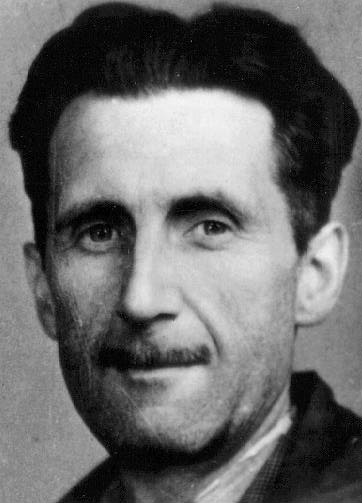
Orwell’s press card portrait, 1943
In spite of my campaign against the jackboot — in which I am not operating single-handed — I notice that jackboots are as common as ever in the columns of the newspapers. Even in the leading articles in the Evening Standard, I have come upon several of them lately. But I am still without any clear information as to what a jackboot is. It is a kind of boot that you put on when you want to behave tyrannically: that is as much as anyone seems to know.
Others besides myself have noted that war, when it gets into the leading articles, is apt to be waged with remarkably old-fashioned weapons. Planes and tanks do make occasional appearances, but as soon as an heroic attitude has to be struck, the only armaments mentioned are the sword (“We shall not sheathe the sword until”, etc., etc.), the spear, the shield, the buckler, the trident, the chariot and the clarion. All of these are hopelessly out of date (the chariot, for instance, has not been in effective use since about A.D. 50), and even the purpose of some of them has been forgotten. What is a buckler, for instance? One school of thought holds that it is a small round shield, but another school believes it to be a kind of belt. A clarion, I believe, is a trumpet, but most people imagine that a “clarion call” merely means a loud noise. One of the early Mass Observation reports, dealing with the coronation of George VI, pointed out that what are called “national occasions” always seem to cause a lapse into archaic language. The “ship of state”, for instance, when it makes one of its official appearances, has a prow and a helm instead of having a bow and a wheel, like modern ships. So far as it is applied to war, the motive for using this kind of language is probably a desire for euphemism. “We will not sheathe the sword” sounds a lot more gentlemanly than “We will keep on dropping block-busters”, though in effect it means the same.
One argument for Basic English is that by existing side by side with Standard English it can act as a sort of corrective to the oratory of statesmen and publicists. High-sounding phrases, when translated into Basic, are often deflated in a surprising way. For example, I presented to a Basic expert the sentence, “He little knew the fate that lay in store for him” — to be told that in Basic this would become “He was far from certain what was going to happen”. It sounds decidedly less impressive, but it means the same. In Basic, I am told, you cannot make a meaningless statement without its being apparent that it is meaningless — which is quite enough to explain why so many schoolmasters, editors, politicians and literary critics object to it.
George Orwell, “As I Please” Tribune, 1944-08-04.
September 12, 2019
QotD: Canadians and Europeans
“The typical British family,” he writes, “looks much more like the typical German family than the typical American family. We eat Italian food. We watch Spanish soccer. We drive German cars. We work Belgian hours. And we buy second homes in France. Above all, we bow before central government as only true Europeans can.”
He has a point, though cultural similarities are not always determinative: Canadians eat American food, watch American sports, drive American cars, work American hours (more or less), and buy second homes in Florida. But they still bow down before central government as only true Europeans can.
Mark Steyn, Telegraph, originally posted to the old blog (no longer online), 2004-09-30.
September 8, 2019
Burn London, Burn it’s the Blitz – WW2 – 054 – September 07 1940
World War Two
Published on 7 Sep 2019This week, the battle in the skies of Britain enters a new, even deadlier phase, as the crowded streets of London turn into a war zone. It is the start of the Blitz.
Join us on Patreon: https://www.patreon.com/TimeGhostHistory
Or join The TimeGhost Army directly at: https://timeghost.tvFollow WW2 day by day on Instagram @World_war_two_realtime https://www.instagram.com/world_war_t…
Join our Discord Server: https://discord.gg/D6D2aYN.
Between 2 Wars: https://www.youtube.com/playlist?list…
Source list: http://bit.ly/WW2sourcesWritten and Hosted by: Indy Neidell
Produced and Directed by: Spartacus Olsson and Astrid Deinhard
Executive Producers: Bodo Rittenauer, Astrid Deinhard, Indy Neidell, Spartacus Olsson
Creative Producer: Joram Appel
Research by: Indy Neidell
Edited by: Iryna Dulka
Map animations: EastoryColorisations by Norman Stewart and Julius Jääskeläinen https://www.facebook.com/JJcolorization/
Eastory’s channel: https://www.youtube.com/channel/UCEly…
Archive by Screenocean/Reuters https://www.screenocean.com.Sources:
– IWM: SP 2553, FL 5186, H 23836, HU 93069, CH 19
– Colorization of Hugo Sperrle by Ruffneck88
– Narodowe Archiwum CyfroweA TimeGhost chronological documentary produced by OnLion Entertainment GmbH.
Boris may have a viable escape hatch after all
It could not only untangle the current mess in Parliament but have the almost equally attractive feature of sending his opponents into paroxysms of rage:
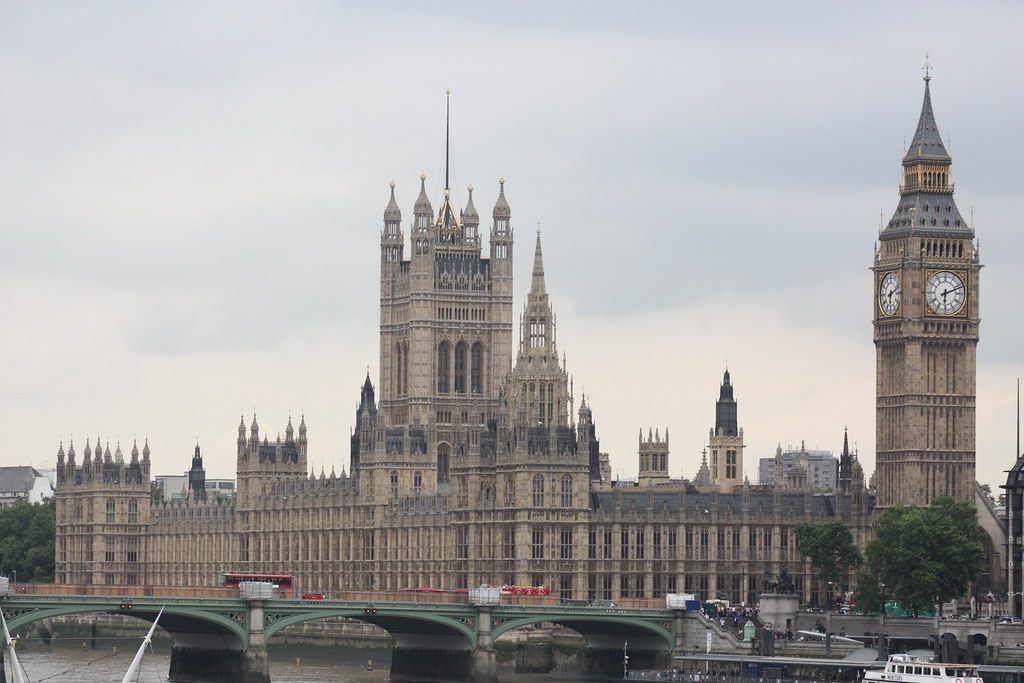
“Palace of Westminster”by michaelhenley is licensed under CC BY-NC-SA 2.0
The consensus is that the Government is trapped in an iron vice that will now be tightened till it cracks. The truth, however, is that this vice is less of iron than of hot air.
The Civil Contingencies Act 2004 is a constitutional outrage. It allows a government to declare an emergency, and then to rule by decree. It should never have been made. But it was made; and it can now be used as an instrument of liberation.
The Act defines “emergency” as just about anything the authorities may dislike. One possible definition is “an event or situation which threatens serious damage to human welfare in a place in the United Kingdom.” (s.1(1)) This sounds a promising excuse. It seems to cover what the Opposition claims would be the effect of a No-Deal Brexit.
Triggering the Act requires no more than “a senior Minister of the Crown” – that is, Boris Johnson – to announce an Emergency. This done, he can make, alter or suspend almost any law he likes. (s.22) He can do this for a period of thirty days. (s.26) All he has to do is preface his decree with a statement that he “is satisfied that the regulations contain only provision which is appropriate for the purpose of preventing, controlling or mitigating an aspect or effect of the emergency in respect of which the regulations are made.” (s.20(5)(b)(ii))
He cannot change the Act itself, or the Human Rights Act. He cannot set up concentration camps for his opponents, or put them before a firing squad. But the Fixed Term Parliament Act is fair game. He could suspend that. Then he could dissolve Parliament in the traditional way.
He must, “as soon as is reasonably practicable,” lay his decrees before Parliament. (s.27(1)(a)) No doubt, the Parliament we have would punish him with an Act of Attainder. But this Parliament would no sooner reassemble after the prorogation than it would be dissolved. The Speaker would barely have time to open his mouth. Assuming the general election went as hoped, the next Parliament would not be inclined to dispute the circumstances of its birth.
All the opposition parties would go screaming mad. But, as said, we are not talking about concentration camps and firing squads. The only use of the Emergency would be to give a voice to the people. Who could legitimately deny that? As for sharp practice in general, the opposition parties have spent this year turning the Constitution upside down. Who could complain if the Government now joined in the fun?
Miscellaneous Myths: Animal Brides
Overly Sarcastic Productions
Published on 6 Sep 2019Yes, it really is as weird as it sounds. Sorry!
This video (specifically the Inuit myth) was requested by patron Richard Frederick Schubert III!
PATREON: https://www.Patreon.com/OSP
MERCH LINKS: https://www.redbubble.com/people/OSPY…
OUR WEBSITE: https://www.OverlySarcasticProductions.com
Find us on Twitter https://www.Twitter.com/OSPYouTube
Find us on Reddit https://www.Reddit.com/r/OSP/
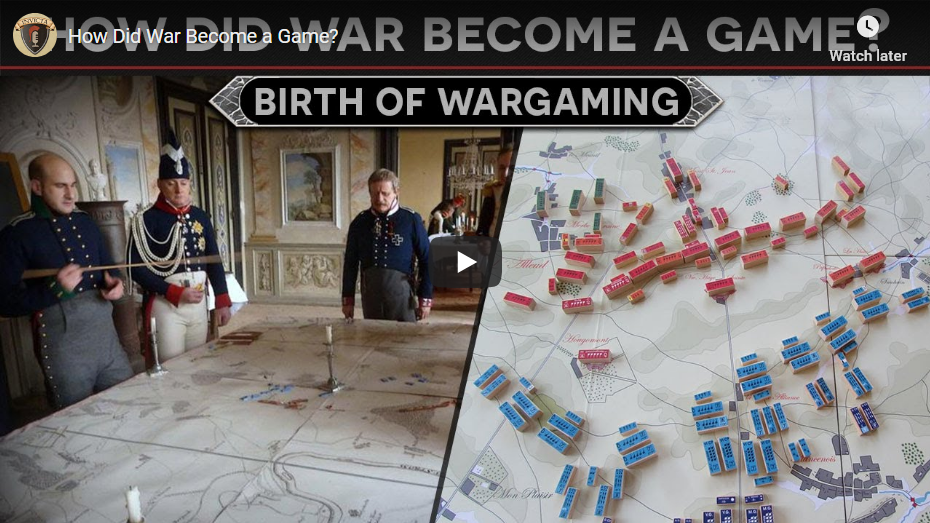
How Did War Become a Game?
Invicta
Published on 28 Jun 2019Get your first audiobook and two Audible originals when you try Audible for 30 days. Visit https://www.audible.com/Invicta or text “Invicta” to 500 500!
In this video we continue to take a look at the history of Kriegsspiel and explore the early days of wargaming that eventually gave rise to modern table top games such as Warhammer and Dungeons & Dragons.
Research: Jon Peterson
Script: Invicta
Narration: Invicta
Artwork: Gabriel Cassata
Editing: InvictaBibliography
Playing at the World by Jon Peterson
Debugging Game History: A Critical Lexicon by Henry Lowood
War Games: A History of War on Paper by Philipp von Hilgers
Pluie de Balles – Complex Wargames In the Classroom by Jorit Wintjes and, Steffen Pielstrom
QotD: The Amritsar massacre and the partition of India
A comparison is in order. At the famous Amritsar massacre of 1919, shot in elaborate and loving detail in the present movie and treated by post-independence Indian historians as if it were Auschwitz, Gurkha troops under the command of a British officer, General Dyer, fired into an unarmed crowd of Indians defying a ban and demonstrating for Indian independence. The crowd contained women and children; 379 persons died; it was all quite horrible. Dyer was court-martialed and cashiered, but the incident lay heavily on British consciences for the next three decades, producing a severe inhibiting effect. Never again would the British empire commit another Amritsar, anywhere.
As soon as the oppressive British were gone, however, the Indians — gentle, tolerant people that they are — gave themselves over to an orgy of bloodletting. Trained troops did not pick off targets at a distance with Enfield rifles. Blood-crazed Hindus, or Muslims, ran through the streets with knives, beheading babies, stabbing women, old people. Interestingly, our movie shows none of this on camera (the oldest way of stacking the deck in Hollywood). All we see is the aged Gandhi, grieving, and of course fasting, at these terrible reports of riots. And, naturally, the film doesn’t whisper a clue as to the total number of dead, which might spoil the mood somehow. The fact is that we will never know how many Indians were murdered by other Indians during the country’s Independence Massacres, but almost all serious studies place the figure over a million, and some, such as Payne’s sources, go to 4 million. So, for those who like round numbers, the British killed some 400 seditious colonials at Amritsar and the name Amritsar lives in infamy, while Indians may have killed some 4 million of their own countrymen for no other reason than that they were of a different religious faith and people think their great leader would make an inspirational subject for a movie. Ahimsa, as can be seen, then, had an absolutely tremendous moral effect when used against Britain, but not only would it not have worked against Nazi Germany (the most obvious reproach, and of course quite true), but, the crowning irony, it had virtually no effect whatever when Gandhi tried to bring it into play against violent Indians.
Despite this at best patchy record, the film-makers have gone to great lengths to imply that this same principle of ahimsa — presented in the movie as the purest form of pacifism — is universally effective, yesterday, today, here, there, everywhere. We hear no talk from Gandhi of war sometimes being a “necessary evil,” but only him announcing — and more than once — “An eye for an eye makes the whole world blind.” In a scene very near the end of the movie, we hear Gandhi say, as if after deep reflection: “Tyrants and murderers can seem invincible at the time, but in the end they always fall. Think of it. Always.” During the last scene of the movie, following the assassination, Margaret Bourke-White is keening over the death of the Great Soul with an English admiral’s daughter named Madeleine Slade, in whose bowel movements Gandhi took the deepest interest (see their correspondence), and Miss Slade remarks incredulously that Gandhi felt that he had failed. They are then both incredulous for a moment, after which Miss Slade observes mournfully, “When we most needed it [presumably meaning during World War II], he offered the world a way out of madness. But the world didn’t see it.” Then we hear once again the assassin’s shots, Gandhi’s “Oh, God,” and last, in case we missed them the first time, Gandhi’s words (over the shimmering waters of the Ganges?): “Tyrants and murderers can seem invincible at the time, but in the end they always fall. Think of it. Always.” This is the end of the picture.
Richard Grenier, “The Gandhi Nobody Knows”, Commentary, 1983-03-01.
September 7, 2019
“A Lifetime of War” – Thirty Years War – Sabaton History 031 [Official]
Sabaton History
Published on 5 Sep 2019The Sabaton song “A Lifetime of War” is about the Thirty Years War, which influenced many lives of Northern European soldiers, mercenaries, farmers and city-dwellers.
Support Sabaton History on Patreon: https://www.patreon.com/sabatonhistory
Listen to Carolus Rex (“Lifetime of War” is featured):
CD: http://bit.ly/CarolusRexStore
Spotify: http://bit.ly/CarolusRexSpotify
Apple Music: http://bit.ly/CarolusRexAppleMusic
iTunes: http://bit.ly/CarolusRexiTunes
Amazon: http://bit.ly/CarolusRexAmz
Google Play: http://bit.ly/CarolusRexGooglePlayWatch the official music video for Lifetime of War right here: https://www.youtube.com/watch?v=zvdbD…
Hosted by: Indy Neidell
Written by: Markus Linke and Indy Neidell
Directed by: Astrid Deinhard and Wieke Kapteijns
Produced by: Pär Sundström, Astrid Deinhard and Spartacus Olsson
Creative Producer: Joram Appel
Executive Producers: Pär Sundström, Joakim Broden, Tomas Sunmo, Indy Neidell, Astrid Deinhard, and Spartacus Olsson
Maps by: Eastory
Edited by: Iryna Dulka
Sound Editing by: Iryna Dulka and Marek KaminskiEastory YouTube Channel: https://www.youtube.com/channel/UCEly…
Archive by: Reuters/Screenocean https://www.screenocean.com
Music by Sabaton.Sources:
– Folger Shakespeare Library
– Map of Hanseatic League: H.F. Helmolt, History of the World, Volume VII, Dodd Mead 1902
– Fondo Antiguo de la Biblioteca de la Universidad de SevillaAn OnLion Entertainment GmbH and Raging Beaver Publishing AB co-Production.
© Raging Beaver Publishing AB, 2019 – all rights reserved.
Mark Steyn – “So the Remainer leaves, putting a question mark over whether the Leaver can remain”
Despite the lovely scenery outside his cabin window … I guess that should be “porthole” … Mark Steyn still finds time to comment on the circus at Westminster:
“Palace of Westminster”by michaelhenley is licensed under CC BY-NC-SA 2.0
Greetings from the Mark Steyn Cruise, currently sailing the beautiful Inside Passage of Alaska. Across the continent and an ocean, Westminster continues to be roiled by Brexiteers and Remoaners locked, like the latter seasons of Dynasty, locked in ever more demented plot twists. Today Her Majesty’s Government suffered its first resignation since Boris Johnson took over as Prime Minister. The Minister for Universities and Science quit, and is leaving Parliament. His name is Jo Johnson. Any relation? Why, yes. He’s Boris’ brother. In the normal course of events, no normal person knows who the Minister for Universities is, or indeed that such a post exists, or, if aware of this grand office, what the chap who holds it does all day long: He ain’t a heavy, he’s his brother — that’s all. But the junior Johnson, a Remainer, has walked out on the senior Johnson, a Leaver, so it’s the biggest thing since Cain fired his Secretary of State for Sheep-Herding. Boris was his brother’s keeper, but he couldn’t keep him. So the Remainer leaves, putting a question mark over whether the Leaver can remain.
~All sides are throwing around media accusations of “constitutional outrage”, ever since Boris got the Queen to prorogue Parliament and was instantly ungraded from PM to Caudillo of the new dictatorship. I am more sympathetic to the charges against his opponents: Jeremy Corbyn, Leader of Her Majesty’s Loyal Opposition, has been claiming for months to want a general election. Indeed, there is no reason not to have one. On Tuesday the Prime Minister formally lost his majority, when some Tory nobody I’d never heard of crossed the floor and became a Liberal. So Boris and his team cannot govern. Indeed, even their minority is shrinking by the hour, as he removes the whip, expels and deselects those who vote against him on Brexit.
And yet Corbyn voted down Boris’ motion for a general election — because the Opposition Leader is determined to force the Government to enact not its own but the Opposition’s policy, by making Boris go to Brussels, grovel, and beg for another extension of Britain’s zombie membership in the European Union. To put it in American terms, the legislative branch wants to maintain the executive branch in power purely as its dead-eyed sock puppet. That is certainly a constitutional abomination, and, cautious as she is in such matters, I have no doubt the Queen regards it as such.
~Why is Corbyn doing this? Isn’t an Opposition Leader supposed to bring down the Prime Minister so he can force an election and replace the bloke? Yes, but Corbyn would lose that election, and Boris would likely win. The guff about the will of Parliament and the people’s representatives obscures the reality — that this situation exists because of the ever wider chasm between the people and their representatives, between a citizenry that voted to leave the European Union and the fanatically Remainer Liberal Democrats, openly Remainer Celtic nationalists, covertly Remainer Labour Opposition, and semi-Remainer Tory backbench all determined to subvert the will of the people. You can dress that up in all kinds of parliamentary flimflam, but, when politicians who’ve been bleating about a “people’s vote” for over a year refuse to let the people vote, you know these tribunes of the masses have gone rogue and left the masses far behind.


