The Swedish Empire was on the verge of collapse. After years of mismanagement and neglect, King Charles XI. could only stand and watch as a huge Danish army invaded the realm from the south. Fortress after fortress fell in front of the Danish advance into Scania. With his back to the wall, King Charles XI. had only one option left: To fight! The Swedish Empire rallied its remaining forces and prepared to strike back with the fury of desperation. With the future of Sweden on the line, the two armies met on the frozen battlefield of Lund.
Hosted by: Indy Neidell
Written by: Markus Linke and Indy Neidell
Directed by: Astrid Deinhard and Wieke Kapteijns
Produced by: Pär Sundström, Astrid Deinhard and Spartacus Olsson
Creative Producer: Maria Kyhle
Executive Producers: Pär Sundström, Joakim Brodén, Tomas Sunmo, Indy Neidell, Astrid Deinhard, and Spartacus Olsson
Community Manager: Maria Kyhle
Post-Production Director: Wieke Kapteijns
Editor: Karolina Dołęga
Sound Editor: Marek Kaminski
Archive: Reuters/Screenocean – https://www.screenocean.com
Sources:
Nationalmuseum
Finnish National Gallery
Icons from The Noun Project: Cannon by Graphic Nehar, Skull by Muhamad Ulum, prisoner by Luis Prado
Song:You Might Have Heard of Me – Arthur Benson
Music by: Sabaton
An OnLion Entertainment GmbH and Raging Beaver Publishing AB co-Production.
In 1892, just a few years after the British military adopted the Lee-Metford rifle, the BSA and LSA factories began offering several configurations on the civilian/commercial market. They would produce them all the way into the 1930s, with your choice of Metford or Enfield rifling, and in Sporting, Trade, or Military/Target configurations. The Lee-Speed name comes from the patents used in the rifles — James Paris Lee for the magazine, and Joseph Speed for several improvements to the bolt and magazine. Speed was an employee of the Royal Small Arms Factory at Enfield, and was instrumental in the development and adoption of the Lee rifles.
This particular example is a Military/Target rifle, of the Lee-Enfield MkII pattern. Note the safety lever on the cocking piece, the Martini style rear sight, and the magazine chained to the trigger guard assembly. When they haven’t been sporterized, the Lee-Speed military pattern rifles are a great time capsule of British rifle design. Military rifles were generally updated as new patterns were adopted, while these civilian guns were not.
Partnership implies the burden is shared more or less equally. If I bought twenty quid’s worth of shares in The Spectator and started swanning about bitching that Conrad Black didn’t treat me as a partner, he’d rightly think I’d gone nuts. The British in their time were at least as ruthless about such realities as the Americans are today. For example, in September 1944, in one of the lesser-known conferences to prepare for the post-war world, Churchill and Roosevelt met in Quebec City. They had no compunction about excluding from their deliberations the Canadian Prime Minister, Mackenzie King, even though he was the nominal host. There’s a cartoon of the time showing King peering through a keyhole as the top dogs settled the fate of the world without him.
And guess what? Militarily speaking, Canada was a far bigger player back then than Britain is today: the Royal Canadian Navy was the world’s third-biggest surface fleet, the Canucks got the worst beach at Normandy — but hey, why bore you with details? In those days that still wasn’t enough to get you a seat at the table.
Mark Steyn, “The Brutal Cuban Winter”, The Spectator, 2002-01-26.
In Spiked, Annabel Denham illustrates how the ongoing Wuhan Coronavirus pandemic has enabled and encouraged nanny state thinking:
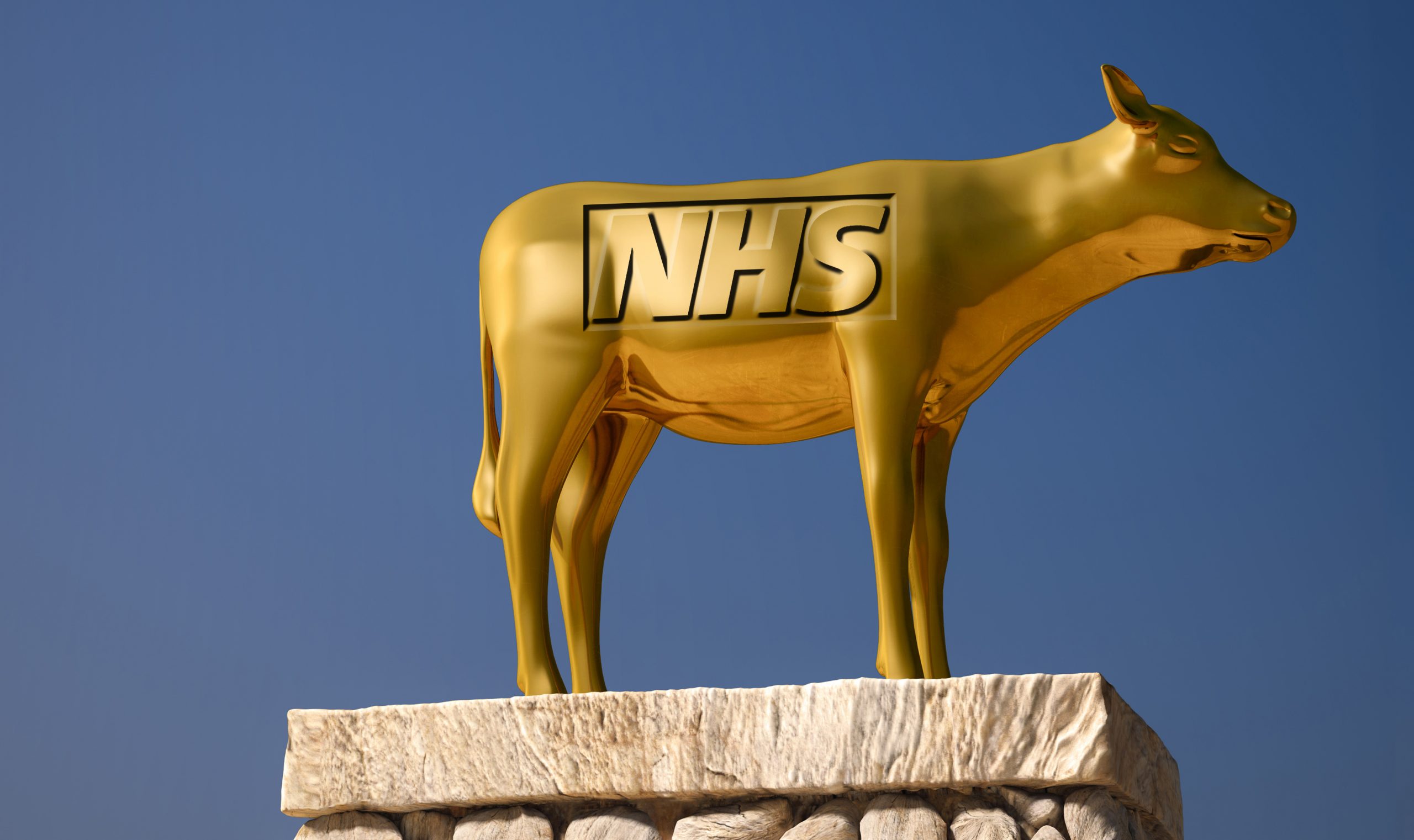
Not actually the official symbol of Britain’s National Health Services … probably.
Over the course of the past seven months, we have seen every indulgence come under fire for its supposed role not just in transmitting coronavirus but also in causing any excess deaths. Cast your mind back to the start of the crisis, when the World Health Organisation launched its #HealthyAtHome campaign, advising us to shun butter and sugary drinks, despite there being little evidence such a move would serve to limit the spread or impact of Covid-19.
Then there was the dismally weak Chinese study, which found smokers were more likely to become seriously ill from Covid, which was warmly received by the public-health establishment. It handed them their smoking gun, until it became clear smokers were significantly less likely to actually contract the disease in the first place.
Now we have the destruction of the pub industry. First there was the 10pm curfew, imposed with little regard for the fact that it would encourage house parties held in far less safe environments than heavily regulated pubs or restaurants. Advocates seemed to gloss over the evidence suggesting that less than five per cent of infected individuals contacted by NHS Test and Trace had been in close contact with another person in a hospitality venue. Then there was the clampdown on households mixing, Scotland’s first minister Nicola Sturgeon’s indoor booze ban, and the bizarre insistence that pubs in Tier 2 could only serve alcohol if food was dished out at the same time.
This pandemic has triggered renewed fervour among nanny-state obsessives – no more so than among those determined to take down the food industry. You can bet that with hospitalisations and deaths on the rise again, there will be a commensurate increase in one-sided agitprop from celebrity supporters like Henry Dimbleby or Jamie Oliver. Just last month the latter called on the government to market water – yes, water – to young people as more attractive than soft drinks and proposed an “eat well to stay well” scheme modelled on the government’s Eat Out to Help Out initiative. Meanwhile, this week the government announced that advertising junk foods like sausage rolls and fish fingers would be banned online.
If the definition of insanity is doing the same thing over and over again and expecting a different result, then the public-health lobby’s mental wellbeing is surely in doubt. According to a collection of essays by Dolly Theis, long-term advocate of anti-obesity measures, 700 policies have been proposed in Britain over the past 30 years. In reality, these are the same policies renewed, repackaged and ramped up by fanatical single-issue pressure groups, the sort who claim obesity is an epidemic when hundreds of thousands are dying by Covid’s hand.
It is a springtime of revolution throughout the world in 1919 and not just the political kind. Era-defining advances in science and technology and iconic cinematography are made this season.
Hosted by: Indy Neidell
Written by: Indy Neidell and Francis van Berkel
Director: Astrid Deinhard
Producers: Astrid Deinhard and Spartacus Olsson
Executive Producers: Astrid Deinhard, Indy Neidell, Spartacus Olsson, Bodo Rittenauer
Creative Producer: Maria Kyhle
Post-Production Director: Wieke Kapteijns
Research by: Indy Neidell and Francis van Berkel
Edited by: Michał Zbojna
Sound design: Marek Kamiński
Colorizations:
Klimbim
Mikołaj Uchman
Wayne Degan
metacolor.org
Sources:
Library of Congress
Bundesarchiv
Icons from The Noun Project:
– retro computer By Tinashe Mugayi, MY
– audio sound recorder By Vectors Point, PK
– Radio by Bill Denk
– Old TV By Pascal Heß, DE
– Radio Tower by Iris Sun
Soundtracks from Epidemic Sound:
– “British Royalty” – Trailer Worx
– “Flight Path” – Cobby Costa
– “Deflection” – Reynard Seidel
– “Flight Path” – Cobby Costa
– “A Single Grain Of Rice” – Yi Nantiro
– “Trapped in a Maze” – Philip Ayers
– “Symphony of the Cold-Blooded” – Christian Andersen
– “Rainy Landscapes” – Farrell Wooten
– “Ancient Saga” – Max Anson
A TimeGhost chronological documentary produced by OnLion Entertainment GmbH.
From the comments:
TimeGhost History
1 day ago J’accuse is one of the many iconic films we’ll explore in this series. The interwar period is when European cinema really starts to hit its stride again after some serious setbacks during the Great War. In those years, American cinema rocketed to the mainstream both at home and abroad, with revolutionary filmmaking techniques being developed that we still see today such as close-ups, huge cast lists, and realistic set design.
The post-Great War is set to be a great era in the history of cinema and not just because of the films themselves, J’accuse and other films are important as historical movers in their own right! They shape public perceptions, influence political change, and inspire whole social movements, so make sure you stay tuned to find out.
And in the meantime, are there any iconic interwar films you think deserve to be in this series?
Comments Off on The General Relativity of Revolution | BETWEEN 2 WARS: ZEITGEIST! | E.03 – Spring 1919
Canadian history from the discovery of the Vikings to the French and English colonization until modern times.
Tags:
Canadian history documentary, Canadian history crash course, Canada history, history of Canada documentary, history Canada summarized, Canada, history, Canadian history, Canadian American history, animated history of Canada, canadian history in a nutshell, canadian history for kids, educational, Canada Indians, Canada great Britain, English Canada, Quebec, French Canada, French English Canada,
Comments Off on The history of Canada explained in 10 minutes
So, government is this all knowing, all seeing, entity which can plan, in detail, what should be produced, by whom, where, at what price. That’s what we need to be true if we are to have an interventionist government which tries to plan the economy.
Government is so ill-equipped to judge the future that it sold €6 billion’s worth of property off for £1.6 billion – that’s what we need to be true for that £4.5 billion loss, no? This is not a world in which we can trust government to plan our economy, is it?
And which government exists in reality? Well, the complaint is that second. And the people complaining are largely those who insist that we should act as if we’ve government of the first type. No, they don’t note the discord in that logic either. Governments aren’t very good at economic decisions therefore governments must make more economic decisions for us all. If you can manage to believe that you too can join the Labour Party.
As German troops pull into eastern Ukraine, locals fight back in any way they can. Some of them have been the target of Soviet brutalisation for decades. For many who are deemed ‘enemy of the Third Reich’, the first two weeks of November 1941 are their last, as the ‘Holocaust of Bullets’ continues.
Sources:
Yad Vashem 2725/6, 953, 145CO2, 2798-2, 48AO3, 2869/48, 4360/99, 83EO4, 2791/5, 4220/3, 48AO5, 3745/140, 48AO4, 95EO2, 142BO7, 3296/4, 4788/72, 4613/625,4788/73
Visuotinė lietuvių enciklopedija
Bundesarchiv
USHMM
Picture of Soviet POWs digging graves, courtesy of Max Peronius
from the Noun Project: Skull by Muhamad Ulum
Soundtracks from the Epidemic Sound:
Peter Sandberg – “Document This 1”
Gavin Luke – “Drifting Emotions 3”
Farrell Wooten – “Blunt Object”
Wendel Scherer – “Defeated”
Gunnar Johnsen – “Not Safe Yet”
Andreas Jamsheree – “Guilty Shadows 4”
Jon Bjork – “For the Many”
Jon Bjork – “Icicles”
A TimeGhost chronological documentary produced by OnLion Entertainment GmbH.
From the comments:
World War Two
1 hour ago
You might have noticed how more and more of our War Against Humanity episodes are restricted by YouTube. For some, it might take up to three separate “warning” windows to see the video. Many don’t get the episodes in their subscription boxes or don’t receive notifications despite their settings having notifications turned on. The video might not be sharable on social media, or some might not be able to watch them at all because they don’t have an account, are deemed too young by YouTube or are in the wrong geographic location.
And that doesn’t even include the huge restrictions YouTube puts on the organic reach of these videos. If it weren’t for out loyal community and other social media channels, these War Against Humanity episodes would go virtually under the radar. Even though our episodes could be a remedy to the problems that YouTube and many societies are dealing with. Misinformation, ignorance, and the obliviousness to the horrors of our past are dangerous and the restriction of our educational, factual and academic coverage of these horrors adds insult to injury.
“The following content has been identified by the YouTube community as inappropriate or offensive to some audiences,” one of the warning says. And mind you that it’s not the facts that people find offensive. They’re facts. They are neutral. It is that we are showing them to the world that people find offensive.
We won’t change our content or our tone. To make sure to see our content no matter what, you can follow our other Social Media accounts and/or join the TimeGhost Army on https://www.patreon.com/TimeGhostHistory or https://timeghost.tv to ensure we stay financially independent.
Cheers,
Joram
Comments Off on How To Kill 15,000 People in One Day – War Against Humanity 022 – November 1941, Pt. 1
A simple recognition of some of our family members who served in the First and Second World Wars:
The Great War
Private William Penman, Scots Guards, died 16 May, 1915 at Le Touret, age 25
(Elizabeth’s great uncle)
Private Archibald Turner Mulholland, Argyll & Sutherland Highlanders, mortally wounded 25 September, 1915 at Loos, age 27
(Elizabeth’s great uncle)
Private David Buller, Highland Light Infantry, died 21 October, 1915 at Loos, age 35
(Elizabeth’s great grandfather)
Private Harold Edgar Brand, East Yorkshire Regiment. died 4 June, 1917 at Tournai.
(My first cousin, three times removed)
Private Walter Porteous, Durham Light Infantry, died 4 October, 1917 at Passchendaele, age 18
(my great uncle)
Corporal John Mulholland, Argyll & Sutherland Highlanders, wounded 2 September, 1914 (shortly before the First Battle of the Aisne), wounded again 29 June, 1918, lived through the war.
(Elizabeth’s great uncle)
The Second World War
Flying Officer Richard Porteous, RAF, survived the defeat in Malaya and lived through the war
(my great uncle)
Able Seaman John Penman, RN, served in the Defensively Equipped Merchant fleet on the Murmansk Run (and other convoy routes), lived through the war
(Elizabeth’s father)
Private Archie Black (commissioned after the war and retired as a Major), Gordon Highlanders, captured at Singapore (aged 15) and survived a Japanese POW camp
(Elizabeth’s uncle)
Elizabeth Buller, “Lumberjill” in the Women’s Land Army in Scotland through the war. (Elizabeth’s mother)
Trooper Leslie Taplan Russon, 3rd Royal Tank Regiment, died at Tobruk, 19 December, 1942 (aged 23). Leslie was my father’s first cousin, once removed (and therefore my first cousin, twice removed).
For the curious, the Commonwealth War Graves Commission the Royal British Legion, and the Library and Archives Canada WW1 and WW2 records site provide search engines you can use to look up your family name. The RBL’s Every One Remembered site shows you everyone who died in the Great War in British or Empire service (Canadians, Australians, New Zealanders, South Africans and other Imperial countries). The CWGC site also includes those who died in the Second World War. Library and Archives Canada allows searches of the Canadian Expeditionary Force and the Royal Newfoundland Regiment for all who served during WW1, and including those who volunteered for the CEF but were not accepted.
In Flanders fields the poppies blow
Between the crosses row on row,
That mark our place; and in the sky
The larks, still bravely singing, fly
Scarce heard amid the guns below.
We are the Dead. Short days ago
We lived, felt dawn, saw sunset glow,
Loved and were loved, and now we lie
In Flanders fields.
Take up our quarrel with the foe:
To you from failing hands we throw
The torch; be yours to hold it high.
If ye break faith with us who die
We shall not sleep, though poppies grow
In Flanders fields.
Lieutenant Colonel John McCrae, MD Canadian Army Medical Corps (1872-1918)
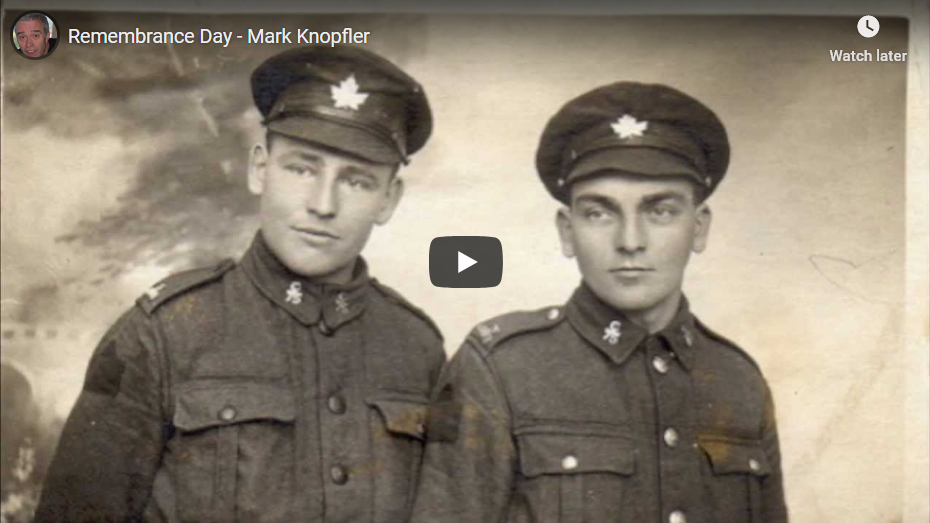
A Remembrance Day slideshow using Mark Knopfler’s wonderful “Remembrance Day” song from the album Get Lucky (2009). The early part of the song conveys many British images, but I have added some very Canadian images also which fit with many of the lyrics. The theme and message is universal… “we will remember them”.
Although it was in every way more pardonable, the attitude of the Left towards the Russian régime has been distinctly similar to the attitude of the Tories towards Fascism. There has been the same tendency to excuse almost anything “because they’re on our side”. It is all very well to talk about Lady Chamberlain photographed shaking hands with Mussolini; the photograph of Stalin shaking hands with Ribbentrop is much more recent. On the whole, the intellectuals of the Left defended the Russo-German Pact. It was “realistic”, like Chamberlain’s appeasement policy, and with similar consequences. If there is a way out of the moral pigsty we are living in, the first step towards it is probably to grasp that “realism” does not pay, and that to sell out your friends and sit rubbing your hands while they are destroyed is not the last word in political wisdom.
The Pritchard bayonet for the Webley revolver is one of the more photogenic and less truly practical weapons to come out of the Great War. Designed by one Captain Pritchard after he spent a year in France in 1915-1916 with the Royal Berkshire Regiment, the idea was to use the front 8 inches or so of a sword on a cast gunmetal hilt to create a bayonet mounted on a British service revolver. He first presented the idea to the Wilkinson Sword Company, but they were too busy making sabers and rifle bayonets, and suggested that having to sacrifice usable sword blades for production would make it quite the expensive endeavor.
Pritchard next took his idea to W.W. Greener, where he found a more receptive audience. Greener had a large supply of surplus French Gras bayonets, which were cheap and served as excellent donors for the Pritchard bayonets. Something like 200 were made in total — not formally adopted by the British but available for commercial sale to officers who might want them. While some may have seen service, no hard evidence has been found to prove any combat action with them.
Over the decades, a great many fake and reproduction Pritchard bayonets have been made — many times more than there are originals. As far as I can determine, this one is a legitimate original (although it may have a replacement locking lever). A few things to look for in authenticating a Pritchard are engraved patent and manufacturer marks (most reproductions have no manufacturer logo and a stamped patent number) and a quality casting. When you hold the blade and tap the handle with a hard object, it should ring bright and bell-like (which this one does).
Comments Off on WWI Pritchard Bayonet for the Webley Revolver
For TANKFEST 2019, The Tank Museum was extremely lucky to be able to display the Leopard PRTL courtesy of The Historic Collection of the Royal Netherlands Army, in cooperation with the National Military Museum of the Netherlands.
David Willey explores how the self-propelled anti-aircraft system, based on a Leopard 1 tank, works and operates, alongside some footage of the PRTL in action.
Don’t miss the special announcement of our new exciting collaboration at the end of this episode!
Register for free at World of Warships here: https://wo.ws/PearlHarbor and receive a special in-game package worth €25, including the ships USS St. Louis, Japanese Cruise Tenryū – and more bonuses.
In this episode:
There is a lull now on the Eastern Front, and Adolf Hitler uses the time to plan another drive on Moscow and points beyond, but he’ll be facing a larger Red Army, as reinforcements and recruits hope to nearly double its size in a matter of weeks. The British are counting down the days to their upcoming North African offensive, and the Japanese are sending out orders that will change the world dramatically in a single morning.
Written and Hosted by: Indy Neidell
Director: Astrid Deinhard
Producers: Astrid Deinhard and Spartacus Olsson
Executive Producers: Astrid Deinhard, Indy Neidell, Spartacus Olsson, Bodo Rittenauer
Creative Producer: Maria Kyhle
Post-Production Director: Wieke Kapteijns
Research by: Indy Neidell
Edited by: Miki Cackowski
Sound design: Marek Kamiński
Map animations: Eastory (https://www.youtube.com/c/eastory)
Sources:
Bundesarchiv
Arkiv i Nordland
Narodowe Archiwum Cyfrowe
IWM C 4748, E 6661, WPN 298, E 6724, MH 9292, E 3469E, E 7008, E 759C
Picture of Alfred Godwin-Austin, courtesy of Berserker276 https://commons.wikimedia.org/wiki/Fi…
from the Noun Project: company soldiers by Andrei Yushchenko, Bell by wahyakup
Soundtracks from the Epidemic Sound:
Reynard Seidel – “Deflection”
Johannes Bornlof – “Deviation In Time”
Rannar Sillard – “March Of The Brave 4”
Bonnie Grace – “The Dominion”
Johan Hynynen – “Dark Beginning”
Johannes Bornlof – “The Inspector 4”
Fabien Tell – “Last Point of Safe Return”
Hakan Eriksson – “Epic Adventure Theme 3”
A TimeGhost chronological documentary produced by OnLion Entertainment GmbH.
From the comments:
merdiolu81
22 hours ago (edited)
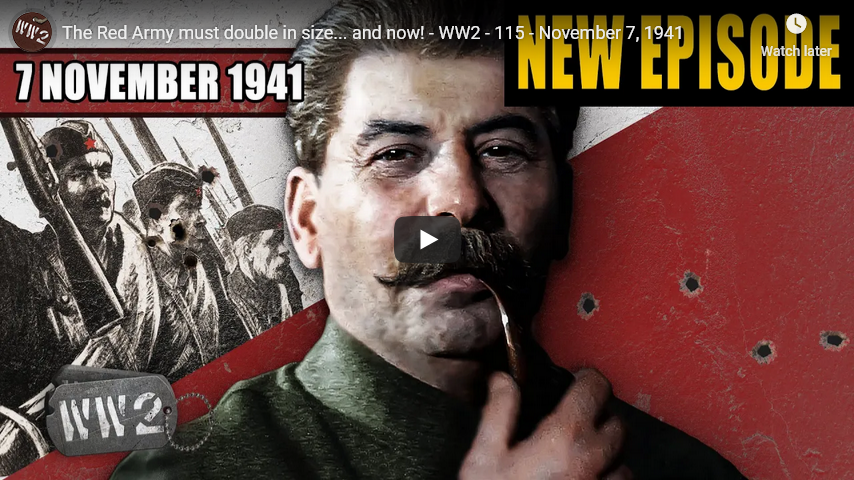
Meanwhile, on 30 October, Stalin had raised a casual question. “How are we going to do the military parade?” That was the great, traditional 7 November Red Square parade, the celebration of the 1917 “October” Revolution, which had taken place on 24-5 October, Old Style — 6-7 November, New Style. General Pavel Artem’ev, who had been commander of the Moscow Military District and had taken command of the Moscow defence zone as the critical phase began, on 12 October, said it could not happen. Yes, it would, said Stalin. If there was a German air raid, the dead and wounded should be removed quickly, he added. It would happen. The risk was considerable. The potential political response was devastatingly positive, and worth the risk. The “Boss” had his faults (aside being a brutal tyrant) , but this was the decision of a leader. The parade would take place, and the troops, guns and armoured vehicles would then proceed straight to the front. It was a stroke of genius. The military effect would be compounded by the media and political effect. As always, everything was kept secret until the last moment. The officers involved did not receive their final briefing until 02.00. Stalin liked surprises, as most dictators do.
On 7 November, at 08.00 hours, just after dawn, under a steely, overcast Russian sky, with rimy air on the brink of freezing and snow beginning to fall, the troops marched south-east down the “square”, towards St Basil’s Cathedral and the Moskva river, beyond. Red Square, which owes its name to the old Slavic word for “beautiful”, and not to communism at all, is not really a square, either. It is a wide cobbled boulevard, running past the north-east wall of the red-brick, triangular Renaissance fortress. St Basil’s Cathedral is the onion-domed fantasy built for Ivan the Terrible. He was so delighted with it that he had the architect’s eyes put out, so that he could not build for anybody else anything so whimsically fantastic and beautiful. Stalin admired Ivan. The Germans were coming from the north-north-west, so, once the troops, guns and armoured vehicles had passed Lenin’s Mausoleum and reached St Basil’s, they would turn smartly about and head in the opposite direction, up Gor’kiy Street, and then north-west, to face the Germans.
The stars of the show were the new T-34 and KV tanks. But one of the heavy KV tanks screeched to a halt and then turned the wrong way. Another followed. The tanks were all armed, ready for battle, and if anybody wanted to take out the Politburo standing on Lenin’s Mausoleum, that would have been an ideal opportunity. Given the paranoia which prevailed in Moscow at the time, overreaction might have been the order of the day. Artem’ev demanded to know what had happened. The first tank, it turned out, had suffered a mechanical problem, and its commander did not want to cause any embarrassment on the big parade, so he got out of the way. Following the standard operating procedures the newly trained crews had been taught, the second tank went to its aid. This was starting to look like a professional army. The boss classes gathered on the Mausoleum found it amusing, and no one was reprimanded. The big parade was an iconic image of the war, and a stroke of public-relations genius. And, that night, earlier than usual, the Russian winter snow really began to fall.
Absolute War, Soviet Russia in the Second World War – Chris Bellamy
Comments Off on The Red Army must double in size… and now! – WW2 – 115 – November 7, 1941




 Private William Penman, Scots Guards, died 16 May, 1915 at