Quotulatiousness

June 4, 2020

Tank Chats #71 M3 Stuart Hybrid | The Tank Museum

Filed under: Britain, History, Military, USA, Weapons, WW2 — Tags: , , , — Nicholas @ 02:00

The Tank Museum
Published 29 Mar 2019

David Fletcher talks about the Second World War M3 Stuart and why this particular version is a hybrid.

The M3 Stuart was built by the USA for WW2 and went into service in 1941. The tank in this video was gifted to The Tank Museum by the Brazilian Army.

Support the work of The Tank Museum on Patreon: ► https://www.patreon.com/tankmuseum

Visit The Tank Museum SHOP: ► https://tankmuseumshop.org/
Twitter: ► https://twitter.com/TankMuseum
Tiger Tank Blog: ► http://blog.tiger-tank.com/
Tank 100 First World War Centenary Blog: ► http://tank100.com/ #tankmuseum #tanks #tankchats

June 3, 2020

How to be a Pirate: Quartermaster Edition 📙📈

Filed under: Britain, Business, Economics, History, Humour — Tags: , , , — Nicholas @ 06:00

CGP Grey
Published 2 Jun 2020

‣ Adapted largely from The Invisible Hook. It’s great, go read it: https://amzn.to/36PLKSE
‣ Director’s Commentary later today: https://www.patreon.com/cgpgrey

## Special Thanks

Peter T. Leeson for reviewing a draft of the script. Check out his newest book, WTF?!: An Economic Tour of the Weird: https://amzn.to/3eEMm09

## Crowdfunders

Steven Snow, Bob Kunz, John Buchan, Nevin Spoljaric, Donal Botkin, BN-12, Chris Chapin, Richard Jenkins, Phil Gardner, Martin, سليمان العقل, Steven Grimm, Colin Millions, Saki Comandao, Jason Lewandowski, Andrea Di Biagio, David F Watson, Ben Schwab, Elliot Lepley, rictic, Bobby, Marco Arment, Shallon Brown, Shantanu Raj, emptymachine, George Lin, Henry Ng, Jeffrey Podis, Thunda Plum, Awoo, David Tyler, Derek Bonner, Derek Jackson, Fuesu, iulus, Jordan Earls, Joshua Jamison, Mikko, Nick Fish, Nick Gibson, Orbit_Junkie, Ron Bowes, Tómas Árni Jónasson, Tyler Bryant, Zach Whittle, Oliver Steele, Kermit Norlund, Kevin Costello, Ben Delo, Arctic May, Bear, chrysilis, David Palomares, Emil, Erik Parasiuk, Esteban Santana Santana, Freddi Hørlyck, Frederick The Great, John Rogers, ken mcfarlane, Leon, Maarten van der Blij, Peter Lomax, Rhys Parry, ShiroiYami, Tijmen van Dien, Tristan Watts-Willis, Veronica Peshterianu, Dag Viggo Lokøen, John Lee, Maxime Zielony, Bryan McLemore, Elizabeth Keathley, Alex Simonides, Felix Weis, Melvin Sowah, Giulio Bontadini, Paul Alom, Ryan Tripicchio, Scot Melville

## Music

David Rees: http://www.davidreesmusic.com

The Wehrmacht‘s License to Kill the Innocent – War Against Humanity 012 – May 1941

Filed under: Europe, Germany, History, Military, WW2 — Tags: , , , , , , , — Nicholas @ 04:00

World War Two
Published 2 Jun 2020

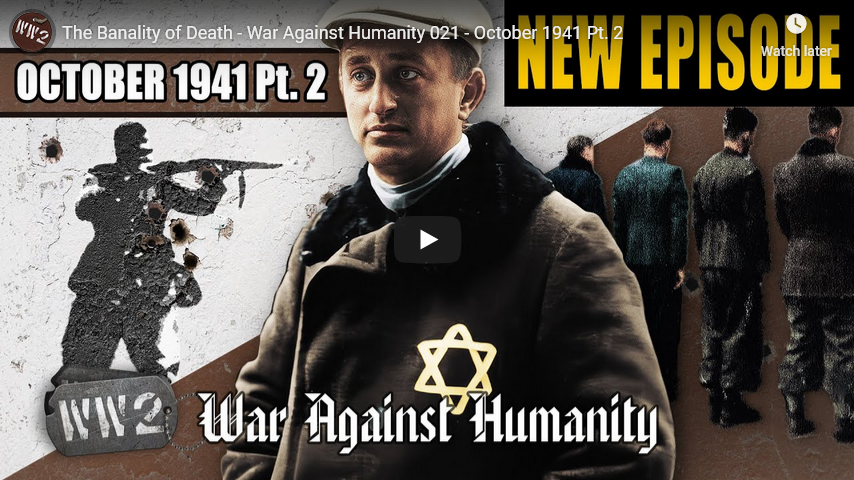
As the Blitzes of Britain slow down considerably, violence in Croatia increases dramatically as the Ustaše government purges the country of Jews and Serbs and the Wehrmacht gets deadly instructions for their invasion of the Soviet Union.

Join us on Patreon: https://www.patreon.com/TimeGhostHistory
Or join The TimeGhost Army directly at: https://timeghost.tv

Follow WW2 day by day on Instagram @World_war_two_realtime https://www.instagram.com/world_war_t…
Between 2 Wars: https://www.youtube.com/playlist?list…
Source list: http://bit.ly/WW2sources

Hosted by: Spartacus Olsson
Written by: Joram Appel and Spartacus Olsson
Director: Astrid Deinhard
Producers: Astrid Deinhard and Spartacus Olsson
Executive Producers: Astrid Deinhard, Indy Neidell, Spartacus Olsson, Bodo Rittenauer
Creative Producer: Joram Appel
Post-Production Director: Wieke Kapteijns
Research by: Joram Appel
Edited by: Mikołaj Cackowski
Sound design: Marek Kamiński
Map animations: Eastory (https://www.youtube.com/c/eastory)

Colorizations by:
Norman Stewart – https://oldtimesincolor.blogspot.com/
Adrien Fillon – https://www.instagram.com/adrien.colo…
Carlos Ortega Pereira – BlauColorizations, https://www.instagram.com/blaucoloriz…
Cassowary Colorizations – https://www.flickr.com/people/cassowa…

Sources:
Bundesarchiv
Narodowe Archiwum Cyfrowe
IWM D 5984, D 1091
USHMM

Bibliography:
Barton, Brian, “A Belfast Blitz Memorial?”. In: History Ireland 24:2 (March/April 2016) 8-9.
Biondich, Mark, “Religion and Nation in Wartime Croatia: Reflections on the Ustaša Policy of Forced Religious Conversions, 1941-1942″. In: The Slavonic and East European Review 83:1 (Jan 2005) 71-116.
Clapson, Mark, “Air Raids in Britain, 1940-45”. In: The Blitz companion: Aerial Warfare, Civilians and the City since 1911 (2019) 37-76.
Gotovich, Aron, Dictionnaire de La Seconde Guerre Mondiale En Belgique (2008).
MacDonald, David B., “From Jasenovac to Srebrenica; Subaltern Genocide and the Serbs”. In: Nicholas Robins, Adam Jones (ed.), Genocides by the Oppressed: Subaltern Genocide in Theory and Practice (2009) 103-121, 106.
Tanner, Marcus, “The Ustashe”. In: Croatia: A Nation Forged in War; Third Edition (2010) 141-167.
Williamson, Murray, and Allan Millett, “Barbarossa 1941”. In: A War To Be Won (2000) 110-142.

Primary Sources:
Barbarossa Decree, 13 May 1941. http://users.clas.ufl.edu/ggiles/barb….
Commissar Order, 6 June 1941. http://users.clas.ufl.edu/ggiles/barb….
William Sansom: Westminster in War, 1947.

Soundtracks from the Epidemic Sound:
Cobby Costa – “From the Past”
Reynard Seidel – “Deflection”
Johan Hynynen – “Dark Beginning”
Gunnar Johnsen – “Not Safe Yet”
Farell Wooten – “Blunt Object”
Peter Sandberg – “Document This 1”
Andreas Jamsheree – “Guilty Shadows 4”
Cobby Costa – “Flight Path”

Archive by Screenocean/Reuters https://www.screenocean.com.

A TimeGhost chronological documentary produced by OnLion Entertainment GmbH.

From the comments:

World War Two
2 hours ago
For many living in newly occupied territories in South-Eastern Europe, May 1941 marked the start of a hellish life under fascist occupation. For many more, May 1941 will be the month in which their fate is sealed. Many hundreds of thousands more will suffer by the decisions made this months. From this episode, and the next ones, it will become very clear that there is no such thing as a “clean Wehrmacht“, and that this is very much a myth. Some parts of the internet still seem to hold on tight to this, but we will counter it time and again, wether it is about occupying forces, Operation Barbarossa or Erwin Rommel.

Cheers,
Joram

Fanatics gonna fanatic … they can’t help it

It’s funny that no matter what the claimed crisis, the answers always go in the same direction, as Kristian Niemietz points out with the demands to turn our still unending lockdown toward “protecting the environment”:

The change, superficially, is to encourage “a safe return to work” allowing more social distancing between pedestrians, but more substantially in order to preserve the cleaner air that has resulted from the lockdown.

The health and safety excuse for the policy change can be largely dismissed. The simple truth of the pandemic and national policy is that if social distancing matters, the centre of London is not safe to return to work. It is too densely populated and almost entirely reliant on mass transit which cannot operate above 10-15% capacity with 2m exclusion rules. With average commutes over 9 miles each way, substitution effects to walking and cycling will be extremely limited and temporary.

It is then hard to see then how the policy’s architects imagine the streets will fill up to the extent urgent measures are needed. Conversely, if social distancing does not matter (and it will cease to matter eventually), then a policy to enable more social distancing outside by widening the pedestrian streetscape is redundant. If it is safe to sit on a crowded train, it is safe to walk on a crowded pavement. It is not hard then to cut through the pandemic packaging to note that the motive for this policy is opportunistic, to accelerate a pedestrianisation plan that is the dream of many an urban planner.

Many will see this as self-evidently a good thing. Removing vehicle traffic from densely populated narrow streets will reduce air pollution, congestion and road traffic accidents. As a policy it will have more supporters than opponents; very few people drive into the centre of London to commute and there is very little capacity for parking. London’s leaders are not wrong to think that this is the future, the question is really one of timing and how they go about it, which is far more difficult and does not have anything to do with managing a coronavirus.

What the pandemic allows is the ability to use emergency powers for something that is not an emergency. This matters, in normal times it took several years to close one dangerous junction at Bank to most traffic, and this under a hail of protests from local businesses and taxi drivers. The same result can now be achieved in a few weeks across many streets. The democratic checks and balances that differentiate the UK from authoritarian states can be ditched and London officialdom granted extraordinary powers to do as they please. If the protestors don’t like it this time, they should note the right to protest has also been suspended, at least for now.

June 2, 2020

The Fall Of The Roman Empire With Tom Holland | History Hit LIVE on Timeline

Filed under: Europe, History, Middle East — Tags: , , , , — Nicholas @ 04:00

Timeline – World History Documentaries
Published 29 May 2020

The Roman Empire remains one of the most enduring and prolific civilisations of written history. Yet it, like all great civilisations, would eventually come to an end. Join Dan Snow as he speaks to historian Tom Holland about the many contributing factors that would bring this seismic and seemingly invincible empire to its knees.

#StayHome #WithMe #FallOfRome

June 1, 2020

How to be a Pirate 🏴‍☠️

Filed under: Britain, History, Humour — Tags: , , , — Nicholas @ 04:00

CGP Grey
Published 30 May 2020

‣ Adapted largely from The Invisible Hook. It’s great, go read it: https://amzn.to/36PLKSE
‣ Thank you, my Patrons, for making this video possible: https://www.patreon.com/posts/37699725

## Special Thanks

Peter T. Leeson for reviewing a draft of the script. Check out his newest book, WTF?!: An Economic Tour of the Weird: https://amzn.to/3eEMm09

## Crowdfunders

Steven Snow, Bob Kunz, John Buchan, Nevin Spoljaric, Donal Botkin, BN-12, Chris Chapin, Richard Jenkins, Phil Gardner, Martin, سليمان العقل, Steven Grimm, Colin Millions, Saki Comandao, Jason Lewandowski, Andrea Di Biagio, David F Watson, Ben Schwab, Elliot Lepley, rictic, Bobby, Marco Arment, Shallon Brown, Shantanu Raj, emptymachine, George Lin, Henry Ng, Jeffrey Podis, Thunda Plum, Awoo, David Tyler, Derek Bonner, Derek Jackson, Fuesu, iulus, Jordan Earls, Joshua Jamison, Mikko, Nick Fish, Nick Gibson, Orbit_Junkie, Ron Bowes, Tómas Árni Jónasson, Tyler Bryant, Zach Whittle, Oliver Steele, Kermit Norlund, Kevin Costello, Ben Delo, Arctic May, Bear, chrysilis, David Palomares, Emil, Erik Parasiuk, Esteban Santana Santana, Freddi Hørlyck, Frederick The Great, John Rogers, ken mcfarlane, Leon, Maarten van der Blij, Peter Lomax, Rhys Parry, ShiroiYami, Tijmen van Dien, Tristan Watts-Willis, Veronica Peshterianu, Dag Viggo Lokøen, John Lee, Maxime Zielony, Bryan McLemore, Elizabeth Keathley, Alex Simonides, Felix Weis, Melvin Sowah, Giulio Bontadini, Paul Alom, Ryan Tripicchio, Scot Melville

## Music

David Rees: http://www.davidreesmusic.com

The true GOAT

Filed under: Britain, History, Military, Sports — Tags: , — Nicholas @ 03:00

Nigel Davies explains why even the greatest athletes and sportspersons of today are no match for the Greatest Of All Time – William the Marshal, 1st Earl of Pembroke:

Head of the effigy of William Marshal, 1st Earl of Pembroke, in Temple Church, London.
Photo by Kjetil Bjørnsrud via Wikimedia Commons.

William the Marshall is almost universally recognised as “the best knight that ever lived”, by all those who consider his extraordinary career as a fighter, warrior, war leader, political leader, guardian, and shining light of courtly and knightly achievements at the height of the chivalric and troubadouring shift (that moved culture from adoring thugs who hit hard, to adoring all round “renaissance men” who could dance, sing, write poetry, play chess, fight, and negotiate treaties that bought peace to generations). He was one of the men whom the word “paragon” — a person or thing regarded as a perfect example of a particular quality — was invented for.

But he was also the GOAT athlete and sportsman.

Tournament fighting and jousting were the Olympic Games of the medieval world, and — far from being an elitist sport, or an act of middle class pretention — tournament fighting in both its foot and horseback forms is a sport common to all classes from all cultures throughout most of human history … from the Olympics and gladiatorial combats, to the foot combat of Fencing and Kendo and Judo, to the horse archery of most of the nomadic tribes of Asia and Africa and even the American Indians: combat games are virtually the only universal human sport there has ever been.

William the Marshall was competing at a sport — armed combat — that is universal, worldwide, and largely classless. Admittedly he was competing at the most elite level (only the Samurai or Persian or Eastern Roman Cataphracts really come close to European kinghts for an equivalent dedication to a lifetime of training and specialist equipment and expense). But you can confidently say that here was a sport whose experts could face any other expert in any other combat sport in the world without confusion or fear.

And you could confidently predict that William the Marshall could defeat the equivalent character in any of those other combat sports … (As he apparently did when he fought Muslim horse archers or Mameluke foot soldiers in his brief years on Crusade.)

As a man whose prowess in his chosen field could adapt to all equivalent fields, he certainly outranks Muhammed Ali: who is the closest competitor on the above list to a world class showman and rough and tumble performer for the crowds.

As a person who statistically outperformed even Donald Bradman in comparison to his competition. He comes out in front there too.

As a winner above all others — his deathbed comment that he had bested more than 500 knights in hs career from all over Europe and the Middle East is not something that a squash player with 555 wins is likely to compare.

And as an athletic freak, even Usain Bolt or Michael Phelps — with their scant decade or so of dominance, could dream of competing with.

William the Marshall won his first international class tournaments in his teens, and was still winning them in his 60s. His unsurpassed competitiveness lasted not a few years, but several decades. He beat the GRANDCHILDREN of his previous conquests. And did so in a deadly serious full contact sport, not a namby pamby game like tennis or golf!

May 31, 2020

Sink the Bismarck! – The Pride of the Kriegsmarine‘s Demise – WW2 – 092 – May 30 1941

Filed under: Britain, China, Germany, History, Japan, Military, WW2 — Tags: , , , , — Nicholas @ 04:00

World War Two
Published 30 May 2020

This week, the Battle of Crete continues as the Bismarck and Prinz Eugen set sail to the Atlantic, starting one of the most dramatic episodes in the histories of the Royal Navy and the Kriegsmarine.

Join us on Patreon: https://www.patreon.com/TimeGhostHistory
Or join The TimeGhost Army directly at: https://timeghost.tv

Follow WW2 day by day on Instagram @World_war_two_realtime https://www.instagram.com/world_war_t…
Between 2 Wars: https://www.youtube.com/playlist?list…
Source list: http://bit.ly/WW2sources

Written and Hosted by: Indy Neidell
Director: Astrid Deinhard
Producers: Astrid Deinhard and Spartacus Olsson
Executive Producers: Astrid Deinhard, Indy Neidell, Spartacus Olsson, Bodo Rittenauer
Creative Producer: Joram Appel
Post-Production Director: Wieke Kapteijns
Research by: NN
Edited by: Iryna Dulka
Sound design: Marek Kamiński
Map animations: Eastory (https://www.youtube.com/c/eastory)

Colorizations by:
– Norman Stewart – https://oldtimesincolor.blogspot.com/
– Daniel Weiss
– Jaris Almazani (Artistic Man), https://instagram.com/artistic.man?ig…
– Carlos Ortega Pereira, BlauColorizations, https://www.instagram.com/blaucoloriz…

Sources:
– Imperial War Museum: A 6152, A 6155, A 3898, IWM A4057, HU 50190, HU 374, FL 2120, E 3464, E 450
– U.S. Naval History and Heritage Command Photograph
– Narodowe Archiwum Cyfrowe
– Drawing of Churchill from Museon
– Battlecruiser Renown shape by Emoscopes from Wikimedia

Archive by Screenocean/Reuters https://www.screenocean.com.

A TimeGhost chronological documentary produced by OnLion Entertainment GmbH.

May 30, 2020

QotD: The “Americanization” of German philosophy

Filed under: Germany, History, Media, Quotations, USA — Tags: , , , — Nicholas @ 01:00

This popularization of German philosophy in the United States is of peculiar interest to me because I have watched it occur during my own intellectual lifetime, and I feel a little like someone who knew Napoleon when he was six. I have seen value relativism and its concomitants grow greater in the land than anyone imagined. Who in 1920 would have believed that Max Weber’s technical sociological terminology would someday be the everyday language of the United States, the land of the Philistines, itself in the meantime become the most powerful nation in the world? The self-understanding of hippies, yippies, yuppies, panthers, prelates and presidents has unconsciously been formed by German thought of a half-century earlier; Herbert Marcuse’s accent has been turned into a Middle Western twang; the echt Deutsch label has been replaced by a Made in America label; and the new American life-style has become a Disneyland version of the Weimar Republic for the whole family.

Allan Bloom, The Closing of the American Mind, 1987.

May 29, 2020

Der Bismarck: Doomed to Fail? – WW2 Biography Special

Filed under: Germany, History, Military, WW2 — Tags: , , , , — Nicholas @ 06:00

World War Two
Published 28 May 2020

The Bismarck is without a doubt a force to be reckoned with. But with the Kriegsmarine experiencing an identity crisis throughout the 1930s, the Bismarck‘s design and strategic purpose foreshadow a dramatic ending.

Join us on Patreon: https://www.patreon.com/TimeGhostHistory
Or join The TimeGhost Army directly at: https://timeghost.tv
Check out our TimeGhost History YouTube Channel: https://www.youtube.com/c/timeghost?s…

Follow WW2 day by day on Instagram @World_war_two_realtime https://www.instagram.com/world_war_t…
Between 2 Wars: https://www.youtube.com/playlist?list…
Source list: http://bit.ly/WW2sources

Hosted by: Indy Neidell
Written by: Joram Appel
Director: Astrid Deinhard
Producers: Astrid Deinhard and Spartacus Olsson
Executive Producers: Astrid Deinhard, Indy Neidell, Spartacus Olsson, Bodo Rittenauer
Creative Producer: Joram Appel
Post-Production Director: Wieke Kapteijns
Research by: Joram Appel
Edited by: Mikołaj Cackowski
Sound design: Marek Kamiński
Map animations: Eastory (https://www.youtube.com/c/eastory)

Colorizations by:
Ruffneck88, Wikimedia Commons
Norman Stewart – https://oldtimesincolor.blogspot.com/

Sources:
Bundesarchiv
IWM HU 374, HU 67486, HU 1041, HU 108392, A 6155, D 2373, HU 55631
From the Noun Project: Game by Ecem Afacan, Shield by Nikita Kozin

Soundtracks from the Epidemic Sound:
Phoenix Tail – “At the Front”
Johannes Bornlof – “The Inspector 4”
Rannar Sillard – “March Of The Brave 10”
Max Anson – “Ancient Saga”
Johannes Bornlof – “Deviation In Time”
Reynard Seidel – “Deflection”

Archive by Screenocean/Reuters https://www.screenocean.com.

A TimeGhost chronological documentary produced by OnLion Entertainment GmbH.

Theodore Dalrymple reviews 100 Principles for a New World by Nicolas Hulot

Filed under: Books, France — Tags: , — Nicholas @ 05:00

It’s kind of subtle, but I don’t think he’s a fan of the writer or his work:

Theodore Dalrymple on 24 September 2007.
Photo by jaapstronks at Flickr via Wikimedia Commons.

No opinion is worth expressing that is not also worth contradicting (except, perhaps, this one); nevertheless, clichés have their attraction. They are the teddy-bears of the mind, or, to change the metaphor slightly, the mental lifebuoys we cling to in times of stormy intellectual or political weather. They are the sovereign remedy for thought, which is always a rather painful activity.

“Can’t you stop me thinking, doctor?” asked some of my patients in the prison in which I worked, in the hope of a prescription of pills that would make them feel fuzzy and incapable of coherent mentation. For those who prefer a less drastic or non-pharmacological solution to the discomforts wrought by the contemplation of the world and their part in it, there are pseudo-thoughts with comforting connotations of wisdom, generosity, goodness, kindness, benevolence, etc. They are the kind of people, I suppose, who might think that Kahil Gibran’s kitsch vapourings are profound.

They would no doubt like Nicolas Hulot’s 100 Principles for a New World, published on 7 May in Le Monde. Hulot, an ecological activist, television personality and journalist once specialising in motorcycle racing, was M. Macron’s Minister for the Ecological and Solidary Transition (by their job titles shall ye know them) until he resigned with maximal noise in August 2018, having held the post for 15 months.

I confess that I was shocked by the banality of the mind, or alternatively the cynicism, of the person who could have written and published a manifesto such as Hulot’s – to say nothing of the astonishing lack of judgment of a respectable newspaper in publishing it. The last time that I was shocked so much by a politician’s vacuity was when I heard another Nicolas, Sarkozy this time, give a speech in person. He was like a dried pea rattling about and shaken in a tin box. He jumped around the stage making a passionate verbal noise, but nothing he said had any discernible tether to anything concrete. Within seconds of his finishing, no one could have given any account of what he had said. Is mastery of this kind of meaningless verbalisation, eloquently empty and passionately delivered, the key to political success? And if so what does it say of us, the citizens of democracies?

But to return to Hulot and his Hundred Principles. They each started “The time has come to…” or “The time has come for…”, followed by a cliché, a truism, or a banal falsehood, all expressed with a self-satisfaction that would have made Mr Pecksniff seem like a self-doubter.

“Night Witches” Pt. 2 – Female Soldiers – Sabaton History 069 [Official]

Filed under: France, History, Media, Military, Russia, WW2 — Tags: , , , , , , — Nicholas @ 04:00

Sabaton History
Published 28 May 2020

Quarantined Sabaton History is back! And this week we talk about female badass warriors of the Second World War! From a Soviet sniper to a French resistance fighter, many women chose to volunteer for the front and fight alongside the men. These are some of their tales.

Support Sabaton History on Patreon: https://www.patreon.com/sabatonhistory

Listen to “Night Witches” on the album Heroes here:
CD: http://bit.ly/HeroesStore
Spotify: http://bit.ly/HeroesSpotify
Apple Music: http://bit.ly/HeroesAppleMusic
iTunes: http://bit.ly/HeroesiTunes
Amazon: http://bit.ly/HeroesAmz
Google Play: http://bit.ly/HeroesGoogleP

Check out the trailer for Sabaton’s new album The Great War right here: https://www.youtube.com/watch?v=HCZP1…

Listen to Sabaton on Spotify: http://smarturl.it/SabatonSpotify
Official Sabaton Merchandise Shop: http://bit.ly/SabatonOfficialShop

Hosted by: Spartacus Olsson, substituting for Indy Neidell
Written by: Markus Linke and Indy Neidell
Directed by: Astrid Deinhard and Wieke Kapteijns
Produced by: Pär Sundström, Astrid Deinhard and Spartacus Olsson
Creative Producer: Joram Appel
Executive Producers: Pär Sundström, Joakim Broden, Tomas Sunmo, Indy Neidell, Astrid Deinhard, and Spartacus Olsson
Post-Production Director: Wieke Kapteijns
Edited by: Iryna Dulka
Sound Editing by: Marek Kaminski
Maps by: Eastory: https://www.youtube.com/c/eastory

Archive by: Reuters/Screenocean https://www.screenocean.com
Music by Sabaton.

Colorizations:
– Olga Shirnina, a.k.a. Klimbim – https://klimbim2014.wordpress.com/
– Jaris Almazani (Artistic Man), https://instagram.com/artistic.man?ig…
– Carlos Ortega Pereira, BlauColorizations, https://www.instagram.com/blaucoloriz…

Sources:
– Central Intelligence Agency
– Museum.ru
– Imperial War Museum:HU 66187
– Bundesarchiv, CC-BY-SA 3.0: Bild_101I-027-1477-24, 101I-301-1951-11, 101i-721-0395-22
– ETH-Bibliothek
– RIA Novosti archive, image #58861 / V. Krasutskiy / CC-BY-SA 3.0
– Crosshair by DTDesign from the Noun Project

An OnLion Entertainment GmbH and Raging Beaver Publishing AB co-Production.

© Raging Beaver Publishing AB, 2019 – all rights reserved.

The contagion of fear and the progressive loss of perspective in the modern world

Filed under: Britain, Government, Health, Media — Tags: , , , , , — Nicholas @ 03:00

In the Hector Drummond Magazine, Dan C. discusses what he calls the “comfort of fear”:

Not actually the official symbol of Britain’s National Health Services … probably.

This is the sort of glib response (akin to “so you WANT people to die then?”) that has essentially hijacked all conversation and debate since the start of the Coronavirus outbreak. I didn’t respond, partly because I didn’t have the energy for an argument with a friend (at least Twitter rows tend to be anonymous) and quite frankly, what does one say to this? That we shouldn’t send out children back to school ever again in case one child happens to pass away from any illness or disease? That we should continue in lockdown until we cure death itself?

My concern is that this bizarre way of thinking is commonplace right now for many parents. Locked inside their houses for weeks on end, soaking up an endless stream of Netflix programs, mawkish Instagram feeds and daily Government briefings, convinced that Black Death Mk II has landed outside their front door, paid by the state to stop working and lapping up every rainbow-based hashtag that emerges from “our NHS”, all sense of balance and perspective has vanished. With such an unprecedented paradigm shift, this new state of heightened safety has led many to consider their view on illness and risk for the very first time in their lives and unfortunately the concept of critical thinking has been found lacking. Real life, which has been slowly eroded for many decades, has suddenly been switched off completely overnight and the worst of it is that most people don’t seem to care.

The scary part of all of this is that if the adults in the room have suddenly lost their desire to engage in the outside world, to have meaningful human interaction, to take risks (don’t get me started on the definition of “risk”) and to live their lives in the fullest possible way then what chance do children stand? After all, you can’t miss what you’ve never had.

Historians will look back in bewilderment at this period, noting that it took no more than a month during the spring of 2020 for fearlessness to completely evaporate in society. In its place is a comfortable sense of fear.

QotD: Historical ways to deal with your “rage heads”

Filed under: Germany, History, Politics, Quotations, Russia, USA — Tags: , , , , , — Nicholas @ 01:00

The main lesson I hope our distant descendants draw from the Orange Man Era is: The rage heads ye have always with you, so ye must find a way to channel them into something as non-destructive as possible. The story of modern politics can be written in a sentence: The weaponization of rage heads, combined with the inability of any society to properly dispose of said WMDs.

Set the Wayback Machine to the turn of the 20th century. Lenin’s great insight is that “the masses” will never achieve the proper revolutionary consciousness without a dedicated cadre of hardcore, professional revolutionaries to lead the way. Lenin recognized the prevalence of incipient rage heads in his society — how could he not? — but realized that, absent some guiding hand, they’d flounder around incoherently. At best (from the “furthering the Revolution” point of view), they’d do what his, Lenin’s, idiot brother did: Try to knock off the tsar, and get himself hung for it. Thus, the Bolsheviks.

The problem, though, is that rage heads by definition suffer from poor impulse control. The tiny subset of them that are pure sociopaths (like Lenin), and thus have the icy-veined self-control to hold their fire, have to maintain the very tightest discipline over the Party, or all hell breaks loose. See, for example, the massive street battles in Weimar Germany between the KPD (German Commies) and the SD. Hitler, like Lenin, had to get his rage heads on a tight leash, so he channeled the disciplined sociopaths from the SD into the SS, cooled out the coolable in the SD by buying them off, and shanked the incorrigible remainder. See also the almost-exactly-contemporary Moscow Show Trials.

Note please that this is your best-case scenario for a purely ideological revolution. From Robespierre to Kim Il Sung, the first step in consolidating the Revolution is killing off a large fraction of the original revolutionaries.

The worst-case scenario (again, from the “furthering the Revolution” standpoint) is what the American wannabe-bolshies did / are currently doing. Knowing that you can’t shank or show-trial the dreadlocked poetry majors that make up your goon squad, you try to channel them into academia, the Media, the “arts.” Which fails egregiously, because whatever tenuous contact with reality they once had gets completely severed by those institutions’ social bubbles. They never were very good at holding fire, and now they can’t, literally can’t, see any reason to — life is great here on campus, so why can’t it be that way everywhere?

Severian, “Living in End Times”, Rotten Chestnuts, 2020-02-28.

May 28, 2020

Why Halftracks? Why limited to WW2 only? (Featuring Tank Fest 2018)

Filed under: Germany, History, Military, USA, Weapons, WW2 — Tags: , , , , — Nicholas @ 02:00

Military History not Visualized
Published 6 Jul 2018

Disclaimer: I was invited to Tank Fest by the Tank Museum.

Why were half-tracks used in the first place? Why not trucks, fully-tracked vehicles or something else? Also, why after the Second World War did the half-track disappear? Why were there no new types produced by major powers?

Big thank you to green_goblin_z for sending me 2 books from my amazon wishlist!

»» SUPPORT MHV ««
» patreon – https://www.patreon.com/mhv
» paypal donation – https://www.paypal.com/cgi-bin/webscr…

»» MERCHANDISE – SPOILS OF WAR ««
» shop – https://www.redbubble.com/people/mhvi…

Military History not Visualized is a support channel to Military History Visualized with a focus personal accounts, answering questions that arose on the main channel and showcasing events like visiting museums, using equipment or military hardware.

» SOURCES «

Spielberger, Walter; Doyle, Hilary Lous, Jentz, Thomas L.: Halbkettenfahrzeuge des deutschen Heeres
Spielberger: Halftracked Vehicles of the German Army 1909-1945
(Spielberger German Armor and Military Vehicle)

Zaloga, Steven J.: M3 Infantry Half-Track. 1940-73. Osprey Publishing: Oxford, UK (1992 / 2002).

Citino, Robert M.: The German Way of War. From the Thirty Years’ War to the Third Reich. University Press of Kansas: USA, 2005.

Krapke, Paul-Werner: Armor, in: Margiotta, Franklin D. (Executive Editor): Brassey’s Encyclopedia of Land Forces and Warfare. Brassey’s: Washington, USA (1996), p. 42-53

Pöhlmann, Markus: Der Panzer und die Mechanisierung des Krieges: Eine deutsche Geschichte 1890 bis 1945 (Zeitalter der Weltkriege)

Munzel, Oskar: Die deutschen gepanzerten Truppen bis 1945

Fleischer, Wolfgang: Die motorisierten Schützen und Panzergrenadiere des deutschen Heeres: 1935-1945 – Waffen, Fahrzeuge, Gliederung, Einsätze

Felberbauer, Franz: Waffentechnik I – Band 2: Geschütze, Waffen in Entwicklung, Nichttödliche Waffensysteme, Ballistik, Physikalische Grundlagen (Truppendienst)
https://www.truppendienst.com/td-buec…

« Newer PostsOlder Posts »

Powered by WordPress