
Such a system could not work without price control. In 301, Diocletian and his colleagues issued an Edictum de pretiis, dictating maximum legal prices or wages for all important articles or services in the Empire. Its preamble attacks monopolists who, in an “economy of scarcity”, had kept goods from the market to raise prices:
Who is … so devoid of human feeling as not to see that immoderate prices are widespread in the markets of our cities, and that the passion for gain is lessened neither by plentiful supplies nor by fruitful years? — so that … evil men reckon it their loss if abundance comes. There are men whose aim it is to restrain general prosperity … to seek usurious and ruinous returns. … Avarice rages throughout the world. … Wherever our armies are compelled to go for the common safety, profiteers extort prices not merely four or eight times the normal, but beyond any words to describe. Sometimes the soldier must exhaust his salary and his bonus in one purchase, so that the contributions of the whole world to support the armies fall to the abominable profits of thieves.
The Edict was, until our time, the most famous example of an attempt to replace economic laws by governmental decrees. Its failure was rapid and complete. Tradesmen concealed their commodities, scarcities became more acute than before, Diocletian himself was accused of conniving at a rise in prices, riots occurred, and the Edict had to be relaxed to restore production and distribution. It was finally revoked by Constantine.
The weakness of this managed economy lay in its administrative cost. The required bureaucracy was so extensive that Lactantius, doubtless with political license, estimated it at half the population. The bureaucrats found their task too great for human integrity, their surveillance too sporadic for the evasive ingenuity of men. To support the bureaucracy, the court, the army, the building program, and the dole, taxation rose to unprecedented peaks of ubiquitous continuity.
As the state had not yet discovered the plan of public borrowing to conceal its wastefulness and postpone its reckoning, the cost of each year’s operations had to be met from each year’s revenue. To avoid returns in depreciating currencies, Diocletian directed that, where possible, taxes should be collected in kind: taxpayers were required to transport their tax quotas to governmental warehouses, and a laborious organization was built up to get the goods thence to their final destination. In each municipality, the decuriones, or municipal officials, were held financially responsible for any shortage in the payment of the taxes assessed upon their communities.
Since every taxpayer sought to evade taxes, the state organized a special force of revenue police to examine every man’s property and income; torture was used upon wives, children, and slaves to make them reveal the hidden wealth or earnings of the household; and severe penalties were enacted for evasion. Towards the end of the 3rd century, and still more in the 4th, flight from taxes became almost epidemic in the Empire. The well-to-do concealed their riches, local aristocrats had themselves reclassified as humiliores to escape election to municipal office, artisans deserted their trades, peasant proprietors left their overtaxed holdings to become hired men, many villages and some towns (e.g., Tiberias in Palestine) were abandoned because of high assessments; at last, in the 4th century, thousands of citizens fled over the border to seek refuge among the barbarians.
It was probably to check this costly mobility, to ensure a proper flow of food to armies and cities, and of taxes to the state, that Diocletian resorted to measures that, in effect, established serfdom in fields, factories, and guilds. Having made the landowner responsible through tax quotas in kind for the productivity of his tenants, the government ruled that a tenant must remain on his land till his arrears of debt or tithes should be paid.
We do not know the date of this historic decree; but in 332, a law of Constantine assumed and confirmed it, and made the tenant adscriptitius, “bound in writing”, to the soil he tilled; he could not leave it without the consent of the owner; and when it was sold, he and his household were sold with it. He made no protest that has come down to us; perhaps the law was presented to him as a guarantee of security, as in Germany today. In this and other ways, agriculture passed in the 3rd century from slavery through freedom to serfdom and entered the Middle Ages.
Similar means of compelling stability were used in industry. Labor was “frozen” to its job, forbidden to pass from one shop to another without governmental consent. Each collegium or guild was bound to its trade and its assigned task, and no man might leave the guild in which he had been enrolled. Membership in one guild or another was made compulsory on all persons engaged in commerce and industry, and the son was required to follow the trade of his father. When any man wished to leave his place or occupation for another, the state reminded him that Italy was in a state of siege by the barbarians and that every man must stay at his post.
Will Durant, The Story of Civilization, Volume 3: Caesar and Christ, 1944.
April 16, 2022
QotD: The Edict of Diocletian
April 15, 2022
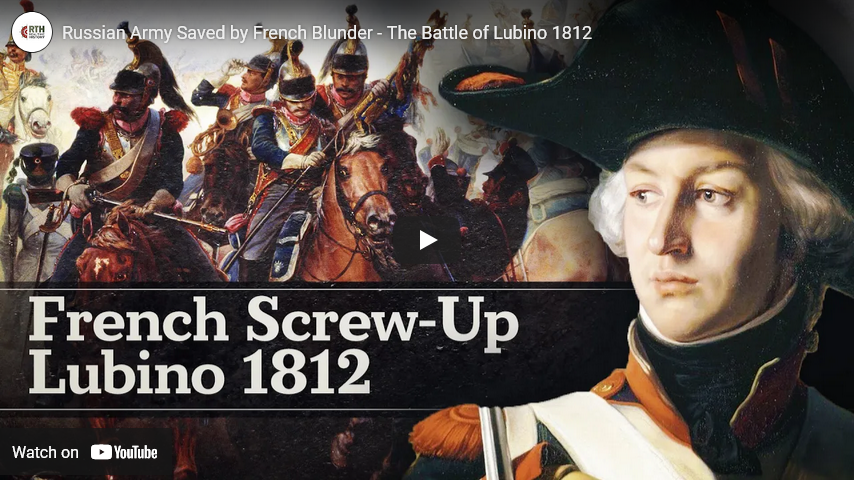
Russian Army Saved by French Blunder – The Battle of Lubino 1812
Real Time History
Published 14 Apr 2022Support us on Patreon: https://patreon.com/realtimehistory
French general Junot and Emperor Napoleon I had a bit of a history by the time of the 1812 campaign. Even though Junot has been in Napoleon’s service for years, he hadn’t been promoted to Marshal. At the Battle of Lubino (Battle of Valutino-Gora) Junot stands idly by as the Grande Armée is missing their best chance yet to win a decisive victory over the Russians. To the north, at Polotsk the French and Russians are also clashing.
» THANK YOU TO OUR CO-PRODUCERS
John Ozment, James Darcangelo, Jacob Carter Landt, Thomas Brendan, Kurt Gillies, Scott Deederly, John Belland, Adam Smith, Taylor Allen, Rustem Sharipov, Christoph Wolf, Simen Røste, Marcus Bondura, Ramon Rijkhoek, Theodore Patrick Shannon, Philip Schoffman, Avi Woolf,» SOURCES
Boudon, Jacques-Olivier. Napoléon et la campagne de Russie en 1812. 2021.
Lieven, Dominic. Russia Against Napoleon. 2010.
Maag, Albert. De Schicksale der Schweizerregimente in Napoleons I. Feldzug nach Russland 1812. 1900.
Rey, Marie-Pierre. L’effroyable tragédie: une nouvelle histoire de la campagne de Russie. 2012.
Zamoyski, Adam. 1812: Napoleon’s Fatal March on Moscow. 2005.» OUR STORE
Website: https://realtimehistory.net»CREDITS
Presented by: Jesse Alexander
Written by: Jesse Alexander
Director: Toni Steller & Florian Wittig
Director of Photography: Toni Steller
Sound: Above Zero
Editing: Toni Steller
Motion Design: Toni Steller
Mixing, Mastering & Sound Design: http://above-zero.com
Digital Maps: Canadian Research and Mapping Association (CRMA)
Research by: Jesse Alexander
Fact checking: Florian WittigChannel Design: Simon Buckmaster
Contains licensed material by getty images
Maps: MapTiler/OpenStreetMap Contributors & GEOlayers3
All rights reserved – Real Time History GmbH 2022
Volodymyr Zelensky has become a “pop cultural admixture of Churchill and an ’80s action hero”
In The Line, Andrew Potter explains how Ukrainian President Zelensky has shamed all the western leaders — like Trudeau — who have been long on rhetoric and short on action to support their claimed values:
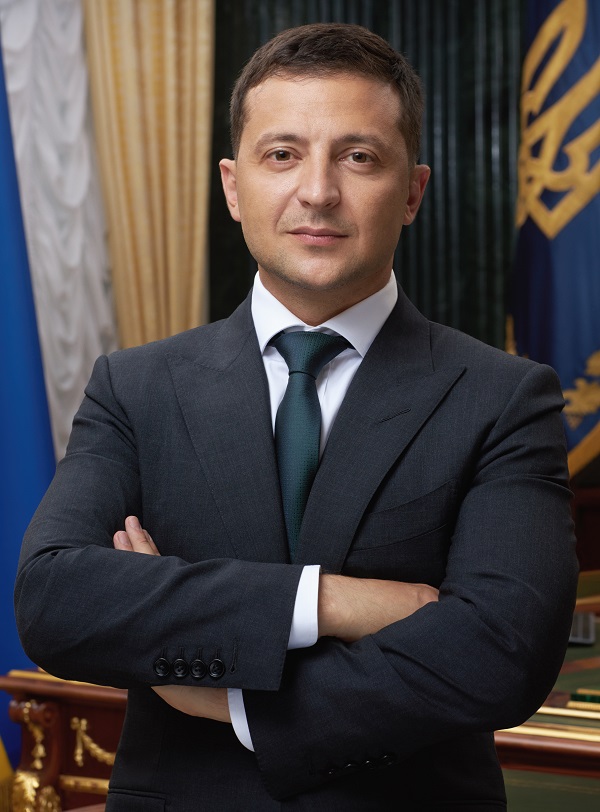
“Volodymyr Zelensky Official portrait” by http://www.president.gov.ua/ is licensed under CC BY 4.0

When asked by journalists to explain his refusal to head for safety, Zelensky has made it clear that he has no wish to die, and that he fears for the lives of his loved ones (his wife and kids have since been moved to relative safety.) But, he added: “As for my life: I am the president of the country, and I simply do not have the right to it.” Sure, he could flee to preserve his own life. But, he has said, how would he explain his actions to his kids? As Zelensky sees it, he has no choice in the matter. His duty requires that he remain and lead his country in the fight; to do anything less would be dishonourable.
But while his Last Action Hero schtick has proven enormously popular with European and North American audiences, Zelensky’s refusal to leave Kyiv, and Ukraine’s insistence on fighting off the Russians instead of capitulation, has put our so-called leaders in a bit of a bind.
To begin with, Ukraine’s refusal to capitulate to Russian aggression has forced many governments into taking steps they almost certainly would have preferred to avoid — economic and political sanctions against Russia, costly shipments of arms and other aid, diplomatic side-choosing, rethinking of trade agreements, and so on. Ukraine’s defence is coming at a pretty high cost, and the final bill is far from being tallied.
But beyond the economic and political price that is being paid to support Ukraine, there is the extraordinary amount of cognitive dissonance Zelensky’s behaviour has generated amongst the leadership of the West. Honour? Duty? Sacrifice? What century does he think he’s living in?
For centuries, honour reflected the sorts of qualities that gentlemen were expected to possess: dignity, integrity, courage. But it is hard to even talk about honour now with a straight face. It brings to mind 19th-century aristocrats in wigs and hose, demanding satisfaction and challenging one another to a meeting over some best-forgotten offence. The old honour codes couldn’t survive the triumph of the values of liberal democracy and the arrival of what Francis Fukuyama famously called the End of History, where the willingness to risk one’s life for abstract ideas or principles has been replaced by voting and economic calculation in the public sphere and “the satisfaction of sophisticated consumer demands” in the private.
Today, the old notion of honour survives only in small and isolated precincts of (mostly) male society, places like the military and some sports, places where how you behave in front of your peers matters more than comfort, more than money, more than health, maybe even more than life itself. The rest of us have become versions of what Nietszche derided as “the last man” — creatures of liberalism who have no pride, take no risks, and desire only comfort and security.
The West Sacrifices Poland to the Soviets – WAH 056 – April 1943, Pt.1
World War Two
Published 14 Apr 2022There are cracks in the alliances on both sides. Hitler’s allies are refusing to do his every bidding, and the revelations about the Soviet massacre of Poles in Katyn has set a wedge between Poland and the USSR.
(more…)
Vladimir Putin as real-life Bond villain
In The Critic, Peter Caddick-Adams makes a case for Vladimir Putin being all of Ian Fleming’s fictional 007 adversaries brought to life in a single person:
I am certain Vladimir Putin has a giant coloured globe, or maybe a huge map set in a wall, which at the tap of a button, silently slides in and out of view. In his mind, he will no doubt have experimented with his artist’s palette, of coating many of his geographical neighbours with his favourite shade of bright, bloody crimson.
Talking of sliding panels operated by secret switches, I would be surprised if the Russian leader has not watched all the James Bond movies, if only out of professional interest. He would see, if so, that he is every one of Ian Fleming’s villainous creations — Ernst Stavro Blofeld, Le Chiffre, Sir Hugo Drax, Auric Goldfinger, Emilio Largo, Dr Julius No and Francisco Scaramanga — all rolled into one person.
Presiding over the robber state that is the Russian Federation, Putin is at once militarily and politically all-powerful, but also the master international criminal. At a 2017 US Senate Judiciary Hearing, the Putin arch-critic and American financier, Bill Browder, estimated the Russian had “accumulated $200 billion of ill-gotten gains”, describing him as “one of the richest men in the world, if not the richest”.
It was the Second World War espionage boss, Commander Ian Fleming, who brought not only his world famous spy to life, but also the lairs of James Bond’s opponents. Fleming had inspected many of the Nazi underground factories and subterranean rocket bases immediately after the defeat of the Fatherland in 1945. In print, they appeared as his villains’ secret headquarters.
Fleming’s novels were in turn translated into celluloid by the talent of set designer Ken Adam. He worked on seven Bond movies, beginning with Dr No in 1962, via You Only Live Twice, and Diamonds Are Forever, and devised the circular War Room in Stanley Kubrick’s Dr Strangelove of 1964. If you don’t remember the scene, you’ll recall its most poignant line: “Please, gentlemen, you can’t fight in here. This is the War Room.”
Adam was also working with inside knowledge, for he was born in Berlin, to Jewish parents, who fled to Britain in 1934. On the outbreak of war, Adam enlisted into a British army engineering unit composed of Axis nationals, designing bomb shelters. He later joined the Royal Air Force as a fighter pilot, where he was known as “Heiney the Tank Buster”. After VE-Day, Adam toured the concrete structures and German bases he had attacked. “I flew fighters in the war, made some great movies and was Knighted by the Queen [in 2003]. Not bad for a Jewish lad from Berlin,” he told me in an interview.
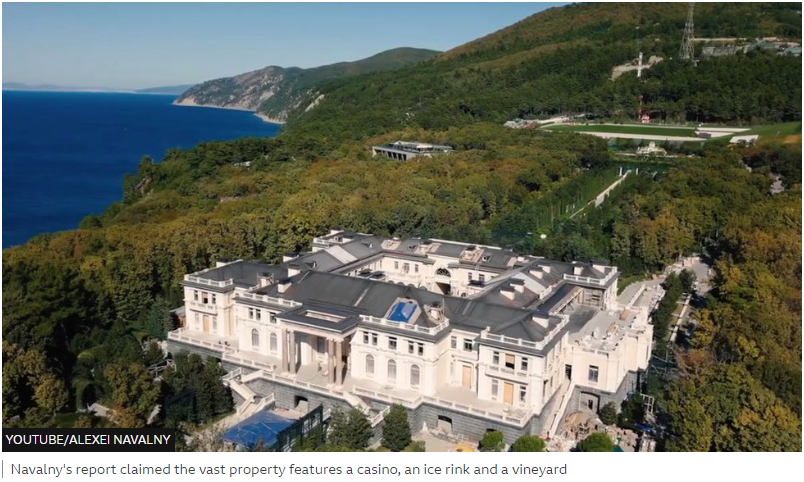
A screen capture from Alexei Navalny’s YouTube video on Vladimir Putin’s Black Sea palace.In a bizarre case of real life imitating fiction, it was Alexei Navalny, now rotting in Russia’s harshest penal colony for his exposé, who discovered Putin’s covert lair. Sprawling on the Black Sea coast, it might have been designed by Ken Adam. The Russian leader’s $1.9 billion palace comes with a below-ground grand salon, hollowed-out of the cliff-face, lit by a gigantic panoramic window, that, at the touch of another button, can be retracted to let in the sea breezes. Access to the beach or the rest of the complex is by tunnels carved into the rock.
Its existence is naturally denied by the Kremlin, but the site, at Cape Idokopas, near the village of Praskoveevka, is equipped with two helipads, and reputedly 39 times the size of Monaco. I make the basic assumption that scores of designer-stubbled security muscle, dressed in black, toting sub-machine-guns, with a shoot-on-sight brief, will be prowling about.
Look at Life – Thunder in Waiting (1960)
PauliosVids
Published 20 Nov 2018The deadly cargo of the Vulcan Bomber is a crucial part of Britain’s deterrent force.

April 14, 2022
“This might just be the dumbest, most ill-advised and lethally consequential thing Biden has said since taking office”
Brendan O’Neill on Joe Biden’s most recent maybe official/maybe “Joe being Joe” moment on the Russia-Ukraine conflict:

Once considered a gaffe, Biden doing this again might have been a good move.
Bumbling Joe Biden isn’t funny anymore. It might be amusing when your crazy uncle blurts out something unexpected at a family dinner. But when the most powerful man on Earth does it? Not so much. Yesterday, “in passing”, as the Guardian put it, President Biden referred to Russia’s war in Ukraine as a “genocide”. This might just be the dumbest, most ill-advised and lethally consequential thing Biden has said since taking office.
The circumstances in which he uttered the g-word, in which he made the most serious accusation you can make against a nation state, were bizarre. He was in Iowa, at a public discussion on the use of ethanol in petrol, of all things. Then – “in passing” – he said: “Your family budget, your ability to fill up your tank, none of it should hinge on whether a dictator declares war and commits genocide half a world away.” And so did an announcement about the lifting of restrictions on ethanol use in order to reduce the price of fuel turn – “in passing” – into the United States of America accusing the Russian Federation of committing the most heinous crime known to man.
It is unclear whether accusing Putin of genocide is White House policy now, or if Biden was just running his mumbling mouth, as is his wont. Pressed by reporters as to whether he really meant to say “genocide”, Biden said: “Yes, I called it genocide because it’s become clearer and clearer that Putin is just trying to wipe out the idea of even being Ukrainian.” Not surprisingly, other world leaders were a tad alarmed. French president Emmanuel Macron rebuked Biden for his “verbal escalations”. We need to be “careful” with our terminology, he said, rightly.
It remains to be seen whether this is the White House consciously upping the ante or just Biden having another senior moment. He has form, after all. At the end of March – again in passing – he called for regime change in Russia. “This man cannot remain in power”, he said about Putin in an “off the cuff” remark at the end of March. Most of us make jokes off the cuff or express exasperation off the cuff – Biden expands America’s war aims off the cuff. The White House swiftly walked back this unscripted declaration of regime-change hostilities. Before that, Biden made a blunder that suggested US troops had been deployed to Ukraine. The White House walked that back, too. “[We] are not sending US troops to Ukraine”, a spokesman clarified.
Maybe the White House will walk back the “genocide” thing as well. Though it might be too late. The word’s out there now. And not just from the mouths of those irritating liberal commentators and laptop bombardiers who think every war is a genocide (except the ones they support, of course, like Iraq, Afghanistan, Libya), but from the mouth of the American president himself. Make no mistake – this is incredibly dangerous war talk. It transforms Ukraine from an undoubtedly bloody conflict that has global implications into a possible site of further external intervention and fighting. Indeed, the United Nations’ policy on “The Responsibility to Protect” expressly obliges the Security Council to take action – ideally diplomatic action, but if that fails, then military action – in order to “protect populations from genocide”. If Russia is committing genocide, then the US and its allies have a responsibility to stop it somehow. This is the dire, destabilising situation Biden has either blunderingly or consciously pushed the world towards.
Dining First Class on the RMS Titanic
Tasting History with Max Miller
Published 12 Apr 2022Signup for your FREE trial to Wondrium here: http://ow.ly/rSyS30sfmaG
Support the Channel with Patreon ► https://www.patreon.com/tastinghistory
Merch ► crowdmade.com/collections/tastinghistory
Instagram ► https://www.instagram.com/tastinghist…
Twitter ► https://twitter.com/TastingHistory1
Tiktok ► TastingHistory
Reddit ► https://www.reddit.com/r/TastingHistory/
Discord ► https://discord.gg/d7nbEpy
Amazon Wish List ► https://amzn.to/3i0mwGtSend mail to:
Tasting History
PO Box 766
Burbank, CA 91503LINKS TO INGREDIENTS & EQUIPMENT**
Sony Alpha 7C Camera: https://amzn.to/2MQbNTK
Sigma 24-70mm f/2.8 Lens: https://amzn.to/35tjyoW
Green Chartreuse: https://bit.ly/onlinebottlesmax
Leaf Gelatin: https://amzn.to/3NY6Y5SLINKS TO SOURCES**
Last Dinner on the Titanic by Rick Archbold and Dana McCauley: https://amzn.to/3tqNz5s
Titanic, First Accounts: https://amzn.to/3L2f7UH
The Sinking of the Titanic: 1912 Survivor Accounts by Bruce M. Caplan and Logan Marshall: https://amzn.to/3KSKock
The 10 Best Titanic Survivor Stories: https://amzn.to/3wioSK3RECIPE
Ingredients:
16 sheets Gelatin (or 4 envelopes of powdered gelatin)
3 cups (750ml) Water
1/2 cup (50g) Sugar
1 cup (250ml) Chartreuse
2-4 ripe Peaches or a large can of peaches in syrup
1 cup (250ml) Simple syrup (not necessary if using canned peaches1. Soak the gelatin in cold water for 5 minutes.
2. Bring the water and sugar to a simmer in a large saucepan then remove it from the heat. Squeeze out any excess water in the gelatin, then add it to the water and stir until dissolved. Stir in the Chartreuse.
3. Pour the liquid into a well greased mold, then refrigerate for 1-3 hours, or until the jelly is beginning to thicken.
4. To remove the skin from the peaches, score and X at the bottom of the peaches, then plunge into boiling water for 45 seconds, then immediately into ice cold water for 10 seconds. If the peaches are ripe, the skin should easily slide off. Remove the pit and slice.
5. Heat the simple syrup to simmering, then add the peach slices. Coat and turn off the heat and let them cool in the syrup.
6. Carefully insert the peaches into the jelly in whatever pattern you like. Then return to the refrigerator until fully set. 8 – 24 hours depending on the depth of the mold.
7. Once set, run a knife around the edge of the jelly, then dip the mold into hot (not boiling) water for 5 seconds. Remove it and place a well greased plate over the top of the mold then flip it over. The jelly should fall out with little more than a tap.
8. Top with Italian meringue or whipped cream, and serve.**Some of the links and other products that appear on this video are from companies which Tasting History will earn an affiliate commission or referral bonus. Each purchase made from these links will help to support this channel with no additional cost to you. The content in this video is accurate as of the posting date. Some of the offers mentioned may no longer be available.
Subtitles: Jose Mendoza | IG @worldagainstjose
#tastinghistory #titanic #firstclass

QotD: “… when life was simpler”
And then you get hold of primary sources on the thirties or fifties. Let’s say it’s particularly hilarious to read stuff from the right lauding that time of great freedom in either of those decades. Let’s just say that if some of the things happening back then were happening now we’d all be talking about how we were ready for revolution. (And the only reason they weren’t then is that the press was mass-media. You think it’s bad enough now, with a lying press? They had the same, but no way to check it. It was that concentration and lack of individual communication or access to the public by individuals unfiltered by the media/publishers that put us in the situation we’re in, with what is functionally the enemy of western civilization in control of the vital organs of culture. Before you get discouraged, it helps to remember, we’re only now fighting back. Continue fighting, but remember things take time. The larger a movement is, the longer it takes for it to become noticeable, much less prominent in the culture.)
And as for the left thinking that everyone before the oughts were good white Christians or whatever … Oh, sweet summer children. Let’s say when they get their freak on, with witchcraft or being naked in public, or talking about their poly relationships, or whatever the actual hell they have in their heads that day, they rarely if ever (I’ve never seen it) would have managed to shock their ancestors or ancestresses 100 years ago. Those Edwardians … well … Let’s just say they had fewer hangups. Yes, I know what the public image is. But none of them would have worried about things that the left worries about now like “differential of power” or “implied patriarchy” which meant they were much freer to do whatever crossed their heads at the moment. Of course they also thought they would have shocked their ancestors. And I bet you they wouldn’t.
At some point, if you have a chance, read a book called Our Bones Are Scattered about the Indian revolt in Victorian times. I only read it once because it’s a deeply disturbing book, one of those clashes of civilization where you feel sorry for both sides. But it is very well written, and the beginning of the book is … revealing. The British commander was … well … sort of married to a woman who had been sort of married something like six times before and who went from man to man, collecting kids along the way. Notwithstanding which, they were Victorian nobility and had a bunch of kids of their own and …
Let’s just say Victorians aren’t the way we’ve learned to think of them either. In fact you can be sure pretty much no one ever was. People kept and keep the front they need to, but behind the scenes things were always messy and complicated.
Which often makes finding our own way in this messy and complicated way very difficult.
Sarah Hoyt, “Finding Your Way”, According to Hoyt, 2019-02-18.
April 13, 2022
Theodore Dalrymple visits the barber to find out what happened in the French elections
Rather than depend on the untrustworthy political analysis available in the legacy media, Theodore Dalrymple prefers to get the straight story from his Paris barber:

“barber pole” by triviaqueen is licensed under CC BY 2.0
My barber is highly intelligent and from the way he talks, I should guess that he received a decent education in Morocco. I mean no disrespect either to him or to barbers when I say that, in other circumstances, he might have occupied a more elevated position in society. The last time I went to him, we discussed French politics over the snip-snip of the scissors.
“Since I arrived in this country,” he said, “I have heard the same discussions on the same subjects by the same people.”
“France,” he continued, “is like a man who has complained of toothache for 25 years but hasn’t found the time to go to the dentist.”
I suppose, when you come to think of it, that captures the situation in more than one Western country. Naturally, I was eager to hear what he had to say about the election results, which would be as penetrating as that of any professional commentator.
Another customer, in his late sixties I should guess, entered the shop immediately after me. I was worried that his presence might inhibit the discussion, but once in the barber’s chair, my bib around me, I asked the barber, “Did the election results please you?”
I needn’t have worried about inhibition. No sooner were the words out of my mouth than the other customer exploded with anger. He almost trembled with rage, all of it directed against the incumbent (and winner so far), Emmanuel Macron. I don’t recall ever having witnessed a reaction like it.
I knew that those who didn’t like or approve of Macron were said to hate him: Few people, it seems, are merely indifferent to him. I’m no great admirer of him myself, and I think in his own way he’s potentially dangerous: He’s determined to push ahead with European integration that will, sooner or later, lead to an explosion. But to witness the visceral hatred toward him nevertheless shocked me.
He has long been accused of being the president of, or for, the rich. That he once worked for the Rothschild bank only encourages this view. There is in the accusation the larger assumption that the interests of the rich and those of everyone else are diametrically opposed and necessarily irreconcilable.
Few people can escape entirely or for very long thinking of an economy as a cake, such that a larger slice for you is necessarily a smaller one for me and vice versa. And since the slices of the supposed cake that most of us have are distinctly modest by comparison with those of the rich (the rich being those with at least five times as much as we), the room in our minds for resentment is ample. And even though I know that the metaphor of an economy as a cake is a dangerous one — how many millions were killed in the name of economic egalitarianism in the 20th century! — still I catch myself occasionally feeling resentful at the pharaonic incomes of people who seem to me not to deserve them, though I’m not myself yet on the breadline and have no desire either for great wealth.
Life in a German U-Boat – WW2 Special
World War Two
Published 12 Apr 2022The German U-Boats were one of the most dangerous armed forces of World War II. From the North Sea to the Mexican coast to the Cape of Good Hope, everywhere they put fear into the Allied merchant marine. But what was life like on a German submarine? What dangers did the crew face? How did they endure the long voyages far away from home?
(more…)
A new look at the Commonwealth and the Protectorate of Oliver Cromwell
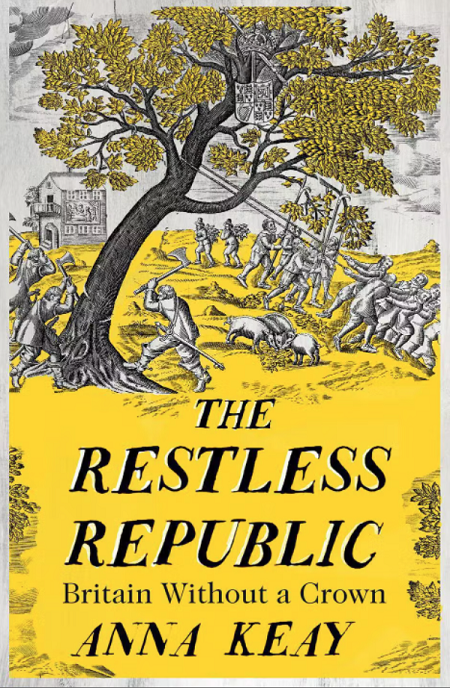
In The Critic, Miranda Malins reviews a new history of the period between the execution of Charles I and the Stuart restoration of Charles II, The Restless Republic: Britain Without a Crown by Anna Keay:
This evasion is not for the historian Anna Keay. Faced with these collective shortcomings (“This book was born of ignorance,” she explains in opening), she explores this most dynamic of decades, looking it squarely in the face. With her, we roam around the period, the broad chronological narrative softened through a selection of nine interwoven biographies ranging from the irrepressible newspaperman Marchamont Nedham, to the indomitable royalist Countess of Derby, from the brilliant scientist William Petty to the dreaming Digger Gerrard Winstanley.
This structure achieves a broad perspective and rare realism, giving the reader the sense of dipping and diving through the restless waves of the republic and taking them to all corners of the new Britain forged in the fire of three Civil Wars. As expected, we travel from the trial and execution of Charles I to the Restoration of his son, but Keay’s achievement is to make the shape-shifting years of the kingless Commonwealth and Protectorate that lie between more thrilling than either royal bookend, demonstrating how far from inevitable the return of the Stuarts was. There is no “high road to Restoration” here, but rather a snaking maze of paths striking off in new directions and looping back: an uncharted landscape for Keay’s characters to navigate where every choice counted.
The result is a panoramic and pulsating drama every bit as restless as the republic it captures so well. Indeed the “Restless” adjective of the title perfectly conjures the progressive spirit of Britain without a crown: unstable and dangerous, yes, but as a result, experimental and unafraid. As Keay puts it: “The 1650s was a time of extraordinarily ambitious political, social, economic and intellectual innovation, and it was not a foregone conclusion that the British republic would fail.”
This portrait will be, for many, a revelation. Far from the dour, militaristic regimes of popular imagination, life under the Commonwealth and Oliver Cromwell’s Protectorate emerges as innovative and exciting: the effect of the hitherto unimaginable act of abolishing the monarchy and House of Lords after years of transformative conflict being to unleash an energetic spirit of ambitious experimentation and industry.
We feel this bold energy in the meetings of the Oxford Experimental Philosophy Club (which would become the Royal Society in 1660) and its young member William Petty managing to survey the whole of Ireland in record time despite having no cartographical experience; in failed cloth trader Gerrard Winstanley’s determination to dig the new Jerusalem that had come to him on an autumn ramble; in Marchamont Nedham escaping Newgate prison and picking his way through several dangerous changes of side, pen in hand, always managing to land cat-like on his feet through sheer commercial nous and audacity.
April 12, 2022
Last War Patrol of HMS Terrapin
The History Guy: History Deserves to be Remembered
Published April 11, 2022On her seventh war patrol, in the south Java Sea, the T class British submarine HMS Terrapin and her crew had faced the terror of battle and barely survived. Badly damaged and far from home, sometimes the drama of war is not just in the battle, but in the voyage home.
Check out our new community for fans and supporters! https://thehistoryguyguild.locals.com/
This is original content based on research by The History Guy. Images in the Public Domain are carefully selected and provide illustration. As very few images of the actual event are available in the Public Domain, images of similar objects and events are used for illustration.
You can purchase the bow tie worn in this episode at The Tie Bar:
https://www.thetiebar.com/?utm_campaign=BowtieLove&utm_medium=YouTube&utm_source=LanceGeigerAll events are portrayed in historical context and for educational purposes. No images or content are primarily intended to shock and disgust. Those who do not learn from history are doomed to repeat it. Non censuram.
Find The History Guy at:
New community!: https://thehistoryguyguild.locals.com/
Please send suggestions for future episodes: Suggestions@TheHistoryGuy.netThe History Guy: History Deserves to Be Remembered is the place to find short snippets of forgotten history from five to fifteen minutes long. If you like history too, this is the channel for you.
Awesome The History Guy merchandise is available at:
https://teespring.com/stores/the-history-guyScript by THG
#history #thehistoryguy #WWII
Experimental video embed from Rumble.com. Please let me know if you have problems viewing this video.

How to Make a Royal Marines Officer: Part 1 (1989)
Royal Marines
Published 13 Sep 2012First transmitted in 1989, this is the first part of a programme that follows the progress of 29 men who want to be Royal Marine officers. After arriving at Commando Training Centre, Devon, they find that their fortitude is tested to the very limits as they undertake the All Arms Commando Course to earn their green berets.

Mark Steyn on the first round of the French Presidential election
It must seem uncanny to Americans that the French can hold a vote, count all the votes, and announce the results all within the same 24-hour window …
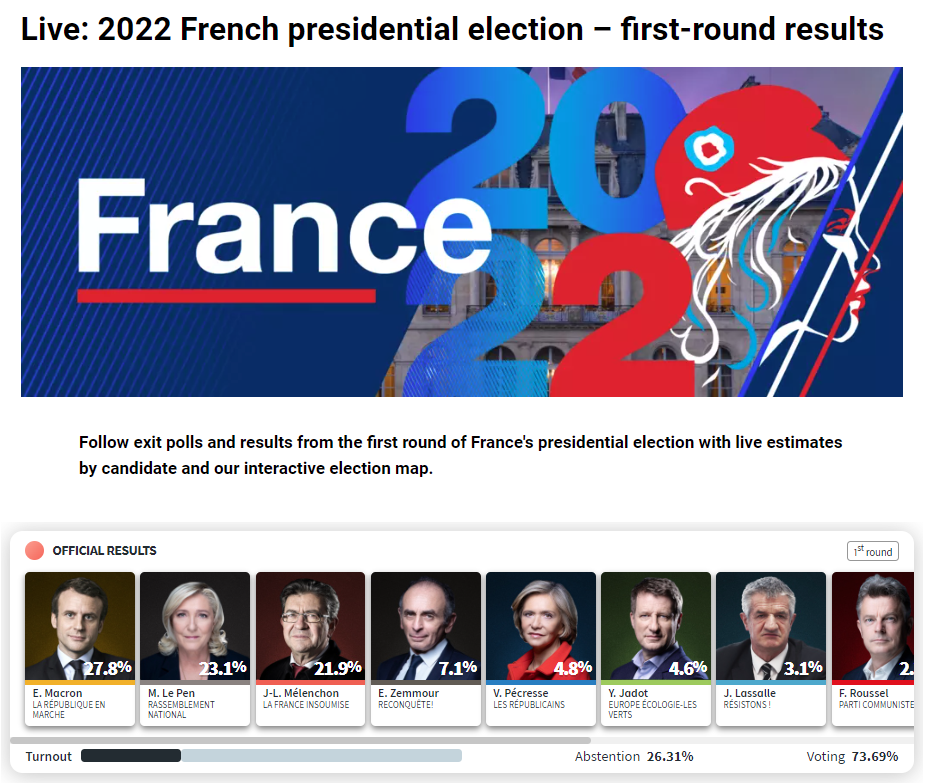
Say what you will about la République française but, unlike America, its election operations are not a rusted malodorous sewer of brazenly corrupt practices. So the election was held, the votes were counted in hours, and the official result was known by 1am Paris time. There are no unmarked vans motoring the Dordogne or the Pas de Calais in the dead of night bearing additional votes sufficient to the need.
That speaks well for any nation. Alas, not much else about yesterday does. The Top Three is as follows:
Emmanuel Macron 27.6 per cent; Marine Le Pen 23.41 per cent;
Jean-Luc Mélenchon 21.95 per cent.Mme Le Pen is designated by the BBC “far right” and M Mélenchon “hard left”. I am unclear whether, in Beeb parlance, it is worse to be “hard” than “far. But, be that as it may, they could at least cease applying the label “mainstream” to candidates who can’t crack five per cent, which is the threshold below which your election expenses are not covered by the French state.
On Friday’s Clubland Q&A I mentioned en passant that I’m all about the urgency: The west will die unless we change what we’re doing very fast. Yesterday was yet another of those election nights when the people turn but passing slow. Especially after the buzz about a Le Pen surge and a looming Macron humiliation, last night she didn’t have a spectacular breakthrough and he survived.
There will now be a fortnight to the run-off in which the forty per cent of French voters who cast their ballots for “hard left”, soft left, Green left and nutso left will be told that a vote for other than Macron is a vote against democracy itself. Mme Le Pen ran the blandest, most inoffensive campaign she has ever run, leaving it to the “even farther right” Éric Zemmour to do all the heavy lifting on la fenêtre d’Overton. And in the end all that got her was a couple of extra points in the first round.
We will see how well that approach withstands the onslaught already under way. The one man who could make a difference is the soi-disant “hard leftie”, M Mélenchon. His own surge attracted less attention in the last week or two, but it’s likely that, had not M Zemmour bungled his response to the war, the even-more-far rightist would have drawn enough votes from Mme Le Pen to enable Mélenchon to come through the middle and give France a run-off between a bloodless globalist and a full-bore Marxist.
In pocketbook terms, the gap between “hard left” and “far right” is now barely detectable: Mme Le Pen is pledging that no one under thirty will pay tax. There is surely plenty of overlap between the Mélenchon and Le Pen voters. Yet his priority was plain at last night’s speech, because he said it four times:
Il ne faut pas donner une seule voix à Mme Le Pen.
Not a single vote for Marine!
So even the hardcore class-warrior shrugs: Better the globalist you know …


