
World War Two
Published 22 Jul 2023This week, Adolf Hitler is blown up and Hideki Tojo steps down. In the Pacific, the Americans land on Guam and prepare for hard fighting. In France, the Americans take Saint-Lô and British and German armored forces clash around Caen. In the East, the Red Army enters Latvia, tears a gap in Army Group North, and reaches the gates of Lvov.
(more…)
July 23, 2023
Sayonara Tojo – WW2 – Week 256 – July 22, 1944
Comments Off on Sayonara Tojo – WW2 – Week 256 – July 22, 1944
Tom Whipple’s history of radar development during WW2
In The Critic, Robert Hutton reviews The Battle of the Beams by historian Tom Whipple, who retells the story of the technological struggle between Britain and Germany during the Second World War to find ways to guide RAF or Luftwaffe pilots to their targets:
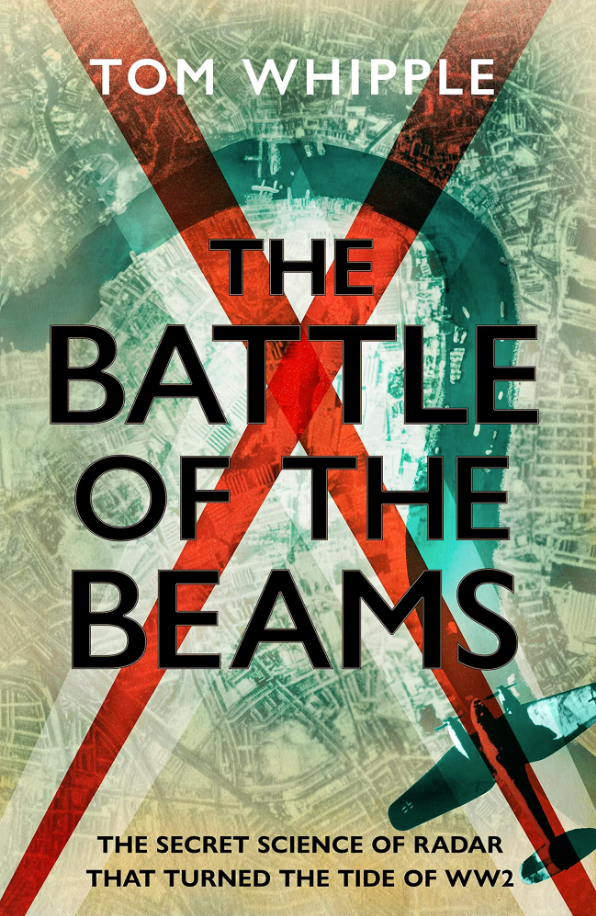
In an age when my phone can tell me exactly where I am and how to get where I’m going, it’s hard sometimes to imagine a time when navigation was one of any traveller’s great challenges. At the outbreak of the Second World War, the advice to Royal Air Force pilots trying to find their way was, more or less, to look out of the window and see whether anything on the ground looked familiar. The Luftwaffe, though, had a rather more sophisticated means of finding their targets.
As Britain braced herself for the bomber onslaught of 1940, there was comfort in knowing that radar would give Hurricanes and Spitfires advance warning of where the attack was coming. As soon as the sun went down, so did the fighters: at night, relying on their eyeballs, they simply couldn’t find the enemy.
That wasn’t so bad, as long as the German pilots had the same problem, but one young British scientist began to suspect that the Luftwaffe had developed a technology that allowed them to find their way even in the dark, guided by radio beams. In June 1940 he found himself explaining to Winston Churchill that German bombers could accurately reach any spot over England that they wanted, even in darkness.
Reg “RV” Jones was the original boffin: a gifted physicist who was recruited to the Air Ministry at the start of the war to help make sense of intelligence reports that offered clues about enemy technology. It was a role to which he was perfectly suited: a man who liked puzzles, with the ability to absorb lots of information and see links, as well as the arrogance to insist on his conclusions, even when his superiors didn’t like them.
The story of the radio battle has been told before, not least by Jones himself. His 1978 memoir Most Secret War was a bestseller and remains in print. It is 700 pages long, though, and it assumes a lot of knowledge about the way 1940s radios worked that readers probably had 50 years ago. Since few people under 50 have much clue why a radio would need a valve or what you might do with a slide rule, there is definitely room for a fresh telling.
Comments Off on Tom Whipple’s history of radar development during WW2
Explained: What Is Pace Sticking?
Forces News
Published 18 Sept 2021A pace stick is a tool made of two pieces of timber that are hinged at the top.
Each summer, 18 pace sticking armed forces teams from around the world come together in an international competition at the Royal Military Academy Sandhurst.
We look at what pace sticking involves, and the history behind it.
(more…)
Comments Off on Explained: What Is Pace Sticking?
QotD: Losing the Mandate of Heaven is fatal for a ruler
If there’s one thing I’ve learned as a professional historian (aside from the fact that we’re all just big apes … and not particularly bright ones, either) it’s that the most powerful force in human affairs is not envy, not lust, surely not money, not even Wille zur Macht — it’s inertia. Nothing lasts forever, but even seemingly intolerable situations can continue all-but-indefinitely, provided there’s no clear alternative on offer …
… so long as the rulers keep the Mandate of Heaven.
That no doubt seems like a stolen base, as something as amorphous as the “Mandate of Heaven” can be stretched to cover just about anything, but it’s the best I can do to convey what I mean. And I think you’ll see the utility of it when we look at a few examples. The negative first: Since Usurpers are much in the news these days, look at any successful one. England’s Henry IV, for example, or Henry VII. They had endless troubles during their personal rule, as all the people who mattered knew them when they were just one noble among many. Their sons, on the other hand, sat about as easily on the throne as any medieval monarch could, and while some of that was no doubt due to their sterling personal qualities,1 a lot of it was simply, for lack of a better term, “the Mandate of Heaven” — the Usurper who delivered stability and competence in his lifetime passed on the purple to a stable, competent son, which proves the regime’s essential rightness.
In other words, inertia kicks in — just an object in motion tends to stay in motion, a competent regime continues competent, in public perception at least. Those who are old enough to remember the Wars of the Roses (etc.) are just grateful that they don’t have to go through it again, while the younger generations simply don’t know any different. So long as the usurper’s son isn’t both personally loathsome and egregiously incompetent, things will go on much as before. (And please note what an extremely high bar that is — we’re talking Nero- or Commodus-level loathsome incompetence. France spent a lot of the Hundred Years’ War under the “leadership” of a filthy lunatic who thought he was made of glass, and they came out ok … largely because soon after he kicked, it was England’s turn to suffer the long reign of a filthy lunatic, but still. It’s got to be spectacular on both counts to kick off a revolution).
Severian, “Witch Trial Syndrome”, Rotten Chestnuts, 2021-01-27.
1. Opinions are bitterly divided on Henry VIII even among the laity, and professionals carry on blood feuds about it, but everyone agrees that for all his faults, the young Henry VIII was a seriously impressive guy. Contemporaries certainly thought so — Erasmus was a professional ass-kisser, but Thomas More was dazzled by Henry, too, and More was a tough guy to fool.
Comments Off on QotD: Losing the Mandate of Heaven is fatal for a ruler
July 22, 2023
“… no-one has a ‘right’ to a bank account …”
Unlike in Canada, where the extra-legal debanking of an unknown number of what Justin Trudeau described as a “small fringe minority … holding unacceptable views” had all the bien-pensants in and out of the legacy media nodding along, British opinion is not so friendly toward the extra-legal debanking of Nigel Farage and his family and friends:

An acquaintance of mine on Facebook, a hardline capitalist (so he says) made a comment that no-one has a “right” to a bank account, as they don’t have “rights” (those inverted commas are doing a lot of work here) to healthcare, education, paid-for holidays, etc. He was, of course, writing about the Nigel Farage/Coutts saga that has seen the CEO of NatWest, Coutts’ parent firm (39% owned by the taxpayer) issue a sort-of apology to the former UKIP leader.
[…]
When a person is “debanked” today, they can have a problem opening an account anywhere else if the bank asks them why they left a bank in the past. As a result, we have almost a sort of “cartel” system operating.
In time, hopefully, competition will swing back, and some of the nonsense going on will disappear. In the meantime, while I agree with you that the idea of having a “right” to a bank account is as bogus as many of the other “rights” that people talk about today, the fact that banking is such an embedded form of life in a modern economy means this issue hits hard in a way that, say, isn’t the case if you are banned from a pizza restaurant or candy store for holding the “wrong” views. Of course, it may be that the Farage case might encourage a firm to go out of its way to court business from those who have been targeted. Let’s hope so. For example, a bank could, without incurring wrath from the “woke” or regulators, say something like “Banking is all we do. No politics. No agendas. Just finance.”
And as I have said before, the outrageous Nigel Farage case, and that of others, surely demonstrates that a central bank digital currency idea must be resisted. This would be the end of any financial autonomy at all.
As you’d expect, Brendan O’Neill isn’t a fan of this latest attempt to make certain political viewpoints effectively illegal:

So there you have it. Nigel Farage really was given the boot from the prestigious private bank Coutts because of his political views. Because he is very pro-Brexit, is fond of Donald Trump and has been critical of Black Lives Matter. Because, in the words of an extraordinary internal dossier compiled by Coutts, his views “do not align’ with the bank’s values”. For the past fortnight the chattering classes have been chortling over Farage’s claim that Coutts was persecuting him for his political beliefs. How dumb – worse, how complacent in the face of corporate tyranny – those people look now.
Last month, Farage went public about the closure of his Coutts account. I’ve been given the heave-ho for political reasons, he said. He also said that nine other banks have since rejected his custom. Now he has published a dossier that was distributed at a meeting of Coutts’ “reputational risk committee” on 17 November 2022. It is a truly chilling read. It runs to 36 pages. There is a strong case for “exiting” Farage from the bank, it says, because his publicly stated views are “at odds with our position as an inclusive organisation”. The Stasi once compiled dossiers on dissident activists and artists whose views ran counter to those of the GDR regime. Now Coutts seems to be doing similar on customers who dare to bristle against the regime of woke.
The dossier basically finds Farage guilty of wrongthink. It highlights his renegade views not only on Brexit and Trump but also on Net Zero and even on King Charles – he has had the audacity to criticise His Majesty. Like dissidents in East Germany, his friendships are held against him, too. His links with Trump and tennis champ Novak Djokovic make him suspect, apparently. The dossier quotes the Independent‘s description of Farage’s visit to Djokovic’s trophy room in Belgrade, during which he criticised Australia’s expulsion of Djokovic for failing to get vaccinated against Covid, as “the spineless, chaotic behaviour of a chancer”.
[…]
The Farage / Coutts story is important because it highlights what a huge threat woke capitalism poses to freedom and fairness. Let’s be clear about what has happened here: a man has been economically unpersoned for having the supposedly wrong views. He’s been blacklisted for being a little too dissenting on the big issues of the day. And it’s happening to others, too – including people who do not have access to the same media platforms as Farage and thus have little leeway to protest against their expulsion from economic life by unelected, unaccountable banks and businesses. We acquiesce to this capitalist policing of thought at our peril. It is surely time for the government to act and clip the wings of banks and companies that believe they have the right to penalise citizens for the contents of their conscience. It might be Farage today, it could be you tomorrow.
Theodore Dalrymple sees it as a sign of the rise of woke totalitarianism:
It isn’t a question of whether Mr. Farage is always right or sometimes horribly wrong; when the bank says that it “uncovered” something that he said, as if he had recorded saying it by secret microphones, it makes itself ridiculous. Not even his worst enemies, or perhaps his best friends, would accuse him of hiding his light under a bushel.
The question is whether it’s the role of a bank to examine its clients’ views and deny them service if those views don’t accord with those of the chief executive, as if the latter were indisputably true and from which it were heresy to dissent. Is a bank an inquisition?
The chief executive of the parent bank, Alison Rose, said soon after her appointment that “tackling climate change would be a central pillar” of her work, and on the occasion of the so-called Pride month last year said that “our focus on diversity, equity and inclusion is integral to our purpose of championing the potential of people, families, and businesses”. This year, the company headquarters were covered in the rainbow colors of the LGBT flag, with lettering the height of humans declaring the “Championing the power of Pride”. Under her leadership, staff may “identify” as women and men on alternate days, should they so wish.
Of course, when she said that “diversity” and “inclusion” was “integral to our purpose”, she was using these terms in a strictly technical sense to mean “everyone who thinks as I do and has a fair bit of money”. The diversity “integral” to the “purpose” of Coutts doesn’t include those persons with less than $1 million to deposit, who even in these days of currency depreciation remain a small minority. People bank with Coutts because it’s exclusive, not inclusive.
The chief executive, however, is safely within what we might call the Coutts Community, because she was paid about $5.2 million last year. The prospect of being barred from the bank will no doubt inhibit anyone who banks with her banks from suggesting in public that she’s paid too much.
Comments Off on “… no-one has a ‘right’ to a bank account …”
In European politics, “far right” doesn’t mean what Americans think it means
In The European Conservative, Rod Dreher tries to put the various “far right” European political parties into context for North American readers:

If you are an American who depends on the U.S. and other English-language media for news about continental European politics — and most Americans obviously do — then you might well be afraid that a wave of fascism is poised to sweep Europe.
The European Conservative, obviously, is a great source of news and information about Europe for our American readers — and I hope with this column to help American conservatives better understand what’s going on with the European Right — because there are very few venues for them to do so.
American and British news agencies are reporting that the “far-right” party VOX is likely to do well in this weekend’s Spanish elections. The “far-right” Alternative für Deutschland (AfD) is surging in German opinion polls. It seems like just yesterday that the “far-right” party of Giorgia Meloni topped Italian elections. “Far-right” parties are key to governing coalitions in Finland and Sweden.
And, of course, the BBC website informs its readers to mind “the ultra-conservative, authoritarian-leaning governments in Poland and in Hungary”. Far-rightists to the fingertips, the lot, right?
Well, no. Not even close. American conservatives should understand that by U.S. standards, the “far-right” parties are basically center-right contemporary Republicans. The declining establishment conservative parties of the European continent are more or less Clinton-style Democrats. There do exist genuinely far-right parties in Europe, but they aren’t anywhere near government.
(Though in this spring’s Hungarian elections, the actually far-right party Jobbik, which considers Viktor Orban to be a squish, went into coalition with the left-wing parties. This caused the coalition prime ministerial candidate to boast moronically that his side was truly diverse, because it spanned the ideological spectrum from communist to fascist.)
When U.S. journalists describe these nationalist and populist parties as “far-right”, they intend to call up images of burly fascists marching down cobblestone streets in hobnail boots, shouting abuse at Jews and minorities. I can’t decide if they do this deliberately to mislead American readers into thinking Europe is two tics away from a gran mal Nazi seizure, or if the reporters themselves are so absorbed in the ideology of their class that they honestly cannot discern gradations of right-wing politics.
H/T to Blazing Cat Fur for the link.
Comments Off on In European politics, “far right” doesn’t mean what Americans think it means
Look at Life – Ticket to Tokyo (1959)
PauliosVids
Published 24 Nov 2018Travelling with Britannia Airline from London via Bombay to Tokyo to discover Japan and back via Hong Kong.
Comments Off on Look at Life – Ticket to Tokyo (1959)
July 21, 2023
The Führer Adolf Hitler is Dead!?
World War Two
Published 20 Jul 2023Stauffenberg, Olbricht and the plotters launch Operation Valkyrie. The army moves in to seize power, troops surround the government quarter in Berlin, and Joseph Goebbels is arrested. But things start going wrong pretty much immediately and far away in East Prussia the Nazi fightback begins.
(more…)
Comments Off on The Führer Adolf Hitler is Dead!?
Belgian Gendarmerie FAL w/ DSA Receiver
Forgotten Weapons
Published 24 Apr 2023A few months ago FN America was able to import 400 parts sets from original Belgian Gendarmerie FAL rifles. I got one of them, and had it completed by DSA. They made receivers with Gendarmerie markings, as well as the barrel and other parts not included with the kit. So today we’ll take a look at the finished rifle and the work that went into completing it.
(more…)
Comments Off on Belgian Gendarmerie FAL w/ DSA Receiver
QotD: War elephant weaknesses against Roman troops
So today we’re going to ask, “why?” We’ve answered that question in the immediate term – to quote Trautmann (2015) on the point, “the Roman refusal of the war elephant … was based upon a low estimate of its value” (250). To put another way, they thought they sucked. We know elephants could be quite potent in battle, so the answer must be a touch more complicated. We’ll look at this two ways: first (because it’s me) in terms of logistics, and then in terms of anti-elephant tactics, to see why elephants could not succeed against (or with) Rome. I am also going to speculate – just a touch – on which of these factors might explain the other major area elephant warfare did not penetrate: China.
Roman Elephants
But first, a necessary caveat to an objection no doubt already brewing in the minds of some: but didn’t the Romans use elephants sometimes? Yes, though Roman employment of elephants was at best uneven (this is a point, I’d like to note, where Trautmann (2015) shows its value over, for instance, J. M. Kistler’s War Elephants (2006) – the latter’s reading of Roman use of war elephants bends the evidence to serve an argument, rather than the other way around). Nevertheless, the Romans did use war elephants during the last two centuries of the Republic.The Romans had some war elephants (just 20) at Cynocephelae (197 B.C.) against Macedon – these had been drawn from the kingdom of Numidia, which had sided with Rome against Carthage in the Second Punic War. Plutarch (Flam. 8.2-5) leaves the animals out of the battle narrative, but Livy (who is the better source; Liv. 33.9) notes their use to break up the Macedonian right wing, which was not yet even in fighting formation. It’s not clear the elephants were necessary for the Roman victory here and the key action was actually a flanking attack by infantry.
The Romans brought elephants to Magnesia (190 B.C.), but left them in reserve; the Romans only had a few, whereas their Seleucid opponents had brought many more. Moreover, the Roman elephants were smaller African elephants, effectively useless against the large Asian elephants the Seleucids used. Pydna (168 B.C.) against the Macedonians again, is harder to assess because the sources for it are poor (part of Livy’s narrative of the battle is mostly lost). Plutarch (Aem. 19-22) leaves the elephants out again, whereas Livy notes that Perseus’ dedicated elephant-fighting corps was ineffective in fighting the Roman elephants on the right wing, but attributes success there to the socii infantry rather than the elephants (Liv. 44.41.4-6). Kistler reads this as a notable elephant success, but Livy does not say this, instead crediting the socii on the right and the legions breaking up the Macedonian center.
The Romans did find elephants useful in places like Spain or southern Gaul (modern Provence) where just a handful could bewilder and terrify opponents completely unused to and unprepared for them. The last gasp of true Roman war elephants came in 46 B.C., where Julius Caesar defeated a Roman army led by Metellus Scipio which had sixty elephants in it. The elephants lost and one of Caesar’s legions (my personal favorite, Legio V Alaudae (Larks!)) took the elephant as a legionary symbol in commemoration of having beaten them.
So absolutely yes, the Romans of the Middle and Late Republic made some use of war elephants, but it was hardly a distinguished run. As Trautmann notes – quite correctly, in my view – the Romans were always more interested in ways to defeat elephants than to use them.
Bret Devereaux, “Collections: War Elephants, Part II: Elephants against Wolves”, A Collection of Unmitigated Pedantry, 2019-08-02.
Comments Off on QotD: War elephant weaknesses against Roman troops
July 20, 2023
The Fights for Assoro & Leonforte with Mark Zuehlke
OTD Military History
Published 19 Jul 2023Join me as I have Mark Zuehlke back on the channel to discuss the fights for Assoro and Leonforte during the campaign in Sicily.
(more…)
Comments Off on The Fights for Assoro & Leonforte with Mark Zuehlke
July 19, 2023
Diplomats Fight the Nazis in Budapest – War Against Humanity 104
World War Two
Published 18 Jul 2023Hungary’s Jews are facing a Holocaust machine in overdrive. The deportation trains are arriving in such volume that even the extermination factory of Auschwitz can barely keep up with the pace. The entire country swiftly becomes Judenfrei and the Jews of Budapest sit helplessly as Adolf Eichmann and his Hungarian collaborators tighten the noose around them. Admiral Miklós Horthy is one of the few who can save them, but so far he has done nothing. Will that change?
(more…)
Comments Off on Diplomats Fight the Nazis in Budapest – War Against Humanity 104
July 18, 2023
QotD: “Nothing to lose”
In line with the notion that people need “a stake in society” in order to refrain from breaking shop windows and taking what they think they have been wrongfully denied (interestingly, the bookshop was the only shop in a very badly looted commercial street that went completely unscathed during the riots), a man called Earl Jenkins — “who was one of up to 60 youth workers who went on to the streets of Toxteth [a poor area of Liverpool] during the disturbances to persuade youngsters not to get involved” — was reported in the Guardian to have said, “If you’ve got nothing to lose, you’ll do what you can to survive, won’t you?”
There was no comment in the newspaper on the deep contradiction in the attitude of Earl Jenkins (let us leave aside the question of how many “youth workers” in Toxteth are needed to prevent a riot there). For if it is true that the riots were a survival mechanism, why was Earl Jenkins trying to persuade young people not to join in? Did he not want them to survive? Suffice it to say that the objects looted during the riots were not such as people on the verge of famine, or who fear that famine is around the corner, might be expected to loot. They were, rather, the things that spoilt children might be expected to want for their birthday.
The term “If you’ve got nothing to lose” in this context is ambiguous. It might mean such penury, such drastic poverty, that you possessed nothing that could have been removed from you. But it clearly cannot mean this, since all the rioters were at liberty, and were clothed, fed, housed, educated (if unsuccessfully), provided with medical care, and given at least a small income, much of which could, in theory at any rate, be removed from them. They could be made homeless; their central heating could be turned off; they could go hungry and literally penniless, made to wear rags; their telephones could be taken from them; they could be deprived of their liberty and even enslaved.
But none of this was going to happen to them and they knew it perfectly well; so in this sense it was indeed true that they had nothing to lose. One of the commissioners appointed to enquire into the riots actually put it succinctly:
When people don’t feel they have a reason to stay out of trouble, the consequences for communities can be devastating …
But the reason they “don’t feel a reason to stay out of trouble” is not because they have nothing to lose in the sense of being so deeply impoverished that they have nothing removable from them, it is because they have nothing to lose because they know that whatever they have will never be removed from them, under any circumstances whatever.
Theodore Dalrymple, “It’s a riot”, New English Review, 2012-04.
Comments Off on QotD: “Nothing to lose”
July 17, 2023
The WEF considers whether to use the carrot or the stick next time
Elizabeth Nickson on the World Economic Forum’s latest gathering in China:

Last week the WEFers held their summer camp in China. More to come, they warned us. More pandemics, more catastrophic global warming, more inflation, hell on wheels, they promise us, Armageddon is coming. Be very afraid.
The following was a particularly lovely event:
“How to Stay Within Planetary Boundaries — Carrot or Stick?” which focused on whether to incentivize or force compliance with “climate goals”. It was hosted by some joker who edits a magazine called Nature Energy, no doubt funded by the WEF and read by exactly nobody. And some very po-faced morons of various colors, paid in the six figures, cited a bunch of falsified statistics ending with these pretty little paragraphs:
We are — broadly speaking — agreed that we need to get on track towards a net-zero, climate-safe and nature-positive future, but we know this will not be easy. And we’re going to need to change behaviours of both individuals but also the way that our industries and corporations and also our governments work and practices.
We’re going to need to do this through a mixture of carrots and hopefully perhaps not so many sticks, in some kind of mix. And there is a very active and live debate as to how we go about this. But we’re likely to see an increasing move towards more stick-like interventions …
These guys, they make me laugh. Seriously? How stupid do they think we are? How hated are they? All over the world, they are loathed and laughed at. Every time one of them is taken out, we laugh and laugh and laugh. Larry Fink from BlackRock? Hiding, Scared. Mocked, publicly humiliated. We need a lot more of that.
[…]
They have to destroy western culture, because we middle-class-unnecessary-eaters are too damned uppity. They have stolen so much that when the tipping point arrives, and it will, they will be hung from the highest tree. “Better to ruin those likely to catch and imprison us, and feed on peasants and serfs, the desperate in the rest of the world.”
Proof?
OK, let’s review the Biden/Trudeau/Macron/Sunak economy shall we? Since the out-in-the-open globalist theft of elections during the past three years — Sunak was installed, Trudeau is the most hated man in Canada, Biden is gaga and Macron is just crazy — this is what the bottom 50% are experiencing. Short form, ground into the dirt.
Ninety percent of the jobs “created” were those gained back after the pandemic. Most jobs are going to the foreign born – they work cheap.
Of the roughly 900 days Joe Biden has been in the White House, real wages have fallen for almost 700 days — about 75% of Biden’s time in office. All total, the collective drop in real wages has been 3% rather than the robust real wage gains workers deserve and expect.
Every single American has lost $36,000 to Biden’s inflation. It has crippled us, especially those working in the real (not digital) economy — Uber drivers, truckers, farmers, manufacturers, ranchers, the bottom 50% — gas prices have gone up 50%. Home heating up 23%, milk 16%, beef 25%, eggs 83%. Home prices 32%, rents 15%, electricity 21%.
Let’s not even talk about interest rates. Ten raises in the last 30 months. Last week the Bank of Canada gave its people $26 million in bonuses. Meanwhile, people are losing their houses.
How much more punishment are we expected to take? This is directly caused by their mad hatter spending during the pandemic — which was fake but for a few months in early 2020 — and their subsequent restriction of the energy supply. Restriction of energy causes prices to skyrocket because producing anything requires energy.
Comments Off on The WEF considers whether to use the carrot or the stick next time
Uncancelled History with Douglas Murray | EP. 06 George Washington
Nebulous Media
Published 27 Dec 2022Allen Guelzo joins Douglas Murray on this episode to discuss George Washington. From his early childhood to his years as president, the two analyze the founding father’s legacy. Should the first president stay cancelled?
(more…)
Comments Off on Uncancelled History with Douglas Murray | EP. 06 George Washington


