
Forgotten Weapons
Published Jun 5, 2024Lines Brothers was a company in the UK that made sheet metal childrens’ toys prior to the war. When production of the Sten guns began, Lines Bros was a parts subcontractor. Their engineers analyzed the design alongside the machinery the company had available and redesigned a version of the Sten that they could make very quickly and cheaply in-house, by replacing the tube receiver with a rolled and spot-welded piece of sheet steel. Their first order came in January 1942, to a whopping 500,000 guns, which were designated the MkIII.
The Sten MkII and MkIII were produced simultaneously, and Lines Brothers was the only producer of the MkIII. Ultimately they got three contracts, although the second one was cancelled before it was completed and the third was never begun. A total of 876,794 MkIII Stens were made by September 1943. Once submachine gun production caught up with British needs, the MkII was found to be the superior of the two designs and only it remained in production.
(more…)
September 14, 2024
Sten MkIII: A Children’s Toy Company Makes SMGs
September 13, 2024
Recreating the Last Meal of Ötzi the Iceman
Tasting History with Max Miller
Published Jun 4, 2024City/Region: Ötztal Alps
Time Period: c. 3230 B.C.Over 5,000 years ago, before the pyramids and Stonehenge, Ötzi the Iceman was killed in the Ötztal Alps near the border between modern day Austria and Italy. His body was soon covered with snow and ice, which helped preserve it for thousands of years until it was discovered in 1991.
There is a lot of speculation about what Ötzi’s life was like and what the circumstances surrounding his death were, but one thing that is known for sure is what his last meal was.
Researchers found red deer and ibex meat, einkorn, and ferns in Ötzi’s mummified stomach. This is just one version of what his last meal might have been, and while it’s plain compared to modern tastes, there’s a surprising amount of flavor in the meat and einkorn cakes, though I wouldn’t judge you if you added a bit of salt or seasoning.
(more…)
September 12, 2024
PIAT: The weapon that could punch through steel but needed nerves to match
Forces News
Published Jun 3, 2024Tanks, soft-skin vehicles, bunkers and buildings — the PIAT could deal with them all.
The PIAT — Projector, Infantry, Anti-Tank — was a British weapon that proved its worth during the Normandy Landings.
It was introduced in 1943, first seeing action in Tunisia, but was used to good effect in France, and despite its name it was a true multi-purpose weapon.
(more…)
September 11, 2024
The Korean War Week 012 – Green Light for Incheon – September 10, 1950
The Korean War by Indy Neidell
Published 10 Sep 2024Douglas MacArthur’s brazen plan to land two full divisions far behind enemy lines and sabotage the North Korean logistics finally gets the green light from the President and the Joint Chiefs of Staff, despite the myriad difficulties everyone knows the operation will face. It is to go off next week. In the field, the North Korean offensive against the Naktong Bulge continues, though it seems to be running out of steam, and the UN forces get beefed up as the first British troops to arrive in Korea join the battle line.
Chapters
01:03 Recap
01:23 KPA Offensive and Counterattacks
07:31 JCS Approve Incheon
10:33 Eugene Clark Investigates
13:32 More UN Forces for the fight
15:00 Summary
15:24 Conclusion
18:14 Call to Action
(more…)
⚔️Parry! ⚔️Parry! 🗡️Thrust! 🗡️Thrust! GOOD!
Jill Bearup
Published Jun 3, 2024They’re MEN. They’re men in TIGHTS (tight tights!) Please enjoy the extended edition of this video with many random digressions that will mostly be cut for the public version 😀
00:00 Robin Hood: Men in Tights
00:50 The Plot, It Goeth Thusly
03:03 Prince of Thieves/Men in Tights/Maid Marian and Her Merry Men
04:50 What kind of fight do you like?
06:19 Setup for the ending fight
07:03 The Prince of Thieves fight
07:38 The Adventures of Robin Hood fight
07:53 FIGHT!
08:53 My favourite thing (compare and contrast)
10:03 The first phrase
10:39 The second phrase
11:24 The third phrase
11:43 The fourth phrase
12:29 The fifth phrase
12:40 and FIN
13:13 I love it, I really do
14:17 Book chat
15:52 Men hitting each other with sticks
17:40 Matching vibes
18:46 Just Stab Me Now audiobook update
(more…)
September 10, 2024
Chilling effect (with a British accent) – “No one is now sure what they are allowed to say”
Spaceman Spiff makes a bid to star in one of Gauleiter Keir Stürmer’s big show trials, coming far too soon to a town hall near you:
In Britain many of us now walk on eggshells.
The country and its systems are broken. Free speech is being outlawed. Many are frightened to say anything, although it doesn’t stop them noticing and thinking.
Recent emphasis on invented categories of offence — misinformation, disinformation and now malinformation — mean almost anything can come under the purview of the State and its informers, from ill-timed comments to jokes and humorous observations.
Famously, memes based on simple observation are admissible in Britain’s world-famous show trials, including this one no doubt:1
It is difficult to know what people are thinking when they endorse the importation of people who want to kill them for their lifestyle choices.
Everything must be monitored because less and less can be tolerated by those in positions of authority. Their narratives are failing, and they are panicking. They are getting desperate.
Noticing is verboten
Many of the topics that trigger the strongest response by the British Government are simply unpopular policies that normal people can no longer ignore.
More accurately, policies that directly affect growing numbers of law-abiding taxpayers who did not vote for them.
Do not discuss immigration
Mass immigration is the supreme example. Britain’s cities are being flooded with “asylum seekers”, most of whom are economic migrants with no right to settle in the country.
Many are alien peoples from distinct cultures with no connection to Europe and a poor track record of assimilation.
They are aided by an army of well-funded human rights lawyers who distort laws designed to help the genuinely dispossessed, which most immigrants are not.
Thanks to our generosity many privileges are extended to foreigners that are unavailable to natives such as free housing and financial help on the understanding these are used sparingly and temporarily to aid the desperate.
These myriad of kindnesses did not emerge to serve those who want the benefits of first-world living while dodging the corresponding costs; the development of high-trust social structures, the communal spirit that transcends tribalism, and the selflessness it all requires. These are rare phenomenon much of the world cannot produce or maintain, and they are being squandered in Western nations by the selfish obsessed with demonstrating their own virtue.
No serious discussion of immigration is tolerated at any level in Britain. However, this does not stop the erosion of goodwill upon which most of their schemes depend. The generosity they abuse is a limited resource and the magnanimity upon which it depends is evaporating quickly.
1. Many are being jailed in Britain for posting memes and related social media content. The judges often go to some lengths to confirm it is not the content of the material they are questioning as they are perfectly legal, but the perceived intent behind the posting itself.
This unprecedented legal descent into clairvoyance, hate speech and arrogance is relatively new. It will not age well and tells us more about the decline in competency in the judiciary than anything else. Standards are clearly not what they once were.
To put this kind of absurd reasoning on display in irremovable public court records speaks to the level of delusion and arrogance we are now dealing with in Britain. Our social betters are truly lost in a world of their own.


September 9, 2024
Update your Overton Window – “[A]nyone to the immediate right of 2024 liberal democracy is a fascist”
In Niccolo Soldo’s weekly commentary, a few insights into European “mainstream” political views on extreme right-wing crypto-fascists like … everyone who doesn’t support far left positions:

If you think that US media is bad, you should check out just how awful their German colleagues are. Their media is filled to the brim with daily hysteria about the Russians, Nazis, fascists, and so on. Every single day is a struggle to survive against these existential threats.
To the mainstream German media, a conservative Christian Democrat (the kind that ruled much of Western Europe during the Cold War) like Viktor Orban is a fascist in disguise. To the mainstream German media, a statist centrist like Vladimir Putin is Hitler without the disguise. A 90s Clinton Liberal like Donald Trump is both.
Thankfully, Der Spiegel reached out to writers and researchers who specialize in fascism to tell us that all of the above are fascists, and some are Nazis too:
The reversion to fascism is a deep-seated fear of modern democratic societies. Yet while it long seemed rather unlikely and unimaginable, it has now begun to look like a serious threat. Vladimir Putin’s imperial ambitions in Russia. Narendra Modi’s Hindu nationalism in India. The election victory of Giorgia Meloni in Italy. Marine Le Pen’s strategy of normalizing right-wing extremism in France. Javier Milei’s victory in Argentina. Viktor Orbán’s autocratic domination of Hungary. The comebacks of the far-right FPÖ party in Austria and of Geert Wilders in the Netherlands. Germany’s AfD. Nayib Bukele’s autocratic regime in El Salvador, which is largely under the radar despite being astoundingly single-minded, even using the threat of armed violence to push laws through parliament. Then there is the possibility of a second Trump administration, with fears that he could go even farther in a second term than he did during his first. And the attacks on migrant hostels in Britain. The neo-Nazi demonstration in Bautzen. The pandemic. The war in Ukraine. The inflation.
Meloni, Modi, Milei, Wilders, Bukele … all are suspected of crypto-fascism here.
Trump? “Fascist”, says neo-conservative Robert Kagan:
In May 2016, Donald Trump emerged as the last Republican standing following the primaries, and the world was still a bit perplexed and rather concerned when the historian Robert Kagan published an article in the Washington Post under the headline “This is how fascism comes to America.”
The piece was one of the first in the U.S. to articulate concerns that Trump is a fascist. It received significant attention around the world and DER SPIEGEL published the article as well. It was an attention-grabbing moment: What if Kagan is right? Indeed, it isn’t inaccurate to say that Kagan reignited the fascism debate with his essay. Interestingly, it was the same Robert Kagan who had spent years as an influential member of the Republican Party and was seen as one of the thought leaders for the neocons during the administration of George W. Bush.
The article has aged well. Its characterization of Trump as a “strongman”. Its description of his deft use of fear, hatred and anger. “This is how fascism comes to America, not with jackboots and salutes,” Kagan wrote, “but with a television huckster, a phony billionaire, a textbook egomaniac ‘tapping into’ popular resentments and insecurities, and with an entire national political party – out of ambition or blind party loyalty, or simply out of fear – falling into line behind him.”
Jason Stanley, the Jacob Urowsky Professor of Philosophy at Yale University, says that fascism has already come to America:
Six years ago, Stanley published a book in the U.S. called How Fascism Works: The Politics of Us and Them. The German translation only appeared two months ago, a source of annoyance for Stanley. He also has German citizenship and says that he loves the country despite everything.
So how does fascism work? Modern-day fascism, Stanley writes, is a cult of the leader in which that leader promises rebirth to a disgraced country. Disgraced because immigrants, leftists, liberals, minorities, homosexuals and women have taken over the media, the schools and cultural institutions. Fascist regimes, Stanley argues, begin as social and political movements and parties – and they tend to be elected rather than overthrowing existing governments.
Timothy Snyder says that both Trump AND Putin are fascists:
Timothy Snyder speaks thoughtfully and quietly, but with plenty of confidence. Putin is a fascist. Trump is a fascist. The difference: One holds power. The other does not. Not yet.
“The problem with fascism,” Snyder says, “is that it’s not a presence in the way we want it to be. We want political doctrines to have clear definitions. We don’t want them to be paradoxical or dialectical.” Still, he says, fascism is an important category when it comes to understanding both history and the present, because it makes differences visible.
Austrian Political Scientist Natascha Strobl says that fascists are now everywhere:
But this kind of violence can be seen everywhere, says the Austrian political scientist Natascha Strobl. It merely manifests itself differently than it did in the 1920s, when, early on in the fascist movement in northern Italy, gangs of thugs were going from village to village attacking farmer organizations and the offices of the socialist party, killing people and burning homes to the ground. Today, says Strobl, violence is primarily limited to the internet. “And it is,” says Strobl, “just as real. The people who perpetrate it believe they are involved in a global culture war, a struggle that knows no boundaries. An ideological civil war against all kinds of chimeras, such as ‘cultural Marxism’ or the ‘Great Replacement’.”
For Bulgarian think-tanker Ivan Krastev, AfD is a fascist organization:
It is all rather perplexing. Back in Berlin, Ivan Krastev makes one of his Krastevian jokes. An American judge, he relates, once said that he may not be able to define pornography, “but I know it when I see it”. The reverse is true with fascism, says Krastev: It is simple to define, but difficult to recognize when you see it.
The “F-word”. F as in fascism or F as in “Fuck you”. It is permissible, as a court in Meiningen ruled, to refer to Höcke as a fascist. The question remains, though, what doing so actually achieves.
So there you have it: anyone to the immediate right of 2024 liberal democracy is a fascist.
September 8, 2024
Ancient sources
In writing history from the early modern period onward, it’s a common problem to have too many sources for a given event so that it’s the job of the historian to (carefully, one hopes) select the ones that hew closer to the objective truth. In ancient history, on the other hand, we have so few sources to rely upon that it’s a luxury to have multiple accounts of a given event from which to choose:
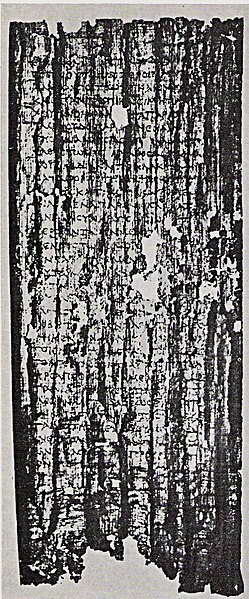
Unrolled papyrus scroll recovered from the Villa of the Papyri.
Picture published in a pamphlet called “Herculaneum and the Villa of the Papyri” by Amedeo Maiuri in 1974. (Wikimedia Commons)
We used to play this game in graduate school: find one, lose one. Find one referred to finding a lost ancient text, something that we know existed at one time because other ancient sources talk about it, but which has been lost to the ages. What if someone was digging somewhere in Egypt and found an ancient Greco-Roman trash dump with a complete copy of a precious text – which one would we wish into survival? Lose one referred to some ancient text we have, but we would give up in some Faustian bargain to resurrect the former text from the dead. Of course there is a bit of the butterfly effect; that’s what made it fun. As budding classicists, we grew up in an academic world where we didn’t have A, but did have B. How different would classical scholarship be if that switched? If we had had A all along, but never had B? For me, the text I always chose to find was a little-known pamphlet circulated in the late fourth century by a deposed Spartan king named Pausanias. It’s one of the few texts about Sparta written by a Spartan while Sparta was still hegemonic. I always lost the Gospel of Matthew. It’s basically a copy of Mark, right down to the grammar and syntax. Do we really need two?
What would you choose? Consider that Homer’s Iliad and Odyssey are only two of the poems that make up the eight-part Epic Cycle. Or that Aristotle wrote a lost treatise on comedy, not to mention his own Socratic dialogues that Cicero described as a “river of gold”. Or that only eight of Aeschylus’s estimated 70 plays survive. Even the Hebrew Old Testament refers to 20 ancient texts that no longer exist. There are literally lost texts that, if we had them, would in all likelihood have made it into the biblical canon.
The problem is more complex than the fact that many texts were lost to the annals of history. Most people just see the most recent translation of the Iliad or works of Cicero on the shelf at a bookstore, and assume that these texts have been handed down in a fairly predictable way generation after generation: scribes faithfully made copies from ancient Greece through the Middle Ages and eventually, with the advent of the printing press, reliable versions of these texts were made available in the vernacular of the time and place to everyone who wanted them. Onward and upward goes the intellectual arc of history! That’s what I thought, too.
But the fact is, many of even the most famous works we have from antiquity have a long and complicated history. Almost no text is decoded easily; the process of bringing readable translations of ancient texts into the hands of modern readers requires the cooperation of scholars across numerous disciplines. This means hours of hard work by those who find the texts, those who preserve the texts, and those who translate them, to name a few. Even with this commitment, many texts were lost – the usual estimate is 99 percent – so we have no copies of most of the works from antiquity.1 Despite this sobering statistic, every once in a while, something new is discovered. That promise, that some prominent text from the ancient world might be just under the next sand dune, is what has preserved scholars’ passion to keep searching in the hope of finding new sources that solve mysteries of the past.
And scholars’ suffering paid off! Consider the Villa of the Papyri, where in the eighteenth century hundreds, if not thousands, of scrolls were discovered carbonized in the wreckage of the Mount Vesuvius eruption (79 AD), in a town called Herculaneum near Pompeii. For over a century, scholars have hoped that future science might help them read these scrolls. Just in the last few months – through advances in computer imaging and digital unwrapping – we have read the first lines. This was due, in large part, to the hard work of Dr. Brent Seales, the support of the Vesuvius Challenge, and scholars who answered the call. We are now poised to read thousands of new ancient texts over the coming years.
[…]
Now let’s look at a text with a very different history, the Hellenica Oxyrhynchia. The Hellenica Oxyrhynchia is the name given to a group of papyrus fragments found in 1906 at the ancient city of Oxyrhynchus, modern Al-Bahnasa, Egypt (about a third of the way down the Nile from Cairo to the Aswan Dam). These fragments were found in an ancient trash heap. They cover Greek political and military history from the closing years of the Peloponnesian War into the middle of the fourth century BC. In his Hellenica, Xenophon covers the exact same time frame and many of the same events.2 Both accounts pick up where Thucydides, the leading historian of the Peloponnesian War (fought between Athens and Sparta in the fifth century BC), leaves off.
While no author has been identified for the Hellenica Oxyrhynchia, the grammar and style date the text to the era of the events it describes. This is a recovered text, meaning it was completely lost to history and only discovered in the early twentieth century. Here, the word discovered is appropriately used, as this was not a text that was renowned in ancient times. No ancient historians reference it, and it did not seem to have a lasting impact in its day. What is dismissible in the past is forgotten in the present. The text is written in Attic Greek. This implies that whoever wrote the Hellenica Oxyrhynchia must have been an elite familiar enough with the popular Attic style to replicate it, and likely intended for the history to equal those of Thucydides and Xenophon. There were other styles available to use at the time but Attic Greek was the style of both the aforementioned historians, as well as the writing style of the elite originating in Athens. Any history not written in Attic would have been seen as inferior. Given that the Hellenica Oxyrhynchia was lost for thousands of years, it would seem our author failed in his endeavor to mirror the great historians of classical Greece.
The Hellenica Oxyrhynchia serves as a reminder that the modern discovery of ancient texts continues. Many times, these are additional copies of texts we already have. This is not to say these copies are not important. Such was the case of the aforementioned Codex Siniaticus, discovered by biblical scholar Konstantin von Tischendorf in a trash basket, waiting to be burned, in a monastery near Mount Sinai in Egypt in 1844. Upon closer examination, Tischendorf discovered this “trash” was in fact a nearly complete copy of the Christian Bible, containing the earliest complete New Testament we have. One major discrepancy is that the famous story of Jesus and the woman taken in adultery – from which the oft-quoted passage “let he who is without sin cast the first stone” originates – is not found in the Codex Sinaiticus.
Yet, sometimes something truly new to us, that no one has seen for thousands of years, is unearthed. In the case of the Hellenica Oxyrhynchia, no one seemingly had looked at this text for at least 1,500 years, maybe more. This demonstrates that there is always the possibility that buried in some ancient scrap heap in the desert might be a completely new text that, once published for wider scholarship, greatly increases our knowledge of the ancients.
How does this specific text increase our knowledge? Bear in mind that before this period of Greek history, we have just one historian per era. Herodotus is the only source we have for the Greco-Persian Wars (480–479), and the aforementioned Thucydides picks up from there and quickly covers the political climate before beginning his history proper with the advent of the Peloponnesian War in 431 BC. But Thucydides’s history is unfinished – one ancient biography claims he was murdered on his way back to Athens around 404 BC. Many doubt this, citing evidence that he lived into the early fourth century BC. Either way, his narrative ends abruptly. Xenophon picks it up from there, and later we get a more brief history of this period from Diodorus, who wrote much later, between 60 and 30 BC. While describing the same time frame and many of the same events, these two sources vary widely in their descriptions of certain events. In some cases, they make mutually exclusive claims. One historian must have got it wrong.
For centuries, Xenophon’s account was the preferred text. That is not to say Diodorus’s history was dismissed, but when the two accounts were in conflict, Xenophon’s testimony got the nod. This was partially because Xenophon actually lived during the times he wrote about, whereas Diodorus lived 200 years after these events in Greek history. Consider if there were two conflicting accounts of the Battle of Gettysburg from two different historians: one actually lived during and participated in the war, while the other was a twenty-first century scholar living 150 years after the events he describes. They disagree on key elements of the battle. Who do you believe? This was precisely the case with Xenophon and Diodorus. Yet, once the Hellenica Oxyrhynchia was published, it corroborated Diodorus’s history far more than that of Xenophon, forcing historians to reconsider their bias toward the older of the two accounts.
1. You can find a list of texts we know that we have lost at the Wikipedia page “Lost literary work“.
2. “Oxyrhynchus Historian”, in The Oxford Companion to Classical Literature, ed. MC Howatson (Oxford University Press, 2011).
Hitler’s Victory in Thüringen – Rise of Hitler 01
World War Two
Published 7 Sep 2024In this issue of the Weimar Wire, we dive deep into the critical events of January 1930. Political violence in the streets, uncertainty over the nation’s very character and Nazis entering a governing coalition provide a veritable treasure trove of political intrigue, hidden aspirations, and grand schemes.
(more…)
Romney Marsh and the Battle of Britain (BBC 1976)
BBC Archive
Published Jun 2, 2024Romney Marsh has been dubbed the “sixth continent”, due to its size and the sense that it has its own rules.
A shingle beach that silently grows bigger every year, scattered debris from the Battle of Britain, an old-fashioned lighthouse hidden from the sea by a nuclear power station. It has a character unlike anywhere else in the UK.
Presented by Dilys Morgan and Bernard Clark.
Clip taken from Nationwide on the Road: Romney Marsh, originally broadcast on BBC One, Wednesday 7 April, 1976.
You have now entered the BBC Archive, a time machine that will transport you back to the golden age of TV to educate, entertain and enlighten you with classic clips from the BBC vaults.
QotD: Life in pre-mechanical times
Anyway, because I’m actually interested in how people are and how they lived, I love “living history”. I know, I know, I’m the one who brought up the Civil War, but though I admire (in a very limited sense) the dedication of “reenactors”, we ain’t going there, lest the comments get way off track. Instead, I’ll refer you to the works of Ruth Goodman. She apparently shows up on a lot of “living history” shows in Britain, which are apparently quite popular over there, and she writes good books about the experience, most with “How to” in the title: I’ve read How to be a Victorian and How to be a Tudor, and they’re both great fun.
The thing you’ll notice right away if you read them is how utterly tedious life was pre-electricity. Actually, no, tedious is the wrong word, since in our usage it implies “mindless” and that’s exactly the opposite of Victorian and especially Tudor life. A much better word is “laborious”, maybe even just “hard”. Life was hard back then. Even the simplest tasks took hours, because everything had to be done by hand. You had a few simple machines, of course — simple in the mechanical sense, though nearly every page brings its “gosh, I never would’ve thought of that!” surprise — but mostly it’s muscle power. If you’re lucky, a horse’s or a donkey’s muscles do some of the heaviest work, but mostly it’s straight-up human effort.
And it’s far from mindless. How to be a Tudor has a long section on baking bread, for instance, and it’s fascinating. There’s a reason bakers had their own guild and were considered tradesmen; it takes a lot of well-honed skill to make anything but the coarsest peasant stuff. And of course that coarse peasant stuff takes a decent amount of skill itself, which is just one of a zillion little skills your average housewife would have. If you read the section on bread-baking and really try to imagine doing it, you’ll find yourself almost physically exhausted … and that’s just one minor chore among dozens, maybe hundreds, that everyday people had to do each and every day.
In other words, everyday Tudor people were “simple”, in the old sense that means “unsophisticated”, but they were never, ever bored. Even the relatively well-off, even when everything was peaceful and prosperous and functioning perfectly, were constantly mentally engaged with the world. They had to be. Imagine if getting your daily bread took not just two hours’ labor, but an actual plan. If you didn’t start your day figuring out how you were going to get fed that day, you wouldn’t eat. They had dozens, probably hundreds, more daily tasks than we ever have, and while any one of those tasks can probably be performed on autopilot if taken in isolation, they were never taken in isolation. Maybe the housewife could bake bread on autopilot, but while her hands were doing that seemingly of their own volition, her mind was lining up the zillion other things she had to do that day. Her mind was constantly engaged.
And “housewife” was a deeply meaningful term back then. The next thing that strikes you, after the sheer amount of effort everything took, is the necessity of communal life. Just the basics of day-to-day living pretty much requires a nuclear family — husband, wife, a few kids. And that’s your hardy yeoman type on the edge of starvation on the forest’s fringes. In any larger settlement, everyone knows everyone, intimately, because your very life depends on it — not only do you know the miller personally, you’ve got a major, indeed mortal, interest in how he lives his life, because if he’s shorting you, you die … or, at least, your already hard life gets a whole lot harder. There’s basically no such thing as privacy, because there can’t be.
Severian, “On Boredom”, Rotten Chestnuts, 2021-08-17.
September 5, 2024
Matilda I – The Little Tank That Did | Tank Chat #176
The Tank Museum
Published May 24, 2024In 1940, this small but well armoured tank was pretty much all that stood between the German Blitzkrieg and a battered British Army that was retreating to the coast.
Slow, small, and armed only with a machine gun, the A11 Infantry Tank (Matilda I) would achieve great things in its only significant battlefield action – effectively saving the British Expeditionary Force from annihilation.
At Arras on 21st May 1940, Matilda Is and IIs of 4th and 7th Royal Tank Regiment counterattacked the rapidly advancing 7th Panzer Division. In doing so, they successfully halted the German advance and unnerved Hitler so much that he issued an order forbidding further advances — thus giving the British and French chance to organize the Dunkirk evacuation.
In this video, David Willey covers the history of this diminutive and often ridiculed little tank which altered the course of history by saving an entire army.
This video features archive footage courtesy of British Pathé.
QotD: Common misunderstandings about the title of “Dictator” in the Roman Republic
The nearest equivalent to this I can think of would be if Olaf Scholz suddenly announced that he was reviving the position of Deutscher Kaiser (German Emperor) for himself, except without the legal structure of that title (e.g. the Prussian crown acting as the permanent president of a federation of monarchs) or the constitutional limits it used to have. We would rightly regard that as a new office, using the title of the old one.
This point is often missed in teaching Roman history because Roman history is very long and so gets very compressed in a classroom environment. Even in a college course focused entirely on the history of Rome, the gap between the end of the old dictatorship and the start of the new one might just be a couple of weeks, so it is easy for students to accept the new dictators as direct continuations of the old ones, unless the instructor goes out of their way to stress the century-long discontinuity. This is, of course, all the more true if the treatment is in a broader European History (or “Western Civ”) course or in a High school World History course – which might be able to give the Roman Republic as a whole only a week of class time, if even that much. In that kind of compressed space, everything gets mushed together. Which in turn leads to a popular view of the Roman dictatorship that this office was always a time-bomb, ready to inevitably “go off” as soon as it fell into the hands of someone suitably ambitious, because the differences and chronological gap between the old, customary dictatorship and the new irregular one are blurred out of vision by the speed of the treatment.
Just as a side note, this is generally a problem with the Roman Republic. Popular treatments of how the Republic worked – much less pop-culture representations of it – are almost always badly flawed […] The opening minutes, for instance, of the Crash Course video on the Romans is a series of clear errors, one after another, in describing how the Republic functioned as a matter of law and practice. If for some reason you want to not be wrong about the structure of Roman government, the book to read – though it is more than a bit dry and quite pricey – is A. Lintott, The Constitution of the Roman Republic (1999). I keep thinking that, as a future series, I might take a look at the basic structures of Greek and Roman civic government (“How to Polis, 101″ and “How to Res Publica, 101″) – especially if I can talk a colleague into providing a companion treatment of medieval Italian commune government – both as a historical exercise but also for the world builders out there who want to design more realistic-feeling fictional pre-modern governments that aren’t vassalage/manorialism systems.
Bret Devereaux, “Collections: The Roman Dictatorship: How Did It Work? Did It Work?”, A Collection of Unmitigated Pedantry, 2022-03-18.
September 4, 2024
The Korean War Week 011 – Destroy the Perimeter! – September 3, 1950
The Korean War by Indy Neidell
Published 3 Sep 2024The North Korean forces launch a huge new offensive against the entire Pusan Perimeter, hoping to break through at least somewhere along the line. They are aware that time is of the essence, for the UN forces grow in number daily, while they are losing a battle of attrition. Some new UN arrivals this week are the first British ground troops in Korea for the fight. Meanwhile, Douglas MacArthur’s plans for his upcoming surprise counteroffensive hit all sorts of snags thanks to Korean geography.
Chapters
00:51 Recap
01:26 The British Arrive
03:47 New KPA Strategy
06:49 The New KPA Offensive
12:26 More Incheon Issues
15:16 The US and China
17:12 Summary
(more…)
British Foreign Secretary David Lammy indulges himself with a Trudeau-esque bit of geopolitical posturing
In Spiked, Brendan O’Neill outlines the British government’s odd choice of timing to announce suspension of (some) arms shipments to Israel:

Bereft of vision, the modern politician is obsessed with “optics”. Which makes foreign secretary David Lammy’s announcement this week that the UK will be suspending some arms exports to Israel all the more surreal. The optics of withholding weapons from the Jewish State the day after we discovered that its enemy is so ruthless it will happily murder young Jews in cold blood are atrocious. Did not one functionary in the Foreign Office think to raise his or her hand and say: “Sir, should we at least wait until the bodies of those six Israeli hostages are cold before we shame and punish the nation they came from?”
This goes way beyond optics, of course. It is more than a failure of spin. It is a failure – a colossal, unforgivable one – of morality. As the bodies of the six slain Jews found in one of Hamas’s hellish lairs in Rafah were being transported back to a grief-stricken Israel, our government took action not against the Islamist extremists who carried out this unutterable atrocity, but against the nation that suffered it. Mere hours after the discovery of an act of fascistic savagery, our government handed a propaganda victory to the fascists by dragging Israel’s name through the mud. What were they thinking? Shameful doesn’t cover it.
Mr Lammy has said around 10 per cent of arms sales to Israel will be suspended. Thirty out of 350 arms-exports licences will be cancelled, primarily affecting parts for fighter jets, helicopters and drones. The reason for this smug, haughty smackdown of the Jewish State? Because there’s a “clear risk”, said Lammy, that such equipment will be used to “commit or facilitate a serious violation of international humanitarian law”. Big talk from a politician who noisily supported the West’s imperial bombardment of Iraq that led to the deaths of hundreds of thousands of civilians and the widescale torture and rape of prisoners.
Many are damning Lammy’s partial embargo as gesture politics. “What is the point?”, headlines wonder. Denying Israel a few parts for planes won’t make much difference, some moan. For the frothing Israelophobes of the iffy left, nothing less than a complete arms embargo will do. They want not one gun to go to crazy Israel. If only there was a word to describe people who agitate morning, noon and night for the disarming of a Jewish nation that recently suffered the worst act of anti-Semitic violence since the Holocaust.
The obsession with the partial nature of Lammy’s reprimanding of Israel misses the point. What the Foreign Office has just done is huge – and profoundly troubling. Sure, it won’t make much of a dent in Israel’s ability to fight Hamas, but it will cast aspersions on Israel’s fight against Hamas. It won’t militarily weaken Israel’s war on the pogromists that slaughtered more than a thousand of its people on 7 October, but it might morally weaken that war with its sly implication that there’s a criminal element to this crusade against Hamas’s army of anti-Semites. The partial arms embargo is indicative of something far more unsettling: a solidarity embargo as Britain slowly but surely turns its back on the Jewish nation.


