Quotulatiousness

November 14, 2010

Life replicates art, kinda

As one of the comments on this article in The Cord points out, it’s highly ironic that “at a speech about a book detailing how the police did nothing to uphold the laws of the land the university did exactly the same thing.”

What was scheduled as a speech by Globe and Mail columnist Christie Blatchford turned sour tonight as protesters opposing the journalist’s new book Helpless: Caledonia’s Nightmare of Fear and Anarchy, and How the Law Failed All of Us took over the stage.

Three protesters locked themselves together at the centre of the stage where Blatchford was meant to speak at the University of Waterloo’s (UW) Humanities Theatre in Hagey Hall, with another individual acting as their “negotiator”. A fifth, Tallula Marigold, acted as the group’s media representative.

“We don’t want people who are really, really racist teaching [the people we love],” said Marigold of Blatchford. “And we don’t want that person to have a public forum because it makes it dangerous for others in the public forum.”

If nothing else, the passion of the protesters has persuaded me that I must buy and read Blatchford’s latest book . . .

November 10, 2010

UK schools to include study of Paganism with other religions

Filed under: Britain, Bureaucracy, Education, Religion — Nicholas @ 12:10

The Lincolnshire school authorities have decided to allow local schools the choice of including the study of paganism with the existing study of religions:

If you’re looking to improve your child’s chanting skills or enhance their moon dancing, Lincolnshire may soon be the place to go — as the county decided this week to let individual schools decide on the teaching of pagan doctrine.

At present, some six world religions are studied in that County’s schools.

According to the minutes of a meeting of the Standing Advisory Council on Religious Education (Sacre) the county’s RE advisor fed back the results of her investigation into Paganism.

I’m not a fan of teaching any religious beliefs in any public school, but if you’re going to cover any of them, you can’t exclude one arbitrarily. “Paganism”, in this instance is a superset of Druidry, which is now officially recognized as a faith (that is, all Druids are pagans, but not all pagans are Druids):

This makes 2010 a very good year for UK Paganism, following the recognition of druidry as a religion in Britain for the first time in October, when the Charity Commission accepted it as a faith and gave it the charitable status afforded to other religious groups.

Critics — who have been slow off the mark so far on this issue — may also be relieved to learn that modern pagans, unlike ancient druids, are more concerned with focussing personal energies through ritual than human sacrifice. Then again, that allegation was laid by the Romans, who also accused early Christians of eating babies.

November 9, 2010

The five stages of grading

Filed under: Education, Humour — Tags: — Nicholas @ 19:08

By way of Ilkka’s blog, a new look at the plight of the grad student:

Everyone is familiar with Elisabeth Kübler-Ross and her stage model of coping with grief popularly known as the five stages of grief. What you may not know is that Kübler-Ross actually developed her theory as a graduate student, basing her conception of the process of loss on the experiences one goes through over a grading weekend.

In coping with grading, it’s important for graduate students and young professors to know that they are not alone and that this process takes time. Not everyone goes through every stage or processes the reality of grading in this order, but everyone experiences some version of at least two of these steps.

Read the whole thing.

November 7, 2010

See? Anti-drug education is finally working

Filed under: Education, Law, Liberty — Tags: , , , , , — Nicholas @ 13:37

Now that we can get kids to turn in their parents for pot possession:

Two parents are facing drug charges after their child took their drugs to school and told a school officer his parents were breaking the law.

WBTV is not releasing the names of the parents or the name of the school to protect the child’s identity.

The 11-year-old student is in 5th grade at a an elementary school in Matthews. Police say he brought his parents’ marijuana cigarettes to school when he reported them.

Matthews Police say he reported his parents after a lesson about marijuana was delivered by a police officer who is part of the D.A.R.E. program, which teaches kids about the dangers of drugs, alcohol, and tobacco.

Well, thank goodness that this kid’s parents have been saved! I’m sure they’ll just get a stern talking-to from Officer Friendly, they’ll see the error of their ways, and everyone will go out for ice cream sundaes afterwards!

Poor kid. A brief moment of “doing the right thing” may well have ruined three lives. Nice work, Officer Friendly!

Police say both the 11-year old and a sibling have been removed from the parents’ house by social services. Police say they are staying with relatives.

If there were no relatives handy, the two children would probably become wards of the state. And that is something to wish on nobody.

October 22, 2010

Stephen Fry on language

Filed under: Education, Humour, Quotations — Tags: , — Nicholas @ 08:50

October 21, 2010

An excellent example of how not to teach

Filed under: Bureaucracy, Education, History — Tags: , — Nicholas @ 08:49

Cory Doctorow finds the worst example of teacher overreach (for this week, anyway):

Fundamentally, these teachers have prohibited doing any kind of outside work, having any productive discussion with your friends and family that might connect the history you’re learning with the world you’re living in. They have reduced education to absorbing and regurgitating a specific set of facts, divorcing it from any kind of critical thinking, synthesis, or intellectual rigor.

Parents have complained to the principal, who “will decide soon whether these rules are okay.”

I had a high school history teacher who marked me down for including additional information that wasn’t in the textbook (I read history for interest well before high school). I wonder if this is one of her relatives . . .

If I was a parent of one of these students, I’d be giving strong consideration to moving my kid to another school if the principal upholds this policy.

October 18, 2010

QotD: The primary achievement of modern schools

Filed under: Bureaucracy, Education, Government, Liberty, Quotations — Tags: , , — Nicholas @ 12:56

They were right — although I had to see it for myself before I fully grasped the magnitude of the phenomenon — children are learning machines, more or less in the same sense that sharks are eating machines.

The only phenomenon more astonishing than that is the way the public school system manages to kick, stomp, and crush a child’s inherent curiosity and love of learning, often destroying it altogether by the third or fourth grade. Yes, children are learning machines. The fact that government schools have managed to condition them against learning is an astonishing — if wholly negative — feat, achieved at the unspeakable cost of countless hundreds of billions of dollars.

Nobody has any choices in the matter. The government’s schools are underwritten by the kind of theft we call taxation, and nothing good can ever come of that. Their little desks are filled by a kind of conscription. The entire institution is administered and operated by unionized net tax consumers, who savagely resist any attempt to objectively assess their work and reward (or punish) them on that basis.

I’d like to have a nickel for every time I’ve had to listen to school administrators inviting parents to participate in the education of their own children — and then complaining when parents actually do it.

They want you to participate, all right, but only on their terms. They don’t want you questioning their policies and practices. They want you to validate whatever they do to your kids, to provide them with what Ayn Rand called “the sanction of the victim”. And if you won’t do that, or if you won’t sit down and shut up — or better yet, just go away — then they identify you as “problem parents” and “trouble-makers”.

L. Neil Smith, “Salt on the Ruins: A Chapter from the Forthcoming Where We Stand“, Libertarian Enterprise, 2010-10-16

October 14, 2010

The anomaly was the “nuclear family” era, not today

Filed under: Economics, Education, USA — Tags: , , — Nicholas @ 07:57

In so many stories about adult children moving back home after college, the default attitude seems to be that this is “not normal”. This is false: for most of human history, the default living situation has been multiple generations living in the same dwelling. The “nuclear family” era was the break with everything that had gone before. That being said, this should be no surprise:

Getting a degree used to be a stepping stone to limitless career opportunities. Now it’s more of a hiatus from living under your parents’ roof.

Stubbornly high unemployment — nearly 15% for those ages 20-24 — has made finding a job nearly impossible. And without a job, there’s nowhere for these young adults to go but back to their old bedrooms, curfews and chore charts. Meet the boomerangers.

“This recession has hit young adults particularly hard,” according to Rich Morin, senior editor at the Pew Research Center in DC.

So hard that a whopping 85% of college seniors planned to move back home with their parents after graduation last May, according to a poll by Twentysomething Inc., a marketing and research firm based in Philadelphia. That rate has steadily risen from 67% in 2006.

October 13, 2010

QotD: Economic misconceptions

Filed under: Economics, Education, Quotations, USA — Tags: , — Nicholas @ 00:04

Students typically come to an economics class with many misconceptions, not just random errors but systematic biases.

Bill Goffe recently (2009) surveyed one of his macro principles classes and found, for example, that the median student believes that 35% of workers earn the minimum wage and a substantial fraction think that a majority of workers earn the minimum wage (Actual rate in 2007: 2.3% of hourly-paid workers and a smaller share of all workers earn the minimum wage, rates are probably somewhat higher today since the min. wage has risen and wages have not).

When asked about profits as a percentage of sales the median student guessed 30% (actual rate, closer to 4%).

When asked about the inflation rate over the last year (survey was in 2009) the median student guessed 11%. Actual rate: much closer to 0%. Note, how important such misconceptions could be to policy.

When asked by how much has income per person in the United States changed since 1950 (after adjusting for inflation) the median student said an increase of 25%. Actual rate an increase of about 248%, thus the median student was off by a factor of 10.

Alex Tabarrok, “Economic Misconceptions”, Marginal Revolution, 2010-10-11

October 12, 2010

Monty on structural unemployment

Filed under: Economics, Education, Technology, USA — Tags: , , , — Nicholas @ 12:07

Monty is still too busy with real life to do a daily Financial Briefing, but he’s dropping by a few times a week with his insightful-and-acidic thoughts at Ace of Spades HQ:

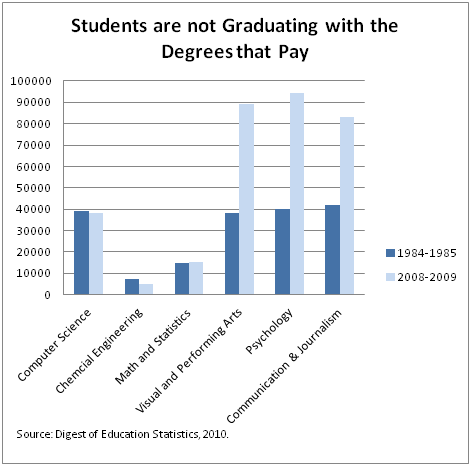
Welding jobs may be plentiful, but that’s no help to you if you’re not a welder. This is called “structural unemployment”, and it has no real short-term solution. It results from a disconnect between current worker skills and employer requirements. It’s really a form of malinvestment. Students train in subjects like Postmodernist Literary Theory and The Hermeneutics of Lesbian Cinema, but the job market is asking for engineers and plumbers. Workers in fading industries won’t or can’t retrain. The last time this problem cropped up was during the 1982 recession: the old manufacturing jobs were gone, and the hundreds of thousands of Rust Belt factory workers — many now middle-aged, with high union wages and benefits packages they didn’t want to lose — either could not or would not re-train into other fields. This led to a long cycle of stagnation in which the American upper midwest remains mired to this very day. Pull quote:

Victor Calix Cruz, 51, has been job hunting for two years after being laid off from construction work in Miami. He, his wife and their two teenage children are “surviving” on his wife’s disability and his unemployment payments, he said. While he heard of openings at hotels, he hasn’t applied because the pay and benefits aren’t as good as what he had before.

I don’t imagine that your unemployment check matches what you were making before either, Chief. It’s like the old Rolling Stones song: you can’t always get what you want.

October 8, 2010

US education reform

Filed under: Bureaucracy, Education, Politics, USA — Tags: — Nicholas @ 08:49

October 6, 2010

Montessori school raided by New Mexico drug cops

Filed under: Education, Law, USA — Tags: , , , , — Nicholas @ 13:10

You can rest easy, knowing that a potentially dangerous grow op has been investigated by New Mexico Schutzstaffel drug cops:

“We were all as a group eating outside as we usually do, and this unmarked drab-green helicopter kept flying over and dropping lower,” she said. “Of course, the kids got all excited. They were telling me that they could see gun barrels outside the helicopter. I was telling them they were exaggerating.”

After 15 minutes, Pantano said, the helicopter left, then five minutes later a state police officer parked a van in the school’s driveway. Pantano said she asked the officer what was happening, but he only would say he was there as a law-enforcement representative.

Then other vehicles arrived and four men wearing bullet-proof vests, but without any visible insignias or uniforms, got out and said they wanted to inspect the school’s greenhouses. Pantano said she then turned the men over to the farm director, Greg Nussbaum.

Ms. Pantano must have nerves of steel . . . most schools would have gone into emergency lock-down at the sight of all those paramilitary types deploying in the driveway.

The comments on BoingBoing were good, and this one was great:

The War on Organic Produce continues to go well. Each of those tomatoes cost the taxpayer $75.00 US! WE WILL NOT BE SATISFIED UNTIL THE DRUG CZAR IS RUMOURED TO CURE GOUT BY WASHING THE FEET OF THE AFFLICTED.

Seriously: What the fucking fuck fuck happened to Probable Cause in this day and age? “We’re spending $20,000 on this operation because we herd thai leik mudkips, so we kipped in thair mud so thai can mud whail thai kip.” In the immortal words of Plato, NON FUCKING SEQUITUR is NOT a RIVER in EGYPT!

“What else floats the same as a Cannabis Sativa plant??? – er, WOOD! – Good, what else? – well, tiny rocks. – OH! A DUCK! – Right! So if the suspects are raising ducks — THEN THEY’RE RAISING POT! – WELL /DONE/!”

Law Enforcement by Superstition is horse-shit.

September 3, 2010

QotD: Another key ingredient to ever-growing bureaucracy

Filed under: Bureaucracy, Education, Government, Quotations — Nicholas @ 12:12

Bureaucrats breed more bureaucrats. A system manned by university graduates, with ever higher levels of accreditation, believes that such a type of learning is socially useful. The Mandarin believes his role to be central in society. The state will manage society, and he and his class will manage the state. Other forms of learning are useful, but inferior. Since the Mandarin also controls the state schools, he will wish to gear the whole system to the generation of more like him.

This may seem counterintuitive. Why have more competition? Why not, like the original Mandarins of Imperial China, select only the best and brightest for higher education? Because the modern Mandarin lives in a democratic society. Such obvious selectivity would be damned as elitist. Mass high school and university education has the added benefit of reinforcing the bureaucratic system. This goes beyond the crude propaganda used in the schools, which really works only on those too young to challenge it, but to the very methods being employed.

The academically uninclined, even though still intelligent, youth acquires a grudging admiration for the academically talented. He begins, and the whole system reinforces this notion, that only this type of aptitude truly matters. His own talents, which might be every bit as useful to himself and society as any other, he begins to regard as inferior. Reluctantly, sometimes bitterly, he begins to defer to the “smart kids.” He has been prepared for a society in which the academic student has become the intellectualized bureaucrat. It will be easier for him to defer to the bureaucrat, whom he regards, if only subconsciously, as his superior.

Publius, “The Education Machine”, Gods of the Copybook Headings, 2010-09-02

August 10, 2010

QotD: The Finnish intelligentsia

Filed under: Education, Europe, History, Quotations — Tags: , , , — Nicholas @ 00:02

I added a whole bunch of Finnish blogs to my Google Reader list that now stands at a hefty 421 subscriptions. Recalling the news back in the end of the year 2008, the Finnish intelligentsia was ecstatic for . . . well, you know why, but as Hannu Visti points out, they have recently been mysteriously quiet about their high hopes of how America will any day now abandon the free market capitalism and turn into a European-style social democratic welfare state. Now, we wingnuts sure like to laugh at the intelligentsia, but the Finnish intelligentsia has always truly been a class of its own, since as Hannu notes, they have been utterly wrong about literally everything over the past fifty years. Whereas their American colleagues merely hinted at the superiority of socialism and communism and took their marching orders and talking points from them only indirectly, the Finnish intelligentsia was proudly a stooge for the Soviet Union, worshipping its raw and brutal power that had no respect for all those pesky individual rights holding back the better world. And since they never really had any ideas of their own, these days this puppet just switched onto a new master that has his hand deep up its ass to move its grimacing mouth . . . or I don’t know if I should rather say two masters, both incidentally wearing the same colour green.

Ilkka, “Dead souls”, The Fourth Checkraise, 2010-07-23

July 31, 2010

That 77 cents myth again

Filed under: Economics, Education, Politics — Tags: , , — Nicholas @ 11:30

Have you heard that women earn only 77 cents for each dollar earned by men? Do you believe it? I hope not, because it’s provably false:

Blau and Kahn found that 59% of the gender differential could be explained by non-discriminatory things: experience, chosen occupation, chosen industry, etc. So the “77 cents” statistic can’t be due to discrimination:

  • Estimated wage gap based on “77 cents” statistic = $0.23 per hour
  • Amount explained by nondiscriminatory factors = $0.14 per hour
  • Amount NOT explained = $0.09 per hour

According to Blau and Kahn, the most that could be attributed to discrimination is $0.09 per hour. And this assumes that their model accounts for ALL legitimate nondiscriminatory factors.

Are there legitimate nondiscriminatory factors that were omitted from their model? Probably — no model is perfect. Some people have argued that men are better negotiators than women, and because of this men tend to get higher starting salaries. Are differences in negotiating skills discriminatory? Perhaps, based on the way that we raise our daughters (that’s a sociological issue). But the employer can’t be held responsible for differences in negotiating skills, can he?

Something else to consider: overtime hours, shift premiums, etc., may cause a difference in earnings between men and women, even though their base rates of pay are the same. If a woman chooses to work fewer overtime hours than her male counterpart, resulting in lower earnings, is that discrimination?

H/T to Walter Olson for the link.

« Newer PostsOlder Posts »

Powered by WordPress