
Published on 13 Dec 2013
“If we are lending money that ostensibly we don’t have to kids who have no hope of making it back in order to train them for jobs that clearly don’t exist, I might suggest that we’ve gone around the bend a little bit,” says TV personality Mike Rowe, best known as the longtime host of Discovery Channel’s Dirty Jobs.
“There is a real disconnect in the way that we educate vis-a-vis the opportunities that are available. You have — right now — about 3 million jobs that can’t be filled,” he says, talking about openings in traditional trades ranging from construction to welding to plumbing. “Jobs that typically parents’ don’t sit down with their kids and say, ‘Look, if all goes well, this is what you are going to do.'”
Rowe, who once sang for the Baltimore Opera and worked as an on-air pitchman for QVC, worries that traditional K-12 education demonizes blue-collar fields that pay well and are begging for workers while insisting that everyone get a college degree. He stresses that he’s “got nothing against college” but believes it’s a huge mistake to push everyone in the same direction regardless of interest or ability. Between Mike Rowe Foundation and Profoundly Disconnected, a venture between Rowe and the heavy equipment manufacturer Caterpillar, Rowe is hoping both to help people find new careers and publicize what he calls “the diploma dilemma.”
December 16, 2013
Reason.tv – Dirty Jobs’ Mike Rowe on the High Cost of College
December 14, 2013
Literacy and demographics
David Warren invites a lot of knee-jerk reaction with this passage in a recent essay:
Whether in West or East, however, the mechanism of societal disintegration is the same. It could be described in one phrase as “the liberation of women.” The modern economy lures women away from home and family with (ludicrously false) promises of wealth, pleasure, and freedom. Industry required a more docile labour force, the State required revenues from double-income taxation. At a level more fundamental than economics, the times have offered atomizing ideologies — the promise of “democracy” in which everyone will be treated the same, whether man, woman, or some other thing. As Goldman has rather plainly shown (and Roberts showed long before him), we must cherchez la femme.
For women are, as they have always been, the bedrock of both family and religion. Men have, and will be by nature (whether this is recognized or not) the hunters and gatherers and bread winners. There is no point in debating this, for either one gets it or one is wilfully obtuse. A certain minority of talented women have always flourished outside the home, and perhaps a like proportion of men not flourished in the absence of any marketable skills — but the case is straightforward in the main. What we have been enduring, for a century now, is an attempt to change the order of the world by social and sometimes genetic engineering; with results clearly visible all around us, to say nothing of the grief and loneliness and self-pity that each of us is carrying inside.
Curiously enough, Goldman homes in on a statistical fact that Roberts elided. It is that a sharply increasing female literacy rate is a more or less infallible predictor of demographic collapse, in all non-Western countries. Or as I mischievously put it, on Twitter only last night, “statistically and objectively, the quickest way to destroy a nation is to teach their women to read.”
This remark would invite several gallant qualifications. The modern emancipation of women began in the West, where Christian teaching had always accorded women the greatest respect. The social changes were therefore slower and easier to assimilate, here. It is when what happened more gradually in the West, happens more suddenly in the East, that the transformation becomes catastrophic. The whole ancestral order of society comes down, in one generation rather than four or five. And they haven’t seen the worst of it yet, for the West had accumulated reserves of wealth, with which to pay some pensions and geriatric bills. The East will face a more dramatically ageing population, without the reserves.
November 19, 2013
QotD: Education and aptitude
Every time a liberal sees someone behaving badly they sigh and say, “They just need education,” but the solution to America’s problems is less education, not more. If we got over this myth that everyone needs infinite academia, we would have less unemployment, more manufacturing, a stronger economy, less student debt, and less school tax. The economy would be stronger and we would all be happier. Ironically, in an effort not to hurt anyone’s feelings, we developed a system where everyone has to go to college, even the stupid people, until we all feel like shit.
When everybody’s special, nobody is. Getting everyone into college means you have to dumb down the curriculum until it is nothing but meaningless drivel that has no application in the real world. Colleges aren’t going to complain when you stick them with more customers. They just take the check, lower the bar, and say, “Come on in.” But getting a gold star on your math test does not a computer programmer make.
When my dad was a kid in Scotland, Britain was practicing a very successful exam system called 11-plus. Dad came from a huge working-class family and as is often the case, one of them had an IQ much higher than the others. They all took their 11-plus test at age 11. His brothers did fairly poorly and he did incredibly well. The brothers were then diverted from academia and put into trade schools, whereas my father got scholarships for private school and eventually got a degree in physics from Glasgow University. The brothers did very well working at a printing press and now lead fulfilled lives as proud tradesmen. My father went on to develop sonar equipment that called the Russians’ nuclear-submarine bluff and helped lead to the fall of communism. This was all thanks to the 11-plus system and it worked beautifully for over 30 years until 1976 when the egalitarians decided it was cruel to admit that some kids are simply not as smart as others.
Not only is this kind of thinking the stupidest. It’s stupidist. What’s the matter with not being smart? As Hemingway put it, “Happiness in intelligent people is the rarest thing I know.” Have you ever seen a genius at a water park? He’s miserable. The only time people with an IQ over 120 are really happy is when they’re at work. They’re basically our slaves. Dumb people ride ATVs with their sons, go bungee jumping, and laugh their heads off when somebody farts. Many of them are also rich.
Gavin McInnes, “A Nation of Working-Class Dropouts”, Taki’s Magazine, 2013-08-23.
November 16, 2013
QotD: Petronius was right
Sometime in the mid-first century a.d., an otherwise little known consular official, Gaius Petronius, wrote a brilliant satirical novel about the gross and pretentious new Roman-imperial elite. The Satyricon is an often-cruel parody about how the Roman agrarian republic of old had degenerated into a wealth-obsessed, empty society of wannabe new elites, flush with money, and both obsessed with and bored with sex. Most of the Satyricon is lost. But in its longest surviving chapter — “Dinner with Trimalchio” — Petronius might as well have been describing our own 21st-century nomenklatura.
[…]
Another farce in the Satyricon involves the nonchalant ignorance of Trimalchio and his guests. The wannabes equate influence and money with status and learning and so pontificate about current events, with made-up mythologies and half-educated references to history. When Trimalchio and his banqueters begin to sermonize on literature, almost everything that follows turns out to be wrong — as Petronius reminds us how high learning has become as inane a commodity as food or sex, and only sort of half consumed, rather like the 2008 campaign of faux Greek columns and Vero possumus, which were supposed to convey gravitas.
Likewise, in our version, what does a $200,000 Ivy League education or a graduate degree really get you any more? In the sophisticated world of our political and highly credentialed elites, there are 57 states. Atlantic Coast cities are said to lie along the Gulf of Mexico; after all, they are down there somewhere in the South. The Malvinas become the Maldives — Ma- with an s at the end seems close enough. Corps-men serve in the military (as zombies?). Medgar Evans was a civil-rights icon, but you know whom we mean. President Roosevelt addressed the nation on television after the stock-market crash in 1929 — well, he would have, had he been president then and if only Americans had had televisions in their homes. And how are we to know that what we read from celebrity authors is not just made up or plagiarized, whether a Maureen Dowd column or a Doris Kearns Goodwin book?
The famously nouveau-riche Trimalchio’s guests drop the names of the rich and powerful, mostly to remind one another that they are now among the plutocracy that is replacing the old bankrupt aristocracy. We too are seeing something like that metamorphosis. It is hard to guess on any given summer weekend which populist progressive family — the Obamas, the Clintons, the Kerrys, the Gores — will be ensconced on what particular Hamptons, Nantucket, or Martha’s Vineyard beach, rubbing shoulders with just the sort of Silicon Valley or Wall Street new zillionaires who during work hours are supposed to be the evil “1 percent” and “fat cats” who need to be forced to pay their “fair share.”
Victor Davis Hanson, “An American Satyricon”, National Review Online, 2013-08-27
November 13, 2013
BC school bans kindergarten kids touching each other
Apparently Coghlan Fundamental Elementary School in Aldergrove has had a rash of injuries to kindergarten students recently, so the solution is to ban all physical contact between students:
A letter went out to Coghlan kindergarten students’ parents on Friday, one of those types that often sit in backpack over a weekend or are put aside to be read later and somehow never are.
Julie Chen found the letter, explaining a new no-touch policy for kindergarten students, on Monday morning as she was packing lunch for her five-year-old daughter.
It reads, in part: “We have unfortunately had to ban all forms of hands-on play for the immediate future … we will have a zero-tolerance policy.”
Penalties for making physical contact with a schoolmate include being grounded during play time and/or a trip to the office “for those who are unable to follow the rules.”
“I read the letter, it said there had been quite a few injuries, I said, ‘OK,’ and kept reading,” Chen said. “When I saw no hands-on would be allowed, I just got mad, I got so upset.
[…]
School employee Arthur Bourke drove up in his van and was happy to defend the policy.
“I don’t know how anyone would be against this,” Bourke said. “They’re trying to make it safe for everybody.
“They do a terrific job here of making sure everyone is safe.
“It’s something we have to do — if we don’t control it, it will get out of hand.”
The letter to parents cited “several injuries” in the past few weeks.
October 30, 2013
Human Progress
At Reason, Marian Tupy introduces a new website celebrating Human Progress:
In a world where we are constantly bombarded with bad news, it can sometimes be difficult to think of “progress” and “humanity” in the same sentence. Are there not wars taking place, people going hungry, children at work, women being abused, and mass poverty around the world?
In fact, for most of human history, life was very difficult for most people. People lacked basic medicines and died relatively young. They had no painkillers and people with ailments spent much of their lives in agonizing pain. Entire families lived in bug-infested dwellings that offered neither comfort nor privacy. They worked in the fields from sunrise to sunset, yet hunger and famines were commonplace. Transportation was primitive and most people never traveled beyond their native villages or nearest towns. Ignorance and illiteracy were rife. The “good old days” were, by and large, very bad for the great majority of humankind.
Average global life expectancy at birth hovered around 30 years from the Upper Paleolithic to 1900. Even in the richest countries, like those of Western Europe, life expectancy at the start of the 20th century rarely exceeded 50 years. Incomes were quite stagnant, too. At the beginning of the Christian era, annual incomes per person around the world ranged from $1,073 to $1,431. As late as 1820, average global income was only $1,274 per person. (Angus Maddison, whose income estimates I use here, gives his data in 1990 dollars. I have adjusted Maddison’s figures for inflation.)
Humanity has made enormous progress — especially over the course of the last two centuries. For example, average life expectancy in the world today is 67.9 years. In 2010, global per capita income stood at $13,037 — over 10 times what it was two centuries ago.
The new website is called Human Progress:
It is perhaps best to start by explaining what the Human Progress website is not trying to accomplish. It will not try to convince you that the world is a perfect place. As long as there are people who go hungry or die from preventable diseases, there will always be room for improvement. To that end, we all have a role to play in helping the destitute in our communities and beyond.
Our goal, then, is not to paint a rosy picture of the state of humanity, but a realistic one. A realistic account of the world should focus on long-term trends, comparing living standards between two or more generations. Crucially, it should compare the imperfect present with a much more imperfect past, rather than with an imagined utopia in the future.
As such, this website has two main aims. First is to inform you about the many ways in which the world has become a better place. Second is to allow you to search for reasons that brought that improvement about. While we think that policies and institutions compatible with freedom and openness are important factors in promoting human progress, we let the evidence speak for itself and hope the website stimulates an intelligent debate on the drivers of human progress.
October 22, 2013
QotD: They We were better people in those days…
Back in the bad old days, before Pierre Trudeau saved Canada from the horrors of fiscal solvency and smallish government, school children, mostly girls, were taught something called home economics. The theory, terrible quaint though it sounds, is that since most women would become homemakers they should be prepared for that role. Some, no doubt, came from good homes where dutiful mothers ensured that their daughters knew how to cook, sew and deal with troublesome infants. Some did not come from good homes. Part of the point of public education was to make sure that all girls knew how to cook nutritious food for their families. More broadly it was to ensure that all children acquired life skills along with whatever algebra and Shakespeare they could pick up.
That was one of the goals of public education. Educating a self reliant, sober and decent citizenry. Not rationalizing every vice and undermining the founding tenets of Canadian society. There was plenty of propaganda, but it was mostly propagating positive values. A tad parochial and silly by our standards, but not without its merits. It was not a platform for allowing anti-capitalist and anti-industrial zealots like David Suzuki to pontificate.
If there is a problem with “food insecurity” it’s because many Canadians, especially among the lower classes, lack basic life skills. That, not incidentally, is why most are in the lower class. If the Pakistani cab driver with a scant English vocabulary can feed and cloth his family with some decency, what does that say about the Mackenzies who have been here since Simcoe? Some of the poor are poor because they’re physically or mentally incapable of fending for themselves. In an advanced society they comprises only a small fraction of the working age population. Much of the poor in Canada are poor because they exhibit poor behaviour.
Most of the long-term poor, this excludes those who are simply suffering from temporary misfortune, think in a much different way than those in the middle class. The long-term poor are short-range in their thinking. Their savings rate is close to non-existent. They can’t resist instant gratification, like junk food or gambling. This also extends to their sexual lives. They exhibit a strong tendency toward highly unstable short-term relationships based on fleeting desire. The notion of a long-term, emotionally stable relationship is either alien or absurd.
Richard Anderson, “Thinking of the Children”, Gods of the Copybook Headings, 2013-10-21
October 13, 2013
October 9, 2013
England performs poorly in literacy and numeracy survey
In the Guardian, Randeep Ramesh reports on a recent OECD ranking of literacy and numeracy which shows England in a poor light:
England is the only country in the developed world where the generation approaching retirement is more literate and numerate than the youngest adults, according to the first skills survey by the Organisation for Economic Co-operation and Development.
In a stark assessment of the success and failure of the 720-million-strong adult workforce across the wealthier economies, the economic thinktank warns that in England, adults aged 55 to 65 perform better than 16- to 24-year-olds at foundation levels of literacy and numeracy. The survey did not include people from Scotland or Wales.
The OECD study also finds that a quarter of adults in England have the maths skills of a 10-year-old. About 8.5 million adults, 24.1% of the population, have such basic levels of numeracy that they can manage only one-step tasks in arithmetic, sorting numbers or reading graphs. This is worse than the average in the developed world, where an average of 19% of people were found to have a similarly poor skill base.
When the results within age groups are compared across participating countries, older adults in England score higher in literacy and numeracy than the average among their peers, while younger adults show some of the lowest scores for their age group.
As with any sort of survey of this kind, it helps to know how they went about assessing skills in various countries and how similar countries rank:
Literacy for people aged 16-24
6 Australia
15 Canada
17 Ireland
19 England/N Ireland
20 United States
Literacy for all adults
5 Australia
10 Canada
14 England/N Ireland
16 United States
19 Ireland
Numeracy for people aged 16-24
14 Australia
16 Canada
18 Northern Ireland
20 Ireland
24 United States
Numeracy for all adults
13 Australia
14 Canada
16 England/N Ireland
19 Ireland
20 United States
If there’s reason for English authorities to be concerned with their middle-of-the-Anglosphere ranking, there’s even more reason for American educators to take note.
H/T to Tyler Cowen for the link.
September 11, 2013
L.Neil Smith responds to Allison Benedikt’s “manifesto”
In the latest Libertarian Enterprise, L. Neil Smith calls for “Public schools delenda est” in response to Benedikt’s paean to the glories of government-run schools:
Which brings us to the subject of today’s diatribe, an article I was directed to (hat-tip to Tatiana Covington) on Slate.com, awkwardly entitled, “If You Send Your Kid to Private School, You Are a Bad Person — A Manifesto”. This unintelligent but very revealing piece, posted Thursday, August 29, 2013, was written by somebody called Allison Benedikt, who slings a keyboard like some breathless high school cheerleader, but is apparently a movie critic for the Chicago Tribune.
As Joe-Bob would say, check it out.
What this little death-dealer proposes — “demands” would be more accurate — is that all private schools be outlawed (whoops there go the First, Fourth, Fifth, Ninth, and Tenth Amendments) and everybody forced to send their children to, and participate in the public school system. (Later in the essay she denies wanting to outlaw private schools, but, as we all know, consistency is the hobgoblin of small minds.)
This is, given the unignorable temper and tendency of our times, exactly like seeing the private structure of the Internet demolished, and then being compelled at bayonet-point (Why is it that liberals never seem to remember that the law, no matter how noble it may sound or high-minded its intentions, consists of nothing but brute force: guns, clubs, noxious sprays, and tasers?) to go back to the United States Postal System or the good old mercantilist Bell Telephone monopoly.
“Progressives”? I call them regressives.
What’s more, she issues this bizarre edict — which she labels a “manifesto” — not for the sake of your children, nor even for their children down the road. In words straight from an Ayn Rand villain’s mouth (what critic says real people don’t talk like this?), she says this: “Your children and grandchildren might get mediocre educations in the meantime, but it will be worth it, for the eventual common good.”
Yes, she openly admits that your progeny will probably suffer, educationally (and no doubt otherwise — look at the extracurricular activities she admits to), as a result of being forced back into the public system as it exists and operates today. she waxes positively lyrical over the egalitarian ecstasy of attending school with individuals more likely to knife somebody for a pair of shoes than she is.
She keeps congratulating herself on how well she turned out, even as she almost brags at how badly educated she is — and demonstrates it with her writing. Would she brag if she knew she’s an enabler of democide?
What do libraries have to do with rent seeking?
As Logan Albright explains, quite a lot:
Libraries are wonderful places. There is nothing like a vast repository of knowledge, filled with undiscovered treasures for anyone who cares to look. They provide free access to information, both in book form and over the internet, to people would otherwise not be able to afford it. All in all, it’s a lovely service. But as much as I enjoy them, libraries also provide a useful example of the inefficiencies of the public sector and the numerous problems with government funded programs.
You may not realize it, but most librarian jobs these days require a specialized education – a master’s degree in the field of Library Science. The curriculum of such a degree varies from school to school, but the main focus is on using a variety of complex databases, as well as interacting with the public. Why is such a specialized form of education required to work in a library? It’s not like a degree in aeronautics or medicine where actual lives could depend on your competence. A quick search for the job duties of a reference librarian turns up the following: “A reference librarian provides assistance to users of a library who need help locating resources and information.” The average salary for a reference librarian? $39,659 – $55,008. Other library science related jobs can make as much as $100,000 a year.
Of course, it’s not as simple as all that. Locating information in a library database is not like searching Google. It requires specialized skills. You can’t simply type in what you want and expect to get it. The obvious question here is: why not?
The simple answer is that the public funding structure of libraries provides no incentive to improve things. In fact, it encourages just the opposite. Since the library’s budget does not depend on how many customers it pleases, there is no compelling reason to make things easier. Since a library’s revenues come from the public coffers and not from the pockets of voluntary patrons, there is no competitive pressure to keep costs low.
September 5, 2013
QotD: An important lesson for university students
You could find a dozen websites offering more trenchant progressive political analysis in five minutes.
Yet Professor Penn’s lesson has value to his students. They can learn the following important things:
1. In the course of your life, people with power will act badly with impunity.
2. People with power over you will use that power to indulge themselves in droning, whether or not their droning offers any value.
3. People can be tremendously talented and knowledgeable about Subject X and be useless louts about Subject Y. Often they’ll want to talk about Subject Y.
4. People think others want to hear their opinions about politics, and think their opinions about politics are insightful.
5. A significant part of developing as an adult is deciding how you will deal with points 1 – 4.
6. Huge amounts of government money pay for absolute shit.
7. People who nominally favor freedom of expression will drop it like a hot coal when their political biases are aroused. Case in point: many angry conservative people saying that Professor Penn should be fired for a banal political rant, even though he’s a professor at a state university enjoying First Amendment protections that are rather broad. Check the comments on the sites complaining about Professor Penn if you don’t believe me.
I submit those are all valuable lessons.
I think that it’s pathetic that these students are paying to hear Professor Penn indulge himself like that even for ten minutes. I think his calling out a student in class for seeming to disagree displays low character and an excellent reason to avoid his class. But I don’t see anything that merits firing from his position at a public institution, and I am not enthused about a system in which public universities will be policed for insipid partisanship by other partisans.
But how enthusiastic do you suppose Professor Penn’s students are about faculty free speech rights after sitting through that?
Ken White, “William S. Penn of Michigan State University Teaches Important Lessons To College Students”, Popehat, 2013-09-04
August 27, 2013
What hath Horace Mann wrought?
Sippican Cottage on modern public schools:
I grew up in the same town as Horace Mann. I know all about public schools. The concept is as dead as a Pharaoh. The idea that universal literacy and a coherent public attitude toward citizenship would result in a better life for the country as a whole was a sweet one, and it worked for a while, until they “fixed” it. They’ve been fixing the hell out of it for over half a century now. They fixed it the way a veterinarian fixes dogs, to my eye.
Here’s Wikipedia‘s list of Horace Mann’s reasons for public schooling:
(1) the public should no longer remain ignorant
(2) that such education should be paid for, controlled, and sustained by an interested public
(3) that this education will be best provided in schools that embrace children from a variety of backgrounds
(4) that this education must be non-sectarian
(5) that this education must be taught by the spirit, methods, and discipline of a free society
(6) that education should be provided by well-trained, professional teachers. Mann worked for more and better equipped school houses, longer school years (until 16 years old), higher pay for teachers, and a wider curriculum.
Let’s take them in turn, and see how Old Howlin’ Horace’s ideas have turned out in what’s called the public schools, but aren’t anymore.
1) Is that cursive? I don’t read cursive.
2) The public seems completely uninterested in what happens in public school, or they wouldn’t send their kids there. Anyone really interested in public schools is horrified by what they find out. Talk to a teacher about what they’re required to do in there — after they’ve had a few drinks. I have. One I spoke to referred to themselves as a “tard farmer.” Do you want to sent your children to a “tard farm”? We don’t.
3) My children are from a variety of backgrounds, all by themselves. We didn’t turn either of them away. Tell my Irish grandmother and wife’s Calabrian grandfather that all white people are the same. Bring a weapon to defend yourself. A “back-up piece” is probably a good idea if you’re talking to my grandmother, by the way.
4) Public Schools aren’t non-sectarian. They teach their own religion, and persecute any vestige of any other, except for momentary alliances with subcultures that will help them persecute what they feel is the dominant culture outside the school.
5) Parents are not allowed to enter a public school, even to walk their children to the door. Children are routinely persecuted for any behavior that deviates one iota from the what a militant vegan on a recumbent bicycle prefers. That’s not the spirit, method, or discipline of a free society.
6) Teachers are well-trained and professional — just not in delivering an education to children. They are trained to be vestal virgins in a weird temple that forgot where they put the statue of the deity of mammon they worship. If public school worked, everyone who graduated from it would be capable of teaching in one.The teachers in public school are as much at the mercy of this weird situation as the students. A teacher recently told us she has to keep a dossier on every child in the class, every day. That’s the Stasi, not Goodbye, Mr. Chips. They said that it’s not possible, really, so they have to make stuff up to finish it. All that time is subtracted from what little time they have for the kids in the first place. The teachers don’t know where all these weird directives come from any more than you do. They just don’t want to get fired for forgetting to rat out little Timmy if he chews his Pop-Tart in to a recognizable weapon-like shape. They go along to get along.
Update, 28 August: ESR posted a brief entry I have to quote in full.
Hunger Games for real
“Students can only have one serving of meat or other protein. However, rich kids can buy a second portion each day on their own dime.” This is from coverage of Michelle Obama’s national school-lunch regulations.
Protein-starving the peasantry so it will remain docile and biddable is a tyrant’s maneuver thousands of years old. I was unaware until today that this has become official policy in the American public school system.
How clever of them to sell it as a healthy-eating measure! That’ll get all the gentry liberals on board; of course, their kids will be buying that second serving.
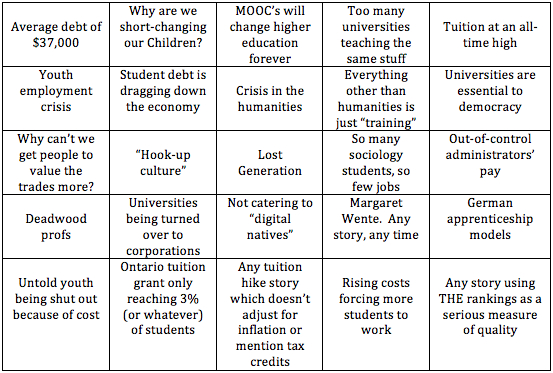
Hey, Kids! It’s time for back-to-school bad journalism bingo!
The slow news days of August have reached the traditional back-to-school phase of page filling:
I love back-to-school time: the joy, the energy, the sense of limitless possibilities. It’s almost enough to make you forget about the tsunami of dreadful journalism that accompanies it.
There are basically three reasons for bad back-to-school journalism. First, higher education is complicated; it doesn’t lend itself to the simplistic narratives required for 800-word articles. Second, there’s a serious lack of decent data about higher education in Canada, what with the Millennium Scholarship Foundation gone, HRSDC no longer funding any decent Statscan surveys, and provinces and universities holding on tightly to their own data on the grounds that someone might use it to compare them against other provinces/institutions (and that would never do!). In this data vacuum, interested parties with their own agendas find it easy to peddle all sorts of demented, half-true factoids to journalists; hence, the frequent appearance of stories based on “data” which simply aren’t true.
The third problem is the lack of outcome measures. Everyone wants “good” education, but no one knows what that is. So journalists tend to fall back on input measures: small classes, students per professors, etc., which inevitably lead to a weird mythologizing of university life in the 1970s. Nothing wrong with the 1970s of course, but it somehow never quite clicks with op-ed writers that a major reason life was so great for students back then was that access was restricted to a fairly small elite, and that the comparative “failures” of today’s universities are largely the result of expanded access.
Here’s the Bingo card for you to play along at home:
August 4, 2013
The Day The Universe Changed – “The Way We Are”
Episode 1 of James Burke’s ground-breaking series “The Day The Universe Changed” which explores the evolution of Western Scientific thought starting from the fall of Rome.


