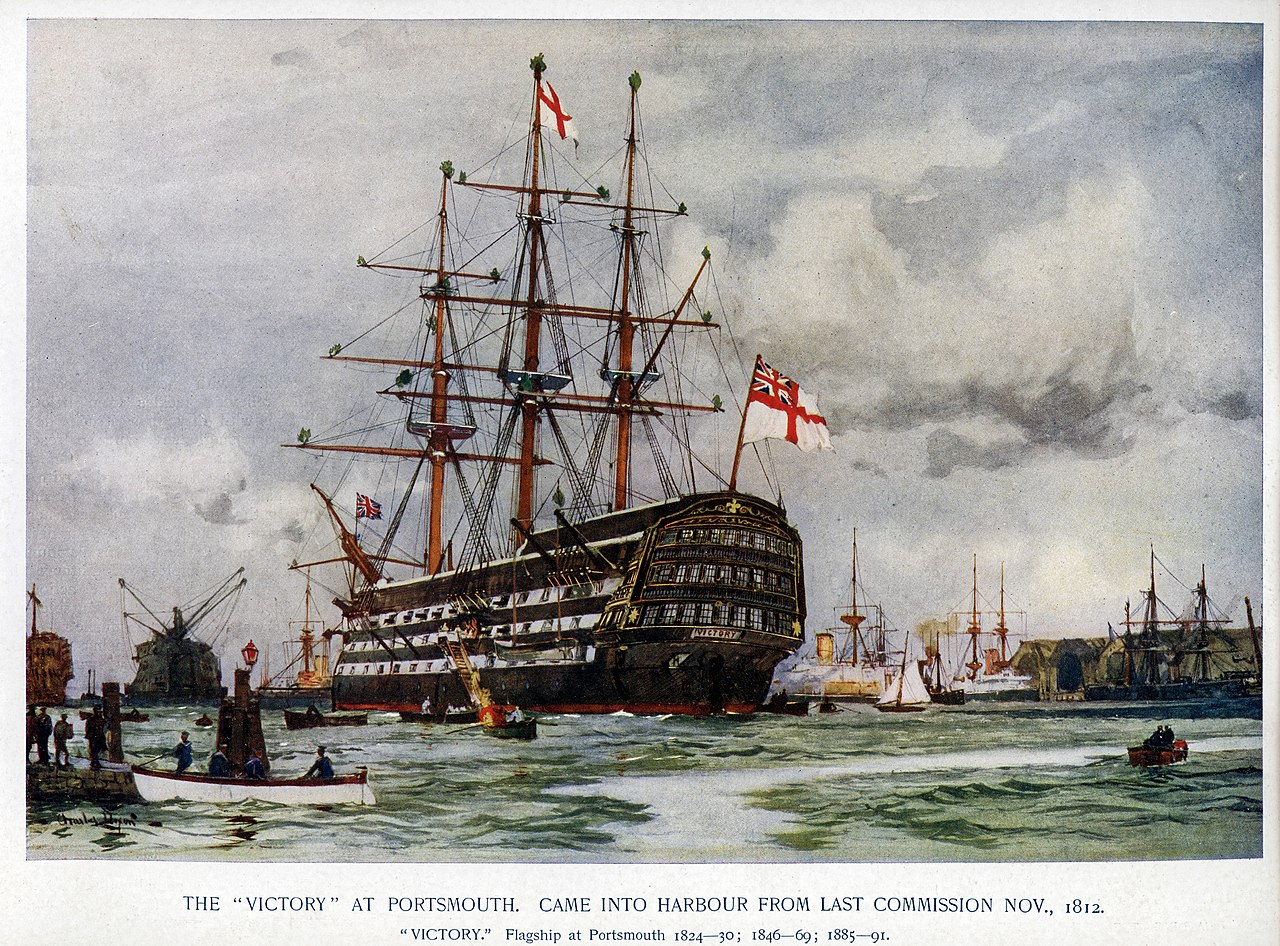
The final (and possibly ultimate) sort of empire is the Trade Empire. These develop more because exploring traders have a need for safe bases and secure lines of communication to make their trade work. Theoretically trade empires could be land based (and both the American West and the Chinese spread down the Silk Road argue the case that they started as trade security rather than conquest … no matter how they finished). But in reality the main cause of and reason for trade empires is the development of water transport. Specifically ocean transport.
So let us consider the motives of Empire in a few cases.
The Phoenicians had a magnificent trade empire, though with a few elements we find familiar from the more recent Viking version, or indeed the Venetian “Republic” — namely a bit of raiding, and quite a bit of slave trading. All three broadened into a bit of conquest — Carthage, Normandy and the sack of Constantinople in the 4th Crusade come to mind — but all those offshoots were by-products of the original cultures, and none of them became the norm for the ongoing home culture (each of which faded away as circumstances changed and they failed to adapt). So we could say that they were essentially trading empires.
Greece and Carthage and Rome were also trade empires, initially letting their security concerns drag them into a bit of conquest on the side. The difference in their cases was that the conquest element became dominant and completely changed the “homeland”. The city states of Greece becoming the world-conquering hordes of Alexander, and completely undermining the vibrant city state cultures that had proceeded them. The Phoenician trading city of Carthage becoming an expansionary conquest state that eventually pushed Rome too hard. And Rome’s overseas campaigns in Spain and North Africa completely undermining the independent farmer/citizen/soldier class of the Roman Republic, and replacing them with a system of professional troops whose loyalty could only be bought by ever increasing conquests by the emperors.
Naturally every expansion eventually reaches limits, and the concern reverts to trying to secure what you have, and hold the outsiders further away. Which is why, amusingly, people like the Romans and the Chinese came through their expansionary conquest phase, and then found themselves back in the position of having to protect the fringes through deals with tribes that can be traded with/employed by/or paid tribute. Cue Attila the Hun and his ilk.
So empires on the way down may also be considered trade and security empires I suppose, though many still had a conquest impulse (for fame or fortune or simply to pay the defenders off) built in, or tried to act as if they were still conquering hordes. Cue Constantinople and Belisarius.
In fact most empires will go through a variety of stages, though I think it fair to say that most empires have a core purpose and attitude, no matter how they tinker at the edges to deal with specific circumstances.
Nigel Davies, “Types of Empires: Security, Conquest, and Trade”, rethinking history, 2020-05-02.
May 8, 2025
QotD: Trade empires
May 5, 2025
Make America Austere Again?
The first 100 days of the BOM haven’t been quite what anyone expected. Close allies and trading partners were shocked at the new administration’s devotion to 1920s tariff “diplomacy”, supporters were dismayed to not get lots and lots of perceived wrongdoers of the Biden administration getting perp-walked for the cameras, and ordinary Americans were presented with a much worse domestic economy than they were promised:

Trump wasn’t totally fixated on economic matters … he still found time in his busy schedule to troll Catholics on his Truth Social platform.
On Wednesday, in the prelude to a cabinet meeting, U.S. President Donald Trump made yet another remark to chill the blood for those concerned about his country. Trump’s cat-and-mouse game of arbitrary changes to American import tariffs is starting to raise concerns about prices and supply chains for consumer goods. The American economy has unexpectedly shrunk in the first 100 days of Trump 2.0, even though workers and businesses are scrambling to make purchases before the effects of Trump tariffs set in. The underlying state of the economy is probably worse than the short-term numbers.
Trump says this is all a matter of “get(ting) rid of the Biden ‘Overhang'”, i.e., it’s his immediate predecessor’s fault. And let’s face it: no other politician on Earth would say anything else 100 days into an executive term. If that was as far as Trump went, it wouldn’t be of unusual concern. What struck me was his separate remark implying that, yeah, tariffs might foul up supply chains a little in the transition to the glorious economy of the future, but haven’t we Americans had it too soft for too long?
“Maybe the children will have two dolls instead of 30 dolls,” the president mused. “So maybe the two dolls will cost a couple bucks more than they would normally.” The message, which brazenly puts the contentment of children front and centre, is one you can’t imagine any other American leader delivering so directly in peacetime: have you all considered being happy with less?
The answer one would expect the median American voter to give is “Hell no”. It’s crazy that I should have to write this, but consumer abundance is a defining feature of the United States! During the Cold War, American supermarkets were the unanswerable argument for economic freedom: you could summarize the United States pretty reasonably as “It’s the country that coined the word ‘super-market'”. In our hyper-interconnected social-media world, I see a dozen conversations a week in which some European boasts of affordable healthcare, walkable neighbourhoods and having July and August and half of September off work every year: the inevitable answer from Americans is “OK, but have you been inside a Buc-ee’s, Gustav?”
Of course, it’s been a very long time since media-decried austerity in government has actually meant any kind of actual reduction in outlay … it’s usually just a (very) slight decrease in the rate of increase rather than actual dollar-value reduction. But, as Chris Bray points out, this time for sure:
I was planning to spend $100 on groceries this morning, but then I decided to slash my grocery budget, so the amount I actually spent on groceries plummeted to just $99.97, plus a small eight dollar supplemental on previously deferred grocery needs, bringing the total to a shockingly parsimonious $107.97. These major cuts caused serious alarm in my household.
Donald Trump, Politico warns, is scorching the earth:
This is the common theme everywhere, as the administration offers the first not-very-detailed hints about its plans for FY ‘26 discretionary federal outlays. The Huffington Post concludes that Trump is pulling out the BUZZSAW:
The Federal News Network sums up the size of the hit, and compare the topline number to the language about scorched earth and buzzsaws:
Overall, the administration is looking to increase national security spending next year by 13% and decrease non-defense discretionary spending by 7.6%, meaning the White House is asking for $1.7 trillion for the discretionary budget down from $1.83 trillion this year.
While the White House plans don’t get into the subject of total federal spending, focusing narrowly on discretionary spending, the implication is that federal spending overall will go from about $7 trillion to about … $7 trillion. But TBD.
You can read the entire White House proposal for discretionary funding here. Trump is proposing deep cuts in some federal departments and programs, but is also proposing to offset those cuts with sharp increases in military spending and “homeland security”, meaning border security and sending poor gentle immigrants to places where Chris Van Hollen will fly to stare into their beautiful eyes.
May 1, 2025
When “looming dystopia” is the preferable scenario
Elizabeth Nickson on just how badly the great and the powerful have managed to screw up so badly that instead of opening for Anthrax at the Hollywood Bowl, “Looming Dystopia” might actually be one of the better possible futures we face:

I asked Grok to show me Looming Dystopia opening for Anthrax. This is the “in Gothic style” version.
I am a person of faith, of Christ, not a very good one, but one who has been devoted for a long time. I’m not saying I didn’t spend twenty years in the great big glittering world, where I indulged every whim, lived among the powerful, beautiful, God- hostiles, adopted their habits of speech and dress, went to every small exquisite museum, the play of the moment, the art openings, the restaurants and parties, became a sophisticate able to live within that world as handmaiden or companion. I mean, for almost ten of those years, I had a husband who never, not once, came home without a present. But even that came of prayer, of a desire fulfilled a wish granted, of prayer, as in “You want this? Ok then, you will sicken, but here it is”.
That world – the enrichment of culture that came out of the 80’s and 90’s – determines today. That life is the model and goal for many and in fact, now the design, the plan laid out by those who plan the future of the world. Humans shunted deliberately into city life, then enhanced via surgery and chip. Indulgence, consumption, fighting for preference, ambition. Cultural creatives, unmarried, oddly-sexed, politically left would determine the future, their gifts the siren call of the arts, fashion, grand bohemia, Hollywood, eat, drink and travel merrily. The end goal of life: your individuality, your woundedness, your self care, the full expression of your specific gifts. If you are lucky you too can be Lady GaGa or BlackPink and have stadiums roar when you appear. Other humans? The state will take care of them, do not worry. Maybe they will die off. Like dinosaurs.
The central banks have gamed this going forward, making the insane assumption that this social movement was permanent. Did they depend on feminism and drugs to stop the next step, ie, young people leaving the city to build families? Even if they did, they thought they could stop it. Why? Because fascist greens like John Kerry, told them that rural regions must be left to “recover”.
Therefore they gutted the suburbs of financing, because “poor land use”, and “too much car required”, which is preposterous in the Americas with all this land. What else does a young family want but trees and parks, and lawns and a neighborhood of friends, not riven with whores, crackheads and murderous migrants?
The ‘08 crash was predicated on Thatcher’s fiscal success in selling people their council houses in the 80’s. Wonderful! thought Bill Clinton’s team, let’s lead marginal Americans into housing, and lo, we still haven’t paid the freight for that insane idea. I had a paralegal friend in Florida who was foreclosing on $500,000 loans to actual crackhead whores. Clinton’s people, lost in their greed and benevolence, forgot that the British council estate dweller was homogenous, placed, as in deep roots in the area, and stable. In the U.S and Canada, idiot banks lent to just about any joker who turned up with a plausible story. Then the speculators invaded, everyone cashed out merrily, then ka-boom. And pioneering walking away with $100 million from government “service” was Jimmy Johnson, Head of Fannie Mae.
I mean, it’s stupid. The western world’s current bankruptcy (and it’s severe) was caused by Central Bank clowns. Those ridiculous, repellent, hideously expensive COP #8,789 conferences had two outcomes: banks would be compelled to lend to green, require green, require climate mitigation, and jump through DEI, ESG hoops, and governments would chunk up green regs. And prosperity would bloom! Not only that, they surreptitiously, across the world, funded actual companies that poisoned the air, water and land. And when I say “they funded”, I mean the taxpayer did. A lot of our money went into insane outfits like this:
And just like Malcom Gladwell’s tipping point – it took ten years – boom, economic activity came to a screeching halt, except for the wreckage of green energy enterprises everywhere, government debt and re-financing. For instance, the Obama-created outfit, the Ivanpah Solar Power Facility, that consists of three solar concentrating thermal power plants in California burned through $1 billion before it collapsed in February. It is one of thousands across the west, all subsidized by the taxpayer. Unwittingly. The press is so embarrassed, they don’t report the trillions lost to green energy projects.
Again, the central bankers own this.
Central bankers have become a metastatic cancer on the economy. By definition, they are late adopters on the marketing curve. By the time they notice something and make their plans upon it, it’s over and something new is growing. Today, the mega-cities everywhere are emptying of everyone over 30 with an income, even or rather especially in China, where the young have just said … nope, a pox on your Commie plans. Chinese, European, British, American, everyone is trickling back to the towns of which their ancestral memories sing, where they can root, where they can live smaller, without environmental toxicity, the rank depravity of the super-culture, the ruinous stupidity of green. The great cities are now super-dangerous for women, and that is spreading as the autocrats in power force violent young men into towns. Last week a young woman in Vancouver fought off a migrant who tried to kill her three times in Stanley Park. My modest, Christian, pioneer family who built the early city along with their community of 10,000 and neglible government, made that park in the early 1900’s; my great grandmother was the first woman to ride a bike in bloomers through that park. It was so safe for 100 years you could let kids play in it after dark, calling them home with a whistle. It is one of the world’s great urban parks, more astonishing than Central Park. This is an outright tragedy. And it is unnoticed, unreported, except on TikTok.
The economics of migration
Lorenzo Warby wonders if an entire discipline can commit suicide:
Can an academic discipline seriously decline? Yes. Disciplines which were once mainstays of universities have either vanished or shrunk to pale shadows of their former selves.
What about a social science? One can envisage a social science disappearing. The most obvious way is it gets utterly discredited and replaced. A less obvious way is its institutional bases could disappear. A final way is its entire social basis disappears.
The West is currently marked by two entirely different discourses on migration that seem unable to interact. One is migration-as-economic-boon. This is the outlook of mainstream Economics. Migrants add to the economic activity of societies and potentially retard the effect of an ageing population by replacing absent local children with foreign migrants. This discourse invokes the authority of Economic Theory and its statistical methods.
This outlook typically treats criticism of migration as economically illiterate, socially retrograde, or morally bankrupt; or some combination of thereof. It is protected by the Self-Righteous, Knowing scoff which is such a feature of the modern professional-managerial class. They are the Masters of Knowledge, and of Moral Concern, who the plebs should defer to.
The other discourse talks in terms of social and democratic decay, increased crime, threats of violence, increased fiscal stress, even the possibility of civil war.
This is the world where, in Sweden — due to the stress on social and fiscal order from migration — it has become policy to pay migrants to go away. This is the world where highly intelligent and informed folk quietly discuss how the performance of economists on migration has been so catastrophically bad, it may bring down the entire discipline.
The adherents of the second, problems-with-migration, discourse are well aware of what mainstream Economics has to say on migration, and judge it to be obviously and demonstrably — even catastrophically — false. That it is much harder for migrants to contribute positively to a society than mainstream Economics admits, and this gets worse the higher the rate of migration. A recent Dutch study (Jan van de Beek, Joop Hartog, Gerrit Kreffer, Hans Roodenburg, The Long-Term Fiscal Impact of Immigrants in the Netherlands, Differentiated by Motive, Source Region and Generation, IZA DP No. 17569, December 2024. https://docs.iza.org/dp17569) found that:
Only 20% of all immigrants [to the Netherlands] make a positive lifetime net contribution to the public budget. Groups with large contributions come from Scandinavia, the Anglo-Saxon world and a few other countries like France and Japan.
The adherents of the first discourse seem either utterly unaware of the second discourse, or protected from even considering it by the Self-Righteous Knowing scoff. Their mastery of Theory is such, they cannot possibly be so catastrophically wrong.
The notion that migration could break a society along its existing fracture lines to the point of civil war would absolutely be treated with the Self-Righteous Knowing scoff, despite there being — as is discussed below — at least three historical examples of precisely that happening.
April 30, 2025
Low-energy Europe
Depending on who you read, it appears that the massive power outage in southwestern Europe nearly expanded across the continent, as Spain and Portugal went dark taking parts of other neighbouring countries’ networks down as well. James Price explains that this sort of thing is likely to be a recurring phenomenon as Europe leans ever more heavily on unreliable sources of electricity:
In his 2017 book The Strange Death of Europe, Douglas Murray accused Western European nations of Geschichtsmüde, being weary of history. President Trump might translate this by recycling a sobriquet he used against Jeb Bush — being low-energy.
This is now literally the case in both the United Kingdom and Germany, who have the most expensive energy costs in the developed world. The consequences have been catastrophic, in economic, political, environmental, and even geostrategic terms.
The true tragedy is that so much of the pain is self-inflicted, the result of bad, rushed policy designed to make people feel warm and fuzzy inside, rather than actually keeping people warm.
Net Zero
The commitment in Britain to “net zero emissions by 2050” was signed into law in the dying days of Theresa May’s premiership, as an attempt to give her a “legacy” after three painful years as Prime Minister. That legacy is likely to be lost, like the works of Ozymandias, as the world comes crashing back to economic reality.
The debate over the introduction of net zero was conducted during the Conservative Party’s leadership contest to succeed May, and therefore all attention was away from what would prove to be the most impactful economic decision of the year. The debate lasted all of 90 minutes.
The results have been completely devastating for Britain’s economy in all sorts of corrosive ways. For one, 169 years after Henry Bessemer worked out how to mass-produce steel in Sheffield, Yorkshire, Britain almost lost its ability to make the stuff here in Britain. Global factors like Chinese dumping play a part, but the extent of environmental regulation on British industry is making it impossible to sustain any kind of heavy industry. And now, British Steel has been nationalized once more, lumping the taxpayer with the losses and liabilities, but without doing anything to address the root causes.
But the government meddling does not stop there. In agriculture, a cruel, ideological attack on farmers (over whether farms can be charged inheritance tax) is going to spur more prime farmland to be turned into solar panel fields in a country where the sun often doesn’t shine.
There are now many statutory requirements to push environmental policies in all sorts of areas, to the complete detriment of other requirements, namely economic prosperity, that would otherwise be carefully balanced. So new homes in Britain have to have small windows, to increase insulation efficiency.
HS2, a much delayed and hideously over-budget high speed rail line between London and Birmingham, is building a one-kilometer-long tunnel to prevent bats being harmed by high-speed trains. The tunnel will cost over £100 million to build. Not only is there no evidence that the trains would interfere with bats, but there is also some evidence that the bat tunnel may actually be a bat-killing tunnel.
Hinkley Point C, the only nuclear power station being constructed at the moment in Britain, is having to construct a “fish disco” at huge costs to push fish away from being sucked into the cooling system.
This kind of environmental “everythingism” is not just holding back progress, not just costing huge amounts; it is corrosive of every attempt by people who just want to get on with building and growing — even “green” enterprises. Orsted, an offshore wind company, had to fill in forms five times longer than Tolstoy’s War and Peace, and had to wait nearly three years for a decision to build one farm.
And specifically about the Spanish situation that nearly triggered a Europe-wide blackout, from the social media network formerly known as Twitter:
SPAIN BLACKOUTS: AN ANONYMOUS EXPERT VIEW
From a deep groupchat, last night, translated from Spanish, written by an expert in transmission and distribution of power. Not my words.
“What has happened on April 28 has a well-located origin: the Aragón-Catalonia corridor, which is one of the most important electric highways in Spain. There is not only the electricity produced by our solar and wind farms in the northeast, but also the electricity that we import from France. This international interconnection, although weak (it can only contribute 3% of our demand, well below the minimum of 10% that marks the EU), in times of stress is essential to balance the network.
“At 12:32 p.m., in that Aragón-Catalonia corridor there was an electric [shake]. What exactly does “shake” mean? It means that suddenly and abnormally, the power that flowed through those lines began to vary violently, rising and falling in a very short time. Such abrupt variability can be due to three main causes:
“1. That a relay or transformer on that electric highway detects an abnormal flow of current or voltage (higher or lower than expected) and automatically disconnected to avoid burning or [being] destroyed. This is called that “opens” a relay or switch: it jumps and cuts the passage of electricity to protect itself.
“2. That the enormous concentration of renewable energy in that area (mainly solar and wind) has created an electrical resonance: electronic inverters, which synchronize current, can sometimes be amplified between them if a small voltage alteration (for example, due to clouds, strong wind or a slight failure) extends like an echo to all devices, causing widespread oscillations.
“3. That a wrong control order has been sent (by mistake or attack) from the SCADA systems, disconnecting or reducing the generation of multiple hit plants. There is no confirmation of this possibility yet, but it is being investigated.
“What is known is that as a consequence of that shake, the interconnection with France jumped: we were isolated just at the worst time, when the peninsula needed external support to stabilize.
“Without that French help, the frequency of the peninsular network (which should always be 50 Hz exact) began to drop quickly. The frequency is like the heartbeat of the network: if it falls too much, the systems understand that the patient (the network) is collapsing and automatically disconnected so as not to self-destruct. Thus, in just five seconds, the solar and wind farms were turned off — [they are] very sensitive to frequency variations — 15 GW of power was lost suddenly (60% of all the electricity generated at that time), and the network could not take it anymore: it collapsed completely, showing the Redeia Platform (REE) a “0 MW” nationwide. That does not mean that all the turbines were physically turned off, but there was no generator synchronized at the common frequency of 50 Hz. It was, for practical purposes, a country [turned] off.
“To [restart] a completely dead network, one essential thing is needed: plants that can start in black, that is, without receiving energy from anywhere else. Spain has identified five large hydroelectric jumps capable of doing this. However, and here is one of the great negligences that are coming to light, three of those five groups were stopped in scheduled maintenance, by business decision supervised by the administration. Only two were operational. That made the recovery much slower and weaker than it should be in a normal contingency plan.
“The result is that, after almost 10 hours, only 35% to 40% of the national supply has been recovered, and there are still large areas in the dark or under scheduled cuts.
“The situation reveals a very serious underlying problem:
“Spain is still an energy island: it only has 3% foreign exchange capacity compared to its total demand.”
Part 2:
“The network depends a lot on variable renewables, which are disconnected quickly in the face of any instability.
“The lack of physical inertia reserves (i.e. large rotating masses such as thermal power plants or classic hydraulics) prevents the disturbances from damping.
“And poor maintenance planning left without enough hydraulic muscle to respond to a crisis.
“The most likely causes, with current data, are:
“A combination of technical failure in protection or in synchronization, added to a serious lack of operational forecast and maintenance (probability ≈ 40%).
“The possibility of an intentional cyber-physical attack remains in analysis (≈ 25% estimated probability).
“Other factors such as human error, punctual atmospheric phenomenon or mixed causes complete the rest.
“In short: an initial shake at the most sensitive point of the Spanish network — the Aragón-Catalonia corridor, door to Europe — left the peninsula isolated and vulnerable. The network could not sustain its own demand because it did not have sufficient assistance, nor stable physical reserve, nor enough bootable plants in black. Three of five hydroelectric jumps were out of service when they were most needed.
“For this reason, Spain went out in five seconds, and that is why it still continues to light little by little, fragile, slow and exposed.”
April 29, 2025
The US Cancels Tariffs and Saves the World – W2W 025
TimeGhost History
Published 28 Apr 2025After seeing the devastating effects of the trade war that ravaged the global economy between the world wars, in 1948 the US is determined to usher in an age of free trade and global cooperation that will last until the spring of 2025.
(more…)
April 26, 2025
Lies, damned lies and government statistics
Francisco at Small Dead Animals linked to this interesting examination of the difference between the official inflation rate and the actual inflation ordinary Canadians are coping with:
Great news! We’ve brought inflation back under control and stuff is now only costing you 2.4 percent more than it did last year!
That’s more or less the message we’ve been hearing from governments over the past couple of years. And in fact, the official Statistics Canada consumer price index (CPI) numbers do show us that the “all-items” index in 2024 was only 2.4 percent higher than in 2023. Fantastic.
So why doesn’t it feel fantastic?
Well statistics are funny that way. When you’ve got lots of numbers, there are all kinds of ways to dress ‘em up before presenting them as an index (or chart). And there really is no one combination of adjustments and corrections that’s definitively “right”. So I’m sure Statistics Canada isn’t trying to misrepresent things.
But I’m also curious to test whether the CPI is truly representative of Canadians’ real financial experiences. My first attempt to create my own alternative “consumer price index”, involved Statistics Canada’s “Detailed household final consumption expenditure“. That table contains actual dollar figures for nation-wide spending on a wide range of consumer items. To represent the costs Canadian’s face when shopping for basics, I selected these nine categories:
- Food and non-alcoholic beverages
- Clothing and footwear
- Housing, water, electricity, gas and other fuels
- Major household appliances
- Pharmaceutical products and other medical products (except cannabis)
- Transport
- Communications
- University education
- Property insurance
I then took the fourth quarter (Q4) numbers for each of those categories for all the years between 2013 and 2024 and divided them by the total population of the country for each year. That gave me an accurate picture of per capita spending on core cost-of-living items.
Overall, living and breathing through Q4 2013 would have cost the average Canadian $4,356.38 (or $17,425.52 for a full year). Spending for those same categories in Q4 2024, however, cost us $6,266.48 – a 43.85 percent increase.
By contrast, the official CPI over those years rose only 31.03 percent. That’s quite the difference. Here’s how the year-over-year changes in CPI inflation vs actual spending inflation compare:
As you can see, with the exception of 2020 (when COVID left us with nothing to buy), the official inflation number was consistently and significantly lower than actual spending. And, in the case of 2021, it was more than double.
Since 2013, the items with the largest price growth were university education (57.46 percent), major household appliances (52.67 percent), and housing, water, electricity, gas, and other fuels (50.79).
April 25, 2025
Is Anschluss Back on the Menu? – Rise of Hitler 15, March 1931
World War Two
Published 24 Apr 2025March 1931 sees President Hindenburg unleash a controversial emergency decree, suspending key civil liberties to crush political violence in Germany. Meanwhile, Hitler promises legality but openly prepares the SA for the “Third Reich”, and the Nazi coalition in Thuringia collapses dramatically. Germany’s proposed customs union with Austria sparks international alarm — could this trigger another European conflict?
(more…)
Canada’s lost decade, 2015-2025
It’s quite remarkable how many economic charts show the US and Canadian economies tracking along similar paths up until “something” happened in 2015 that knocked the Canadian economy well below the US trend line. I wonder what happened in 2015 that could account for this quite visible change in fortune?
Throughout the 2025 campaign, the Conservatives have frequently referred to what they call the “Lost Liberal Decade”, a reference to the fact that Canada has lagged dramatically on virtually every available indicator since the Liberals first came to power in 2015.
In sum, the economy is worse, crime is worse, public services are worse, affordability is worse — and there’s a whole galaxy of niche indicators, such as firearms incidents, refugee backlogs, even life expectancy, that are worse than they’ve ever been.
Below, a quick guide to the fact that, whatever you think of the Liberals, the last decade has really not been great for Canada.
In the year the Liberals took office, 604 people were murdered across Canada. This was already a slight uptick from the year before, when murder rates hit a low not seen since the mid-1960s.
Just seven years later, in 2022, homicides would hit a high of 874. In raw numbers, that’s 270 more murdered Canadians.
But even when accounting for population growth, there are way more murders happening now than in 2015. The homicide rate in that year was 1.71 murders per 100,000 people. As of 2023, the most recent year for which Statistics Canada has released data, it was 1.94.
Put another way, if Canada had stuck to the homicide rates of 2015, we’d have had 94 fewer murders in 2023, 216 fewer murders in 2022, and about 150 fewer murders in 2021.
And it’s a similar story when it comes to virtually every other category of crime. Statistics Canada maintains a “crime severity index” that attempts to aggregate the raw amount of criminality each year in Canada. The index bottoms out just before the Liberals came to power in 2015, and has been on the upswing ever since.
Unfortunately, this is particularly true when it comes to violent crime. For one thing, the number of guns being turned on people each year in Canada has never been higher.
In 2015, for every 100,000 Canadians, there were 28.6 incidents of firearm-related violent crime. By 2022, the last full year for which data is available, this had surged to 36.7 incidents — nearly a 30-per-cent increase in just seven years.
The Correctional Service of Canada publishes annual statistics on incarceration rates, and a noticeable trend begins to emerge starting in 2015: The prison population begins to plummet.
April 24, 2025
Berlin Airlift: From Bombs to Candy – W2W 23 – 1948 Q3
TimeGhost History
Published 23 Apr 2025In 1948, Stalin blockades West Berlin, isolating over two million people without food, fuel, or supplies. Refusing to surrender the city, Western powers launch the Berlin Airlift, history’s largest aerial supply mission, to deliver food, coal, and even candy. As tensions soar, planes defy Soviet threats around the clock — can the Allies really sustain a city from the sky?
(more…)
April 23, 2025
“Liberals have never met a crisis they didn’t think they could spend their way out of”
Jesse Kline refutes Mark Carney’s recent diss against libertarians:
“The capacity of the federal government to invest in the economy, to support businesses and individuals, will ensure that we bounce back strongly.”
That was Prime Minister Justin Trudeau announcing an $82-billion support package at the beginning of the COVID-19 pandemic, but it could just as easily have been Carney, who said over the weekend that, “In a crisis … government needs to step up.”
At a Saturday news conference, the Liberal leader unveiled his party’s election platform, which includes $130 billion in new spending over four years to fend off the threats posed by U.S. President Donald Trump.
“It’s said there are no atheists in foxholes, there should be no libertarians in a crisis,” Carney argued to justify the continued spending spree.
This offends me as both a libertarian and an atheist. In fact, Canada would be in much better shape today if there were a few libertarians in the room when the Liberals were dealing with the numerous emergencies they’ve faced over the past decade.
The problem with crises is that there’s no way to predict when the next one will hit. But a prudent government should expect the unexpected and leave some fiscal room in the budget to address unforeseen events, while working to fortify the economy during good times so it can withstand the bad. This is not what the Liberals have done.
They took a $1.9-billion surplus in the 2014-15 fiscal year and turned it into a $25-billion deficit in 2016-17.
[…]
And so, we got more Big Government programs that we could ill afford, while Trudeau turned away world leaders looking to Canada to help solve an energy crisis resulting from Russia’s invasion of Ukraine.
Now, as Carney prepares to launch another massive spending spree to deal with the effects of U.S. tariffs, he’s pledging hundreds of millions of dollars for unnecessary programs, including permanent funding for the Sexual and Reproductive Health Fund to make it easier to abort babies, and $400 million for IVF treatments to create new ones in a test tube.
Needless to say that if there were some libertarians around the cabinet table during the crises of the past 10 years, we likely wouldn’t be facing a major economic upheaval with a $40-billion budget deficit, which Carney wants to increase to $62 billion, and a national debt approaching $1.26 trillion.
Spending always appeals to the voters at election time, and the Liberals have been past masters of using that to get into power. But even though there may be a lot of ruin in a nation, even the biggest of nations eventually runs out of money. According to a report from Policy Horizons Canada, an in-house government think tank, we’re well on the way to reaching that ruin and nobody will like what that looks like:
The report warns that by 2040, housing affordability is essentially limited to the wealthy or those with family help; most new homeowners get help from family, some depend on intergenerational mortgages and have several generations of family living together, and others enter “alternative” household mortgages with friends, with a growing percentage of homeowners also owning rental properties.
“Inequality between those who rent and those who own has become a key driver of social, economic, and political conflict,” reads the report.
Moreover, the report highlights a growing dependence on intergenerational wealth, noting that by 2040, inheritance is widely seen as the only reliable path to prosperity. “Society increasingly resembles an aristocracy,” it states, as family background — particularly property ownership — becomes the defining factor in determining one’s opportunities.
Canadians in this future rarely mix with others of different socio-economic status, and there is a clear disconnect between the aspirations of the country’s youth and economic realities, which leaves most with limited expectations of success.
And finally, the rapid propagation of artificial intelligence has dramatically reshaped the labour market. By 2040, the rise of artificial intelligence will have significantly diminished the availability of jobs in creative and knowledge-based professions, once seen as stable paths to upward mobility.
[…]
As a result of the six factors, Canada’s economy could shrink or become less predictable, with the consumer economy shrinking in size, and a higher proportion of very wealthy, older people holding the capital capacity for investment in new businesses. Labour unions could also grow in power and size from a frustrated population. The mental health of Canadians could suffer from living cost challenges.
With these upward mobility issues, Canada may become a less attractive destination for immigrants, and there could be an exodus of young workers, which would exacerbate the issues with supporting the public and social services that support the country’s growing cohort of seniors. This could also result in a labour shortage in industries where artificial intelligence is most difficult.
Perhaps most dystopian is a partial reversion of Canadian society to a trade-and-barter and neo-hunter-gatherer society by 2040, in response to declining trust in formal systems and reduced access to traditional economic opportunities.
[…]
The report’s vision of a future Canada — where trust in institutions collapses, effort no longer yields reward, and people yearn for systemic change — carries echoes of that dangerous historical crossroads, where ideological extremes once flourished in the face of prolonged despair.
With all that said, how likely is this precarious scenario of Canadian society in just 15 years from 2025?
According to Policy Horizons Canada, its “research suggests that it is plausible and would create challenges across a range of policy areas.”
April 21, 2025
The Battles That Broke the Chinese Nationalists – W2W 22 – 1948 Q2
TimeGhost History
Published 20 Apr 2025This episode, we see the Chinese Civil War turn decisively against Chiang Kai-Shek. Mao’s Communists score great victories on the battlefield while the Nationalists face economic collapse. How much longer can Chiang hold on?
(more…)
April 19, 2025
QotD: Allied air and sea operations won WWII
In [How the War Was Won author Phillips Payson] O’Brien’s methodology, we should look at what the Axis spent its productive effort making and consider what Allied actions slowed that productive effort. In both theaters, the answer is shocking. The Germans spent relatively little productive effort on tanks, focusing far more on aircraft, submarines, and vengeance weapons (i.e., proto-cruise missiles and rockets). The Japanese spent heavily on aircraft as well, but also a tremendous amount on freighters and oil tankers.
The Allies won the war by using air power to destroy the German and Japanese capacity both to produce military equipment and to transport it to the battlefield. By 1944-45, the Germans and Japanese could not use their economies to arm and supply their armies on the battlefield, leading to their inevitable defeat.
In the European war, American and British airpower: (a) directly destroyed a significant amount of productive capacity, (b) rendered remaining capacity far less efficient, (c) made it impossible for the Germans to defeat western ground forces, and (d) compelled the Germans to waste tremendous resources on air defense and exorbitant, ultimately ineffective vengeance weapons.
In the Pacific, the United States used carrier-based airpower, submarines, and bomber-deployed mines to isolate Japan from the resources of the empire it conquered in 1941-42. American bombers also directly destroyed factories and transportation systems, leading to similar levels of economic dysfunction as in Germany.
Anonymous, “Your Book Review: How the War Was Won“, Astral Codex Ten, 2024-08-09.
April 15, 2025
Learning from history can be helpful … if you learn the correct lessons
Tim Worstall explains why Donald Trump and his advisors pointing to the historical experience of high tariffs after the US civil war fails to take into account all the technological changes that happened during that time:

Trump and his economics team clearly believe that tariffs work (at least for certain values of “work”)
Post US Civil War tariffs rose strongly. Doubled and in some cases more than that. It’s also true that the US economy expanded remarkably in that period. Went from the exploitative frontier (and slave) economy to the world’s richest manufacturing one in fact. So, yay for tariffs, obviously.
Except US trade kept increasing over this period. So, tariffs were not reducing imports. Or rather, the total level of imports did not fall because tariffs even as tariffs obviously had an effect upon limiting imports — without tariffs there would have been more.
So, what happened here? The answer is the ocean going steamship.
Tariffs are only one barrier to trade, one cost of trade. Paperwork is another, local standards a third, the theft by rapacious dockside unions a fourth and, obviously enough, the cost of transport a fifth. And we can go on — the cost of information flow a sixth and soon enough we’ll be Richard Murphy shouting eleventhly.
The ocean going steamship reduced the total costs of trade by more than the tariffs raised it. Therefore trade carried on increasing.
Now forward a century, the 1970s and following. We’re told that there’s been some grand policy turn to free trade. That everyone decided to gut the rich world of real manly jobs and ship them off to sweating coolies who could be paid peanuts. The GATT, WTO, just proof of the contention and look, look, they lowered tariffs!
But the container ship (which did for those rapacious dockside unions in most places other than the US), the jet liner, the telephone and now the internet have lowered all those other costs of trade massively. The total costs of trade have dropped massively whatever we could have, should have, done about tariffs. Global trade was going to expand by multiples whatever GATT or WTO did that is.
Which is why these tariffs now have to be so large and bigly. Because to get back to that 1970s – let alone 1870s — it’s necessary to raise total costs of trade to where they were, not just tariffs.
April 12, 2025
President Trump … or any president … shouldn’t have the unilateral power to levy tariffs
Love him or hate him — and there are lots of people in both camps — President Donald Trump has the power to randomly throw spanners into the international trade arena … because Congress ceded that power to the presidency long before Trump began his political career:
In response to Donald Trump’s tariff maneuvers, Senator Rand Paul has been arguing that presidents shouldn’t have the power to raise tariffs themselves. Taxing power belongs to Congress, and that’s where tariffs should be born. Trump’s tariffs result from the use of emergency power that Congress gave to the POTUS, and we shouldn’t normalize emergency rule. You can watch him say all of that here.
Every word of that is completely right. I don’t disagree with a single breath of it. I respect Rand Paul, and I’m inordinately fond of his dad. But it misses the point about how we got here, and why, starting with the fact that Congress gave away its taxing authority.
- Congress delegated its authority;
- Donald Trump used the authority that Congress gave him;
- Therefore, Donald Trump is very bad, and what he’s doing is wrong.
The core sickness at the heart of the American republic is Congress, and we keep discussing that sickness by saying that Trump sucks. He’s doing what you gave him the power to do, and he’s not the first.
See also my recent post in which I described a time when Congress made something illegal, than asked the administrative agencies to explain to them what they had just banned. Congress has delegated its authority, over and over again, and the resulting political vacuum is a serious problem. But anyway, TRUMP TRUMP TRUMP.
American political discourse keeps taking a wide range of political pathologies and assigning them to the same account. Orange Man Bad, Orange Man Bad, Orange Man Bad, they explained, with drool running down their chins. Donald Trump is our deflector object, our national excuse. [Problem name here]; OH NO WHY IS TRUMP DOING THIS TO US.
The commandant of the United States Coast Guard spoke at a maritime conference, a few days ago, and he said that the organization he runs wakes up every day and tries to keep the doors from falling off: “The US Coast Guard is less ready today than any other time since World War II. We are on a readiness spiral. Today our fleet of cutters are in significant decline. We are in repair failure mode … No ship today gets underway without cannibalizing others for parts.”
See also, from one of his subordinates:
Serious question: Did all of those problems begin at noon on January 20, 2025?