
Jared Henderson
Published 16 Jul 2025Why do major online platforms keep getting worse? Cory Doctorow’s work helps us understand the pattern of growth, decline, and eventual demise.
→ Timestamps
00:00 Beginning
00:51 How Platforms Die
08:29 The Death of a Platform (From the Inside)
12:14 Ads, Everywhere
14:47 Yes, I Make Money from Ads
16:32 Bots
22:04 The Internet We Need
(more…)
July 22, 2025
The internet keeps getting worse. Let’s talk about why.
Comments Off on The internet keeps getting worse. Let’s talk about why.
July 21, 2025
AI slop seems to have finally triggered significant pushback
Ted Gioia says that he’s seeing strong indicators that the AI slop superabundance has helped create a widespread rejection of it and all its works:
2025 has been the year of garbage culture.
Creators watch in horror as dismal AI slop threatens their livelihoods — and the integrity of their fields. It’s everywhere, spreading faster than a pharaoh’s plague.
In recent months, we’ve been bombarded with millions of lousy AI songs, idiotic AI videos, and clumsy AI images. Error-filled AI texts are everywhere — from your workplace memos to the books sold on Amazon.com.
Even my lowly vocation, music journalism, gets turned into a joke when it’s accompanied by slop images of fake events.
No, these things did not really happen.
But something has changed in the last few days.
The garbage hasn’t disappeared. It’s still everywhere, stinking up the joint.
But people are disgusted, and finally pushing back. And they are doing so with such fervor that even the biggest AI companies are now getting nervous and pulling back.
Just consider this surprising headline:
This was stunning news. YouTube is part of the biggest AI slop promoter of them all — namely the Google/Alphabet empire. How can they possibly abandon AI garbage? Their bosses are the biggest slopmasters of them all.
After this shocking news reverberated through the creative economy, YouTube started to backtrack. They said that they would not punish every AI video — some can still be monetized.
But even the revised guidelines are still a major blow to AI slop purveyors. YouTube made clear that “creators are required to disclose when their realistic content is altered or synthetic”. That’s a huge win—we finally have a requirement for disclosure, and it came straight from the dark planet Alphabet.
YouTube also stressed that it opposes “content that is mass-produced or repetitive, which is content viewers often consider spam”. This is just a step away from blocking slop.


Update, 22 July: Ted posted a follow-up with a bit more evidence that the pushback is working:
In my latest article I criticized Spotify for allowing uploads of unauthorized AI tracks to the profiles of dead musicians.
But the company may finally be listening to criticisms of its AI policies. In this case, Spotify has now taken steps to stop the abuses, and a spokesperson reached out to me today with an update and expressing a clear and proper policy on AI fraud.
I share it below (and have also updated my article):
We’ve flagged the issue to SoundOn, the distributor of the content in question, and it has been removed. This violates Spotify’s deceptive content policies, which prohibit impersonation intended to mislead, such as replicating another creator’s name, image, or description, or posing as a person, brand, or organization in a deceptive manner. This is not allowed. We take action against licensors and distributors who fail to police for this kind of fraud and those who commit repeated or egregious violations can and have been permanently removed from Spotify.
They acted quickly, and I give them credit for that.
Update the second, 23 July: Ah, Spotify giveth and Spotify taketh away:
“Spotify is publishing new, AI-generated songs on the official pages of artists who died years ago without the permission of their estates or record labels,” reports 404 Media.
This scandal came to light because of an AI song attributed to Blaze Foley, who died in 1989. The bogus track is accompanied by an AI-generated image of a man who bears no resemblance to the singer.
What’s going on here? Is this just ignorance or carelessness at Spotify? Or does it represent something more sinister — another example of the company’s willingness to deceive users in the pursuit of profits?
These scams must stop. If Spotify doesn’t fix this mess immediately, courts should intervene.
But the dead musician scandal is just a start — because other bizarre things are happening at Spotify.
The whole situation is positively surreal.
Comments Off on AI slop seems to have finally triggered significant pushback
July 20, 2025
Generational differences about … ugh … talking on the telephone
As a late boomer — and unlike most of my cohort — I’ve always hated talking on the telephone to someone. I’m sure part of it is my innate shyness and social awkwardness: if I can’t see how the other person reacts to my verbal blundering, how can I correct myself in time to salvage something from the call? As a result, I’m rather more sympathetic to younger Millennials and Gen Z’ers who have a common generational aversion to telephone calls:

“Candle-stick phone with courtesy pay box” by CodeName47km is licensed under CC BY-SA 4.0 

 .
.
I’ve been working to wean myself off the phone. I try to use it only when it feels necessary: we require an answer now, things are too complex to lay out in an email, or I want to be sure what I’m saying is received as I intend it. Sometimes these calls are spontaneous. Increasingly, I schedule them, or ask permission first.
I’ve done this because it’s how business communications work today, and I don’t like to remind people that I’m getting on. I also do it in deference to my colleagues, all of whom are much younger than me. They prefer email, texts, or the group chat.
The landline decision was forced by our acquisition of Fitzhenry & Whiteside, which has had the same telephone number for decades. F&W has many more authors than does Sutherland House, and a good number of them are over sixty. We’re trying to make the transition to new ownership seamless. We didn’t want people calling up to hear “this number is no longer in service”. So the newly installed phone sits on a stand beside the desk I share with Shalomi. I call it Shalomi’s phone and make her answer it when she’s around. Mostly it goes to voicemail and tells people how to contact us by email.
Accustomed as I’ve become to phone-free work, I was taken aback this week when I asked one of our interns to call a printer — we needed a quick quote — and she responded, “I don’t do telephones”. She looked at me bewildered. I responded in kind.
My mind was racing to figure out if I’d mishandled the matter. I’d just read that story in the New York Times about the “Gen Z stare”, the blank look given by a young person (usually in a service job) where a verbal response would be common. It is often interpreted as a freeze on the part of the starer, an inability or reluctance to engage, perhaps rooted in anxiety, perhaps a remnant of the pandemic’s social dislocations, although some insist the starer is telling their interlocutor “you’re in my space and you ought to back off”.
I heard from a number of people about that article this week, and while the Times had not mentioned phone usage and etiquette, my conversations did. Apparently there are a lot of young people who don’t know how to answer their phones. They see a call pop up on their screen and they stare at it, waiting for it to go away. Or they press answer and listen without saying anything. Some, I’m told, answer even scheduled calls from people they know with silence.
I’ve heard parents say they didn’t expect they’d have to teach their children to answer a phone. A university lecturer explained that journalism professors now demonstrate use of a telephone before instructing students on how to conduct an interview over it. Apparently, the same goes for rookie salespeople.
Poking around online, I found a BBC article reporting that a quarter of people aged eighteen to thirty-four never answer their phones, more than half of them interpret any unexpected call as bad news. CBS reports 90 per cent of Gen-Z are anxious about phone calls.
In fairness, a lot of adults are similarly leery of their phones. They don’t want to engage with spam dialers or scammers — they answer and listen for the brief pause that betrays a call centre. Some let every unrecognized call go to voicemail. The savvier ones have figured out that your iPhone, properly configured, will send calls from people not in your contacts directly to voicemail.
Back to our intern. Eventually, I recovered myself. This wasn’t an instance of Gen-Z awkwardness or anxiety around real-time conversations. She is bright, confident, and as socially adept as anyone in the office. I asked if she had a phone. She did. I asked if she used it for calls. She said only to speak to her mom, who pays for her phone. Perfectly reasonable. And it was her personal phone, not a company phone, so she was under no obligation to use it at work. So we suggested she make the call on the company phone, which she cheerfully did.
We spoke later about generational differences with regard to communications technology. She likes the control one has over email communication as compared to the unpredictable nature of phone calls. I told her about life when no one had phones, yet we could all somehow manage to show up at the same place and the same hour. I can hardly believe I lived in such times. Hearing this must have hit her like I was once hit by the reporter Ray Stannard Baker’s account of how he used to walk up to the White House, knock on the front door, and ask to speak with the president.
July 12, 2025
Noah Smith on how surprisingly well free market policies are working in Argentina
In the headline, you should read the unstated “surprising to far too many mainstream economists and political commentators”, but full credit to Noah Smith for admitting that Milei’s radical agenda has started to make life much better for ordinary Argentinians:

Javier Milei at CPAC in National Harbor, Maryland 20 February, 2025.
Photo by Gage Skidmore via Wikimedia Commons.
So to be clear, when I say that criticism of free markets has been overdone, I’m partly talking to myself. A couple of months ago, horrified by Trump’s tariff policies, I wrote an apology to libertarians, admitting that I had failed to see the political usefulness of their project in terms of maintaining economic sanity on the Right.
But it’s not just the political benefits of free markets that have been undersold; I think the purely economic advantages are also too often ignored.
Exhibit A is Javier Milei’s track record in Argentina. A year and a half ago, when Milei was elected President of Argentina, a bunch of left-wing economists warned darkly that his radical free-market program would lead to economic devastation:
The election of the radical rightwing economist Javier Milei as president of Argentina would probably inflict further economic “devastation” and social chaos on the South American country, a group of more than 100 leading economists has warned … [S]ignatories include influential economists such as France’s Thomas Piketty, India’s Jayati Ghosh, the Serbian-American Branko Milanović and Colombia’s former finance minister José Antonio Ocampo …
The letter said Milei’s proposals – while presented as “a radical departure from traditional economic thinking” – were actually “rooted in laissez-faire economics” and “fraught with risks that make them potentially very harmful for the Argentine economy and the Argentine people” … [T]he economists warned that “a major reduction in government spending would increase already high levels of poverty and inequality, and could result in significantly increased social tensions and conflict.”
“Javier Milei’s dollarization and fiscal austerity proposals overlook the complexities of modern economies, ignore lessons from historical crises, and open the door for accentuating already severe inequalities,” they wrote.
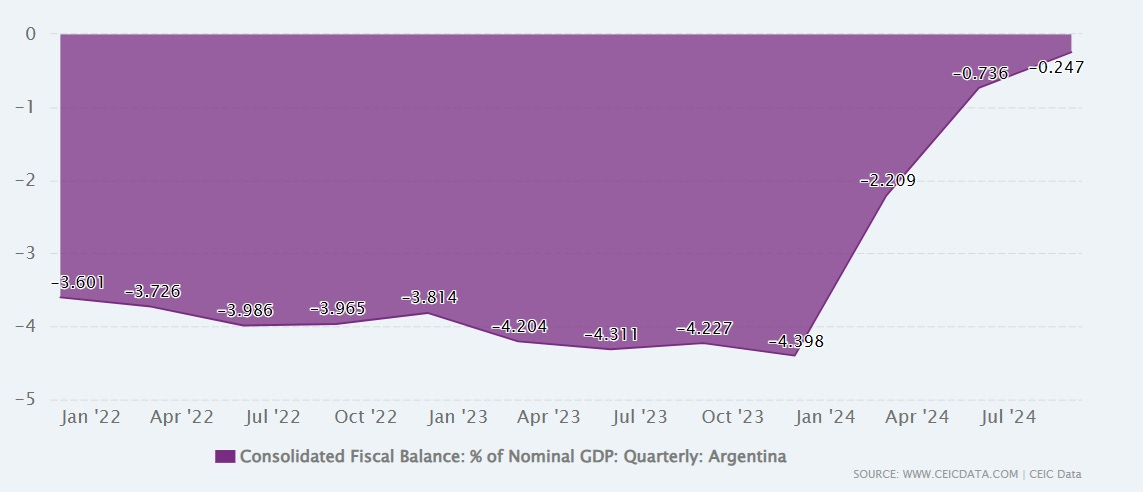
Milei won anyway. His first big policy, and the one the lefty economists fretted about the most, was deep fiscal austerity. Argentina’s long-standing economic model, created by dictator Juan Peron in the 1950s, involved a large and complex array of public works projects and subsidies for various consumer goods like energy and transportation. Milei slashed many of these, as well as cutting pensions, civil service employment, and transfers to provinces. Overall, he cut public spending by about 31%, resulting in a near-total elimination of Argentina’s chronic budget deficit:
The point of all this cutting wasn’t just to remove state intervention in the economy — it was to stop inflation. Basically, macroeconomic theory says that if deficits are high and persistent enough, then they convince everyone that the government will eventually inflate its debt away by printing money (which becomes a self-fulfilling prophecy). And most or all countries that experience hyperinflation end up escaping it only when they get their fiscal house in order. Perpetual deficits were part of Argentina’s “Peronist” system, and it’s probably a good bet that this has been responsible for the periodic bouts of hyperinflation that it experiences.
[…]
But still, Milei’s success so far should make us somewhat more confident about free-market policies — especially when we evaluate them against the new socialist ideas that have been gaining currency in the U.S. In the past, socialists and other left-leaning economic thinkers advocated central planning and nationalization of industry; in recent years, they have taken to calling for expansion of the state through fiscal policy, mixing macroeconomic justifications with micro. At all times, they call for deficit-financed expansion of social programs; when fiscal hawks want to tame the deficits, the lefties warn of the short-term macroeconomic harms of austerity.
If you’re always more terrified of austerity than you are of deficits, expansion of the state — and of the deficit — becomes a one-way ratchet. This approach is very different than Keynesianism, which advocates stimulus to overcome recessions, followed by austerity during boom times. You’ll recognize it as bearing a distinct similarity to MMT; that pseudo-theory has largely fallen out of favor, but there are plenty of more respectable progressive types whose ideas nonetheless have a lot of this “macroleftist” flavor.
Comments Off on Noah Smith on how surprisingly well free market policies are working in Argentina
July 10, 2025
Mandatory online age verification
Michael Geist discusses the rush of the Canadian and other governments in the west to try to impose one-size-fits-all age verification schemes on the internet:
The Day I Knew I Was Old 😉 by artistmac CC BY-SA 2.0
When the intersection of law and technology presents seemingly intractable new challenges, policy makers often bet on technology itself to solve the problem. Whether countering copyright infringement with digital locks, limiting access to unregulated services with website blocking, or deploying artificial intelligence to facilitate content moderation, there is a recurring hope the answer to the policy dilemma lies in better technology. While technology frequently does play a role, experience suggests that the reality is far more complicated as new technologies also create new risks and bring unforeseen consequences. So too with the emphasis on age verification technologies as a magical solution to limiting under-age access to adult content online. These technologies offer some promise, but the significant privacy and accuracy risks that could inhibit freedom of expression are too great to ignore.
The Hub runs a debate today on the mandated use of age verification technologies. I argue against it in a slightly shorter version of this post. Daniel Zekveld of the Association for Reformed Political Action (ARPA) Canada makes the case for it in this post.
The Canadian debate over age verification technologies – which has now expanded to include both age verification and age estimation systems – requires an assessment of both the proposed legislative frameworks and the technologies themselves. The last Parliament featured debate over several contentious Internet-related bills, notably streaming and news laws (Bills C-11 and C-18), online harms (Bill C-63) and Internet age verification and website blocking (Bill S-210). Bill S-210 fell below the radar screen for many months as it started in the Senate and received only cursory review in the House of Commons. The bill faced only a final vote in the House but it died with the election call. Once Parliament resumed, the bill’s sponsor, Senator Julie Miville-Dechêne, wasted no time in bringing it back as Bill S-209.
The bill would create an offence for any organization making available pornographic material to anyone under the age of 18 for commercial purposes. The penalty for doing so is $250,000 for the first offence and up to $500,000 for any subsequent offences. Organizations can rely on three potential defences:
- The organization instituted a government-approved “prescribed age-verification or age estimation method” to limit access. There is a major global business of vendors that sell these technologies and who are vocal proponents of this kind of legislation.
- The organization can make the case that there is “legitimate purpose related to science, medicine, education or the arts”.
- The organization took steps required to limit access after having received a notification from the enforcement agency (likely the CRTC).
Note that Bill S-209 has expanded the scope of available technologies for implementation: while S-210 only included age verification, S-209 adds age estimation technologies. Age estimation may benefit from limiting the amount of data that needs to be collected from an individual, but it also suffers from inaccuracies. For example, using estimation to distinguish between a 17 and 18 year old is difficult for both humans and computers, yet the law depends upon it. Given the standard for highly effective technologies, age estimation technologies may not receive government approvals, leaving only age verification in place.
Comments Off on Mandatory online age verification
July 9, 2025
QotD: “Look at those high cars roll”
Another New York Central president who rode The Century in preference to the fine business car No. 1 which was at his disposal was F.E. Williamson. […] he took pleasure in the same amenities of luxury travel as he shared with other Century regulars: cocktails in the club car, a breath of fresh air on the open observation platform that survived into his regime, The Century Dinner and a long night’s sleep as the train rolled tranquilly under the stars.
Once encountered on the observation platform by the author as The Century rocketed through the Indiana countryside to overtake and pass a long merchandise train doing a mere sixty on the adjacent track […]
“Look at those high cars roll”, he exclaimed, as we passed the head end of the swiftly moving freight. “There’s nothing so beautiful in the world as a money making train going places fast on a spring evening!”
Lucius Beebe, 20th Century, 1962.
Comments Off on QotD: “Look at those high cars roll”
July 7, 2025
Consumers don’t want AI in everything, but you’ll be forced to take your AI, peasants!
Ted Gioia — like about 92% of consumers at last count — doesn’t want to have artificial intelligence “enhancing” the software he uses every day, but software companies don’t want him — or you — to have that choice:
A few months ago, I needed to send an email. But when I opened Microsoft Outlook, something had changed.
Microsoft asked me to use Copilot to write my email. Copilot is my AI companion. (That’s the cute word they use.)
Hey I don’t want a companion — especially not a fake AI buddy. I never asked for this.
And what about the people receiving my emails? They don’t want this either. They want to hear from me, not a bot.
How do I turn my companion off?
After some trial-and-error, I found a way to disable Copilot. Phew!
But a few days later, Microsoft surprised me again. It wouldn’t let me save an Excel file until I had agreed to new terms for my software account.
Guess what? AI is now bundled into all of my Microsoft software.
Even worse, Microsoft recently raised the price of its subscriptions by $3 per month to cover the additional AI benefits. I get to use my AI companion 60 times per month as part of the deal.
But I don’t want to use it. I want to kill it.
As you can see, I’ve never used this service. I still have all 60 credits unused. But I’m paying for it — because it’s now embedded into Microsoft Word, Excel, etc.
This is how AI gets introduced to the marketplace — by force-feeding the public. And they’re doing this for a very good reason.
Most people won’t pay for AI voluntarily — just 8% according to a recent survey. So they need to bundle it with some other essential product.
You never get to decide.
Before proceeding let me ask a simple question: Has there ever been a major innovation that helped society, but only 8% of the public would pay for it?
That’s never happened before in human history. Everybody wanted electricity in their homes. Everybody wanted a radio. Everybody wanted a phone. Everybody wanted a refrigerator. Everybody wanted a TV set. Everybody wanted the Internet.
They wanted it. They paid for it. They enjoyed it.
AI isn’t like that. People distrust it or even hate it — and more so with each passing month. So the purveyors must bundle it into current offerings, and force usage that way.




Comments Off on Consumers don’t want AI in everything, but you’ll be forced to take your AI, peasants!
July 5, 2025
“This is what happens when a major label morphs into a copyright and IP management business”
Ted Gioia reads the tea leaves of the big music labels and says that the future does not look good. At all:
I follow music industry news the way other people read obituaries.
Those two kinds of articles have a lot in common — both death notices and music biz news deal mostly with the past. The only new thing in the story is that something was living, and now it ain’t.
Here’s an example from yesterday:
This sounds like a happy story, no? These smart people are investing in music.
But it isn’t a happy story. They are investing in the rights to old music. They won’t spend any of that money on new music.
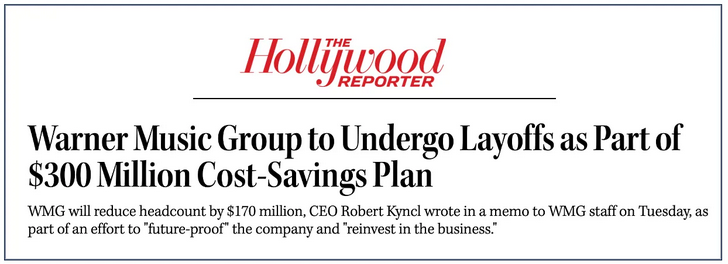
If you have any doubts about Warner’s priorities, here’s another headline — also from yesterday.
If you’re looking for a clear signal from a major record label, it won’t get any clearer than this.
This is exactly what a record label does when it no longer views music as a vital creative force in the current day. This is what happens when a major label morphs into a copyright and IP management business — which can be run by a small team of lawyers and accountants.
Yes, you can make money living off the past — but not for long.
I keep waiting to read a news story about a major label investing a billion dollars in developing new artists. But I never see that story.
I’ve written in the past about fans who prefer old music. But big record labels are even more obsessed with vintage and retro songs.
And it’s not just Warner Music. Universal Music is doing the same thing. So is Sony and Concord and other big labels.
That’s disturbing.
These are the same companies who should be creating the future of music. They should be convincing the public to listen to new songs and new artists. After all, if record labels don’t invest in the future of music, who will?
Maybe nobody.
A few years ago, investment firms started viewing old songs as investments. That didn’t work out very well. The most prominent song investment fund crashed and burned — as I predicted long in advance.
At that point, the smart money headed for the exits.
In the aftermath, the only enthusiastic buyers of old songs were the big record labels. They are the buyers of last resort.

Comments Off on “This is what happens when a major label morphs into a copyright and IP management business”
June 29, 2025
The oddity of Donald Trump’s personal “golden share” in US Steel
In the National Post, Colby Cosh points out the weirdest element of President Trump’s deal with Nippon Steel for the takeover of venerable US Steel:

A “golden share” is a special kind of equity that gives its holder veto power over specified corporate decisions. It is often used in privatizations to give governments some vestige of control over corporate entities originally created by the state (or, in Canada, the Crown) for public purposes. In this unusual case, the U.S. government is magically gaining a golden share in exchange for permitting the sale of one private company to another. The government will be given the right to choose some U.S. Steel board directors, to forbid any name change, and to veto factory closures, offshoring, acquisitions and other moves.
As the Cato Institute immediately pointed out, this is a de facto nationalization of U.S. Steel — the sort of thing that would have had Cold War conservatives climbing the walls and hooting about socialism. But at least socialism professes to be social! Yesterday a lefty energy reporter named Robinson Meyer was nosing around in the revised corporate charter for the newly-acquired U.S. Steel, and he discovered a remarkable detail that the Cato folks had missed: the decision powers of the golden share have been legally assigned to Donald Trump in person and by name for the duration of his presidency. Only after Trump has left the White House do those golden-share powers revert to actual U.S. government departments (Treasury and Commerce).
The stench of banana-republicanism here is truly overwhelming. Again, any species of government foreign-investment review is bound to have a personal character, but such decisions are not supposed to involve the legally explicit assignment of a valuable corporate asset to the decision-maker in his own person. Can this be described as anything but legalized, open bribery — assuming that U.S. courts will find it legal if the terms of sale are challenged? Where in the U.S. Constitution, or in the history of the United States, can any warrant for this extraordinary behaviour conceivably be found? And will unholy bargains of this nature soon become routine?
Comments Off on The oddity of Donald Trump’s personal “golden share” in US Steel
June 23, 2025
80% of top-grossing movies are prequels, sequels, spin-offs, remakes or reboots
Ted Gioia on the death of creativity in the movie business, which also seems to be tracking almost exactly with the trend in music business profits:
I’m not shocked when I look in the mirror. Yeah, the Honest Broker isn’t getting any younger. But that’s the human condition.
Maybe I should start using a moisturizer. What do y’all think?
Nah. I’ll just let this aging thing play out.
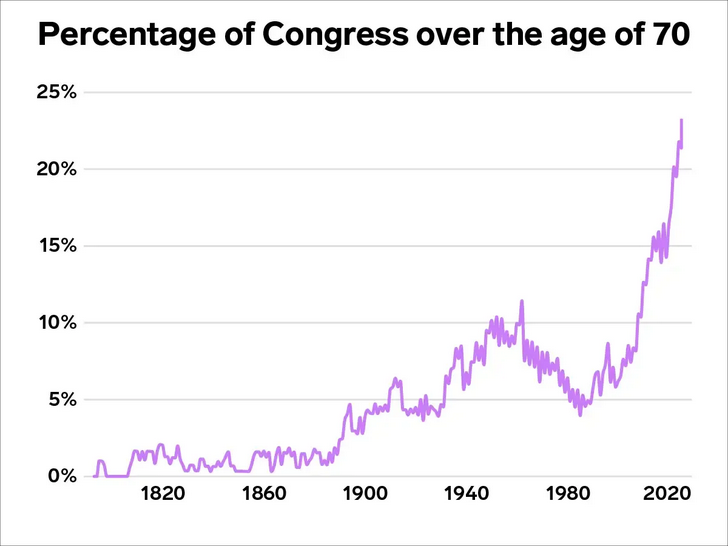
On the other hand, I’m dumbfounded at everything in public life getting older — even older than me! Consider the current political landscape.
With each passing year, the US Congress looks more like the College of Cardinals (average age =78) or the Rolling Stones (average age = also 78).
We’re gonna need a lot of moisturizer.
But Congress is young and spry compared to Hollywood.
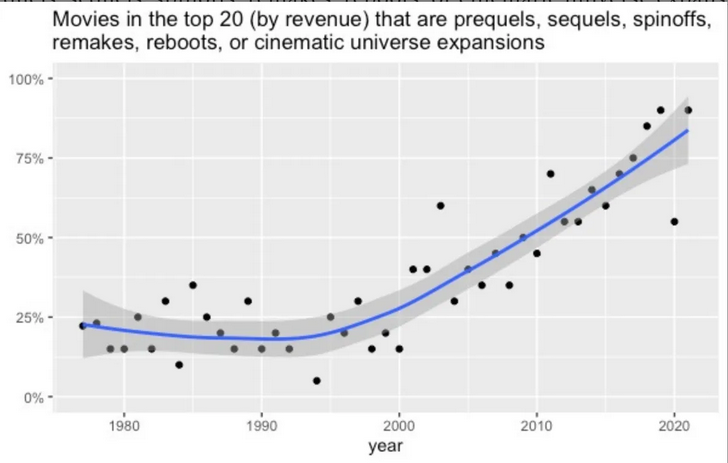
Back in 2000, 80% of movie revenues came from original ideas. But this has now totally flip-flopped.
Today 80% of the movie business is built on old ideas — remakes, and spin-offs, and various other brand extensions. And we went from 80% new to 80% old in just a few years.
Source: Experimental History
[…]
Look at music — and you see the same thing.
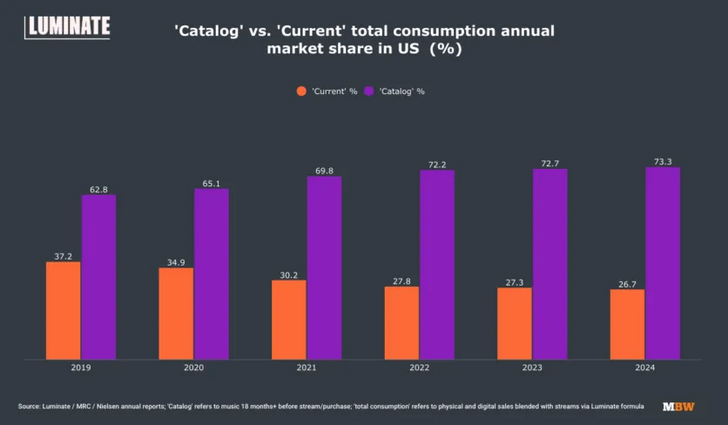
The share of old songs on streaming will soon reach 80%. It’s not quite there yet — the latest figures are 73%. But it was at 63% back in 2019. So it’s just a matter of time.
In 2000, streaming didn’t exist, so we looked to the Billboard chart to gauge a song’s success. And new music made up more than 80% of charted songs. So here — just like the movies — we’re flip-flopping from 80% new to 80% old over the course of a few years.
I don’t have good figures on publishing. But I’m pretty sure that AI-generated books and articles will soon represent 80% of the marketplace. Maybe we’ve already reached that threshold.
AI is deliberately designed to cut-and-paste, rehashing past work as its modus operandi. And it will do this to every field — replacing originality with repetition and regurgitation.
This is the new 80% rule.
Just imagine if traditional businesses operated this way.
- “Welcome to our restaurant, 80% of the food is leftovers.”
- “Welcome to our boutique, 80% of clothing is secondhand.”
- “Welcome to our dating service, 80% of the choices are your ex-girlfriends (or ex-boyfriends).”
None of that sounds very appetizing.
Comments Off on 80% of top-grossing movies are prequels, sequels, spin-offs, remakes or reboots
June 22, 2025
Delaying Mark Carney’s next book
In the latest SHuSH newsletter, Ken Whyte outlines the various oddities of Mark Carney’s next book to market:

Three years ago, long before he declared himself a politician, Mark Carney published Value(s), his attempt at solving some of the world’s biggest problems: income inequality, climate change, systemic racism, etc. The book was reasonably well received. It sold well. A sequel was in order.
Announced last year, The Hinge: Time to Build an Even Better Canada was ostensibly Carney’s attempt to address Canada’s biggest issues, and perhaps to position himself as our future leader. The book was set for release in May 2025. Events interceded and Carney was elected prime minister on a far tighter timeline than anyone, including his publisher, could have imagined. Publication of The Hinge was delayed. An anonymous source told the Toronto Star Carney was too busy politicking to finish the final edits on the book. I heard the delay had more to do with campaign finance rules that would consider a book publicized or released in election season as political advertising. Anyway, a new release date was set for July 1. Amazon now has The Hinge coming next January.
Carney’s political opponents have been enjoying the delay. Critics both left and right have attributed it to the difficulty of squaring positions taken by Carney a year or two ago with positions he espoused during the campaign and, more recently, as prime minister.
I don’t doubt that Carney’s politics have moved over the last six months. And I wouldn’t be surprised if his second book is being rewritten in whole or in part. I don’t have a problem with that. Much has happened, both in Canada and south of the border. We’ve all been reconsidering our positions.
My problem with Carney’s conduct is not that he’s revising his manuscript, if he is, but that he’s not revising his publishing contract.
The Hinge is set to be published by Signal. Signal is a division of McClelland & Stewart. M&S is a division of Penguin Random House Canada. PRHC is a division of Penguin Random House LLC, corporate headquarters at 1745 Broadway, 3rd Floor, New York, New York, 10019.
Penguin Random House LLC is owned by Bertelsmann, a media conglomerate in Gütersloh, Germany, but legally and operationally, it is a US company. Its executive leadership, including CEO Nihar Malaviya, works out of the above address. Strategy and publishing priorities are set in New York, and profits in PRH’s many far-flung international divisions flow to New York. So the prime minister of Canada is publishing his book with the Canadian branch plant of a US company.
Other recent prime ministers have done the same. Justin Trudeau published Common Ground with HarperCollins. Steven Harper published Right Here, Right Now with Signal, and his forthcoming memoir sits there, too. Jean Chretien released My Stories, My Time with Random House Canada. Most of our politicians have published with branch plants of American firms.
I should add that many of our best writers publish at these same branch plants, if not directly with US publishers. (Even middling scribblers like me have published directly in the US.)
But, again, the world has changed. To quote no less an authority than Mark Carney, Canada’s old relationship with the US, “based on deepening integration of our economies and tight security and military cooperation, is over”. We need to “fundamentally reimagine our economy”, “retool” our industry, and enhance our self-sufficiency.
He sees our cultural relationship with the US as part of this project. From the Liberal platform: “In this time of crisis, protecting Canada means protecting our culture, our journalism, our perspectives. The Americans have threatened our sovereignty and issued inflammatory statements about our economy; we need to be able to tell a story that fights back.”
Right under the cultural section of the platform was a “Buy Canadian” plank. “At a time when our economy is under threat, consumers want to do their part as patriotic Canadians, buying things that are truly made here.” Team Carney promised to make it easier to determine what is and isn’t a Canadian product and prioritize made-in-Canada suppliers in every sector of the economy, limiting bidders from foreign suppliers, and so on.
So it’s “eLbOwS uP!” for the voters, but carry on publishing your next book through a US-owned subsidiary, eh? You have to admit they wear their hypocrisy proudly.
Comments Off on Delaying Mark Carney’s next book
June 18, 2025
Canada’s Supply Management system – protecting us from cheaper milk, eggs, and chicken
On the social media site formerly known as Twitter, The Food Professor celebrates the latest achievement in Canada’s omni-competent supply management system:
The Chicken Crisis Supply Management Won’t Admit
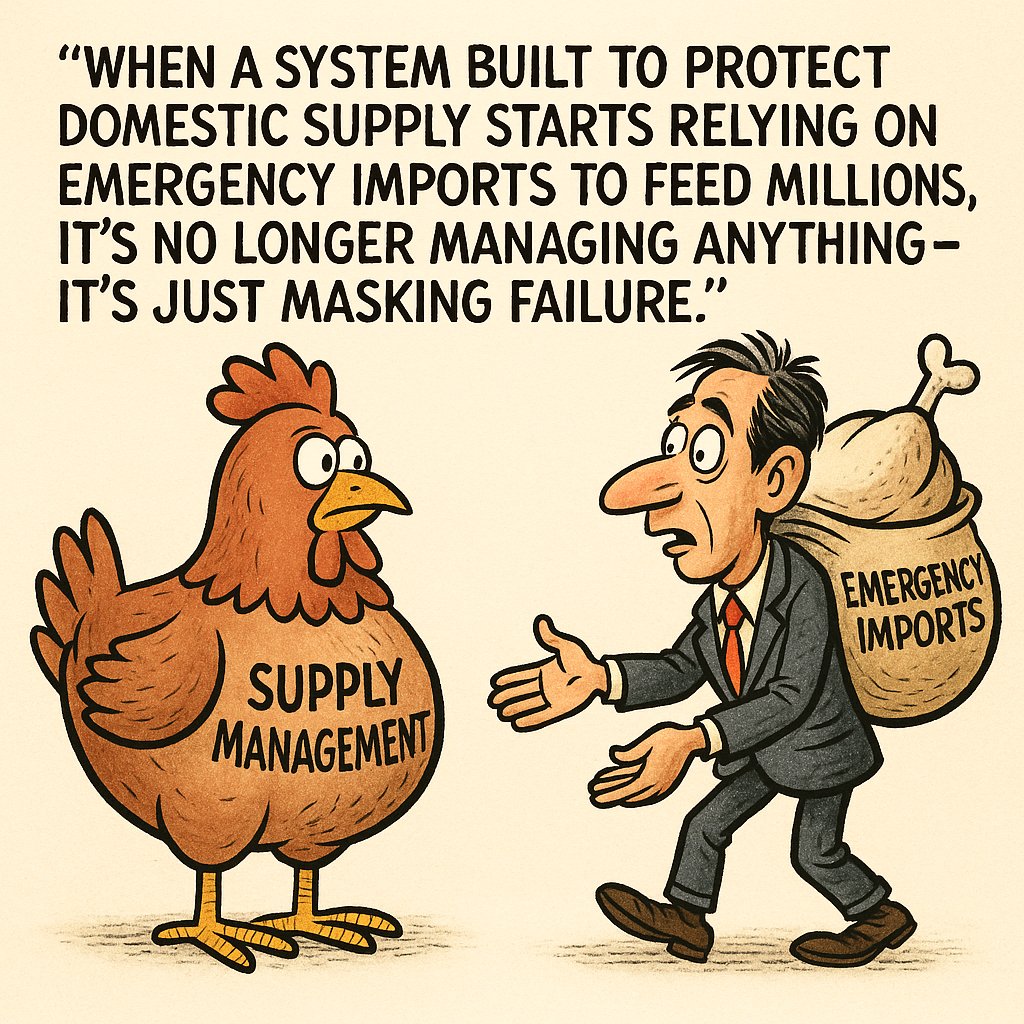
Canada’s supply management system—once heralded as a pillar of food security and agricultural self-sufficiency—is failing at its most basic function: ensuring reliable domestic supply.
According to the latest figures from the Canadian Association of Regulated Importers (CARI), Canada imported over 66.9 million kilograms of chicken as of June 14 — a 54.6% increase from the same period last year. To put that in perspective, this volume could feed 3.4 million Canadians for an entire year, based on per capita poultry consumption. That’s roughly 446 million individual meals — meals that, under a tightly managed quota system, were meant to be produced domestically.
To be fair, the avian influenza outbreak in Canada has disrupted poultry production, and it partially explains some of the shortfall. But even accounting for that disruption, the numbers are staggering. Imports under trade quotas established by the WTO, CUSMA, and CPTPP are all running at or near pro-rata levels, signaling not just opportunity — but urgency. Supplementary import permits — meant to be emergency tools — have already surpassed 48 million kilograms, exceeding the total annual import volumes of some previous years. This is not a seasonal hiccup. It is systemic failure.
Canada’s poultry sector is supposed to be insulated from global volatility through supply management. Yet internal shocks — like the domestic avian flu outbreak — have shown how fragile the system truly is. When emergency imports become routine, we must ask: what exactly is being managed?
The original intent of supply management was to align production with domestic demand while stabilizing prices and farm incomes. But that balance is clearly off. The A195 production period, ending May 31, 2025, showed one of the worst underproduction shortfalls in more than 50 years. Producers remain constrained by rigid quota allocations, while consumers continue to face rising poultry prices. More imports. Higher costs. Diminished confidence.
Some defenders will insist this is an isolated event. It’s not. This is the second week in a row Canada has reached pro-rata import levels across all chicken categories. Bone-in and processed poultry products — once minor parts of emergency programs — are now central to keeping the market supplied.
The dysfunction extends beyond chicken. Egg imports under the shortage allocation program have already topped 14 million dozen, up 104% from last year. Just months ago, Canadians were criticizing high U.S. egg prices — yet theirs have fallen. Ours haven’t.
All this in a country with $30 billion in quota value, intended to protect domestic production and reduce reliance on imports. Instead, we are importing more — and paying more.
Meanwhile, Bill C-202, now before the Senate, aims to shield supply management from future trade negotiations, making it even harder to adapt or reform. So we must ask: is this what we’re protecting? A system that fails to meet demand, relies on foreign supply, and costs Canadians more at the checkout?
Our trading partners are seizing the moment. Chile, for instance, has increased its chicken exports to Canada by over 63%, now representing nearly 96% of CPTPP-origin imports. While we double down on rigidity, others are gaining long-term footholds in our market.
It’s time to face the facts. Supply management no longer guarantees supply. And when a system meant to ensure resilience becomes the source of fragility, it’s no longer an asset — it’s an economic liability.
Comments Off on Canada’s Supply Management system – protecting us from cheaper milk, eggs, and chicken
June 13, 2025
The new marketing strategy is “Always Be Annoying”
Ted Gioia explains that the rules of marketing as explained in Glengarry Glen Ross no longer apply:

The rules of marketing never change. That’s what they told me in business school.
If you could peer inside the meetings at head office, you would see a never-ending loop of Glengarry Glen Ross.
Always be closing. Those are the A-B-Cs of business.
But that’s not true anymore.
In recent days, a new marketing strategy has emerged. I’ve never seen it before. And I wish it would go away. You probably do too.
It’s a new way of advertising. It’s a new way of marketing. It’s a new motivational tool.
It didn’t exist when I studied marketing back at Stanford GSB. I had the best marketing teachers in the world, but they never dreamed of doing this to customers.
Here’s the new marketing playbook of 2025:
- Do NOT try to close.
- Do NOT try to sell.
- Do NOT try to persuade.
- Don’t even listen.
The goal now is merely to ANNOY. The big companies do it on purpose.
Big streaming platforms are the experts at this new marketing tool. They want you to pay for a premium, ad-free subscription. The more annoying the commercials, the more likely you are to pay.
You will pay just to get rid of the ad.
In this topsy-turvy world, the more painful the ad, the better it works. The digital platforms have studied this — YouTube has tested using up to ten unskippable ads on users.
That’s not marketing — it’s water-boarding. But they need to test these techniques. Their business model is built on optimizing the level of annoyance.
And guess what? Even paying for premium doesn’t guarantee escape from ads. Welcome to the new digital platforms — which increasingly resemble prisons.
[…]
We once lived in an industrial economy — built on industry. Then we shifted to a consumer economy — built on consumption. And more recently we lived in a service economy — built on service.
But we now are entering the age of the Annoyance Economy. And it is the inevitable result of corporations battling for your attention.
They monetize your eyeballs — measured in clicks and microseconds — and they will do anything to hold on to them. This increasingly involves annoying, intrusive actions that no business would have dared to implement in a consumer-oriented economy.
Comments Off on The new marketing strategy is “Always Be Annoying”
QotD: The Subaru BRAT
If you know this truck, you also know why it’s no longer available.
Such fun things are no longer allowed.
They are not saaaaaaaaaaaaaaaaafe! “Moms” are “concerned”!
But in 1977, the Safety Cult — which ended such fun things — was still a backwater aberration, like dancing with rattlesnakes — and most people still esteemed fun over fear. There were roofless Broncos and K5 Blazers — and cars with beds.
You could buy all kinds of different stuff back when America was still a fairly free country — and the Subaru BRAT was as different as it got.
BRAT — all caps — was short for Bi-Drive Recreational All-Terrain Transporter. It was superficially similar to other small import pickups of the ’70s, such as the Datsun 620 and similar models from Toyota (SR5), Mazda (B210), and Chevy (via Isuzu) Luv.
But unlike them, it was a four seater — with two of the four in the bed, facing the other way. The seats were made of all-weather plastic and far from the most comfortable — but the view was spectacular. Watching the world recede as you progressed is another one of many freedoms denied today in the name of “safety”.
Subaru wasn’t “unconcerned” about “safety”. Grab handles — to keep passengers from bouncing out of the bed — were included. Though holding onto them made it harder to reach for a cold one in the cooler. That was another fun thing people did in pickups back in the day — before the Safety Cult put the kibosh on that, too.
The seats were actually a dodge — of a federal fatwa known as the “chicken tax”, which was a retaliatory tariff of 25 percent applied to import-brand pickups manufactured outside the United States as tit-for-tat for tariffs applied by foreign countries to American chicken exported outside the United States.
The “chicken tax” hit trucks with just two seats — at the time almost exclusively the small import models, which didn’t offer the extended and crew cab configurations that are commonplace today.
By adding the extra seats in the bed, BRAT qualified as a passenger vehicle rather than a “light truck”, and thus Subaru evaded the chicken tax on a happy technicality — and was also able to sell the BRAT for less than two-seater rivals that had the cost of the tax folded into their MSRP.
Eric Peters, “Doomed: Subaru BRAT (1977-87)”, The American Spectator, 2020-04-26.
Comments Off on QotD: The Subaru BRAT
June 12, 2025
Why it’s economically impossible for Walmart to “eat the tariffs” as Trump demands
At FEE, Peter Jacobsen shows the clear financial reason why Walmart and other big US retailers are passing along the price increases due to Trump’s tariffs rather than “eating them”:
Recently, a post from President Trump on Truth Social went viral. An attempt to convince retail giant Walmart to keep prices down despite the tariffs, it read:
Walmart should STOP trying to blame Tariffs as the reason for raising prices throughout the chain. Walmart made BILLIONS OF DOLLARS last year, far more than expected. Between Walmart and China they should, as is said, “EAT THE TARIFFS”, and not charge valued customers ANYTHING. I’ll be watching, and so will your customers!!!
Trump’s demand here is, simply put, unreasonable, and it reflects a basic misunderstanding of how pricing decisions are made in a market economy. Let’s unpack why.
Walmart’s Thin Margins
The biggest problem with the President’s view is that it doesn’t pass a basic numbers test. To break it down, let’s look at Walmart’s financials.
It’s true that Walmart generates billions of dollars in revenue each year, but revenue alone doesn’t tell us how much Walmart makes.
To understand that, we need to consider profit, which accounts for the company’s costs. More specifically, we want to look at Walmart’s net profit margin, because that’s an extremely important indicator of whether Walmart could realistically “eat the tariffs”.
Depending on the source, Walmart’s net profit margin is somewhere between 2% and 3%. Let’s split the difference and say it’s 2.5%. What does that mean?
That means, if Walmart sells you $1 of goods, it only keeps 2.5 cents in profit. That’s right, 97.5 cents goes toward inventory, employee wages, store maintenance, and a variety of other operating costs.
Put another way, if you spend $100 at Walmart, they make $2.50 in profit.
Now let’s say you buy a $100 television that Walmart imports. A $20 tariff is imposed — an added cost Walmart has to pay to import the TV. Before the tariff, Walmart was making $2.50 in profits. After the tariff, it’s now taking a $17.50 loss.
The only way Walmart can still sell this TV is by raising the price.
At this point, a tariff supporter might respond: “The easy way to fix this is to buy US-made TVs instead!”
Sure — you can avoid tariffs by only buying domestic, but the problem is that domestic TVs tend to be more expensive. If they weren’t, Walmart wouldn’t be importing them in the first place. So even if Walmart pulls international TVs off the shelves and replaces them with US-made ones, the prices still increase.
Here’s the key point: “eating” the tariffs is not an option. Walmart operates on slim margins, barely making pennies on the dollar — there isn’t room to eat 20% cost increases!
Comments Off on Why it’s economically impossible for Walmart to “eat the tariffs” as Trump demands


