So it goes with the Juggalos. There are still nodes of the Apparat that perform competently to brilliantly. Since we’ve been using the Pacific War, let’s go ahead and call Tubman’s Illegitimate Gangster Regime (TIGR) the “Flying TIGRs”. It’s clear that the Flying TIGRs really really want their war with China, in the same way it seemed clear at the time that Wheels Roosevelt really really wanted his war with Japan (more correctly, really really wanted his war with Germany, but Japan had to be the patsies). And yet, they keep doing things that make no goddamn sense — indeed, they make anti-sense.
I suppose this should be a post unto itself, but very briefly, If They Were Serious about war with China, you’d expect a few very basic things. Massively stepped-up armaments production, if nothing else, and if you wanted to be really slick about it, you’d do it under the guise of replenishing all the stocks we sent to our plucky allies in Ukraine — purchase orders for 100x the total amount shipped to Keeeeeve, that kind of thing. But that’s the kind of retooling that’s hard to hide, because it would also involved massively stepped-up mining, refining, and so on, not to mention upgrading the transportation infrastructure and so on.
None of those things appear to be happening. And since even an all hands on deck, Nazi-style crash rearmament program has a lag time of a few years, If They Were Serious about premiering Showdown in the Taiwan Strait anytime in the next decade, they’d be jamming that shit out NOW. Right now. Afterburners full.
You also need soldiers to use all that stuff, so you’d expect massively stepped-up military recruiting. Which would entail, at minimum, a push to get American boys into some kind of fighting shape. Which not only isn’t happening, but the exact opposite is happening. Unless you want Uncle Sugar to pay for your “top surgery” or your addadicktome, why would anyone enlist? When you further consider that the same TLAs who are so smoothly rolling out their Hate the Han™ campaign could easily order up some ultra-jingoistic remakes of Stallone movies from the 1980s, it seems as if They are not, in fact, Serious …
… but some of the nodes are, because failure is a distributed system. I love playing If They Were Serious — it’s my favorite drinking game — but alas for me, it relies on the Assumed Internal Consistency Fallacy. Like the Japanese Navy, or the Wehrmacht on the Eastern Front, or even poor Adm. Kimmel, you’ve got certain nodes of the Apparat performing competently to brilliantly in the service of skull-fuckingly stupid objectives, or NO objectives. The Flying TIGRs are even dumber than [Hitler], who at least called a meeting to say “Hey, how’s about we invade Russia in the winter?” While it’s clear to everyone who matters that the TIGRs really really really really really want their war, nobody’s in charge, so everyone is left to figure it out as best they can, on their own initiative, with the resources they have to hand.
And again, much like the Wehrmacht etc., the better the competent nodes perform, the harder and faster the overall system failure. We’re going to end up charging headlong into a war with China because the TLAs at Twitter etc. are doing such a great job making Hate the Han™ the Current Thing. Meanwhile, one imagines Brandon’s handlers telling their Chinese paymasters that no no, that won’t be happening, please don’t cut off our paychecks. And since they’re pretty good at their job, too — their job being “telling Beijing what they want to hear while lugging away huge sacks of cash” — it’s gotta fuck with the People’s Liberation Army command staff.
Consider further that the Army (etc.) are, Kimmel-style, doing a pretty decent job of carrying out their on-paper objectives. Kimmel was told “Get the Fleet ready for a likely confrontation with Japan a few years down the line”, and he did it. The Fistagon has told all its commanders to get ready for a war with China, yeah, sometime down the line … but right now, the important thing is to get as many gays, girls, and trannies as possible into uniform while promoting the Diversity that’s already in uniform as far up the chain of command as possible. General Sasqueetchia, in command of the Fightin’ 45th Mechanized Hairdresser Battalion, says thanks for a job well done … and it IS a job well done, according to the only actual orders anyone has received.
Fun times, right?
Severian, “Failure Nodes”, Founding Questions, 2023-04-18.
July 19, 2023
QotD: If they were serious …
July 18, 2023
Seaplanes? How 1940s. No, we’re seeking to “leverage emerging technologies” instead
CDR Salamander wonders about a modern need for military sea rescue capability that the US Navy filled with flying boats and seaplanes during the Second World War, then supplemented with helicopters during Korea and Vietnam. For ocean search-and-rescue in a combat environment in the present or near future, what are the USN’s plans?
I will be the first person to admit that good, well-meaning, and informed people can disagree with seaplanes in general or the US-2 specifically, but they have to engage the conversation. Directly argue the requirement or offer realistic alternatives.
This does neither. If anything is demonstrates the narrowness of thought and fragility of substance used in opposition.
What an patronizingly toxic stew that answer is. I highly doubt Lung typed out that answer himself, so my commentary below is not directed at him personally, but … and it is what comes after the “but” that counts — but at the three-digit J or N code that extruded that from the random acquisitions professional statement subroutine from ChatGPT.
Let’s give that answer a full Fisking;
- “The Indo-Pacific operational environment has evolved significantly since World War II”:
Let me check my WWII Pacific chart, my Vietnam War era globe, and GoogleEarth … and … no. The geography has not changed. The distances have not changed. The requirement of thousands of years to take and hold territory or eliminate your enemy from access to it has not changed. All the little islands, regardless of what Al Gore and John Kerry say, are still there. As we are seeing in the Russo-Ukrainian War, a million PPT slides saying so does not change the fundamentals of war.
Sentence one is invalid.
- “The employment of seaplanes today would not meet the operational demands and current threat scenario.”
Is there an operational demand for us to rescue downed airmen and to be able to reach remote islands without airfields? Yes. Does your “current threat scenario” run from Northern Japan through to Darwin, Australia? Yes.
Sentence two is invalid.
- “However, we support the continuous development of new and innovative solutions that may provide solutions to logistical challenges.”
So, you define “new” as something that only exists on PPT slides? By “continuous development” you mean never matures as a design that goes into production. By “innovative” you mean high on technology risk. Undefined program risk. Unknown design risk. No known production line or remote estimate to IOC, much less FOC when we know that the next decade is the time of most danger of the next Great Pacific War.
Sentence three is irresponsible and professionally embarrassing given the history of transformational wunderwaffe this century.
- “As an example, DARPA’s Liberty Lifter X-Plane seeks to leverage emerging technologies that may demonstrate seaborn strategic and tactical lift capabilities.”
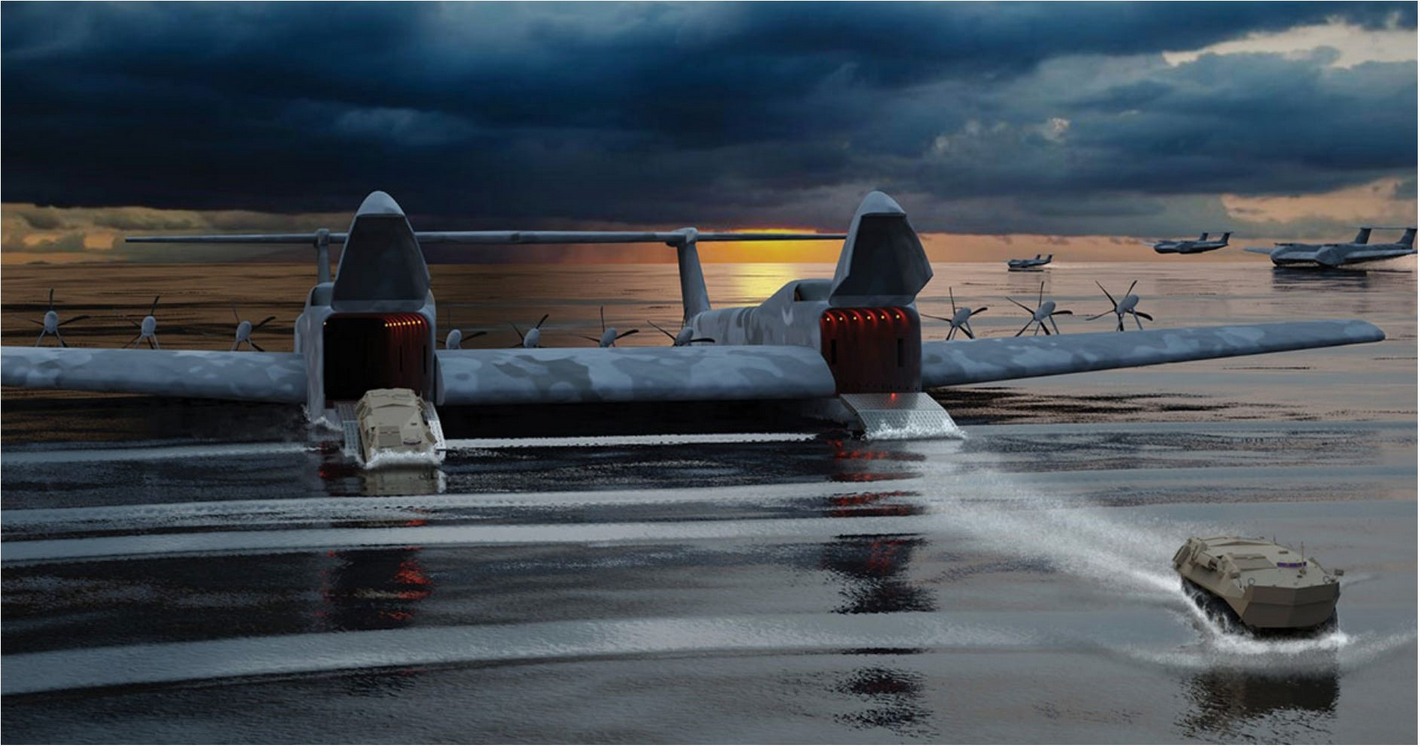
Well, goodness, we will have to micro-Fisk this gaslighting horror show of a sentence. To start with, they are talking about either this from General Atomics;
… that could only be used on a very few select beaches under ideal weather in a completely permissive environment and could only be used for one specific mission and nowhere any possible hostile aircraft or ground forces. Also looks like we’d need a whole new engine and a small town’s worth of engine mechanics to maintain the maintenance schedule on those engines.
Then we have this offspring of an accidental mating of the Spruce Goose with the Caspian Sea Monster idea from Aurora Flight Sciences;
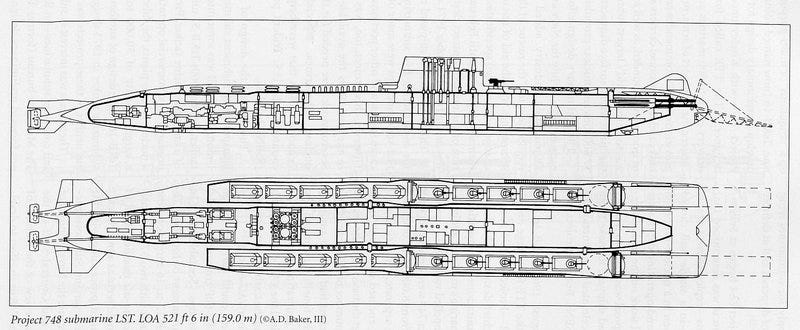
I give the odds of either one of those taking to the air prior to 2035, if ever, on par with a return of the submarine LST of Cold War fame (deck gun not included).
Let’s get back to the wording of that dog’s breakfast of a final sentence. Feel slimy reading it? You should;
- “seeks to leverage” — that is just a way of saying, “hope in magic beans.” Gobbledegook.
- “emerging technologies” — oh, you mean something that hasn’t left the computer, white board, or PPT slide.
- “that may demonstrate” — so, even if our magic beans managed to fuse unobtainium with Amrita, we’re not really sure if the strip mining of strange blue creatures’s holy sites and drilling holes in the soft pallet of whale-like thing will result in something of use.
- “strategic and tactical lift capabilities” — I’m sorry, an eight or ten-engined aircraft that any goober with a 1960s-era iron-sighted RPG-7 could target at maximum range is going do anything “tactical” — especially at the expected price of those things and the resulting precious few that wind up displacing water. Oh, and you admit that it will only be used for cargo, so it can’t do the full range of possible missions the US-2 can … just cargo. On just a few beaches that are fully surveyed ahead of time. At the right tide. In the right weather. In a 100% safe and permissive environment.
- The final sentence is a caricature.
Rep. Austin Scott (R-GA) should feel at least mildly insulted by this reply. It was a serious question given a canned answer that, slightly modified, could have been provided at any time in the last quarter century by the lethargically complacent maintainers of the suboptimal habits of the mistakingly entitled acquisitions nomenklatura

July 17, 2023
The WEF considers whether to use the carrot or the stick next time
Elizabeth Nickson on the World Economic Forum’s latest gathering in China:

Last week the WEFers held their summer camp in China. More to come, they warned us. More pandemics, more catastrophic global warming, more inflation, hell on wheels, they promise us, Armageddon is coming. Be very afraid.
The following was a particularly lovely event:
“How to Stay Within Planetary Boundaries — Carrot or Stick?” which focused on whether to incentivize or force compliance with “climate goals”. It was hosted by some joker who edits a magazine called Nature Energy, no doubt funded by the WEF and read by exactly nobody. And some very po-faced morons of various colors, paid in the six figures, cited a bunch of falsified statistics ending with these pretty little paragraphs:
We are — broadly speaking — agreed that we need to get on track towards a net-zero, climate-safe and nature-positive future, but we know this will not be easy. And we’re going to need to change behaviours of both individuals but also the way that our industries and corporations and also our governments work and practices.
We’re going to need to do this through a mixture of carrots and hopefully perhaps not so many sticks, in some kind of mix. And there is a very active and live debate as to how we go about this. But we’re likely to see an increasing move towards more stick-like interventions …
These guys, they make me laugh. Seriously? How stupid do they think we are? How hated are they? All over the world, they are loathed and laughed at. Every time one of them is taken out, we laugh and laugh and laugh. Larry Fink from BlackRock? Hiding, Scared. Mocked, publicly humiliated. We need a lot more of that.
[…]
They have to destroy western culture, because we middle-class-unnecessary-eaters are too damned uppity. They have stolen so much that when the tipping point arrives, and it will, they will be hung from the highest tree. “Better to ruin those likely to catch and imprison us, and feed on peasants and serfs, the desperate in the rest of the world.”
Proof?
OK, let’s review the Biden/Trudeau/Macron/Sunak economy shall we? Since the out-in-the-open globalist theft of elections during the past three years — Sunak was installed, Trudeau is the most hated man in Canada, Biden is gaga and Macron is just crazy — this is what the bottom 50% are experiencing. Short form, ground into the dirt.
Ninety percent of the jobs “created” were those gained back after the pandemic. Most jobs are going to the foreign born – they work cheap.
Of the roughly 900 days Joe Biden has been in the White House, real wages have fallen for almost 700 days — about 75% of Biden’s time in office. All total, the collective drop in real wages has been 3% rather than the robust real wage gains workers deserve and expect.
Every single American has lost $36,000 to Biden’s inflation. It has crippled us, especially those working in the real (not digital) economy — Uber drivers, truckers, farmers, manufacturers, ranchers, the bottom 50% — gas prices have gone up 50%. Home heating up 23%, milk 16%, beef 25%, eggs 83%. Home prices 32%, rents 15%, electricity 21%.
Let’s not even talk about interest rates. Ten raises in the last 30 months. Last week the Bank of Canada gave its people $26 million in bonuses. Meanwhile, people are losing their houses.
How much more punishment are we expected to take? This is directly caused by their mad hatter spending during the pandemic — which was fake but for a few months in early 2020 — and their subsequent restriction of the energy supply. Restriction of energy causes prices to skyrocket because producing anything requires energy.
July 16, 2023
Mass Suicide on Saipan – WW2 – Week 255 – July 15, 1944
World War Two
Published 15 Jul 2023Japanese troops and civilians commit mass suicide rather than surrender to the Americans in the Marianas; in Normandy, Caen has finally fallen to the Allies though the fight for St. Lo is not over; the Soviet offensives in the north take Vilnius and the fighting continues up in Finland, but the big eastern front news is the mighty new Soviet offensive in Western Ukraine. (more…)
July 13, 2023
Bill Slim’s plan for the Battle of Meiktila in March 1945
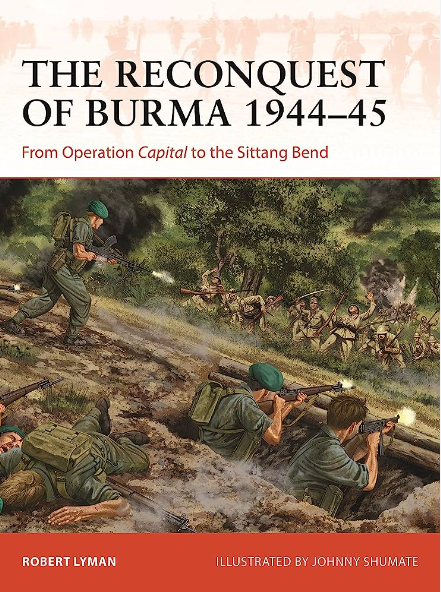
Dr. Robert Lyman on the subject of his most recent book, The Reconquest of Burma 1944-45: From Operation Capital to the Sittang Bend:
When I was writing my latest book with General Lord Dannatt he said to me, “Rob, if I’ve got one criticism of A War of Empires it’s that you don’t emphasise enough the role of Bill Slim in coming up with the plan for victory in 1945, and executing it perfectly.” Fair. As Slim’s military biographer, I told Richard that I didn’t want to be accused of rewriting that book again. I was conscious of this problem as I was writing A War of Empires.
But it is fair criticism. It may be that I underplayed Slim’s role when I was considering all the other critical features in this great campaign. The idea behind the dramatic victory by 14th Army in Burma in 1945 was Slim’s and Slim’s alone. He pursued his own plan through to its remarkable conclusion.
[…]
Slim’s original plan was to fight the main strength of the Japanese army on the Shwebo Plain, a dry, flat plain between the loops of the Chindwin and Irrawaddy. Not only would the terrain be well suited to the deployment of armour, for which the Japanese had little effective reply, but the Japanese would be trapped with the river-line at their back. Slim had assumed that the Japanese would be unprepared to make a voluntary withdrawal. The scene was set for Slim to be able to deploy his superior mobility and firepower to destroy the main Japanese army in Burma.
By the end of the year, however, it became apparent that the Japanese were not going to conform to Slim’s plan for the battle, and General Kimura had seen the trap which his forces would be caught in if they attempted to stand and fight in the Shwebo Plain. Showing unusual flexibility and moral courage Kimura promptly withdrew his reconstituted 15th Army behind the Irrawaddy. Kimura hoped, not without reason, to be able to smash Slim’s army as it attempted to cross the river, which in itself presented an immense obstacle to the British. He would then counter-attack and destroy Slim as the British withdrew during the monsoon to the Chindwin.
Kimura’s move behind the Irrawaddy destroyed at a stroke Slim’s plan. Undaunted, and recognising the supreme importance of destroying Kimura’s army rather than taking ground for its own sake, Slim came up with another plan. In basic outline, his new plan (Operation Extended Capital) entailed crossing the Irrawaddy and fighting the decisive battle in February in the plain around Mandalay and the low hills around Meiktila, the key enemy air and supply base in Central Burma. Both the road and rail links between Mandalay and Rangoon ran through Meiktila. If Meiktila fell, the whole structure of the Japanese defence of Central Burma would collapse.
July 9, 2023
The Destruction of Army Group Center – Week 254 – July 8, 1944
World War Two
Published 8 Jul 2023Operation Bagration continues, smashing the armies of German Army Group Center and taking ever more territory including the prize of Minsk; on Saipan the Americans have taken most of the island when the Japanese resort to a huge suicidal banzai charge to try and turn the tide; and in Normandy new attacks begin try to finally take Caen and St. Lo.
(more…)
July 3, 2023
The Battle That Prevented A Nuclear World War Three | Kapyong: The Forgotten War | Timeline
Timeline – World History Documentaries
Published 2 Jul 2023On April 24, 1951, following a rout of the South Korean army, the Chinese People Volunteer Army pursued their enemy to the lines of Australian and Canadian troops still digging fall-back defences, 39 kilometres to the rear. Here, sometimes at the length of a bayonet, often in total darkness, individual was pitted against individual in a struggle between a superpower and a cluster of other nations from across the world. They fought for a valley, the ancient and traditional invasion route to Seoul. If it fell the southern capital and the war, was lost. The United Nations troops had the military advantage of the high ground and artillery support: the Chinese relied entirely on vastly superior numbers. As a result, young men from both sides found a battle which was very close and very personal.
The Battle of Kapyong became the turning point of China’s Fifth Offensive in that Korea spring. The aim of the offensive was to finally drive the foreign troops out of South Korea and into the sea. What happened instead, changed the history of the Korean War. The Chinese were denied victory and forced back into negotiations. Had they succeeded, another crushing defeat for the US could have triggered events that led to a nuclear holocaust in Asia — and World War Three.
(more…)
July 2, 2023
Allies Liberate Cherbourg – WW2 – Week 253 – July 1, 1944
World War Two
Published 1 Jul 2023Several weeks after the invasion of Normandy began, the Allies finally take a port city there, though the actual harbor has been destroyed. On Saipan the Americans have the advantage, in Finland, the Soviets do, but the big news is the Soviet destruction of huge chunks of German Army Group Center, demolishing entire Army Corps, and surrounding tens of thousands of the enemy.
(more…)
June 28, 2023
The Treaty of Versailles: 100 Years Later
Gresham College
Published 4 Jun 2019The Treaty of Versailles was signed in June 1919. Did the treaty lead to the outbreak of World War II? Was the attempt to creat a new world order a failure?
A lecture by Margaret MacMillan, University of Toronto
04 June 2019 6pm (UK time)
https://www.gresham.ac.uk/lectures-an…A century has passed since the Treaty of Versailles was signed on 28 June 1919. After WWI the treaty imposed peace terms which have remained the subject of controversy ever since. It also attempted to set up a new international order to ensure that there would never again be such a destructive war as that of 1914-18. Professor MacMillan, a specialist in British imperial history and the international history of the 19th and 20th centuries, will consider if the treaty led to the outbreak of the Second World War and whether the attempt to create a new world order was a failure.
(more…)
June 27, 2023
Uncancelled History with Douglas Murray | EP. 05 Winston Churchill
Nebulous Media
Published 20 Dec 2022Andrew Roberts joins Douglas Murray on this episode to discuss Winston Churchill. The two discuss the soldier, writer and prime minister in detail, leaving nothing off limits. Should the British Bulldog stay cancelled?
(more…)
June 25, 2023
The Greatest Pincer Movement in Military History – WW2 – Week 252 – June 24, 1944
World War Two
Published 24 Jun 2023The Red Army surges forward in Operation Bagration, a mighty new offensive to destroy German Army Group Centre. Fighting continues in Normandy, Italy, and Finland. The United States Navy tears the heart out of the Imperial Japanese Navy in the Philippine Sea even as the Imperial Japanese Army has success in China. The British and Indian armies lift the siege of Kohima.
(more…)
June 23, 2023
From Operation Barbarossa in 1941 to the disinformation and cover-up over the origins of the Wuhan Coronavirus
Chris Bray outlines the utterly amazing situation between the Soviet Union and Nazi Germany on the eve of Hitler launching Operation Barbarossa — where Stalin refused to believe that Hitler would attack Russia despite overwhelming evidence from many sources — to the parallel situation over Covid:
Several sources quite specifically reported to the Soviet government that the Germans would invade around dawn on June 22. Their reports can be found in the Soviet archives in a “folder of dubious and misleading reports”. Then, shortly before dawn on June 22, Germany invaded the Soviet Union. Military leaders on the border called in reports of the invasion, and the people they talked to in Moscow declined to believe them. Soviet border troops held their fire, seeing Germans while being ordered to understand that no true invasion could possibly be underway. Stalin knew better, and contradicting Josef Stalin was known to be a fatal mistake. Achieving an entirely avoidable surprise, the Germans destroyed much of the Soviet air force on the ground, parked wingtip-to-wingtip for the convenience of the invader’s bombers.
[…]
An invasion that could have been met with brutal severity from the first moment instead achieved considerable initial success against a supine nation because the Soviet leader, and the chain of subordinates beneath him who were forced to adopt his conception of facts and truth, assumed that things they didn’t wish to believe constituted disinformation. Millions of lives were wasted for that illusion. A society that categorizes inconvenient truths in this way is committing a form of suicide, hiding from hard facts that demand acknowledgment.
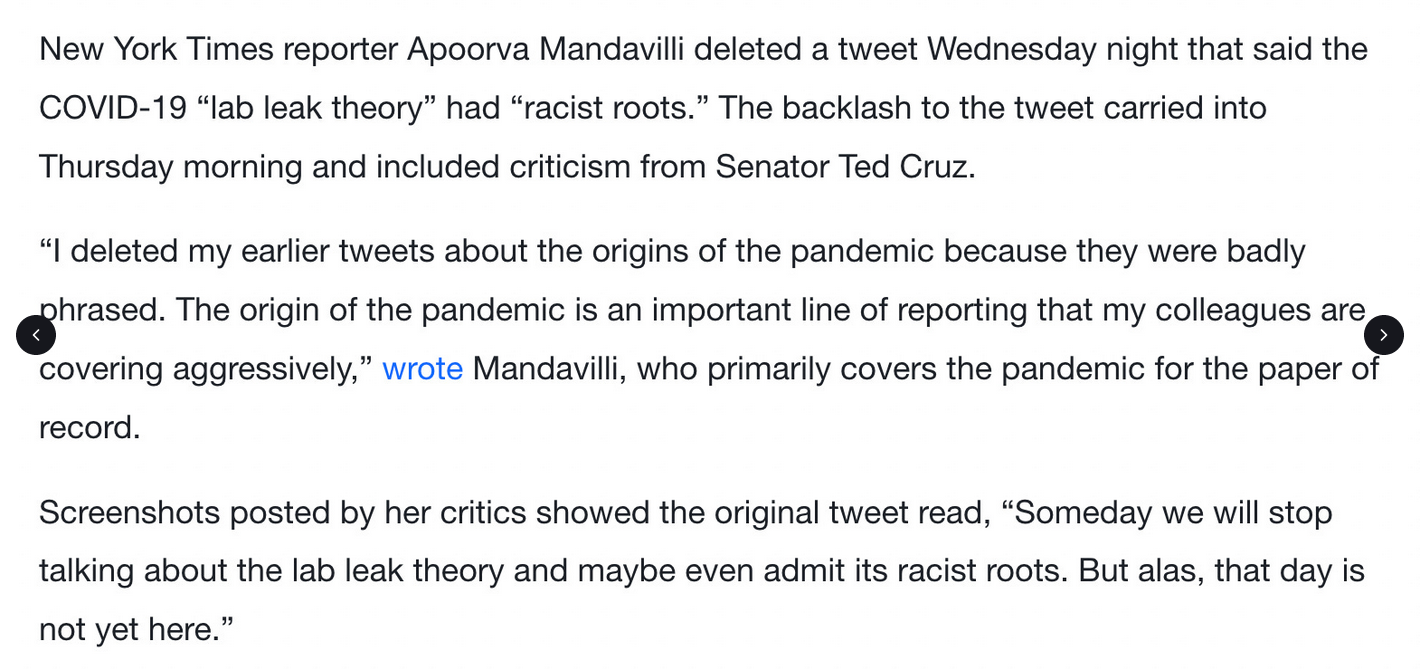
Now: In 2021, the lab leak theory was a disgusting lie with “racist roots”.
In June of 2023, the, uh, first people who got sick with Covid turn out to have been, uh, scientists at the lab in Wuhan. BUT THEY PROBABLY HAD SOME BAT SOUP AT THE WET MARKET, IS WHY, or something.
Stupid conspiracy theorists, you people are such MORONS, do you actually bel— okay, that one’s true too.
We’ve somehow developed an industry of professional information barriers, dimwitted parasitical human garbage whose sole function in life is to prevent understanding by pasting “disinformation” stickers on things that you’re not supposed to know.

June 18, 2023
Titanic Clash Looms In Pacific – WW2 – Week 251 – June 17, 1944
World War Two
Published 17 Jun 2023Japanese and American navies are heading for a showdown in the Philippine Sea, even as American forces land on Saipan in the Marianas in force. The Japanese have Changsha under siege in China, the Allies advance in both Normandy and Italy, the Soviets advance in Finland, and the massive Soviet summer operation is coming together and will begin in a matter of days.
(more…)
June 17, 2023
China’s long-term revenge for the Opium Wars
In Quillette, Aaron Sarin discusses what he calls the “Reverse Opium War” with Chinese drugs flooding the US street drug culture:
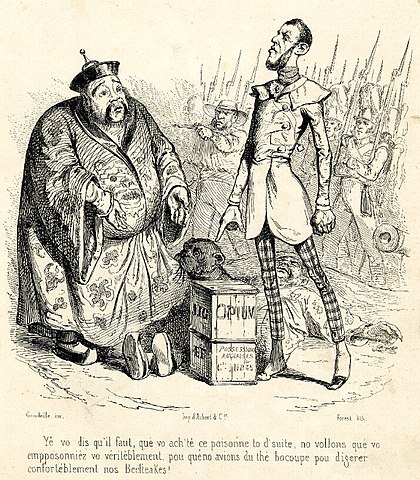
Jean-Jacques Grandville cartoon originally published in Charivari in 1840. “I tell you to immediately buy the gift here. We want you to poison yourself completely, because we need a lot of tea in order to digest our beefsteaks.”
Image and translated caption from Wikimedia Commons.
An epidemic is stalking American cities. Every day, men and women die on sidewalks, in bus shelters, on park benches. Some die sprawled in crowded plazas at midday; others die slumped in the corners of lonely gas station bathrooms. Internally, however, the circumstances are the same. They all end their lives swimming in the warm amniotic dream of a lethally dangerous opioid. When it comes, the moment of death is imperceptible: coaxed by the drug further and further from shore, the user simply floats out too far, passing some unmarked point of no return. The heartbeat weakens, the breathing slows and shallows. As soft an end as anyone might wish for.
This is the fentanyl crisis. It may seem strange to connect a very modern and very American phenomenon to a brace of wars waged 200 years ago by the British Empire on the last of the Chinese dynasties. But so the rhetoric runs: we are witnessing a Reverse Opium War; a belated Sinic revenge.
The Communist Party teaches schoolchildren that China was once a glorious superpower, until it was brought low by that subtlest and most devious of British weapons: Lachryma papaveris (poppy tears). Opium sapped the nation’s strength, and when the Chinese authorities banned it, then Britain went to war — twice.
Those wars crippled the Qing and heralded a “century of humiliation” for China — multiple military defeats and lopsided treaties, the Anglo-French looting and burning of the Emperor’s Summer Palace, the Japanese Rape of Nanking and lethal human experimentation by Unit 731 — ending only with the liberating forces of Marxism-Leninism in 1949. Now some commentators are telling us that history has inverted, that karma has kicked in.
Before examining this idea, we should remind ourselves of the American predicament. Ten years ago, fentanyl began its steady flow from China to the United States. Within just three years the drug had surpassed heroin to become the most frequent cause of American overdose deaths. Fentanyl is many times more powerful than heroin, and so there should be no surprise that lethality has spiked since the great Chinese flow began: in 2012, heroin topped the list with 6,155 deaths; by 2016, fentanyl was proving three times as deadly, with 18,335 deaths. The opioid’s influence seeps into all corners of the narcotics market, due to dealers hiding it in cocaine, heroin, and ecstasy. And it leaks across social strata, killing the homeless but also the rock star Prince, who passed away in an elevator at his Paisley Park estate after ingesting fentanyl disguised as Vicodin.
Under American pressure, the Chinese authorities agreed to regulate fentanyl analogs and two fentanyl precursor chemicals, but it soon turned out that shipments were being rerouted via Mexico. With this new arrangement, the crisis only deepened: between 2019 and 2021, the opioid killed 200 Americans a day. Last year alone, the DEA seized quantities of the drug equivalent to 410 million lethal doses. That’s enough to kill everyone in the US. Even a pandemic couldn’t stem the flow for long: in fact, Wuhan is one of the world’s most reliable suppliers of fentanyl precursors (a role it played both before and after starring at the eye of the COVID storm).
The booming fentanyl trade does not appear to rely on traditional criminal organisations, in the way that East Asian methamphetamine trafficking depends on the Triads. Instead, it turns out to be small family-based groups and legitimate businesses who manufacture and move the drug. Usually located on China’s south-eastern seaboard — Zhejiang, Fujian, Guangdong — these groups use the cover of the vast Chinese chemical industry to channel ingredients into the manufacture of fentanyl-class drugs and their precursors.
June 16, 2023
Friday Foundlings
A few items that I didn’t feel required a full post of their own, but might be of interest:
- “Lunch of suffering”: plain “white people food” goes viral in China
- From a review of Njal’s Saga – “There are only about 40,000 people in medieval Iceland. The book focuses on the Southwest Quarter, so let’s say 10,000 there. Each of our characters is a large landowning farmer with many children, servants, tenants, etc; if he is patriarch of a 20 person household, then there must be about 500 such patriarchs. Each of these 500 relevant Icelanders is profiled in loving depth. And if there are 500 characters in Njal’s Saga, and n people can have n(n-1)/2 possible two-person feuds, that’s 124,750 possible feuds. Of these, about 124,749 actually take place over the course of the saga (Njal and his friend Gunnar are best buds, and refuse to feud for any reason).”
- The Canadian government continues to rack up the internet regulation wins – “The fallout from Bill C-11 has been the subject of several posts this week, including the demands from a wide range of services for exceptions to the law and warnings from streaming services such as PBS and AMC that they may block the Canadian market due to the regulatory burden imposed by the law. While those stories focus on the availability of services and content in Canada, a new Variety report points to another negative impact from the bill: less film and television production in Canada, at least in the short term. Throughout the Bill C-11 debate, there were concerns that the large streamers might pause their productions in Canada given the uncertainty over whether they would ‘count’ for the purposes of new CRTC imposed contribution requirements. In other words, the bill could initially lead to less investment in Canada.”
- Random meme of the day: