I have been reading the recent biography of the British CIGS Alanbrooke, and been struck by the clear and concise explanation of the differences between the British and Americans over the “second front” in Europe, and when it could be.
[…]
A plan put together for the incredibly unlikely event of sudden German collapse, was Sledgehammer. This was the understanding of Sledgehammer adopted by most Americans. A very limited offensive by very inadequate forces, which could only succeed had Germany already gone close to collapse. Given the circumstances this was somewhat delusional, but it never hurts to plan for eventualities, and the British were happy to go along with this sort of plan.
[…]
Any attempt at Sledgehammer would of course have failed. The German army had not yet been bled dry on the Eastern front, and the Luftwaffe was still a terrifying force which could be (and regularly was) easily moved from Russian mud to Mediterranean sunshine and back again in mere weeks. Even ignoring the opposition, the British were gloomily aware that the Americans had not a clue of the complexities of such a huge amphibious operation. At the time of discussion – May 1942 – the British were using their first ever Landing Ship Tanks and troopships equipped with landing craft to launch a brigade-size pre-emptive operation against the Vichy French on Madagascar. (Another move many historians think was useless. But coming only months after the Vichy had invited the Japanese into Indo-China – fatally undermining the defenses of Malaya – and the Germans into Syria, it was probably a very sensible precaution. Certainly Japanese submarines based in Madagascar [could] have finally caused the allies to lose the war at sea!)
The British deployed two modern aircraft carriers, and a fleet of battleships, cruisers, destroyers and escorts and a large number of support ships, on this relatively small operation. It was the first proper combined arms amphibious operation of the war, and was very helpful to the British to reveal the scale of amphibious transport needed for future operations. By contrast the US Marines hit Guadalcanal six months later from similar light landing craft, and with virtually the same Great War-vintage helmets and guns that the ANZACS had used at Gallipoli. Anyone who reads the details of the months of hanging on by the fingernails at Guadalcanal against very under-resourced Japanese troops, will be very grateful that the same troops did not have to face veteran German Panzer divisions for several years.
So I do not know of any serious historian who imagines that an invasion of France in 1942 could have led to anything except disaster. There are no serious generals who thought it either. (Only Marshall and his “yes-man” Eisenhower consistently argued that it might be possible. And Eisenhower later came to realise – when he was in charge of his third or fourth such difficult operation – that his boss was completely delusional in his underestimation of the difficulties involved. See Dear General: Eisenhower’s Wartime Letters to Marshall for Eisenhower’s belated attempts to quash Marshalls tactical ignorance about parachute drops and dispersed landings for D-Day.)
In practice no matter how much Marshall pushed for it, only British troops were availabe for such a sacrificial gesture, and the British were not unnaturally reluctant to throw away a dozen carefully nurtured and irreplaceable divisions on a “forlorn hope”, when they would prefer to save them for a real and practical invasion … when circumstances changed enough to make it possible.
Unfortunately Roosevelt told the Soviet foreign minister Molotov that “we expect the formation of a second front this year”, without asking even Marshall, let alone wihtout consulting his British allies who would have to do it with virtually no American involvement. The British Chiefs of Staff only had to show Churchill the limited numbers of landing craft that could be available, and the limited number of troops and tanks they could carry, to make it clear that this was ridiculous. Clearly this stupidity was just another example of Roosevelt saying stupid things without asking anyone (like “unconditional surrender”) that did so much to embitter staff relations during the war, and internationaly relations postwar. But it seems likely that the British refusal to even consider such nonsense was taken by Marshall and Stimson as a sample of the British being duplicitous about “examining planning options”.
The British fixed on a “compromise” to pretend that a “second front” could be possible. North Africa, could be conquered without prohibitive losses. It was not ideal, and in practical terms not even very useful. But it might satisfy the Americans and the Russians. Nothing else could.
Marshall in particular spent the rest of the war believing that when the British assessment clearly demonstrated that action in Europe was impractical and impossible, they had just been prevaricating to get what they always intended: operations in the Med. In some ways he was correct. The British had done the studies on France despite thinking that it was unlikely they would be practical, and were proved right. Marshall and Eisenhower had just deluded themselves into thinking an invasion might be practical, and could not accept that there was not a shred of evidence in favour of their delusion.
Nigel Davies, “The ‘Invasion of France in 1943’ lunacy”, rethinking history, 2021-06-21.
June 6, 2023
QotD: “A second front” in 1942
June 4, 2023
The Allies are Driving for Rome – WW2 – Week 249 – June 3, 1944
World War Two
Published 3 Jun 2023The Allies head north in Italy after the fall of Monte Cassino last week; the Japanese head south in China in a new phase of their offensive; and the Soviets and the Western Allies make ever more concrete plans for their huge offensives, to go off very soon.
(more…)
June 2, 2023
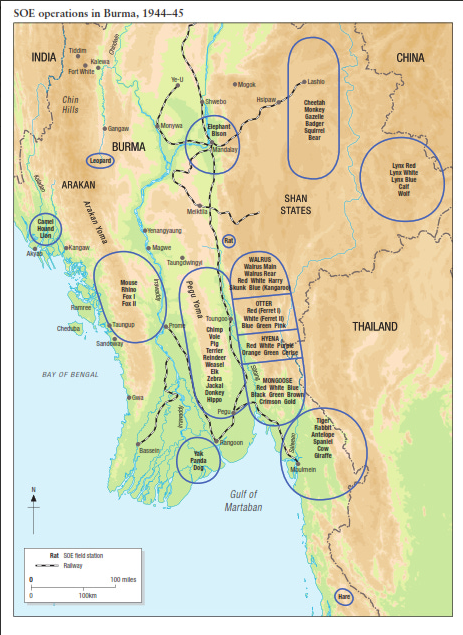
“Montgomery was a military talent; Slim was a military genius”
Dr. Robert Lyman is a known fan of Field Marshal Slim (as am I, for the record), not only for his brilliant military achievements, but also as a writer:

Field Marshal Sir William Slim (1891-1970), during his time as GOC XIVth Army.
Portrait by No. 9 Army Film & Photographic Unit via Wikimedia Commons.
How many British generals have been able to write as well as they could fight? Strangely perhaps, quite a few. Field Marshal Sir Michael Carver (Dilemmas of the Desert War, The Seven Ages of the British Army), General Sir David Fraser (And We Shall Shock Them), General Sir John Hackett (The Third World War) and Major General John Strawson (Beggars in Red) are four outstanding soldier-writers that spring immediately to mind. Even Monty wrote his memoirs. And in our own day I’ve read plenty of competent books from a slew of men who’ve reached the top of the profession of arms. The work of some, like that of General Sir Richard Sherriff (2017: War with Russia), Major General Mungo Melvin (Manstein) and Brigadier Allan Mallinson (Too Important for the Generals et al), could be described as outstanding. Julian Thompson and Richard Dannatt also fit this bill. But by far and away the best of Britain’s soldier-writers in the last century was also probably the greatest soldier – and field commander – of them all: Bill Slim. He was, more properly, Field Marshal William J. Slim KG, GCB, GCMG, GCVO, GBE, DSO, MC, KStJ, the onetime General Officer Commanding the famous 14th Army – the so-called Forgotten Army – of Burma fame. He was, in this author’s view, the greatest British general of the last war (to avoid further debate, let’s just agree that Monty failed as a coalition commander, whereas Slim excelled). Slim’s ability as a general is perfectly summed up by the historian Frank McLynn:
Slim’s encirclement of the Japanese on the Irrawaddy deserves to rank with the great military achievements of all time – Alexander at Gaugamela in 331 BC, Hannibal at Cannae (216 BC), Julius Caesar at Alesia (58 BC), the Mongol general Subudei at Mohi (1241) or Napoleon at Austerlitz (1805). The often made – but actually ludicrous – comparison between Montgomery and Slim is relevant here … there is no Montgomery equivalent of the Irrawaddy campaign … Montgomery was a military talent; Slim was a military genius.1
Some hint of Bill Slim’s fluency with the written word to complement his ability as a soldier came with the publication of Defeat into Victory in 1956, his superb retelling of the Burma story. Apart from its remarkable tale – the humiliation of British Arms in 1942 eventually overturned by a triumphant (and largely Indian) army in 1945 (87% of Slim’s army was Indian) – the quality of the writing was astonishing. Its author, a man who would be appointed Chief of the Imperial General Staff in 1949 (following Monty), the first Sepoy General ever to do so, and by Attlee no less, could clearly wield a pen every bit as he could destroy Japanese armies in battle (a feat he achieved twice, first in 1944 and again in 1945). When the book was first published it was an instant publishing sensation with the first edition of 20,000 selling out immediately. The Field recorded: “Of all the world’s greatest records of war and military adventure, this story must surely take its place among the greatest. It is told with a wealth of human understanding, a gift of vivid description, and a revelation of the indomitable spirit of the fighting man that can seldom have been equalled – let alone surpassed – in military history.” The London Evening Standard was as effusive in its praise: “He has written the best general’s book of World War II. Nobody who reads his account of the war, meticulously honest yet deeply moving, will doubt that here is a soldier of stature and a man among men.” The author John Masters, who served in the 14th Army, wrote in the New York Times on 19 November 1961 that it was “a dramatic story with one principal character and several hundred subordinate characters”, arguing that Slim was “an expert soldier and an expert writer”. The book remains a best seller today.
The following year Slim also published an anthology of speeches and lectures, loosely based on the theme of leadership, called Courage and Other Broadcasts. Then in 1959 he published his second book, Unofficial History, which bears out in full Masters’ description of Slim as a superb writer. It was a deeply personal, honest though light hearted account of events during his service. It received widespread acclaim. The author John Connell described it as “for the most part uproarious fun. If Bill Slim hadn’t been a first-rate soldier, what a short story writer he might have made.” For its part, The National Review wrote: “One of the most significant aspects of Field Marshal Slim’s book is the affectionate respect he shows when he writes about British and Indian soldiers. He finds plenty to amuse him too. I doubt whether a kindlier or truer description of the contemporary soldier has been given anywhere than in Unofficial History … It is one of the most delightful and amusing books about modern campaigning I have ever read.”
1. The General Wondered Why https://amzn.eu/d/45gHfOH
June 1, 2023
Recent discoveries in ancient DNA
The Psmiths, John and Jane, decided to jointly review a book by David Reich called Who We Are and How We Got Here: Ancient DNA and the New Science of the Human Past. This is Jane’s first contribution to an extended email thread between the Psmiths:
The problem with history is that there just isn’t enough of it. We’ve been around for, what, fifty thousand years? Conservatively.1 And we’ve barely written things down for a tenth of that. Archaeological excavation can take you a little farther back, but as the archaeologists always like to remind us, pots are not people. If you get lucky with a society that made things out of durable materials in a cold and/or dry environment (or you get very lucky with anaerobic preservation of organic materials, like in ice or bogs), maybe you can trace a material culture’s expansion and contraction across time and space. But that won’t tell you whether it’s a function of people moving and taking their stuff with them, or people’s neighbors going “ooh, using string to make patterns on your pots, that’s cool” and copying it. It certainly doesn’t tell you what their descendants were doing several thousand years later, potentially in an entirely different place and probably using an entirely different suite of technologies. Trying to understand what happened in the human past based on the historical and archaeological records is like walking into a room where a bomb has gone off and trying to reconstruct the locations of all the objects before the explosion. You can get some idea, but it’s all very broad strokes. And actually it’s worse than that, because it wasn’t just one explosion, it was lots, and we wouldn’t even know how many if we didn’t have a way of winding the clock back. But these days we do, and it’s ancient DNA.
Sometime between when my grandfather gave me a copy of Luca Cavalli-Sforza’s Genes, Peoples, and Languages for my birthday and when you and I decided to read Reich’s book together, two big things happened: humans got really, really good at sequencing and reading genomes, and Svante Pääbo’s lab in Leipzig got really, really good at extracting DNA from ancient bones. (How they developed their procedures is actually a really interesting story, which Pääbo retells in his book, but Reich — whose lab uses the same techniques on an industrial scale — gives a good, brief summary of how it works.) Together, these two advances unlocked … well, not quite everything about the deep past, but an absolutely enormous amount. Suddenly we can track the people, not just the pots, and the story is more complicated and fascinating than anything we might have expected. I’ve written elsewhere about some of the aDNA discoveries about human evolution (Neanderthal admixture, the Denisovans, etc.), but I’m even more excited about what ancient DNA reveals about our more recent past. Luckily, that’s what Reich spends most of the book on, with discussion of ancient ghost populations who now exist only in admixture and then chapters on the specific population genetic histories of Europe, India, North America, East Asia, and Africa, each of which contains some discoveries that would make (at least the more sensible) archaeologists and historical linguists go “well, duh” and others that are real surprises.
One of the “duh” stories is the final, conclusive identification of the people who brought horses, wagons, and Indo-European languages to Europe with the Yamnaya culture of the Pontic Steppe and their descendants. (David Anthony gives a very good overview of the archaeological case for this in The Wheel, the Horse, and Language, including some very cool experimental archaeology about horse teeth; you have my permission to skim the sections on pots.) My favorite surprising result, though, comes from a little farther north. People usually assume that Native Americans and East Asians share a common ancestor who split from the ancestors of Europeans and Africans before dividing into those two populations, but when Reich’s lab was trying to test the idea they found, to their surprise, that in places where Northern European genomes differ from Africans’, they are closer to Native Americans than to East Asians. Then, using a different set of statistical techniques, they found that Northern European populations were the product of mixture between two groups, one very similar to Sardinians (who are themselves almost-unmixed descendants of the first European farmers) and one that is most similar to Native Americans. They theorized a “ghost” population, which they called the “Ancient North Eurasians”, who had contributed DNA both to the population that would eventually cross the Bering land bridge and to the non-Early European Farmer ancestors of modern Northern Europeans. Several years later, another team sequenced the genome of a boy who died in Siberia 24kya and who was a perfect match for that theorized ghost ANE population.
But we’ve already established that I’m the prehistory nerd in this family; were you as jazzed as I was to read about the discovery of the Ancient North Eurasians?
1. That’s the latest plausible date for the arrival of full “behavioral modernity” in Africa, though our genus goes back about two million years, tool use probably three million, and I think there’s a good case that Homo was meaningfully “us” by 500kya. (That’s “thousand years ago” in “I talk about deep history so much I need an acronym”, fyi.)
May 28, 2023
Breakout from Anzio! – WW2 – Week 248 – May 27, 1944
World War Two
Published 27 May 2023After four months, the Allies breakout from their bridgehead at Anzio and meet with the advancing troops heading north after the fall of Monte Cassino last week. The Japanese begin phase two of their big operation in China, and both the Soviets and the Western Allies continue making plans for their massive June offensives to squeeze the Axis from both sides of Europe.
(more…)
May 27, 2023
“David Johnston is an honourable man”
From this heading, you might be a bit reminded of Mark Antony’s funeral oration for Caesar, as imagined by William Shakespeare (well, I was, so you’ll have to suffer a few lines of iambic pentameter):
Friends, Romans, countrymen, lend me your ears;
I come to bury Caesar, not to praise him.
The evil that men do lives after them;
The good is oft interred with their bones;
So let it be with Caesar. The noble Brutus
Hath told you Caesar was ambitious:
If it were so, it was a grievous fault,
And grievously hath Caesar answer’d it.Here, under leave of Brutus and the rest–
For Brutus is an honourable man;
So are they all, all honourable men–
Come I to speak in Caesar’s funeral.
He was my friend, faithful and just to me:
But Brutus says he was ambitious;
And Brutus is an honourable man.He hath brought many captives home to Rome
Whose ransoms did the general coffers fill:
Did this in Caesar seem ambitious?
When that the poor have cried, Caesar hath wept:
Ambition should be made of sterner stuff:
Yet Brutus says he was ambitious;
And Brutus is an honourable man.
Perhaps I’m reading too much into the opening line of Philippe Lagassé’s article about former Governor General David Johnston’s role in whitewashing the Trudeau running dogs, however:
David Johnston is an honourable man. As a former governor general, he holds the title of Right Honourable and he wears it better than many former prime ministers who share that moniker. Johnston is also a champion of trust in democratic institutions; he literally wrote a book called Trust: Twenty Ways to Build a Better Country.
Although his appointment has been plagued by questions about his perceived conflicts of interest, it’s hard to accept that Johnston set out to protect the Liberal party. Whether one agrees with him or not, Johnston’s conclusions were arrived at sincerely and in keeping with his view that “Democracy is built on trust.” Unfortunately, his recommendation against a public inquiry is not only bewildering from a political perspective, but could erode the very trust in democracy that he wants to strengthen.
Whatever we think about Johnston’s first report, we should be concerned with his appointment as the special rapporteur. Aside from the perceived conflicts of interest, we should ask why a former governor general accepted the role in the first place. Serving as a vice-regal representative should be the last public role an individual performs. Any other public duty performed by a former governor general or lieutenant governor, however well-intentioned and performed, carries risks that can diminish these offices. Johnston’s experience is a cautionary tale for future vice-regals.
The governor general is the second-highest office of the Canadian state, under the monarch alone. The King’s representative performs most of the Crown’s head of state functions in Canada, both constitutional and ceremonial. Official independence and non-partisanship are essential parts of the head of state function. Canadians should be able to trust (there’s that word again) that governors general will be impartial in the exercise of their constitutional powers. We need only look at the 2008 prorogation controversy and the 2017 election in British Columbia to see why this matters for Canadian democracy.
Although less vital, independence and non-partisanship are also important for the governor general’s ceremonial roles. Having the governor general bestow honours ensures that Canadians are recognized by a neutral, but high-standing, representative of the state. An ardent Conservative can receive the Order of Canada while a Liberal government is in power without wincing, since the prime minister and cabinet are kept at a safe distance from the whole thing.
[…]
Former vice-regal representatives should take heed. They would do well to avoid becoming a new set of “retired Supreme Court justices”, whose judicial halo effect has become comically overused to stem political controversy. Indeed, Canadians should insist that the governor general’s salary and annuity come with a tacit bargain: you were set for life to ensure your impartiality and independence, now we never want to hear you wading into political controversies or see you hold another public office again.
This should not be too much to ask of the King’s representatives. No other public role has the formal role stature of a vice-regal office, aside from the monarch, and none are as carefully insulated from partisan battles. The office of governor general should be held by those at the end of a remarkable career, as a final act of independent and impartial public service.
Also in The Line, Mitch Heimpel seems to be a bit less willing to tolerate the use of a former Governor General as ablative shielding for a compromised government:
In the end, David Johnston proved himself to be exactly what his critics argued he always was.
A fervent defender of his advantaged status quo. Another among the thoroughly compromised set of politicians, senior civil servants and academics who have, over the decades when it comes to Canadian foreign policy regarding China, taken the money and run. The idea that he was ever going to be anything else was a figment of our own collective fantasy.
We believed we were a serious country. David Johnston has laughed in our faces at the very thought.
The families of members of Parliament have been targeted for possible “sanctions”? No matter.
Our elections are the subject of coordinated foreign intelligence operations? Well, sure. But what is democracy really?
Really, you see, Johnston told us — without ever being quite so direct about it, because people of Johnston’s polite air are rarely so crass — the media was your problem. They published things without the appropriate “context.”
Choosing Johnston was always a bit grubby. It was meant to politically neuter Conservatives because, after all, Stephen Harper appointed him to be the governor general. How could he possibly be compromised? Yes, he’s known the prime minister whose government he was investigating since Justin Trudeau was a small child. And, yes, as a university president, he was long an advocate for more open relations with China. And, yes, he involved with the Trudeau Foundation, which has found itself at the heart of the question of foreign interference coordinated by the Chinese Communist Party, but …
No, there is no “but”.
There is no other democracy which would have successfully conducted an elaborate farce of this magnitude to tell its citizens what it is painfully obvious that it wanted to tell them all along: You have no right to know.
QotD: The war elephant’s primary weapon was psychological, not physical
The Battle of the Hydaspes (326 BC), which I’ve discussed here is instructive. Porus’ army deployed elephants against Alexander’s infantry – what is useful to note here is that Alexander’s high quality infantry has minimal experience fighting elephants and no special tactics for them. Alexander’s troops remained in close formation (in the Macedonian sarissa phalanx, with supporting light troops) and advanced into the elephant charge (Arr. Anab. 5.17.3) – this is, as we’ll see next time, hardly the right way to fight elephants. And yet – the Macedonian phalanx holds together and triumphs, eventually driving the elephants back into Porus’ infantry (Arr. Anab. 5.17.6-7).
So it is possible – even without special anti-elephant weapons or tactics – for very high quality infantry (and we should be clear about this: Alexander’s phalanx was as battle hardened as troops come) to resist the charge of elephants. Nevertheless, the terror element of the onrush of elephants must be stressed: if being charged by a horse is scary, being charged by a 9ft tall, 4-ton war beast must be truly terrifying.
Yet – in the Mediterranean at least – stories of elephants smashing infantry lines through the pure terror of their onset are actually rare. This point is often obscured by modern treatments of some of the key Romans vs. Elephants battles (Heraclea, Bagradas, etc), which often describe elephants crashing through Roman lines when, in fact, the ancient sources offer a somewhat more careful picture. It also tends to get lost on video-games where the key use of elephants is to rout enemy units through some “terror” ability (as in Rome II: Total War) or to actually massacre the entire force (as in Age of Empires).
At Bagradas (255 B.C. – a rare Carthaginian victory on land in the First Punic War), for instance, Polybius (Plb. 1.34) is clear that the onset of the elephants does not break the Roman lines – if for no other reason than the Romans were ordered quite deep (read: the usual triple Roman infantry line). Instead, the elephants disorder the Roman line. In the spaces between the elephants, the Romans slipped through, but encountered a Carthaginian phalanx still in good order advancing a safe distance behind the elephants and were cut down by the infantry, while those caught in front of the elephants were encircled and routed by the Carthaginian cavalry. What the elephants accomplished was throwing out the Roman fighting formation, leaving the Roman infantry confused and vulnerable to the other arms of the Carthaginian army.
So the value of elephants is less in the shock of their charge as in the disorder that they promote among infantry. As we’ve discussed elsewhere, heavy infantry rely on dense formations to be effective. Elephants, as a weapon-system, break up that formation, forcing infantry to scatter out of the way or separating supporting units, thus rendering the infantry vulnerable. The charge of elephants doesn’t wipe out the infantry, but it renders them vulnerable to other forces – supporting infantry, cavalry – which do.
Elephants could also be used as area denial weapons. One reading of the (admittedly somewhat poor) evidence suggests that this is how Pyrrhus of Epirus used his elephants – to great effect – against the Romans. It is sometimes argued that Pyrrhus essentially created an “articulated phalanx” using lighter infantry and elephants to cover gaps – effectively joints – in his main heavy pike phalanx line. This allowed his phalanx – normally a relatively inflexible formation – to pivot.
This area denial effect was far stronger with cavalry because of how elephants interact with horses. Horses in general – especially horses unfamiliar with elephants – are terrified of the creatures and will generally refuse to go near them. Thus at Ipsus (301 B.C.; Plut. Demetrius 29.3), Demetrius’ Macedonian cavalry is cut off from the battle by Seleucus’ elephants, essentially walled off by the refusal of the horses to advance. This effect can resolved for horses familiarized with elephants prior to battle (something Caesar did prior to the Battle of Thapsus, 46 B.C.), but the concern seems never to totally go away. I don’t think I fully endorse Peter Connolly’s judgment in Greece and Rome At War (1981) that Hellenistic armies (read: post-Alexander armies) used elephants “almost exclusively” for this purpose (elephants often seem positioned against infantry in Hellenistic battle orders), but spoiling enemy cavalry attacks this way was a core use of elephants, if not the primary one.
Bret Devereaux, “Collections: War Elephants, Part I: Battle Pachyderms”, A Collection of Unmitigated Pedantry, 2019-07-26.
May 23, 2023
Mustard: A Spicy History
The History Guy: History Deserves to be Remembered
Published 15 Feb 2023In 2018 The Atlantic observed “For some Americans, a trip to the ballpark isn’t complete without the bright-yellow squiggle of French’s mustard atop a hot dog … Yet few realize that this condiment has been equally essential — maybe more so — for the past 6,000 years.”
(more…)
May 21, 2023
The Fall of Monte Cassino – WW2 – Week 247 – May 20, 1944
World War Two
Published 20 May 2023In Italy, the Allies finally overcome Monte Cassino and break through the Gustav Line; in Burma Merrill’s Marauders surprise the Japanese and take Myitkyina Airfield; in China, it’s the Japanese who are playing offense, as Operation Ichi Go and the siege of Luoyang continue. That’s the field action, but there’s big planning behind the scenes for major June offensives going on by both the Western Allies and the Soviets.
(more…)
May 19, 2023
QotD: The horses of the Eurasian Steppe
The horse is native to the Eurasian Steppe – that is where it evolved and was first domesticated, though the earliest domesticated wild horses were much smaller and weaker (but more robust and self-sufficient) than modern horses. The horse was first domesticated here, on the Eurasian Steppe, by the nomadic peoples there around 3,700 BCE. It seems likely that the nomads of the steppe were riding these horses more or less from the get-go (based on bridle and bit wear patterns on horse bones), but the domesticated horse first shows up in the settled Near East as chariotry (rather than cavalry) around 2000 BCE; true cavalry won’t become prominent in the agrarian world until after the Late Bronze Age Collapse (c. 1200 BCE).
I wanted to start by stressing these dates just to note that the peoples of the Eurasian Steppe had a long time to adapt themselves to a nomadic lifestyle structured around horses and pastoralism, which, as we’ve seen, was not the case for the peoples of the Americas, whose development of a sustainable system of horse nomadism was violently disrupted.
That said, the steppe horse (perhaps more correctly, the steppe pony) is not quite the same as modern domesticated horses. The sorts of horses that occupy stables in Europe or America are the product of centuries of selective breeding for larger and stronger horses. Because those horses were stable fed (that is, fed grains and hay, in addition to grass), they could be bred much larger what a horse fed entirely on grass could support (with the irony that many of those breeds of horses, if released into the wild in their native steppe, would be unable to subsist themselves), because processed grains have much higher nutrition and calorie density than grass. So while most modern horses range between c. 145-180cm tall, the horses of the steppe were substantially smaller, 122-142cm. Again, just to be clear, this is essential because the big chargers and work-horses of the agrarian world cannot sustain themselves purely on grass and the Steppe nomad needs a horse which can feed itself (while we’re on horse-size, mustangs, the feral horses of the Americas, generally occupy the low-end of the horse range as well, typically 142-152cm in height – even when it is clear that their domesticated ancestors were breeds of much larger work horses).
Bret Devereaux, “That Dothraki Horde, Part II: Subsistence on the Hoof”, A Collection of Unmitigated Pedantry, 2020-12-11.
May 14, 2023
Victory at Sevastopol! – WW2 – Week 246 – May 13, 1944
World War Two
Published 13 May 2023The Soviets push the Axis out of the Crimea this week once and for all. In Italy, the Allies launch a major offensive, and the French make a breakthrough there by week’s end. In China, the Japanese are aiming at Luoyang, but in India at Kohima they’re slowly being pushed back.
(more…)
May 7, 2023
The Line reports on “a Liberal policy convention in Fantasia”
It used to be said that the marketing department in any given organization was where the rubber met the sky (three drink minimum), but the Liberal convention in Barad-dûr-by-the-Rideau now owns that territory:
Once upon a time, Canada was led by a serious man named Pierre Elliot Trudeau. No matter what you think of his tenure as prime minister, there is no question that he took the job, and the country, seriously. Today his offspring, both biological and ideological, prance around the Canadian political landscape, smug and entitled and all the rest of it. But none of them has the foggiest idea of what they are doing with with the power they inherited, or why, or for what purpose.
[…]
For the evening entertainment on Friday, they brought out Jean Chrétien — another fantastically unserious person — to do his usual petit gars de Shawinigan routine. And did the old coot ever deliver, bragging yet again about keeping Canada out of Iraq, jabbing at Pierre Poilievre, and joking that he expects The Globe and Mail to call for a royal commission into Hillary Clinton showing up at the Liberal convention and interfering in Canadian elections.
Oh, our sides. They split. No matter that two days ago was World Press Freedom day. No matter that Friday also happened to be NNA night, where the Globe and Mail won nine awards. This is the Liberal convention after all, where one of the main policy proposals up for debate is a suggestion from the B.C. Liberals to essentially nationalise the news. Why not aim a few kicks at the media. The Liberals are paying for it anyway, aren’t they?
In his speech, Chrétien played to the latest Liberal idée fixe, which is that all of the party’s troubles since 2018 — from SNC Lavalin to WEgate to the egregious handling of Chinese interference — are all due to the clickbait chasing yellow journalists at the failing Globe and Mail.
For those of you who weren’t lucky enough to live through the nineties, Chrétien is the Liberal prime minister who brought you such hits as “what me worry?” about a Quebec referendum on secession; a joke about his PMO ordering the RCMP to pepper spray UBC students protesting his decision to invite a brutal dictator to dinner on their campus; and the Shawinigate and Adscam scandals, both of which are still routinely taught and referenced as case studies in ruling party greaseballery at its most unctuous.
But Liberals be Liberals. As National Post columnist Chris Selley noted: “This is deadly serious shit and this buffoon is playing it for laughs, just like [he] always played deadly serious shit.”
The “deadly serious shit” Selley had in mind is surely the river of scandal coursing through the Liberal Party in Ottawa over Chinese interference in Canadian politics, with tributaries flowing in from riding associations across the country, the Trudeau Foundation in Montreal, and numerous other parts of the Canadian political landscape. On Monday, the Globe and Mail reported on a CSIS analysis from 2021 which alleged that the family of Conservative MP Michael Chong was targeted by China’s security apparatus for unknown sanctions, in response to Chong’s sponsorship of a House of Commons motion calling China’s persecution of the Uighurs a genocide.
On Tuesday an understandably alarmed Chong was given an emergency briefing about the threat by CSIS director David Vigneault, in a meeting arranged by the prime minister.
This isn’t just about Michael Chong. Every member of parliament, every member of the government, should be up in arms over this. The Chinese diplomat in Canada involved, Zhao Wei, should have been sent home immediately, but Melanie Joly is still weighing the pros and cons.
As appalling as the targeting of Chong is in its own right, more scandalous still is the government’s response — equal parts utterly incompetent, unbelievably shady, and shamelessly partisan.
The scandal begins with the fact that Chong himself was never told about the CSIS report. Why is that? On Wednesday, the prime minister claimed it was because the threat identified in the CSIS report wasn’t deemed serious enough by the intelligence agency, so it never circulated outside of the agency. The first Trudeau had heard of this, apparently, was when he read about it in the newspaper.
But on Thursday, Michael Chong told the House of Commons that he’d been told, in a call from Trudeau’s current national security advisor Jody Thomas, that the report had actually made its way to the desk of one of her predecessors. When Trudeau was asked to explain this apparent contradiction on Friday, he said: “In terms of what I shared, I shared the best information I had at the time on Wednesday, both to Mr. Chong and to Canadians.” When asked who had given him this information, Trudeau declined to answer.
Look, we’ve seen this game before, countless times, with this government and this prime minister. Trudeau’s habit of responding to allegations of wrongdoing or incompetence or mismanagement by first denying any knowledge of the issue, then discrediting the source, and finally throwing unidentified third parties under the bus, is a well trod path for this deeply unserious man.
Given the pattern, we’re pretty skeptical of Trudeau’s claim that he’d been given incomplete information. Honestly, it wouldn’t surprise us in the slightest if it turns out that he just made the whole thing up.
Total Chaos on the Chinese Front! – WW2 – Week 245 – May 6, 1944
World War Two
Published 6 May 2023A command crisis in the Chinese Nationalist Army benefits the Japanese invaders, in Italy, Mark Clark spends his birthday planning new offensives, the Japanese are pushing for Imphal, and the Soviets for Sevastopol — another busy week of the war!
(more…)
May 5, 2023
Alligator Creek: America Learns to Fight the Japanese
Forgotten Weapons
Published 7 Jan 2023The Battle of Alligator Creek (aka Battle of the Tenaru) was a formative moment in the American World War Two psyche. After making an unopposed landing on Guadalcanal and taking its mostly-completed airfield at minimal cost, the US Marines had to defend their permitter on the night of August 21st, 1942.
Colonel Kiyonoa Ichiki was sent from the Japanese base at Truk with about 900 tough veteran soldiers to push the Marines off the airfield. These men had originally been slated to assault Midway Island, but the Japanese naval defeat there forced a change in plans. Ichiki was overconfident, and more concerned about retaking the islands of Tulagi, Gavutu, and Tanambogo across the straights, where Japan’s main base in the area had also been captured by Marine Raiders. Marching up the coastline towards Henderson Field, Ichiki’s men hit the thin single strand of Marine barbed wire about about 1:30am on the morning of there 21st. An intense firefight erupted, with the well dug-in Marine positions opening up with .30 caliber and .50 caliber machine guns, small arms, and 37mm canister rounds.
The fighting continued after daybreak, with Ichiki’s men digging in on the east bank of Alligator Creek. The Marines launched a two prong counterattack, with one force crossing the Creek inland and advancing down the east bank while a second group, including several Stuart light tanks, advanced across the sandbar. These two groups linked up in the early afternoon of the 21st, almost completely annihilating the Ichiki Detachment.
This was the first real land combat between American and Japanese forces in which American soldiers were able to report back on their experience. It was here that the US military as an institution learned that the Japanese would die rather than surrender, and this engagement set the American expectations for the rest of the Pacific campaign.
(more…)
May 1, 2023
Britain’s first embassy to India
In The Critic, C.C. Corn reviews Courting India: England, Mughal India and the Origins of Empire by Nandini Das, a look at the first, halting steps of the East India Company at the court of the Mughal Emperor Jahangir early in the seventeenth century:
The late Sir Christopher Meyer, the closest thing modern British diplomacy has produced to a public figure, enjoyed comparing his trade to prostitution. Both are ancient trades, and neither enjoys a wholly favourable reputation. Any modern diplomat will discreetly confirm that the profession is far from the anodyne, flag-emoji civility and coyly embarrassed glamour they project on Twitter.
Whilst none of our modern representatives are working in quite the same conditions as their predecessor Sir Thomas Roe, they may well find uncanny parallels with his unfortunate mission.
The fledgling and precarious East India Company, founded in 1600, had sent representatives to the Mughal court before, but they were mere merchants and messengers. The stern rebuff they received called for a formal representative of the King.
After the company persuaded James I of the necessity, Thomas Roe (a well-connected MP, friend to John Donne and Ben Jonson, and already an experienced traveller after an attempt to reach the legendary El Dorado) was dispatched to the court of Mughal Emperor Jahangir in 1615. He remained there until 1619, in an embassy that the cultural historian, Nandini Das, describes in Courting India as “infuriatingly unproductive”.
The company kept rigorous records, and Roe meticulously kept a daily diary. Professor Das uses these and the reports of other English travellers to narrate Roe’s journey, as well as contemporary literature and, more importantly, their Indian equivalents. It is not so much the diplomatic success that fascinates Das about Roe’s embassy, but the mindset of the early modern encounter between England and India.
In a boom time for histories of British colonialism, this is an intelligent and gripping book with a thoughtful awareness of human relationships and frailties, and a model approach to early modern cross-cultural encounters.
The privations suffered by Roe’s embassy are striking. Only three in ten people had a chance of coming home alive from the voyage to India. Das’s recreation of the journey out is as intense and claustrophobic as Das Boot, with rotten medicine, cruel maritime punishments and untrained boys acting as surgeons. Dead bodies onboard would have their toes gnawed off by rats within hours.
In India, the English sailors excelled themselves as uncouth Brits abroad: drinking, fighting and baiting local customs, such as killing a calf. A chaplain was notorious for “drunkenly dodging brothel-keepers and engaging in half-naked brawls”. For most of his time, Roe — seeking to keep costs down — lived with merchants and factors already in India, in a cramped, filthy, dangerous house.