Quotulatiousness

November 24, 2010

China’s first aircraft carrier approaching completion?

Filed under: China, Military — Tags: , — Nicholas @ 08:08

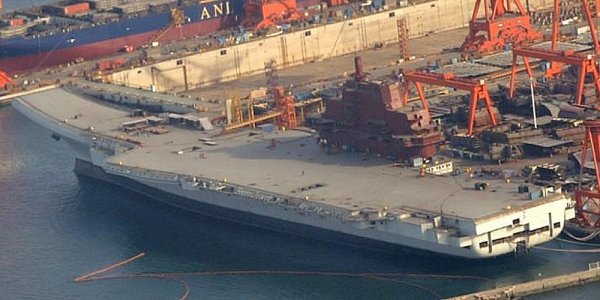
In their growth from a small coastal protection flotilla to a blue water navy, the next milestone for China’s navy will be the completion of the Shi Lang:

Work is picking up on what appears to be China’s first aircraft carrier, the Shi Lang. For eight years now, China has been tinkering with a half finished Russian aircraft carrier. Two years ago, this ex-Russian aircraft carrier, Varyag, was renamed the Shi Lang (after the Chinese general who took possession of Taiwan in 1681, the first time China ever paid any attention to the island) and given the pennant number 83.

Until last year, progress was slow. But there has been a lot of work lately. Early in 2009, China moved the Shi Lang into dry dock, where work is now obviously underway to install engines and other heavy equipment. A year ago, the radar mast was completed, and now there is a Chinese radar system being installed. Officially, the Chinese say nothing. But the dockyard workers keep at it, and it’s possible to take photos from a distance. It appears that the Shi Lang is a year or so from going to sea.

November 11, 2010

Chinese wine buyers get all-VQA store that Ontario wine buyers can’t have

Filed under: Bureaucracy, Cancon, China, Law, Wine — Tags: , , , — Nicholas @ 12:56

I’m all in favour of improving the visibility and availability of Ontario’s VQA wines in other markets, so this news is both good and infuriating simultaneously:

A couple of weeks ago the Government of Ontario announced the opening of an all-VQA wine store in China (in the city of Zhengzhou, the capital of Henan Province). Oh happy day — now the Chinese can drink (and copy) all the Ontario icewine they want . . . but this begs the question: why should the Chinese have an advantage that we Ontarians do not? Do the Chinese drink more Ontario wine? Why is it so important that China get the opportunity to drink Ontario wines that folks in Thunder Bay, Sault Ste. Marie and Sudbury can not?

I have nothing against the Chinese getting their hands on our wine; I’m glad to see a country embrace our wines as so many of us have embraced their food. But seriously, why should folks living in China have more and better access to Ontario wines then those of us living in the actual province. When I first heard the news, all I could say was an incredulous, “Seriously?” Has Ontario really become, as wine writer Dean Tudor puts it, every time he mentions Ontario, “a have not province”? When it comes to our own wine industry it keeps getting more and more “have not” and won’t get.

See what I mean? Great that they’re opening outlets in a new foreign market, but we still can’t get that kind of opportunity to buy here at home? All-VQA stores have been discussed (and rejected) before, but they’re apparently a great idea for foreign markets.

Update: Fixed the broken link.

November 1, 2010

Shipping at Age-of-Sail speeds

Filed under: Asia, China, Economics, Germany — Tags: — Nicholas @ 12:40

In an attempt to save fuel, shipping lines have been ordering their ships to go slower. Some of them are now slower than 19th century clipper ships:

For those who haven’t followed the situation closely, many container ships right now have practiced ‘slow steaming’ due to a glut of ships being built worldwide.

Essentially, they are sailing at speeds well below their potential in order to reduce the supply of ships in the market, and thus support shipping rates.

The way this works is that the slower a ship sails, the fewer times it can make a round trip per year. Thus purposely sailing slowly reduces the effective supply of ships. It’s a response to insufficient shipping demand relative to the size of the global container shipping fleet.

Yet these poor shipping companies have taken this practice to such an extreme that many ships are now sailing at speeds slower than old clipper ships from the 1800’s.

H/T to Monty:

Overcapacity in shipping means lower demand for the finished goods overall. This is also a prime reason why export-driven economies (China, Germany) are in for a pretty dramatic adjustment soon. They’ve been counting on an economic recovery in America and Europe to soak up all that excess production, but it looks like things are going to stay weak for at least another six months to a year.

October 26, 2010

The intelligence bonanza of the 2001 American EP-3E incident

Filed under: China, Military, USA — Tags: , , , , , — Nicholas @ 12:30

If you cast your mind back far enough, you’ll remember the political impact of the mid-air collision between a Chinese fighter and an American EP-3E electronic surveillance aircraft. It certainly had the potential to turn into a major standoff between the two powers, but apparently the real story was the intelligence breach following the emergency landing:

On April 1, 2001, an American EP-3E Aries II reconnaissance plane on an eavesdropping mission collided with a Chinese interceptor jet over the South China Sea, triggering the first international crisis of George W. Bush’s Administration. The Chinese jet crashed, and its pilot was killed, but the pilot of the American aircraft, Navy Lieutenant Shane Osborn, managed to make an emergency landing at a Chinese F-8 fighter base on Hainan Island, fifteen miles from the mainland. Osborn later published a memoir, in which he described the “incessant jackhammer vibration” as the plane fell eight thousand feet in thirty seconds, before he regained control.

The plane carried twenty-four officers and enlisted men and women attached to the Naval Security Group Command, a field component of the National Security Agency. They were repatriated after eleven days; the plane stayed behind. The Pentagon told the press that the crew had followed its protocol, which called for the use of a fire axe, and even hot coffee, to disable the plane’s equipment and software. These included an operating system created and controlled by the N.S.A., and the drivers needed to monitor encrypted Chinese radar, voice, and electronic communications. It was more than two years before the Navy acknowledged that things had not gone so well. “Compromise by the People’s Republic of China of undestroyed classified material . . . is highly probable and cannot be ruled out,” a Navy report issued in September, 2003, said.

The loss was even more devastating than the 2003 report suggested, and its dimensions have still not been fully revealed. Retired Rear Admiral Eric McVadon, who flew patrols off the coast of Russia and served as a defense attaché in Beijing, told me that the radio reports from the aircraft indicated that essential electronic gear had been dealt with. He said that the crew of the EP-3E managed to erase the hard drive — “zeroed it out” — but did not destroy the hardware, which left data retrievable: “No one took a hammer.” Worse, the electronics had recently been upgraded. “Some might think it would not turn out as badly as it did, but I sat in some meetings about the intelligence cost,” McVadon said. “It was grim.”

H/T to Bruce Schneier for the link.

October 25, 2010

QotD: Mark Steyn on China’s coming demographic bomb

Filed under: China, Economics, Quotations, USA — Tags: , , — Nicholas @ 12:29

In 2009, the US spent about $665 billion on its military, the Chinese about $99 billion. If Beijing continues to buy American debt at the rate it has in recent times, then within a few years US interest payments on that debt will be covering the entire cost of the Chinese military. This summer, the Pentagon issued an alarming report to Congress on Beijing’s massive military build-up, including new missiles, upgraded bombers, and an aircraft-carrier R&D program intended to challenge US dominance in the Pacific. What the report didn’t mention is who’s paying for it.

Answer: Mr and Mrs America.

By 2015, the People’s Liberation Army, which is the largest employer on the planet, bigger even than the US Department of Community-Organizer Grant Applications, will be entirely funded by US taxpayers. When the Commies take Taiwan, suburban families in Connecticut and small businesses in Idaho will have paid for it.

[. . .]

Chinese state-controlled enterprises are buying up everything from copper in Canada to zinc in Australia to bauxite in Jamaica. They’re doing what the first settlers did vis a vis the Indians: They sell us trinkets in return for our resources. That said, I disagree with the conclusion of this video. The danger from China is not its strength, but its underlying weaknesses: As I wrote in America Alone, it will get old before it gets rich, and, unless it’s planning on becoming the first gay superpower since Sparta, the millions of surplus young men whom the One-Child Policy has deprived of female companionship is a recipe for profound social convulsions. That’s actually worse news than if China was cruising to global hegemony — because it means their calculations on how the Sino-American relationship evolves are even less likely to align with ours.

Mark Steyn, “Campaign Countdown”, SteynOnline, 2010-10-25

October 17, 2010

New laws aim to reduce military corruption in China

Filed under: China, Economics, Military — Tags: , , — Nicholas @ 11:39

Strategy Page looks at the latest attempt to curb military corruption:

China is enacting new laws that puts additional pressure on the military to maintain quality standards (in the construction and use of military equipment). Why should something like this be thought necessary? It’s all because of corruption, an ancient, and growing, problem in China. There, it is taken as a given that, if you get a government job, you have a license to steal. In the military, this means weapons are built in substandard ways, and equipment is not properly maintained. Military corruption is an ancient Chinese custom, and accounts for most of the poor military performance in the past.

For over a decade, the government has worked to eliminate the worst of the theft and moonlighting by the troops. The most outrageous examples of this have been curbed. Thus military officers no longer use cash from the defense budget to set up weapons factories they run and profit from. Big chunks of procurement cash no longer disappear into the offshore bank accounts of generals and admirals.

It’ll take more than new laws and a few high-profile prosecutions to tackle a problem that has been endemic for generations.

September 29, 2010

Austin Bay summarizes the demographic problems China is facing

Filed under: China, Economics, Environment — Tags: , , , — Nicholas @ 09:11

This is all old hat if you’ve been reading the blog for a while, but it’s always good to see a good summary of key points, like this list by Austin Bay:

Internal Disorder: China’s primary threat is not the United States, or any other foreign power, but internal disorder. There are more angry people in China every day, and the government knows that this could blossom into widespread uprisings. It has happened so many times before in Chinese history. Protesting factory workers are an indicator.

Corruption: Corruption is the biggest complaint among China’s discontented; government officials, who are more interested in enriching themselves than in taking care of “the people” are particular targets. Many of the demonstrations and labor disruptions are the result of corruption among local officials, including the police.

The Communications Dilemma: In 2007, Chinese Internet use grew to over 210 million users. Cell phones are also increasingly available. China is the world’s largest cell phone market. The Internet is an economic and educational tool. However, it also undermines an authoritarian government’s ability to control (deny and spin) information. China’s 2010 “war with Google.com” illustrated this dilemma.

Ethnic Minorities and Language: China has a population of 1.4 billion. Han Chinese (“ethnic Han”) constitute approximately 92 percent of China’s population. China also has 55 “minority nationalities,” however, amounting to 100 million people. The 2009 Uighur riots in Xinjiang province (western China) and resistance in Tibet are symptomatic of the problem. They are resisting “Hanicization.”

Pollution and Water: In early 2008, China began shutting down “high pollution” factories. The reason? To clear the air for the 2008 Beijing Olympics. The growing wealth of the Chinese people is causing enormous pollution problems and water shortages. Effective pollution controls mean more expensive production methods. That makes Chinese goods less competitive.

The Marriage Gap: China’s “one child” policy crimped population growth, all right. More boys were born than girls; Chinese culture “favors” sons. As a result, there is a serious imbalance between men and women. In some places, there are 120 men per 100 women. Marriageable daughters are, reportedly, going largely to the upper social groups within each village or district. The sons of the poorest families are, to an extent, not finding wives. This is an indicator of future social trouble.

As I’ve said several times before, I’m not anti-Chinese: China has accomplished economic marvels in amazingly short time spans . . . but not without serious costs. Urban and coastal dwellers have benefitted disproportionally from the growth: rural and inland Chinese have suffered to provide the means for that growth. China is still not a free economy, and still represses dissent, imprisons critics, and controls far too much of the country’s economy both directly and indirectly. Corruption is rife, despite the savage punishment meted out to (some of) the (accused) perpetrators.

China’s miracle can’t continue for much longer unless the government starts to address these problems with the same kind of single-mindedness that they’ve brought to other problems. Introducing the rule of law would be an excellent first step, but it would directly challenge too many powerful men, some of whom (literally) have armies.

August 14, 2010

China’s petroleum producers make more sense than the US government

Filed under: China, Economics, Environment, USA — Tags: — Nicholas @ 01:01

Not everybody has bought into the “ethanol as a clean alternative to petroleum” bullshit: China’s petroleum producers are asking the Chinese government to stop subsidizing the corn-to-ethanol project (similar to the US government’s subsidy program).

[. . .] to enjoy the subsidy of 1880 Yuan per ton of alcoholic gasoline for vehicles and the tax-exemption policy for the corn-to-ethanol project, some plants in China began a wave of buying corn, causing the severe shortage of corn for animal feed and the rapid increase of corn prices.

“In the first half year of this year, China imported 78 million tons of corn, mainly due to the higher domestic corn price than overseas. In July, the average corn price in northeast China was 1845 Yuan per ton, rising by 15.7% year on year” said Zhang Jianbo, a market analyst with Distribution Productivity Promotion Center of China Commerce…

Of course the US has also been criticized for this insane subsidy of corn ethanol as well and blamed for dramatic price increases in corn based products in Mexico, and South/Central America.

The bottom line is corn ethanol makes no economic sense, never did, and when the total environmental impact end-to-end from dirt farm to tailpipe is considered, its even worse than ordinary gasoline. Its always been a lose/lose proposition all the way around, and many of the environmental groups have started to cool on their enthusiasm for it as the real cost/impacts manifested themselves.

Even if you’re not a whole-hearted “green”, this kind of market-rigging by government intervention should be greeted with derision: it’s not “green” to consume more resources to produce a less energy-intensive end-product and pretend it’s a viable substitute. This is another case where the government would produce better environmental results by burning the dollar bills rather than using them to subsidize corn production for ethanol.

July 26, 2010

The unwillingness to disbelieve

Filed under: China, Economics, India, Media — Tags: , , , , , — Nicholas @ 15:03

Mike Elgan debunks the latest “mind-crogglingly cheap computer for the masses” announcement:

“India unveils $35 computer for students,” says CNN.com. “India unveils prototype for $35 touch-screen computer,” reports BBC News. “India to provide $35 computing device to students,” says BusinessWeek.

Wow! That’s great! Too bad it will never exist. That this announcement is reported straight and without even a hint of skepticism is incomprehensible to me.

[. . .]

India itself doesn’t build touch screens. They would have to be imported from China or Taiwan. The current price for this component alone exceeds $35. Like touch screens, most solar panels are also built in China. But even the cheapest ones powerful enough to charge a tablet battery are more expensive to manufacture than $35.

Plus you need to pay for the 2GB of RAM, the case and the rest of the computer electronics. Even if you factor in Moore’s Law and assume the absolute cheapest rock-bottom junk components, a solar touch tablet with 2GB of RAM cannot be built anytime soon for less than $100.

More to the point, no country in the world can build a cheaper computer than China can. The entire tech sector in China is optimized for ultra-low-cost manufacturing. All the engineering brilliance in India can’t change that.

There’s also the point that government bureaucracies and university engineering departments are not designed for or experienced in the mass production techniques that any of these “ultra-cheap but powerful” computing initiatives all require. Have you ever heard of a government that could keep their hands (and political priorities) out of the critical decision of where this wonder device would be assembled, tested, packed, and distributed? The “industrial policy” wonks would need to get intensely involved in such a decision and the location would have to meet diverse electoral and financial requirements (note that the economics of the project won’t even make the top five priorities in the process).

Awarding the contract to just one area would be unthinkable: the benefits must be seen to be helping areas that elected the current government and emphatically not going to opposition ridings. The horsetrading over that alone would consume any possible price advantage such a scheme might have over ordinary computers and software bought commercially.

July 15, 2010

Reasons not to get angsty over China’s growth

Filed under: China, Economics, Government, USA — Tags: , , , — Nicholas @ 10:02

The ever-sensible and highly entertaining Monty points out that Americans fretting over the growth of the Chinese economy are bothered over (comparatively) minor issues:

The angst over China’s economic ascent continues to smell rather strongly of the same panic the US felt over Japan in the 1980’s. I respond to this panic in two ways: 1) I am happy for the average Chinese citizen, who is finally seeing some benefit from their labor after 400 years of failure and ineptitude — they deserve any success that comes their way; and 2) America is in the enviable position of being able to worry about unlikely hypotheticals because we are the world’s largest economy and will continue to be so for much of the 21st century and perhaps beyond. We face severe problems — public spending being #1 among them — but our competitors also have problems, in many cases more dire than our own. We as a people have a habit of overestimating our own problems and underestimating those of our adversaries. Don’t begrudge the Chinese people some measure of success; just hope that they can cast off their Communist government and move towards being a freer people. There may come a time when the US and China square off as enemies rather than just competitors, but that outcome is not inevitable.

Fitch agrees with me about taking the whole “China is taking over the world” thing with a grain of salt. The Chinese are hiding an enormous amount of bad debt. If China hopes to succeed beyond their export-driven economy, their finances are going to have to become more transparent. And when/if this happens . . . look out below. That crash is going to make our little economic vacation of the past couple of years look mild in comparison.

I know that it may appear that I’m anti-Chinese based on some of my past economic postings, but that’s not true. I’m actually quite positive about China in the long term — once they manage to get rid of the last trappings of authoritarian government and overcome the huge dead hand of army-controlled crony capitalism. Most Chinese markets are not yet free, but they’re in most cases far more free than they were a decade ago. That’s wonderful, both for ordinary Chinese people and for the rest of the world. China has immense untapped resources of skills, talents, and ideas that can’t be accessed in a controlled economy. If-and-when their economy becomes as free as typical western markets, sit back and watch all that human ingenuity go to work.

On the down side, while China is becoming a bit more free, many western countries are becoming less so: piling on regulations and creating additional barriers to economic growth (Canada, for the most part, has not been doing this . . . it’s a significant factor in Canada’s escape from recession). If these trends continue, perhaps the worriers-about-China will see the Chinese economy vault into first place as the American government tries to control everything.

June 21, 2010

China’s latest currency move

Filed under: China, Economics, USA — Tags: , , , , — Nicholas @ 10:31

The always entertaining Monty has a few thoughts that are worth considering:

BNP Paribas forecasts parity (and below!) for the poor, unloved Euro. The Euro is like the easy girl in every town: popular enough when she was young and cute, but now that she’s looking like nine miles of bad road, no one wants to be seen with her or has a kind word to say about her.

After insisting for months that they weren’t keeping the Yuan artificially devalued via the dollar-peg, the Chinese lift the peg, shout Squirrel!, and run away.

Meanwhile, a floating Yuan may not work out quite the way the US thinks it will. This happens to be my view — I think the export-driven Chinese economy is a lot weaker than they’re letting on (or may even realize themselves), and they have severe internal economic problems that the authoritarian government has been papering over for years. There will be a huge banking crisis in China at some point when the huge numbers of bad loans come to light — they can’t hide them forever. Further, the recent labor troubles in China may be only the leading edge of a big wave.

Of course, if you’ve been following Quotulatiousness for any time, you’ll know that I’m fully in agreement with Monty about the Chinese economy. In the long term, I’m quite hopeful about China and their ongoing liberalization and modernization, but in the short- to medium-term I think there are many problems that need to be resolved and that will cause a great deal of upheaval and disturbance.

Remember that even with the best good will in the world, China’s economy is still moving painfully from state-run to private enterprise, and the most common stop on that road is crony capitalism (that’s like capitalism without the rule of law but with private armies). The good news is that a greater proportion of the economy is adjusting to free(r) markets, but there’s still lots of zombie corporate entities set up and run by various branches of the government . . . and the army.

In the latest move, the exchange rate change may not be the panacea that too many American politicians are hoping for:

China’s decision to move away from its currency peg might mean the yuan weakens against the dollar instead of strengthens as Washington wants, Nouriel Roubini, one of Wall Street’s most closely followed economists, said Saturday.

China said Saturday it would gradually make the yuan more flexible after pegging it to the dollar for nearly two years, a move that the U.S. government and others around the world have long been calling for.

It won’t fix the underlying trade issues, even if the yuan moves in the “desired” direction, as the problem is much more rooted in American policy than in Chinese currency rates. As long as the American government insists on increasing the debt load, piling on additional regulatory regimes, and directly interfering in corporate decisions, the longer the economy will be unsettled. Stability is a key condition for economic recovery, yet the American government demonstrates a knee-jerk reaction against stability for every opportunity that arises.

Oh, and if you think the US banking system has bad loan issues, wait for the other shoe to drop:

China’s banking regulator warned Tuesday that the nation’s banking system faces risks from bad loans, particularly among those made to local governments and to the real-estate sector.

In its 2009 annual report, the China Banking Regulatory Commission urged banks to use cause and scientific risk analysis in their lending, and warned of dangers to the sector, both from lending in the past year and from development in the future.

June 18, 2010

A “new chapter in U.S. history”

Filed under: China, Economics, Government, Humour, USA — Tags: , , , , , — Nicholas @ 10:23

Ron Hart congratulates President Obama for delivering on his promised change:

We are so in debt to China that President Obama had to visit their president in his first year in office. It was an important meeting between the most powerful communist leader in the world and the president of China.

Obama is so popular in China that a nightclub named after him opened in Beijing. In keeping with the Obama theme, the club opened with $10 trillion in debt. It will, hopefully, close in just four years with $15 trillion in debt and no apologies to its “hope-based” investors.

[. . .]

To sum up our situation just short of two years into this Obamanation of an administration: Our debt is much higher, an unwanted ObamaCare bill that will cost us at least $2 trillion more than predicted was rammed through Congress, more troops are in Afghanistan, unemployment is much higher even after a union handout “stimulus” bill, and the biggest tax increase in American history is coming in 2011. So yes, Mr. President, technically I guess you can say you have brought about “change.”

As for your assertion, Mr. Obama, that you are going to usher in a “new chapter in U.S. history,” it looks like you will make good on that too. Unfortunately, it will be Chapter 11.

H/T to Jon, my former virtual landlord.

June 4, 2010

Detroit has no monopoly on post-apocalyptic urban scenery

Filed under: Asia, China, History, Japan — Tags: , , — Nicholas @ 21:56

For example, check the images from Battleship Island (Gunkanjima) in Japan:

What’s now decay and rot once was bright and brilliantly full of hope: Who lived here? What were their lives like? What happened? How did it all come apart? How did it all crumble to almost nothing?

In the case of Hashima Island, or Battleship Island (Gunkanjima in Japanese) as it’s often called, hope and optimism became dust and decay because one black resource (coal) was replaced by a cheaper black resource (oil). Populated first in 1887, the island — which is 15 kilometers from Nagasaki — only began to really, and phenomenally, become populated much later, in 1959.

Even the nickname “Battleship Island” has a bit of history behind it.

H/T to Ace of Spades for the original link.

April 15, 2010

QotD: Chinese espionage in Canada

Filed under: Cancon, China, Economics, Quotations — Tags: , , — Nicholas @ 12:39

China’s not buying our oil; it’s buying the reliable flow of Canadian corporate profits and our stable economic outlook.

Is it a national security risk to Canada?

No, again. It is true that, according to CSIS, the Chinese government represents the largest espionage threat to Canada, stealing the equivalent of $1-billion a month from our country in industrial secrets. (That’s more than our annual exports to China.)

But that espionage is done illegally by Chinese students, expats and other sympathizers, not through the legal ownership of share certificates. No doubt our high-tech energy secrets are being stolen and will continue to be stolen, but that is not happening because of a Wall Street deal. The central strategic value of the oil sands is not at risk.

Ezra Levant, “Pipeline to Asia”, National Post, 2010-04-15

Uninhabited islands could be flashpoint in Sino-Japanese conflict

Filed under: China, Japan, Military — Tags: , , , — Nicholas @ 07:35

A group of uninhabited islands south of Okinawa have the potential to increase tensions between China and Japan. The Senkaku island group is subject to overlapping claims from China, Taiwan, and Japan:

Japan reports that, for the third time in the past 18 months, Chinese warships have been spotted south of the Japanese Island of Okinawa. This time, it was two Chinese submarines, running on the surface. That had never been seen before, in the area near the Senkaku islands (which are claimed by China, Taiwan and Japan). The Senkakus are eight uninhabited islands, which in the past were only used occasionally by fishermen. The Senkakus are 220 kilometers from Taiwan, 360 kilometers from China and 360 kilometers from Okinawa (which is part of Japan).

[. . .]

Five years ago, a Chinese oil drilling platform, in disputed waters halfway between China and the Japanese island of Okinawa, began producing natural gas, despite ongoing negotiations over who owns what in that patch of ocean. The Chinese spent two years building that platform, in waters claimed by Japan. A second platform was later built, as well as an underwater oil pipeline for both platforms. China regularly sends groups of warships to patrol the area, to underline their belief that this bit of water is under Chinese control. Japan would probably win any naval war with China, but since China has nuclear weapons, and Japan does not (at least not right now), such a war could go seriously against Japan. This has been brought up in Japan before, and it is feared that the issue may lead to Japan secretly, or openly, building nuclear weapons (which it could certainly do, and quite quickly.)

I’m certainly hoping that this is just speculation on the part of Strategy Page (the bit about nuclear weapons), as territorial disputes over islands do have a way of getting out of hand (see Falkland Islands, for example).

« Newer PostsOlder Posts »

Powered by WordPress