
By the late 1990s the rapid expansion of the universities came to a halt, especially in the humanities. Faculty openings slowed or stopped in many fields. Graduate enrollment cratered. In my own department in 10 years we went from accepting over a hundred students for graduate study to under 20 for a simple reason. We could not place our students. The hordes who took courses in critical pedagogy, insurgent sociology, gender studies, radical anthropology, Marxist cinema theory, and postmodernism could no longer hope for university careers.
What became of them? No single answer is possible. They joined the work force. Some became baristas, tech supporters, Amazon staffers and real estate agents. Others with intellectual ambitions found positions with the remaining newspapers and online periodicals, but most often they landed jobs as writers or researchers with liberal government agencies, foundations, or NGOs. In all these capacities they brought along the sensibilities and jargon they learned on campus.
It is the exodus from the universities that explains what is happening in the larger culture. The leftists who would have vanished as assistant professors in conferences on narratology and gender fluidity or disappeared as law professors with unreadable essays on misogynist hegemony and intersectionality have been pushed out into the larger culture. They staff the ballooning diversity and inclusion commissariats that assault us with vapid statements and inane programs couched in the language they learned in school. We are witnessing the invasion of the public square by the campus, an intrusion of academic terms and sensibilities that has leaped the ivy-covered walls aided by social media. The buzz words of the campus — diversity, inclusion, microaggression, power differential, white privilege, group safety — have become the buzz words in public life. Already confusing on campus, they become noxious off campus. “The slovenliness of our language”, declared Orwell in his classic 1946 essay, “Politics and the English Language“, makes it “easier for us to have foolish thoughts.”
Orwell targeted language that defended “the indefensible” such as the British rule of India, Soviet purges and the bombing of Hiroshima. He offered examples of corrupt language. “The Soviet press is the freest in the world.” The use of euphemisms or lies to defend the indefensible has hardly disappeared: Putin called the invasion of Ukraine “a special military operation”, and anyone calling it a “war” or “invasion” has been arrested.
But today, unlike in 1946, political language of Western progressives does not so much as defend the indefensible as defend the defendable. This renders the issue trickier than when Orwell broached it. Apologies for criminal deeds of the state denounce themselves. Justifications for liberal desiderata, however, almost immunize themselves to objections. If you question diversity mania, you support Western imperialism. Wonder about the significance of microaggression? You are a microaggressor. Have doubts about an eternal, all-inclusive white supremacy? You benefit from white privilege. Skeptical about new pronouns? You abet the suicide of fragile adolescents.
Russell Jacoby, “The Takeover”, Tablet, 2022-12-19.
April 7, 2023
QotD: The effluvium of the university’s overproduction of progressive “elites”
April 1, 2023
The fastest growing demographic in Canada might be the “Pretendians”
In Quillette, George Case outlines the fraught topic of claimed First Nations heritage among Canadians:
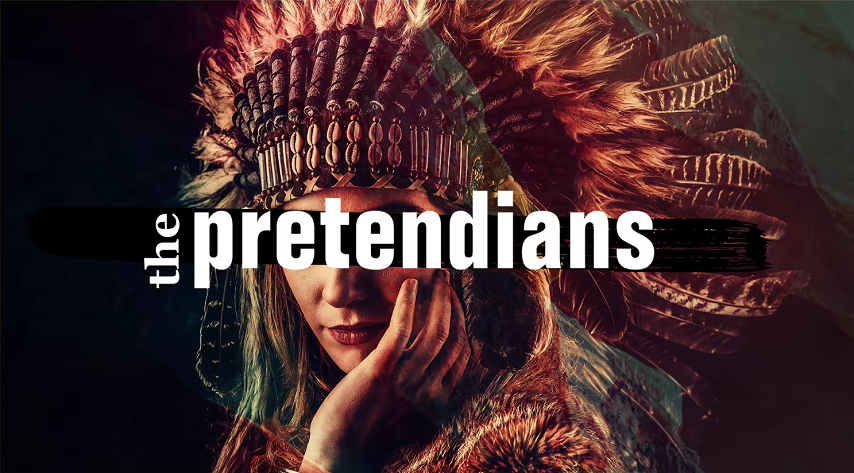
“The Pretendians”, a CBC documentary – https://www.cbc.ca/passionateeye/episodes/the-pretendians
Many North Americans have cited such extraction as a conversation piece, an exotic mark of character, or just an intriguing bit of genealogy: among them are singers Cher and Beyoncé, actor Johnny Depp, rockers Jimi Hendrix and Robbie Robertson, baseball great Johnny Bench, and numerous others.
That such backgrounds are both perfectly plausible and difficult to verify tells us something about the history of the human species since 1492. Consensual or coerced relations between Europeans, Africans, and Indigenous people throughout the Americas — even when socially deplored or officially prohibited—must have happened countless times to generate the populace we are today. Most of us, by some measure, are mini-melting pots. And consider, too, today’s routine unions of partners whose great-grandparents might have been horrified at the prospect of “marrying out”: Protestants with Catholics, Jews with Gentiles, Asians with Anglos, and a rainbow of other combinations. Indeed, to oppose such relationships, and the products thereof, is now usually seen as a small-minded prejudice of the ignorant and intolerant.
Unless the opponent happens to be a Native person. In Canada, over the last few years, a rash of scandals have erupted over prominent figures whose claims of Aboriginal heritage have been heatedly disproved, like novelist Joseph Boyden, actress and filmmaker Michelle Latimer, academic Carrie Bourassa, and former judge Mary Ellen Turpel-Lafond. The uproar around “Pretendians” has raised uncomfortable questions around race and politics that the angriest Aboriginals may not have intended in their denunciations. Métis lawyer Jean Teillet has called the phenomenon “the ultimate step in colonialism”, while on The Indigenous Foundation website, Neegahnii Madeline Chakasim has asserted, “To claim Indigenous ancestry and/or claim to be a member of a Nation without any evidence, or claiming Indigeneity for the fun of it, is a complete slap to the face of any existing Indigenous person.” And Ojibwe writer Drew Hayden Taylor explained the message of his 2022 documentary, The Pretendians, by remarking, “In past centuries, the dominant culture has tried to take so many things from us, leaving behind the one thing most important to us: who we are.”
Yet just who are “we”? As with so much else in conventional Canadian wisdom around Native issues, the jealous guarding of authentic Native identity has its logical terminus in a separate-but-equal regime that contradicts the universal impartiality promised to all citizens: sanctioned racial essentialism for Aboriginals, mandatory multiculturalism for everyone else. Never discriminate against, but always discriminate in favor. In principle, all people are to be treated interchangeably, but in practice, one subset of people must be impermeably sealed off from others. At its creepiest, the Pretendian problem has echoes of the one-drop standards that obtained in Nazi Germany and the Jim Crow American South, insofar as sorting the real Natives from the fake ones is determined in part by a biological purity that few other cultures attempt to preserve, much less openly endorse.
It’s also ironic that in many episodes of exposed Pretendians, the purported disadvantage of a Native background — statistically, Canadian Natives are poorer than non-Natives, suffer higher rates of addiction and suicide, and have long been overrepresented in prisons and as victims of crime — is used as a bonus credential in academia or the arts. Schools and other institutions eager to boast of their ameliorative “Indigenization” programs have hired, commissioned works by, or otherwise granted special recognition to applicants based on unchecked claims of Aboriginal ancestry.
Eventually — and inevitably — some of those claims turn out to be flimsy: a vague personal biography here, a tenuous adoption record there, suspicious gaps in government documentation (Canadian Natives are entitled to hold a “Status Indian” card issued by federal or provincial agencies) somewhere else. This has happened across Canada, from Vancouver’s Emily Carr University of Art and Design, where faculty member Gina Adams’s Native lineage was called into question in 2021, to Kingston Ontario’s Queen’s University, where no less than six instructors and staff had their Native self-identification doubted in an anonymous report that came out the same year.
Complicating these situations, however, is that few of these cases seem to have been deliberate frauds. Even the famous imposter Archie Belaney (1888–1938), an Englishman whose Scottish-Apache persona of “Grey Owl” was wholly invented, parlayed his imaginary Native status into genuinely progressive campaigns for wilderness conservation in the early 20th century.
March 11, 2023
QotD: We used to call them “parlour pinks”
What’s life like in the Soviet Union? They neither know nor care, until the brute facts of life in the USSR are rubbed into their faces for so long that they have to acknowledge them. At which point they simply switch allegiances. Kolakowski’s essay doesn’t mention Paul Hollander’s Political Pilgrims, but they arrive at essentially the same conclusion — that instead of becoming disillusioned with Communism (Socialism, “social justice”) itself, the irritated butterflies of the Left grow disillusioned with a particular country or leader. The USSR has failed, yes, but — all together now! — “real Communism has never been tried”, so let’s put all our faith in Mao … and then Castro … and then Chavez, et cetera ad nauseam.
It’s all about maintaining the purity of the idea in the face of disappointing, vulgar, grubby reality. An honest-to-Marx Communist will come into plenty of contact with reality. A Leftist never will, because xzhey have convinced xzhemself that even the mugging they’re currently experiencing is a lofty and noble expression of authenticity. They’re willing to die for the Revolution, certainly — the urge for martyrdom has always been highly conspicuous on the Left. So long as they never feel that base, grubby, vulgar proletarian urge to defend themselves, they’ll be fine.
[…]
“Never cheer for your own.” When you come right down to it, that’s the Leftist motto. Leftists don’t deride “sportsball”, for instance, because they’re un-athletic little dweebs who were always picked last at recess (well, ok, not only that). It’s because cheering for a team, any team, is vulgar. It’s what grubby little proles do. (That’s another way to distinguish a Communist from a Leftist, by the way. Actual Commies love sports; look at all the resources the USSR poured into the Olympics, for instance. That’s because sports are good training for war).
Is Leftism curable? Can they be made to cheer for their own? Experience suggests that the cure will be very harsh indeed … if indeed it’s possible at all.
Severian, “Grubby Little Proles”, Rotten Chestnuts, 2020-05-31.
March 7, 2023
Getting rid of the SAT won’t help low-income or minority students – in fact, it’ll hurt them
Rob Henderson explains why the notion of getting rid of SAT requirements will to the opposite of what is being claimed, based on his own experience:

US Navy Seaman Chanthorn Peou takes the SAT aboard USS Kitty Hawk, 23 February, 2004.
US Navy photograph by Photographer’s Mate 3rd Class Jason T. Poplin via Wikimedia Commons.
I graduated in the bottom third of my high school class with a 2.2 GPA. Didn’t think of myself as “smart”. I thought a lot and read a lot. But I hated homework, teachers, rules, etc. I thought “smart” meant kids who did their homework and raised their hand in class. Those types.
My senior year of high school I took the required test to join the military — the Armed Services Vocational Aptitude Battery (ASVAB). Half my motivation to take this test was because I got to skip class. I spent the night before with my friends drinking Four Loko and playing Fight Night Round 3 on Xbox 360. Woke up with a hangover, chugged 20 ounces of Rockstar energy drink, and took the test. Afterwards, the Air Force recruiter showed me how to convert ASVAB to SAT scores. I got the same score as my smartest friend who always got straight-As and was headed for college. What the fuck? I thought.
At the time, I wasn’t aware these tests are thinly veiled IQ tests. The SAT, ASVAB, and the ACT are all highly correlated with IQ at about r = .8.
A study on Army recruits found that scores on an intelligence test, along with 2-mile run time, were the best predictors of success in infantry training.
Research on tank gunners found that replacing a gunner who scores around the 20th percentile with one who scores around the 55th percentile improves the likelihood of hitting a target by 34 percent.
To qualify, potential military recruits must score higher than roughly one-third of all who take the ASVAB. The lowest acceptable percentile score to join is 36 for the Air Force, 35 for the Navy, 32 for the Marine Corps, and 31 for the Army. By definition, the worst test taker who makes it into the military still scores higher than one-third of his or her peers. The military slices off the bottom third of standardized test-takers, not allowing them to join.
The psychologist and intelligence researcher Linda Gottfredson has written:
IQ 85 … the U.S. military sets its minimum enlistment standards at about this level … The U.S. military has twice experimented with recruiting men of IQ 80-85 (the first time on purpose and the second time by accident), but both times it found that such men could not master soldiering well enough to justify their costs.
In the 1960s, Secretary of Defense Robert McNamara launched Project 100,000 which lowered the testing requirement. This allowed people at the 10th percentile (80~ IQ) — a standard deviation lower than the previous standard — to join.
Supposedly, the aim was to alleviate poverty. LBJ had recently begun his War on Poverty program. The story was that getting more recruits into the military would help them move into the middle class. And they needed more recruits for the Vietnam War. Lowering recruitment standards was an easy way to get them.
Recruits of Project 100,000 were 9 times more likely to require remedial training and training took up to 4 times longer to complete compared to their peers who had entered under the higher score requirement. In Vietnam, men recruited under the lower testing threshold were 2.5 times more likely to die in combat.
Did the veterans who made it home achieve upward mobility? No. Compared to civilians with similar attributes who were not recruited, McNamara’s Morons (as they were later termed) were less likely to be employed, less likely to own a business, and obtained less education. Later, the policy changed to improve the talent pool of the armed forces. Higher ASVAB score thresholds were reinstated. Along with additional rigid requirements.
Today, eight out of ten Americans between 17 and 24 are ineligible for military service. Mostly due to obesity, medical issues, and criminal records.
Anyway, seeing my ASVAB score was the first time I learned I could have been a good student. It was possible. How many kids out there are like this. Kids who have fucked up lives and get bad grades which mask their underlying potential. Potential that a standardized test could reveal.
The SAT is a “barrier” according to that NYT op-ed. But it’s also a gateway. Most poor kids don’t take the SAT. Or any other standardized test. More should.
March 3, 2023
QotD: What’s the opposite of university? “Diversity”
Severian, “Advice to Young Dissidents”, Rotten Chestnuts, 2020-04-01.
March 1, 2023
QotD: What do we mean by “the humanities”?
By way of example, that methodological difference is why there’s a division between political science and history, despite the two disciplines historically being concerned with many of the same subjects and the same questions (to the point that Thucydides is sometimes produced as the founder of both): they use different methods. History is a humanities discipline through and through, whereas political science attempts to hybridize humanities and STEM (Science, Technology, Engineering and Mathematics) approaches; that’s not to say historians never use statistical approaches (I do, actually, quite a lot) but that there are very real differences in methodology. As you might imagine, that difference leads to some competition and conflict between the disciplines as to whose methodology best answers those key questions or equips students to think about them. Given that I have a doctorate in history and self-identify as a historian, you will have no trouble guessing which side of this I come down on, although that might be a bit self-interested on my part.
So if the STEM fields are, at some level, fundamentally about numbers, the humanities are fundamentally about language. The universe may be made of numbers, but the human mind and human societies are constructed out of language. Unlike computers, we do not think in numbers, but in words and consequently, the study of humans as thinking creatures is mostly about those words (yes, yes, I see you there, economics and psychology; there are edge cases, of course). Our laws are written in words because our thoughts form in our heads as words; we naturally reason with words and we even feel with words. Humans are linguistic creations in a mathematical universe; consequently, while the study of the universe is mediated through math, the study of humans and human minds is fundamentally linguistic in nature.
Thus, the humanities.
Bret Devereaux, “Collections: The Practical Case on Why We Need the Humanities”, A Collection of Unmitigated Pedantry, 2020-07-03.
February 23, 2023
QotD: Academic types
You do acknowledge, of course, that it’s in the nature of math that 50% of the population are below average?
Our default “solution” for university shooters […] is psychiatry. More access to better “mental health care”, we say, would’ve prevented this. Maybe, maybe not, but at least it’s something. The problem, though, is that the only diagnostic criterion you can realistically use is “So-and-So is a twitchy, weird loner”, which — trust me — exactly describes 99% of grad students and 100% of professors. Do we force feed all of them powerful prescription psychotropics on the off-chance?
Before you jump to agree — and yes, I fully acknowledge how awesome that would be, if you put it on Pay-per-View I’d be the first to sign up […] I’d ask you to consider two things:
First, it’s the government doing this. The same stupid motherfuckers who can’t manage to rig a poll where only a handful of addled old farmers vote. Do you really want to bet America’s future social stability on them loading the right drug into the sprayers? Given the federal bureaucracy’s sterling reputation for basic competence, they’d probably crop-dust the ‘hood with meth.
Severian, “The Scientific Management of Populations”, Rotten Chestnuts, 2020-02-15.
February 21, 2023
Smart people are at least as likely to fall for false beliefs as anyone else
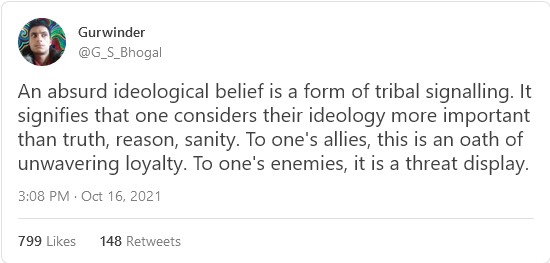
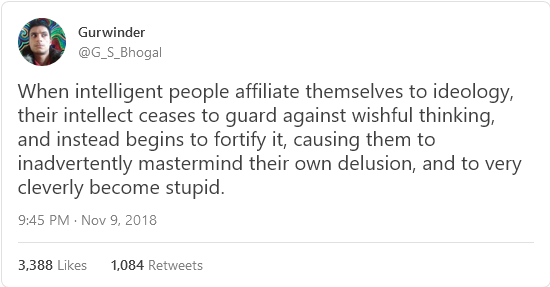
Gurwinder explains why people well above average intelligence are actually more likely to adopt irrational ideas:
What causes delusion?
The prevailing view is that people adopt false beliefs because they’re too stupid or ignorant to grasp the truth. This may be true in some cases, but just as often the opposite is true: many delusions prey not on dim minds but on bright ones. And this has serious implications for education, society, and you personally.
In 2013 the Yale law professor Dan Kahan conducted experiments testing the effect of intelligence on ideological bias. In one study he scored people on intelligence using the “cognitive reflection test”, a task to measure a person’s reasoning ability. He found that liberals and conservatives scored roughly equally on average, but the highest scoring individuals in both groups were the most likely to display political bias when assessing the truth of various political statements.
In a further study (replicated here), Kahan and a team of researchers found that test subjects who scored highest in numeracy were better able to objectively evaluate statistical data when told it related to a skin rash treatment, but when the same data was presented as data regarding a polarizing subject — gun control — those who scored highest on numeracy actually exhibited the greatest bias.
[…]
Since we’re a social species, it is intelligent for us to convince ourselves of irrational beliefs if holding those beliefs increases our status and well-being. Dan Kahan calls this behavior “identity-protective cognition” (IPC).
By engaging in IPC, people bind their intelligence to the service of evolutionary impulses, leveraging their logic and learning not to correct delusions but to justify them. Or as the novelist Saul Bellow put it, “a great deal of intelligence can be invested in ignorance when the need for illusion is deep”.
What this means is that, while unintelligent people are more easily misled by other people, intelligent people are more easily misled by themselves. They’re better at convincing themselves of things they want to believe rather than things that are actually true. This is why intelligent people tend to have stronger ideological biases; being better at reasoning makes them better at rationalizing.
This tendency is troublesome in individuals, but in groups it can prove disastrous, affecting the very structure and trajectory of society.
For centuries, elite academic institutions like Oxford and Harvard have been training their students to win arguments but not to discern truth, and in so doing, they’ve created a class of people highly skilled at motivated reasoning. The master-debaters that emerge from these institutions go on to become tomorrow’s elites — politicians, entertainers, and intellectuals.
Master-debaters are naturally drawn to areas where arguing well is more important than being correct — law, politics, media, and academia — and in these industries of pure theory, secluded from the real world, they use their powerful rhetorical skills to convince each other of FIBs. During their master-debatery circlejerks, the most fashionable delusions gradually spread from individuals to departments to institutions to societies.
Some of these FIBs can now be found everywhere. A particularly prominent example is wokeism, a popularized academic worldview that combines elements of conspiracy theory and moral panic. Wokeism seeks to portray racism, sexism, and transphobia as endemic to Western society, and to scapegoat these forms of discrimination on white people generally and straight white men specifically, who are believed to be secretly trying to enforce such bigotries to maintain their place at the top of a social hierarchy.
February 11, 2023
QotD: “The rest of philosophy is not, as Alfred North Whitehead would have it, a series of footnotes to Plato … but all secular religions are”
And Plato’s actually pretty clear, as philosophers go. You’d really get into trouble with a muddled writer … or a much clearer one. A thinker like Nietzsche, for example, who’s such a lapidary stylist that you get lost in his prose, not realizing that he’s often saying the exact opposite of what he seems to be saying. To briefly mention the most famous example: “God is dead” isn’t the barbaric yawp of atheism triumphant. The rest of the paragraph is important, too, especially the next few words: “and we have killed him.” Nietzsche, supposedly the greatest nihilist, is raging against nihilism.
[…]
So here’s what I’d do, if I were designing a from-scratch college reading list. I’d go to the “for Dummies” versions, but only after clearly articulating the why of my reading list. I’d assign Plato, for example, as one of the earliest and best examples of one of mankind’s most pernicious traits: Utopianism. The rest of philosophy is not, as Alfred North Whitehead would have it, a series of footnotes to Plato … but all secular religions are. The most famous of these being Marxism, of course, and you’d get much further into the Marxist mindset by studying The Republic than you would by actually reading all 50-odd volumes of Marx. “What is Justice?” Plato famously asks in this work; the answer, as it turns out, is pretty much straight Stalinism.
How does he arrive at this extraordinary, counter-intuitive(-seeming) conclusion? The Cliff’s Notes will walk you through it. Check them out, then go back and read the real thing if the spirit moves you.
Articulating the “why” saves you all kinds of other headaches, too. Why should you read Hegel, for example? Because you can’t understand Marx without him … but trust me, if you can read The Republic for Dummies, you sure as hell don’t have to wade through Das Kapital. Marxism was a militantly proselytizing faith; they churned out umpteen thousand catechisms spelling it all out … and because they did, there are equally umpteen many anti-Marxist catechisms. Pick one; you’ll get all the Hegel you’ll ever need just from the context.
Severian, “How to Read ‘The Classics'”, Rotten Chestnuts, 2020-02-13.
February 9, 2023
“Prediction is very difficult, especially about the future” … but sometimes it’s almost prophetic
Once again, Ted Gioia’s Honest Broker Substack has something interesting I’d like to share with you (I wouldn’t blame you at all for cutting out the middleman and just subscribing for yourself):
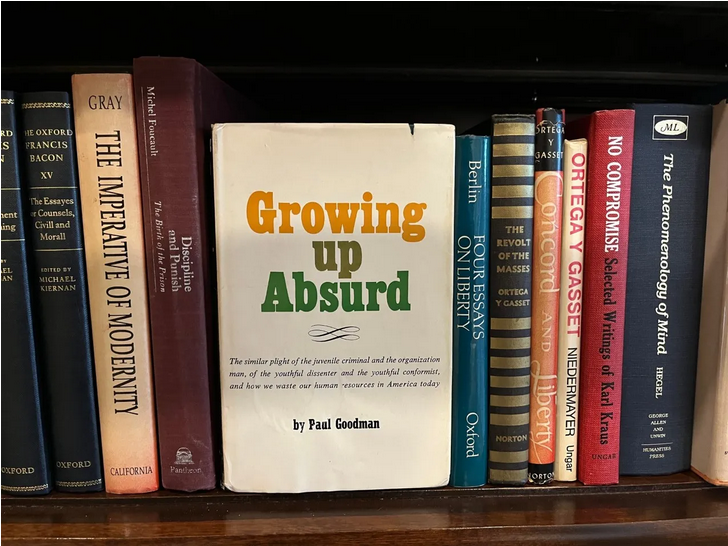
Today I want to focus on a single paragraph published in 1960.
You’re asking yourself: How much can a single paragraph matter — especially if it was written 63 years ago? But read it first and judge for yourself.
It’s a chilling paragraph.
[…]
By any measure, [Paul Goodman] was one of the most eccentric thinkers of the era. Yet he anticipated our current situation with more insight than any of his peers.
Let’s look at this one paragraph from the Preface to Growing Up Absurd. It’s a long paragraph — it takes up most of two pages. So we will break it down into pieces.
Goodman begins with a puzzle he needs to solve — society is stagnating everywhere, and we all can see it. But there’s no action plan to fix it. There’s a lot of huffing and puffing and finger-pointing everywhere, but nobody has even started on developing a practical agenda.
According to Goodman, this is because people “have ceased to be able to imagine alternatives”. Everybody accepts that the current system “is the only possibility of society, for nothing else is thinkable”.
Now comes his analysis, and — to my surprise — Goodman begins by talking about music. This was the last thing I expected in a social critique, but for Goodman the manufacturing of hit songs is a metaphor for everything else that’s wrong in a stagnant society.
He writes:
Let me give a couple of examples of how this [inability to imagine healthy alternatives] works. Suppose (as is the case) that a group of radio and TV broadcasters, competing in the Pickwickian fashion of semi-monopolies, control all the stations and channels in an area, amassing the capital and variously bribing Communications Commissioners in order to get them; and the broadcasters tailor their programs to meet the requirements of their advertisers of the censorship, of their own slick and clique tastes, and of a broad common denominator of the audience, none of whom may be offended: they will then claim not only that the public wants the drivel that they give them, but indeed that nothing else is being created. Of course it is not! Not for these media; why should a serious artist bother?
When I first read this, I was dumbstruck. Goodman wrote this during the winter of 1959 and 1960, when radio stations were independent and freewheeling. Back in my teen years, a single business was only allowed to control one AM station and one FM station. In 1985 this was increased to 12 stations on each band. And in 1994 this was raised again, this time to 20 AM stations and 20 FM stations.
But then all hell broke lose when the Telecommunications Act of 1996 passed in the Senate by a 91 to 5 margin and was signed into law. Now the sky was the limit — and all the airwaves it contained.
Soon Clear Channel Communications owned more than 1,200 radio stations in some 300 cities. The company began the process of standardizing and homogenizing our musical culture. We still suffer from that today.
Even after radio started losing influence in the Internet Age, huge streaming platforms (Spotify, Apple Music, etc.) ensured that access to the ears of America would be controlled by a tiny number of huge corporations. A musical culture that was once local, indie, and flexible has become centralized, corporatized, and stagnant.
How could Paul Goodman even dream of such a scenario back in 1960? That future was decades away at the time.
But we are only at the start of this visionary paragraph. Goodman now explains that the same thing will happen in universities.
Colleges and schools were small and non-bureaucratic back in 1960. Yet Goodman sees a crisis looming. On the next page Goodman warns against “the topsy-turvy situation that a teacher must devote himself to satisfying the administrator and financier rather than to doing his job, and a universally admired teacher is fired for disobeying an administrative order that would hinder teaching”.
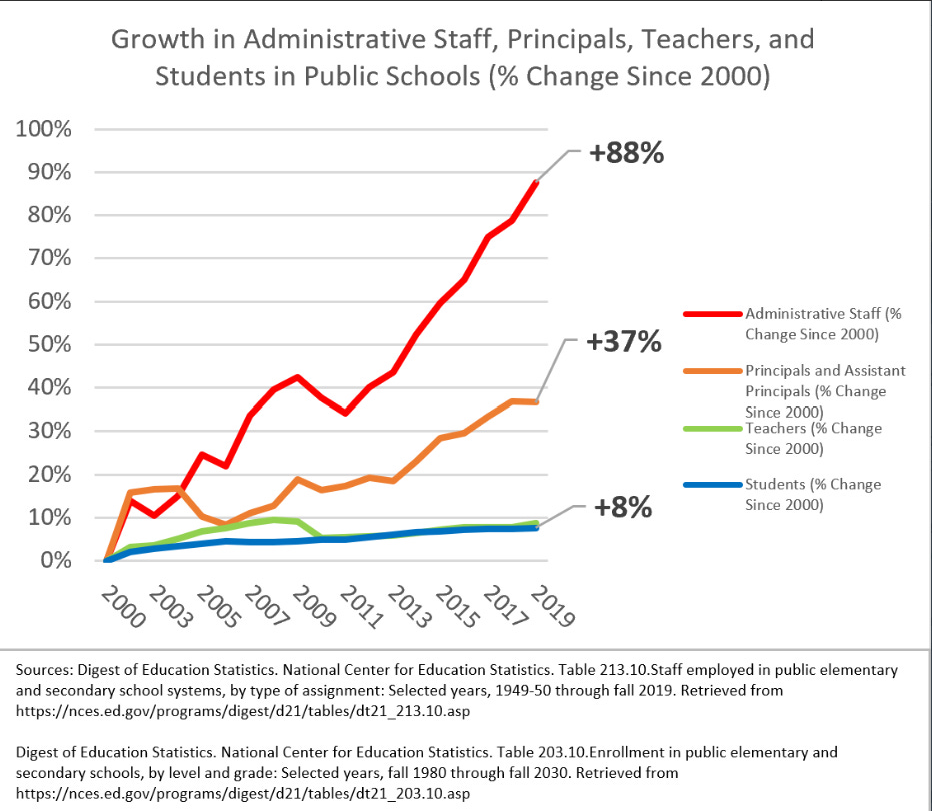
Administration at US colleges has grown exponentially in the last two decades and has turned almost every academic institution into a plodding bureaucracy — but how in the world did Goodman anticipate this in 1960?
Now let’s return to our chilling paragraph. Immediately after discussing radio stations, Goodman adds a gargantuan sentence. It jumps all over the place but hits the target at every twist and turn:
Or suppose again (as is not quite the case) that in a group of universities only faculties are chosen that are “safe” to the businessmen trustees or the politically appointed regents, and these faculties give out all the degrees and licenses and union cards to the new generation of students, and only such universities can get Foundation or government money for research, and research is incestuously staffed by the same sponsors and according to the same policy, and they allow no one but those they choose, to have access to either the classroom or expensive apparatus: it will then be claimed that there is no other learning or professional competence; that an inspired teacher is not “solid”; that the official projects are the direction of science; that progressive education is a failure; and finally, indeed — as in Dr. James Conant’s report on the high schools — that only 15 per cent of the youth are “academically talented” enough to be taught hard subjects.
Here in a nutshell is the credentialing crisis of our times. Learning is replaced by exclusionary certification programs that limit career opportunities — unless you take out loans and “purchase” the necessary credential from these academic gatekeepers.
This has become so destructive in our own time that many are crushed by student loans, and others seek ingenious ways of bypassing college entirely. There’s no way that Goodman could have grasped this in 1960 — when only 7.7 percent of Americans had college degrees.
Nor could he have known about the replicability crisis in science or the destructive games now played in awarding of scientific grants. Those are the problems of our times — not his.
But somehow Paul Goodman saw it coming.
February 7, 2023
QotD: The misery of certainty
So why are they always so fucking miserable?
Let’s stipulate, for instance, that gender really is just a social construction. Even if it’s not, you’re dogmatically certain of this. Crucially, everyone else in your world is equally dogmatically certain, so even if it’s not, it is. Shouldn’t you be much, much, much happier? So you’re really a wingless golden-skinned dragonkin. Cool. Everyone else is 100% on board with this. You should be the happiest wingless golden-skinned dragonkin on earth … but you’re not. You’re miserable, and you do your damnedest to make every single other person you come in contact with miserable, too.
As a wise man once put it, if you run into an asshole in the morning, well, you just ran into an asshole. If you run into nothing but assholes all day, then you’re the asshole.
Same question to atheists. I can understand nonbelievers being tormented by their uncertainty, but an atheist is dogmatically certain there’s no god … so why aren’t y’all happier? Why, exactly, does the kid with cancer make you mad? The universe, you’re sure, is nothing but the random collision of atoms. It sucks for the kid that those atoms collided in that particular way, but why are you mad? More to the point, why are you mad? It’s like getting mad at gravity for that apple bonking you on the head. There’s no cosmic injustice without cosmic justice. I’d expect a zenlike calm, but instead, every time I write something about atheism (which I really don’t very often), I get a whole bunch of sour, bitter, angry atheists dropping in to tell me that I’m the asshole.
Severian, “The Emotion is the Tell”, Rotten Chestnuts, 2020-01-24.
January 31, 2023
“Thorstein Veblen’s famous ‘leisure class’ has evolved into the ‘luxury belief class'”
Rob Henderson had a particularly difficult childhood, but thanks to his own efforts ended up going to Yale after leaving the military. He discovered a very different world when he began his studies:
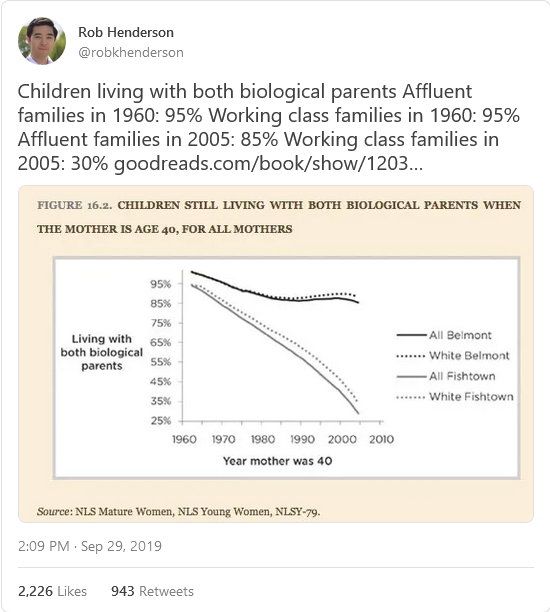
I was bewildered when I encountered a new social class at Yale four years ago: the luxury belief class. My confusion wasn’t surprising given my unusual background. When I was three years old, my mother was addicted to drugs and my father abandoned us. I grew up in multiple foster homes, was then adopted into a series of broken homes, and then experienced a series of family tragedies. Later, after a few years in the military, I went to Yale on the GI Bill. On campus, I realized that luxury beliefs have become fashionable status symbols. Luxury beliefs are ideas and opinions that confer status on the rich at very little cost, while taking a toll on the lower class.
In the past, people displayed their membership in the upper class with their material accoutrements. But today, luxury goods are more affordable than before. And people are less likely to receive validation for the material items they display. This is a problem for the affluent, who still want to broadcast their high social position. But they have come up with a clever solution. The affluent have decoupled social status from goods, and re-attached it to beliefs.
[…]
You might think that rich students at elite universities would be happy because they are in the top 1% of income earners. But remember, they’re surrounded by other members of the 1%. Their social circle, their Dunbar number, consists of 150 baby millionaires. Jordan Peterson has discussed this phenomenon. Citing figures from his experience teaching at Harvard in the 1990s, Peterson noted that a substantial proportion of Ivy League graduates go on to obtain a net worth of a million dollars or more by age 40. And yet this isn’t enough for them. Not only do top university graduates want to be millionaires-in-the-making, they also want the image of moral righteousness. Elite graduates desire high status not only financially, but morally as well.
For our affluent social strivers, luxury beliefs offer them a new way to gain status.
Thorstein Veblen’s famous “leisure class” has evolved into the “luxury belief class”. Veblen, an economist and sociologist, made his observations about social class in the late nineteenth century. He compiled his observations in his classic work, The Theory of the Leisure Class. A key idea is that because we can’t be certain of the financial standing of other people, a good way to size up their means is to see whether they can afford to waste money on goods and leisure. This explains why status symbols are so often difficult to obtain and costly to purchase. These include goods such as delicate and restrictive clothing, like tuxedos and evening gowns, or expensive and time-consuming hobbies like golf or beagling. Such goods and leisurely activities could only be purchased or performed by those who did not live the life of a manual laborer and could spend time learning something with no practical utility. Veblen even goes so far as to say, “The chief use of servants is the evidence they afford of the master’s ability to pay.” For Veblen, butlers are status symbols, too.
Converging on these sociological observations, the biologist Amotz Zahavi proposed that animals evolve certain displays because they are so costly. The most famous example is the peacock’s tail. Only a healthy bird is capable of growing such plumage while managing to evade predators. This idea might extend to humans, too. More recently, the anthropologist and historian Jared Diamond has suggested that one reason why humans engage in displays such as drinking, smoking, drug use, and other physically costly behaviors, is because they serve as fitness indicators. The message is “I’m so healthy that I can afford to poison my body and continue to function.” Get hammered while playing a round of golf with your butler, and you will be the highest status person around.
January 30, 2023
QotD: Teaching … back in the day
Of course, this was so long ago that students used to be unsure how to address me. Most professors had gone “hip” and had students call them by first name, but there were enough crusty old codgers around who insisted on “Dr. So-and-So” that they didn’t assume. After which I started telling them “you can call me whatever you want, but as a general rule life runs smoother if we respect each other’s station. If you know someone has a title, it’s best to use it unless they specifically tell you otherwise, and it’s always good to respect the social distance between yourself and someone who has something you want. So, choose accordingly.” 20 years ago, most of them got it, and addressed me by my title. 15 years ago, I started getting lots of puzzled puppy dog looks (“what’s a ‘social station’?”). 10 years ago, they all just assumed first names were fine, and before I retired I counted myself lucky if I got so much as a “hey dude”.
Meanwhile, as far as the students were concerned, my job went from “trying to teach them something” to “the annoying meat puppet whose presence we have to tolerate until he puts the A+ in the gradebook for record-keeping purposes”.
Severian, responding to a comment on “Movies Made On Mars”, Rotten Chestnuts, 2019-02-04.
January 20, 2023
QotD: Michael Ignatieff
Google “Michael Ignatieff” and you wonder if it was really legal for one man to have enjoyed so many blessings. Everything the Canadian intellectual touched turned to gold. At boarding school in Toronto in the Sixties he was captain of the soccer team and editor of the yearbook. He taught at Oxford and the London School of Economics. He presented The Late Show for the BBC and wrote columns for the Observer. His documentaries won awards; his biography of Isaiah Berlin was shortlisted for some of the world’s most prestigious non-fiction prizes; his novel was even shortlisted for the Booker Prize. He was awarded a professorial chair at Harvard, then another at Toronto. And when his friends in the Canadian Liberal Party invited him to make a bid for the leadership, further glory seemed inevitable.
What happened next, however, makes Kwarteng’s stewardship of the Treasury look like a triumph. In 2011 Ignatieff led the Liberals to the worst defeat in their history, finishing third with just 34 seats. What was worse, he even lost his own seat in Etobicoke–Lakeshore, the first Canadian opposition leader to do so since 1900. His staff were in tears, the world was watching, and all those book prizes must have seemed an awfully long way away. In the cruellest twist imaginable, the man who always came top in exams had failed the most public exam of all.
Dominic Sandbrook, “Kwasi Kwarteng was the wrong sort of clever”, UnHerd, 2022-10-17.
January 14, 2023
QotD: What would it be like to always believe you’re right?
This is not because I’m such a humble guy. If anything, it’s the reverse — it’s because “being right” is such an important part of my self-concept that if I’m going to put my reputation on the line, I need to really BE right. And as we all know, 99% of being right comes from acknowledging all the times you were wrong. Admitting I don’t know when I really don’t know is painless. Admitting I was wrong when I thought I was right stings, but it doesn’t hurt nearly as bad as my own inner self-knowledge of being wrong. That really stings, and so I’d rather take the pain of admitting I was wrong any number of times to the much greater pain of actually being wrong on something fundamental.
To the Leftist, none of that computes. They’re always right. About everything. They literally can’t be wrong. And if what they were right about yesterday is 180 degrees from what they’re right about today, well, that’s just Reality reconfiguring itself. The Earth is stable; it’s the sun and stars that are moving around it. And if that leaves you with deferents and epicycles and retrograde motion and all that, well, so be it. See above, re: the physical impossibility of them being wrong …
… at least as individuals. But get them in a group, and all of a sudden a whole roomful of sort-of-Gods turns into a persecuted minority, even when everyone in the group agrees with everyone else. Even when the group, collectively, controls everything. If you think it’s bad in politics, y’all, go to a faculty meeting at the nearest college. To hear them tell it, the wolf is always at the door. Donald Trump and his jackbooted stormtroopers really are lurking behind every bush, waiting to jump out and pour bleach on them while yelling “This is MAGA country, bitch!” They’re afraid of their own students, because they just know those kids are out there thinking Unapproved Thoughts, and somehow those Unapproved Thoughts can physically harm them … even though they control the grade book, and can — and of course do — punish Unapproved Thought with extreme prejudice.
[…]
If I’m reading Zorost correctly, the answer might be as simple as: They can’t abstract, so they’re literally physically incapable of Reality-testing their heuristics. The Experts have given them the TORAH (that’s The One Right Answer, H8rz!), and since they can only evaluate individual cases as they come into view — they can only micro-focus on each parked car in the lot, to return to the earlier metaphor — they can’t draw the really-obvious-to-non-autists conclusion that they are not a persecuted minority, but in fact control everything.
Severian, “Why Are They Always Underdogs?”, Founding Questions, 2022-09-07.


