Quotulatiousness

December 10, 2013

Origins of the “infographic” plague

Filed under: Books, Media — Tags: , , , — Nicholas @ 09:28

As Tim Harford says, “So it’s HIS fault”:

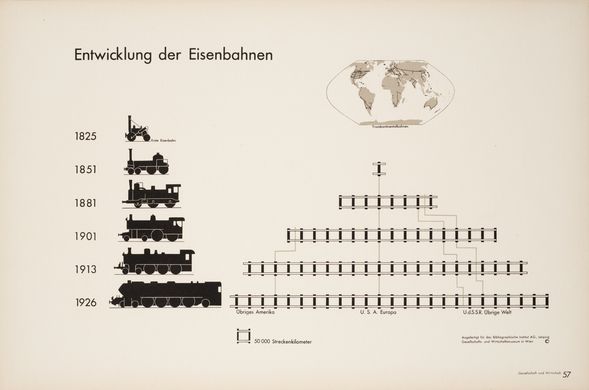
In the 1930s, Austrian sociologist, philosopher and curator Otto Neurath and his wife Marie pioneered ISOTYPE — the International System Of TYpographic Picture Education, a new visual language for capturing quantitative information in pictograms, sparking the golden age of infographics in print.

The Transformer: Principles of Making Isotype Charts is the first English-language volume to capture the story of Isotype, an essential foundation for our modern visual language dominated by pictograms in everything from bathroom signage to computer interfaces to GOOD’s acclaimed Transparencies.

Isotype1

The real cherry on top is a previously unpublished essay by Marie Neurath, who was very much on par with Otto as Isotype’s co-inventor, written a year before her death in 1986 and telling the story of how she carried on the Isotype legacy after Otto’s death in 1946.

Isotype2

December 6, 2013

Mismeasuring inequality

Filed under: Economics, USA — Tags: , , — Nicholas @ 15:20

Tim Worstall on a Wall Street Journal article which asks “how do we measure inequality”. Tim says “not that way, idiots” (although I might have imagined the “idiots” part):

The title of the piece is “How do you measure ‘inequality’?” to which a very good response is “Not that way”. For although all the numbers there are exact and accurate (well, as much as any economic statistic is such) the whole statement is entirely misleading. For the numbers that are being used for the USA are calculated on an entirely different basis to the way that the numbers for the other countries are. So much so that in this instance we have Wikipedia being more accurate than either the WSJ or the CIA itself. Which, while amusing, isn’t quite the world I think we’d all like to have.

Here’s what the problem is. Conceptually we can measure inequality in a number of different ways and this particular one, the Gini, looks at the spread of incomes across the society. OK, no need for the details of how we calculate it except for one. We again, conceptually, have two different incomes that can be measured.

So, the guy pulling down $1 million a year dealing bonds on Wall Street. Does he really have an income of $1 million a year? Or is it more true to say that he gets $600,000 a year after the Feds, NY State and NYC have all dipped their hands into his paycheck? And the guy at the other end, making $15,000 a year as a greeter at WalMart. Is he really making $15,000? Or should we add in the EITC, the State EITC (if there is one), Section 8 housing vouchers, Medicaid and all the rest to what he’s earning? He might be consuming as if he’s getting $25 k a year, even though his market income is only $15k.

What we actually do is we calculate both of these. The first is called the Gini at market incomes, the second the Gini after taxes and benefits. There’s nothing either right or wrong about either measure: they just are what they are. However, we do have to be clear about which we are using in any circumstance and similarly, very clear about not comparing inequality in one country by one measure with inequality in another by the other measure. Yet, sadly, that is exactly what is being done here.

December 4, 2013

Apple iPhone pricing in different markets

Filed under: Economics, Technology — Tags: , , , — Nicholas @ 08:06

In Forbes, Tim Worstall explains a misunderstanding of Ricardo’s Iron Law of One Price on the part of the Guardian:

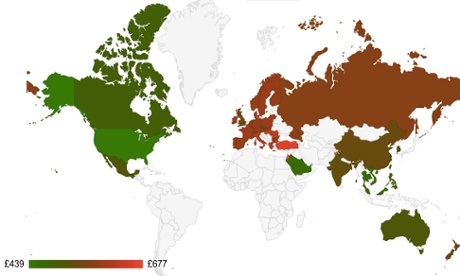
This is a fun little bit of data calculation and visualisation. It’s a database and then mapping of the global price list for Apple’s iPhone 5s. And there are two interesting ways of using it. The first is simply to look at how prices differ around the world:

iPhone price mapYou can do this in USD or GBP as you wish. And this can be used to explore the violations of Ricardo’s Iron Law of One Price. Which is where David Ricardo insisted that the prices of traded goods would inevitably move to being equal all over the world. Well, equal minus the transport costs of getting them around the world. And transport costs for an iPhone are trivial: it would be amazing if Apple were paying more than a couple of dollars to airfreight one to anywhere at all. So, we would expect prices to be the same everywhere: but they obviously are not.

[…]

However, when The Guardian reports on this something appears to go wrong. Not their fault I suppose, it’s about economics and lefties never really do get that subject. But here:

    Similar to the way the Economist tracks the cost of the ubiquitous McDonalds burger across countries, nations and states, Mobile Unlocked tracked the price of the iPhone 5S across 47 countries in native currencies with native sales tax, and then converted those prices into US dollars (USD) or British pounds (GBP).

No … the Big Mac Index operates entirely and exactly the other way around. We need to make the distinction between traded goods and non-traded goods. The Iron Law only works on traded goods. What we’re trying to find out with PPP calculations is what are the price differentials of non-traded goods? Which is why the Big Mac is used. It is (supposedly at least) exactly the same all over the world. It is also made almost entirely from local produce bought at the local price in local markets. US Big Macs use American beef, Argentine ones Argentine and so on. So we get to see the impact of local prices on the same product worldwide. That’s what we’re actually attempting with that Big Mac Index. The Economist then goes on to compare the prices of this non-traded good with exchange rates and attempt to work out whether the exchange rates are correct or not.

This is entirely different from using the price of a traded good to measure local price variations. For what we’re going to be measuring here is what interventions there are into stopping the Iron Law working, not what local price levels are.

November 28, 2013

What’s the real US unemployment rate?

Filed under: Economics, Government, USA — Tags: , — Nicholas @ 11:44

Statistics can be very helpful tools in analysis, but the quality of analysis will depend on the accuracy of the statistics. In the US, the organization responsible for compiling the unemployment numbers is the Bureau of Labor Statistics (BLS). They actually compile several different categories of unemployment data, only one of which is commonly used by the media: the U-3 unemployment rate. Wendy McElroy explains why this may be a very misleading number:

The Bureau of Labor Statistics (BLS) compiles the United States’ unemployment statistics every month. It looks at six categories of different data, that are called U-1 to U-6. U-3 counts how many people were unemployed but were actively looking for work during the past month; this is the official unemployment rate that is broadcast by the media. By contrast, U-6 counts the unemployed and underemployed who are excluded from the U-3 data. For example, U-6 classifies people who have unsuccessfully looked for a job in the last year as “not participating in the labor force” rather than as unemployed. U-6 also includes part-time workers who need more employment in order to live, but the number of these workers is dwarfed by the number of long-term unemployed. (“Long-term employment” is defined as lasting 27 weeks or more).

The data included in the categories increase as the numbers ascend; the categories are defined as follows:

  • U-3 Total unemployed, as a percent of the civilian labor force
  • U-4 Total unemployed plus discouraged workers
  • U-5 Total unemployed, plus discouraged workers, plus all other persons marginally attached to the labor force
  • U-6 Total unemployed, plus all persons marginally attached to the labor force, plus total employed part time for economic reasons

What is America’s real unemployment rate? According to U-3 for October 2013, 11.3 million people were officially unemployed. BLS adds that 91,541,000 working age people did not participate in the labor force. If these numbers are added together, there are 102 million working age Americans who are either unemployed or not in the labor force for reasons that are not clear; for example, they could be retired. The non-working population represents 37.2% of working age people.

(Note: it is not known how the federal furlough of employees during the October shutdown affected the data, if at all. The furloughed employees seem to have been counted as both unemployed and working because they eventually received full payment for the time off.)

The unemployment rate reflected by the last four categories of BLS data break down as follows:

  • U-3 = 7.3%
  • U-4 = 7.8%
  • U-5 = 8.6%
  • U-6 = 13.8%

The American media used the U-3 numbers and reported the unemployment rate for October to be 7.3%, which is about 1/2 of the more realistic U-6 total. The media also glossed over U-3 figures that were alarming. For example, the official rate for teen unemployment (16 to 19 years old) stood at 22.2%; black unemployment is 13.1%

November 23, 2013

Houston – sex trafficking capital of the world (says Dallas newspaper)

Filed under: Law, Media — Tags: , , , — Nicholas @ 09:17

According to a Dallas newspaper, Houston is the focal point of a vast sex trafficking operation:

Check out this obvious crap — unbelievable to any thinking person — in the November 22 Dallas Morning News.

The Texas Senator and Representative that the paper apparently very credulously and obediently took notes from contend that there are 300,000 sex trafficking cases prosecuted every year — “in Houston alone.”

Here’s the quote from the Dallas Morning News editorial:

    Editorial: Cracking down on sex traffickers

    Two Texas Republicans, Sen. John Cornyn and Rep. Ted Poe of the Houston area, are co-sponsoring a bill that would impose stiff penalties on these adult victimizers of up to life in prison. The Justice for Victims of Trafficking Act, which has bipartisan support in both houses, would supplement an existing law that focuses primarily on punishing sex-trafficking organizations abroad.

    Poe and Cornyn estimate that one-quarter of U.S. sex-trafficking victims have Texas roots. Poe says our state’s proximity to Mexico and high immigrant population give the state a particularly high profile. In Houston alone, about 300,000 sex trafficking cases are prosecuted each year.

Do they work butt-drunk at this paper?

300,000? Do you realize how many people that is?

[…]

Of course, Houston’s population is only 2.161 million. So, throw in my fantasy guestimate of at least 200,000 uncaught and unpunished people guilty of sex trafficking on top of the 300,000 supposedly documented. This suggests that a vast segment of Houston’s population — at least 15 percent and maybe 25 percent — is engaged in the business of sex trafficking.

Math is hard.

November 19, 2013

Making Granny pay … full fare

Filed under: Business, Cancon, Economics — Tags: , , , , , — Nicholas @ 17:43

In Maclean’s, a look at the feel-good but economically silly reasons for senior discounts:

The seniors discount has long been justified as a way to recognize the constraints faced by pensioners stuck on fixed incomes, and as a modest token of appreciation for a lifetime spent paying taxes and contributing to society. And for those truly in need, who would quibble? But with half a million Baby Boomers — a group not known for frugality or lack of financial resources — turning 65 every year for the next few decades, the seniors discount is in for much greater scrutiny.

[…]

There was a time when the seniors discount made a lot more sense. In the mid-1970s, nearly 30 per cent of all seniors were considered poor, as defined by Statistics Canada’s low-income cut-off. But today, this has fallen to a mere 5.2 per cent. The impact of this turnaround is hard to overstate. Seniors once faced the highest rates of poverty in Canada; now they enjoy the lowest level of any age group: The poverty rate among seniors is almost half that of working-age Canadians.

Thanks to a solid system of government support programs, the very poorest seniors receive more income in retirement than they did when they were of working age. The near-elimination of seniors’ poverty is widely considered to be Canada’s greatest social policy triumph of the past half-century.

This tremendous improvement in seniors’ financial security has dramatically changed the distribution of income across age categories, as well. In 1976, median income for senior households was 41 per cent of the national average. Today, it’s 67 per cent. Over the same period, median income for families where the oldest member is aged 25-34 has fallen in both absolute and relative terms.

Then there’s the vast wealth generated for the Boomer generation by the housing and stock markets (only some of which was lost during the great recession). The stock of wealth in housing, pensions and financial assets held by the average senior family is nearly double that of working-age households. Accounting for the financial benefits of home ownership and rising house values, Statistics Canada calculates the true net annual income of retired households rises to 87 per cent of a working-age household’s income. In other words, non-working seniors are making almost as much as folks in their prime earning years, but without all the expenses and stressors that go with a job, children at home, or middle age. Not only that, the current crop of seniors enjoys historically high rates of pension coverage. The much-publicized erosion of private-sector pensions will hit younger generations who are currently far from retirement.

November 10, 2013

Growth forecasts continue to over-estimate Canada’s actual economic progress

Filed under: Cancon, Economics — Tags: , , , , — Nicholas @ 12:12

In Maclean’s, Debbie Downer Colin Campbell takes a survey of the state of Canada’s economy:

A key qualification for landing a job at the Bank of Canada, it seems, is an unfailing sense of optimism. In 2009, the bank forecast the economy would grow 3.3 per cent in 2011. It grew 2.5 per cent. In 2011, it said the economy would grow 2.9 per cent in 2013. It will likely be just 1.6 per cent. Now it says the economy will grow 2.3 per cent next year. How likely is that? The bank has consistently viewed the economy through rose-coloured glasses in recent years, perhaps believing its low-interest-rate policy will eventually bear fruit. Rates have been held at one per cent for three years now. But the economy seems only to be getting worse.

It grew 0.3 per cent in August, Statistics Canada said last week — mostly attributed to a familiar crutch, the oil business. Elsewhere, things aren’t looking up. A new TD Bank report said corporate Canada is “in a slump,” with profits down 16 per cent from their post-recession peak in 2011. Some observers point out that Canada is still doing better than Europe and Japan. But so are most countries that aren’t in a recession, from South Africa and New Zealand to Equatorial Guinea and Guatemala. After breezing through the recession, Canada is back to old habits: hoping its fortunes (i.e., exports) will rise along with America’s comeback. But the U.S., too, is back in a rut. Last week, the Federal Reserve said it would continue with its $85-billion-a-month bond-buying stimulus program.

With the economy sputtering, Ottawa has meanwhile remained preoccupied with fiscal restraint and balancing the budget within two years. So, with neither low interest rates nor government spending providing a boost, the outcome seems predictable: Official growth forecasts will look nice, but will keep missing the mark.

October 29, 2013

Poverty in America

Filed under: Economics, USA — Tags: , , , — Nicholas @ 10:40

Zero Hedge recently went on a tear about “soaring poverty in America”, compiling a list of 29 items which “proved” the case. Tim Worstall indulges in a bit of fisking over the mythical claims:

    2. New numbers have just been released, and they show that the number of public school students in this country that are homeless is at an all-time record high. It is hard to believe, but right now 1.2 million students that attend public schools in America are homeless.

No, I’m afraid not. In fact, this isn’t possible in the slightest. The numbers for homelessness are here.

    In January 2012, 633,782 people were homeless on a single night in the United States. Most (62 percent) were homeless as individuals and 38 percent were homeless as persons in families.

At any one time we have 630,000 homeless people. We cannot therefore have twice that number of children alone being homeless at any one time. This is not one of the mathematical possibilities that this universe offers us.

What is actually being said in the original number is that over the course of a a year 1.2 million children will suffer one or more incidents of homelessness. We can still think that this is appalling, that it shouldn’t happen and that we ought to be doing more about it. But it is not true that “right now 1.2 million students that attend public schools are homeless”.

    3. When I was growing up, it seemed like almost everyone was from a middle class home. But now that has all changed. One recent study discovered that nearly half of all public students in the United States come from low income homes.

Well, if you grow up in a middle class area then of course those you grow up with are likely to be middle class. But that nearly half of students coming from low income homes is indeed true. But it’s extremely uninteresting that it is. Here’s the definition of low income they are using:

    To be crystal clear, the researchers were not analyzing poverty rates per se. Rather, they tracked at the percentage of children in each state who received free or reduced school lunches, which are only available to students whose families earn below 185 percent of the poverty line. For a family of four, that amounted to about $41,000 in 2011.

As it happens, median household income is around two times that federal poverty line. So, 185% of the federal poverty line is going to be pretty close to the median household income. Median household income being the amount that 50% of households get more than and 50% get less than. So, yes, we would pretty much expect that 50% of children are coming from low income families. Because it’s only in Lake Woebegon that all the children are above average. This is a statistical artifact of the measure they are using as low income, nothing else.

And, of course, the traditional mis-measurement of poverty in the US compared to pretty much every other western country:

    6. According to the U.S. Census Bureau, approximately one out of every six Americans is now living in poverty. The number of Americans living in poverty is now at a level not seen since the 1960s.

No, this is not true, as I’ve pointed out in these pages many a time. Many, many, many, many times in fact.

The 15% in poverty measure is the number of people who would be in poverty if we didn’t help them by giving them money, food, housing and health care. It is not the number living in poverty. It is the number in poverty before we help them out of poverty. And as to the comparison with the 1960s, in the 1960s it really was the number in poverty after we helped, now it’s the number before we help.

As to why this is when we calculate the number below the poverty line we look only at cash incomes. This includes any actual money that people might be given to alleviate their poverty. In 1960s America pretty much the only poverty alleviation that was done was to give money to poor people (“welfare”). Today we give very little money directly. But we spend a vastly greater amount in giving people things. Medicaid, Section 8 housing vouchers, SNAP (or food stamps). We also give aid to the low paid through the tax system, with the EITC. However, we do not count all of those things, nor the EITC through the tax system, in our calculation of the number below the poverty line. So, since the 1960s the US measure of poverty has changed. From being one of people who are indeed living in poverty after whatever help they get to one of the number of people who would be in poverty before any help that they get.

When we correct for this the US poverty rate is significantly lower now than it was in the 60s. One estimate is that it is about half the 60s number.

October 21, 2013

Nate Silver on Chinese economic data

Filed under: China, Economics — Tags: — Nicholas @ 08:37

The Wall Street Journal‘s China Real Time Report has an interview with celebrity statistician Nate Silver:

Can you apply good data analysis to poor data, for example, in China?

People in the United States and the United Kingdom overestimate the quality of economic data. Even if people are above board, it is simply hard to estimate something like the American economy.

With China, you would have even more difficulty. I think the general lesson is that by looking at a broader consensus of indicators, you do well than just looking at one indicator or one sector.

It is problematic to think about “how do you measure Chinese growth”. One way [is to look at] more public facing measures — by looking, for example, at the amount of light output emanating from China.

I flew through Beijing [on the way to Hong Kong] — there was less physical brightness coming from Beijing than you would have seen from a comparable American city or European city.

A true cynic might suggest that the lights were dimmed by the pervasive air pollution in Beijing…

October 16, 2013

US wages and personal mobility

Filed under: Economics, USA — Tags: , , , , — Nicholas @ 08:07

Coyote Blog looks at the widely touted flattening of income growth in the United States and wonders how much mobility (people moving from one state to another) might play a part in the overall picture:

All of this is a long introduction to some thinking I have been doing on all the “Average is Over” discussion talking about the flattening of growth in median wages. I begin with this chart:

Click to see full-sized image

Click to see full-sized image

There is a lot of interstate migration going on. And much of it seems to be out of what I think of as higher cost states like CA, IL, and NY and into lower cost states like AZ, TX, FL, and NC. One of the facts of life about the CPI and other inflation adjustments of income numbers is that the US essentially maintains one average CPI. Further, median income numbers and poverty numbers tend to assume one single average cost of living number. But everyone understands that the income required to maintain lifestyle X on the east side of Manhattan is very different than the income required to maintain lifestyle X in Dallas or Knoxville or Jackson, MS.

Could it be that even with a flat average median wage, that demographic shifts to lower cost-of-living states actually result in individuals being better off and living better?

For some items one buys, of course, there is no improvement by moving. For example, my guess is that an iPhone with a monthly service plan costs about the same anywhere you go in the US. But if you take something like housing, the differences can be enormous.

Let’s compare San Francisco and Houston. At first glance, San Francisco seems far wealthier. The median income in San Francisco is $78,840 while the median income in Houston in $55,910. Moving from a median wage job in San Francisco to a media wage job in Houston seems to represent a huge step down. If you and a bunch of your friends made this move, the US median income number would drop. It would look like people were worse off.

But something else happens when you take this nominal pay cut to move to Houston. You also can suddenly afford a much nicer, larger house, even at the lower nominal pay. In San Francisco, your admittedly higher nominal pay would only afford you the ability to buy only 14% of the homes on the market. And the median home, which you could not afford, has only about 1000 square feet of space. In Houston, on the other hand, your lower nominal pay would allow you to buy 56% of the homes. And that median home, which you can now afford, will have on average 1858 square feet of space.

October 9, 2013

Reasons not to be fearful of “China’s economic threat”

Filed under: China, Economics, Government — Tags: , , , , — Nicholas @ 13:50

If you’ve been following the blog for a while, you’ll probably have picked up some of my disdain for the “OMG! China’s going to eat our (economic) lunch!” meme that is pretty much a copy-paste of the same worry over Japan in the 1980s. In Maclean’s, Colby Cosh explains why you shouldn’t put too much effort into worrying about the Chinese economic Colossus crushing us any time real soon:

What I always wonder when I encounter a China bull or a Chinaphobe — for they are two sides of the same coin — is this: Even if they think “socialism with Chinese characteristics” is economically superior to ordinary capitalism, where in China are the parallel cultural institutions to support prolonged capitalist-style growth? Maybe China doesn’t need reciprocal free trade to blow our doors off in the race to utopia. Maybe it doesn’t need untidy democratic quarrelling. One presumes it won’t need a high level of achievement in basic science, either, judging by the Nobels: It is well-documented that the Chinese civilian research establishment is awash in fraud and plagiarism, to say nothing of the destructive favouritism inherent to a one-party state.

Rowan Callick’s new book The Party Forever: Inside China’s Modern Communist Party makes a simple, compact judgment on the general state of Chinese higher education: Just look where the Party leadership sends its own children to university: the U.S. Another important leading indicator of cultural progress is press freedom, which, if history has anything to say on the matter at all, appears to be utterly integral to sustained prosperity. But Mainland China has no newspapers as we understand them; it is not even clear that the regimented, spoon-fed “reporters” there could assemble one, even if the Party would allow it.

The Diane Francises of the world would have us reject the relevance of the Soviet experience to China’s future, to the point of ignoring familiar Soviet themes that are increasingly apparent in China: the vast infrastructure projects standing unused in the middle of nowhere, the blind environmental despoliation, the dodgy economic statistics. Beyond mastery of trading, interior China has simply never possessed much of the cultural technique upon which the advanced stages of economic development would seem to depend. Hong Kong is the exception, but having taken it over, China shows little appetite so far for imitating its social openness and individuality — or for those of Taiwan or Japan or South Korea. It still requires a strange leap of faith to believe it possible for China to economically surpass these neighbours, and ourselves, without becoming a great deal more like us.

Regular visitors to the blog know that I’ve been rather skeptical about the official statistics reported by Chinese government and media sources.

Mismeasuring American poverty

Filed under: Bureaucracy, Economics, Government, USA — Tags: , , — Nicholas @ 08:47

It’s always headline-worthy to say that some absurdly high number of Americans are living in poverty — that the richest country in history still has desperately poor people in vast numbers. It’s shocking to see … and it’s mostly bogus:

We get told they do often enough I know, the latest example being this:

    About 15% of Americans live in poverty, so why is no one talking about it?

It isn’t true.

    In a nation where, according to the US Census Bureau’s poverty statistics released last month, 46.5 million people (roughly 15%) of the nation’s population lives in poverty,

Sorry, but their repeating it does not make it true.

The correct formulation is that 15% of Americans would be living in poverty if it were not for the things that are done to alleviate poverty.

There are two things that make this correction really rather important. The first being that everyone else measures poverty after all the things that are done to alleviate it. Thus any comparison across countries is going to leave the US looking very bad indeed: for others are talking about the residual poverty left after trying to do something about it and the US is talking about the poverty before alleviation. Very different things I hope you’ll agree.

There are reasons why this meme won’t go away (aside from it being a handy eye-catching headline to attract readers for newspapers and websites), including the fact that many civil servants are employed in federal, state, and local organizations to work on programs intended to alleviate poverty. If they are too successful, their caseload goes down and so will their budget and headcount. Any bureaucracy has a prime directive quite separate from their original reason for existing — organizations have primal motivations for surviving and growing. Their incentive is thus merely to ease the problem, not to solve it, or else they’re working to put themselves out of business.

October 7, 2013

Even the “revised” official Chinese economic stats are dodgy

Filed under: China, Economics — Tags: , , — Nicholas @ 09:23

In a survey of China’s military and economic status, Strategy Page mentions the perennial issue of unreliable official economic statistics for China:

Chinese officials are becoming more open about the problems they have getting accurate economic information for such things like annual GDP and unemployment rates. Apparently Chinese GDP has not been growing steadily at near ten percent a year for decades. Chinese officials do eventually (months or years later) get more accurate data and while Chinese GDP has actually been steadily growing over the last three decades the annual growth has actually varied from 5-15 percent. Chinese official policy was to keep everyone calm by issuing less variable annual growth rates. In short, the official numbers were doctored. For more accurate and immediate indicators of economic activity Chinese and foreign economists and business leaders use things like electricity production, railroad traffic and similar data that cannot be manipulated by local officials to make their city or province look more successful. Many financial exerts inside and outside China fear that all this official manipulation of economic data (an ancient practice in China) is masking some serious economic problems that could go sideways at any time and cause a banking crises that would paralyze the economy for a while and cause political chaos. It’s very much a crouching tiger and hidden dragon. This is an ancient phrase warning that behind seeming success and talent lurks the possibility of imminent disaster. Chinese are ever mindful of these bits of ancient wisdom.

October 5, 2013

Climate models, trust, and spin

Filed under: Environment, Media — Tags: , , — Nicholas @ 08:58

In Reason, Ronald Bailey asks whether we can trust the IPCC’s climate models:

On Monday, the U.N.’s Intergovernmental Panel on Climate Change (IPCC) released the final draft of Climate Change 2013: The Physical Sciences Basis. The report’s Summary for Policymakers flatly states: “Warming of the climate system is unequivocal, and since the 1950s, many of the observed changes are unprecedented over decades to millennia. The atmosphere and ocean have warmed, the amounts of snow and ice have diminished, sea level has risen, and the concentrations of greenhouse gases have increased.” Pretty much everyone concerned with this issue agrees that those are the facts. But what is causing the planet to warm up? Here is where it gets interesting.

[…]

The IPCC report acknowledges that almost all of the “historical simulations do not reproduce the observed recent warming hiatus.” Not to worry, it assures us; 15-year pauses just happen, and you can’t really expect the models to simulate these kind of random natural fluctuations in the climate. Once this little slow-down passes, “It is more likely than not that internal climate variability in the near-term will enhance and not counteract the surface warming expected to arise from the increasing anthropogenic forcing.” In other words, when the warm-up resumes it will soar.

John Christy, a climatologist at the University of Alabama in Huntsville, has come to a different conclusion. Christy compared the outputs of 73 climate models for the tropical troposphere used by the IPCC in its latest report with satellite and weather balloon temperature trends since 1979 until 2030. “The tropics is so important because that is where models show the clearest and most distinct signal of greenhouse warming — so that is where the comparison should be made (rather than say for temperatures in North Dakota),” Christy explains in an email. “Plus, the key cloud and water vapor feedback processes occur in the tropics.” When it comes to simulating the atmospheric temperature trends of the past 35 years, Christy found, all of the IPCC models are running hotter than the actual climate.

[…]

Average of model results compared with temperature trends

Average of model results compared with temperature trends

To defend himself against any accusations of cherry-picking his data, Christy notes that his “comparisons start in 1979, so these are 35-year time series comparisons” — rather longer than the 15-year periods whose importance the IPCC disputes.

Why the discrepancy between the IPCC and Christy results? As Georgia Tech climatologist Judith Curry notes, data don’t speak for themselves; researchers have to put them into a context. And your choice of context — say, the year you choose to begin with — can influence your conclusions considerably. While there may be nothing technically wrong with the way the IPCC chose to display the comparison between model data and observation data, “Curry observes, it will mislead the public to infer that climate models are better than we thought.” She adds, “What is wrong is the failure of the IPCC to note the failure of nearly all climate model simulations to reproduce a pause of 15+ years.”

September 25, 2013

Redefining “austerity” (again)

Filed under: Economics, Government, USA — Tags: , , — Nicholas @ 07:51

At Coyote Blog, an illuminating comparison of “austerity” measurements, responding to a piece in Mother Jones by Kevin Drum:

He uses this graph to “prove” that our fiscal response to this recession is weak vis a vis past recessions. The graph is a bit counter-intuitive — note that it begins at the end of each recession. His point is that Keynesian spending needs to continue long after (five years ?!) after the recession is over to guarantee a good recovery, and that we have not done that.

Government spending after recessions

[…]

I took roughly the same data and started each line two years earlier, so that my first year is two years ahead of his graph and the zero year in my graph is the same as the zero point in Drum’s chart. His data is better in the sense that he has quarterly data and I only have annual. Mine is better in that it looks at changes in spending as a percentage of GDP, which I would guess would be the more relevant Keynesian metric (it also helps us correct for the chicken and egg problem of increased government spending being due to, rather than causing, economic expansion).

Here are the results (I tried to use roughly the same colors for the same data series, but who in the world with the choice of the entire color pallet uses two almost identical blues?)

Government spending before and after recessions

That second image tells a radically different story to the first one, doesn’t it? Hard to make that fit into the traditional definition of the word “austerity” though…

« Newer PostsOlder Posts »

Powered by WordPress