
Thersites the Historian
Published 23 Feb 2025After its efflorescence during the 2nd Century, Roman Britain entered steep decline during the 3rd Century and the benefits of Roman civilization had all but vanished by the time that the Romans withdrew their forces and support.
August 28, 2025
History of Britain VII: Fall of Roman Britain
Comments Off on History of Britain VII: Fall of Roman Britain
August 19, 2025
Roman Hellenism
In his post “A Pagan Confession“, Fortissax provides an explanation of Roman Hellenism, the most widespread religious system in Europe before Christianity:
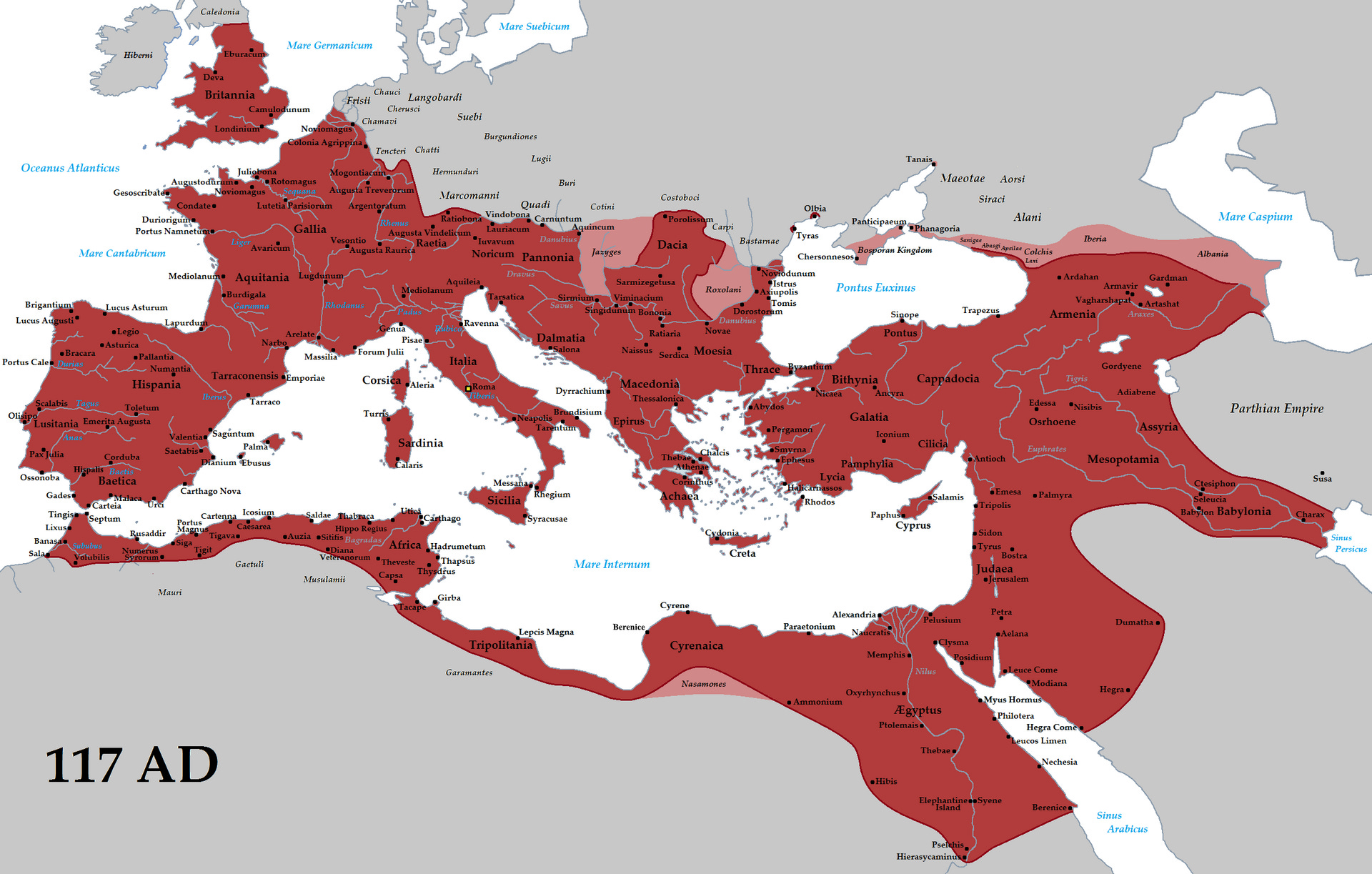
The Roman Empire at its maximum extent
The closest term that would describe me is “Roman Hellenist”.
Roman Hellenism was the largest religion in the Western world prior to the rise of Christianity. It was followed from Britain to Greece, from Spain to Romania, and was the first civilization-wide faith for Europeans.
At its height under the Roman Empire, Hellenism was a vast and adaptable religious tradition that united Greek mythology, Roman state religion and cults, household rites, and philosophical schools into a coherent spiritual world. As the organized state religion, the Dii Consentes were worshipped in every corner of the empire under both Latin and Greek names. Jupiter, Mars, Venus, Apollo, Minerva, and others were honoured through public festivals, imperial temples, military devotions, and local folk religion. This civic devotion was shaped by writers such as Cicero, Livy, and Plutarch, who emphasized the importance of piety, order, and divine ancestry.
Hellenism offered more than just myth or folklore. It provided a structured understanding of the cosmos, where the gods represented natural and moral forces, and where religion was interwoven with daily life, civic duty, and personal virtue. Mystery cults such as those of Dionysus and the Eleusinian rites offered deeper initiatory experiences, described by authors like Herodotus and Euripides. Philosophers such as Plato, Plotinus, Porphyry, Iamblichus, Proclus, Damascius, and Hierocles were considered divinely inspired and were often trained by the augurs, or in the College of Pontiffs, established in 400 B.C., and the inspiration for the College of Cardinals. These were priests within the state religion.
They built the theology of the faith. These philosophers were not monotheists or atheists, but pagans, and their theology came from Hellenism. Ordinary people prayed, sacrificed, and kept sacred fires at home. This marks the distinction between the folk religion of the everyman and the theological work of the priestly and philosophical elite, though they formed a whole, similar to Christian folk religion compared to the sophistication of the clergy. Hellenism in the Roman world was participation in a divine order that shaped identity, politics, culture, and destiny.
It had a core, but it was a dynamic tapestry. It often accommodated or incorporated local and regional gods of subject peoples throughout the empire, including other Europeans. It was normal to find shrines or temples dedicated to syncretic deities where Roman and provincial traditions were blended. This reflected a deeper truth shared by many Indo-European peoples. Across vast distances, from the Celts and Germans to the Greeks and Romans, there was a common spiritual grammar. Their gods often held similar roles, attributes, and origins. Rather than destroy or suppress local belief, Roman Hellenism often absorbed and integrated it within a universal metaphysical framework, though one without too strict of a dogma, which allowed spiritual continuity across cultures.
The Romans referred to this process as interpretatio graeca, the identification of foreign gods with Greek ones, and interpretatio romana, the application of Roman names and attributes. In Gaul and Germania, local deities such as Lugh or Wodan were equated with Hermes or Mercury. Camulos and Tyr equated with Mars, Taranis with Jupiter through interpretatio gallica and interpretatio germanica.
These interpretive traditions allowed theological bridges across linguistic and ethnic boundaries, fostering religious continuity and civic unity. Writers like Varro, Tacitus, and Strabo observed this continuity, noting that while names and symbols differed, the gods themselves were one in essence. This interpretive unity was ritualized practically in temple, altar, hymn, and law.
This faith, was shaped by the Iliad and the Aeneid, the rituals of Rome and the hymns of Orpheus, the Chaldean Oracles, the laws of the Twelve Tables and the meditations of Aurelius. It spoke through the Sibyl and the Stoic, the philosopher and the priest, the hearth and the polis. It is the soul of the West in its first religious form, a religion of cosmic order, virtue, memory, and return. Its path leads from the One to the many, and back again through sacrifice, contemplation, and union.
To be a Hellenist, in this fuller sense, is to honour the gods as real beings and divine intelligences who participate in the life of the soul and the order of the cosmos. It is to seek harmony with this order through philosophy, ritual, moral striving, and ancestral memory. It is a way of life, rooted in reason and reverence.
Comments Off on Roman Hellenism
August 17, 2025
QotD: The benefits of using auxilia units to the Roman Empire
That frankly unusual structure for a multi-ethnic imperial army [the non-citizen auxilia numbering about half the total “Roman” army] brought three principal benefits for the Roman army and consequently for the Roman empire itself.
The most obvious of these is manpower. Especially with a long-service professional army, capable and qualified recruits are in limited supply. The size of the Roman army during the imperial period ranged from around 300,000 to around 500,000, but in 14 AD (the year of Augustus‘ death) there were only 4,937,000 Roman citizens (Res Gestae 8.11), a figure which probably (a word I am using to gloss over one of the most technical and complex arguments in the field) includes women and children. Needless to say, keeping something close to a fifth of the adult male citizen population under arms continually, forever was simply never going to be feasible. After his victory in 31 BC at Actium, Octavian (soon to be Augustus) had acted quickly to pare down the legions, disbanding some, merging others, until he reached a strength of just 28 (25 after the three legions lost in 9 AD were not replaced). It was a necessary move, as the massive armies that had been raised during the fever-pitch climax of the civil wars simply could not be kept under arms indefinitely, nor could a short-term service conscript army be expected to garrison the hundreds of miles of Roman limes (“frontier, border”) in perpetuity.
Harnessing the manpower of the provinces was simply the necessary solution – so necessary that almost every empire does it. By their very nature, empires consist of a core which rules over a much larger subject region, typically with far greater population; securing all of that territory almost always requires larger forces than the core’s population is able or willing to provide, leading to the recruitment of auxiliaries of all kinds. But whereas many imperial auxiliaries, as noted above, turn out to be potential dangers or weaknesses, Rome’s auxilia seem to have been fairly robustly “bought in” on the system, allowing Rome to access motivated, loyal, cohesive and highly effective manpower, quite literally doubling the amount of military force at their disposal. Which in turn mattered a great deal because the combat role of the auxilia was significant, in stark contrast to many other imperial armies which might use auxiliaries only in subsidiary roles.
The auxilia also served to supply many of the combat arms the Romans themselves weren’t particularly good at. The Romans had always performed very well as heavy infantry and combat engineers, but only passably as light infantry and truly poorly as shock cavalry; they generally hadn’t deployed meaningful numbers of their own missile cavalry or archers at all. We’ve already talked a lot about how social institutions and civilian culture can be important foundational elements for certain kinds of warfare, and this is no less true with the Romans. But by recruiting from subject peoples whose societies did value and practice the kinds of warfare the Romans were, frankly, bad at, the Roman skill-set could be diversified. And early on, this is exactly what we see the auxilia being used for (along with also providing supplemental heavy infantry), with sagitarii (archers), funditores (slingers), exploratores (scouts) and cavalry (light, heavy and missile), giving the Romans access to a combined arms fighting force with considerable flexibility. And the system clearly works – even accounting for exaggerated victories, it is clear that Roman armies, stretched over so long a frontier, were both routinely outnumbered but also routinely victorious anyway.
As Ian Haynes notes, the ethnic distinctiveness of various auxilia units does not seem to have lasted forever, though in some cases distinctive dress, equipment and fighting styles lasted longer. Most auxilia were posted far from their regions of origin and their units couldn’t rely on access to recruits from their “homeland” to sustain their numbers over the long haul (although some number of recruits would almost certainly come from the military families of veterans settled near the forts). But that didn’t mean the loss of the expertise and distinctive fighting styles of the auxilia. Rather skills, weapons and systems which worked tended to get diffused through the Roman army (particularly in the auxilia, but it is hard not to notice that eventually the spatha replaces the gladius as the sword of the legions). As Ovid quips, Fas est et ab hoste doceri, “It is right to learn, even from the enemy” (Met. 4.428); the Romans do that a lot. The long-service professional nature of these units presumably made a lot of this possible, with individual cohortes and alae becoming their own pockets of living tradition in the practice of various kinds of fighting and acclimating new recruits to it. Consequently, not only did the Roman army get access to these fighting-styles, because the auxilia were actually integrated into the military system rather than merely attached to it, they also got the opportunity to adopt or imitate the elements of the fighting styles that worked.
Finally, the auxilia system also minted new Romans. We’ve already mentioned that auxilia veterans received Roman citizenship on retirement, but that wasn’t the extent of it. We can see in inscriptions that the degree of cultural fluency that soldiers in the auxilia gained with Roman culture was high; they often adopted Roman or Romanized names and seem to have basically always learned Latin (presumably because their Roman officers wouldn’t have spoken their language). While some units of the auxilia kept distinctive national dress as a sort of uniform, most of the auxilia seem to have adopted a style of dress that, while distinct from the legions, was generally in keeping with the Roman tradition of military dress (which was not quite the same as Roman civilian dress). They also partook of the Roman military diet (Roman soldiers kept a similar diet all over the empire, even if that meant shipping thousands of amphora of olive-oil and sour wine to northern England) which would have given them a diet in common with many work-a-day Romans too. Once retired, auxilia soldiers tended to settle where they served (rather than returning to their “home” provinces), which meant settling in frontier provinces where their citizenship set them apart as distinctively Roman, wherever they may have come from.
Exactly how many auxilia would have retired like this requires a degree of number crunching. Given a 20-year tour of service and zero mortality, we might expect around 7,500 men to pass through the auxilia each year. But of course, mortality wasn’t zero and so we have to expect that of our c. 20-year-old recruits, some number are going to die before retirement. Using some model life tables (following B. Frier, “Demography” in CAH^2 XI (2000)), we should figure that very roughly one third of our recruits will have died before reaching discharge. We then we need to adjust our recruitment figures to retain the same total strength and we get something like 9,000 new recruits each year to keep a strength of c. 150,000 with mortality counted for and 20 year tours. That gives us roughly 6,000 auxilia living to retirement each year. That may seem a small number, but that gradual accretion matters when it runs for decades and centuries and the newly enfranchised family units (recall that the citizenship grant covers children and sort-of-kind-of his spouse1) tend to settle on the frontiers, which is a really handy place to have communities of citizens. If we assume that these new citizen families mostly reproduced themselves (or more correctly that they went extinct or split with multiple children at roughly the same rate with no natural population growth), then we’d expect this process to produce perhaps something like 1.5 million new citizen households up until the Constitutio Antoniniana. Being very back of the envelope then, we might – once we account for women and children descendants of those soldiers – assume that on the eve of the general grant of citizenship in 212, there were perhaps 4 million Romans whose citizenship status was a product of service in the auxilia somewhere in their history; perhaps representing something like 7% of the entire population (including non-free persons). Were we to assume larger households (which seems wise, given that retired auxiliaries are probably more likely than average to be in an economic position to have a larger family), that figure would be even higher.
That is a very meaningful number of new Romans. And those figures don’t account for some of the other ways Roman citizenship tended to expand through communities both through manumission but also the political networks citizenship created (your Latin-speaking former-auxiliary citizen neighbors are a lot more likely to be able to help intercede to get you citizenship or get your community recognized as a municipia with that attendant citizenship grant). And not only are those new Romans by legal status, but new Romans who have, by dint of military training and discipline, absorbed quite a lot of Roman culture. As best we can tell, they tended to view the Roman Empire as their polity, rather than as a foreign or oppressive entity. They were “bought in” as it were. Again, this does not seem to have been the Roman intent, but rather an opportunistic, self-serving response to the need to maintain the loyalty of these troops; citizenship was, after all, a free benefit the emperor might bestow at no cost to the treasury (since citizens who lived outside of Italy still owed taxes) or himself.
Of course that fits the auxilia in to a later pattern in the provinces which becomes perhaps most apparent as the Roman Empire begins to collapse …
Bret Devereaux, “Collections: The Queen’s Latin or Who Were the Romans, Part V: Saving and Losing and Empire”, A Collection of Unmitigated Pedantry, 2021-07-30.
- Note on the coverage of the spouse. The grant of citizenship covered any biological children of the discharged auxiliary but did not extend citizenship to his wife. It did however, give an auxiliary the right to contract a lawful marriage with effectively any free woman, including non-citizens and the children resulting from such a union would be citizens themselves. Consequently, it extended one of the core privileges of citizenship to the non-citizen wife of a discharged auxiliary: the right to bear citizen children. Since the wife would be part of the retired auxiliary’s household (and then later, if he predeceased her, potentially in the household of her male citizen children) she’d be legally covered in many cases because a legal action against her would generally be an action against her husband/child. Given that a number of the rights of citizens simply didn’t apply to women in the Roman world (e.g. office holding), this system left the wife of a retired auxiliary with many, but not all, of the privileges of citizenship, so long as her husband and her marriage survived. That said, the legal status remained vested in her husband or her children, which made it more than a little precarious. One of these days, we can talk more about the structure of the Roman familia.
Comments Off on QotD: The benefits of using auxilia units to the Roman Empire
August 11, 2025
QotD: The job of the fuller
The cleaning agents for fulling wool varied by time and place. Roman fulleries generally used urine allowed to sit for a time (becoming “stale” – such urine is known as “wash”) because that concentrated the ammonium in the urine which acted as the cleansing agent. By the Middle Ages, we see the use of “fuller’s earth” (ammonia-rich clay), although urine continued to be used as well, presumably for its greater availability. As J.S. Lee notes (op. cit., 53), from the late twelfth century, we begin to see the use of water-power to replace the fullery worker as the treading agent, with the use of heavy wooden hammers driven by a water wheel to pummel the fabric.
Once this process was done the clothes or fabric were removed from the basin, scrubbed and wrung out fully, before being rinsed. In the Roman context – Roman fulleries (fullonicae) are fairly well archaeologically preserved and so give clues to the process at that time – the rinsing basins are set up to allow workers to walk in and out of them (some have working benches) which suggests that rinsing may have included additional scrubbing and wringing to make sure to remove both all of the impurities as well as all of the cleaning agents (Flohr, The World of the Fullo, 179-81). Fabrics would then have to be hung to be dried. In the Roman context, artwork tends to show clothes hung over high beams in the fullonica to dry; in the medieval context they were often hung to dry outdoors on long wooden frames called “tenters”.
Finally, the cloth would be “napped” (also called “raising the nap”, “rowing”, “teasing”, or polishing), which may have actually been the most labor intensive part of the process. Cloth would be brushed first, to raise the nap (the fuzzy, rough raised surface on woolen cloth), which would then be sheared to leave the cloth smooth. This stage also provided an opportunity for burling (and now you know why the coat factory is in Burlington), the inspection of the cloth and the manual removal of burrs, knots and other defects. Flohr (op. cit.) argues that this stage in the process consumed the bulk of the time and labor of fulling (a point on which J.S. Lee concurs for the Middle Ages). It is to a significant degree unfortunate that the sensational “they washed clothes in urine!” element of fulling has tended to eclipse the rest of the process in not only the popular imagination but occasionally in the scholarly discourse (the already cited Flohr, The World of the Fullo is a good antidote to this).
The position of fulling in the production chain of textiles seems to have varied a bit over time. In the medieval and early modern periods, fulling was generally done only once, as a final finishing stage in cloth production. By contrast, as Miko Flohr argues (op. cit., 57ff), the primary job of the Roman fuller was effectively as a laundry (though they may have treated freshly woven wool as well). Part of this probably has to do with differences in Roman clothing; Roman clothes were generally fairly simple in shape which must have made them easier to put through a fullery as a completed garment. Myself, I wonder if the changing role of fulling has to do with the introduction of soap during the later Roman Empire, which would have made it more possible for clothes to be laundered domestically (the Romans cleaned their bodies with oil, scraping it off with a strigil, which while perfectly good for cleaning skin would obviously not do for clothes, but soap and scubbing will work for both).
Fulling was generally a commercial (that is, not household) operation, done by professional fullers and we’ll talk about them (along with dyers and cloth merchants) in just a moment in terms of their place in society.
Bret Devereaux, “Collections: Clothing, How Did They Make It? Part IVa: Dyed in the Wool”, A Collection of Unmitigated Pedantry, 2021-04-02.
Comments Off on QotD: The job of the fuller
August 8, 2025
The Rise and Fall of Books in Ancient Rome
toldinstone
Published 21 Mar 2025This video explores how books were published and distributed in ancient Rome.
Chapters
0:00 Introduction
0:30 Literacy and texts
1:19 Libraries
2:09 Scrolls and codices
3:13 Bookstores and booksellers
4:07 Helix
5:13 Publication
6:17 Luxury and vintage books
7:14 Bestsellers
8:10 The end of the book trade
Comments Off on The Rise and Fall of Books in Ancient Rome
July 30, 2025
History of Britain VI: Prime Roman Britain
Thersites the Historian
Published 13 Feb 2025Britain became a quietly productive part of the Roman Empire once the Celts of southern Britain were subjugated. This was the period when the Romans built cities, forts, and roads across the southern portion of the island. The good times corresponded with the Classical Optimum. However, after 150 or 200 CE, Britain was beginning to experience a decline in its material well-being.
Comments Off on History of Britain VI: Prime Roman Britain
July 28, 2025
Claudius: The Disabled Emperor Who Conquered Britain
The Rest Is History
Published 27 January 2025This is part 4 of our series on Suetonius and the Emperors of Rome.
00:00 The rebirth of the republic?
10:05 Who is Claudius
15:18 The relationship between Augustus and Claudius
16:20 The scholar emperor
21:12 Claudius’ relationship with Caligula
28:53 Claudius’ rule as emperor
45:50 The problem he had with his wives
56:40 The rise of Nero
58:40 Was he poisoned?
59:51 The lack of sources in Ancient historyProducer: Theo Young-Smith
Assistant Producer: Tabby Syrett
Executive Producers: Jack Davenport + Tony Pastor
Comments Off on Claudius: The Disabled Emperor Who Conquered Britain
July 26, 2025
The Julio-Claudians – The Conquered and the Proud 15
Adrian Goldsworthy. Historian and Novelist
Published 26 Feb 2025This time we take a look at the reigns of Augustus’ successors — Tiberius, Gaius Caligula, Claudius and Nero, referred to collectively by scholars as the Julio-Claudian dynasty. We think about the whole question of the succession, and trace how each diverged from Augustus when it came to the style of governing.
Comments Off on The Julio-Claudians – The Conquered and the Proud 15
QotD: The accumulated friction of bureaucratic growth
[…] In the early Republic, raising a legion was as simple as a patrician calling his clients to service, or the Senate issuing a conscription decree. One task: the summoning of free men, with their own equipment, and there you go — Legio I Hypothetica.
By the late Empire, though, all those freeholds had been turned into slave-worked Latifundia, so the effort of raising a legion increased enormously. Now the bureaucracy had to go out and hire freemen (if it could even find them), equip them at State expense, train them (again at State expense), and so on. In itself, the number of tasks isn’t that large — we’ve identified three — and they only increase at the rate of n+1.
But the effort each task requires increases to the power of n, such that if you could somehow express the effort expended in physical terms — joules or kilowatts or whatever — you’d see that the creation of Legio I Hypothetica under Scipio Africanus took 10 kilowatts, while raising the same legion under Diocletian took 10,000,000.
This isn’t (just) corruption. Sure, everyone at every level of the Imperial Bureaucracy was getting his beak wet, that goes without saying, but it’s the nature of bureaucracy itself that’s most to blame.
Severian, “Collapse II”, Founding Questions, 2021-12-09.
Comments Off on QotD: The accumulated friction of bureaucratic growth
July 23, 2025
The Most Bitter Man In All Of Ancient Rome: Meet JUVENAL
MoAn Inc.
Published 27 Feb 2025
(more…)
Comments Off on The Most Bitter Man In All Of Ancient Rome: Meet JUVENAL
July 21, 2025
Caligula: Was He Really Mad?
The Rest Is History
Published 3 Feb 2025Enough of the Princeps, what remains to be described, is the monster …
The Roman emperor Caligula endures as one of the most notorious figures in not only Roman history, but the history of the world. Famed as a byword for sexual degeneracy, cruelty and corruption, the account of his life written by the Roman historian Suetonius has, above all, enshrined him as such for posterity. Throughout the biography there is a whiff of dark comedy, as Caligula is cast as the ultimate demented Caesar, corrupted absolutely by his absolute power and driven into depravity. Born of a sacred and illustrious bloodline to adored parents, his early life — initially so full of promise — was shadowed by tragedy, death, and danger, the members of his family picked off one by one by the emperor Tiberius. Nevertheless, Caligula succeeded, through his own cynical intelligence and cunning manipulation of public spectacle, to launch himself from the status of despised orphan, to that of master of Rome. Yet, before long his seemingly propitious reign, was spiralling into a nightmare of debauchery and terror …
Join Tom and Dominic as they discuss the most notorious emperor in Rome: Caligula, a man said to have slept with his sister, transformed his palace into a brothel, cruelly humiliated senators, and even made his horse into a consul. But what is the truth behind these horrific legends? Was Caligula really more monster than man …?
00:00 A mysterious emperor
05:18 Why are the stories about Caligula so bad?
08:40 Germanicus: the best man in Rome
16:20 Caligula is the heir
19:30 The death of Tiberius
20:55 Caligula’s cynical intelligence
22:50 Caligula’s skill playing to the gallery
28:39 Caligula’s turn to evil (according to Suetonius)…
31:35 Caligula as Suetonius’ monster
37:22 Caligula confronts the senate
45:10 The conspiracy against him moves
48:14 Did all this actually happen?
58:43 Did he make his horse a consul?Producer: Theo Young-Smith
Assistant Producer: Tabby Syrett
Video Editor: Jack Meek
Social Producer: Harry Balden
Executive Producers: Jack Davenport + Tony Pastor
Comments Off on Caligula: Was He Really Mad?
July 18, 2025
QotD: Christianity destroyed the ancient Graeco-Roman culture
Consider celibacy: Fustel de Coulanges examines several ancient legal codes and finds that in all of them the deliberate refusal to procreate was a crime that carried severe punishments. This makes total sense in light of all you’ve said — a man does not belong to himself, he belongs to his family, a diachronic (or transtemporal?) entity that lives in and through and above individuals. Deliberate celibacy would be like your hand or your kidney refusing to perform its assigned function and trying to murder you instead. Cancer, in other words. And the solution to cancer is to cut it out and destroy it.
Now imagine a religion praising cancer and vaunting the tumor as the highest form of biological life, and maybe we can feel a sliver of the horror that the ancients must have felt towards Christianity. And it wasn’t just celibacy either — in area after area Christianity emancipated individuals from the dense, ancient web of obligations, loyalties, and client-patron relationships. Loyalty to the city and loyalty to the family were both such incomparably important qualities for the ancients that Sophocles got several tragedies out of the collisions when they came into conflict, but Christianity in its most radical form says that both are ephemeral and contingent, and must be subordinated to a higher loyalty — fidelity to the Truth. To the ancients I bet this didn’t just seem like antisocial behavior, I bet it seemed like the apocalypse. No wonder there were so many martyrs. No wonder so many of them were martyred by their closest relations.
I’m almost tempted to say that that old snake Gibbon was right, it was Christianity that destroyed the Roman Empire, destroyed the entire ancient Mediterranean civilization that had lasted for a millennium or more, first bit-by-bit then all at once. But of course that isn’t quite right either. By the time Pentecost occurred, the dissolution was already well underway. Christianity massively accelerated a process that was inexorable by then, and changed the shape of what was to come after it, but the collapse was baked in.
Read any of the Roman authors from either shortly before or shortly after the Lord’s birth — Virgil, Cicero, Pliny, Suetonius — all of them, in one way or another, are obsessed with the unraveling of the matrix of tribal and familial relationships that Fustel de Coulanges describes. There were a lot of reasons for it, including but not limited to: mass migration to the cities, economic rationalization that replaced freehold farming with massive latifundia (plantations), and just the accumulated stresses from centuries of continuous warfare and expansion. The cumulative effect of all this was that a society formerly governed by ritual, familial and civic piety, tribe, and clan was transformed into an ocean of atomized and deracinated individuals engaging in mass politics.1
One of my favorite passages in Gibbon’s Decline and Fall2 is in the intro to the chapter on Alaric’s invasion of Italy. Gibbon contrasts this with Hannibal’s invasion 700 years earlier, and goes on this beautiful riff about how on paper, the Rome of the 5th century AD looks incomparably stronger than that of the 3rd century BC — it had a massively larger population, greater wealth, a greater technological edge over its opponents, etc. And yet when it came to a responsibility as basic as that of defense against a foreign invasion, all the GDP and technology in the world wasn’t able to make up for a lack of asabiyyah. When Hannibal annihilated the legions at the Battle of Cannae, something like 20% of the entire adult male population of Rome was killed, including most of her military and political leadership, to which the Romans simply gritted their teeth and raised a few more armies. The descendants of those heroes, despite having a vastly larger population to draw from, weren’t able to muster a single legion or a single capable commander, and surrendered their city to the Visigoths almost without a fight.
Rome was a rocket that soared into the sky and then came crashing back down, and it’s easiest to see it right at the apogee, the point midway between the first and the last great invasions of Italy. The first century glory days of Rome, the time that we moderns consider the height of her power, were actually a moment of deep institutional and social decay. Like an exothermic reaction — a bonfire or an explosion or a fireworks display — what we notice immediately is the ebullient, magnificent blaze. But it’s easier to miss all the fuel that’s being consumed: solidarity, economic resilience, social technology, all of it woven through with the tight bands of ancient law and custom that Fustel de Coulanges documents. Just as the Greek philosophy we love was an uncharacteristic flash in the pan, an evanescent moment that subverted and destroyed the culture that had given rise to it; so too the Roman imperial achievement was an engine fueled by a society and a citizen-soldiery that it quickly burned to cinders.
I wonder if every civilizational golden age would turn out to have this unsustainable character if you inspected it closely. If so it would explain a historical mystery, which is why these epochs are rare, and why they never last long. From this angle history looks a bit like a 2-stage cyclic phenomenon wherein the long “dark ages” are actually epochs of patient stewardship of economic, cultural, and demographic resources, whilst the short “golden ages” are a kind of manic civilizational fire sale of the accumulated inheritance. Maybe we need a new historiography founded on the idea that what we have heretofore considered dark ages are the true golden ages, and vice versa. This transvaluation of values would be like a temporal version of James Scott’s attempted reversal of civilization and barbarism.
Alas, while peasants could vote with their feet and migrate across the imperial frontier, our options for time travel are a bit more limited. Would we prefer to live in the cozy but constricting deep prehistory of a civilization, or in the wild glory of its last days? No doubt it would depend a lot on who we imagine being in each of these phases, but at the end of the day it doesn’t matter, because we don’t have a choice. May as well sit back and enjoy watching the blaze. It will be beautiful and exhilarating while it lasts.
Jane and John Psmith, “JOINT REVIEW: The Ancient City, by Numa Denis Fustel de Coulanges”, Mr. and Mrs. Psmith’s Bookshelf, 2023-02-20.
1. If this sounds familiar, it should. Whenever I read about first century Rome I always come away with a weirdly twentieth century vibe.
2. Yes, I’ve read the whole thing cover-to-cover. What? Why are you looking at me like that? There was a pandemic happening, okay?
Comments Off on QotD: Christianity destroyed the ancient Graeco-Roman culture
July 14, 2025
Emperor Hadrian and Antinous the God
Reginald Godwyn reviews a new monograph from Dr. Sean Gabb:
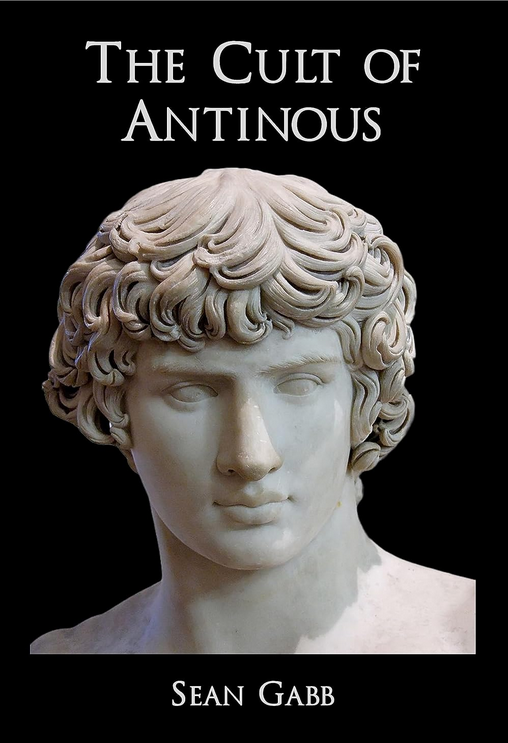
Sean Gabb’s The Cult of Antinous is not a hagiography. It is something better: a quiet, erudite demolition of pious lies from both the ancient and modern world. The lecture-turned-book is a brisk, sardonic tour through the most decadent cult of the Roman world, and one of its most effective. The boy died, yes — but what followed was a miracle of political opportunism and spiritual success. Gabb does not flinch from the disturbing parts. Nor does he genuflect before the fashionably uncritical idolatry now surrounding Antinous as gay icon. This is not a work of celebration. It is a work of historical thought, dressed as a lecture and sharpened with scepticism.
It begins, as it must, with a photograph of Hadrian and Antinous — stone fragments now housed in the British Museum, staring out from beneath museum glass and centuries of self-serving speculation. “Hadrian is on the left”, Gabb says, “Antinous on the right”. But from then on, it is the boy — not the emperor — who takes centre stage. The story is simple enough. Antinous was a Bithynian youth, met Hadrian at around age twelve, became his lover, travelled with him, and died in the Nile under suspicious circumstances. Hadrian made him a god. Cities were built. Statues were raised. Coins were minted. Shrines were erected. And the worship spread quickly and widely—and in ways that make some modern historians uncomfortable.
Gabb’s treatment of all this is not exactly kind, but it is always fair. He reminds us that, when it comes to Antinous, we know almost nothing. The written sources are sparse: Dio Cassius gives a few lines; the Historia Augusta offers rumour. Most of what we “know” is based on “could have”, “may have”, “might have”. And yet on this we have built dissertations, operas, novels, and now neopagan blogs filled with inverted pentagrams and airbrushed torsos. Gabb is not impressed. His repeated refrain is “castle of supposition”. And rightly so. Royston Lambert, he notes, was especially fond of these castles.
But for all that, there is a real story here. Gabb walks us through the ancient views of sex, pausing only to make the necessary disclaimer for his mixed audience of Chinese undergraduates and English middle class language students:
Please be aware that other civilisations frequently have or had views of sexual propriety different from our own. This lecture will discuss, and sometimes show depictions of, sexual relationships between adults and persons somewhat below the present age of consent. Some of these relationships involve disparities of legal status. Though not recommended for imitation in modern England, such relationships are nowhere explicitly condemned. The lecture will also not avoid language that many may consider indelicate or obscene.
What follows is a lesson in ancient sexual economics. Among Greeks, boy-love was structured: older men pursued beautiful adolescent boys, usually between 12 and 17, who were supposed to receive but not enjoy. The Romans were less sentimental: they cared only who did the penetrating. “To use was fine. To be used was shameful.” Gabb’s phrasing here is withering, but accurate. There is no anachronistic moralising — just the dry, clinical reconstruction of a culture with different priorities.
Comments Off on Emperor Hadrian and Antinous the God
Tiberius: Rome’s Most Underrated Emperor?
The Rest Is History
Published 31 Jan 2025The Roman historian Suetonius’ biography of the controversial Emperor Tiberius is one of his most shocking and salacious, condemning Tiberius to infamy. But was Tiberius really the perverted monster Suetonius would have us believe? Born of Rome’s most illustrious family and a sacred bloodline — the Claudians — Tiberius’ mother Livia was unceremoniously taken from his father while she carried him, to marry the great Emperor Augustus. So it was that Tiberius grew up in the very heart of imperial power, proving himself intelligent, and a superb military commander. But, following the unforeseen deaths of Augustus’ young heirs, he found himself primed to become the next Caesar of Rome. The reign that ensued would prove largely peaceful, prosperous and stable, though Tiberius himself was increasingly plagued by paranoia and fear. While the last of Augustus’ bloodline were wiped out one by one, he retired to Capri, much to the horror of the Roman people. Before long, rumours had begun percolating of the heinous deeds, sick proclivities, and vile abominations Tiberius was practicing on his pleasure island …
Join Tom and Dominic as they discuss Tiberius, the impressive though widely lambasted second emperor of Rome. What is the truth behind the sordid myths and mysteries of his reign …?
00:00 The bad emperor?
06:45 Was he depraved?
08:30 The Roman version of the Kennedys
13:29 How he became the heir
16:50 The greatest general of his generation
17:53 Tiberius is manoeuvred into the succession
21:23 Tiberius the emperor
(more…)
Comments Off on Tiberius: Rome’s Most Underrated Emperor?
July 12, 2025
Feeding Emperor Augustus Caesar – Handmade Roman Cheese
Tasting History with Max Miller
Published 11 Feb 2025Fresh handmade cheese as Augustus might have enjoyed it with some bread and figs
City/Region: Rome
Time Period: 1st CenturyAugustus, a man meticulous about his public image and about consolidating power as the first emperor of Rome, had rather simple tastes when it came to food. Suetonius, a Roman historian from the first and second centuries, wrote in The Lives of the Twelve Caesars that Augustus “preferred the food of the common people, particularly the coarse sort of bread, small fishes, fresh, moist, hand-pressed cheese, and green figs of the second crop”.
This recipe from the first century does indeed make a fresh, moist, hand-pressed cheese that is slightly nutty and is a clear predecessor to modern mozzarella. It’s just as historically accurate if you make it with goat, sheep, or cow milk, you just need to make sure that the milk is pasteurized, not ultra-pasteurized, and that it’s non-homogenized.
Note that this recipe is vegetarian if you use vegetable rennet.
Cheese should be made of pure milk which is as fresh as possible … It should usually be curdled with rennet obtained from a lamb or a kid … and equally well with fresh sap from a fig-tree … The least amount of rennet that a pail of milk requires weighs a silver denarius … It is sprinkled with pounded salt … Some crush green pine nuts and mix them with the milk and curdle it in this way … Their method of making what we call “hand-pressed” cheese is the best-known of all: when the milk is slightly congealed in the pail and still warm, it is broken up and hot water is poured over it, and then it is shaped by hand.
— De re rustica by Columella, 1st century
Comments Off on Feeding Emperor Augustus Caesar – Handmade Roman Cheese


