
Thersites the Historian
Published 5 Feb 2025The emperor Claudius felt insecure about his standing in the Roman world, so he sent four legions to Britain. The result was that Britain officially joined the Roman world and was now a peripheral part of the Roman Empire rather than an independent land of Celts.
July 11, 2025
History of Britain V: Roman Conquest of Britain
Comments Off on History of Britain V: Roman Conquest of Britain
July 7, 2025
Augustus: Visionary Statesman or Destroyer Of The Republic?
The Rest Is History
Published 27 Jan 2025The Roman historian Suetonius’ The Lives of the Caesars, written during the early imperial period of the Roman Empire, is a seminal biography covering the biographies of the early emperors of Rome, during two spectacular centuries of Roman history. Delving deep into the personal lives of the Caesars and sparing no detail, no matter how prurient, pungent, explicit or salacious, it vividly captures Rome at the peak of her power, and those colourful individuals at the heart of everything. It is an unsettling yet fascinating portrait of the alien and the intimate, that sees some of history’s most famous characters revealed as almost modern men, plotting a delicate line between private and public, respectability and suspicion. From the showmanship of Augustus, the first Caesar, and his convoluted family melodramas, to Tiberius, a monster in the historical record famed for his sexual misdeeds, to Caligula, who delighted in voyeuristic moral degeneracy, and the looming shadow of Nero; all will be revealed …
00:00 A humble plug from Tom
02:55 The most spectacular two centuries in Roman history
05:25 The value of Suetonius as a biographer
08:43 Suetonius’ interest in the love lives of the Caesars
12:58 Suetonius’ influence on popular culture
16:15 Augustus: Rome’s greatest actor
21:25 Roman politics as spectacle
21:55 Augustus as the model of a good emperor
24:30 What kind of monarchy was this?
28:00 The life of Suetonius
35:52 How did Roman histories work?
39:04 Why Romans had no idea of privacy
40:05 Did Roman emperors sexual misdemeanours matter
42:08 How we see sexual relations different to the Romans
(more…)
Comments Off on Augustus: Visionary Statesman or Destroyer Of The Republic?
July 5, 2025
QotD: Roman provinces under the Republic
When Rome first expands overseas in 264, they opt not to continue replicating the socii-system as they go, but rather through a gradual and ad hoc process, develop a separate system of governance-by-magistrate for these provinciae or “provinces”, though as we’ll see the exact meaning of this word changes over time as well.
While the Romans mostly improvise this system for just a handful of provinces – most of the basic patterns of Roman provincial governance develop in just the first four provinces1 – that system becomes the customary way Roman magistrates [consuls and praetors]and promagistrates [proconsuls and propraetors] handled the overseas provinces they were assigned to. Consequently, it was replicated over and over again through Rome’s steadily expanding empire. By the time the Republic collapses into the Empire, Rome will have not four provinces but fourteen; by the end of the reign of Augustus, as the Roman Empire largely took the borders it would mostly hold for the next four centuries, there were just under thirty provinces. Yet the way Rome will govern these provinces largely continued to hold to model established in the Republic, at least through to the Severan Dynasty (193-225 AD), if not further.
As a result, the improvised system the Romans developed for those first four provinces would end up being how the vast majority of people in the Roman empire would experience Roman governance.
Bret Devereaux, “Collections: How to Roman Republic 101, Addenda: The Provinces”, A Collection of Unmitigated Pedantry, 2023-11-03.
1. Sicily, Corsica et Sardinia, Nearer Spain and Further Spain, gained in the period from 241 to 197 and Rome’s only provinces until the addition of Macedonia in 147.
Comments Off on QotD: Roman provinces under the Republic
June 23, 2025
Augustus and the empire – The Conquered and the Proud 14
Adrian Goldsworthy. Historian and Novelist
Published 15 Jan 2025This time we look at Augustus, the empire and the army. The man who built the Altar of Augustan Peace in Rome was also the last of the great conquerors, who added more territory to the Roman Empire than any other individual leader. How he did this, and how he kept the army under control, is the theme of this video.
Comments Off on Augustus and the empire – The Conquered and the Proud 14
June 5, 2025
QotD: Political institutions of the late western Roman Empire
Roman rule as effectively codified under the first emperor, Augustus (r. 31BC – 14AD) was relatively limited and indirect, not because the Romans believed in something called “limited government” but because the aims of the Roman state were very limited (secure territory, collect taxes) and the administrative apparatus for doing those things was also very limited. The whole of the central Roman bureaucracy in the first century probably consisted of just a few hundred senatorial and equestrian officials (supported, of course, by the army and also several thousand enslaved workers employed either by the state directly or in the households of those officials) – this for an empire of around 50 million people. Instead, day to day affairs in the provinces – public works, the administration of justice, the regulation of local markets, etc. – were handled by local governments, typically centered in cities (we’ll come back to them in a moment). Where there were no cities, the Romans tended to make new ones for this purpose. Roman officials could then interact with the city elites (they preferred oligarchic city governments because they were easier to control) and so avoid having to interact directly with the populace in a more granular way unless there was a crisis.
By contrast, the Roman governance system that emerges during the reigns of Diocletian (r. 284-305) and Constantine (r. 306-337) was centralized and direct. The process of centralizing governance had been going on for some time, really since the beginning of the empire, albeit slowly. The Constitutio Antoniniana (212), which extended Roman citizenship to all free persons in the empire, in turn had the effect of wiping out all of the local law codes and instead extending Roman law to cover everyone and so doubtless accelerated the process.
During the Crisis of the Third Century (235-284) this trend accelerates substantially; the sources for this period are relatively poor, making it hard to see this process clearly. Nevertheless, the chaotic security situation led Roman generals and usurpers to make much greater demands of whatever local communities were in their reach, while at the same time once in power, emperors sought to draw a clearer distinction between their power and that of their subordinates in an effort to “coup proof” their regimes. That new form of Roman rule was both completed and then codified by Diocletian (r. 284-305): the emperor was set visually apart, ruling from palaces in special regalia and wearing crowns, while at the same time the provinces were reorganized into smaller units that could be ruled much more directly.
Diocletian intervened in the daily life of the empire in a way that emperors before largely had not. When his plan to reform the Roman currency failed, sparking hyper-inflation (whoops!), Diocletian responded with his Edict on Maximum Prices, an effort to fix the prices of many goods empire wide. Now previous emperors were not averse to price fixing, mind you, but such efforts had almost always been restricted to staple goods (mostly wheat) in Rome itself or in Italy (typically in response to food shortages). Diocletian attempted to enforce religious unity by persecuting Christians; his successors by the end of the century would be attempting to enforce religious unity by persecuting non-Christians. Whereas before taxes had been assessed on communities, Diocletian planned a tax system based on assessments of individual landholders based on a regular census; when actually performing a regular census proved difficult, Constantine responded by mandating that coloni – the tenant farmers and sharecroppers of the empire – must stay on the land they had been farming so that their landlords would be able to pay the taxes, casually abrogating a traditional freedom of Roman citizens for millions of farmers out of administrative convenience. Of course all of this centralized direction demanded bureaucrats and the bureaucracy during this period swelled to probably around 35,000 officials (compared to the few hundred under Augustus!).
All of this matters here because it is this kind of government – centralized, bureaucratic, religiously framed and interventionist, which the new rulers of the fifth century break-away kingdoms will attempt to emulate. They will mostly fail, leading to a precipitous decline in state capacity. This process worked differently in different areas: in Britain, the Roman government largely withered away from neglect and was effectively gone before the arrival of the Saxons and Angles, a point made quite well by Robin Flemming in the first chapter of Britain after Rome (2010), while in Spain, Gaul, Italy and even to an extent North Africa, the new “barbarian” rulers attempted to maintain Roman systems of rule.
This is thus an odd point where the “change and continuity” and “decline and fall” camps can both be right at the same time. There is continuity here, as new kings mostly established regimes that used the visual language, court procedure and to a degree legal and bureaucratic frameworks of Late Roman imperial rule. On the other hand, those new kingdoms fairly clearly lacked the resources, even with respect to their smaller territories, to engage in the kind of state activity that the Late Roman state had, for instance, towards the end of the fourth century. Instead, central administration largely failed in the West, with the countryside gradually becoming subject to local rural magnates (who might then be attached to the king) rather than civic or central government.
The problem rulers faced was two-fold: first that the Late Roman system, in contrast to its earlier form, demanded a large, literate bureaucracy, but the economic decline of the fifth century (which we’ll get to next time) came with a marked decline in literacy, which in turn meant that the supply of literate elites to staff those positions was itself shrinking (while at the same time secular rulers found themselves competing with the institutional Church for those very same literate elites). Second – and we’ll deal with this in more depth in just a moment – Roman rule had worked through cities, but all over the Roman Empire (but most especially in the West), cities were in decline and the population was both shrinking and ruralizing.
That decline in state capacity is visible in a number of different contexts. Bryan Ward-Perkins (Rome and the End of Civilization (2005), 148ff) notes for instance a sharp decline in the size of Churches, which for Christian rulers (both the post-Constantine emperors and the new “barbarian” kings) were major state building projects meant to display either royal or local noble wealth and power; Church size really only reaches Late Roman equivalent in the west (an important caveat here, to be sure) in the ninth century. In this kind of context it is hard to say that Visigothic or Merovingian rulers are actually just doing a different form of rulership because they’re fairly clearly not – they just don’t have the resources to throw at expensive building projects, even when you adjust for their smaller realms.
Nor is it merely building projects. Under Constantine, the Romans had maintained a professional army of around 400,000 troops. Much of the success of the Roman Empire had been its ability to provide “public peace” within its borders (at least by the relatively low standards of the ancient world). While the third century had seen quite a lot of civil war and the in the fourth century the Roman frontiers were cracking, for much of the empire the legions continued to do their job: war remained something that happened far away. This was a substantial change from the pre-Roman norm where war was a regular occurrence basically everywhere.
The kingdoms that emerged from the collapse of Roman rule proved incapable of either maintaining a meaningful professional army or provisioning much of that public peace (though of course the Roman state in the west had also proved incapable of doing this during the fifth century). Instead those kingdoms increasingly relied on armies led by (frequently mounted) warrior-aristocrats, composed of a general levy of the landholding population. We’ve actually discussed some of the later forms of this system – the Anglo-Saxon fyrd and the Carolingian levy system – already; those systems are useful reference points because they’re quite a bit better attested in our evidence and reflect many of the general principles of how we suppose earlier armies to have been organized.
The shift to a militia army isn’t necessarily a step backwards – the army of the Middle Roman Republic had also been a landholder’s militia – except that in this case it also marked a substantial decrease in scale. Major Merovingian armies – like the one that fought at Tours in 732 – tended to be around 10,000-20,000 men (mostly amateurs), compared to Late Roman field armies frequently around 40,000 professional soldiers or the astounding mobilizations of the Roman Republic (putting around 225,000 – that is not a typo – citizen-soldiers in the field in 214BC, for instance). Compared to the armies of the Hellenistic Period (323-31BC) or the Roman Empire, the ability of the post-Roman kingdoms to mobilize force was surprisingly limited and the armies they fielded also declined noticeably in sophistication, especially when it came to siege warfare (which of course also required highly trained, often literate engineers and experts).
That said, it cannot be argued that the decline of “public peace” had merely begun in the fifth century. One useful barometer of the civilian sense of security is the construction of city walls well within the empire: for the first two centuries, many Roman cities were left unwalled. But fresh wall construction within the Empire in places like Northern Spain or Southern France begins in earnest in the third century (presumably in response to the Crisis) and then intensifies through the fifth century, suggesting that rather than a sudden collapse of security, there had been a steady but significant decline (though again this would thus place the nadir of security somewhere in the early Middle Ages), partially abated in the fourth century but then resumed with a vengeance in the fifth.
Consequently the political story in the West is one of an effort to maintain some of the institutions of Roman governance which largely fails, leading to the progressive fragmentation and localization of power. Precisely because the late Roman system was so top-heavy and centralized, the collapse of central Roman rule mortally wounded it and left the successor states of Rome with much more limited resources and administration to try to achieve their aims.
Bret Devereaux, “Collections: Rome: Decline and Fall? Part II: Institutions”, A Collection of Unmitigated Pedantry, 2022-01-28.
Comments Off on QotD: Political institutions of the late western Roman Empire
May 31, 2025
Social Hierarchy in the Early Roman Empire
seangabb
Published 31 Dec 2024The second lecture in the series – an exploration of social divisions within the Early Roman Empire. Contents include:
00:00:00 – Introduction
00:05:37 – The Roman Social Structure
00:09:02 – The Position of the Emperor
00:11:49 – Perception and Role of the Emperor
00:19:24 – Evolution of the Imperial Senate
00:22:19 – What Kind of Men became Senators?
00:25:34 – The Functions of Senators
00:27:41 – The Equestrian Order
00:30:56 – Local Government
00:35:49 – The Imperial Bureaucracy
00:37:16 – Narcissus, Pallas, Felix
00:42:12 – Ordinary People
00:43:06 – Roman Citizenship
00:45:15 – How to Become a Citizen?
00:47:21 – Justice According to Class
00:51:34 – How was Status Legally Determined?
00:59:44 – Patron and Client
(more…)
Comments Off on Social Hierarchy in the Early Roman Empire
May 27, 2025
Augustus and his family – the start of the Julio-Claudians
Adrian Goldsworthy. Historian and Novelist
Published 17 Dec 2024An extra session for the Augustus and politics episode, with a look at Augustus and his extended family, using family trees from my biography of Augustus.
Comments Off on Augustus and his family – the start of the Julio-Claudians
May 24, 2025
History of Britain, II: Stonehenge; The Druids, Vates, and Celtic Religion
Thersites the Historian
Published 15 Jan 2025In this episode, I briefly examine the presence of prehistorical megaliths on the British Isles and talk about the religion of the Celts, which was ascendant at the time that Britain entered entered the historical record.
Comments Off on History of Britain, II: Stonehenge; The Druids, Vates, and Celtic Religion
QotD: Comparing living standards and technology between the Roman period and medieval western Europe
While I am convinced that the evidence suggests there was a drop in living standards and some loss of technology in the immediate aftermath of the collapse of the Roman Empire in the West, most of that drop was fairly short-lived. But exactly when development in medieval Europe meets and then exceeds the same for antiquity (typically we’re comparing the second century height of the Roman Empire) also depends on exactly what kind of measure is being used.
If the question, for instance, is agricultural productivity on a per capita basis (the most important component of per capita economic production), medieval Europe probably moves ahead of the Roman Empire fairly quickly with the introduction of better types of plow and widespread use of watermills for grinding grain. My understanding is that by c. 1000 AD, watermills show up fairly frequently in things like monastic charters, suggesting they were reasonably widespread (the Romans used watermills too, though their spread was uneven) and by that point, plow technology had also moved forward, mostly through the development of plow types better suited to Europe’s climate. So as best we can tell, the farmer of c. 1000 AD had better tools than his Roman predecessors and probably had such for some time.
If the question is technology and engineering, once again what you see depends on where you look. Some technologies don’t appear to have regressed much, if at all, ironworking being one example where it seems like little to nothing was lost. On the other hand, in western Europe, the retreat in architecture is really marked and it is hard to say when you would judge the new innovations (like flying buttresses) to have equaled some of the lost ones (like concrete); certainly the great 12th/13th century Cathedrals (e.g. Notre Dame, the Duomo di Sienna and I suppose the lesser Duomo di Firenze, if we must include it) seem to me to have matched or exceeded all but perhaps the biggest Roman architectural projects. Though we have to pause here because in many cases the issue was less architectural know-how (though that was a factor) as state capacity: the smaller and more fragmented states of the European Middle Ages didn’t have the resources the Roman Empire did.
If one instead looks for urbanization and population as the measure of development, the Middle Ages looks rather worse. First and Second century Rome is probably unmatched in Europe until the very late 1700s, early 1800s, when first London (c. 1800) and Paris (c. 1835) reach a million. So one looking for matches for the large cities and magnificent municipal infrastructure of the Romans will have rather a long wait. Overall population is much more favorable as a measurement to the Middle Ages. France probably exceeds its highest Roman population (c. 9m) by or shortly after 1000AD, Italy (c. 7.5m) by probably 1200; Spain is the odd one out, with Roman Hispania (est. 7.5m) probably only matched in the early modern period. So for most of the Middle Ages you are looking at a larger population, but also a more rural one. That’s not necessarily bad though; pre-modern cities were hazardous places due to sanitation and disease; such cities had a markedly higher mortality, for instance. On the flip-side, fewer, smaller cities means less economic specialization.
So one’s answer often depends very much on what one values most. For my own part, I’d say by 1000 or 1100 we can very safely say the “recovery” phase of the Middle Ages is clearly over (and I think you could make an argument for setting this point substantially earlier but not meaningfully later), though even this is somewhat deceptive because it implies that no new technological ground was being broken before then, which is not true. But the popular conception that the whole of the Middle Ages reflects a retreat from the standards of antiquity is to be discarded.
Bret Devereaux, “Referenda ad Senatum: August 6, 2021: Feelings at the Fall of the Republic, Ancient and Medieval Living Standards, and Zombies!”, A Collection of Unmitigated Pedantry, 2021-08-06.
Comments Off on QotD: Comparing living standards and technology between the Roman period and medieval western Europe
May 19, 2025
The Roman Empire and climate change
Sebastian Wang considers “what we all know” about the rise and fall of the Roman Empire in the light of more recent research (not all of it politically motivated) into climate change:
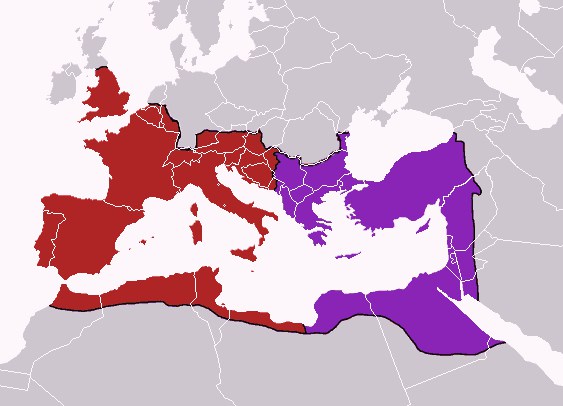
The approximate extent of the Roman empire circa 395AD.
Before we get into climate, and for those who tend to the wholly ignorant spectrum of my readers, we need a quick sketch of Roman history. The Empire officially began in 27 BC, when Octavian — better known as Augustus — became the first emperor. It ended in the west in AD 476, when the last western emperor was kicked out. As said, the eastern half, based in Constantinople, carried on for another thousand years.
Broadly, we can divide Roman history as follows:
- 27 BC – AD 180: The golden age. Augustus and his successors took over and further expanded a huge empire. There was peace (mostly), trade flourished, and cities grew. People call it the “Pax Romana“.
- AD 180 – 284: Everything starts to fall apart. This is called the Crisis of the Third Century. Civil wars, foreign invasions, plagues, and economic collapse all hit at once.
- AD 284 – 395: The empire pulls itself together. Emperors like Diocletian and Constantine bring in reforms. But the empire is now divided for administrative convenience — east and west.
- AD 395 – 476: The west goes under. It’s invaded. It’s conquered and broken up. Very quickly, it disappears. Though, once again, a parochial view of history, we call this the Fall of the Roman Empire.
The standard histories still blame bad rulers or too many wars. That’s fair enough. There were some very bad rulers, and the wars without number. But if you look at the climate data — tree rings, ice cores, sediment levels — you start to see another pattern underneath what may be called the political and economic superstructure of Roman history.
When Rome came to greatness, the climate was unusually good. From around 200 BC to AD 150, there was a long phase of stable, warm, and mostly wet conditions. Scientists call this the Roman Climate Optimum. In Egypt, the Nile flooded regularly and well. That meant lots of grain. In the Alps, glaciers shrank. In northern Europe, people were growing grapes in places too cold for vineyards today. In the Middle East, the Dead Sea stayed high, showing good rainfall.
This kind of weather made everything easier. Crops were reliable. Surpluses could be taxed. Cities could be fed. Roads and aqueducts could be built and maintained. And because the army was well supplied, the Empire was protected, and could even continue a modest expansion. But, as McCormick and his team point out, the high phase of Nile flooding correlates exactly with the high point of Roman prosperity — and once those floods became less predictable, problems followed.
The good times came to an end. By the mid-second century, a wave of volcanic eruptions thew great masses of dust into the atmosphere, blocking sunlight. Solar activity dropped. The climate became less stable. Then came the Antonine Plague in AD 166. It probably started in the east and spread quickly. Some think it was smallpox. Whatever it was in terms of microbiology, it was almost certainly brought on by changes in the climate. It may have killed a third of the Empire’s population.
Worse was coming. By AD 200, climate records show more erratic rainfall and cooling. In Gaul and the Balkans, harvests became less predictable. Glaciers began to advance again. Speleothem data from Austrian caves shows sharp shifts in rainfall patterns.
At the same time, the empire started to shake. Between 235 and 284, Rome had over twenty emperors. Most were generals who seized power, then got killed. Civil wars broke out. Trade declined. Foreign tribes pushed harder at the frontiers. Coin hoards — money buried for safety — increased in number. That’s usually a sign of fear and instability. Cities shrank. The economy shrivelled.
Was this all because of climate? No — not wholly. A good definition of historical crank is someone who tries to explain everything in terms of one cause or set of causes. But as McCormick et al. argue, bad weather made everything worse. It weakened agriculture, strained supplies, and made people more likely to panic or rebel. In a world without modern logistics, you couldn’t afford bad harvests two or three years in a row.
The empire buckled in the third century, but didn’t collapse. And its survival probably was an effect of human agency. A line of competent Emperors rose from the army and stabilised the frontiers. This line culminated in the reigns of Diocletian and Constantine, who restructured the Empire. They fixed taxes. They reorganised the army. Constantine built his new capital in the east. His successors found Constantinople safer and more strategically useful than Rome.
This being said, around AD 290, climate records suggest a small rebound. Warmer temperatures and better rainfall returned — especially in the east. That helped the eastern provinces recover faster. They had stronger governments and better infrastructure. But climate helped. Dead Sea levels remained relatively high, which meant steady rain in the Levant.
The west wasn’t so lucky. Italy and parts of Gaul stayed unstable. In Britain, pollen records show that farmland was being abandoned. The archaeology matches this, with fewer building projects and shrinking urban centres. The killing shock for the west came in the fifth century. In Central Asia, a long drought began around AD 370. Steppe tribes like the Huns were hit hard. They migrated west, pushing other tribes like the Goths ahead of them. In AD 376, the Goths crossed the Danube into Roman territory. Two years later, they crushed a Roman army at Adrianople. This all happened in the eastern half. But greater wealth and better leadership allowed the government in Constantinople to push the barbarians west. Over the next century, the western empire was hit again and again.
Meanwhile, the weather got worse. Europe cooled. Rainfall patterns shifted. Flooding and crop failures increased. Volcanic sulphur levels spike in the ice core record from Greenland.
Rome was sacked in AD 410. Again in 455. Finally, in 476, the last western emperor was deposed. That was it. The western Roman Empire was gone.
The east survived. But was hardly untroubled. In AD 536, a huge volcanic eruption darkened skies around the world. The sun barely shone. Crops failed. Famines spread.
A few years later, the Plague of Justinian broke out. It probably started in Egypt and spread through trade routes. Some say it killed half the population in affected areas.
Climate and disease worked together. Hunger weakened people. Infection finished them off. As McCormick et al. put it, the event of 536 and the plague that followed created one of the worst demographic shocks in recorded history.
Comments Off on The Roman Empire and climate change
May 11, 2025
History of Britain, I: Hail Prettanike! Early References to the British Isles
Thersites the Historian
Published 6 Jan 2025The natural starting point for examining the history of Britain is to look at how the island and its inhabitants first entered the historical record.
Comments Off on History of Britain, I: Hail Prettanike! Early References to the British Isles
May 10, 2025
How did ancient people travel without maps? | How did they imagine the world?
Historia Militum
Published 15 Nov 2024Today we are straying away from the Roman military, but only a bit! Travel and Geography is still a very important aspect to understand when thinking about the military logistics of the Roman Empire, but it was just as important for its administration and civilian life. This video explains why most pop culture and visual depictions of Roman maps are wrong!
Scale Maps? (0:00)
Case 1: The Island Mosaic (2:55)
Case 2: Notitia Dignitatum (3:38)
Case 3: Madaba Mosaic (4:10)
Travel itineraries (5:07)
Cursus Publicus (8:06)
The Antonine Itinerary (8:47)
Galen’s Adventure (10:10)
Milestones (13:25)
Crossroads and visual itineraries (14:56)Small mistake! At 16:36, I meant to say “topological” diagrams, which disregard the accuracy of both scale and direction. “Topographical” diagrams, on the other hand, are very much to scale!
Primary Sources:
Historia Augusta, Alexander Severus 45, 2–3
Galen, De simplicium medicamentorum temperamentis 9Secondary Sources:
Adams, C., & Laurence, R. (Eds.) (2001). Travel and Geography in the Roman Empire
The Antonine Itinerary by Bernd Löhberg: https://www.tabulae-geographicae.de/e…
Comments Off on How did ancient people travel without maps? | How did they imagine the world?
May 8, 2025
Augustus and the creation of the Principate – The Conquered and the Proud 13
Adrian Goldsworthy. Historian and Novelist
Published 11 Dec 2024Continuing the series “The Conquered and the Proud”, this video looks at the political system created by Augustus — the Principate or rule of a princeps or “first”. We look at the twin elements of his formal power, the tribunician potestas and the maius imperium proconsulare. Next time we we look at Augustus, the provinces and imperial expansion.
Comments Off on Augustus and the creation of the Principate – The Conquered and the Proud 13
May 4, 2025
Everyday Life in the Roman Empire – Culture and Literacy in the Roman Empire
seangabb
Published 28 Dec 2024This is the eighth video in my series on Everyday Life in the Roman Empire. In this, I wander about at the beginning, with talk of poetry and philosophy, before realising that the real theme is the extent of ancient literacy. The whole of the remainder is given over to this, and how it enabled a literary civilisation wholly different from our own.
Introduction – 00:00:00
Our perceptions of culture in the Ancient world – 00:01:40
Virgil – 00:03:45
Catullus – 00:05:17
Philosophy in Rome – 00:06:23
The Romans and Stoicism – 00:08:40
The Romans and Epicureanism – 00:10:27
Pretty silver things from Roman Britain – 00:16:25
Broad-based cultural participation in the Ancient World? – 00:19:26
The Ancient World: a largely illiterate civilisation (no spectacles) – 00:28:27
The Ancient World: a largely illiterate civilisation (expensive education, expensive books) – 00:35:40
The Ancient World: a largely illiterate civilisation (economic imperatives) – 00:42:35
The Ancient World: a largely illiterate civilisation (expensive writing materials) – 00:44:44
The Ancient World: a largely illiterate civilisation (difficulties of reading) – 00:49:16
The Ancient memory – 00:53:14
The primacy of oral communication – 00:55:23
The Ancient World: a largely illiterate civilisation (the Second Sophistic and linguistic change) – 00:59:53
Bibliography – 01:08:10
(more…)
Comments Off on Everyday Life in the Roman Empire – Culture and Literacy in the Roman Empire
April 18, 2025
QotD: Literature in (and after) the late Western Roman Empire
Well, no.
Here I think the problem is the baseline we assess this period against. Most people are generally aware that the Greeks and Romans wrote a lot of things and that we have relatively few of them. Even if we confine ourselves only to very successful, famous Greek and Roman literature, we still only have perhaps a low single-digit percentage of it, possibly only a fraction of a percent of it. In our post-printing-press and now post-internet world, famous works of literature do not simply vanish, generally and it is intuitive to assume that all of these lost works must have been the result of some catastrophe or intentional sabotage.
I am regularly, for instance, asked how I feel about the burning of the Library of Alexandria. The answer is … not very much. The library burned more than once and by the time it did it was no longer the epicenter of learning in the Mediterranean world. Instead, the library slowly declined as it became less unique because other libraries amassed considerable collections. There was no great, tragic moment where countless works were all lost in an instant. That’s not how the chain of transmission breaks. Because a break in the chain of transmission requires no catastrophe – it merely requires neglect.
The literature of the Greeks and Romans (and the rest of the ancient iron age Mediterranean) were largely written on papyrus paper, arranged into scrolls. The problem here is that papyrus is quite vulnerable to moisture and decay; in the prevailing conditions in much of Europe papyrus might only last a few decades. Ancient papyri really only survive to the present in areas of hard desert (like Egypt, conveniently), but even in antiquity, books written on papyrus would have been constantly wearing out and needing to be replaced.
Consequently, it didn’t require anyone going out and destroying books to cause a break in the chain of transmission: all that needed to happen was for the copying to stop, even fairly briefly. Fortunately for everyone, Late Antiquity was bringing with it a new writing material, parchment, and a new way of putting it together, the codex or book. The transition from papyrus to parchment begins in the fourth century, but some books are still being produced in papyrus in the 7th century, particularly in the Eastern Mediterranean. Whereas papyrus is a paper made of papyrus stalks pressed together, parchment is essentially a form of leather, cleaned, soaked in calcium lye and scraped very thin. The good news is that as a result, parchment lasts – I have read without difficulty from 1200 year old books written on parchment (via microfilm) and paged through 600 year old books with my own hands. Because making it requires animal hide, parchment was extremely expensive (and still is) but its durability is a huge boon to us because it means that works that got copied onto parchment during the early middle ages often survive on that parchment down to the present.
But of course that means that the moment of technological transition from short-lived papyrus to long-lasting parchment was always going to be the moment of loss in transition: works that made it to parchment would largely survive to the present, while works that were not copied in that fairly narrow window (occupying Late Antiquity and the Early Middle Ages) would be permanently lost. And that copying was no simple thing: it was expensive and slow. The materials were expensive, but producing a book also required highly trained scribes (often these were monks) who would hand copy, letter by letter, the text for hundreds of pages. And, for reasons we’ll talk about later in this series, the resources available for this kind of copying would hit an all-time-low during the period from the fifth to the seventh centuries – this was expensive work for poor societies to engage in.
And here it is worth thus stopping to note how exceptional a moment of preservation this period is. The literary tradition of Mediterranean antiquity represents the oldest literary tradition to survive in an unbroken line of transmission to the present (alongside Chinese literature). The literary traditions of the Bronze Age (c. 3000-1200 BC and the period directly before antiquity broadly construed) were all lost and had to be rediscovered, with stone and clay tablets recovered archaeologically and written languages reconstructed. The Greeks and Romans certainly made little effort to preserve the literature of those who went before them!
In that context, what is actually historically remarkable here is not that the people of Late Antiquity and the Early Middle Ages lost some books – books had always been being lost, since writing began – but that they saved some books. Never before had a literary tradition been saved in this way. Of course these early copyists didn’t always copy what we might like. Unsurprisingly, Christian monks copying books tended to copy a lot more religious texts (both scriptures but also patristic texts). Moreover, works that were seen as important for teaching good Latin (Cicero, Vergil, etc.) tended to get copied more as well, though this is nothing new; the role of the Iliad and the Odyssey in teaching Greek is probably why their manuscript traditions are so incredibly robust. In any event, far from destroying the literature of classical antiquity, it was the medieval Church itself that was the single institution most engaged in the preservation of it.
At the same time, writers in the fifth, sixth and seventh centuries did not stop writing (or stop reading). Much of the literature of this period was religious in nature, but that is no reason to dismiss it (far more of the literature of the Classical world was religious in nature than you likely think, by the by). St. Augustine of Hippo was writing during the fifth century; indeed his The City of God, one of the foundational works of Christian literature, was written in response to the news of the sack of Rome in 410. Isidore of Seville (560-636) was famous for his Etymologies, an encyclopedia of sorts which would form the foundation for much of medieval learning and which in its summaries preserves for us quite a lot of classical bits and bobs which would have otherwise been lost; he also invented the period, comma and colon. Pope Gregory I (540-604) was also a prolific writer, writing hundreds of letters, a collection of four books of dialogues, a life of St. Benedict, a book on the role of bishops, a commentary on the Book of Job and so on. The Rule of St. Benedict, since we’ve brought the fellow up, written in 516 established the foundation for western monasticism.
And while we’ve mostly left the East off for this post, we should also note that writing hardly stopped there. Near to my heart, the emperor Maurice (r. 582-602) wrote the Strategikon, an important and quite informative manual of war which presents, among other things, a fairly sophisticated vision of combined arms warfare. Roman law also survived in tremendous quantities; the emperor Theodosius II (r. 402-450) commissioned the creation of a streamlined law code compiling all of the disparate Roman laws into the Codex Theodosianus, issued in 439. Interestingly, Alaric II (r. 457-507), king of the Visigoths in much of post-Roman Spain would reissue the code as past of the law for his own kingdom in 506 as part of the Breviary of Alaric. Meanwhile, back at Constantinople, Justinian I (r. 527-565) commissioned an even more massive collection of laws, the Corpus Iuris Civilis, issued from 529 to 534 in four parts; a colossal achievement in legal scholarship, it is almost impossible to overstate how important the Corpus Iuris Civilis is for our knowledge of Roman law.
And it is not hard again to see how these sorts of literary projects represented a continuing legacy of Roman culture too (particularly the Roman culture of the third and fourth century), concerned with Roman law, Roman learning and the Roman religion, Christianity. And so when it comes to culture and literature, it seems that the change-and-continuity knight holds the field – there is quite a lot of evidence for the survival of elements of Roman culture in post-Roman western Europe, from language, to religion, to artwork and literature. Now we haven’t talked about social and economic structures (that’s part III), so one might argue we haven’t quite covered all of “culture” just yet, and it is necessary to note that this continuity was sometimes uneven. Nevertheless, the fall of Rome can hardly be said to have been the end of Roman culture.
Bret Devereaux, “Collections: Rome: Decline and Fall? Part I: Words”, A Collection of Unmitigated Pedantry, 2022-01-14.
Comments Off on QotD: Literature in (and after) the late Western Roman Empire


