The policy of the emperors and the senate, as far as it concerned religion, was happily seconded by the reflections of the enlightened, and by the habits of the superstitious, part of their subjects. The various modes of worship, which prevailed in the Roman world, were all considered by the people, as equally true; by the philosopher, as equally false; and by the magistrate, as equally useful. And thus toleration produced not only mutual indulgence, but even religious concord.
The superstition of the people was not imbittered by any mixture of theological rancor; nor was it confined by the chains of any speculative system. The devout polytheist, though fondly attached to his national rites, admitted with implicit faith the different religions of the earth. Fear, gratitude, and curiosity, a dream or an omen, a singular disorder, or a distant journey, perpetually disposed him to multiply the articles of his belief, and to enlarge the list of his protectors. The thin texture of the Pagan mythology was interwoven with various but not discordant materials. As soon as it was allowed that sages and heroes, who had lived or who had died for the benefit of their country, were exalted to a state of power and immortality, it was universally confessed, that they deserved, if not the adoration, at least the reverence, of all mankind. The deities of a thousand groves and a thousand streams possessed, in peace, their local and respective influence; nor could the Romans who deprecated the wrath of the Tiber, deride the Egyptian who presented his offering to the beneficent genius of the Nile. The visible powers of nature, the planets, and the elements were the same throughout the universe. The invisible governors of the moral world were inevitably cast in a similar mould of fiction and allegory. Every virtue, and even vice, acquired its divine representative; every art and profession its patron, whose attributes, in the most distant ages and countries, were uniformly derived from the character of their peculiar votaries. A republic of gods of such opposite tempers and interests required, in every system, the moderating hand of a supreme magistrate, who, by the progress of knowledge and flattery, was gradually invested with the sublime perfections of an Eternal Parent, and an Omnipotent Monarch. Such was the mild spirit of antiquity, that the nations were less attentive to the difference, than to the resemblance, of their religious worship. The Greek, the Roman, and the Barbarian, as they met before their respective altars, easily persuaded themselves, that under various names, and with various ceremonies, they adored the same deities. The elegant mythology of Homer gave a beautiful, and almost a regular form, to the polytheism of the ancient world.
The philosophers of Greece deduced their morals from the nature of man, rather than from that of God. They meditated, however, on the Divine Nature, as a very curious and important speculation; and in the profound inquiry, they displayed the strength and weakness of the human understanding. Of the four most celebrated schools, the Stoics and the Platonists endeavored to reconcile the jarring interests of reason and piety. They have left us the most sublime proofs of the existence and perfections of the first cause; but, as it was impossible for them to conceive the creation of matter, the workman in the Stoic philosophy was not sufficiently distinguished from the work; whilst, on the contrary, the spiritual God of Plato and his disciples resembled an idea, rather than a substance. The opinions of the Academics and Epicureans were of a less religious cast; but whilst the modest science of the former induced them to doubt, the positive ignorance of the latter urged them to deny, the providence of a Supreme Ruler. The spirit of inquiry, prompted by emulation, and supported by freedom, had divided the public teachers of philosophy into a variety of contending sects; but the ingenious youth, who, from every part, resorted to Athens, and the other seats of learning in the Roman empire, were alike instructed in every school to reject and to despise the religion of the multitude. How, indeed, was it possible that a philosopher should accept, as divine truths, the idle tales of the poets, and the incoherent traditions of antiquity; or that he should adore, as gods, those imperfect beings whom he must have despised, as men? Against such unworthy adversaries, Cicero condescended to employ the arms of reason and eloquence; but the satire of Lucian was a much more adequate, as well as more efficacious, weapon. We may be well assured, that a writer, conversant with the world, would never have ventured to expose the gods of his country to public ridicule, had they not already been the objects of secret contempt among the polished and enlightened orders of society.
Edward Gibbon, “Chapter II: The Internal Prosperity In The Age Of The Antonines — Part I”, History of the Decline and Fall of the Roman Empire, 1782.

October 8, 2015
QotD: The religious life of the early Roman Empire
September 26, 2015
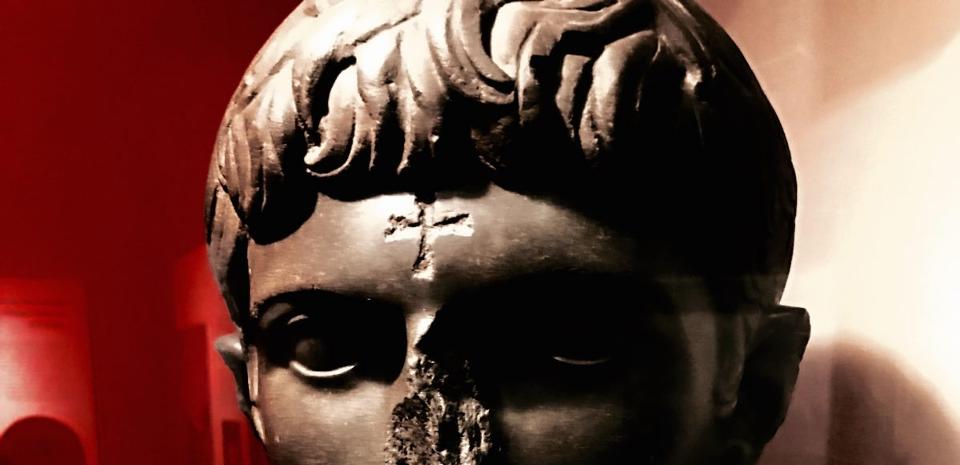
Tiberius Caesar
A thumbnail sketch of the second Roman Emperor:
Upon the death of Augustus, Tiberius Claudius Nero stood as the last logical choice in a long and tumultuous line of potential heirs. In 14 AD, at the age of 56, Tiberius ascended to Imperial power as a somewhat uncertain figure. The continuation and success of the newly created Principate rested squarely on the shoulders of a man who seemingly had only a partial interest in his own personal participation.
For the first time the transfer of power from the greatness of Augustus was to be tested. The passing of this test would prove to be more a culmination of Augustus’ long reign and establishment of precedent than the ability of Tiberius to fill the enormous sandals of his step-father.
While Augustus was the perfect political tactician with powerful personality yet approachable demeanor, Tiberius was a direct contrast. He was a dark figure, keenly intelligent, sometimes terribly cunning and ruthless, yet pre-disposed to a more Republican ideal than any emperor that followed him. Tiberius’ failures, however seem to have been his inability to define his own role within the Principate and the roles of those around him, including the Senate. While he professed a desire for the Senate to play a more active role in Imperial government, he did little to illustrate what these roles should be. To an aristocratic body that had been cowed into general subservience through the sheer will and force of Augustus, defining a new role required more definitive action than the simple desire of Tiberius for change.
He was inconsistent in policy and behavior, sometimes dictating his own idea of order from the position of ultimate power, sometimes withdrawing completely in favor of any who might dictate the appearance of command. Mood swings and depression plagued him, perhaps resulting from a life spent as an uncertain member of the ‘Julio-Claudian’ family. Until his final ascension, and only after the deaths of several favored ‘heirs’, did Tiberius probably know for sure that the ultimate power would actually belong to him.
June 23, 2015
Richard Blake reviews ten films set in the Roman empire
Wandering a bit off his usual (Byzantine empire) era, Richard Blake looks at how Hollywood has portrayed Rome in film:
My purpose in this article is to describe and compare and judge ten films set in the Roman Empire. I will apply two criteria. The first, and most obvious, is how these films stand as works of art in their own right — narrative structure, acting, general production values and so forth. The second, and for me almost equally important, is how well they show that the Ancients lived in a moral universe fundamentally different from our own.
Now, for the avoidance of doubt, I will say at once that I have no time for any of the neo-Marxist claims about Antiquity. Karl Polanyi and Moses Finlay were wrong in their belief that the laws of supply and demand have only operated since the eighteenth century. Michel Foucault was more than usually wrong when he denied that the Ancients had any notion of the individual. In all times and places, human nature is the same. All people are motivated by some combination of sex, money, status, power and the fear of death. The laws of Economics apply just as well in Ancient Rome as they do in Modern England.
What I do mean, however, is that these basic motivations showed themselves in often radically different ways. The Ancients were not Christians. They were not universalists. They had no concept of human equality. The establishment of chattel slavery among them normalised attitudes and behaviour that would have been thought outrageous in Ancien Régime Europe, and that every religious denomination would have been mobilised to denounce in the ante bellum American South.
The Ancients lacked technologies and scientific and moral concepts that we have taken for granted for five or six or even eight centuries. A modern secularist has more in common with a twelfth century theologian than with a Greek rationalist. He probably has more in common with a sixth century Bishop than with a pagan philosopher.
One of the main, though seldom noticed, differences between virtually everyone in the past and us is that they lived under the continual shadow of death. I have reached the age of fifty five. I might fall dead tomorrow, but the insurance tables tell me I have a long way yet to go before I need to start thinking hard about the inevitable end of things. I put off begetting children until I was in my forties. I only took up a serious study of the piano last year. Catullus was dead at thirty, Horace and Vergil in their fifties. Constantine the Great was an old and dying man when he was younger than I am now. Shorter time horizons must have an effect on almost every approach to life.
Any fictional recreation must show these differences, and show them without vexing readers or viewers with endless asides. I try to show them in my series of thrillers set in seventh century Byzantium. Without more elaboration, let me see how well they are shown in the ten films I have selected.
May 27, 2015
QotD: The amazing longevity of the Byzantine Empire
… I revere Classical Antiquity. But, once your eyes adjust, and you look below the glittering surface, you see that it wasn’t a time any reasonable person would choose to be alive. The Greeks were a collection of ethnocentric tribes who fought and killed each other till they nearly died out. The Roman Empire was held together by a vampire bureaucracy directed more often than in any European state since then by idiots or lunatics. Life was jolly enough for the privileged two or three per cent. But everything they had was got from the enslavement or fiscal exploitation of everyone else.
Now, while the Roman State grew steadily worse until the collapse of its Western half, the Eastern half that remained went into reverse. The more Byzantine the Eastern Roman Empire became, the less awful it was for ordinary people. This is why it lasted another thousand years. The consensus of educated opinion used to be that it survived by accident. Even without looking at the evidence, this doesn’t seem likely. In fact, during the seventh century, the Empire faced three challenges. First, there was the combined assault of the Persians from the east and the Avars and Slavs from the north. Though the Balkans and much of the East were temporarily lost, the Persians were annihilated. Then a few years after the victory celebrations in Jerusalem, Islam burst into the world. Syria and Egypt were overrun at once. North Africa followed. But the Home Provinces — these being roughly the territory of modern Turkey — held firm. The Arabs could sometimes invade, and occasionally devastate. They couldn’t conquer.
One of the few certain lessons that History teaches is that, when it goes on the warpath, you don’t face down Islam by accident. More often than not, you don’t face it down at all. In the 630s, the Arabs took what remained of the Persian Empire in a single campaign. Despite immensely long chains of supply and command, they took Spain within a dozen years. Yet, repeatedly and with their entire force, they beat against the Home Provinces of the Byzantine Empire. Each time, they were thrown back with catastrophic losses. The Byzantines never lost overall control of the sea. Eventually, they hit back, retaking large parts of Syria. More than once, the Caliphs were forced to pay tribute. You don’t manage this by accident.
The Byzantine historians themselves are disappointingly vague about the seventh and eight centuries. Our only evidence for what happened comes from the description of established facts in the tenth century. As early as the seventh century, though, the Byzantine State pulled off the miracle of reforming itself internally while fighting a war of survival on every frontier. Large parts of the bureaucracy were scrapped. Taxes were cut. The silver coinage was stabilised. Above all, the great senatorial estates of the Later Roman Empire were broken up. Land was given to the peasants in return for military service. In the West, the Goths and Franks and Lombards had moved among populations of disarmed tax-slaves. Not surprisingly, no one raised a hand against them. Time and again, the Arabs smashed against a wall of armed freeholders. A few generations after losing Syria and Egypt, the Byzantine Empire was the richest and most powerful state in the known world.
Richard Blake, “The Joys of Writing Byzantine Historical Fiction”, Libertarian Enterprise, 2014-07-27.
March 29, 2015
A Tour through Imperial Rome, circa 320AD
Published on 12 May 2012
A project between Khan Academy and Rome Reborn – with Dr. Bernard Frischer
March 14, 2015
QotD: The unlikely survival of the Byzantine empire
Above all, Byzantine history is a record of survival and even prosperity in the face of terrible odds. Between about 540 and 720, the Byzantines were hit by wave after wave of catastrophe. First, there was the Great Plague of the 540s, that killed around a third of the population. Then, in the first decades of the seventh century, they were attacked on every frontier by the Persians and the Barbarians. They saw off these challenges, but had no time to recover before the first eruption of Islam from the deserts. In almost a single bite, the Arabs swallowed up the remains of the Persian Empire. They conquered vast areas of the East, and, within less than a century, pushing into Southern France. But, if they took Syria and Egypt and North Africa, they never conquered the core territories of the Byzantine Empire.
The reason for this is that the Byzantine State was ruled by creative pragmatists. The Roman Empire was a ghastly place for most of the people who lived in it. The Emperors at the top were often vicious incompetents. They ruled through an immense and parasitic bureaucracy. They were supreme governors of an army too large to be controlled. They protected a landed aristocracy that was a repository of culture, but that was ruthless in its exaction of rent. Most ordinary people were disarmed tax-slaves, where not chattel slaves or serfs.
During the seventh century, the Byzantines scrapped almost the entirety of the Roman heritage. Much of the bureaucracy was shut down. Taxes were cut. The silver coinage was stabilised. Above all, the landed estates were broken up and given to those who worked on them, in return for service in local militias. Though never abolished, chattel slavery became far less pervasive. The civil law was simplified, and the criminal law humanised – after the seventh century, the death penalty was rarely used.
The Byzantine Empire survived because of a revolutionary transformation in which ordinary people became armed stakeholders. The inhabitants of Roman Gaul and Italy and Spain barely looked up from their ploughs as the Barbarians swirled round them. The citizens of Byzantium fought like tigers in defence of their country. Now, this was a transformation pushed through in a century and a half of recurrent crises during which Constantinople itself was repeatedly under siege. Alone among the ancient empires in its path, Byzantium faced down the Arabs, and kept Islam at bay for nearly five centuries.
Don’t tell me this isn’t an inspiring story. I could have written yet another series of novels around the Persian War or the murder of Julius Caesar. But, if you can take the trouble to master your sources – and never let them master you – I really can’t think of a finer background than the early flowering of the one of the most remarkable, and effectively democratic, civilisations that ever existed.
Richard Blake, interviewed by Jennifer Falkner, 2014-06-23.
January 5, 2015
The role of price controls in the decline of the Roman empire
The latest issue of Libertarian Enterprise included this selection from Ludwig von Mises’ Human Action on how government restrictions on prices and trade contributed to the downfall of the western empire:
Knowledge of the effects of government interference with market prices makes us comprehend the economic causes of a momentous historical event, the decline of ancient civilization.
It may be left undecided whether or not it is correct to call the economic organization of the Roman Empire capitalism. At any rate it is certain that the Roman Empire in the second century, the age of the Antonines, the “good” emperors, had reached a high stage of the social division of labor and of interregional commerce. Several metropolitan centers, a considerable number of middle-sized towns, and many small towns were the seats of a refined civilization. The inhabitants of these urban agglomerations were supplied with food and raw materials not only from the neighboring rural districts, but also from distant provinces. A part of these provisions flowed into the cities as revenue of their wealthy residents who owned landed property. But a considerable part was bought in exchange for the rural population’s purchases of the products of the city-dwellers’ processing activities. There was an extensive trade between the various regions of the vast empire. Not only in the processing industries, but also in agriculture there was a tendency toward further specialization. The various parts of the empire were no longer economically self-sufficient. They were interdependent.
What brought about the decline of the empire and the decay of its civilization was the disintegration of this economic interconnectedness, not the barbarian invasions. The alien aggressors merely took advantage of an opportunity which the internal weakness of the empire offered to them. From a military point of view the tribes which invaded the empire in the fourth and fifth centuries were not more formidable than the armies which the legions had easily defeated in earlier times. But the empire had changed. Its economic and social structure was already medieval.
The freedom that Rome granted to commerce and trade had always been restricted. With regard to the marketing of cereals and other vital necessities it was even more restricted than with regard to other commodities. It was deemed unfair and immoral to ask for grain, oil, and wine, the staples of these ages, more than the customary prices, and the municipal authorities were quick to check what they considered profiteering. Thus the evolution of an efficient wholesale trade in these commodities was prevented. The policy of the annona, which was tantamount to a nationalization or municipalization of the grain trade, aimed at filling the gaps. But its effects were rather unsatisfactory. Grain was scarce in the urban agglomerations, and the agriculturists complained about the unremunerativeness of grain growing. The interference of the authorities upset the adjustment of supply to the rising demand. The showdown came when in the political troubles of the third and fourth centuries the emperors resorted to currency debasement. With the system of maximum prices the practice of debasement completely paralyzed both the production and the marketing of the vital foodstuffs and disintegrated society’s economic organization. The more eagerness the authorities displayed in enforcing the maximum prices, the more desperate became the conditions of the urban masses dependent on the purchase of food. Commerce in grain and other necessities vanished altogether. To avoid starving, people deserted the cities, settled on the countryside, and tried to grow grain, oil, wine, and other necessities for themselves. On the other hand, the owners of the big estates restricted their excess production of cereals and began to produce in their farmhouses — the villae — the products of handicraft which they needed. For their big-scale farming, which was already seriously jeopardized because of the inefficiency of slave labor, lost its rationality completely when the opportunity to sell at remunerative prices disappeared. As the owner of the estate could no longer sell in the cities, he could no longer patronize the urban artisans either. He was forced to look for a substitute to meet his needs by employing handicraftsmen on his own account in his villa. He discontinued big-scale farming and became a landlord receiving rents from tenants or sharecroppers. These coloni were either freed slaves or urban proletarians who settled in the villages and turned to tilling the soil. A tendency toward the establishment of autarky of each landlord’s estate emerged. The economic function of the cities, of commerce, trade, and urban handicrafts, shrank. Italy and the provinces of the empire returned to a less advanced state of the social division of labor. The highly developed economic structure of ancient civilization retrograded to what is now known as the manorial organization of the Middle Ages.
The emperors were alarmed with that outcome which undermined the financial and military power of their government. But their counteraction was futile as it did not affect the root of the evil. The compulsion and coercion to which they resorted could not reverse the trend toward social disintegration which, on the contrary, was caused precisely by too much compulsion and coercion. No Roman was aware of the fact that the process was induced by the government’s interference with prices and by currency debasement. It was vain for the emperors to promulgate laws against the city-dweller who relicta civitate rus habitare maluerit [deserted the cities, preferring to live in the country]. The system of the leiturgia, the public services to be rendered by the wealthy citizens, only accelerated the retrogression of the division of labor. The laws concerning the special obligations of the shipowners, the navicularii, were no more successful in checking the decline of navigation than the laws concerning grain dealing in checking the shrinkage in the cities’ supply of agricultural products.
The marvelous civilization of antiquity perished because it did not adjust its moral code and its legal system to the requirements of the market economy. A social order is doomed if the actions which its normal functioning requires are rejected by the standards of morality, are declared illegal by the laws of the country, and are prosecuted as criminal by the courts and the police. The Roman Empire crumbled to dust because it lacked the spirit of liberalism and free enterprise. The policy of interventionism and its political corollary, the Führer principle, decomposed the mighty empire as they will by necessity always disintegrate and destroy any social entity.
From: Ludwig von Mises, Human Action: A Treatise on Economics, vol. 3 (LF ed.) [1996], Chapter 30. Online at http://oll.libertyfund.org/titles/1895#lf3843-03_head_036, the Online Library of Liberty, A collection of scholarly works about individual liberty and free markets.
December 11, 2014
QotD: Favourite expressions of the Emperor Augustus
“What about Apollo?” interrupted Vinicianus. “I never heard that Apollo was married. That seems to me a very lame argument.” The Consul called Vinicianus to order. It was clear that the word “lame” was intended offensively. But I was accustomed to insults and answered quietly: “I have always understood that the god Apollo remains a bachelor either because he is unable to choose between the Nine Muses, or because he cannot afford to offend eight of them by choosing the other as his bride. And he is immortally young, and so are they, and it is quite safe for him to postpone his choice indefinitely; for they are all in love with him, as the poet What’s-his-name says. But perhaps Augustus will naturally persuade him to do his duty by Olympus, by taking one of the Nine in honourable wedlock, and raising a large family — ‘as quick as boiled asparagus’.”
Vinicianus was silenced in the burst of laughter that followed, ‘quick as boiled asparagus’ was one of Augustus’s favourite expressions. He had several others: ‘As easily as a dog squats’ and ‘There are more ways than one of killing a cat’ and ‘You mind your own business, I’ll mind mine’ and ‘I’ll see that it gets done on the Greek Kalends’ (which, of course, means never) and ‘The knee is nearer than the shin’ (which means that one’s first concern is with matters that affect one personally). And if anyone tried to contradict him on a point of literary scholarship, he used to say: ‘A radish may know no Greek, but I do’. And whenever he was encouraging anyone to bear an unpleasant condition patiently he always used to say: ‘Let us content ourselves with this Cato’. From what I have told you about Cato, that virtuous man, you will easily understand what he meant. I now found myself often using these phrases of Augustus’s: I suppose that this was because I had consented to adopt his name and position. The handiest was the one he used when he was making a speech and had lost his way in a sentence — a thing that constantly happens to me, because I am inclined, when I make an extempore speech, and in historical writing too when I am not watching myself, to get involved in long, ambitious sentences — and now I am doing it again, you notice. However, the point is that Augustus, whenever he got into a tangle, used to cut the Gordian knot, like Alexander, saying ‘Words fail me, my Lords. Nothing that I might utter could possibly match the depth of my feelings in this matter.”
Robert Graves, Claudius the God, 1935.
March 26, 2014
December 17, 2013
Io Saturnalia!
In History Today, Matt Salusbury traces the Roman festival of Saturnalia (which was celebrated on December 17th) and its relationship to Christmas in the late empire:
It was a public holiday celebrated around December 25th in the family home. A time for feasting, goodwill, generosity to the poor, the exchange of gifts and the decoration of trees. But it wasn’t Christmas. This was Saturnalia, the pagan Roman winter solstice festival. But was Christmas, Western Christianity’s most popular festival, derived from the pagan Saturnalia?
The first-century AD poet Gaius Valerius Catullus described Saturnalia as ‘the best of times’: dress codes were relaxed, small gifts such as dolls, candles and caged birds were exchanged.
[…]
Saturnalia originated as a farmer’s festival to mark the end of the autumn planting season in honour of Saturn (satus means sowing). Numerous archaeological sites from the Roman coastal province of Constantine, now in Algeria, demonstrate that the cult of Saturn survived there until the early third century AD.
Saturnalia grew in duration and moved to progressively later dates under the Roman period. During the reign of the Emperor Augustus (63 BC-AD 14), it was a two-day affair starting on December 17th. By the time Lucian described the festivities, it was a seven-day event. Changes to the Roman calendar moved the climax of Saturnalia to December 25th, around the time of the date of the winter solstice.
From as early as 217 BC there were public Saturnalia banquets. The Roman state cancelled executions and refrained from declaring war during the festival. Pagan Roman authorities tried to curtail Saturnalia; Emperor Caligula (AD 12-41) sought to restrict it to five days, with little success.
Emperor Domitian (AD 51-96) may have changed Saturnalia’s date to December 25th in an attempt to assert his authority. He curbed Saturnalia’s subversive tendencies by marking it with public events under his control. The poet Statius (AD 45- 95), in his poem Silvae, describes the lavish banquet and entertainments Domitian presided over, including games which opened with sweets, fruit and nuts showered on the crowd and featuring flights of flamingos released over Rome. Shows with fighting dwarves and female gladiators were illuminated, for the first time, into the night.
December 12, 2013
Sex and the Romans
In the New York Review of Books, Peter Brown reviews a new book on the evolution of our knowledge about Roman sexuality at the start of the Christian era:
One of the most lasting delights and challenges of the study of the ancient world, and of the Roman Empire in particular, is the tension between familiarity and strangeness that characterizes our many approaches to it. It is like a great building, visible from far away, at the end of a straight road that cuts across what seems to be a level plain. Only when we draw near are we brought up sharp, on the edge of a great canyon, invisible from the road, that cuts its way between us and the monument we seek. We realize that we are looking at this world from across a sheer, silent drop of two thousand years.
Antiquity is always stranger than we think. Nowhere does it prove to be more strange than where we once assumed that it was most familiar to us. We always knew that the Romans had a lot of sex. Indeed, in the opinion of our elders, they probably had a lot more than was quite good for them. We also always knew that the early Christians had an acute sense of sin. We tend to think that they had a lot more sense of sin than they should have had. Otherwise they were very like ourselves. Until recently, studies of sex in Rome and of Christianity in the Roman world were wrapped in a cocoon of false familiarity.
Only in the last generation have we realized the sheer, tingling drop of the canyon that lies between us and a world that we had previously tended to take for granted as directly available to our own categories of understanding. “Revealing Antiquity,” the Harvard University Press series edited by Glen Bowersock, has played its part in instilling in us all a healthy sense of dizziness as we peer over the edge into a fascinating but deeply strange world. Kyle Harper’s book From Shame to Sin: The Christian Transformation of Sexual Morality in Late Antiquity is a scintillating contribution to this series. Not only does it measure the exact nature of the tension between the familiar and the deeply unfamiliar that lies behind our image of the sexual morality of Greeks and Romans of the Roman Empire of the classical period. It also goes on to evoke the sheer, unexpected strangeness of the very different sexual code elaborated in early Christian circles, and its sudden, largely unforeseen undermining of a very ancient social equilibrium in the two centuries that followed the conversion of Constantine to Christianity in 312. As Harper makes plain on the first page of his dense and vivid book, “Few periods of premodern history have witnessed such brisk and consequential ideological change. Sex was at the center of it all.”
December 2, 2013
Sea level changes during recorded history
Some interesting points in this guest post by Robert W. Endlich:
Sea level changes over relatively recent geologic and human history demonstrate that alarmist claims do not withstand scrutiny. Sea levels rose significantly after the last ice age, fell during the Little Ice Age, and have been rising again since the LIA ended around 1850. In fact, Roman Empire and Medieval port cities are now miles from the Mediterranean, because sea levels actually fell during the Little Ice Age.
[…]
Those rising oceans created new ports for Greek and Roman naval and trade vessels. But today many of those structures and ruins are inland, out in the open, making them popular tourist destinations. How did that happen? The Little Ice Age once again turned substantial ocean water into ice, lowering sea levels, and leaving former ports stranded. Not enough ice has melted since 1850 to make them harbors again.
The ancient city of Ephesus was an important port city and commercial hub from the Bronze Age to the Minoan Warm period, and continuing through the Roman Empire. An historic map shows its location right on the sea. But today, in modern-day Turkey, Ephesus is 5 km from the Mediterranean. Some historians erroneously claim “river silting” caused the change, but the real “culprit” was sea level change.
Ruins of the old Roman port Ostia Antica, are extremely well preserved – with intact frescoes, maps and plans. Maps from the time show the port located at the mouth of the Tiber River, where it emptied into the Tyrrhenian Sea. The Battle of Ostia in 849, depicted in a painting attributed to Raphael, shows sea level high enough for warships to assemble at the mouth of the Tiber. However, today this modern-day tourist destination is two miles up-river from the mouth of the Tiber. Sea level was significantly higher in the Roman Warm Period than today.
An important turning point in British history occurred in 1066, when William the Conqueror defeated King Harold II at the Battle of Hastings. Less well-known is that, when William landed, he occupied an old Roman fort now known as Pevensey Castle, which at the time was located on a small island in a harbor on England’s south coast. A draw bridge connected it to the mainland. Pevensey is infamous because unfortunate prisoners were thrown into this “Sea Gate,” so that their bodies would be washed away by the tide. Pevensey Castle is now a mile from the coast – further proof of a much higher sea level fewer than 1000 years ago.
November 16, 2013
QotD: Petronius was right
Sometime in the mid-first century a.d., an otherwise little known consular official, Gaius Petronius, wrote a brilliant satirical novel about the gross and pretentious new Roman-imperial elite. The Satyricon is an often-cruel parody about how the Roman agrarian republic of old had degenerated into a wealth-obsessed, empty society of wannabe new elites, flush with money, and both obsessed with and bored with sex. Most of the Satyricon is lost. But in its longest surviving chapter — “Dinner with Trimalchio” — Petronius might as well have been describing our own 21st-century nomenklatura.
[…]
Another farce in the Satyricon involves the nonchalant ignorance of Trimalchio and his guests. The wannabes equate influence and money with status and learning and so pontificate about current events, with made-up mythologies and half-educated references to history. When Trimalchio and his banqueters begin to sermonize on literature, almost everything that follows turns out to be wrong — as Petronius reminds us how high learning has become as inane a commodity as food or sex, and only sort of half consumed, rather like the 2008 campaign of faux Greek columns and Vero possumus, which were supposed to convey gravitas.
Likewise, in our version, what does a $200,000 Ivy League education or a graduate degree really get you any more? In the sophisticated world of our political and highly credentialed elites, there are 57 states. Atlantic Coast cities are said to lie along the Gulf of Mexico; after all, they are down there somewhere in the South. The Malvinas become the Maldives — Ma- with an s at the end seems close enough. Corps-men serve in the military (as zombies?). Medgar Evans was a civil-rights icon, but you know whom we mean. President Roosevelt addressed the nation on television after the stock-market crash in 1929 — well, he would have, had he been president then and if only Americans had had televisions in their homes. And how are we to know that what we read from celebrity authors is not just made up or plagiarized, whether a Maureen Dowd column or a Doris Kearns Goodwin book?
The famously nouveau-riche Trimalchio’s guests drop the names of the rich and powerful, mostly to remind one another that they are now among the plutocracy that is replacing the old bankrupt aristocracy. We too are seeing something like that metamorphosis. It is hard to guess on any given summer weekend which populist progressive family — the Obamas, the Clintons, the Kerrys, the Gores — will be ensconced on what particular Hamptons, Nantucket, or Martha’s Vineyard beach, rubbing shoulders with just the sort of Silicon Valley or Wall Street new zillionaires who during work hours are supposed to be the evil “1 percent” and “fat cats” who need to be forced to pay their “fair share.”
Victor Davis Hanson, “An American Satyricon”, National Review Online, 2013-08-27
July 30, 2013
Was Caligula the victim of a historical smear campaign?
I confess, my views on Emperor Caligula (formally Gaius Julius Caesar Augustus Germanicus) were almost completely informed by the character in the novels I, Claudius and Claudius the God by Robert Graves. BBC News Magazine‘s Mary Beard thinks Caligula got a fearful load of bad press:
Of course, there had been some very nasty monarchs and despots before Caligula. But, so far as we know, none of his predecessors had ever ticked all the boxes of a fully fledged tyrant, in the modern sense.
There was his (Imelda Marcos-style) passion for shoes, his megalomania, sadism and sexual perversion (including incest, it was said, with all three of his sisters), to a decidedly odd relationship with his pets. One of his bright ideas was supposed to have been to make his favourite horse a consul — the chief magistrate of Rome.
Roman writers went on and on about his appalling behaviour, and he became so much the touchstone of tyranny for them that one unpopular emperor, half a century later, was nicknamed “the bald Caligula”.
But how many of their lurid stories are true is very hard to know. Did he really force men to watch the execution of their sons, then invite them to a jolly dinner, where they were expected to laugh and joke? Did he actually go into the Temple of the gods Castor and Pollux in the Roman Forum and wait for people to turn up and worship him?
It is probably too sceptical to mistrust everything that we are told. Against all expectations, one Cambridge archaeologist thinks he may have found traces of the vast bridge that Caligula was supposed to have built between his own palace and the Temple of Jupiter — so it was easier for him to go and have a chat with the god, when he wanted.
So the idea that Caligula was a nice young man who has simply had a very bad press doesn’t sound very plausible.
All the same, the evidence for Caligula’s monstrosity isn’t quite as clear-cut as it looks at first sight. There are a few eyewitness accounts of parts of his reign, and none of them mention any of the worst stories.
No revisionist slant on Caligula is complete without a few nasty cracks directed towards kindly old Uncle Claudius:
More topical though is the question of what, or who, came next. Caligula was assassinated in the name of freedom. And for a few hours the ancient Romans do seem to have flirted with overthrowing one-man rule entirely, and reinstating democracy.
But then the palace guard found Caligula’s uncle Claudius hiding behind a curtain and hailed him emperor instead. Thanks to Robert Graves, Claudius has had a good press, as a rather sympathetic, slightly bumbling, bookish ruler.
But the ancient writers tell a different story — of an autocrat who was just as bad as the man he had replaced. The Romans thought they were getting freedom, but got more of the same.
Considering what happened then, it’s hard not to think of the excitements and disappointments of the Arab Spring.
January 29, 2013
Economic analysis of Imperial Rome
A post by Jasmine Pui at History Today discusses a new online tool for economic analysis of the Roman Empire:
A recently launched online interactive research source, ORBIS, the Stanford Geospatial Network Model of the Roman World, has made it possible to analyse data about the Roman Empire in new ways that reveal the fragility of Roman communication and freight systems. Conventional maps are often unable to capture the environmental constraints that govern the flows of people, goods and information. Museum and ancient sites usually include titbits of information about the wide-ranging origins of artefacts, hinting at the relative cost of goods and labour in the Roman era, but factors such as sailing times and inland routes for freight cannot be precisely revealed through archaeological finds, Roman coins, taxation records or riot reports.
The first resource of its kind, ORBIS offers comprehensive graphic tools to portray the transport and communication infrastructure that underpinned the Roman Empire’s existence. By typing in a starting point, destination, an imagined weight of goods to transport and the time of year, the site shows whether such a movement would have been feasible and at what cost. Studying movement during the course of the empire’s existence suggests it was far more difficult to hold an empire together than to expand one. There are few scenarios where marching and conquering is not easier and less costly than moving goods and slaves between regions. Cost, rather than distance, was the principal determinant of connectivity in the Roman world.
ORBIS is based on a simplified version of the giant network of cities, roads, rivers and sea lanes that framed movement across the Roman Empire. The Stanford team has relied on data such as historical tide and weather information, size and grade of road surfaces and an average walking distance of 30 kilometres per day. Hundreds of cities, ports and routes, vehicle speeds for ships, ox carts and horses, as well as the variable cost of transport have been logged. The data mainly focuses on the period around AD 200, when Septimius Severus expanded control of Africa and Roman power was at one of its peaks.