Quotulatiousness

September 22, 2019

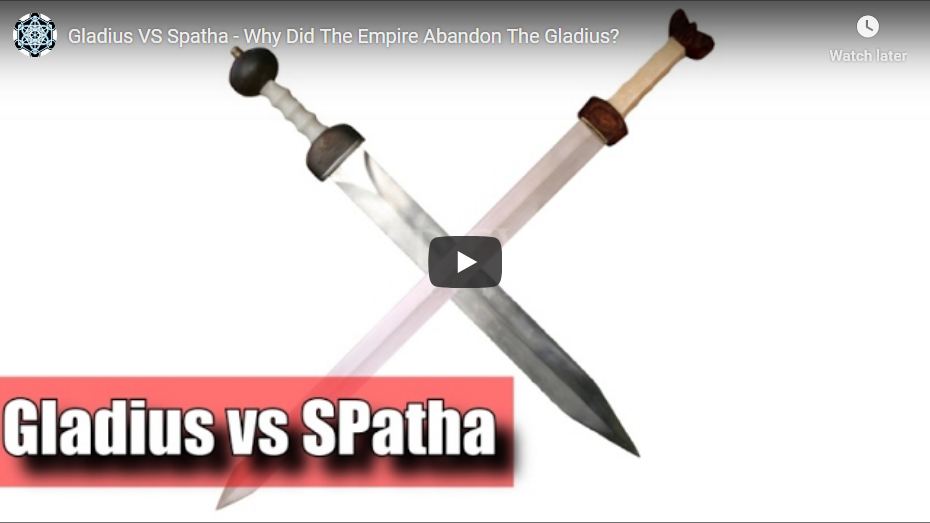
Gladius VS Spatha – Why Did The Empire Abandon The Gladius?

Filed under: Europe, History, Military, Weapons — Tags: , , , , — Nicholas @ 02:00

Metatron
Published on 11 Feb 2017

If the famous Gladius/rectangular Scutum combo had proven to be so effective for so many centuries why did the Late Empire Romans choose to abandon it in favour of a spatha/round shield combination? Here is what I think.

Gladius was one Latin word for sword, and is used to represent the primary sword of Ancient Roman foot soldiers.

A fully equipped Roman legionary after the reforms of Gaius Marius was armed with a shield (scutum), one or two javelins (pila), a sword (gladius), often a dagger (pugio), and, perhaps in the later Empire period, darts (plumbatae). Conventionally, soldiers threw javelins to disable the enemy’s shields and disrupt enemy formations before engaging in close combat, for which they drew the gladius. A soldier generally led with the shield and thrust with the sword. All gladius types appear to have been suitable for cutting and chopping as well as thrusting.

Gladius is a Latin masculine second declension noun. Its (nominative and vocative) plural is gladiī. However, gladius in Latin refers to any sword, not specifically the modern definition of a gladius. The word appears in literature as early as the plays of Plautus (Casina, Rudens).

Modern English words derived from gladius include gladiator (“swordsman”) and gladiolus (“little sword”, from the diminutive form of gladius), a flowering plant with sword-shaped leaves.

Gladii were two-edged for cutting and had a tapered point for stabbing during thrusting. A solid grip was provided by a knobbed hilt added on, possibly with ridges for the fingers. Blade strength was achieved by welding together strips, in which case the sword had a channel down the center, or by fashioning a single piece of high-carbon steel, rhomboidal in cross-section. The owner’s name was often engraved or punched on the blade.

August 21, 2019

Summer Stupidity: GLADIATOR (Media Review!)

Filed under: Europe, History, Humour, Media — Tags: , , , — Nicholas @ 04:00

Overly Sarcastic Productions
Published on 20 Aug 2019

The first time I saw Gladiator (2000) was in Latin class, and I have maintained since that first viewing that this movie rules.

Just pretend it’s historical fiction and the emperors are named literally anything else, and you’re set.

PATREON: https://www.Patreon.com/OSP

DISCORD: https://discord.gg/sS5K4R3

MERCH LINKS: https://www.redbubble.com/people/OSPY…

OUR WEBSITE: https://www.OverlySarcasticProductions.com
Find us on Twitter https://www.Twitter.com/OSPYouTube
Find us on Reddit https://www.Reddit.com/r/OSP/

July 30, 2019

Units of Classical Antiquity: The Praetorian Guard (Roman Army)

Filed under: Europe, History, Military — Tags: , , — Nicholas @ 04:00

Invicta
Published on 18 Mar 2016

Who were the Praetorian Guard? Special Forces, dictatorial musclemen, or ceremonial relics? In this documentary episode we dive deep into the history of this feared unit of the Roman empire!

July 27, 2019

Life and Death in Herculaneum (Prof. Wallace-Hadrill)

Filed under: Europe, History, Science — Tags: , , — Nicholas @ 02:00

Cardo Maximus
Published on 20 Jun 2013

June 29, 2019

Ancient Rome in 20 minutes

Filed under: Europe, History — Tags: , , , , — Nicholas @ 02:00

Arzamas
Published on 30 May 2017

Caesar, The Colosseum, Republic, Nero, geese, plebeians, legions – everything that you once knew, but forgot, in a crash course video by Arzamas.

Narrated by Brian Cox.

“Ancient Rome in 20 minutes” is a Russian version of a Russian video by Arzamas.

June 22, 2019

History Summarized: The Fall of Rome

Overly Sarcastic Productions
Published on 21 Jun 2019

Go to http://www.audible.com/overlysarcastic or text OVERLYSARCASTIC to 500500 to get a free audiobook, 2 free Audible Originals, and 30-day free trial.

Rome, in one form or another, has been around for a *while*. Kinda seemed like it was going to last forever, like it was basically immortal. Well bad news for everyone involved: Rome goes bye-bye just like all the other empires in world history. So let’s talk about when, how, and why Rome fell!

SEASONS OF ROME T-Shirt: https://www.threadless.com/discover/s…

SOURCES & FURTHER READING:
Gibbon’s Decline and Fall: https://amzn.to/2FwBRvO
Mary Beard’s SPQR: https://amzn.to/2Wwu2x3
The History of Rome Podcast: https://apple.co/2U7Q4tq
Lectures from TheGreatCourses: “The Decline and Fall of the Roman Empire?” (Gregory Aldrete), “Late Antiquity — Crisis and Response” & “Barbarians & Emperors” (Thomas Noble)
If I see anyone complaining that I didn’t sufficiently cite this video I’m going to sack your ancient capital and pillage your temples.

PATREON: https://www.Patreon.com/OSP

OUR WEBSITE: https://www.OverlySarcasticProductions.com
Find us on Twitter https://www.Twitter.com/OSPYouTube
Find us on Reddit https://www.Reddit.com/r/OSP/

January 12, 2019

The role of tyche in the fall of the Roman empire

Filed under: Environment, Europe, History — Tags: , , — Nicholas @ 03:00

Williamson Murray posted this review at The Strategy Bridge back in August, but I don’t recall seeing it linked anywhere. He emphasizes the role of tyche both in the small events and the greater flow of history (tyche is a Greek word meaning luck, chance, or random events that change the course of human activity). In his review, he makes it clear that he feels earlier historians have failed to emphasize just how much tyche impacted the Roman world:

The approximate extent of the Roman empire circa 395AD, when the empire was formally divided into eastern and western zones with joint emperors in Rome and Constantinople.

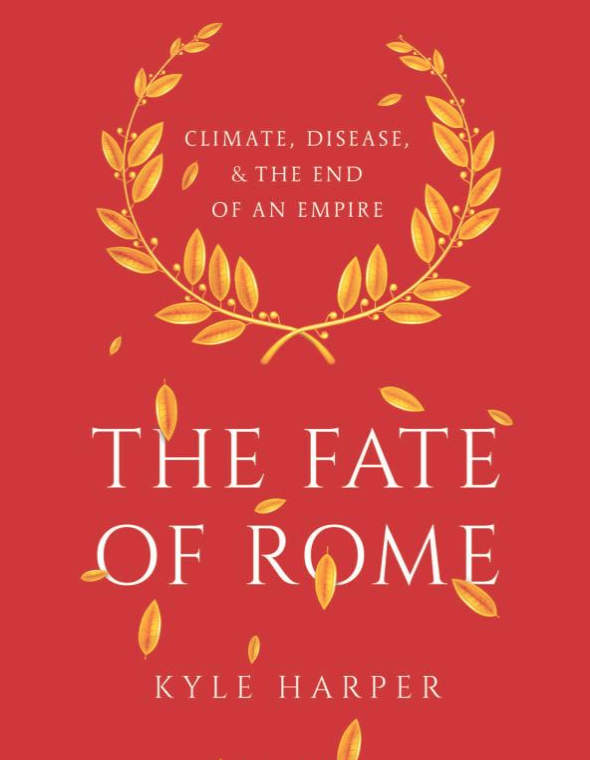
In The Fate of Rome: Climate, Disease & the End of an Empire, Kyle Harper has presented us with a case study, namely the collapse of the Roman world in the period between the third and sixth centuries CE. Here tyche, in the largest sense, created a perfect storm of disastrous natural events and happenings that brought about the complete collapse of the Western Roman Empire in the fifth century CE, and eventually the ability of the Eastern Roman Empire to control much of the Mediterranean world after the seventh century. These natural events created conditions the Roman world was incapable of understanding, but which nevertheless brought about the collapse of one of the greatest, longest lasting empires in history. What Professor Harper’s book underlines is that the military difficulties that Rome’s generals and soldiers experienced in the period from the third century on were only the surface manifestations of far deeper systemic changes that could not be predicted, but which in combination created a perfect storm. Thus, fate, or more accurately tyche, undermined the best efforts to prevent what turned out to be a disastrous collapse.

The slide to catastrophe began after a period of unparalleled prosperity that had seen the population of Rome grow from approximately 60 million under Emperor Augustus in 33 BC to 75 million in 165 AD. The historian Edward Gibbon would describe the period in the following terms: “If a man were called to fix a period in the history of the world, during which the condition of the human race was most happy and prosperous, he would without hesitation, name” that period. Significantly, archeological and scientific evidence indicates the period from 200 BCE through the mid-point of the second century CE was extraordinarily favorable in terms of its climate for agriculture and the development of an extensive and expansive civilization in the Mediterranean and Western Europe. Combined with the favorable weather was a period of general peace under the empire that, for the most part, removed the generally disastrous role played by war throughout history. Except for one short period of civil wars between the claimants to Nero’s throne (70-71 CE, the year of the three emperors) and the two Jewish rebellions (66-71 CE and 135 CE), Rome fought its wars on the frontiers: the Rhine, the Danube, and Syria.

All that changed in the midst of the rule of the emperor Marcus Aurelius. The traditional narrative suggests that in 165 CE Roman soldiers returning from the campaign against the Parthians in Mesopotamia brought a plague. In fact, the pathogen most probably came through the Red Sea, brought by traders. In the great urban centers of the empire, all closely linked, it found an ideal environment. Given the extent of trade among these urban centers, the smallpox pathogens spread rapidly from urban center to urban center. As Professor Harper points out, “[i]n one sense, the Antonine Plague was a creature of chance, the final unpredictable outcome of countless millennia of evolutionary experimentation. At the same time, the empire — its global connections and fast-moving networks of communications — had created the ecological conditions for the outbreak of history’s first pandemic.” We have no way of knowing how many died, but it was substantial, on the order most probably of what was to occur in the Black Death of the fourteenth century.

Had the Antonine Plague been the only major problem besetting the Romans, the empire would likely have weathered the initial storm without catastrophic results. It was, however, not the only major factor that would affect the long-term health of the empire, based as it was on the slight surpluses that subsistence agriculture produced. Almost concurrently with the Antonine Plague, the weather patterns across the Mediterranean and Europe, reaching into central Asia, began a slow, steady shift that resulted in an average drop in temperature and rainfall. That decline would continue through to the mid-fifth century, which was to see the beginning of an even colder period, what climatologists are now calling the “Late Antique Little Ice Age” — one that was even less favorable to agriculture.

December 11, 2018

Why the Byzantine Empire Never Existed

Filed under: Europe, History, Middle East, Religion — Tags: , , — Nicholas @ 02:00

KhAnubis
Published on 12 Aug 2018

We frequently talk about the Eastern Roman Empire as if it were some separate empire from the Roman Empire, when in fact, in a lot of ways, the Roman and Byzantine Empires were really the same empire.

September 19, 2018

The Byzantine Empire should really be called the “Medieval Roman Empire”

Filed under: Europe, History, Middle East — Tags: , , , , — Nicholas @ 03:00

Sean Gabb makes the case for the least well-known part of the Roman world that outlasted the western empire by a thousand years:

Properly considered, the history of what I will from now call not the Byzantine Empire, but the Mediaeval Roman Empire, is perhaps the most astonishing instance of how courage and determination can keep civilisation alive in the face of the most forbidding and apparently overpowering challenges. In setting out my argument, I hope you will forgive me if I begin with an introduction covering much that many of your will know at least as well as I do, but that may not be so familiar to those reading the text or watching the speech on YouTube.

If you look at the first of the maps that I have put on your tables, you will see the Roman Empire as it was in the year 395 AD. This shows the Empire at something close it its greatest extent. The conquests that Trajan made to the north of the Danube and east of the Euphrates have been given up. But it includes the whole of the Mediterranean World and its various hinterlands – an area stretching from the North of England to Upper Egypt, from Casablanca to Trebizond. In that year, however, nearly a century of political experiments is formally ended with the division of the Empire into two administrative zones. There is the Western or the red Empire, ruled by an Emperor in Rome or Milan or Ravenna. There is the Eastern or the purple Empire, ruled by an Emperor in Constantinople.

If you look at the second map, dated roughly 650 AD, you will see that the Western Empire has disappeared. Excepting North Africa and parts of Italy, now ruled from Constantinople, the whole of the Western Empire has disappeared – replaced by a set of barbarian kingdoms from which modern Europe takes its origin. The Eastern Empire itself has lost both Syria and Egypt to the Arabs.

If you look at the third map, dated roughly 867 AD, you will see that the Empire has suffered the further loss of Cyprus and North Africa and most of Sicily. Nevertheless, what we have in that year should undeniably be called the Mediaeval Roman Empire. It has weathered the storm of the Early Middle Ages. It is the richest and most powerful state in the Mediterranean World. Indeed, during the next few centuries, it will expand. It has already reconquered Greece. It will conquer the Bulgarian Kingdom and re-establish its ancient frontier on the Danube. It will even retake Antioch and make Egypt for a while its economic and diplomatic client.

After 1071, the Empire falls on evil days. In that year, the Turks deprive it of its Anatolian heartland. But this loss is stabilised and in part reversed by a skilful handling of the Crusades. There is another disaster in 1204, when the Venetians take and plunder Constantinople. But this is not the end. The Empire is restored in large parts in 1261; and, even if as little more than a city-state based around Constantinople, it continues to the final Turkish conquest of 1453. Indeed, the formal extinction of the Empire comes nearly a decade after 1453, with the annexation of its last territories in Southern Greece.

There was a time when school textbooks in England dated the fall of the Roman Empire to 476 AD. Its continued survival for a thousand years after then had to be explained, where admitted, by taking a contemptuous view of what was called the Byzantine Empire. See, for example, W.E.H. Lecky:

    Of that Byzantine empire, the universal verdict of history is that it constitutes, without a single exception, the most thoroughly base and despicable form that civilization has yet assumed. There has been no other enduring civilization so absolutely destitute of all forms and elements of greatness, and none to which the epithet “mean” may be so emphatically applied… The history of the empire is a monotonous story of the intrigues of priests, eunuchs, and women, of poisonings, of conspiracies, of uniform ingratitude.

Lecky is one of my favourite historians. But, if you look even at the mediaeval Greek and Italian historians of the Empire, you will see that this is a bizarre judgement. Undoubtedly, these historians tended to focus on intrigues in and about the Imperial Palace. But they also record much else. They record the story of a rich and powerful empire, directed with high military and diplomatic ability – an empire in which slavery and the death penalty have been almost abolished, where people lived, and knew that they lived, under a set of divinely-ordained laws that protected life, liberty and property to a degree unknown in any other mediaeval state.

August 30, 2018

A Drone at Pompeii

Filed under: Europe, History, Italy, Science — Tags: , , , — Nicholas @ 02:00

pdvaeriennes
Published on Mar 3, 2015

August 7, 2018

QotD: Sailing past Byzantium

Filed under: Europe, History, Middle East, Quotations — Tags: , , , , — Nicholas @ 01:00

To those who know nothing about the mediaeval, “byzantine” East of Christendom (and what do I know about anything?) a book by the respectable Oxford scholar, Averil Cameron, is worth mentioning. It is a short survey of developments in her academic field, entitled, Byzantine Matters (2014). It poses five basic questions on which our common assumptions are mostly wrong, and provides succinct directions for thinking again.

Mediaeval Greece, the Byzantine dynasties, and Orthodox Christianity: these are far from interchangeable concepts. Moreover, “Byzantine art” — the focus of enthusiasm in the anglosphere through the last century or so — is misunderstood. The term “Byzantine” itself — conceived from late antiquity as a deprecation — persists in the academy as an intelligence neutralizer. The vanity of “the West” gets in the way of appreciating a parallel Christian realm, which flourished for more than a thousand years, and never succumbed to the Arabs. (It finally succumbed to the Turks.) We disdain what amounts to an alternative universe of Christian witness and high culture, of great variety and depth, even more obtusely than we disdain our own Middle Ages.

We are narrowed and prejudiced by the attitudinizing of Edward Gibbon, and the inheritance (or disinheritance) of our Western “Enlightenment,” to view as backward a civilization in most ways superior to our “modern” own, from pride in the tinsel of technology. From AD 330 (the founding of Constantine’s capital) to 1453 (when it fell into Ottoman hands), we see only a continuous story of “decline.” But there were many declines over this vast period, and in the intervals between them, many recoveries.

David Warren, “Sailing past Byzantium”, Essays in Idleness, 2016-11-07.

May 27, 2018

Middle East: Odenathus – Ghosts of the Desert – Extra History

Filed under: History, Middle East — Tags: , — Nicholas @ 02:00

Extra Credits
Published on 31 Oct 2015

Watch the afterword about Palmyra Today: http://bit.ly/1kiAKTN
Support us on Patreon: http://bit.ly/EHPatreon
____________

In 260 CE, the Roman Empire was falling apart on all sides. Emperor Valerian gathered the legions to push back on the worst incursions from the Sassanid Empire in the east. They not only lost – they were massacred, and the emperor was taken captive. This left the empire in disarray. Into this desperate moment stepped Odenathus from the city-state of Palmyra. Palmyra was a vassal state that owed fealty to Rome and had been decorated with many honors and recognition in the past. If Rome fell, the Sassanid Empire would certainly look to conquer and annex Palmyra, so Odenathus rode to the rescue. He gathered all the soldiers he could find and took the Sassanid army by surprise on their way back from the battle with Valerian. He destroyed them. From there, he rode north to protect the emperor’s son, and the next heir to Rome, then south again where he pushed the Sassanids all the way back to their capitol twice. Despite his success and undeniable military power, he never took power for himself or declared himself an emperor. Rome showered him with appreciation and titles. Sadly, he was murdered by his nephew in 267 CE, but his loyalty had bought the Roman Empire enough time to recover and survive for another 200 years.

November 26, 2017

The “fall” of the Roman Empire

Filed under: Europe, History — Tags: , , , , , , — Nicholas @ 03:00

If you haven’t read much history, you may be aware that the Roman Empire fell in 476 AD. If you have read a bit more history, you’ll be fully aware that the Western Roman Empire fell then … the rest of it lasted nearly another thousand years. Richard Blake, who has a very readable series of novels set in the “blind spot” of history between the collapse of the West and the revival of the Eastern Empire, offers a quick thumbnail sketch of the historical background to his fiction:

In 395 AD, following a century of experiment, the Roman Empire was divided into Eastern and Western administrative zones, with joint Emperors in Rome and in Constantinople. The purpose was to let each Emperor deal with the pressure on his own critical frontiers – the barbarians along the Rhine and Danube frontiers in the West, and the Persians along the Euphrates and desert frontiers in the East.

In theory, each Emperor was equal. In practice, the Eastern Emperor, ruling from Constantinople, was soon the senior partner. During the next two hundred years, becoming increasingly Greek in language in culture, the Eastern Empire flourished, and Constantinople became one of the largest and most opulent cities in the world.

The Western Empire went into immediate and rapid decline. In 406 AD, barbarians crossed the Rhine in large numbers, and broke into Italy. In 410 AD, they sacked Rome. By then, the Western Capital had been moved to Ravenna, a city in North Eastern Italy, impregnable behind marshes, and within easier reach of the frontiers – and within easier reach of Constantinople.

During the next seventy years, the Barbarians took France and Spain and North Africa from the Empire. Britain remained in the Empire, but its people were told to look to their own defence. In 476 AD, the last Western Emperor was deposed. By 500 AD, the whole of the Western Empire had been replaced by a patchwork of barbarian kingdoms.

After 527 AD, the Emperor Justinian began to reach out from Constantinople to reconquer the lost Western provinces. He recovered North Africa and Italy and part of Spain. However, the effort was exhausting. After his death in 568, the Empire lost much of Italy to the Lombard barbarians, and Rome itself fell under papal domination. Slavic and Avar barbarians crossed the Danube and conquered and burned all the way to Athens and the walls of Constantinople. After 602, the Persians began a war of destruction against the Empire. Though they ultimately lost, they did briefly take Egypt and Syria.

November 5, 2017

The decline of the (western) Roman empire

Filed under: Economics, Europe, History — Tags: , , , , — Nicholas @ 03:00

Richard Blake considers some of the popular explanations for the slow decline of the Roman empire in the west:

The Empire was an agglomeration of communities which were illiterate to an extent unknown in Western Europe since about 1450. Even most officers in the bureaucracy were at best semi-literate. There was no printing press. Writing materials were very expensive – one sheet of papyrus cost about £100 in today’s money. Cheaper materials were still expensive and were of little use for other than ephemeral use. Central control was usually notional, and the more effective Emperors – Hadrian, Diocletian, et al – were those who spent much of their time touring the Empire to supervise in person.

The economic legislation of the Emperors was largely unenforceable. Some effort was made to enforce the Edict of Maximum Prices. But this appears to have been sporadic, and it lasted only between 301 and 305, when Diocletian abdicated. The Edict’s main effect was to leave a listing of relative prices for economic historians to study 1,500 years later.

As for inflation, it can be doubted how far outside the cities a monetary economy existed. This is not to doubt whether the laws of supply and demand operated, only whether most transactions were not by barter at more or less customary ratios of exchange. This being so, the debasement of the silver coinage would have had less disruptive effect than the silver inflation in Europe of the sixteenth century. Also, the gold coinage was stabilised over a hundred years before the Western military collapse of the fifth century. And the military crisis of the late third century was overcome while the inflation continued.

Nor is there any evidence that people left the cities in large numbers for the countryside. The truth seems to be that the Roman Empire was afflicted, from the middle of the second century, by a series of epidemic plagues, possibly brought on by global cooling, that sent populations into a decline that continued until about the eighth century. The cities shrank not because their inhabitants left them, but because they died. So far as they were enforced, the Imperial responses to population decline made things worse, but were not the ultimate cause of decline. Where population decline was less severe, there was no economic decline. Whenever the decline went into temporary reverse – as it may have in the fifth century in the East – economic activity recovered.

Von Mises is right that the barbarian invasions were not catastrophic floods that destroyed everything in their path. They were incursions by small bands. What made them irreversible was that they took place in the West into a demographic vacuum that would have existed regardless of what laws the Emperors made.

October 11, 2017

Reading Gibbon’s History of the Decline and Fall of the Roman Empire

Filed under: Books, Europe, History — Tags: , , , — Nicholas @ 03:00

In the latest Libertarian Enterprise, Richard Blake introduces one of the greatest English historians and explains why his work is still well worth reading:

Edward Gibbon (1737-94) was born into an old and moderately wealthy family that had its origins in Kent. Sickly as a child, he was educated at home, and sent while still a boy to Oxford. There, an illegal conversion to Roman Catholicism ruined his prospects of a career in the professions or the City. His father sent him off to Lausanne to be reconverted to the Protestant Faith. He came back an atheist and with the beginnings of what would become a stock of immense erudition. He served part of the Seven Years War in the Hampshire Militia. He sat in the House of Commons through much of the American War. He made no speeches, and invariably supported the Government. He moved for a while in polite society – though his increasing obesity, and the rupture that caused his scrotum to swell to the size of a football, made him an object of mild ridicule. Eventually, he withdrew again to Switzerland, where obesity and his hydrocele were joined by heavy drinking. Scared by the French Revolution, he came back to England in 1794, where he died of blood-poisoning after an operation to drain his scrotum.

When not eating and drinking, and putting on fine clothes, and talking about himself, he found time to become the greatest historian of his age, the greatest historian who ever wrote in English, one of the greatest of all English writers, and perhaps the only modern historian to rank with Herodotus and Thucydides and Tacitus. The first volume of his History of the Decline and Fall of the Roman Empire astonished everyone who knew him. The whole was received as an undisputed classic. The work has never been out of print during the past quarter-millennium. It remains, despite the increase in the number of our sources and our better understanding of them, the best – indeed, the essential – introduction to the history of the Roman Empire between about the death of Marcus Aurelius and the death of Justinian.

I’ve read a few abridged versions of Gibbon’s great work, and I intend to start on the unexpurgated version once I’ve finished the New Cambridge Modern History (I have all in hand except Volume XII, the Companion Volume). This is why Blake considers Gibbon to be such an important and still-relevant writer:

1. Greatness as a Writer and a Liberal

I cannot understand the belief, generally shared these past two centuries, that the golden age of English literature lay in the century before the Civil War. I accept the Prayer Book and the English Bible as works of genius that will be appreciated so long as our language survives. I admire the Essays of Francis Bacon and one or two lyrics. But I do not at all regard Shakespeare as a great writer. His plays are ill-organised, his style barbarous and tiresome. I fail to understand how pieces like A Midsummer Night’s Dream and Romeo and Juliet, with their long, ranting monologues, can be thought equal to the greatest products of the Athenian theatre. I grant that Julius Caesar is a fine play – but only because Shakespeare stayed close to his ancient sources for the plot, and wrote in an uncharacteristically plain style. Perhaps I am undeveloped in some critical faculty; and I know that people whose judgements I trust have thought better of him. But I cannot see Shakespeare as a great writer or his age as the greatest in our literature. […]

2. His Scholarship

As said, this was not my first meeting with Gibbon. I was twelve when I found him in the abridgement by D.M. Low. As an undergraduate, I made use of him in the J.B. Bury edition up till the reign of Heraclius and the Arab conquests. In my middle twenties, I went through him again in a desultory manner, skipping chapters that did not interest me. But it was only as I approached thirty that I read him in the full and proper order, from the military resources of the Antonines to the revival of Rome under the Renaissance Popes. It is only by reading him in the whole, and by paying equal attention to text and footnotes, that he can be appreciated as a supreme historian. […]

3. His Fairness as an Historian

Even where he can be criticised for letting his prejudices cloud his judgement, Gibbon remains ultimately fair. He dislikes Christianity, and is convinced that it contributed to the decline of the Empire. His fifteenth and sixteenth chapters are one long sneer at the rise and progress of the Christian Faith. They excited a long and bitter controversy. There was talk for a while of a prosecution for blasphemy. But this was only talk. A man of Gibbon’s place in the social order was not to be taken into court like some hack writer with no connections.

« Newer PostsOlder Posts »

Powered by WordPress