
Invicta
Published 29 Oct 2022The True Size of a Roman Legion.
A history documentary on the True Size of a Roman Legion. This is our first episode in the new True Size series which seeks to bring history to life in 3D using Unreal Engine 5. In this episode we cover the organization of a Roman Legion from the soldier to the Contubernium, the Century, the Cohort, and the Legion. Along the way we not only include the troops and their officers but all the slaves, mules, support, staff, and gear which accompanied them. This makes for a much better understanding of the Roman army structure.
We then put these into context by looking at a Roman army camp, a Roman army on the march, and a Roman army in battle order. This gives the viewer a full 3D history of a legion like never before.
(more…)
February 22, 2023
True Size of a Roman Legion
February 13, 2023
Prostitution in the Roman Empire
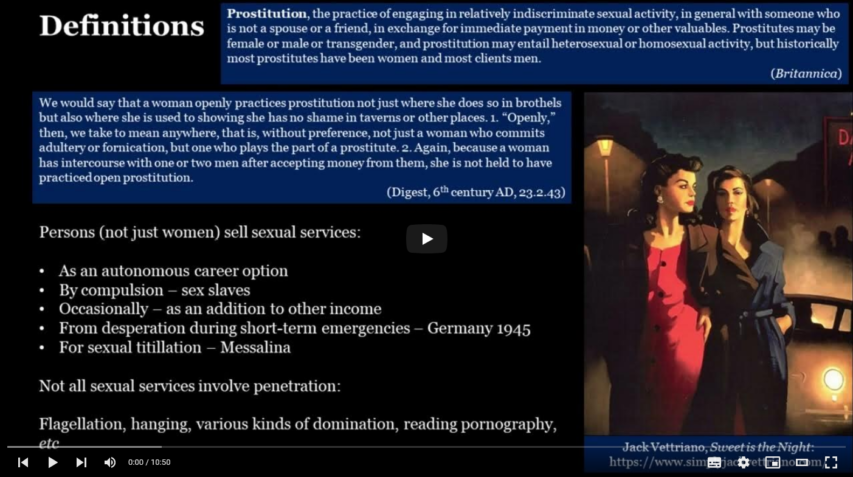
[Note: This is the introduction to a 95-minute lecture that can only be viewed on YouTube directly due to age restrictions. The link to the full video is here.]
seangabb
Published 13 Dec 2022This lecture is concerned with the customs and institutions of paid sex in the Roman World. The main focus is on the market for paid sex between the founding of the Empire in the last decades before the birth of Christ, down to the establishment of Christianity as the faith of the Empire, with a brief overview of the shifting views of paid sex by the authorities in the Christian Empire. It involves extensive quotation from legal and literary and other contemporary sources, plus modern research and the archaeology, to provide an overview of a subject that if often harrowing and even disgusting, but that is, or should be, a core unit in any history of the Roman World. Subjects covered include:
Sex slaves
“Free” Prostitutes
Forced prostitution
Foundlings as prostitutes
The age of consent in ancient times
The legal status of prostitutes
Violence against prostitutes
Male prostitution
Castration of male sex slaves
The price of sexual services
Brothels
Erotic art
Sexually transmitted diseases
Christianity and prostitutionThere is a full bibliography at the end of both ancient and modern sources.
Note: This lecture deals in an explicit manner with themes that are very controversial and that may give considerable offence. If you believe that you may be offended by any of the images and readings, please do not watch.
(more…)
January 26, 2023
QotD: Non-commissioned officers
“Deltas”, the “socio-sexual hierarchy” spergs inform us, are the good soldiers, the go-along-to-get-along types who know their place in an organization and — crucially — derive their sense of self worth from excelling in it.
Your ideal “delta” is something like a lifer noncom in a non-pozzed military. Back in the days, I’m told, new recruits and civilians used to call crusty old gunny sergeants “sir”, to which the gunny would reply “Don’t call me ‘sir’, I work for a living!” That’s the attitude. Those guys with all the stripes on their sleeves aren’t officers because they lack “command presence”; they’re not officers because they don’t want to be officers. They know themselves, and, crucially, they know where they best fit into the organization’s overall mission. “Get in where you fit in” is, in a very real sense, their identity.
Examples of that kind of guy are tougher to find in the historical literature, which is why we need to develop, and pump up, the archetype. […] the ideal is the centurion, the backbone of Marcus Aurelius’ army. A soldier, a Stoic, a leader … but one who knows, and values, his place in the organization above all things.
Severian, “Be a Centurion!”, Rotten Chestnuts, 2020-04-07.
January 25, 2023
Dinner with Attila the Hun
Tasting History with Max Miller
Published 24 Jan 2023
(more…)
January 18, 2023
The Roman Army, With Adrian Goldsworthy
Well That Aged Well
Published 12 May 2021In this episode we take a look at the Roman Army, and its comanders. What made the Roman Army so efficent? Was it the practice? The motivation? Their courrage? Or was it more to it? Find out in this week’s episode of “Well That Aged Well”, With Erlend Hedegart.
(more…)
January 17, 2023
The Early Emperors, Part 11 – The Flavian Reconstruction
seangabb
Published 29 Dec 2022This is a video record of a lecture given by Sean Gabb, in which he discusses the three Flavian Emperors who ruled between 69 and 98 AD — Vespasian, Titus, and Domitian. He also discusses the Jewish Revolt and the eruption of Vesuvius.
The Roman Empire was the last and the greatest of the ancient empires. It is the origin from which springs the history of Western Europe and those nations that descend from Western Europe.
(more…)
Growing an Ancient Roman Garden
Tasting History with Max Miller
Published 23 Aug 2022
January 12, 2023
The Early Emperors, Part 10 – The Year of the Four Emperors
seangabb
Published 27 Dec 2022This is a video record of a lecture given by Sean Gabb, in which he discusses the three Emperors who followed in swift succession between the fall of Nero and the accession of Vespasian — Galba, Otho, and Vitellius.
The Roman Empire was the last and the greatest of the ancient empires. It is the origin from which springs the history of Western Europe and those nations that descend from Western Europe.
(more…)
January 10, 2023
The Early Emperors, Part 9 – Nero: Can We Trust the Sources?
seangabb
Published 25 Dec 2022This is a video record of a lecture given by Sean Gabb, in which he discusses the reasons for the black reputation possessed by the Emperor Nero.
The Roman Empire was the last and the greatest of the ancient empires. It is the origin from which springs the history of Western Europe and those nations that descend from Western Europe.
(more…)
January 5, 2023
Roman Emperors, Part 8 – Nero: Life and Death
seangabb
Published 20 Dec 2022This is a video record of a lecture given by Sean Gabb, in which he discusses what we can know or suspect about the life of the Emperor Nero. Some criticism here of Tacitus as a reliable source.
The Roman Empire was the last and the greatest of the ancient empires. It is the origin from which springs the history of Western Europe and those nations that descend from Western Europe. It is the political entity within which the Christian faith was born, and the growth of the Church within the Empire, and its eventual establishment as the sole faith of the Empire, have left an indelible impression on all modern denominations. Its history, together with that of the Ancient Greeks and the Jews, is our history. To understand how the Empire emerged from a great though finally dysfunctional republic, and how it was consolidated by its early rulers, is partly how we much understand ourselves.
(more…)
December 24, 2022
History-Makers: Saint Nicholas to Santa Claus
Overly Sarcastic Productions
Published 23 Dec 2022Merry Sinterklaasfeest to all, and to all a good night.
Our content is intended for teenage audiences and up.
(more…)
December 21, 2022
Tom Holland’s Dominion
Ed West expands on the review he wrote when Holland’s book was first published in 2019:
The Romans are the most “epic” figures in history, to use my young son’s favourite word, exerting a glamour and allure that no civilisation has successfully matched. This magnetism can also appear heightened by what followed, the illiterate bleakness of the early Middle Ages, and the fun-sucking religion that came with it. Many down the years have lamented the switch from the Rome of the Caesars to the Rome of the popes.
The young Tom Holland was one of them. Raised as an Anglican, the historian’s childhood fascination with dinosaurs evolved into one for the equally glamorous ancients. “Although I vaguely continued to believe in God,” he writes: “I found him infinitely less charismatic than the gods of the Greeks: Apollo, Athena, Dionysus. I liked the way that they did not lay down laws, or condemn other deities as demons; I liked their rock-star glamour. As a result, by the time I came to read Edward Gibbon and his great history of the decline and fall of the Roman Empire, I was more ready to accept his interpretation of the triumph of Christianity: that it had ushered in an ‘age of superstition and credulity’. My childhood instinct to see the biblical God as the po-faced enemy of liberty and fun was rationalised.”
This, indeed, is a widespread view. Since Gibbon wrote his great work in the late 18th century there has existed the popular idea that the Renaissance, with its return to classical values, and the Enlightenment, which saw the birth of reason over superstition, were a reaction to Christianity, which had in those thousand dark medieval years suppressed science and freedom.
Yet the truth and paradox, as Holland shows in this truly epic account of how Christianity came to shape the West, is that the western idea of secularism is itself a very Christian one. Liberalism was never a reaction to Christianity, it was a product, perhaps one might heresy; ditto Marxism, socialism and the various progressive creeds of the modern era, right up to the current Great Awokening with its focus on the sanctity of victimhood.
All our assumptions about progress, the rights of the individual, our horror of racism and sexual exploitation, even the acceptance of gay marriage, are the products of Christianity. They are not in themselves universal or “natural”, and to the Romans these ideas of human rights and dignity would have been incomprehensible, laughable even.
Holland made his name with thrilling popular histories set in the ancient world, yet the more he studied antiquity, the more alien it became to him. It wasn’t just that Spartans or Romans killed innocents in large numbers, but that they lacked even the suggestion that the weak might be worth pitying. “That my belief in God had faded over the course of my teenage years did not mean that I had ceased to be Christian,” he writes.
Cruelties such as the exposure of infants – especially female infants – were almost universally accepted in antiquity, except among one or two small German tribes and, at the other end of the empire, a monotheistic people in the eastern Mediterranean. Perhaps the obscenest horror, however, was the practice of crucifixion, a death so cruel that Roman writers barely touched on the subject. Indeed only “four detailed accounts of the process by which a man might be sentenced to the cross, and then suffer his punishment, have survived from antiquity. Remarkably, they all describe the same execution.”
This is the story of how on that one Friday in Judea the world was changed forever — with a moral revolution like nothing before or since.
December 14, 2022
QotD: The “tooth-to-tail ratio” in armies
The Roman legion, for instance, was essentially all tooth. While there was a designation for support troops, the immunes, so named because they were immune from having to do certain duties in camp, these fellows were still in the battle line when the legion fought. The immunes included engineers, catapult-operators, musicians, craftsmen, and other specialists. Of course legions were also followed around by civilian non-combatants – camp-followers, sutlers, etc. – but in the actual ranks, the “tail” was minimal.
You can see much the same in the organization of medieval “lances” – units formed around a single knight. The Burgundian “lance” of the late 1400s was composed of nine men, eight of which were combatants (the knight, a second horsemen, the coustillier, and then six support soldiers, three mounted and three on foot) and one, the page, was fully a non-combatant. A tooth-to-tail ratio of 8:1. That sort of “tooth-heavy” setup is common in pre-industrial armies.
The industrial revolution changes a lot, as warfare begins to revolve as much around mobilizing firepower, typically in the form of mass artillery firepower as in mobilizing men. We rarely in our fiction focus on artillery, but modern warfare – that is warfare since around 1900 – is dominated by artillery and other forms of [indirect] fires. Artillery, not tanks or machine guns, after all was the leading cause of combat death in both World Wars. Suddenly, instead of having each soldier carry perhaps 30-40kg of equipment and eat perhaps 1.5kg of food per day, the logistics concern is moving a 9-ton heavy field gun that might throw something like 14,000kg of shell per day during a barrage, for multiple days on end. Suddenly, you need a lot more personnel moving shells than you need firing artillery.
As armies motorized after WWI and especially after WWII, this got even worse, as a unit of motorized or mechanized infantry needed a small army of mechanics and logistics personnel handling spare parts in order to stay motorized. Consequently, tooth-to-tail ratios plummeted, inverted and then kept going. In the US Army in WWI, the ratio was 1:2.6 (note that we’ve flipped the pre-industrial ratio, that’s 2.6 non-combat troops for every front line combat solider), by WWII it was 1:4.3 and by 2005 it was 1:8.1. Now I should note there’s also a lot of variance here too, particularly during the Cold War, but the general trend has been for this figure to continue increasing as more complex, expensive and high-tech weaponry is added to warfare, because all of that new kit demands technicians and mechanics to maintain and supply it.
[NR: Early in WW2, British Prime Minister Winston Churchill frequently harassed his various North African generals for the disparity between the “ration strength” of their commands and the much-smaller number of combat troops deployed. If General Wavell had 250,000 drawing rations, Churchill (who last commanded troops in the field in mid-WW1) assumed that this meant close to 200,000 combat troops available to fight the Italians and (later) the Germans. This almost certainly contributed to the high wastage rate of British generals in the Western Desert.]
Bret Devereaux, “Fireside Friday, April 22, 2022”, A Collection of Unmitigated Pedantry, 2022-04-22.
December 10, 2022
QotD: The Western Roman Empire – “decline and fall” or “change and continuity”?
With that out of the way, the old view, that of Edward Gibbon (1737-1794) and indeed largely the view of the sources themselves, was that the disintegration of the western half of the Roman polity was an unmitigated catastrophe, a view that held largely unchallenged into the last century; Gibbon’s great work, The History of the Decline and Fall of the Roman Empire (1789) gives this school its name, “decline and fall“. While I am going at points to gesture to Gibbon’s thinking, we’re not going to debate him; he is the “old man” of our title. Gibbon himself largely exists only in historiographical footnotes and intellectual histories; he is not at this point seriously defended nor seriously attacked but discussed as the venerable, but now out of date, origin point for all of this bickering.
The real break with that view came with the work of Peter Brown, initially in his The World of Late Antiquity (1971) and more or less canonically in The Rise of Western Christendom (1st ed. 1996; 2nd ed. 2003, 3rd ed. 2013). The normal way to refer to the Peter Brown school of thought is “change and continuity” (in contrast to the traditional “decline and fall”), though I rather like James O’Donnell’s description of it as the Reformation in late antique studies.
Among medievalists this reformed view, which focuses on continuity of culture and institutions from late antiquity to the early Middle Ages, remains essentially the orthodoxy, to the point that, for instance, the very recent (and quite excellent) The Bright Ages: A New History of Medieval Europe (2021) can present this vision as an uncomplicated fact, describing the “so-called Fall of Rome” and noting that “there was never a moment in the next thousand years in which at least one European or Mediterranean ruler didn’t claim political legitimacy through a credible connection to the empire of the Romans” and that “the idea that Rome ‘fell’ on the other hand, relies upon a conception of homogeneity – of historical stasis … things changed. But things always change” (3-4, 12-3). As we’ll see, I don’t entirely disagree with those statements, but they are absolute to a degree that suggests there is no real challenge to the position. There have been a few cracks in this orthodoxy among medievalists, particularly the work of Robin Flemming (a revision, not a clear break, to be sure), to which we’ll return, but the cracks have been relatively few.
While some ancient historians also bought into this view, purchase there has always been uneven and seems, to me at least, now to be waning further. Instead, a process of what James O’Donnell describes as a “counter-reformation” (which he stoutly resists with his own The Ruin of the Roman Empire; O’Donnell is a declared reformer) is well underway, a response to the “change and continuity” narrative which seeks to update and defend the notion that there really was a fall of Rome and that it really was quite bad actually. This is not, I should note, an effort to revive Gibbon per se; it does not typically accept his understanding of the cause of this decline (and often characterizes exactly what is declining differently). Nevertheless, this position too is sometimes termed the “decline and fall” school. My own sense of the field is that while nearly all ancient historians will feel the need to concede at least some validity to the reformed “change and continuity” vision, that the counter-reformation school is the majority view among ancient historians at this point (in a way that is particularly evident in overview treatments like textbooks or the Cambridge Ancient History (second edition)). We’ll meet many of the core works of this revised “decline and fall” school as we go.
As O’Donnell noted in a 2005 review for the BMCR, the reformed school tends to be strongest in the study of the imperial east rather than the west (something that will make a lot of sense in a moment), and in religious and cultural history; the counter-reformation school is stronger in the west than the east and in military and political history, though as we’ll see, to that list must at this point now be added archaeology along with demographic and economic history, at which point the weight of fields tends to get more than a little lopsided.
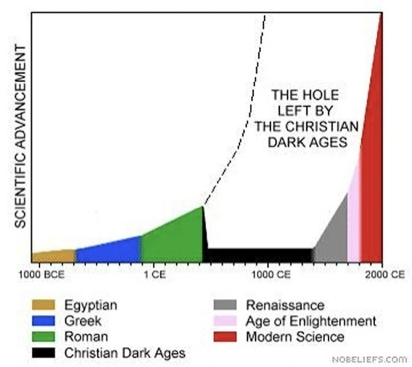
Those are our two knights – the “change and continuity” knight and the “decline and fall” knight (and our old man Gibbon, long out of his dueling days). To this we must add the nitwit: a popular vision, held by functionally no modern scholars, which represents the Middle Ages in their entirety as a retreat from a position of progress during the Roman period which was only regained during the “Renaissance” (generally represented as a distinct period from the Middle Ages) which then proceeded into the upward trajectory of the early modern period. Intellectually, this vision traces back to what Renaissance thinkers thought about themselves and their own disdain for “medieval” scholastic thinking (that is, to be clear, the thinking of their older teachers), a late Medieval version of “this ain’t your daddy’s rock and roll!”
But almost every intellectual movement represents itself as a radical break with the past (including, amusingly, many of the scholastics! Let me tell you about Peter Abelard sometime); as historians we do not generally accept such claims uncritically at face value. For a long time, well into the 19th century, the Renaissance’s cultural cachet in Europe (and the cachet of the classical period where it drew its inspiration) shielded that Renaissance claim from critique; that patina now having worn thin, most scholars now reject it, positioning the Renaissance as a continuation (with variations on the theme) of the Middle Ages, a smooth transition rather than a hard break. At the same time, knowledge of developments within the Middle Ages have made the image of one unbroken “Dark Age” untenable and made clear that the “upswing” of the early modern period was already well underway in the later Middle Ages and in turn had its roots stretching even deeper into the period. It is also worth noting here, that the term “Dark Age” has to do with the survival of evidence, not living conditions: the age was not dark because it was grim, it was dark because we cannot see it as clearly.
The popular version of this idea continues, however, to have a lot of sway in the popular conception of the Middle Ages, encouraged by popular culture that mistakes the excesses of the early modern period for “medieval” superstition and exaggerates the poverty of the medieval period (itself essentialized to its worst elements despite being approximately a millennia long), all summed up in this graph:
We are mostly going to just dunk relentlessly on this graph and yet we will not cover even half of the necessary dunking this graph demands. We may begin by noting that in its last century, the Roman Empire was Christian, a point apparently missed here.
While that sort of vision is not seriously debated by scholars, it needs to be addressed here too, in part because I suspect a lot of the energy behind the “change and continuity” position is in fact to counter some of the worst excesses of this thesis, which for simplicity, we’ll just refer to as “The Dung Ages” argument, but also because assessing how bad the fall of the Roman Empire in the West was demands that we consider how long-lasting any negative ramifications were.
Bret Devereaux, “Collections: Rome: Decline and Fall? Part I: Words”, A Collection of Unmitigated Pedantry, 2022-01-14.
December 2, 2022
QotD: Rome’s legions settle down to permanent fortresses
What absolutely does begin happening during the reign of Augustus and subsequently is that the Roman legions, which had spent the previous three centuries on the move outside of Italy, begin to settle down more permanently on Rome’s new frontiers, particularly along the Rhine/Danube frontier facing Central and Eastern Europe and the Syrian frontier facing the Parthian Empire. That in turn meant that Roman legions (and their supporting auxiliary cohorts) now settled into permanent forts.
The forts themselves, at least in the first two centuries, provide a fairly remarkably example of institutional inertia. While legionary forts of this early period typically replaced the earthwork-and-stakes wall (the agger and vallum) with stone walls and towers and the tents of the camp with permanent barracks, the basic form of the fort: its playing-card shape, encircling defensive ditches (now very often two or three ditches in sequence) remain. Of particular note, these early imperial legionary forts generally still feature towers which do not project outward from the wall, a stone version of the observation towers of the old Roman marching camp. Precisely because these fortifications are in stone they are often very archaeologically visible and so we have a fairly good sense of Roman forts in this period. In short then, put in permanent positions, Roman armies first constructed permanent versions of their temporary marching camps.
And that broadly seems to fit with how the Romans expected to fight their wars on these frontiers. The general superiority of Roman arms in pitched battle (the fancy term here is “escalation dominance” – that escalating to large scale warfare favored the heavier Roman armies) meant that the Romans typically planned to meet enemy armies in battle, not sit back to withstand sieges (this was less true on Rome’s eastern frontier since the Parthians were peer competitors who could rumble with the Romans on more-or-less even terms; it is striking that the major centers in the East like Jerusalem or Antioch did not get rid of their city walls, whereas by contrast the breakdown of Roman order in the third century AD and subsequently leads to a flurry of wall-building in the west where it is clear many cities had neglected their defensive walls for quite a long time). Consequently, the legionary forts are more bases than fortresses and so their fortifications are still designed to resist sudden raids, not large-scale sieges.
They were also now designed to support much larger fortification systems, which now gives us a chance to talk about a different kind of fortification network: border walls. The most famous of these Roman walls of course is Hadrian’s Wall, a mostly (but not entirely) stone wall which cuts across northern England, built starting in 122. Hadrian’s Wall is unusual in being substantially made out of stone, but it was of-a-piece with various Roman frontier fortification systems. Crucially, the purpose of this wall (and this is a trait it shares with China’s Great Wall) was never to actually prevent movement over the border or to block large-scale assaults. Taking Hadrian’s wall, it was generally manned by something around three legions (notionally; often at least one of the legions in Britain was deployed further south); even with auxiliary troops nowhere near enough to actually manage a thick defense along the entire wall. Instead, the wall’s purpose is slowing down hostile groups and channeling non-hostile groups (merchants, migrants, traders, travelers) towards controlled points of entry (valuable especially because import/export taxes were a key source of state revenue), while also allowing the soldiers on the wall good observation positions to see these moving groups. You can tell the defense here wasn’t prohibitive in part because the main legionary fortresses aren’t generally on the wall, but rather further south, often substantially further south, which makes a lot of sense if the plan is to have enemies slowed (but not stopped) by the wall, while news of their approach outraces them to those legionary forts so that the legions can form up and meet those incursions in an open battle after they have breached the wall itself. Remember: the Romans expect (and get) a very, very high success rate in open battles, so it makes sense to try to force that kind of confrontation.
This emphasis on controlling and channeling, rather than prohibiting, entry is even more visible in the Roman frontier defenses in North Africa and on the Rhine/Danube frontier. In North Africa, the frontier defense system was structured around watch-posts and the fossatum Africae, a network of ditches (fossa) separating the province of Africa (mostly modern day Tunisia) from non-Roman territory to its south. It isn’t a single ditch, but rather a system of at least four major segments (and possibly more), with watch-towers and smaller forts in a line-of-sight network (so they can communicate); the ditch itself varies in width and depth but typically not much more than 6m wide and 3m deep. Such an obstruction is obviously not an prohibitive defense but the difficulty of crossing is going to tend to channel travelers and raids to the intentional crossings or alternately slow them down as they have to navigate the trench (a real problem here where raiders are likely to be mounted and so need to get their horses and/or camels across).
On the Rhine and the Danube, the defense of the limes, the Roman frontier, included a border wall (earthwork and wood, rather than stone like Hadrian’s wall), similarly supported by legions stationed to the rear, with road networks positioned; once again, the focus is on observing threats, slowing them down and channeling them so that the legions can engage them in the field. This is a system based around observe-channel-respond, rather than an effort to block advances completely.
Bret Devereaux, “Collections: Fortification, Part II: Romans Playing Cards”, A Collection of Unmitigated Pedantry, 2021-11-12.


