
The degree to which we should understand the Roman habit of constructing fortified marching camps every night as exceptional is actually itself an interesting question. Our sources disagree on the origins of the Roman fortified camp; Frontinus (Front. Strat 4.1.15) says that the Romans learned it from the Macedonians by way of Pyrrhus of Epirus but Plutarch (Plut. Pyrrhus 16.4) represents it the other way around; Livy, more reliable than either agrees with Frontinus that Pyrrhus is the origin point (Liv. 35.14.8) but also has Philip V, a capable Macedonian commander, stand in awe of Roman camps (Liv. 31.34.8). It’s clear there was something exceptional about the Roman camps because so many of our sources treat it as such (Liv. 31.34.8; Plb. 18.24; Josephus BJ 3.70-98). Certainly the Macedonians regularly fortified their camps (e.g. Plb. 18.24; Liv 32.5.11-13; Arr. Alex. 3.9.1, 4.29.1-3; Curtius 4.12.2-24, 5.5.1) though Carthaginian armies seem to have done this less often (e.g. Plb. 6.42.1-2 encamping on open ground is treated as a bold new strategy).
It is probably not the camps themselves, but their structure which was exceptional. Polybius claims Greeks “shirk the labor of entrenching” (Plb. 6.42.1-2) and notes that the stakes the Romans used to construct the wooden palisade wall of the camp are more densely placed and harder to remove (Plb. 18.18.5-18). The other clear difference Polybius notes is the order of Roman camps, that the Romans lay out their camp the same way wherever it is, whereas Greek and Macedonian practice was to conform the camp to the terrain (Plb. 6.42); the archaeology of Roman camps bears out the former whereas analysis of likely battlefield sites (like the Battle of the Aous) seem to bear out the latter.
In any case, the mostly standard layout of Roman marching camps (which in the event the Romans lay siege, become siege camps) enables us to talk about the Roman marching camp because as far as we can tell they were all quite similar (not merely because Polybius says this, but because the basic features of these camps really do seem to stay more or less constant.
The basic outline of the camp is a large rectangle with the corners rounded off, which has given the camps (and later forts derived from them) their nickname: “playing card” forts. The size and proportions of a fortified camp would depend on the number of legions, allies and auxiliaries present, from nearly square to having one side substantially longer than the other. This isn’t the place to get into the internal configuration of the camp, except to note that these camps seemed to have been standardized so that the layout was familiar to any soldier wherever they went, which must have aided in both building the camp (since issues of layout would become habit quickly) and packing it up again.
Now a fortified camp does not have the same defensive purpose as a walled city: the latter is intended to resist a siege, while a fortified camp is mostly intended to prevent an army from being surprised and to allow it the opportunity to either form for battle or safely refuse battle. That means the defenses are mostly about preventing stealthy approach, slowing down attackers and providing a modest advantage to defenders with a relative economy of cost and effort.
In the Roman case, for a completed defense, the outermost defense was the fossa or ditch; sources differ on the normal width and depth of the ditch (it must have differed based on local security conditions) but as a rule they were at least 3′ and 5′ wide and often significantly more than this (actual measured Roman defensive fossae are generally rather wider, typically with a 2:1 ratio of width to depth, as noted by Kate Gilliver. The earth excavated to make the fossa was then piled inside of it to make a raised earthwork rampart the Romans called the agger. Finally, on top of the agger, the Romans would place the valli (“stakes”) they carried to make the vallum. Vallum gives us our English word “wall” but more nearly means “palisade” or “rampart” (the Latin word for a stone wall is more often murus).
Polybius (18.18) notes that Greek camps often used stakes that hadn’t had the side branches removed and spaced them out a bit (perhaps a foot or so; too closely set for anyone to slip through); this sort of spaced out palisade is a common sort of anti-ambush defense and we know of similar village fortifications in pre- and early post-contact North America on the East coast, used to discourage raids. Obviously the downside is that when such stakes are spaced out, it only takes the removal of a few to generate a breach. The Roman vallum, by contrast, set the valli fixed close together with the branches interlaced and with the tips sharpened, making them difficult to climb or remove quickly.
The gateway obviously could not have the ditch cut across the entryway, so instead a second ditch, the titulum, was dug 60ft or so in front of the gate to prevent direct approach; the gate might also be reinforced with a secondary arc of earthworks, either internally or externally, called the clavicula; the goal of all of this extra protection was again not to prevent a determined attacker from reaching the gates, but rather to slow a surprise attack down to give the defender time to form up and respond.
And that’s what I want to highlight about the nature of the fortified Roman camp: this isn’t a defense meant to outlast a siege, but – as I hinted at last time – a defense meant to withstand a raid. At most a camp might need to withstand the enemy for a day or two, providing the army inside the opportunity to retreat during the night.
We actually have some evidence of similar sort of stake-wall protections in use on the East Coast of Native North America in the 16th century, which featured a circular stake wall with a “baffle gate” that prevented a direct approach and entrance. The warfare style of the region was heavily focused on raids rather than battles or sieges (though the former did happen) in what is sometimes termed the “cutting off way of war” (on this see W. Lee, “The Military Revolution of Native North America” in Empires and Indigines, ed. W. Lee (2011)). Interestingly, this form of Native American fortification seems to have been substantially disrupted by the arrival of steel axes for presumably exactly the reasons that Polybius discusses when thinking about Greek vs. Roman stake walls: pulling up a well-made (read: Roman) stake wall was quite difficult. However, with steel axes (imported from European traders), Native American raiding forces could quickly cut through a basic palisade. Interestingly, in the period that follows, Lee (op. cit.) notes a drift towards some of the same methods of fortification the Romans used: fortifications begin to square off, often combined a ditch with the palisade and eventually incorporated corner bastions projecting out of the wall (a feature Roman camps do not have, but later Roman forts eventually will, as we’ll see).
Roman field camps could be more elaborate than what I’ve described; camps often featured, for instance, observation towers. These would have been made of wood and seem to have chiefly been elevated posts for lookouts rather than firing positions, given that they sit behind the vallum rather than projecting out of it (meaning that it would be very difficult to shoot any enemy who actually made it to the vallum from the tower).
When a Roman army laid siege to a fortified settlement, the camp formed the “base” from which siege works were constructed (particularly circumvallation – making a wall around the enemy’s city to keep them in – and contravallation – making a wall around your siege position to keep other enemies out. We’ll discuss these terms in more depth a little later). Some of the most elaborate such works we have described are Caesar’s fortifications at the Siege of Alesia (52 BC; Caes. B.G. 7.72). There the Roman line consisted of an initial trench well beyond bow-shot range from his planned works in order to prevent the enemy from disrupting his soldiers with sudden attacks, then an agger and vallum constructed with a parapet to allow firing positions from atop the vallum, with observation towers every 80 feet and two ditches directly in front of the agger, making for three defensive ditches in total (be still Roel Konijnendijk‘s heart! – but seriously, the point he makes on those Insider “Expert Rates” videos about the importance of ditches are, as you can tell already, entirely accurate), which were reinforced with sharpened stakes faced outward. As Caesar expressly notes, these weren’t meant to be prohibitive defenses that would withstand any attack – wooden walls can be chopped or burned, after all – but rather to give him time to respond to any effort by the defenders to break out or by attackers to break in (he also contravallates, reproducing all of these defenses facing outward, as well).
Bret Devereaux, “Collections: Fortification, Part II: Romans Playing Cards”, A Collection of Unmitigated Pedantry, 2021-11-12.
November 24, 2022
QotD: Roman legionary fortified camps
November 17, 2022
QotD: The Dummies’ Guide to Meditations by Marcus Aurelius
Who: Marcus Aurelius, Roman Emperor in the mid-late 2nd century AD. The last of the “Five Good Emperors”, Marcus spent much of his time dealing with barbarian incursions and plague. There are some good biographies of the man, but Wiki covers the high points.
What: Because of the above, the Meditations were something like Marcus’s private self-help manual. He’s reminding himself to remain literally Stoic in the face of serious, seemingly unsolvable problems.
When: Late 2nd century AD. Greco-Roman philosophy was well-developed at this point; Stoicism was part of the classical tradition.
Where: In general, the European part of the Roman Empire. Specifically, on campaign against the barbarians – Marcus wrote a lot of the Meditations at the front.
Why: Because this man was the richest, most powerful individual in his world … and hated it. As a Stoic, he believed that virtue was its own — and, indeed, the only — reward, but as Roman Emperor he was forced to do un-virtuous things all day every day. It’s good instruction for how to live with yourself — how to be a man in a world that so often forces you to act like a snake.
Essential Background: Not much beyond the above.
Nice to have: The basics of Stoic doctrine. Specifically, their belief that “living virtuously” and “living according to nature” were basically synonymous, and that they were the only way to true happiness. A little Stoic epistemology, too — as their way of life depends on seeing the true nature of things, their standards for knowledge (what we’d call “justified true belief”) are extremely high. A statement like “pain is indifferent” is clear, and useful, on its own, but knowing the Stoic view of knowledge helps one appreciate just how prevalent the “indifferents” are, and how tough being truly indifferent is. Also nice to know: The wholesale adoption of Marcus by medieval Christians. There’s a very strong Stoic streak in Christianity’s first 1500 years; Marcus is always up there with the very best of the “virtuous pagans”.
None of these are necessary, though — you could lightly edit the Meditations (taking out the “thank you’s” at the start of Book One, explaining a few allusions) — and publish it today as a self-help manual. Also not necessary: Any real background in ancient philosophy. Back then, “philosophy” meant “a way of living”, not “a system for investigating the world”. Since Marcus is convinced of Stoicism’s truth, he doesn’t spend any time engaging the doctrines of other schools.
Severian, “Reading the Classics: An Illustration”, Rotten Chestnuts, 2020-02-14.
November 12, 2022
Long distance communication in the pre-modern era
In the latest Age of Invention newsletter, Anton Howes considers why the telegraph took so long to be invented and describes some of the precursors that filled that niche over the centuries:
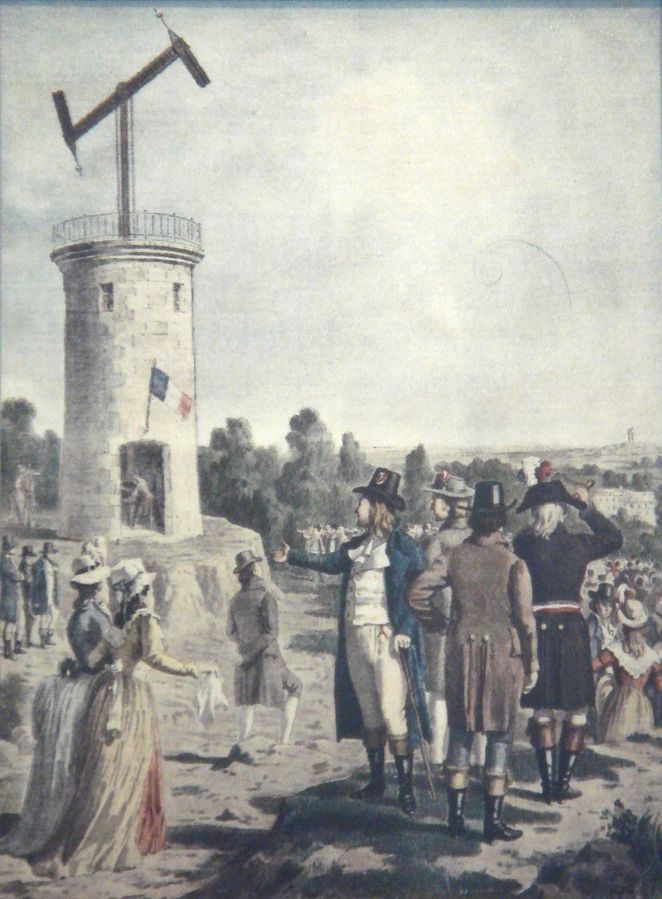
Early 19th century demonstration of Claude Chappe’s semaphore.
Wikimedia Commons.
… I’ve also long wondered the same about telegraphs — not the electric ones, but all the other long-distance signalling systems that used mechanical arms, waved flags, and flashed lights, which suddenly only began to really take off in the eighteenth century, and especially in the 1790s.
What makes the non-electric telegraph all the more interesting is that in its most basic forms it actually was used all over the world since ancient times. Yet the more sophisticated versions kept on being invented and then forgotten. It’s an interesting case because it shows just how many of the budding systems of the 1790s really were long behind their time — many had actually already been invented before.
The oldest and most widely-used telegraph system for transmitting over very long distances was akin to Gondor’s lighting of the beacons, capable only of communicating a single, pre-agreed message (with flames often more visible at night, and smoke during the day). Such chains of beacons were known to the Mari kingdom of modern-day Syria in the eighteenth century BC, and to the Neo-Assyrian emperor Ashurbanipal in the seventh century BC. They feature in the Old Testament and the works of Herodotus, Aeschylus, and Thucydides, with archaeological finds hinting at even more. They remained popular well beyond the middle ages, for example being used in England in 1588 to warn of the arrival of the Spanish Armada. And they were seemingly invented independently all over the world. Throughout the sixteenth century, Spanish conquistadors again and again reported simple smoke signals being used by the peoples they invaded throughout the Americas.
But what we’re really interested in here are systems that could transmit more complex messages, some of which may have already been in use by as early as the fifth century BC. During the Peloponnesian War, a garrison at Plataea apparently managed to confuse the torch signals of the attacking Thebans by waving torches of their own — strongly suggesting that the Thebans were doing more than just sending single pre-agreed messages.
About a century later, Aeneas Tacticus also wrote of how ordinary fire signals could be augmented by using identical water clocks — essentially just pots with taps at the bottom — which would lose their water at the same rate and would have different messages assigned to different water levels. By waving torches to signal when to start and stop the water clocks (Ready? Yes. Now start … stop!), the communicator could choose from a variety of messages rather than being limited to one. A very similar system was reportedly used by the Carthaginians during their conquests of Sicily, to send messages all the way back to North Africa requesting different kinds of supplies and reinforcement, choosing from a range of predetermined signals like “transports”, “warships”, “money”.
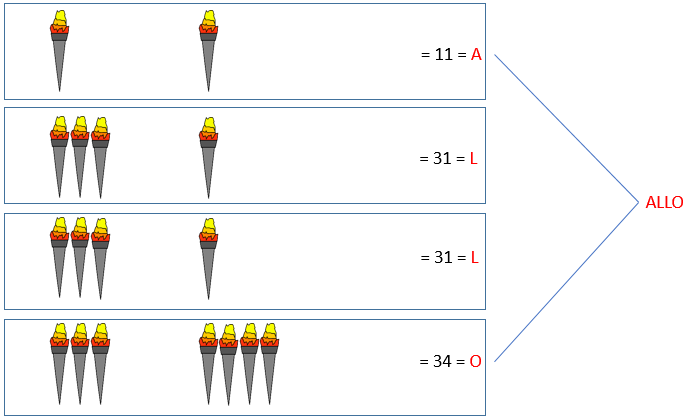
Diagram of a fire signal using the Polybius cipher.
Created by Jonathan Martineau via Wikimedia Commons.By the second century BC, a new method had appeared. We only know about it via Polybius, who claimed to have improved on an even older method that he attributed to a Cleoxenus and a Democleitus. The system that Polybius described allowed for the spelling out of more specific, detailed messages. It used ten torches, with five on the left and five on the right. The number of torches raised on the left indicated which row to consult on a pre-agreed tablet of letters, while the number of torches raised on the right indicated the column. The method used a lot of torches, which would have to be quite spread out to remain distinct over very long distances. So it must have been quite labour-intensive. But, crucially, it allowed for messages to be spelled out letter by letter, and quickly.
Three centuries later, the Romans were seemingly still using a much faster and simpler version of Polybius’s system, almost verging on a Morse-like code. The signalling area now had a left, right, and middle. But instead of signalling a letter by showing a certain number of torches in each field all at once, the senders waved the torches a certain number of times — up to eight times in each field, thereby dividing the alphabet into three chunks. One wave on the left thus signalled an A, twice on the left a B, once in the middle an I, twice in the middle a K, and so on.
By the height of the Roman Empire, fire signals had thus been adapted to rapidly transmit complex messages over long distances. But in the centuries that followed, these more sophisticated techniques seem to have disappeared. The technology appears to have regressed.
October 11, 2022
QotD: The debt we owe to the Carolingian Renaissance
Bret Devereaux, “Collections: A Trip Through Dhuoda of Uzès (Carolingian Values)”, A Collection of Unmitigated Pedantry, 2020-03-27.
October 5, 2022
Ancient Roman Jellyfish for the Black Banquet
Tasting History with Max Miller
Published 4 Oct 2022
(more…)
September 30, 2022
History Re-Summarized: The Roman Empire
Overly Sarcastic Productions
Published 16 Sept 2022
The plot twist of Rome is that it was always a mess, now sit back and enjoy the marble-covered mayhem.This video is a Remastered, Definitive Edition of three previous videos from this channel — “History Summarized: The Roman Empire”, “History Hijinks: Rome’s Crisis of the Third Century”, and “History Summarized: The Fall of Rome”. This video combines them all into one narrative, fully upgrading all of the visuals and audio, with a substantially re-written script in parts 1 and 3.
(more…)
September 12, 2022
History Summarized: Classical Warfare (Feat. Shadiversity!)
Overly Sarcastic Productions
Published 22 Jul 2017How did people fight in ancient times? Well that’s a good question! Step right up and I’ll learn you a thing or two about history.
(more…)
September 11, 2022
Are we looking at a modern equivalent to the Bronze Age Collapse?
If you’re feeling happy and optimistic, Theophilus Chilton has a bucket of cold water to douse you with:
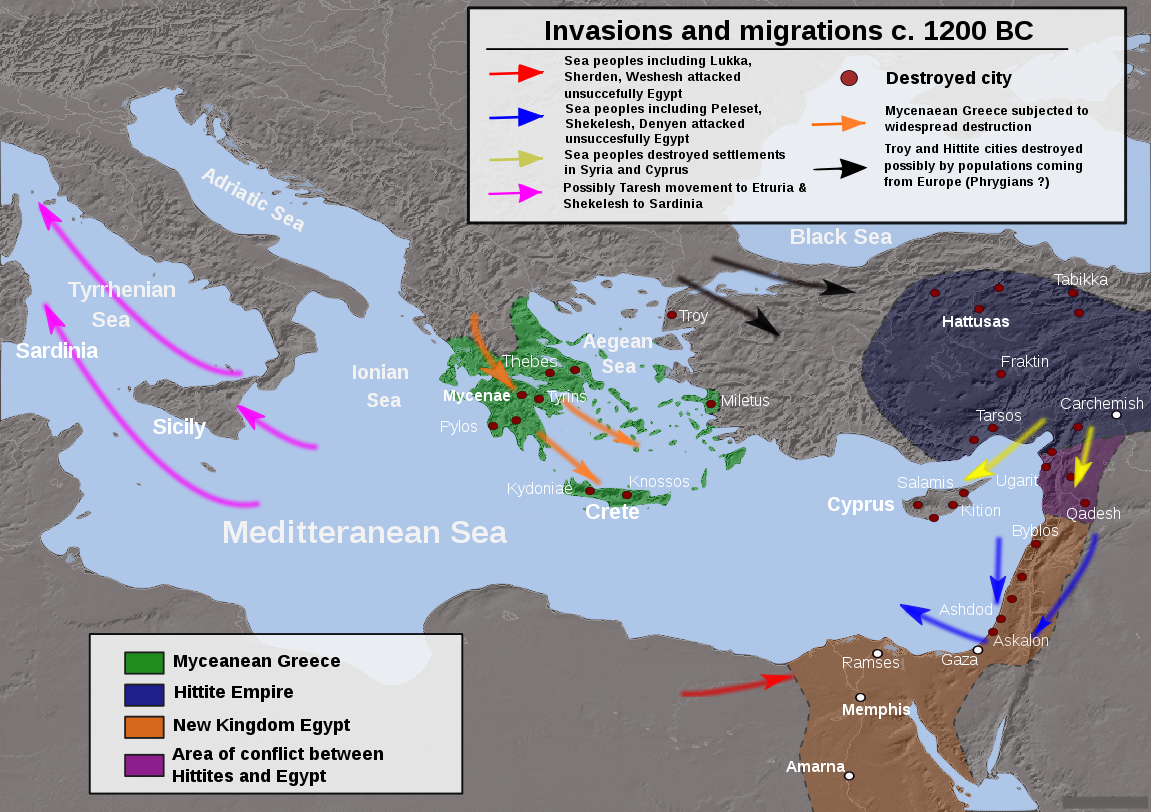
Migrations, invasions and destructions during the end of the Bronze Age (c. 1200 BC), based on public domain information from DEMIS Mapserver.
Map by Alexikoua via Wikimedia Commons.
Regular readers know that I’ve talked about collapse (as well as the implied regeneration that follows it) on here a lot. In nearly all cases, though, I’ve discussed it within a specifically American context – the collapse of the present American system and the potential for one or more post-American successor states arising in place of the present globohomo order. However, we should recognise that collapse is a general phenomenon that affects any and all large nations eventually. Just as America is not a special snowflake who is exempt from the laws of demographic-structural theory, so also is she not the only one subject to them.
Further in this vein, we should recognise that no major nation is isolated from its neighbours. No matter how self-sufficient, sooner or later everybody gets hooked up into trade networks. As trade networks expand, you develop world systems that display increased international interconnectedness and interdependency. From a demographic-structural perspective, the interconnectedness of these global systems acts to “synch up” the secular cycles of the nations involved as “information flows” increase. The upside to this is that when one part of the system prospers, everyone does. The downside, of course, is that when one part collapses, everyone does as well.
There are several historical examples of this kind of interconnected system synching up and then collapsing. Probably one of the most well-known examples would be the Bronze Age collapse which occurred in the Mediterranean world system roughly between 1225-1150 BC. Likely due to several shocks to the system working in tandem (drought, volcanic eruptions, migrations into the Balkans from the north, etc.), a series of invasions of the Sea Peoples spread out across the entire eastern end of the Mediterranean, toppling Mycenaean Greece and the Hittite Empire, and nearly did the same to Egypt. From there, the shocks moved outward throughout the rest of Anatolia and Syro-Palestine and eastward into Mesopotamia, disrupting the entire interconnected trade network. The system was apparently already primed to be toppled by these jolts, however, due to the top-heavy political structures (elite overproduction) and overspecialisation in these empires that contributed to their fragility in the face of system shocks. When the first one fell, the effects spread out like dominoes falling in a row.
There is evidence that this collapse extended beyond the Mediterranean basin and disrupted the civilisation existing in the Nordic Bronze Age around the Baltic Sea. Right around the same time that Bronze Age Mediterranean society was collapsing, serious changes to society in the Baltic basin were also taking place, primarily due to the disruption of trade routes that connected the two regions, with amber flowing south and metals and prestige goods returning north. During this period, the population in the area transitioned from a society organised primarily around scattered villages and farms into one that became more heavily militarised and centred around fortified towns, indicating that there was a change in the region’s elite organisation, or at least a strong modification of it (remember that collapse phases are characterised by struggles between competing elite groups). A large battle that dates to this era has been archaeologically uncovered in the Tollense Valley of northeastern Germany which is thought to have involved over 5000 combatants — a huge number for this area at this time, indicating more centralised state-like organisational capacities than were previously thought to have existed in the region. All in all, the evidence seems to suggest that this culture underwent some type of collapse phase at this time, likely in tandem with that occurring further south.
Other times and places have also seen such world system collapses take place. for instance, when the western Roman Empire was falling in the 3rd-5th centuries AD, the entire Mediterranean basis (again) underwent a systemwide socioeconomic collapse and decentralisation. More recently, the entire Eurasian trade system, from England to China, underwent a synchronised collapse phase in the early 17th century AD that saw revolutions, elite conflict, decentralisation, and social simplification take place across the length of the continent.
The great irony of interconnectedness is that too much of it actually works to reduce resilience within a system. Because an intensively globalised world system entails a lot of specialisation as different parts begin to focus on the production of different commodities needed within the network, this makes each part of the system more dependent upon the others. This works to reduce the resiliency of each of these individual parts, and the greater interconnectedness allows failure in one part to be communicated more widely and rapidly to other parts than might otherwise be the case in less interconnected systems.
September 9, 2022
The Byzantine Empire: Part 2 – Survival and Growth
seangabb
Published 15 Oct 2021Between 330 AD and 1453, Constantinople (modern Istanbul) was the capital of the Roman Empire, otherwise known as the Later Roman Empire, the Eastern Roman Empire, the Mediaeval Roman Empire, or The Byzantine Empire. For most of this time, it was the largest and richest city in Christendom. The territories of which it was the central capital enjoyed better protections of life, liberty and property, and a higher standard of living, than any other Christian territory, and usually compared favourably with the neighbouring and rival Islamic empires.
The purpose of this course is to give an overview of Byzantine history, from the refoundation of the City by Constantine the Great to its final capture by the Turks.
Here is a series of lectures given by Sean Gabb in late 2021, in which he discusses and tries to explain the history of Byzantium. For reasons of politeness and data protection, all student contributions have been removed.
(more…)
September 3, 2022
The Byzantine Empire: Part 1 – Beginnings
seangabb
Published 1 Oct 2021Between 330 AD and 1453, Constantinople (modern Istanbul) was the capital of the Roman Empire, otherwise known as the Later Roman Empire, the Eastern Roman Empire, the Mediaeval Roman Empire, or The Byzantine Empire. For most of this time, it was the largest and richest city in Christendom. The territories of which it was the central capital enjoyed better protections of life, liberty and property, and a higher standard of living, than any other Christian territory, and usually compared favourably with the neighbouring and rival Islamic empires.
The purpose of this course is to give an overview of Byzantine history, from the refoundation of the City by Constantine the Great to its final capture by the Turks.
Here is a series of lectures given by Sean Gabb in late 2021, in which he discusses and tries to explain the history of Byzantium. For reasons of politeness and data protection, all student contributions have been removed.
(more…)
August 30, 2022
How did Rome defend its empire? ⚔️
HistoryMarche
Published 29 Apr 2022🚩 In this video we analyze the three defensive strategies the Roman Empire deployed from c.27BC to 350 AD, as described in Edward Luttwak’s book The Grand Strategy of the Roman Empire.
(more…)
August 25, 2022
Barbarian Europe: Part 8 – The Franks
seangabb
Published 1 Sep 2021In 400 AD, the Roman Empire covered roughly the same area as it had in 100 AD. By 500 AD, all the Western provinces of the Empire had been overrun by barbarians. Between April and July 2021, Sean Gabb explored this transformation with his students. Here is one of his lectures. All student contributions have been removed.
(more…)
August 20, 2022
QotD: The improbable survival of the Byzantine empire
The reason for this is that the Mediaeval Roman State was directed by creative pragmatists. Look for one moment beneath its glittering surface, and the Ancient Roman Empire was a ghastly place for most of the people who lived in it. The Emperors at the top were often vicious incompetents. They ruled through an immense and parasitic bureaucracy. They were supreme governors of an army too large to be controlled. They protected a landed aristocracy that was a repository of culture, but that was ruthless in its exaction of rent. Most ordinary people were disarmed tax-slaves, where not chattel slaves or serfs.
The contemporary historians themselves are disappointingly vague about the seventh and eighth centuries. Our only evidence for what happened comes from the description of established facts in the tenth century. As early as the seventh century, though, the Mediaeval Roman State pulled off the miracle of reforming itself internally while fighting a war of survival on every frontier. Much of the bureaucracy was shut down. Taxes were cut. The silver coinage was stabilised. Above all, the senatorial estates were broken up and given to those who worked on them, in return for service in local militias. Though never abolished, chattel slavery became far less pervasive. The civil law was simplified, and the criminal law humanised – after the seventh century, as said, the death penalty was rarely used.
The Mediaeval Roman Empire survived because of a revolutionary transformation in which ordinary people became armed stakeholders. The inhabitants of Roman Gaul and Italy and Spain barely looked up from their ploughs as the Barbarians swirled round them. The citizens of Mediaeval Rome fought like tigers in defence of their country and their Orthodox faith. Time and again, the armies of the Caliph smashed against a wall of armed freeholders. This was a transformation pushed through in a century and a half of recurrent crises during which Constantinople itself was repeatedly under siege. Alone among the ancient empires in its path, Mediaeval Rome faced down the Arabs, and kept Islam at bay for nearly five centuries. Would it be superfluous to say that no one does this by accident?
Sean Gabb, “The Mediaeval Roman Empire: An Unlikely Emergence and Survival”, SeanGabb.co.uk, 2018-09-14.
August 10, 2022
Barbarian Europe: Part 7 – The Lombards in Italy
seangabb
Published 31 Aug 2021In 400 AD, the Roman Empire covered roughly the same area as it had in 100 AD. By 500 AD, all the Western Provinces of the Empire had been overrun by barbarians. Between April and July 2021, Sean Gabb explored this transformation with his students. Here is one of his lectures. All student contributions have been removed.
(more…)
August 8, 2022
Barbarian Europe: Part 6 – The Birth of England
seangabb
Published 4 Aug 2021In 400 AD, the Roman Empire covered roughly the same area as it had in 100 AD. By 500 AD, all the Western Provinces of the Empire had been overrun by barbarians. Between April and July 2021, Sean Gabb explored this transformation with his students. Here is one of his lectures. All student contributions have been removed.
(more…)


